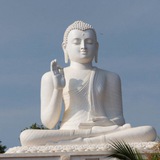
Dhammapada Verses 242 and 243
Annatarakulaputta Vatthu
Malitthiya duccaritam
maccheram dadato malam
mala ve papaka dhamma
asmim loke paramhi ca.
Tato mala malataram
avijja paramam malam
etam malam pahantvana
nimmala hotha bhikkhavo.
Verse 242: Sexual misconduct is the taint of a woman; stinginess is the taint of a giver; evil ways are indeed taints in this world as well as in the next.
Verse 243: A taint worse than these is ignorance (of the Truth), which is the greatest of taints. O bhikkhus, abandon this taint and be taintless.
The Story of a Man Whose Wife Committed Adultery
While residing at the Veluvana monastery, the Buddha uttered Verses (242) and (243) of this book, with reference to a man whose wife committed adultery.
Once, the wife of a man committed adultery. He was so ashamed on account of his wife's misbehaviour that he dared not face anyone; he also kept away from the Buddha. After some time, he went to the Buddha and the Buddha asked him why he had been absent all that time and he explained everything. On learning the reason for his absence, the Buddha said, "My disciple, women are just like a river, or a road, or a liquor shop or a rest house, or a water-pot stand at the roadside; they associate with all sorts of people. Indeed, sexual misconduct is the cause of ruin for a woman."
Then the Buddha spoke in verse as follows:
Verse 242: Sexual misconduct is the taint of a woman; stinginess is the taint of a giver; evil ways are indeed taints in this world as well as in the next.
Verse 243: A taint worse than these is ignorance (of the Truth), which is the greatest of taints. O bhikkhus, abandon this taint and be taintless.
At the end of the discourse many people attained Sotapatti Fruition.
===
Buddha dharma teachings channel:
https://news.1rj.ru/str/lorddivinebuddha
===
Annatarakulaputta Vatthu
Malitthiya duccaritam
maccheram dadato malam
mala ve papaka dhamma
asmim loke paramhi ca.
Tato mala malataram
avijja paramam malam
etam malam pahantvana
nimmala hotha bhikkhavo.
Verse 242: Sexual misconduct is the taint of a woman; stinginess is the taint of a giver; evil ways are indeed taints in this world as well as in the next.
Verse 243: A taint worse than these is ignorance (of the Truth), which is the greatest of taints. O bhikkhus, abandon this taint and be taintless.
The Story of a Man Whose Wife Committed Adultery
While residing at the Veluvana monastery, the Buddha uttered Verses (242) and (243) of this book, with reference to a man whose wife committed adultery.
Once, the wife of a man committed adultery. He was so ashamed on account of his wife's misbehaviour that he dared not face anyone; he also kept away from the Buddha. After some time, he went to the Buddha and the Buddha asked him why he had been absent all that time and he explained everything. On learning the reason for his absence, the Buddha said, "My disciple, women are just like a river, or a road, or a liquor shop or a rest house, or a water-pot stand at the roadside; they associate with all sorts of people. Indeed, sexual misconduct is the cause of ruin for a woman."
Then the Buddha spoke in verse as follows:
Verse 242: Sexual misconduct is the taint of a woman; stinginess is the taint of a giver; evil ways are indeed taints in this world as well as in the next.
Verse 243: A taint worse than these is ignorance (of the Truth), which is the greatest of taints. O bhikkhus, abandon this taint and be taintless.
At the end of the discourse many people attained Sotapatti Fruition.
===
Buddha dharma teachings channel:
https://news.1rj.ru/str/lorddivinebuddha
===
Telegram
Buddha
Buddha dharma teachings from the suttas and commentaries
🏆2❤1
Forwarded from Ajahn Chah - Theravada Thailand Buddhism
Stepping Towards Enlightenment
How deep can your meditation go? Thai forest monk Ajahn Brahm traces the path from mindfulness to profound meditative states through the sixteen steps of anapanasati.
By Ajahn Brahm
Part 2 of 2
Ajahn Chah’s famous simile of the “still forest pool” can help us understand this. When he was wandering in the jungles and forests in Thailand, he’d always try and find a stretch of water when late afternoon came. When he found a pool, stream, or a spring somewhere in the forest, he’d camp nearby overnight.
Sometimes after drinking and bathing and settling in, Ajahn Chah would sit in meditation a few yards away from the pool. He said that sometimes he used to sit so still with his eyes open that he would see many animals coming out of the jungle. They wanted to bathe and drink as well. He said they would only come out if he sat very, very still. When they emerged from the bushes they would look around and sniff to see if it was safe. If they detected him, they would just go away. But if he sat absolutely still, the animals wouldn’t be able to hear him. They wouldn’t even be able to smell him. Then they would come out and drink. Some would drink and play in the water as if he weren’t there. He said sometimes he was so still that, after the ordinary animals came out, some very strange animals emerged, beings whose names he didn’t know. He’d never seen such extraordinary creatures before. His parents had never told him about them. These wonderful creatures came out to drink, but only if he was absolutely still.
This is a well-drawn simile of what happens in deep meditation. The pool or the lake is a symbol for the mind. At this eighth step of anapanasati you are just sitting before it and watching. If you give any orders, you’re not being still. Beautiful creatures, like jhanas, will approach only if you’re absolutely still. The ordinary ones come out first, then the very beautiful ones, and lastly the very strange and wonderful ones. These last are the amazing experiences that you have no names for, the ones you never imagined could exist because they’re so strange, so blissful, so pure. These are the jhanas.
THE NINTH STEP OF the Anapanasati Sutta describes a very important creature that comes to visit the still, silent mind—a nimitta. Pali for “sign,” a nimitta is a reflection of the mind. This step is called citta-patisamvedi, “experiencing the mind,” and is achieved when one lets go of the body, thought, and the five senses (including awareness of the breath) so completely that only a beautiful mental sign, a nimitta, remains. This pure mental object is a real object in the landscape of the mind, and when it appears for the first time it is extremely strange. For most meditators this mental joy, is perceived as a beautiful light. But it is not a light. The eyes are closed, and the sight consciousness has long been turned off. Other meditators choose to describe this first appearance of mind in terms of a physical sensation such as intense tranquility or ecstasy. It is perceived as a light or a feeling because this imperfect denoscription is the best that perception can offer.
Two flaws of the nimitta may hinder further progress: the nimitta appears too dull, or the nimitta is unstable. To address these two common problems, the Buddha taught the tenth and eleventh steps of anapanasati: shining the nimitta and sustaining the nimitta. “Shining” is my expression for the Pali term abhippamodayam cittam, literally, “giving joy to the mind.” The more joy there is in the mind, the more brilliant shines the nimitta. To enter jhana, the nimitta has to be the most brilliant thing that you have ever seen.
When a nimitta has arisen during meditation but appears dull, there are four ways in this tenth step of proceeding. Focus on the center of the nimitta. Even in a dull nimitta, the center is brighter than the periphery. By gently suggesting to yourself to look at the center of the nimitta, the central brightness expands. Then focus on the center of that, and that is brighter still.
How deep can your meditation go? Thai forest monk Ajahn Brahm traces the path from mindfulness to profound meditative states through the sixteen steps of anapanasati.
By Ajahn Brahm
Part 2 of 2
Ajahn Chah’s famous simile of the “still forest pool” can help us understand this. When he was wandering in the jungles and forests in Thailand, he’d always try and find a stretch of water when late afternoon came. When he found a pool, stream, or a spring somewhere in the forest, he’d camp nearby overnight.
Sometimes after drinking and bathing and settling in, Ajahn Chah would sit in meditation a few yards away from the pool. He said that sometimes he used to sit so still with his eyes open that he would see many animals coming out of the jungle. They wanted to bathe and drink as well. He said they would only come out if he sat very, very still. When they emerged from the bushes they would look around and sniff to see if it was safe. If they detected him, they would just go away. But if he sat absolutely still, the animals wouldn’t be able to hear him. They wouldn’t even be able to smell him. Then they would come out and drink. Some would drink and play in the water as if he weren’t there. He said sometimes he was so still that, after the ordinary animals came out, some very strange animals emerged, beings whose names he didn’t know. He’d never seen such extraordinary creatures before. His parents had never told him about them. These wonderful creatures came out to drink, but only if he was absolutely still.
This is a well-drawn simile of what happens in deep meditation. The pool or the lake is a symbol for the mind. At this eighth step of anapanasati you are just sitting before it and watching. If you give any orders, you’re not being still. Beautiful creatures, like jhanas, will approach only if you’re absolutely still. The ordinary ones come out first, then the very beautiful ones, and lastly the very strange and wonderful ones. These last are the amazing experiences that you have no names for, the ones you never imagined could exist because they’re so strange, so blissful, so pure. These are the jhanas.
THE NINTH STEP OF the Anapanasati Sutta describes a very important creature that comes to visit the still, silent mind—a nimitta. Pali for “sign,” a nimitta is a reflection of the mind. This step is called citta-patisamvedi, “experiencing the mind,” and is achieved when one lets go of the body, thought, and the five senses (including awareness of the breath) so completely that only a beautiful mental sign, a nimitta, remains. This pure mental object is a real object in the landscape of the mind, and when it appears for the first time it is extremely strange. For most meditators this mental joy, is perceived as a beautiful light. But it is not a light. The eyes are closed, and the sight consciousness has long been turned off. Other meditators choose to describe this first appearance of mind in terms of a physical sensation such as intense tranquility or ecstasy. It is perceived as a light or a feeling because this imperfect denoscription is the best that perception can offer.
Two flaws of the nimitta may hinder further progress: the nimitta appears too dull, or the nimitta is unstable. To address these two common problems, the Buddha taught the tenth and eleventh steps of anapanasati: shining the nimitta and sustaining the nimitta. “Shining” is my expression for the Pali term abhippamodayam cittam, literally, “giving joy to the mind.” The more joy there is in the mind, the more brilliant shines the nimitta. To enter jhana, the nimitta has to be the most brilliant thing that you have ever seen.
When a nimitta has arisen during meditation but appears dull, there are four ways in this tenth step of proceeding. Focus on the center of the nimitta. Even in a dull nimitta, the center is brighter than the periphery. By gently suggesting to yourself to look at the center of the nimitta, the central brightness expands. Then focus on the center of that, and that is brighter still.
Telegram
Ajahn Chah - Theravada Thailand Buddhism
Collection of teachings of Venerable Ajahn Chah, a foremost meditation and Buddhist teacher from Thailand
🥰1👏1
Forwarded from Ajahn Chah - Theravada Thailand Buddhism
By going to the center, then the center of the center, and so on, the dull nimitta soon becomes incredibly bright and often continues “exploding” in luminosity all the way into jhana. Sharpen the attention in the present moment. Even though present-moment awareness was part of the preliminaries to anapanasati, it often happens that by this stage the attention is “smeared” around the present moment. Personally, I often find that a gentle reminder to focus more sharply on the present moment brightens the mindfulness and shines up the nimitta, abolishing any dullness. Smile at the nimitta. Remember that the nimitta is a reflection of your mind. So if the mind smiles, then the nimitta smiles back! If you do not understand what I mean by smiling at the nimitta, go and look at yourself in a mirror, smile, and then take the mental part of that activity and repeat it in front of the nimitta. Sometimes it is simply too early to go to the nimita, and it is better to exert a gentle determination to remain with the beautiful breath a bit longer.
The second of the two flaws of the nimitta that hinder a deepening of the meditation experience is instability of the nimitta. It does not stay still but quickly disappears. In order to deal with this problem, the Buddha taught the eleventh step of anapanasati, samadaham cittam, literally “attentively stilling the mind” and here meaning “sustaining the attention on the nimitta.”
It is common that the first few times a nimitta appears, it flashes up for a short time and then disappears, or else it moves around in the mental field of vision. Usually, the bright, powerful nimittas remain longer than the dull, weak ones, which is why the Buddha taught the step of shining the nimitta before the step of sustaining the nimitta. Sometimes shining the nimitta is enough to sustain it—the nimitta becomes so beautifully radiant that it grabs the attention for long periods of time. However, even a brilliant nimitta can be unstable, so there are methods to sustain attention on the nimitta.
Once again, it is usually fear or excitement that creates the instability. You are reacting too much rather than passively observing. Experiencing the nimitta in the beginning is like when you first learned how to ride a bicycle. For the first few rides, you probably gripped the handlebars so tightly that, like me, your knuckles went white. And because I wasn’t relaxed, I kept falling off. I soon discovered—after many cuts and bruises—that the more relaxed I was, the easier it was to keep my balance. In the same way, you soon learn to stop gripping the nimitta. You relax and discover that the more you ease off controlling, the easier it is to sustain the nimitta. The marks of good nimittas are that they are the most radiant colors you’ve ever seen. For example, if you see a blue nimitta, the color is no ordinary blue but the deepest, most beautiful, bluest blue you’ve ever known. The good, or should I say “useful,” nimittas are also very stable, almost motionless. When you are experiencing a beautiful, stable nimitta, you are on the edge of the world of jhanas, looking in.
THE TWELFTH STEP in anapanasati is called vimocayam cittam, “freeing the mind.” Here, you have an experience that you might describe afterward in two different ways, depending on your perspective. Either you find yourself sinking or diving into the nimitta, or the nimitta with its brilliant light and ecstatic feeling completely envelops you. You don’t do this. It just happens as a natural result of letting go of all doing.
You enter the jhana through liberating the mind. The jhanas, the Buddha said, are stages of freedom. The mind is now free. That is, free from the body and the five senses. You’re unable to hear anything, unable to say anything, yet fully mindful, still, stable as a rock.
The second of the two flaws of the nimitta that hinder a deepening of the meditation experience is instability of the nimitta. It does not stay still but quickly disappears. In order to deal with this problem, the Buddha taught the eleventh step of anapanasati, samadaham cittam, literally “attentively stilling the mind” and here meaning “sustaining the attention on the nimitta.”
It is common that the first few times a nimitta appears, it flashes up for a short time and then disappears, or else it moves around in the mental field of vision. Usually, the bright, powerful nimittas remain longer than the dull, weak ones, which is why the Buddha taught the step of shining the nimitta before the step of sustaining the nimitta. Sometimes shining the nimitta is enough to sustain it—the nimitta becomes so beautifully radiant that it grabs the attention for long periods of time. However, even a brilliant nimitta can be unstable, so there are methods to sustain attention on the nimitta.
Once again, it is usually fear or excitement that creates the instability. You are reacting too much rather than passively observing. Experiencing the nimitta in the beginning is like when you first learned how to ride a bicycle. For the first few rides, you probably gripped the handlebars so tightly that, like me, your knuckles went white. And because I wasn’t relaxed, I kept falling off. I soon discovered—after many cuts and bruises—that the more relaxed I was, the easier it was to keep my balance. In the same way, you soon learn to stop gripping the nimitta. You relax and discover that the more you ease off controlling, the easier it is to sustain the nimitta. The marks of good nimittas are that they are the most radiant colors you’ve ever seen. For example, if you see a blue nimitta, the color is no ordinary blue but the deepest, most beautiful, bluest blue you’ve ever known. The good, or should I say “useful,” nimittas are also very stable, almost motionless. When you are experiencing a beautiful, stable nimitta, you are on the edge of the world of jhanas, looking in.
THE TWELFTH STEP in anapanasati is called vimocayam cittam, “freeing the mind.” Here, you have an experience that you might describe afterward in two different ways, depending on your perspective. Either you find yourself sinking or diving into the nimitta, or the nimitta with its brilliant light and ecstatic feeling completely envelops you. You don’t do this. It just happens as a natural result of letting go of all doing.
You enter the jhana through liberating the mind. The jhanas, the Buddha said, are stages of freedom. The mind is now free. That is, free from the body and the five senses. You’re unable to hear anything, unable to say anything, yet fully mindful, still, stable as a rock.
❤1👍1💯1
Forwarded from Ajahn Chah - Theravada Thailand Buddhism
A jhana will last a long time. It does not deserve to be called a jhana if it lasts only a few minutes. The higher jhanas usually persist for many hours. Once inside, there is no choice. One will emerge from the jhana only when the mind is ready to come out. Each jhana is such a still and satisfying state of consciousness that its very nature is to persist for a very long time. This is not a trance but a heightened state of awareness. I say this so that you may know for yourself whether what you take to be a jhana is real or imaginary.
A lot of people, after getting a few of these jhanas, want to become a monk or a nun. The world becomes less attractive. Relationships, the arts, music and movies, sex, fame, wealth, and so on, all seem so unimportant and unattractive when compared to the freed mind. But there is much more than just bliss. There is also the philosophical profundity of the experience. The Buddha called it uttari-manussa-dhamma, something that surpasses ordinary experience. He also considered the happiness of jhana so similar to enlightenment happiness that he named it sambodhi sukha, bliss of enlightenment.
So if you develop these stages, the first twelve steps of anapanasati, they will lead you into jhana.
THE LAST FOUR STEPS in the Anapanasati Sutta relate to the meditator who has just emerged from a jhana. After you emerge from your first experience of jhana, you can’t help but think, “Wow, what was that?” So the first thing you should do is review the jhana. Investigate that experience, though you will struggle to give it words. Ask yourself, How did it arise? What special thing did I do? What did it feel like in jhana? Why did it feel like that? How do I feel now? Why is it so blissful? All of these reflections will give rise to deep insight.
You’ll find that the best words to describe why jhana happened are “letting go.” You’ve really let go for the first time. Not letting go of what you’re attached to, but letting go of the thing doing the attaching. You’ve let go of the doer. You’ve let go of the self. It’s a difficult thing for the self to let go of the self, but through these methodological stages you’ve actually done it. And it’s bliss.
The first of these last four steps, the thirteenth step, is reflecting on anicca, usually translated as “impermanence.” What’s important to reflect upon after deep experiences of meditation is that previously there had been something that was so constant that you never noticed it—this thing we call a “self.” In jhana, it disappeared! Notice that. Noticing it will convince you of the truth of no-self (anatta) so deeply that it’s very likely to put you on a direct path to enlightenment.
If reflections on anicca fail to work, there is viraga, the fading away of things (step fourteen). This is when things just disappear. You’ve seen many things disappear when you enter jhana—some which were so close to you that you assumed that they were an essential part of your identity. They are all gone in jhana. You’re experiencing the fading away of yourself. The third reflection after emerging from a jhana, step fifteen, should be on nirodha, or cessation. Something that was once there has now completely disappeared. It has ended, gone, and its place is now empty! Such emptiness can be known only in deep meditation. So much of the universe that you thought was essential has ceased, and you’re in a completely different space.
The last of the reflections described in the Anapanasati Sutta is on the wonderful word patinissagga, “letting go, abandoning.” In this context patinissagga is giving away not what’s “out there” but what’s “in here.” Many times people regard Buddhism as being unworldly, giving away what’s out there. But patinissagga is the letting go of the inner world, the letting go of the doer and even the knower. If you look very carefully, you’ll see what has been happening in jhana is not only letting go of the external world but also letting go of the internal world, especially letting go of the doer, the will, the controller.
A lot of people, after getting a few of these jhanas, want to become a monk or a nun. The world becomes less attractive. Relationships, the arts, music and movies, sex, fame, wealth, and so on, all seem so unimportant and unattractive when compared to the freed mind. But there is much more than just bliss. There is also the philosophical profundity of the experience. The Buddha called it uttari-manussa-dhamma, something that surpasses ordinary experience. He also considered the happiness of jhana so similar to enlightenment happiness that he named it sambodhi sukha, bliss of enlightenment.
So if you develop these stages, the first twelve steps of anapanasati, they will lead you into jhana.
THE LAST FOUR STEPS in the Anapanasati Sutta relate to the meditator who has just emerged from a jhana. After you emerge from your first experience of jhana, you can’t help but think, “Wow, what was that?” So the first thing you should do is review the jhana. Investigate that experience, though you will struggle to give it words. Ask yourself, How did it arise? What special thing did I do? What did it feel like in jhana? Why did it feel like that? How do I feel now? Why is it so blissful? All of these reflections will give rise to deep insight.
You’ll find that the best words to describe why jhana happened are “letting go.” You’ve really let go for the first time. Not letting go of what you’re attached to, but letting go of the thing doing the attaching. You’ve let go of the doer. You’ve let go of the self. It’s a difficult thing for the self to let go of the self, but through these methodological stages you’ve actually done it. And it’s bliss.
The first of these last four steps, the thirteenth step, is reflecting on anicca, usually translated as “impermanence.” What’s important to reflect upon after deep experiences of meditation is that previously there had been something that was so constant that you never noticed it—this thing we call a “self.” In jhana, it disappeared! Notice that. Noticing it will convince you of the truth of no-self (anatta) so deeply that it’s very likely to put you on a direct path to enlightenment.
If reflections on anicca fail to work, there is viraga, the fading away of things (step fourteen). This is when things just disappear. You’ve seen many things disappear when you enter jhana—some which were so close to you that you assumed that they were an essential part of your identity. They are all gone in jhana. You’re experiencing the fading away of yourself. The third reflection after emerging from a jhana, step fifteen, should be on nirodha, or cessation. Something that was once there has now completely disappeared. It has ended, gone, and its place is now empty! Such emptiness can be known only in deep meditation. So much of the universe that you thought was essential has ceased, and you’re in a completely different space.
The last of the reflections described in the Anapanasati Sutta is on the wonderful word patinissagga, “letting go, abandoning.” In this context patinissagga is giving away not what’s “out there” but what’s “in here.” Many times people regard Buddhism as being unworldly, giving away what’s out there. But patinissagga is the letting go of the inner world, the letting go of the doer and even the knower. If you look very carefully, you’ll see what has been happening in jhana is not only letting go of the external world but also letting go of the internal world, especially letting go of the doer, the will, the controller.
👍1🆒1
Forwarded from Ajahn Chah - Theravada Thailand Buddhism
This insight gives rise to so much happiness, so much purity, so much freedom, so much bliss. You’ve found the path to the end of suffering.
THIS IS HOW THE BUDDHA described anapanasati. It’s a complete practice that starts with just sitting down in a quiet place, on a comfortable seat, mindful of what’s in front of you and just watching the breath. Step by step—in steps that you know are within your ability—you can reach these profound and blissful states called jhana.
When you emerge from them, you have all of these four things to contemplate: the impermanence or uncertainty of things, the fading away of things, cessation of self, and letting go of all that’s “in here.” And if you reflect upon these things after the experience of jhana, then something is going to happen. I often say that jhana is the gunpowder and reflection is the match. If you put the two together, then there’s going to be a bang somewhere. It’s only a matter of time.
Adapted from Ajahn Brahm’s book Mindfulness, Bliss, and Beyond: A Meditator’s Handbook, published 2006 by Wisdom Publications.
===
Part 1 of 2:
https://news.1rj.ru/str/wordsofbuddha/2513
Part 2 of 2:
https://news.1rj.ru/str/ajahnchah_buddhism/658
===
Ajahn Chah, Buddhist teacher of Thai forest meditation of Theravada Buddhism channel:
https://news.1rj.ru/str/ajahnchah_buddhism
===
THIS IS HOW THE BUDDHA described anapanasati. It’s a complete practice that starts with just sitting down in a quiet place, on a comfortable seat, mindful of what’s in front of you and just watching the breath. Step by step—in steps that you know are within your ability—you can reach these profound and blissful states called jhana.
When you emerge from them, you have all of these four things to contemplate: the impermanence or uncertainty of things, the fading away of things, cessation of self, and letting go of all that’s “in here.” And if you reflect upon these things after the experience of jhana, then something is going to happen. I often say that jhana is the gunpowder and reflection is the match. If you put the two together, then there’s going to be a bang somewhere. It’s only a matter of time.
Adapted from Ajahn Brahm’s book Mindfulness, Bliss, and Beyond: A Meditator’s Handbook, published 2006 by Wisdom Publications.
===
Part 1 of 2:
https://news.1rj.ru/str/wordsofbuddha/2513
Part 2 of 2:
https://news.1rj.ru/str/ajahnchah_buddhism/658
===
Ajahn Chah, Buddhist teacher of Thai forest meditation of Theravada Buddhism channel:
https://news.1rj.ru/str/ajahnchah_buddhism
===
Telegram
Words of the Buddha
Stepping Towards Enlightenment
How deep can your meditation go? Thai forest monk Ajahn Brahm traces the path from mindfulness to profound meditative states through the sixteen steps of anapanasati.
By Ajahn Brahm
Part 1 of 2
The essence of Buddhism is…
How deep can your meditation go? Thai forest monk Ajahn Brahm traces the path from mindfulness to profound meditative states through the sixteen steps of anapanasati.
By Ajahn Brahm
Part 1 of 2
The essence of Buddhism is…
❤1👏1🏆1
Forwarded from Buddha Dharma books
Free Buddha Dharma ebook
Illustrated King Fruitful - King Six Tusker and The Queen Who Hated Him
Chaddanta Jataka
By Venerable Kurunegoda Piyatissa Mahathera
Free download available:
https://news.1rj.ru/str/buddha_ebooks/881
https://ftp.budaedu.org/ebooks/pdf/EN141.pdf
http://www.buddhanet.net/pdf_file/jataka_p.pdf
============
Illustrated King Fruitful - King Six Tusker and The Queen Who Hated Him
Chaddanta Jataka
By Venerable Kurunegoda Piyatissa Mahathera
Free download available:
https://news.1rj.ru/str/buddha_ebooks/881
https://ftp.budaedu.org/ebooks/pdf/EN141.pdf
http://www.buddhanet.net/pdf_file/jataka_p.pdf
============
🥰1🤩1
Dhammapada Verses 244 and 245
Culasaribhikkhu Vatthu
Sujivam ahirikena
kakasurena dhamsina
pakkhandina pagabbhena
samkilitthena jivitam.
Hirimata ca dujjivam
niccam sucigavesina
alinena' ppagabbhena
suddhajivena passata.
Verse 244: Life is easy for one who is shameless and bold as a crow, who slanders others and is pretentious, aggressive and corrupt.
Verse 245: Life is hard for one with a sense of shame, who always seeks purity, who is free from attachment, who is modest and who sees clearly what is proper livelihood.
The Story of Culasari
While residing at the Jetavana monastery, the Buddha uttered Verses (244) and (245) of this book, with reference to a bhikkhu named Culasari who practised medicine.
One day, Culasari came back after ministering to a patient. On his way he met Thera Sariputta and related to him how he went to treat a patient and had been given some delicious food for his services. He also begged Thera Sariputta to accept some of the food from him. Thera Sariputta did not say anything to him but continued on his way. Thera Sariputta refused to accept food from that bhikkhu because that bhikkhu had transgressed the law prohibiting bhikkhus from practising medicine. Other bhikkhus reported about this to the Buddha and he said to them, "Bhikkhus! A bhikkhu who is shameless is coarse in thought, word and deed. He is arrogant like a crow, he would find a living by unlawful means and live in comfort. On the other hand, life for a bhikkhu who has a sense of shame is not easy."
Then the Buddha spoke in verse as follows:
Verse 244: Life is easy for one who is shameless and bold as a crow, who slanders others and is pretentious, aggressive and corrupt.
Verse 245: Life is hard for one with a sense of shame, who always seeks purity, who is free from attachment, who is modest and who sees clearly what is proper livelihood.
At the end of the discourse many people attained Sotapatti Fruition.
===
Tibetan Buddhism - Vajrayana, Tantrayana and esoteric Buddhism channel:
https://news.1rj.ru/str/tibetanbuddha
Vajrayana Tantrayana Buddhism channel:
https://news.1rj.ru/str/tantrayanabuddhism
===
Culasaribhikkhu Vatthu
Sujivam ahirikena
kakasurena dhamsina
pakkhandina pagabbhena
samkilitthena jivitam.
Hirimata ca dujjivam
niccam sucigavesina
alinena' ppagabbhena
suddhajivena passata.
Verse 244: Life is easy for one who is shameless and bold as a crow, who slanders others and is pretentious, aggressive and corrupt.
Verse 245: Life is hard for one with a sense of shame, who always seeks purity, who is free from attachment, who is modest and who sees clearly what is proper livelihood.
The Story of Culasari
While residing at the Jetavana monastery, the Buddha uttered Verses (244) and (245) of this book, with reference to a bhikkhu named Culasari who practised medicine.
One day, Culasari came back after ministering to a patient. On his way he met Thera Sariputta and related to him how he went to treat a patient and had been given some delicious food for his services. He also begged Thera Sariputta to accept some of the food from him. Thera Sariputta did not say anything to him but continued on his way. Thera Sariputta refused to accept food from that bhikkhu because that bhikkhu had transgressed the law prohibiting bhikkhus from practising medicine. Other bhikkhus reported about this to the Buddha and he said to them, "Bhikkhus! A bhikkhu who is shameless is coarse in thought, word and deed. He is arrogant like a crow, he would find a living by unlawful means and live in comfort. On the other hand, life for a bhikkhu who has a sense of shame is not easy."
Then the Buddha spoke in verse as follows:
Verse 244: Life is easy for one who is shameless and bold as a crow, who slanders others and is pretentious, aggressive and corrupt.
Verse 245: Life is hard for one with a sense of shame, who always seeks purity, who is free from attachment, who is modest and who sees clearly what is proper livelihood.
At the end of the discourse many people attained Sotapatti Fruition.
===
Tibetan Buddhism - Vajrayana, Tantrayana and esoteric Buddhism channel:
https://news.1rj.ru/str/tibetanbuddha
Vajrayana Tantrayana Buddhism channel:
https://news.1rj.ru/str/tantrayanabuddhism
===
Telegram
Tibetan Buddhism Vajrayana Tantrayana esoteric tradition
Buddha Dharma teachings from the esoteric Vajrayana or Tantrayana Buddhism, includes all major schools Nyingma, Kagyu, Gelug, Sakya, Jonang and Bonpo.
👍1👏1🤗1
Forwarded from Words of the Buddha
Free Buddha Dharma ebook
GOOD, EVIL AND BEYOND KAMMA IN THE BUDDHA’S TEACHING
by Bhikkhu P. A. Payutto
The work presented here is based on a single chapter from Buddhadhamma, by Venerable P. A. Payutto. Buddhadhamma is perhaps the author’s most formal and ambitious book to date, a volume of over one thousand pages dealing with the whole of the Buddha’s teaching. Although the work is scholarly in approach, it renders the Buddhist themes so often misunderstood or considered beyond the scope of the ordinary layman more approachable in practical terms.
Free download available:
https://static.sariputta.com/pdf/tipitaka/762/good_evil_beyondpdf.pdf
===
GOOD, EVIL AND BEYOND KAMMA IN THE BUDDHA’S TEACHING
by Bhikkhu P. A. Payutto
The work presented here is based on a single chapter from Buddhadhamma, by Venerable P. A. Payutto. Buddhadhamma is perhaps the author’s most formal and ambitious book to date, a volume of over one thousand pages dealing with the whole of the Buddha’s teaching. Although the work is scholarly in approach, it renders the Buddhist themes so often misunderstood or considered beyond the scope of the ordinary layman more approachable in practical terms.
Free download available:
https://static.sariputta.com/pdf/tipitaka/762/good_evil_beyondpdf.pdf
===
👏1💯1
Dhammapada Verses 246, 247 and 248
Panca Upasaka Vatthu
Yo panamatipateti
musavadanca bhasati
loke adinnamadiyati
paradaranca gacchati.
Suramerayapananca
yo naro anuyunjati
idheva meso lokasmim
mulam khanati attano.
Evam bho purisa janahi
papadhamma asannata
ma tam lobho adhammo ca
ciram dukkhaya randhayum.
Verses 246 & 247: He who destroys life, tells lies, takes what is not given him, commits adultery and takes intoxicating drinks, digs up his own roots even in this very life.
Verse 248: Know this, O man! Not restraining oneself is evil; do not let greed and ill will subject you to prolonged misery.
The Story of Five Lay-Disciples
While residing at the Jetavana monastery, the Buddha uttered Verses (246), (247) and (248) of this book, with reference to five lay-disciples.
On one occasion five lay-disciples were keeping sabbath at the Jetavana monastery. Most of them were observing only one or two of the five moral precepts (sila). Each one of them observing a particular precept claimed that the precept observed by him was the most difficult and there were a lot of arguments. In the end, they came to the Buddha with this problem. To them the Buddha said, "You should not consider any individual precept as being easy or unimportant. Each and every one of the precepts must be strictly observed. Do not think lightly of any of the precepts; none of them is easy to observe."
Then the Buddha spoke in verse as follows:
Verses 246 & 247: He who destroys life, tells lies, takes what is not given him, commits adultery and takes intoxicating drinks, digs up his own roots even in this very life.
Verse 248: Know this, O man! Not restraining oneself is evil; do not let greed and ill will subject you to prolonged misery.
At the end of the discourse the five lay-disciples attained Sotapatti Fruition.
===
Words of the Buddha channel:
https://news.1rj.ru/str/wordsofbuddha
===
Panca Upasaka Vatthu
Yo panamatipateti
musavadanca bhasati
loke adinnamadiyati
paradaranca gacchati.
Suramerayapananca
yo naro anuyunjati
idheva meso lokasmim
mulam khanati attano.
Evam bho purisa janahi
papadhamma asannata
ma tam lobho adhammo ca
ciram dukkhaya randhayum.
Verses 246 & 247: He who destroys life, tells lies, takes what is not given him, commits adultery and takes intoxicating drinks, digs up his own roots even in this very life.
Verse 248: Know this, O man! Not restraining oneself is evil; do not let greed and ill will subject you to prolonged misery.
The Story of Five Lay-Disciples
While residing at the Jetavana monastery, the Buddha uttered Verses (246), (247) and (248) of this book, with reference to five lay-disciples.
On one occasion five lay-disciples were keeping sabbath at the Jetavana monastery. Most of them were observing only one or two of the five moral precepts (sila). Each one of them observing a particular precept claimed that the precept observed by him was the most difficult and there were a lot of arguments. In the end, they came to the Buddha with this problem. To them the Buddha said, "You should not consider any individual precept as being easy or unimportant. Each and every one of the precepts must be strictly observed. Do not think lightly of any of the precepts; none of them is easy to observe."
Then the Buddha spoke in verse as follows:
Verses 246 & 247: He who destroys life, tells lies, takes what is not given him, commits adultery and takes intoxicating drinks, digs up his own roots even in this very life.
Verse 248: Know this, O man! Not restraining oneself is evil; do not let greed and ill will subject you to prolonged misery.
At the end of the discourse the five lay-disciples attained Sotapatti Fruition.
===
Words of the Buddha channel:
https://news.1rj.ru/str/wordsofbuddha
===
Telegram
Words of the Buddha
Daily teachings of Buddha Dharma
👍1💯1