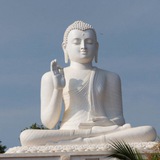
Dhammapada Verses 254 and 255
Subhaddaparibbajaka Vatthu
Akaseva padam natthi
samano natthi bahire
papancabhirata paja
nippapanca tathagata.
Akaseva padam natthi
samano natthi bahire
sankhara sassatta natthi
natthi buddhanaminjitam.
Verse 254: In the sky there is no track; outside the Buddha's Teaching there is no ariya bhikkhu (samana). All beings take delight in fetters (i.e., craving, pride and wrong view) that prolong samsara; all the Buddhas are free from these fetters.
Verse 255: In the sky there is no track; outside the Buddha's Teaching there is no ariya bhikkhu (samana). There is no conditioned thing that is permanent; all the Buddhas are unperturbed (by craving, pride and wrong view).
The Story of Subhadda the Wandering Ascetic
Verses (254) and (255) of this book were uttered by the Buddha in the Sal Grove of the Malla princes near Kusinara, just before the parinibbana (passing away) of the Buddha, in reply to the questions raised by Subhadda, the wandering ascetic (paribbajaka).
Subhadda the wandering ascetic was staying at Kusinara when he heard that the parinibbana of Gotama Buddha would take place in the last watch of that night. Subhadda had three questions which had been troubling him for a long time. He had already put these questions to other religious leaders, namely, Purana Kassapa, Makkhali Gosala, Ajita Kesakambala, Pakudha Kaccayana, Sancaya Belatthaputta and Nigantha Nataputta, but their answers did not satisfy him. He had not yet asked Gotama Buddha, and he felt that only the Buddha could answer his questions. So, he hurried off to the Sal Grove, but the Venerable Ananda did not allow him to see the Buddha, because the Buddha was by that time very weak. The Buddha overheard their conversation and consented to see Subhadda. Subhadda asked three questions. They are: (1) Are there any tracks in the sky? (2) Are there any ariya bhikkhus (samanas) outside the Teaching of the Buddha? and (3) Is there any conditioned thing (sankhara) that is permanent? The Buddha's answer to all the above questions was negative.
Then the Buddha spoke in verse as follows:
Verse 254: In the sky there is no track; outside the Buddha's Teaching there is no ariya bhikkhu (samana). All beings take delight in fetters (i.e., craving, pride and wrong view) that prolong samsara; all the Buddhas are free from these fetters.
Verse 255: In the sky there is no track; outside the Buddha's Teaching there is no ariya bhikkhu (samana). There is no conditioned thing that is permanent; all the Buddhas are unperturbed (by craving, pride and wrong view).
At the end of the discourse Subhadda attained Anagami Fruition and as requested by him the Buddha admitted him to the Order of the bhikkhus. Subhadda was the last one to become a bhikkhu in the life time of the Buddha. Eventually, Subhadda attained arahatship.
End of Chapter Eighteen: Impurities
===
Ajahn Chah, Buddhist teacher of Thai forest meditation of Theravada Buddhism channel:
https://news.1rj.ru/str/ajahnchah_buddhism
===
Subhaddaparibbajaka Vatthu
Akaseva padam natthi
samano natthi bahire
papancabhirata paja
nippapanca tathagata.
Akaseva padam natthi
samano natthi bahire
sankhara sassatta natthi
natthi buddhanaminjitam.
Verse 254: In the sky there is no track; outside the Buddha's Teaching there is no ariya bhikkhu (samana). All beings take delight in fetters (i.e., craving, pride and wrong view) that prolong samsara; all the Buddhas are free from these fetters.
Verse 255: In the sky there is no track; outside the Buddha's Teaching there is no ariya bhikkhu (samana). There is no conditioned thing that is permanent; all the Buddhas are unperturbed (by craving, pride and wrong view).
The Story of Subhadda the Wandering Ascetic
Verses (254) and (255) of this book were uttered by the Buddha in the Sal Grove of the Malla princes near Kusinara, just before the parinibbana (passing away) of the Buddha, in reply to the questions raised by Subhadda, the wandering ascetic (paribbajaka).
Subhadda the wandering ascetic was staying at Kusinara when he heard that the parinibbana of Gotama Buddha would take place in the last watch of that night. Subhadda had three questions which had been troubling him for a long time. He had already put these questions to other religious leaders, namely, Purana Kassapa, Makkhali Gosala, Ajita Kesakambala, Pakudha Kaccayana, Sancaya Belatthaputta and Nigantha Nataputta, but their answers did not satisfy him. He had not yet asked Gotama Buddha, and he felt that only the Buddha could answer his questions. So, he hurried off to the Sal Grove, but the Venerable Ananda did not allow him to see the Buddha, because the Buddha was by that time very weak. The Buddha overheard their conversation and consented to see Subhadda. Subhadda asked three questions. They are: (1) Are there any tracks in the sky? (2) Are there any ariya bhikkhus (samanas) outside the Teaching of the Buddha? and (3) Is there any conditioned thing (sankhara) that is permanent? The Buddha's answer to all the above questions was negative.
Then the Buddha spoke in verse as follows:
Verse 254: In the sky there is no track; outside the Buddha's Teaching there is no ariya bhikkhu (samana). All beings take delight in fetters (i.e., craving, pride and wrong view) that prolong samsara; all the Buddhas are free from these fetters.
Verse 255: In the sky there is no track; outside the Buddha's Teaching there is no ariya bhikkhu (samana). There is no conditioned thing that is permanent; all the Buddhas are unperturbed (by craving, pride and wrong view).
At the end of the discourse Subhadda attained Anagami Fruition and as requested by him the Buddha admitted him to the Order of the bhikkhus. Subhadda was the last one to become a bhikkhu in the life time of the Buddha. Eventually, Subhadda attained arahatship.
End of Chapter Eighteen: Impurities
===
Ajahn Chah, Buddhist teacher of Thai forest meditation of Theravada Buddhism channel:
https://news.1rj.ru/str/ajahnchah_buddhism
===
Telegram
Ajahn Chah - Theravada Thailand Buddhism
Collection of teachings of Venerable Ajahn Chah, a foremost meditation and Buddhist teacher from Thailand
👏1💯1
Forwarded from Ajahn Chah - Theravada Thailand Buddhism
Free Buddha Dharma ebook
No Ajahn Chah
Reflections
Once there was a layman who came to Ajahn Chah and asked him who Ajahn Chah was. Ajahn Chah, seeing that the spiritual development of the individual was not very advanced, pointed to himself and said, "This, this is Ajahn Chah."
On another occasion, someone else asked Ajahn Chah the same question. This time, however, seeing that the questioner’s capacity to understand the Dhamma was higher, Ajahn Chah answered by saying, "Ajahn Chah? There is no Ajahn Chah.
Free download here:
https://ftp.budaedu.org/ebooks/pdf/EN169.pdf
===
No Ajahn Chah
Reflections
Once there was a layman who came to Ajahn Chah and asked him who Ajahn Chah was. Ajahn Chah, seeing that the spiritual development of the individual was not very advanced, pointed to himself and said, "This, this is Ajahn Chah."
On another occasion, someone else asked Ajahn Chah the same question. This time, however, seeing that the questioner’s capacity to understand the Dhamma was higher, Ajahn Chah answered by saying, "Ajahn Chah? There is no Ajahn Chah.
Free download here:
https://ftp.budaedu.org/ebooks/pdf/EN169.pdf
===
🏆2👍1👏1👌1
Dhammapada Verses 256 and 257
Vinicchayamahamatta Vatthu
Na tena hoti dhammattho
yenattham sahasa naye
yo ca attham anatthanca
ubbo niccheyya pandito.
Asahasena dhammena
samena nayati pare
dhammassa gutto medhavi
"dhammattho" ti pavuccati.
Verse 256: He is not just if he decides a case arbitrarily; the wise man should decide after considering both what is right and what is wrong.
Verse 257: The wise man who decides not arbitrarily but in accordance with the law is one who safeguards the law; he is to be called 'one who abides by the law (dhammattho).'
The Story of the Judge
While residing at the Jetavana monastery, the Buddha uttered Verses (256) and (257) of this book with reference to some judges who were corrupt.
One day, some bhikkhus were returning from their round of alms-food when it rained and they went into a law court to take shelter. While they were there, they found out that some judges, having taken bribes, were deciding cases arbitrarily. They reported the matter to the Buddha and the Buddha replied, "Bhikkhus! In deciding cases, if one is influenced by affection or by monetary consideration, he cannot be called 'the just', or 'a judge who abides by the law.' If one weighs the evidence intelligently and decides a case impartially, then he is to be called, 'the just' or 'a judge who abides by the law.'"
Then the Buddha spoke in verse as follows:
Verse 256: He is not just if he decides a case arbitrarily; the wise man should decide after considering both what is right and what is wrong.
Verse 257: The wise man who decides not arbitrarily but in accordance with the law is one who safeguards the law; he is to be called 'one who abides by the law (dhammattho)'.
===
Free Buddhism books, teachings, podcasts and videos from Theravada, Mahayana and Vajrayana traditions:
https://news.1rj.ru/str/buddha_ebooks
===
Vinicchayamahamatta Vatthu
Na tena hoti dhammattho
yenattham sahasa naye
yo ca attham anatthanca
ubbo niccheyya pandito.
Asahasena dhammena
samena nayati pare
dhammassa gutto medhavi
"dhammattho" ti pavuccati.
Verse 256: He is not just if he decides a case arbitrarily; the wise man should decide after considering both what is right and what is wrong.
Verse 257: The wise man who decides not arbitrarily but in accordance with the law is one who safeguards the law; he is to be called 'one who abides by the law (dhammattho).'
The Story of the Judge
While residing at the Jetavana monastery, the Buddha uttered Verses (256) and (257) of this book with reference to some judges who were corrupt.
One day, some bhikkhus were returning from their round of alms-food when it rained and they went into a law court to take shelter. While they were there, they found out that some judges, having taken bribes, were deciding cases arbitrarily. They reported the matter to the Buddha and the Buddha replied, "Bhikkhus! In deciding cases, if one is influenced by affection or by monetary consideration, he cannot be called 'the just', or 'a judge who abides by the law.' If one weighs the evidence intelligently and decides a case impartially, then he is to be called, 'the just' or 'a judge who abides by the law.'"
Then the Buddha spoke in verse as follows:
Verse 256: He is not just if he decides a case arbitrarily; the wise man should decide after considering both what is right and what is wrong.
Verse 257: The wise man who decides not arbitrarily but in accordance with the law is one who safeguards the law; he is to be called 'one who abides by the law (dhammattho)'.
===
Free Buddhism books, teachings, podcasts and videos from Theravada, Mahayana and Vajrayana traditions:
https://news.1rj.ru/str/buddha_ebooks
===
Telegram
Buddha Dharma books
Free Buddhism books, teachings, podcasts and videos from Theravada, Mahayana and Vajrayana traditions
❤1👍1👏1
Forwarded from Words of the Buddha
Free Buddha Dharma ebook
How to Overcome Difficulties, a compilation of works by K. Sri Dhammananda
Are you worried? Are you miserable? Are you anxious and unhappy? If so, you are invited to read this book to develop a better understanding of your problems.
Free download here:
https://ftp.budaedu.org/ebooks/pdf/EN181.pdf
===
How to Overcome Difficulties, a compilation of works by K. Sri Dhammananda
Are you worried? Are you miserable? Are you anxious and unhappy? If so, you are invited to read this book to develop a better understanding of your problems.
Free download here:
https://ftp.budaedu.org/ebooks/pdf/EN181.pdf
===
❤1💯1
Dhammapada Verse 258
Chabbaggiya Vatthu
Na tena pandito hoti
yavata bahu bhasati
khemi averi abhayo
"pandito" ti pavuccati.
Verse 258: He is not a wise man just because he talks much; only he who is peaceful, free from enmity, and does no harm to others, is to be called 'a wise man'.
The Story of a Group of Six Bhikkhus
While residing at the Jetavana monastery, the Buddha uttered Verse (258) of this book, with reference to a group of six bhikkhus.
Once, there was a group of six bhikkhus who made trouble at the place of eating either in the monastery or in the village. One day, while some samaneras were, having their alms-food, the group of six bhikkhus came in and said boastfully to the samaneras, "Look! We only are the wise." Then they started throwing things about, leaving the place of eating in disorder. When the Buddha was told about this, he said, "Bhikkhus! I do not say that one who talks much, abuses and bullies others is a wise man. Only he who is free from hatred, and harms no one is a wise man."
Then the Buddha spoke in verse as follows:
Verse 258: He is not a wise man just because he talks much; only he who is peaceful, free from enmity, and does no harm to others, is to be called 'a wise man'.
===
Buddha dharma teachings channel:
https://news.1rj.ru/str/lorddivinebuddha
===
Chabbaggiya Vatthu
Na tena pandito hoti
yavata bahu bhasati
khemi averi abhayo
"pandito" ti pavuccati.
Verse 258: He is not a wise man just because he talks much; only he who is peaceful, free from enmity, and does no harm to others, is to be called 'a wise man'.
The Story of a Group of Six Bhikkhus
While residing at the Jetavana monastery, the Buddha uttered Verse (258) of this book, with reference to a group of six bhikkhus.
Once, there was a group of six bhikkhus who made trouble at the place of eating either in the monastery or in the village. One day, while some samaneras were, having their alms-food, the group of six bhikkhus came in and said boastfully to the samaneras, "Look! We only are the wise." Then they started throwing things about, leaving the place of eating in disorder. When the Buddha was told about this, he said, "Bhikkhus! I do not say that one who talks much, abuses and bullies others is a wise man. Only he who is free from hatred, and harms no one is a wise man."
Then the Buddha spoke in verse as follows:
Verse 258: He is not a wise man just because he talks much; only he who is peaceful, free from enmity, and does no harm to others, is to be called 'a wise man'.
===
Buddha dharma teachings channel:
https://news.1rj.ru/str/lorddivinebuddha
===
Telegram
Buddha
Buddha dharma teachings from the suttas and commentaries
👍1👏1💯1
Forwarded from Buddha Dharma books
Free Buddha Dharma ebook
Emptiness and Stillness
By Ajahn Brahm
This book has been produced to commemorate the 60th birthday of Ajahn Brahm. It has been generously sponsored for free distribution by his close lay disciples from Perth, interstate and overseas.
All the text is original material written specially for this publication. Likewise, many of the images were taken during recent Dhamma tours. Special thanks for wonderful pictures are due to supporters in Thailand, Hong Kong, Sri Lanka, Malaysia, Singapore, Indonesia, Norway and Germany. Some of the photos are from The Buddhist Society of Western Australia archives and may bring back happy memories. Extracts from two of Ajahn’s Dhamma talks are also included.
Free download here:
https://static.sariputta.com/pdf/tipitaka/213/A-Tribute-to-Ajahn-Brahm_Emptiness_and_Stillness_pdf.pdf
===
Emptiness and Stillness
By Ajahn Brahm
This book has been produced to commemorate the 60th birthday of Ajahn Brahm. It has been generously sponsored for free distribution by his close lay disciples from Perth, interstate and overseas.
All the text is original material written specially for this publication. Likewise, many of the images were taken during recent Dhamma tours. Special thanks for wonderful pictures are due to supporters in Thailand, Hong Kong, Sri Lanka, Malaysia, Singapore, Indonesia, Norway and Germany. Some of the photos are from The Buddhist Society of Western Australia archives and may bring back happy memories. Extracts from two of Ajahn’s Dhamma talks are also included.
Free download here:
https://static.sariputta.com/pdf/tipitaka/213/A-Tribute-to-Ajahn-Brahm_Emptiness_and_Stillness_pdf.pdf
===
🏆2🤗1