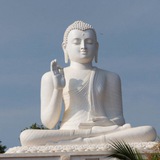
Dhammapada Verse 259
Ekudanakhinasava Vatthu
Na tavata dhammadharo
yavata bahu bhasati
yo ca appampi sutvana
dhammam kayena passati
sa ve dhammadharo hoti
yo dhammam nappamajjati.
Verse 259: He is not "one versed in the Dhamma (Dhammadhara)" just because he talks much. He who hears only a little but comprehends the Dhamma, and is not unmindful is, indeed, "one versed in the Dhamma".
The Story of Ekudana the Arahat
While residing at the Jetavana monastery, the Buddha uttered Verse (259) of this book, with reference to a bhikkhu who was an arahat.
This bhikkhu lived in a grove near Savatthi. He was known as Ekudana, because he knew only one stanza of exultation (Udana) by heart. But the thera fully understood the meaning of the Dhamma as conveyed by the stanza. On each sabbath day, he would exhort others to listen to the Dhamma, and he himself would recite the one stanza he knew. Every time he had finished his recitation, the guardian spirits (devas) of the forests praised him and applauded him resoundingly. On one sabbath day, two learned theras, who were well-versed in the Tipitaka, accompanied by five hundred bhikkhus came to his place. Ekudana asked the two theras to preach the Dhamma. They enquired if there were many who wished to listen to the Dhamma in this out of the way place. Ekudana answered in the affirmative and also told them that even the guardian spirits of the forests usually came, and that they usually praised and applauded at the end of discourses.
So, the two learned theras took turns to preach the Dhamma, but when their discourses ended, there was no applause from the guardian spirits of the forests. The two learned theras were puzzled; they even doubted the words of Ekudana. But Ekudana insisted that the guardian spirits used to come and always applauded at the end of each discourse. The two theras then pressed Ekudana to do the preaching himself. Ekudana held the fan in front of him and recited the usual stanza. At the end of the recitation, the guardian spirits applauded as usual. The bhikkhus who had accompanied the two learned theras complained that the devas inhabiting the forests were very partial.
They reported the matter to the Buddha on arrival at the Jetavana monastery. To them the Buddha said. "Bhikkhus! I do not say that a bhikkhu who has learnt much and talks much of the Dhamma is one who is versed in the Dhamma, (Dhammadhara)." One who has learnt very little and knows only one stanza of the Dhamma, but fully comprehends the Four Noble Truths, and is ever mindful is the one who is truly versed in the Dhamma."
Then the Buddha spoke in verse as follows:
Verse 259: He is not "one versed in the Dhamma (Dhammadhara)" just because he talks much. He who hears only a little but comprehends the Dhamma, and is not unmindful is, indeed, "one versed in the Dhamma".
===
Tibetan Buddhism - Vajrayana, Tantrayana and esoteric Buddhism channel:
https://news.1rj.ru/str/tibetanbuddha
Vajrayana Tantrayana Buddhism channel:
https://news.1rj.ru/str/tantrayanabuddhism
===
Ekudanakhinasava Vatthu
Na tavata dhammadharo
yavata bahu bhasati
yo ca appampi sutvana
dhammam kayena passati
sa ve dhammadharo hoti
yo dhammam nappamajjati.
Verse 259: He is not "one versed in the Dhamma (Dhammadhara)" just because he talks much. He who hears only a little but comprehends the Dhamma, and is not unmindful is, indeed, "one versed in the Dhamma".
The Story of Ekudana the Arahat
While residing at the Jetavana monastery, the Buddha uttered Verse (259) of this book, with reference to a bhikkhu who was an arahat.
This bhikkhu lived in a grove near Savatthi. He was known as Ekudana, because he knew only one stanza of exultation (Udana) by heart. But the thera fully understood the meaning of the Dhamma as conveyed by the stanza. On each sabbath day, he would exhort others to listen to the Dhamma, and he himself would recite the one stanza he knew. Every time he had finished his recitation, the guardian spirits (devas) of the forests praised him and applauded him resoundingly. On one sabbath day, two learned theras, who were well-versed in the Tipitaka, accompanied by five hundred bhikkhus came to his place. Ekudana asked the two theras to preach the Dhamma. They enquired if there were many who wished to listen to the Dhamma in this out of the way place. Ekudana answered in the affirmative and also told them that even the guardian spirits of the forests usually came, and that they usually praised and applauded at the end of discourses.
So, the two learned theras took turns to preach the Dhamma, but when their discourses ended, there was no applause from the guardian spirits of the forests. The two learned theras were puzzled; they even doubted the words of Ekudana. But Ekudana insisted that the guardian spirits used to come and always applauded at the end of each discourse. The two theras then pressed Ekudana to do the preaching himself. Ekudana held the fan in front of him and recited the usual stanza. At the end of the recitation, the guardian spirits applauded as usual. The bhikkhus who had accompanied the two learned theras complained that the devas inhabiting the forests were very partial.
They reported the matter to the Buddha on arrival at the Jetavana monastery. To them the Buddha said. "Bhikkhus! I do not say that a bhikkhu who has learnt much and talks much of the Dhamma is one who is versed in the Dhamma, (Dhammadhara)." One who has learnt very little and knows only one stanza of the Dhamma, but fully comprehends the Four Noble Truths, and is ever mindful is the one who is truly versed in the Dhamma."
Then the Buddha spoke in verse as follows:
Verse 259: He is not "one versed in the Dhamma (Dhammadhara)" just because he talks much. He who hears only a little but comprehends the Dhamma, and is not unmindful is, indeed, "one versed in the Dhamma".
===
Tibetan Buddhism - Vajrayana, Tantrayana and esoteric Buddhism channel:
https://news.1rj.ru/str/tibetanbuddha
Vajrayana Tantrayana Buddhism channel:
https://news.1rj.ru/str/tantrayanabuddhism
===
Telegram
Tibetan Buddhism Vajrayana Tantrayana esoteric tradition
Buddha Dharma teachings from the esoteric Vajrayana or Tantrayana Buddhism, includes all major schools Nyingma, Kagyu, Gelug, Sakya, Jonang and Bonpo.
❤1👍1🏆1
Forwarded from Buddha Dharma books
Free Buddha Dharma ebook
Intuitive Awareness
By Ajahn Sumedho
This book is compiled from talks given mostly in 2001 by Ajahn Sumedho; they convey an intuitive understanding of the Buddha’s teaching which has arisen from over 35 years of practice as a Buddhist monk.
This approach starts with accepting ourselves as we are, not as some ideal of whom we think we should be. By doing this a relaxation can take place that creates space for insight to arise. For some people this space arises as the sound of silence, or simply a quiet or empty mind. However it manifests, this points to the unconditioned; beyond body and mind objects.
Free download available:
https://static.sariputta.com/pdf/tipitaka/216/intuitive-awareness_pdf.pdf
===
Intuitive Awareness
By Ajahn Sumedho
This book is compiled from talks given mostly in 2001 by Ajahn Sumedho; they convey an intuitive understanding of the Buddha’s teaching which has arisen from over 35 years of practice as a Buddhist monk.
This approach starts with accepting ourselves as we are, not as some ideal of whom we think we should be. By doing this a relaxation can take place that creates space for insight to arise. For some people this space arises as the sound of silence, or simply a quiet or empty mind. However it manifests, this points to the unconditioned; beyond body and mind objects.
Free download available:
https://static.sariputta.com/pdf/tipitaka/216/intuitive-awareness_pdf.pdf
===
👏1😍1🤗1
Dhammapada Verses 260 and 261
Lakundakabhaddiyatthera Vatthu
Na tena thero so hoti
yenassa palitam siro
paripakko vayo tassa
"moghajinno" ti vuccati.
Yamhi saccanca dhammo ca
ahimsa samyamo damo
sa ve vantamalo1 dhiro
"thero2" iti pavuccati.
Verse 260: He is not a thera just because his head is grey; he who is ripe only in years is called "one grown old in vain".
Verse 261: Only a wise man who comprehends the Four Noble Truths and the Dhamma, who is harmless and virtuous, who restrains his senses and has rid himself of moral defilements is indeed called a thera.
1. vantamalo: lit., has vomited impurities.
2. thero: an Elder, i.e., a senior member of the Buddhist Order; but often applied to bhikkhus in general.
The Story of Thera Bhaddiya
While residing at the Jetavana monastery, the Buddha uttered Verses (260) and (261) of this book, with reference to Thera Bhaddiya. He was also known as Lakundaka Bhaddiya because he was very short in stature.
One day, thirty bhikkhus came to pay obeisance to the Buddha. The Buddha knew that time was ripe for those thirty bhikkhus to attain arahatship. So he asked them whether they had seen a thera as they came into the room. They answered that they did not see a thera but they saw only a young samanera as they came in. Whereupon, the Buddha said to them, "Bhikkhus! That person is not a samanera, he is a senior bhikkhu although he is small-built and very unassuming. I do say that one is not a thera just because he is old and looks like a thera; only he who comprehends the Four Noble Truths and does not harm others is to be called a thera."
Verse 260: He is not a thera just because his head is grey; he who is ripe only in years is called "one grown old in vain".
Verse 261: Only a wise man who comprehends the Four Noble Truths and the Dhamma, who is harmless and virtuous, who restrains his senses and has rid himself of moral defilements is indeed called a thera.
At the end of the discourse those thirty bhikkhus attained arahatship.
===
Words of the Buddha channel:
https://news.1rj.ru/str/wordsofbuddha
===
Lakundakabhaddiyatthera Vatthu
Na tena thero so hoti
yenassa palitam siro
paripakko vayo tassa
"moghajinno" ti vuccati.
Yamhi saccanca dhammo ca
ahimsa samyamo damo
sa ve vantamalo1 dhiro
"thero2" iti pavuccati.
Verse 260: He is not a thera just because his head is grey; he who is ripe only in years is called "one grown old in vain".
Verse 261: Only a wise man who comprehends the Four Noble Truths and the Dhamma, who is harmless and virtuous, who restrains his senses and has rid himself of moral defilements is indeed called a thera.
1. vantamalo: lit., has vomited impurities.
2. thero: an Elder, i.e., a senior member of the Buddhist Order; but often applied to bhikkhus in general.
The Story of Thera Bhaddiya
While residing at the Jetavana monastery, the Buddha uttered Verses (260) and (261) of this book, with reference to Thera Bhaddiya. He was also known as Lakundaka Bhaddiya because he was very short in stature.
One day, thirty bhikkhus came to pay obeisance to the Buddha. The Buddha knew that time was ripe for those thirty bhikkhus to attain arahatship. So he asked them whether they had seen a thera as they came into the room. They answered that they did not see a thera but they saw only a young samanera as they came in. Whereupon, the Buddha said to them, "Bhikkhus! That person is not a samanera, he is a senior bhikkhu although he is small-built and very unassuming. I do say that one is not a thera just because he is old and looks like a thera; only he who comprehends the Four Noble Truths and does not harm others is to be called a thera."
Verse 260: He is not a thera just because his head is grey; he who is ripe only in years is called "one grown old in vain".
Verse 261: Only a wise man who comprehends the Four Noble Truths and the Dhamma, who is harmless and virtuous, who restrains his senses and has rid himself of moral defilements is indeed called a thera.
At the end of the discourse those thirty bhikkhus attained arahatship.
===
Words of the Buddha channel:
https://news.1rj.ru/str/wordsofbuddha
===
Telegram
Words of the Buddha
Daily teachings of Buddha Dharma
👏1💯1
Vangisa Bhante:
Dear Deva, you are sitting on the back of an elephant that is huge and all white. You travel from park to park, surrounded by goddesses, shining brightly in all directions like the star Osadhi.
What kind of meritorious actions did you do when you were in the human world?
That deva, delighted at being questioned by Arahant Vangisa, gladly explained what he had done that resulted in such great happiness.
Deva:
In my previous life, I was a man in the human world. I was a lay disciple of the Buddha. I abstained from killing, stealing, taking intoxicants, and lying. I was content with my own wife, and did not even think of other women. I offered things with a very happy mind.
Because of these meritorious deeds, I have been born as a very beautiful deva and enjoy all the wonderful things that delight my heart.
Great Bhante, those were the meritorious deeds I did to have such a beautiful body which shines brightly in all directions.
Vv 5.11 Dutiya Nāga Sutta: Second Elephant Mansion
Dear Deva, you are sitting on the back of an elephant that is huge and all white. You travel from park to park, surrounded by goddesses, shining brightly in all directions like the star Osadhi.
What kind of meritorious actions did you do when you were in the human world?
That deva, delighted at being questioned by Arahant Vangisa, gladly explained what he had done that resulted in such great happiness.
Deva:
In my previous life, I was a man in the human world. I was a lay disciple of the Buddha. I abstained from killing, stealing, taking intoxicants, and lying. I was content with my own wife, and did not even think of other women. I offered things with a very happy mind.
Because of these meritorious deeds, I have been born as a very beautiful deva and enjoy all the wonderful things that delight my heart.
Great Bhante, those were the meritorious deeds I did to have such a beautiful body which shines brightly in all directions.
Vv 5.11 Dutiya Nāga Sutta: Second Elephant Mansion
🥰2😍1🤗1
Dhammapada Verses 262 and 263
Sambahulabhikkhu Vatthu
Na vakkaranamattena
vannapokkharataya va
sadhurupo naro hoti
issuki macchari satho.
Yassa cetam samucchinnam
mulaghaccam samuhatam
sa vantadoso medhavi
"sadhurupo" ti vuccati.
Verse 262: Not by fine talk, nor by good looks could one be a good-hearted man, if he were envious, miserly and crafty.
Verse 263: A wise man who has cut off, uprooted and removed these and has rid himself of moral defilements is indeed called a good-hearted man.
The Story of Some Bhikkhus
While residing at the Jetavana monastery, the Buddha uttered Verses (262) and (263) of this book, with reference to some bhikkhus who were very envious of other bhikkhus.
At the monastery, young bhikkhus and samaneras were in the habit of attending on older bhikkhus who were their teachers. They washed and dyed the robes, or else performed other small services for their teachers. Some bhikkhus noticing these services envied those senior bhikkhus, and so they thought out a plan that would benefit them materially. Their plan was that they would suggest to the Buddha that young bhikkhus and samaneras should be required to come to them for further instruction and guidance even though they had been taught by their respective teachers. When they went to the Buddha with this proposal, the Buddha, knowing full well their motive, turned it down. To them the Buddha said, "Bhikkhus I do not say that you are good-hearted just because you can talk eloquently. Only he who has got rid of covetousness and all that is evil by means of Arahatta Magga is to be called a good-hearted man."
Then the Buddha spoke in verse as follows:
Verse 262: Not by fine talk, nor by good looks could one be a good-hearted man, if he were envious, miserly and crafty.
Verse 263: A wise man who has cut off, uprooted and removed these and has rid himself of moral defilements is indeed called a good-hearted man.
===
Dhammapada, beloved and favorite teachings of the Buddha channel:
https://news.1rj.ru/str/dhammapadas
===
Sambahulabhikkhu Vatthu
Na vakkaranamattena
vannapokkharataya va
sadhurupo naro hoti
issuki macchari satho.
Yassa cetam samucchinnam
mulaghaccam samuhatam
sa vantadoso medhavi
"sadhurupo" ti vuccati.
Verse 262: Not by fine talk, nor by good looks could one be a good-hearted man, if he were envious, miserly and crafty.
Verse 263: A wise man who has cut off, uprooted and removed these and has rid himself of moral defilements is indeed called a good-hearted man.
The Story of Some Bhikkhus
While residing at the Jetavana monastery, the Buddha uttered Verses (262) and (263) of this book, with reference to some bhikkhus who were very envious of other bhikkhus.
At the monastery, young bhikkhus and samaneras were in the habit of attending on older bhikkhus who were their teachers. They washed and dyed the robes, or else performed other small services for their teachers. Some bhikkhus noticing these services envied those senior bhikkhus, and so they thought out a plan that would benefit them materially. Their plan was that they would suggest to the Buddha that young bhikkhus and samaneras should be required to come to them for further instruction and guidance even though they had been taught by their respective teachers. When they went to the Buddha with this proposal, the Buddha, knowing full well their motive, turned it down. To them the Buddha said, "Bhikkhus I do not say that you are good-hearted just because you can talk eloquently. Only he who has got rid of covetousness and all that is evil by means of Arahatta Magga is to be called a good-hearted man."
Then the Buddha spoke in verse as follows:
Verse 262: Not by fine talk, nor by good looks could one be a good-hearted man, if he were envious, miserly and crafty.
Verse 263: A wise man who has cut off, uprooted and removed these and has rid himself of moral defilements is indeed called a good-hearted man.
===
Dhammapada, beloved and favorite teachings of the Buddha channel:
https://news.1rj.ru/str/dhammapadas
===
Telegram
Dhammapada - Buddha Dharma Teachings
Daily teachings of the Dhammapada, beloved and favorite teachings of the Buddha
🙏3💯1🏆1
Forwarded from Buddha Dharma books
Free Buddha Dharma ebook
Kamma, The Real Creator
By Dr. Mehm Tin Mon
Who is the Real Creator?
Who create Human beings, celestial beings and woeful beings?
Why are some born rich and some born poor?
Why some are ugly and some are beautiful?
Who are there ups and down in Life?
Who determines your fate and destiny?
How can you be rich and prosperous in every existence?
Free download here:
https://static.sariputta.com/pdf/tipitaka/1244/DrMehmTinMon-KammaTheRealCreator.pdf
===
Kamma, The Real Creator
By Dr. Mehm Tin Mon
Who is the Real Creator?
Who create Human beings, celestial beings and woeful beings?
Why are some born rich and some born poor?
Why some are ugly and some are beautiful?
Who are there ups and down in Life?
Who determines your fate and destiny?
How can you be rich and prosperous in every existence?
Free download here:
https://static.sariputta.com/pdf/tipitaka/1244/DrMehmTinMon-KammaTheRealCreator.pdf
===
👏1🏆1
Dhammapada Verses 264 and 265
Hatthaka Vatthu
Na mundakena samano
abbato alikam bhanam
icchalobhasamapanno
samano kim bhavissati.
Yo ca sameti papani
anumthulani sabbaso
samitatta hi papanam
"samano" ti pavuccati.
Verse 264: Not by a shaven head does a man become a samana, if he lacks morality and austere practices and tells lies. How could he who is full of covetousness and greed be a samana?
Verse 265: He who has totally subdued all evil, great and small, is called a samana because he has overcome all evil.
The Story of Bhikkhu Hatthaka
While residing at the Jetavana monastery, the Buddha uttered Verses (264) and (265) of this book, with reference to a bhikkhu named Hatthaka.
Bhikkhu Hatthaka was in the habit of challenging ascetics of non-Buddhist faiths to meet him in a certain place to debate on religious matters. He would then go out by himself to the self-appointed place. When nobody appeared he would boast, "Look, those wandering ascetics dare not meet me, they have been beaten by me!", and such other things. The Buddha called Hatthaka to him and said, "Bhikkhu! Why do you behave in this way? One who says such things cannot become a samana in spite of his shaven head. Only one who has rid himself of all evil is to be called a samana."
Then the Buddha spoke in verse as follows:
Verse 264: Not by a shaven head does a man become a samana, if he lacks morality and austere practices and tells lies. How could he who is full of covetousness and greed be a samana?
Verse 265: He who has totally subdued all evil, great and small, is called a samana because he has overcome all evil.
===
Buddha dharma teachings channel:
https://invite.viber.com/?g2=AQAKw1y3rv%2F6sk61PI2W4izuIiaEZj8YZujhY1tSzL%2B07s7rFnVFDAd0bAYFaMLw
===
Hatthaka Vatthu
Na mundakena samano
abbato alikam bhanam
icchalobhasamapanno
samano kim bhavissati.
Yo ca sameti papani
anumthulani sabbaso
samitatta hi papanam
"samano" ti pavuccati.
Verse 264: Not by a shaven head does a man become a samana, if he lacks morality and austere practices and tells lies. How could he who is full of covetousness and greed be a samana?
Verse 265: He who has totally subdued all evil, great and small, is called a samana because he has overcome all evil.
The Story of Bhikkhu Hatthaka
While residing at the Jetavana monastery, the Buddha uttered Verses (264) and (265) of this book, with reference to a bhikkhu named Hatthaka.
Bhikkhu Hatthaka was in the habit of challenging ascetics of non-Buddhist faiths to meet him in a certain place to debate on religious matters. He would then go out by himself to the self-appointed place. When nobody appeared he would boast, "Look, those wandering ascetics dare not meet me, they have been beaten by me!", and such other things. The Buddha called Hatthaka to him and said, "Bhikkhu! Why do you behave in this way? One who says such things cannot become a samana in spite of his shaven head. Only one who has rid himself of all evil is to be called a samana."
Then the Buddha spoke in verse as follows:
Verse 264: Not by a shaven head does a man become a samana, if he lacks morality and austere practices and tells lies. How could he who is full of covetousness and greed be a samana?
Verse 265: He who has totally subdued all evil, great and small, is called a samana because he has overcome all evil.
===
Buddha dharma teachings channel:
https://invite.viber.com/?g2=AQAKw1y3rv%2F6sk61PI2W4izuIiaEZj8YZujhY1tSzL%2B07s7rFnVFDAd0bAYFaMLw
===
Viber
Buddha
Buddha dharma teachings from the suttas and commentaries from Theravada tradition
👏1💯1
Forwarded from Words of the Buddha
How to Heal Your Inner Child
Healing the pain of our wounded child within, says Thich Nhat Hanh, is key.
By Thich Nhat Hanh
Part 1 of 2
In each of us, there is a young, suffering child. We have all had times of difficulty as children and many of us have experienced trauma. To protect and defend ourselves against future suffering, we often try to forget those painful times. Every time we’re in touch with the experience of suffering, we believe we can’t bear it, and we stuff our feelings and memories deep down in our unconscious mind. It may be that we haven’t dared to face this child for many decades.
But just because we may have ignored the child doesn’t mean she or he isn’t there. The wounded child is always there, trying to get our attention. The child says, “I’m here. I’m here. You can’t avoid me. You can’t run away from me.” We want to end our suffering by sending the child to a deep place inside, and staying as far away as possible. But running away doesn’t end our suffering; it only prolongs it.
The wounded child asks for care and love, but we do the opposite. We run away because we’re afraid of suffering. The block of pain and sorrow in us feels overwhelming. Even if we have time, we don’t come home to ourselves. We try to keep ourselves constantly entertained—watching television or movies, socializing, or using alcohol or drugs—because we don’t want to experience that suffering all over again.
The wounded child is there and we don’t even know she is there. The wounded child in us is a reality, but we can’t see her. That inability to see is a kind of ignorance. This child has been severely wounded. She or he really needs us to return. Instead we turn away.
When we become aware that we’ve forgotten the wounded child in ourselves, we feel great compassion for that child.
Ignorance is in each cell of our body and our consciousness. It’s like a drop of ink diffused in a glass of water. That ignorance stops us from seeing reality; it pushes us to do foolish things that make us suffer even more and wound again the already-wounded child in us.
The wounded child is also in each cell of our body. There is no cell of our body that does not have that wounded child in it. We don’t have to look far into the past for that child. We only have to look deeply and we can be in touch with him. The suffering of that wounded child is lying inside us right now in the present moment.
But just as the suffering is present in every cell of our body, so are the seeds of awakened understanding and happiness handed down to us from our ancestors. We just have to use them. We have a lamp inside us, the lamp of mindfulness, which we can light anytime. The oil of that lamp is our breathing, our steps, and our peaceful smile. We have to light up that lamp of mindfulness so the light will shine out and the darkness will dissipate and cease. Our practice is to light up the lamp.
When we become aware that we’ve forgotten the wounded child in ourselves, we feel great compassion for that child and we begin to generate the energy of mindfulness. The practices of mindful walking, mindful sitting, and mindful breathing are our foundation. With our mindful breath and mindful steps, we can produce the energy of mindfulness and return to the awakened wisdom lying in each cell of our body. That energy will embrace us and heal us, and will heal the wounded child in us.
Listening
When we speak of listening with compassion, we usually think of listening to someone else. But we must also listen to the wounded child inside us. Sometimes the wounded child in us needs all our attention. That little child might emerge from the depths of your consciousness and ask for your attention. If you are mindful, you will hear his or her voice calling for help. At that moment, instead of paying attention to whatever is in front of you, go back and tenderly embrace the wounded child. You can talk directly to the child with the language of love, saying, “In the past, I left you alone. I went away from you. Now, I am very sorry.
Healing the pain of our wounded child within, says Thich Nhat Hanh, is key.
By Thich Nhat Hanh
Part 1 of 2
In each of us, there is a young, suffering child. We have all had times of difficulty as children and many of us have experienced trauma. To protect and defend ourselves against future suffering, we often try to forget those painful times. Every time we’re in touch with the experience of suffering, we believe we can’t bear it, and we stuff our feelings and memories deep down in our unconscious mind. It may be that we haven’t dared to face this child for many decades.
But just because we may have ignored the child doesn’t mean she or he isn’t there. The wounded child is always there, trying to get our attention. The child says, “I’m here. I’m here. You can’t avoid me. You can’t run away from me.” We want to end our suffering by sending the child to a deep place inside, and staying as far away as possible. But running away doesn’t end our suffering; it only prolongs it.
The wounded child asks for care and love, but we do the opposite. We run away because we’re afraid of suffering. The block of pain and sorrow in us feels overwhelming. Even if we have time, we don’t come home to ourselves. We try to keep ourselves constantly entertained—watching television or movies, socializing, or using alcohol or drugs—because we don’t want to experience that suffering all over again.
The wounded child is there and we don’t even know she is there. The wounded child in us is a reality, but we can’t see her. That inability to see is a kind of ignorance. This child has been severely wounded. She or he really needs us to return. Instead we turn away.
When we become aware that we’ve forgotten the wounded child in ourselves, we feel great compassion for that child.
Ignorance is in each cell of our body and our consciousness. It’s like a drop of ink diffused in a glass of water. That ignorance stops us from seeing reality; it pushes us to do foolish things that make us suffer even more and wound again the already-wounded child in us.
The wounded child is also in each cell of our body. There is no cell of our body that does not have that wounded child in it. We don’t have to look far into the past for that child. We only have to look deeply and we can be in touch with him. The suffering of that wounded child is lying inside us right now in the present moment.
But just as the suffering is present in every cell of our body, so are the seeds of awakened understanding and happiness handed down to us from our ancestors. We just have to use them. We have a lamp inside us, the lamp of mindfulness, which we can light anytime. The oil of that lamp is our breathing, our steps, and our peaceful smile. We have to light up that lamp of mindfulness so the light will shine out and the darkness will dissipate and cease. Our practice is to light up the lamp.
When we become aware that we’ve forgotten the wounded child in ourselves, we feel great compassion for that child and we begin to generate the energy of mindfulness. The practices of mindful walking, mindful sitting, and mindful breathing are our foundation. With our mindful breath and mindful steps, we can produce the energy of mindfulness and return to the awakened wisdom lying in each cell of our body. That energy will embrace us and heal us, and will heal the wounded child in us.
Listening
When we speak of listening with compassion, we usually think of listening to someone else. But we must also listen to the wounded child inside us. Sometimes the wounded child in us needs all our attention. That little child might emerge from the depths of your consciousness and ask for your attention. If you are mindful, you will hear his or her voice calling for help. At that moment, instead of paying attention to whatever is in front of you, go back and tenderly embrace the wounded child. You can talk directly to the child with the language of love, saying, “In the past, I left you alone. I went away from you. Now, I am very sorry.
Telegram
Ajahn Chah - Theravada Thailand Buddhism
Collection of teachings of Venerable Ajahn Chah, a foremost meditation and Buddhist teacher from Thailand
💯1🏆1