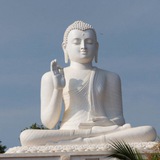
Dhammapada Verse 285
Suvannakaratthera Vatthu
Ucchinda sinehamattano
kumudam saradikamva panina
santimaggameva1 bruhaya
Nibbanam sugatena desitam.
Verse 285: Cut off your craving as one plucks an autumn lily with the hand. Nibbana has been expounded on by the Buddha; cultivate that Path which leads to it.
1. santimaggam: the Path that leads to Nibbana, i.e. the Path with Eight Constituents.
The Story of a Thera who had been a Goldsmith
While residing at the Jetavana monastery, the Buddha uttered Verse (285) of this book, with reference to a bhikkhu, a pupil of Thera Sariputta.
Once, a young, handsome son of a goldsmith was admitted into the Order by Thera Sariputta. The young bhikkhu was given loathsomeness of the dead body as the subject of meditation by Thera Sariputta. After taking the subject of meditation he left for the forest and practised meditation there; but he made very little progress. So he returned twice to Thera Sariputta for further instructions. Still, he made no progress. So Thera Sariputta took the young bhikkhu to the Buddha, and related everything about the young bhikkhu.
The Buddha knew that the young bhikkhu was the son of a goldsmith, and also that he had been born in the family of goldsmiths during his past five hundred existences. Therefore the Buddha changed the subject of meditation for the young bhikkhu; instead of loathsomeness, he was instructed to meditate on pleasantness. With his supernormal power, the Buddha created a beautiful lotus flower as big as a cart-wheel and told the young bhikkhu to stick it on the mound of sand just outside the monastery. The young bhikkhu, concentrating on the big, beautiful, fragrant lotus flower, was able to get rid of the hindrances. He was filled with delightful satisfaction (piti), and step by step he progressed until he reached as far as the fourth level of mental absorption (jhana).
The Buddha saw him from his perfumed chamber and with his supernormal power made the flower wither instantly. Seeing the flower wither and change its colour, the bhikkhu perceived the impermanent nature of the flower and of all other things and beings. That led to the realization of the impermanence, unsatisfactoriness and the insubstantiality of all conditioned things. At that instant, the Buddha sent forth his radiance and appeared as if in person to the young bhikkhu and instructed him to get rid of craving (tanha).
Then the Buddha spoke in verse as follows:
Verse 285: Cut off your craving as one plucks an autumn lily with the hand. Nibbana has been expounded on by the Buddha; cultivate that Path which leads to it.
At the end of the discourse the young bhikkhu attained arahatship.
===
Dhammapada, beloved and favorite teachings of the Buddha channel:
https://invite.viber.com/?g2=AQBLD6phsgvP%2F061YjEM3K%2BNeH1Yb372b9mtfQX2EmuBpgoLUoc99BDMfzHghrme
===
Suvannakaratthera Vatthu
Ucchinda sinehamattano
kumudam saradikamva panina
santimaggameva1 bruhaya
Nibbanam sugatena desitam.
Verse 285: Cut off your craving as one plucks an autumn lily with the hand. Nibbana has been expounded on by the Buddha; cultivate that Path which leads to it.
1. santimaggam: the Path that leads to Nibbana, i.e. the Path with Eight Constituents.
The Story of a Thera who had been a Goldsmith
While residing at the Jetavana monastery, the Buddha uttered Verse (285) of this book, with reference to a bhikkhu, a pupil of Thera Sariputta.
Once, a young, handsome son of a goldsmith was admitted into the Order by Thera Sariputta. The young bhikkhu was given loathsomeness of the dead body as the subject of meditation by Thera Sariputta. After taking the subject of meditation he left for the forest and practised meditation there; but he made very little progress. So he returned twice to Thera Sariputta for further instructions. Still, he made no progress. So Thera Sariputta took the young bhikkhu to the Buddha, and related everything about the young bhikkhu.
The Buddha knew that the young bhikkhu was the son of a goldsmith, and also that he had been born in the family of goldsmiths during his past five hundred existences. Therefore the Buddha changed the subject of meditation for the young bhikkhu; instead of loathsomeness, he was instructed to meditate on pleasantness. With his supernormal power, the Buddha created a beautiful lotus flower as big as a cart-wheel and told the young bhikkhu to stick it on the mound of sand just outside the monastery. The young bhikkhu, concentrating on the big, beautiful, fragrant lotus flower, was able to get rid of the hindrances. He was filled with delightful satisfaction (piti), and step by step he progressed until he reached as far as the fourth level of mental absorption (jhana).
The Buddha saw him from his perfumed chamber and with his supernormal power made the flower wither instantly. Seeing the flower wither and change its colour, the bhikkhu perceived the impermanent nature of the flower and of all other things and beings. That led to the realization of the impermanence, unsatisfactoriness and the insubstantiality of all conditioned things. At that instant, the Buddha sent forth his radiance and appeared as if in person to the young bhikkhu and instructed him to get rid of craving (tanha).
Then the Buddha spoke in verse as follows:
Verse 285: Cut off your craving as one plucks an autumn lily with the hand. Nibbana has been expounded on by the Buddha; cultivate that Path which leads to it.
At the end of the discourse the young bhikkhu attained arahatship.
===
Dhammapada, beloved and favorite teachings of the Buddha channel:
https://invite.viber.com/?g2=AQBLD6phsgvP%2F061YjEM3K%2BNeH1Yb372b9mtfQX2EmuBpgoLUoc99BDMfzHghrme
===
Viber
Dhammapada - Buddha Dharma Teachings
Daily teachings of the Dhammapada, beloved and favorite teachings of the Buddha
❤1👏1🏆1🤗1
Forwarded from Ajahn Chah - Theravada Thailand Buddhism
The Wounded Swan
In this imaginative retelling from the late Thich Nhat Hanh, Gautama Buddha recalls an episode from his childhood.
By Thich Nhat Hanh
Part 2 of 2
“One day, when I was nine years old and strolling alone in the garden, a swan suddenly dropped from the sky and writhed on the ground in front of me in great pain. I ran to pick it up, and I discovered that an arrow had deeply penetrated one of its wings. I clasped my hand firmly around the arrow’s shaft and yanked it out, and the bird cried as blood oozed from its wound. I applied pressure to the wound with my finger to stop the bleeding, and took the bird inside the palace to find princess Sundari, the lady in waiting. She agreed to pick a handful of medicinal leaves and make a poultice for the bird’s wound. The swan shivered, so I took off my jacket and wrapped it around her. Then I placed her close to the royal fireplace.”
Siddhartha paused for a moment to look at Svasti. “Svasti, I did not tell you yet, but when I was young I was a prince, the son of King Suddhodana in the city of Kapilavatthu. Sujata knows this already. I was about to go find some rice for the swan when my eight-year-old cousin, Devadatta, burst into the room. He was clutching his bow and arrows, and he asked excitedly, ‘Siddhartha, did you see a white swan fall down near here?’
“Before I could answer, Devadatta saw the swan resting by the fireplace. He ran toward it, but I stopped him.
‘“You may not take the bird.’
“My cousin protested, ‘That bird is mine. I shot it myself.’
“I stood between Devadatta and the swan, determined not to let him have it. I told him, ‘This bird is wounded. I’m protecting it. It needs to stay here.’
“Devadatta was quite stubborn and not about to give in. He argued, ‘Now listen, cousin, when this bird was flying in the sky, it didn’t belong to anyone. As I’m the one who shot it out of the sky, it rightfully belongs to me.’
“His argument sounded logical, but his words made me angry. I knew there was something wrong with his reasoning, but I couldn’t quite put my finger on it. So I just stood there, speechless, becoming more upset. I felt like punching him. Why I didn’t, I don’t know. Then, I saw a way to answer him.
“‘Listen, cousin,’ I told him, ‘Those who love each other live together, and those who are enemies live apart. You tried to kill the swan, so you and she are enemies. The bird cannot live with you. I saved her, bandaged her wound, warmed her, and was on my way to find food for her when you arrived. The bird and I love each other, and we can live together. The bird needs me, not you.’”
“Love and understanding can ease the suffering of all beings. The truth is the truth, whether or not it is accepted by the majority. Therefore, I tell you children, it takes great courage to stand up for and protect what is right.”
Sujata clapped her hands together, “That’s right! You were right!”
Siddhartha looked at Svasti. “And what do you think, child, of my statement?” Svasti thought for a moment and then answered slowly, “I think you were right. But not many people would agree. Most people would side with Devadatta.”
Siddhartha nodded. “You are right. Most people do follow Devadatta’s view.
“Let me tell you what happened next. As we couldn’t agree on our own, we decided to take our concern to the adults. That day there was a meeting of the government in the palace, so we scurried to the hall of justice, where they were meeting. I held the swan and Devadatta clasped his bow and arrows. We presented our problem to the ministers and asked them to render judgment. The affairs of state came to a halt as the men listened, first to Devadatta and then to me. They discussed the matter at length, but they also were unable to agree. The majority seemed to be leaning toward Devadatta, when my father, the king, suddenly cleared his throat and coughed a few times. All the ministers suddenly stopped speaking, and—tell me if you don’t think this is odd—with total accord, they agreed that my argument was correct and that the bird should be given to me.
In this imaginative retelling from the late Thich Nhat Hanh, Gautama Buddha recalls an episode from his childhood.
By Thich Nhat Hanh
Part 2 of 2
“One day, when I was nine years old and strolling alone in the garden, a swan suddenly dropped from the sky and writhed on the ground in front of me in great pain. I ran to pick it up, and I discovered that an arrow had deeply penetrated one of its wings. I clasped my hand firmly around the arrow’s shaft and yanked it out, and the bird cried as blood oozed from its wound. I applied pressure to the wound with my finger to stop the bleeding, and took the bird inside the palace to find princess Sundari, the lady in waiting. She agreed to pick a handful of medicinal leaves and make a poultice for the bird’s wound. The swan shivered, so I took off my jacket and wrapped it around her. Then I placed her close to the royal fireplace.”
Siddhartha paused for a moment to look at Svasti. “Svasti, I did not tell you yet, but when I was young I was a prince, the son of King Suddhodana in the city of Kapilavatthu. Sujata knows this already. I was about to go find some rice for the swan when my eight-year-old cousin, Devadatta, burst into the room. He was clutching his bow and arrows, and he asked excitedly, ‘Siddhartha, did you see a white swan fall down near here?’
“Before I could answer, Devadatta saw the swan resting by the fireplace. He ran toward it, but I stopped him.
‘“You may not take the bird.’
“My cousin protested, ‘That bird is mine. I shot it myself.’
“I stood between Devadatta and the swan, determined not to let him have it. I told him, ‘This bird is wounded. I’m protecting it. It needs to stay here.’
“Devadatta was quite stubborn and not about to give in. He argued, ‘Now listen, cousin, when this bird was flying in the sky, it didn’t belong to anyone. As I’m the one who shot it out of the sky, it rightfully belongs to me.’
“His argument sounded logical, but his words made me angry. I knew there was something wrong with his reasoning, but I couldn’t quite put my finger on it. So I just stood there, speechless, becoming more upset. I felt like punching him. Why I didn’t, I don’t know. Then, I saw a way to answer him.
“‘Listen, cousin,’ I told him, ‘Those who love each other live together, and those who are enemies live apart. You tried to kill the swan, so you and she are enemies. The bird cannot live with you. I saved her, bandaged her wound, warmed her, and was on my way to find food for her when you arrived. The bird and I love each other, and we can live together. The bird needs me, not you.’”
“Love and understanding can ease the suffering of all beings. The truth is the truth, whether or not it is accepted by the majority. Therefore, I tell you children, it takes great courage to stand up for and protect what is right.”
Sujata clapped her hands together, “That’s right! You were right!”
Siddhartha looked at Svasti. “And what do you think, child, of my statement?” Svasti thought for a moment and then answered slowly, “I think you were right. But not many people would agree. Most people would side with Devadatta.”
Siddhartha nodded. “You are right. Most people do follow Devadatta’s view.
“Let me tell you what happened next. As we couldn’t agree on our own, we decided to take our concern to the adults. That day there was a meeting of the government in the palace, so we scurried to the hall of justice, where they were meeting. I held the swan and Devadatta clasped his bow and arrows. We presented our problem to the ministers and asked them to render judgment. The affairs of state came to a halt as the men listened, first to Devadatta and then to me. They discussed the matter at length, but they also were unable to agree. The majority seemed to be leaning toward Devadatta, when my father, the king, suddenly cleared his throat and coughed a few times. All the ministers suddenly stopped speaking, and—tell me if you don’t think this is odd—with total accord, they agreed that my argument was correct and that the bird should be given to me.
Telegram
Words of the Buddha
Daily teachings of Buddha Dharma
👌1🏆1
Forwarded from Ajahn Chah - Theravada Thailand Buddhism
Devadatta was beside himself with anger, but of course, there was nothing he could do.
“I had the bird, but I wasn’t really happy. Even though I was still young, I knew that my victory had been less than honorable. I was given the bird because the ministers wanted to please my father, not because they saw the truth of what I said.”
“That’s sad,” Sujata said and frowned.
“Yes, it was. But turning my thoughts to the bird, I took comfort in the fact that she was safe. Otherwise she surely would have ended up in a cooking pot.
“In this world, few people look with the eyes of compassion, and so we are cruel and merciless toward each other. The weak are always oppressed by the strong. I still see that my reasoning that day was correct, for it arose from love and understanding. Love and understanding can ease the suffering of all beings. The truth is the truth, whether or not it is accepted by the majority. Therefore, I tell you children, it takes great courage to stand up for and protect what is right.”
“What happened to the swan, Teacher?” asked Sujata.
“For four days, I cared for her. When I saw that her wound had healed, I released her, after warning her to fly far away lest she be shot again.”
Siddhartha looked at the two children, their faces quiet and serious. “Sujata, you must return home before your mother begins to worry. Svasti, isn’t it time for you to return to your buffaloes and cut more grass? The armful of kusa grass you gave me yesterday made a perfect cushion for meditation. Last night and this morning, I sat upon it and my meditation was very peaceful. I saw many things clearly. You have been a great help, Svasti. As my understanding deepens, I shall share the fruit of my meditation with both you children. Now I will continue sitting.”
Svasti looked down at the grass, which Siddhartha had shaped into a cushion. Though the grasses were packed firm, Svasti knew they were still fragrant and soft. He would bring his teacher a fresh armful of grass every three days to make a new cushion. Svasti stood up and, with Sujata, joined his palms and bowed to Siddhartha. Sujata set out for home and Svasti led his buffaloes to graze further along the riverbank.
This article, “The Wounded Swan,” was excerpted from Thich Nhat Hanh’s Old Path White Clouds: Walking in the Footsteps of the Buddha.
===
Thich Nhat Hanh (1926–2022) was a Vietnamese Buddhist monk, author, and peace activist who was nominated for the Nobel Peace Prize by Martin Luther King Jr.
===
Part 1 of 2:
https://news.1rj.ru/str/wordsofbuddha/2746
Part 2 of 2:
https://news.1rj.ru/str/ajahnchah_buddhism/777
===
Words of the Buddha channel:
https://news.1rj.ru/str/wordsofbuddha
===
“I had the bird, but I wasn’t really happy. Even though I was still young, I knew that my victory had been less than honorable. I was given the bird because the ministers wanted to please my father, not because they saw the truth of what I said.”
“That’s sad,” Sujata said and frowned.
“Yes, it was. But turning my thoughts to the bird, I took comfort in the fact that she was safe. Otherwise she surely would have ended up in a cooking pot.
“In this world, few people look with the eyes of compassion, and so we are cruel and merciless toward each other. The weak are always oppressed by the strong. I still see that my reasoning that day was correct, for it arose from love and understanding. Love and understanding can ease the suffering of all beings. The truth is the truth, whether or not it is accepted by the majority. Therefore, I tell you children, it takes great courage to stand up for and protect what is right.”
“What happened to the swan, Teacher?” asked Sujata.
“For four days, I cared for her. When I saw that her wound had healed, I released her, after warning her to fly far away lest she be shot again.”
Siddhartha looked at the two children, their faces quiet and serious. “Sujata, you must return home before your mother begins to worry. Svasti, isn’t it time for you to return to your buffaloes and cut more grass? The armful of kusa grass you gave me yesterday made a perfect cushion for meditation. Last night and this morning, I sat upon it and my meditation was very peaceful. I saw many things clearly. You have been a great help, Svasti. As my understanding deepens, I shall share the fruit of my meditation with both you children. Now I will continue sitting.”
Svasti looked down at the grass, which Siddhartha had shaped into a cushion. Though the grasses were packed firm, Svasti knew they were still fragrant and soft. He would bring his teacher a fresh armful of grass every three days to make a new cushion. Svasti stood up and, with Sujata, joined his palms and bowed to Siddhartha. Sujata set out for home and Svasti led his buffaloes to graze further along the riverbank.
This article, “The Wounded Swan,” was excerpted from Thich Nhat Hanh’s Old Path White Clouds: Walking in the Footsteps of the Buddha.
===
Thich Nhat Hanh (1926–2022) was a Vietnamese Buddhist monk, author, and peace activist who was nominated for the Nobel Peace Prize by Martin Luther King Jr.
===
Part 1 of 2:
https://news.1rj.ru/str/wordsofbuddha/2746
Part 2 of 2:
https://news.1rj.ru/str/ajahnchah_buddhism/777
===
Words of the Buddha channel:
https://news.1rj.ru/str/wordsofbuddha
===
Telegram
Words of the Buddha
The Wounded Swan
In this imaginative retelling from the late Thich Nhat Hanh, Gautama Buddha recalls an episode from his childhood.
By Thich Nhat Hanh
Part 1 of 2
Early the next morning, Svasti led his buffaloes to graze. By noon he had cut enough grass…
In this imaginative retelling from the late Thich Nhat Hanh, Gautama Buddha recalls an episode from his childhood.
By Thich Nhat Hanh
Part 1 of 2
Early the next morning, Svasti led his buffaloes to graze. By noon he had cut enough grass…
👍1🙏1💯1
Forwarded from Buddha Dharma books
Free Buddha Dharma ebook
Mindfulness, Bliss and Beyond
By Ajahn Brahm
This book has three purposes. First, it serves as a course in Buddhist meditation. Meditators who read the book carefully and carry out its instructions conscientiously will receive a progressive and complete course in meditation, one ultimately based on the traditions and sometimes even the actual words of the Buddha himself. These profound, time-honored teachings are presented here in a manner that is compatible with Western thought.
Second, this book is a troubleshooting guide. It is structured to help surmount specific problems in practice. If, for example, ill will is an obstruction, the reader can turn to chapter 3, “The Hindrances to Meditation I,” where one finds the advice to practice loving-kindness meditation (metta) to overcome ill will. Other problem-solving advice is less common—even rare and hard to come by. Chapter 5, “The Quality of Mindfulness,” is a good example. The details of how to set up a “gatekeeper” to both monitor and protect your meditation are invaluable instructions.
The third function of this book is to enable readers to explore aspects of Buddhist meditation that they know little about. It provides information that may be hard to find. Chapters 9–12 on the deep states of meditation bliss (jhana) are a good example. Although the jhanas are fundamental to the Buddha’s meditation instructions, they are generally not well understood these days.
Free download available:
https://static.sariputta.com/pdf/tipitaka/208/Ajahn_Brahm-Mindfulness_Bliss_and_Beyond-Chapters1-4_pdf.pdf
===
Mindfulness, Bliss and Beyond
By Ajahn Brahm
This book has three purposes. First, it serves as a course in Buddhist meditation. Meditators who read the book carefully and carry out its instructions conscientiously will receive a progressive and complete course in meditation, one ultimately based on the traditions and sometimes even the actual words of the Buddha himself. These profound, time-honored teachings are presented here in a manner that is compatible with Western thought.
Second, this book is a troubleshooting guide. It is structured to help surmount specific problems in practice. If, for example, ill will is an obstruction, the reader can turn to chapter 3, “The Hindrances to Meditation I,” where one finds the advice to practice loving-kindness meditation (metta) to overcome ill will. Other problem-solving advice is less common—even rare and hard to come by. Chapter 5, “The Quality of Mindfulness,” is a good example. The details of how to set up a “gatekeeper” to both monitor and protect your meditation are invaluable instructions.
The third function of this book is to enable readers to explore aspects of Buddhist meditation that they know little about. It provides information that may be hard to find. Chapters 9–12 on the deep states of meditation bliss (jhana) are a good example. Although the jhanas are fundamental to the Buddha’s meditation instructions, they are generally not well understood these days.
Free download available:
https://static.sariputta.com/pdf/tipitaka/208/Ajahn_Brahm-Mindfulness_Bliss_and_Beyond-Chapters1-4_pdf.pdf
===
👍1🏆1
Dhammapada Verse 286
Mahadhanavanija Vatthu
Idha vassam vasissami
idha hemantagimhisu
iti balo vicinteti
antarayam na bujjhati.
Verse 286: "Here will I live in the rainy season; here will I live in the cold season and the hot season", so imagines the fool, not realizing the danger (of approaching death).
The Story of Mahadhana, a Merchant
While residing at the Jetavana monastery, the Buddha uttered Verse (286) of this book, with reference to Mahadhana, a merchant from Baranasi.
Once, a merchant from Baranasi came to a festival in Savatthi with five hundred carts fully loaded with textiles and other merchandise. When he reached a river bank near Savatthi the river was in spate; so he could not cross the river. He was held up for seven days as it was raining hard and the water did not subside. By that time, he was already late for the festival, and there was no need for him to cross the river.
Since he had come from a long distance he did not want to return home with his full load of merchandise. So he decided to spend the rainy season, the cold season and the hot season in that place and said so to his assistants. The Buddha while going on an alms-round knew the decision of the merchant and he smiled. Ananda asked the Buddha why he smiled and the Buddha replied, "Ananda, do you see that merchant? He is thinking that he would stay here and sell his goods the whole year. He is not aware that he would die here in seven days' time. What should be done should be done today. Who would know that one would die tomorrow? We have no date fixed with the King of Death. For one who is mindful by day or by night, who is not disturbed by moral defilements and is energetic, to live for just one night is a well-spent life."
Then the Buddha sent Ananda to Mahadhana, the merchant. Ananda explained to Mahadhana that time was running out for him, and that he should practise mindfulness instead of being negligent. On learning about his impending death, Mahadhana was alarmed and frightened. So, for seven days, he invited the Buddha and other bhikkhus for alms-food. On the seventh day, the Buddha expounded a discourse in appreciation (anumodana).
Then the Buddha spoke in verse as follows:
Verse 286: "Here will I live in the rainy season; here will I live in the cold season and the hot season", so imagines the fool, not realizing the danger (of approaching death).
At the end of the discourse Mahadhana the merchant attained Sotapatti Fruition. He followed the Buddha for some distance and returned. On his return, he had a severe headache and passed away soon after. Mahadhana was reborn in the Tusita deva world.
===
Ajahn Chah, Buddhist teacher of Thai forest meditation of Theravada Buddhism channel:
https://news.1rj.ru/str/ajahnchah_buddhism
===
Mahadhanavanija Vatthu
Idha vassam vasissami
idha hemantagimhisu
iti balo vicinteti
antarayam na bujjhati.
Verse 286: "Here will I live in the rainy season; here will I live in the cold season and the hot season", so imagines the fool, not realizing the danger (of approaching death).
The Story of Mahadhana, a Merchant
While residing at the Jetavana monastery, the Buddha uttered Verse (286) of this book, with reference to Mahadhana, a merchant from Baranasi.
Once, a merchant from Baranasi came to a festival in Savatthi with five hundred carts fully loaded with textiles and other merchandise. When he reached a river bank near Savatthi the river was in spate; so he could not cross the river. He was held up for seven days as it was raining hard and the water did not subside. By that time, he was already late for the festival, and there was no need for him to cross the river.
Since he had come from a long distance he did not want to return home with his full load of merchandise. So he decided to spend the rainy season, the cold season and the hot season in that place and said so to his assistants. The Buddha while going on an alms-round knew the decision of the merchant and he smiled. Ananda asked the Buddha why he smiled and the Buddha replied, "Ananda, do you see that merchant? He is thinking that he would stay here and sell his goods the whole year. He is not aware that he would die here in seven days' time. What should be done should be done today. Who would know that one would die tomorrow? We have no date fixed with the King of Death. For one who is mindful by day or by night, who is not disturbed by moral defilements and is energetic, to live for just one night is a well-spent life."
Then the Buddha sent Ananda to Mahadhana, the merchant. Ananda explained to Mahadhana that time was running out for him, and that he should practise mindfulness instead of being negligent. On learning about his impending death, Mahadhana was alarmed and frightened. So, for seven days, he invited the Buddha and other bhikkhus for alms-food. On the seventh day, the Buddha expounded a discourse in appreciation (anumodana).
Then the Buddha spoke in verse as follows:
Verse 286: "Here will I live in the rainy season; here will I live in the cold season and the hot season", so imagines the fool, not realizing the danger (of approaching death).
At the end of the discourse Mahadhana the merchant attained Sotapatti Fruition. He followed the Buddha for some distance and returned. On his return, he had a severe headache and passed away soon after. Mahadhana was reborn in the Tusita deva world.
===
Ajahn Chah, Buddhist teacher of Thai forest meditation of Theravada Buddhism channel:
https://news.1rj.ru/str/ajahnchah_buddhism
===
Telegram
Ajahn Chah - Theravada Thailand Buddhism
Collection of teachings of Venerable Ajahn Chah, a foremost meditation and Buddhist teacher from Thailand
👏1💯1
Forwarded from Words of the Buddha
Buddhists offered food as "amisa dana" to the monk during collecting alms food or "pindacara"
👏1🏆1🤗1
Forwarded from Buddha Dharma books
Free Buddhism Dharma ebook
I Wonder Why
Answers to common questions about Buddhism in everyday English.
By Venerable Thubten Chodron
Written in clear and engaging language, this book presents the Buddhist approach to the fundamental issues and concerns of daily life that any modern individual may have. Common misconceptions about Buddhism are also addressed. I Wonder Why provides a foundation for beginning students as well as a useful refresher for more senior students.
Free download here:
https://thubtenchodron.org/wp-content/uploads/2018/08/i-Wonder-Why-2018.pdf
https://ftp.budaedu.org/ebooks/pdf/EN255.pdf
==================
I Wonder Why
Answers to common questions about Buddhism in everyday English.
By Venerable Thubten Chodron
Written in clear and engaging language, this book presents the Buddhist approach to the fundamental issues and concerns of daily life that any modern individual may have. Common misconceptions about Buddhism are also addressed. I Wonder Why provides a foundation for beginning students as well as a useful refresher for more senior students.
Free download here:
https://thubtenchodron.org/wp-content/uploads/2018/08/i-Wonder-Why-2018.pdf
https://ftp.budaedu.org/ebooks/pdf/EN255.pdf
==================
👏1🤗1
Dhammapada Verse 287
Kisagotami Vatthu
Tam puttapasusammattam
byasattamanasam naram
suttam gamam mahoghova
maccu adaya gacchati.
Verse 287: The man who dotes on his children and his herds of cattle, whose mind longs for and is attached to sensual pleasures, is carried away by Death even as a sleeping village is swept away by a great flood.
The Story of Kisagotami*
While residing at the Jetavana monastery, the Buddha uttered Verse (287) of this book, with reference to Kisagotami, the daughter of a rich man from Savatthi.
Kisagotami came to the Buddha as she was stricken with grief due to the death of her only son. To her the Buddha said, "Kisagotami, you think you are the only one who has lost a son. Death comes to all beings; before their desires are satiated Death takes them away."
Then the Buddha spoke in verse as follows:
Verse 287: The man who dotes on his children and his herds of cattle, whose mind longs for and is attached to sensual pleasures, is carried away by Death even as a sleeping village is swept away by a great flood.
At the end of the discourse Kisagotami attained Sotapatti Fruition.
===
Free Buddhism books, teachings, podcasts and videos from Theravada, Mahayana and Vajrayana traditions:
https://news.1rj.ru/str/buddha_ebooks
===
Kisagotami Vatthu
Tam puttapasusammattam
byasattamanasam naram
suttam gamam mahoghova
maccu adaya gacchati.
Verse 287: The man who dotes on his children and his herds of cattle, whose mind longs for and is attached to sensual pleasures, is carried away by Death even as a sleeping village is swept away by a great flood.
The Story of Kisagotami*
While residing at the Jetavana monastery, the Buddha uttered Verse (287) of this book, with reference to Kisagotami, the daughter of a rich man from Savatthi.
Kisagotami came to the Buddha as she was stricken with grief due to the death of her only son. To her the Buddha said, "Kisagotami, you think you are the only one who has lost a son. Death comes to all beings; before their desires are satiated Death takes them away."
Then the Buddha spoke in verse as follows:
Verse 287: The man who dotes on his children and his herds of cattle, whose mind longs for and is attached to sensual pleasures, is carried away by Death even as a sleeping village is swept away by a great flood.
At the end of the discourse Kisagotami attained Sotapatti Fruition.
===
Free Buddhism books, teachings, podcasts and videos from Theravada, Mahayana and Vajrayana traditions:
https://news.1rj.ru/str/buddha_ebooks
===
Telegram
Buddha Dharma books
Free Buddhism books, teachings, podcasts and videos from Theravada, Mahayana and Vajrayana traditions
👏1💯1
Forwarded from Buddha Dharma books
Free Buddhism Dharma ebook
Buddhism - One Man's Search
By Jonathan Davison
A simplified and concise Buddha's teachings and prayers.
I, Jonathan Davison, use this book on a daily basis, to help guide my thoughts and actions throughout the day.
Buddhism has made a profound change to my life. It has taught me that no matter how big the challenge, the circumstances surrounding it or how many obstacles are placed in my path, I can always see that there is good in every person, and that renews my faith in humanity.
I hope that you will find an inner peace...
May the Buddha and his Dharma help you throughout your life!
May all beings be blessed by the three Jewels!
May the planet be at peace, and the earthstay beautiful!
May all beings be happy!
May all have good fortune!
Free download here:
https://ftp.budaedu.org/ebooks/pdf/EN223.pdf
===
Buddhism - One Man's Search
By Jonathan Davison
A simplified and concise Buddha's teachings and prayers.
I, Jonathan Davison, use this book on a daily basis, to help guide my thoughts and actions throughout the day.
Buddhism has made a profound change to my life. It has taught me that no matter how big the challenge, the circumstances surrounding it or how many obstacles are placed in my path, I can always see that there is good in every person, and that renews my faith in humanity.
I hope that you will find an inner peace...
May the Buddha and his Dharma help you throughout your life!
May all beings be blessed by the three Jewels!
May the planet be at peace, and the earthstay beautiful!
May all beings be happy!
May all have good fortune!
Free download here:
https://ftp.budaedu.org/ebooks/pdf/EN223.pdf
===
👏1🆒1
‘suppaṭipanno bhagavato sāvakasaṅgho, ujuppaṭipanno bhagavato sāvakasaṅgho, ñāyappaṭipanno bhagavato sāvakasaṅgho, sāmīcippaṭipanno bhagavato sāvakasaṅgho, yadidaṃ cattāri purisayugāni, aṭṭha purisapuggalā. Esa bhagavato sāvakasaṅgho āhuneyyo pāhuneyyo dakkhiṇeyyo añjalikaraṇīyo, anuttaraṃ puññakkhettaṃ lokassā’ti.
‘The Saṅgha of the Buddha’s disciples is practicing the way that’s good, straightforward, methodical, and proper. It consists of the four pairs, the eight individuals. This is the Saṅgha of the Buddha’s disciples that is worthy of offerings dedicated to the gods, worthy of hospitality, worthy of a teacher’s offering, worthy of greeting with joined palms, and is the supreme field of merit for the world.’
Vatthasutta, Majjhima Nikaya 7
‘The Saṅgha of the Buddha’s disciples is practicing the way that’s good, straightforward, methodical, and proper. It consists of the four pairs, the eight individuals. This is the Saṅgha of the Buddha’s disciples that is worthy of offerings dedicated to the gods, worthy of hospitality, worthy of a teacher’s offering, worthy of greeting with joined palms, and is the supreme field of merit for the world.’
Vatthasutta, Majjhima Nikaya 7
🙏1💯1🏆1🤝1
Forwarded from Dhammapada - Buddha Dharma Teachings
Kisagotami and the mustard seeds parable
Kisagotami Vatthu
Dhammapada verse 114, Samyutta Nikaya 5.3
https://news.1rj.ru/str/dhammapadas/1037
Kisagotami Vatthu
Dhammapada verse 114, Samyutta Nikaya 5.3
https://news.1rj.ru/str/dhammapadas/1037
👍1🥰1🏆1