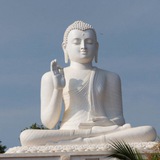
Dhammapada Verse 326
Sanusamanera Vatthu
Idam pure cittamacari carikam
yenicchakam yatthakamam yathasukham
tadajjaham niggahessami yoniso
hatthippabhinnam viya ankusaggaho.
Verse 326: In the past, this mind has wandered as it liked, wherever it liked, at its own pleasure. Now I will control my mind wisely, as a mahout with his goad controls an elephant in must.
The Story of Samanera Sanu
While residing at the Jetavana monastery, the Buddha uttered Verse (326) of this book, with reference to a young samanera named Sanu.
One day, Samanera Sanu was urged by older bhikkhus to go up on the dais and recite parts of the Pali texts. When he had finished his recitation he solemnly called out, "May the merits gained by me today for reciting these sacred texts be shared by my mother and my father". At that time, the devas and the ogress who had been the mother of the young samanera in a previous existence were listening to his recitation. When they heard his words, the ogress was elated and promptly cried out, "My dear son, how happy I am to share your merit; you have done well, my son. Well done! Well done! (Sadhu! Sadhu!)." On account of Samanera Sanu, the mother ogress came to be very much respected and was given precedence in their assemblies by the devas and other ogres.
As the samanera grew older, he wanted to return to the life of a lay man; he went home and asked for his clothes from his mother. His mother did not want him to leave the Order and tried to dissuade him from leaving it, but he was quite firm in his decision. So, his mother promised to give him the clothes after his meal. As his mother was busy cooking his meal, the ogress, who was his mother of a past existence, thought, "If my son Sanu leaves the Order, I shall be put to shame and become a laughing stock among other ogres and devas; I must try and stop him leaving the Order." So, the young samanera was possessed by her; the boy rolled on the floor, muttering in coherently with saliva streaming out of his mouth. The mother got alarmed; neighbours came and tried to appease the spirits. Then, the ogress spoke out "This samanera wants to leave the religious Order and return to the life of a lay man; if he does so he will not be able to escape from dukkha." After saying those words, the ogress left the body of the boy and the boy became normal again.
Finding his mother in tears and the neighbours crowding around him, he asked what had happened. His mother told him everything that had happened to him and also explained to him that to return to lay life after leaving it was very foolish; in fact, even though living he would be like a dead person. The samanera then came to realize his mistake. Taking the three robes from his mother, he went back to the monastery and was soon admitted as a bhikkhu.
When told about Samanera Sanu, the Buddha wishing to teach him about the restraint of mind said, "My son, one who does not restrain the mind which wanders about cannot find happiness. So, control your mind as a mahout controls an elephant."
Then the Buddha spoke in verse as follows:
Verse 326: In the past, this mind has wandered as it liked, wherever it liked, at its own pleasure. Now I will control my mind wisely, as a mahout with his goad controls an elephant in must.
At the end of the discourse Thera Sanu comprehended the Four Noble Truths and later attained arahatship.
===
Words of the Buddha channel:
https://invite.viber.com/?g2=AQAFqzqlj7FmI061PX17rxWMAtZ%2BRuso%2FH2KmHKZSgnv7v9DD8X0bDkKnZDr9JDq
===
Sanusamanera Vatthu
Idam pure cittamacari carikam
yenicchakam yatthakamam yathasukham
tadajjaham niggahessami yoniso
hatthippabhinnam viya ankusaggaho.
Verse 326: In the past, this mind has wandered as it liked, wherever it liked, at its own pleasure. Now I will control my mind wisely, as a mahout with his goad controls an elephant in must.
The Story of Samanera Sanu
While residing at the Jetavana monastery, the Buddha uttered Verse (326) of this book, with reference to a young samanera named Sanu.
One day, Samanera Sanu was urged by older bhikkhus to go up on the dais and recite parts of the Pali texts. When he had finished his recitation he solemnly called out, "May the merits gained by me today for reciting these sacred texts be shared by my mother and my father". At that time, the devas and the ogress who had been the mother of the young samanera in a previous existence were listening to his recitation. When they heard his words, the ogress was elated and promptly cried out, "My dear son, how happy I am to share your merit; you have done well, my son. Well done! Well done! (Sadhu! Sadhu!)." On account of Samanera Sanu, the mother ogress came to be very much respected and was given precedence in their assemblies by the devas and other ogres.
As the samanera grew older, he wanted to return to the life of a lay man; he went home and asked for his clothes from his mother. His mother did not want him to leave the Order and tried to dissuade him from leaving it, but he was quite firm in his decision. So, his mother promised to give him the clothes after his meal. As his mother was busy cooking his meal, the ogress, who was his mother of a past existence, thought, "If my son Sanu leaves the Order, I shall be put to shame and become a laughing stock among other ogres and devas; I must try and stop him leaving the Order." So, the young samanera was possessed by her; the boy rolled on the floor, muttering in coherently with saliva streaming out of his mouth. The mother got alarmed; neighbours came and tried to appease the spirits. Then, the ogress spoke out "This samanera wants to leave the religious Order and return to the life of a lay man; if he does so he will not be able to escape from dukkha." After saying those words, the ogress left the body of the boy and the boy became normal again.
Finding his mother in tears and the neighbours crowding around him, he asked what had happened. His mother told him everything that had happened to him and also explained to him that to return to lay life after leaving it was very foolish; in fact, even though living he would be like a dead person. The samanera then came to realize his mistake. Taking the three robes from his mother, he went back to the monastery and was soon admitted as a bhikkhu.
When told about Samanera Sanu, the Buddha wishing to teach him about the restraint of mind said, "My son, one who does not restrain the mind which wanders about cannot find happiness. So, control your mind as a mahout controls an elephant."
Then the Buddha spoke in verse as follows:
Verse 326: In the past, this mind has wandered as it liked, wherever it liked, at its own pleasure. Now I will control my mind wisely, as a mahout with his goad controls an elephant in must.
At the end of the discourse Thera Sanu comprehended the Four Noble Truths and later attained arahatship.
===
Words of the Buddha channel:
https://invite.viber.com/?g2=AQAFqzqlj7FmI061PX17rxWMAtZ%2BRuso%2FH2KmHKZSgnv7v9DD8X0bDkKnZDr9JDq
===
Viber
Words Of The Buddha
Daily teachings from Buddha Dharma
👍1🤗1
Forwarded from Words of the Buddha
Ruwanweli Maha Seya, swarnamali maha seya, Anuradhapura, Sri Lanka. This Stupa keeps the largest collection of Gautama Buddha relics in the world. This Sinhalese architecture is one of tallest ancient holy places in the world.
❤1👍1🙏1👌1🏆1😎1
Arhat Sivali, the Arahant of wealth and prosperity
17. Rakkhantā sīla tejena
Dhanavanto yasassino
Evaṃ tejānu-bhāvena
Sadā rakkhatu Sīvali
Through the power of his moral strength and great merit of generosity, may Arahant Sīvali
who is affluent and glorious, protect us always.
18. Kappaṭṭhāyiti Buddhassa
Bodhimūle nisīdiya
Mārasenappamaddanto
Sadā rakkhatu Sīvali
This way the Buddha, seated at the foot of the Bodhi Tree, vanquished death (Mara) will
remain for an aeon. May Arahant Sīvali protect us.
Sivali paritta
17. Rakkhantā sīla tejena
Dhanavanto yasassino
Evaṃ tejānu-bhāvena
Sadā rakkhatu Sīvali
Through the power of his moral strength and great merit of generosity, may Arahant Sīvali
who is affluent and glorious, protect us always.
18. Kappaṭṭhāyiti Buddhassa
Bodhimūle nisīdiya
Mārasenappamaddanto
Sadā rakkhatu Sīvali
This way the Buddha, seated at the foot of the Bodhi Tree, vanquished death (Mara) will
remain for an aeon. May Arahant Sīvali protect us.
Sivali paritta
❤1👌1🏆1🦄1
Forwarded from Words of the Buddha
So pay heed, all you celestial beings, have love for humankind, who day and night bring offerings; please protect them diligently.
Tasmā hi bhūtā nisāmetha sabbe
Mettam karotha mānusiyā pajāya
Divā ca ratto ca haranti ye balim
Tasmā hi ne rakkhatha appamattā
Ratana Sutta verse 2
Balinese offerings for the divine, Indonesia.
Tasmā hi bhūtā nisāmetha sabbe
Mettam karotha mānusiyā pajāya
Divā ca ratto ca haranti ye balim
Tasmā hi ne rakkhatha appamattā
Ratana Sutta verse 2
Balinese offerings for the divine, Indonesia.
👏1🤗1😘1
Dhammapada Verse 327
Paveyyakahatthi Vatthu
Appamadarata hotha
sacittamanurakkhatha
dugga uddharath' attanam
panke sannova kunjaro.
Verse 327: Take delight in mindfulness, guard your mind well. As an elephant stuck in mire pulls itself out, so also, pull yourself out of the mire of moral defilements.
The Story of the Elephant Called Paveyyaka
While residing at the Jetavana monastery, the Buddha uttered Verse (327) of this book, with reference to the elephant, called Paveyyaka.
Paveyyaka when young was very strong; in due course, he became old and decrepit. One day, as old Paveyyaka went into a pond he was stuck in the mire and could not get on to the shore. When King Pasenadi of Kosala was told about it, he sent an elephant trainer to help the elephant get out of the mire. The elephant trainer went to the site where the elephant was. There, he made the musicians strike up a martial tune. Hearing the military airs, the elephant felt as if he were in a battlefield; his spirits rose, he pulled himself with all his might, and was soon out of the mire.
When the bhikkhus told the Buddha about this he said, "Bhikkhus! Just as that elephant pulled itself out of the mire, so also, must you all pull yourselves out of the mire of moral defilements."
Then the Buddha spoke in verse as follows:
Verse 327: Take delight in mindfulness, guard your mind well. As an elephant stuck in mire pulls itself out, so also, pull yourself out of the mire of moral defilements.
At the end of the discourse the bhikkhus attained arahatship.
===
Dhammapada, beloved and favorite teachings of the Buddha channel:
https://invite.viber.com/?g2=AQBLD6phsgvP%2F061YjEM3K%2BNeH1Yb372b9mtfQX2EmuBpgoLUoc99BDMfzHghrme
===
Paveyyakahatthi Vatthu
Appamadarata hotha
sacittamanurakkhatha
dugga uddharath' attanam
panke sannova kunjaro.
Verse 327: Take delight in mindfulness, guard your mind well. As an elephant stuck in mire pulls itself out, so also, pull yourself out of the mire of moral defilements.
The Story of the Elephant Called Paveyyaka
While residing at the Jetavana monastery, the Buddha uttered Verse (327) of this book, with reference to the elephant, called Paveyyaka.
Paveyyaka when young was very strong; in due course, he became old and decrepit. One day, as old Paveyyaka went into a pond he was stuck in the mire and could not get on to the shore. When King Pasenadi of Kosala was told about it, he sent an elephant trainer to help the elephant get out of the mire. The elephant trainer went to the site where the elephant was. There, he made the musicians strike up a martial tune. Hearing the military airs, the elephant felt as if he were in a battlefield; his spirits rose, he pulled himself with all his might, and was soon out of the mire.
When the bhikkhus told the Buddha about this he said, "Bhikkhus! Just as that elephant pulled itself out of the mire, so also, must you all pull yourselves out of the mire of moral defilements."
Then the Buddha spoke in verse as follows:
Verse 327: Take delight in mindfulness, guard your mind well. As an elephant stuck in mire pulls itself out, so also, pull yourself out of the mire of moral defilements.
At the end of the discourse the bhikkhus attained arahatship.
===
Dhammapada, beloved and favorite teachings of the Buddha channel:
https://invite.viber.com/?g2=AQBLD6phsgvP%2F061YjEM3K%2BNeH1Yb372b9mtfQX2EmuBpgoLUoc99BDMfzHghrme
===
Viber
Dhammapada - Buddha Dharma Teachings
Daily teachings of the Dhammapada, beloved and favorite teachings of the Buddha
❤1💯1
Forwarded from Buddha Dharma books
Free Buddha Dharma ebook
Ideal Solitude: An Exposition on the Bhaddekaratta Sutta
By Bhikkhu Ñanananda
Bhaddekaratta Sutta of the Majjhima Nikåya (No. 131) consists of a “summary” (uddesa) in four verses and an “exposition” (vibhaga) dealing with some doctrinal points of considerable psychological and ethical import. The theme set out by the Buddha in this discourse recurs in three others — Ananda- bhaddekaratta Sutta, Mahåkaccåna-bhaddekaratta Sutta, and Lomasakagiya-bhaddekaratta Sutta — in which the disciples of these names figure prominently.
These four consecutive suttas (Nos. 131-34) are thus made conspicuous among the discourses of the Majjhima Nikåya and one can well infer that this bespeaks of the importance attached to their theme. That the theme was highly esteemed is clearly revealed by the framework of the two suttas, Mahåkaccåna-bhaddekaratta and Lomasakagiya-bhaddekaratta. In both, one finds a deity appearing before a monk and recommending to him the learning of the summary and exposition of the Bhaddekaratta, as follows:
Monk, you learn the summary and exposition of the Bhaddekaratta. Monk, you master the summary and exposition of the Bhaddekaratta. Monk, you bear in mind the summary and exposition of the Bhaddekaratta. Monk, the summary and exposition of the Bhaddekaratta is beneficial; it pertains to the elements of the Holy Life.
Free download available:
https://www.accesstoinsight.org/lib/authors/nanananda/wheel188.pdf
===
Ideal Solitude: An Exposition on the Bhaddekaratta Sutta
By Bhikkhu Ñanananda
Bhaddekaratta Sutta of the Majjhima Nikåya (No. 131) consists of a “summary” (uddesa) in four verses and an “exposition” (vibhaga) dealing with some doctrinal points of considerable psychological and ethical import. The theme set out by the Buddha in this discourse recurs in three others — Ananda- bhaddekaratta Sutta, Mahåkaccåna-bhaddekaratta Sutta, and Lomasakagiya-bhaddekaratta Sutta — in which the disciples of these names figure prominently.
These four consecutive suttas (Nos. 131-34) are thus made conspicuous among the discourses of the Majjhima Nikåya and one can well infer that this bespeaks of the importance attached to their theme. That the theme was highly esteemed is clearly revealed by the framework of the two suttas, Mahåkaccåna-bhaddekaratta and Lomasakagiya-bhaddekaratta. In both, one finds a deity appearing before a monk and recommending to him the learning of the summary and exposition of the Bhaddekaratta, as follows:
Monk, you learn the summary and exposition of the Bhaddekaratta. Monk, you master the summary and exposition of the Bhaddekaratta. Monk, you bear in mind the summary and exposition of the Bhaddekaratta. Monk, the summary and exposition of the Bhaddekaratta is beneficial; it pertains to the elements of the Holy Life.
Free download available:
https://www.accesstoinsight.org/lib/authors/nanananda/wheel188.pdf
===
👍1🥰1💯1
The Best Remedy
The Venerable Sayadaw U Pandita’s last advice for attaining peace in our inner and outer worlds
By Alan Clements
Part 1 of 3
Regarded as one of the world’s most eminent meditation masters and Theravada Buddhist scholars, the Venerable Sayadaw U Pandita of Burma (now Myanmar) passed away on April 16, 2016, at the age of 94. Successor to Mahasi Sayadaw and spiritual adviser to Burma’s Nobel Peace Prize laureate and State Counsellor, Aung San Suu Kyi, Sayadaw U Pandita entered monastic life at the age of 12. Through decades of experience in the theory and practice of meditation, he cultivated in others the motivation to know and experience the taste of the dhamma, which he viewed as many times better than all the other tastes of the world. With this goal in mind, he established meditation centers throughout the world, working tirelessly to share the Buddha’s teachings in accordance with the instructions of Mahasi Sayadaw (1904–1982), encompassing both noscripture and practice so that neither would be omitted. He lived as head teacher for eight years at the Mahasi Meditation Centre in Yangon, where the worldwide mass lay insight meditation movement began in 1947, until 1990, when he founded the meditation and study monastery Panditarama Shwe Taung Gon Sasana Yeiktha, also in Yangon.
In the months before his death, Sayadawgyi (as he was known in his latter years; the suffix -gyi means “great”) granted me a special invitation to discuss the “dhamma of reconciliation.” Over eight successive nights in February 2016, Sayadawgyi shared the wisdom that forms “Dhamma Advice to a Nation,” his final message to those seeking to heal from decades of brutal totalitarian rule in Burma. The following interview is a short excerpt from that material. While his is perhaps the most renowned and respected voice, U Pandita was but one of many of Burma’s “voices of freedom”—the courageous individuals who have fought tirelessly for human rights and democracy against the tyranny of one of history’s most vicious military regimes, often at risk of imprisonment, sometimes at the cost of their lives. And while the realities of our inhumanity to one another still threaten to drag us into realms alien and incomprehensible, the message of these voices, of freedom through reconciliation, comes from the front lines of a familiar and collective struggle for justice, dignity, and triumph over oppression in all its forms.
–Alan Clements
The following interview will appear in the forthcoming book “Aung San Suu Kyi and Burma’s Voices of Freedom in Conversation with Alan Clements” and its accompanying film highlighting those at the heart of Burma’s 28-year nonviolent revolution of the spirit.
It is common to react to violation with hurt, anger, outrage, and at times revenge. As we know, many millions of people in your country have been oppressed for over 50 years by a succession of dictatorships. What advice can you offer those who harbor feelings of hostility and retribution? How can one overcome those feelings and refrain from acting on them? Forbearance is the best. In this country we say, “Khanti [forbearance] is the highest austerity.” In the human world we are certain to encounter things we do not like. If every time one encounters difficulty there is no forbearance and one retaliates, there will be no end to human problems. There will only be quarrels.
To be patient and forbear fully, there must be the ability to reason, to think logically. Without forbearance, a fight occurs, both sides get hurt, and there’s no relief. Many wrongs are done. When one can forbear, the quarrel quiets.
In this, one needs to add metta—the desire for another’s welfare. When the desire for the welfare of others becomes strong, one can be patient and forbearing. When harmed, one can forgive, one can give up one’s own benefit and make sacrifices.
The Venerable Sayadaw U Pandita’s last advice for attaining peace in our inner and outer worlds
By Alan Clements
Part 1 of 3
Regarded as one of the world’s most eminent meditation masters and Theravada Buddhist scholars, the Venerable Sayadaw U Pandita of Burma (now Myanmar) passed away on April 16, 2016, at the age of 94. Successor to Mahasi Sayadaw and spiritual adviser to Burma’s Nobel Peace Prize laureate and State Counsellor, Aung San Suu Kyi, Sayadaw U Pandita entered monastic life at the age of 12. Through decades of experience in the theory and practice of meditation, he cultivated in others the motivation to know and experience the taste of the dhamma, which he viewed as many times better than all the other tastes of the world. With this goal in mind, he established meditation centers throughout the world, working tirelessly to share the Buddha’s teachings in accordance with the instructions of Mahasi Sayadaw (1904–1982), encompassing both noscripture and practice so that neither would be omitted. He lived as head teacher for eight years at the Mahasi Meditation Centre in Yangon, where the worldwide mass lay insight meditation movement began in 1947, until 1990, when he founded the meditation and study monastery Panditarama Shwe Taung Gon Sasana Yeiktha, also in Yangon.
In the months before his death, Sayadawgyi (as he was known in his latter years; the suffix -gyi means “great”) granted me a special invitation to discuss the “dhamma of reconciliation.” Over eight successive nights in February 2016, Sayadawgyi shared the wisdom that forms “Dhamma Advice to a Nation,” his final message to those seeking to heal from decades of brutal totalitarian rule in Burma. The following interview is a short excerpt from that material. While his is perhaps the most renowned and respected voice, U Pandita was but one of many of Burma’s “voices of freedom”—the courageous individuals who have fought tirelessly for human rights and democracy against the tyranny of one of history’s most vicious military regimes, often at risk of imprisonment, sometimes at the cost of their lives. And while the realities of our inhumanity to one another still threaten to drag us into realms alien and incomprehensible, the message of these voices, of freedom through reconciliation, comes from the front lines of a familiar and collective struggle for justice, dignity, and triumph over oppression in all its forms.
–Alan Clements
The following interview will appear in the forthcoming book “Aung San Suu Kyi and Burma’s Voices of Freedom in Conversation with Alan Clements” and its accompanying film highlighting those at the heart of Burma’s 28-year nonviolent revolution of the spirit.
It is common to react to violation with hurt, anger, outrage, and at times revenge. As we know, many millions of people in your country have been oppressed for over 50 years by a succession of dictatorships. What advice can you offer those who harbor feelings of hostility and retribution? How can one overcome those feelings and refrain from acting on them? Forbearance is the best. In this country we say, “Khanti [forbearance] is the highest austerity.” In the human world we are certain to encounter things we do not like. If every time one encounters difficulty there is no forbearance and one retaliates, there will be no end to human problems. There will only be quarrels.
To be patient and forbear fully, there must be the ability to reason, to think logically. Without forbearance, a fight occurs, both sides get hurt, and there’s no relief. Many wrongs are done. When one can forbear, the quarrel quiets.
In this, one needs to add metta—the desire for another’s welfare. When the desire for the welfare of others becomes strong, one can be patient and forbearing. When harmed, one can forgive, one can give up one’s own benefit and make sacrifices.
Telegram
Dhammapada - Buddha Dharma Teachings
Daily teachings of the Dhammapada, beloved and favorite teachings of the Buddha
👏1🆒1
So to end the cycle of conflict, first neutralize one’s reaction? There are two kinds of enemies, or danger: the danger of akusala and the danger in the form of a person. Akusala are the unwholesome deeds that occur when lobha [desire, selfishness], dosa [anger, cruelty, hatred], and moha [delusion, stupidity] are extreme. These are called the internal enemy. They are also called the nearest danger because they are inside one’s own mind. Danger in the form of a person is an external enemy, a person who is hostile to us. The Buddha practiced to gradually weaken the internal enemies until they disappeared.
What is the basis, the spiritual or moral motivation, to refrain from committing unwholesome deeds, akusala? One should be as disgusted by akusala as one would shrink from picking up a red-hot coal. With a healthy disgust and fear, understanding that participating in unwholesome deeds brings trouble, one can refrain from wrongdoing.
Further, there should be consideration for others. One should spare others because one understands how they would feel if harmed. That is important. Hiri and ottapa [moral shame and moral fear] and consideration for others are the qualities that motivate one to refrain from performing unwholsome deeds.
Hiri and ottappa are also called the deva dhammas. Deva dhammas means dhammas [mental qualities] that make virtues brilliant. When one lacks these, one’s human virtues fade. The quality of behaving like a human being, being able to keep one’s mentality humane, having human intelligence, being able to develop special human knowledge—without moral shame and moral fear, all these human virtues fade. When one has these qualities, one’s virtues become bright. They are the dhammas that make human virtues shine. They are also called the lokapala dhammas. Lokapala means “the guardians of the world.” They preserve the world, keep it from being destroyed. What’s important here is one’s own individual world as well as the world around one. To the extent that these qualities are strong, one’s own world is secure, and equally, one no longer harms the surrounding world.
===
Part 1 of 3:
https://news.1rj.ru/str/dhammapadas/2069
Part 2 of 3:
https://news.1rj.ru/str/wordsofbuddha/3026
Part 3 of 3:
https://news.1rj.ru/str/ajahnchah_buddhism/893
===
Dhammapada, beloved and favorite teachings of the Buddha channel:
https://news.1rj.ru/str/dhammapadas
===
What is the basis, the spiritual or moral motivation, to refrain from committing unwholesome deeds, akusala? One should be as disgusted by akusala as one would shrink from picking up a red-hot coal. With a healthy disgust and fear, understanding that participating in unwholesome deeds brings trouble, one can refrain from wrongdoing.
Further, there should be consideration for others. One should spare others because one understands how they would feel if harmed. That is important. Hiri and ottapa [moral shame and moral fear] and consideration for others are the qualities that motivate one to refrain from performing unwholsome deeds.
Hiri and ottappa are also called the deva dhammas. Deva dhammas means dhammas [mental qualities] that make virtues brilliant. When one lacks these, one’s human virtues fade. The quality of behaving like a human being, being able to keep one’s mentality humane, having human intelligence, being able to develop special human knowledge—without moral shame and moral fear, all these human virtues fade. When one has these qualities, one’s virtues become bright. They are the dhammas that make human virtues shine. They are also called the lokapala dhammas. Lokapala means “the guardians of the world.” They preserve the world, keep it from being destroyed. What’s important here is one’s own individual world as well as the world around one. To the extent that these qualities are strong, one’s own world is secure, and equally, one no longer harms the surrounding world.
===
Part 1 of 3:
https://news.1rj.ru/str/dhammapadas/2069
Part 2 of 3:
https://news.1rj.ru/str/wordsofbuddha/3026
Part 3 of 3:
https://news.1rj.ru/str/ajahnchah_buddhism/893
===
Dhammapada, beloved and favorite teachings of the Buddha channel:
https://news.1rj.ru/str/dhammapadas
===
👌1🤗1
Forwarded from Words of the Buddha
Sanghanussati Bhavana is the recollection on the qualities of the community of Ariya sangha.
Supatipanno Bhagavato savakasangho, ²ujupatipanno Bhagavato savakasangho, ³nayapatipanno Bhagavato savakasangho, 4samicipatpanno Bhagavato savakasangho; yadidam cattari purisa yugani attha purisa puggala, esa Bhagavato savakasangho, 5ahuneyyo, 6pahuneyyo, 7dakkhineyyo, 8anjali karaniyo, 9anuttaram punnakkhettam lokassa ti.”
“ 1Well attained is the Order of the Blessed One’s disciples, 2upright is the Order of the Blessed One’s disciples, 3true is the Order of the Blessed One’s disciples,4proper is the Order of the Blessed One’s disciples. That is, the four pairs of persons, the eight individual persons, this is the Order of the Blessed One’s disciples; 5worthy of gifts, 6worthy of hospitality, 7worthy of offerings, 8worthy of salutations, 9an incomparable field of merits for the world. ”
Supatipanno Bhagavato savakasangho, ²ujupatipanno Bhagavato savakasangho, ³nayapatipanno Bhagavato savakasangho, 4samicipatpanno Bhagavato savakasangho; yadidam cattari purisa yugani attha purisa puggala, esa Bhagavato savakasangho, 5ahuneyyo, 6pahuneyyo, 7dakkhineyyo, 8anjali karaniyo, 9anuttaram punnakkhettam lokassa ti.”
“ 1Well attained is the Order of the Blessed One’s disciples, 2upright is the Order of the Blessed One’s disciples, 3true is the Order of the Blessed One’s disciples,4proper is the Order of the Blessed One’s disciples. That is, the four pairs of persons, the eight individual persons, this is the Order of the Blessed One’s disciples; 5worthy of gifts, 6worthy of hospitality, 7worthy of offerings, 8worthy of salutations, 9an incomparable field of merits for the world. ”
👌1💯1🏆1
Forwarded from Words of the Buddha
The Venerable Sayadaw U Pandita’s last advice for attaining peace in our inner and outer worlds
By Alan Clements
Part 2 of 3
We know that if there isn’t some preventive measure to cure the delusions of the old guard, the very horrors of that old order—imprisoning people, torturing them, and denying them their most basic human rights—could easily recur. And generation to generation, we’d have the same problems. In your worldview, how do these dhamma attributes of forbearance and lovingkindness intersect with accountability and justice? Don’t we need accountability and justice for reconciliation to become real? Those who have done wrong should correct it by dhamma means, just like when a monk commits a monastic offense. They should make an honest admission: “This act and that act were wrong. I ask your forgiveness.” No matter how great the fault, with this, about half [the people] will be satisfied. They will have lovingkindness [for those who confess their wrong].
A hero, a person who is courageous, has the courage to admit one’s mistakes, one’s faults. Such a person also has the courage to do things that are beneficial for society. The most effective way to create peace among the people is for the oppressors to courageously admit their faults and reconcile with the oppressed. That is the best.
One should understand: wrongs done because of selfish greed bring only bad results. On the other hand, tasks done without selfishness, with lovingkindness and compassion present, bring only good results. One should understand the nature of good and bad results. If one knows neither the bad results of lacking lovingkindness or compassion nor the good results from having lovingkindness and compassion at the forefront, there is blind stupidity. There is darkness. And with darkness, one can’t see. As long as this understanding is absent, one lacks moral shame and moral fear.
And the cycle of oppression continues? Without moral shame and moral fear, there are unwholesome actions. With moral shame and moral fear, there are pure, clean, wholesome actions. That is important.
What should one do to prevent problems from occurring in the world? There should be both control and preservation, so that one’s personal world is not destroyed and the world outside one is protected from harm. And if the number of people were to become great who kept their own individual world from being destroyed by restraining unwholesome thoughts, speech, and actions, the world would become peaceful.
Another way to foster self-restraint is to have consideration for others. When there are thoughts, speech, and actions strong enough to cause suffering, reflect: Just as I do not wish to suffer, neither do others wish to suffer. As such, one avoids doing harm. Being able to put oneself in another’s place is very important.
Because people try to conquer others instead of gaining victory over themselves, there are problems. The Buddha taught that one should simply gain victory over oneself.
Do you have hope for real change here in Burma? Resistance power is important for everyone. People work to develop physical resistance to withstand heat, cold, and fatigue. For the most part, people give priority to developing physical resistance. There’s little concern for developing mental resistance. Of course, mental powers are also important. Nothing can be substituted for them.
One has to work to develop mental powers, to put focused energy into one’s mind. When one has developed mental resistance power, one can withstand the ups and downs one encounters. There is spiritual resistance, the strength to control one’s mind. is is needed by everyone. It is weak in the world today. But with the correct method it can be developed.
There are spiritual faculties that bring self-control, self-mastery. These need to be developed in order to have spiritual resistance. They are called indriya or bala in Pali. For developing these faculties, the path of satipatthana [practicing the four foundations of mindfulness: that of the body, of feelings, of the mind, of dhammas] is best.
By Alan Clements
Part 2 of 3
We know that if there isn’t some preventive measure to cure the delusions of the old guard, the very horrors of that old order—imprisoning people, torturing them, and denying them their most basic human rights—could easily recur. And generation to generation, we’d have the same problems. In your worldview, how do these dhamma attributes of forbearance and lovingkindness intersect with accountability and justice? Don’t we need accountability and justice for reconciliation to become real? Those who have done wrong should correct it by dhamma means, just like when a monk commits a monastic offense. They should make an honest admission: “This act and that act were wrong. I ask your forgiveness.” No matter how great the fault, with this, about half [the people] will be satisfied. They will have lovingkindness [for those who confess their wrong].
A hero, a person who is courageous, has the courage to admit one’s mistakes, one’s faults. Such a person also has the courage to do things that are beneficial for society. The most effective way to create peace among the people is for the oppressors to courageously admit their faults and reconcile with the oppressed. That is the best.
One should understand: wrongs done because of selfish greed bring only bad results. On the other hand, tasks done without selfishness, with lovingkindness and compassion present, bring only good results. One should understand the nature of good and bad results. If one knows neither the bad results of lacking lovingkindness or compassion nor the good results from having lovingkindness and compassion at the forefront, there is blind stupidity. There is darkness. And with darkness, one can’t see. As long as this understanding is absent, one lacks moral shame and moral fear.
And the cycle of oppression continues? Without moral shame and moral fear, there are unwholesome actions. With moral shame and moral fear, there are pure, clean, wholesome actions. That is important.
What should one do to prevent problems from occurring in the world? There should be both control and preservation, so that one’s personal world is not destroyed and the world outside one is protected from harm. And if the number of people were to become great who kept their own individual world from being destroyed by restraining unwholesome thoughts, speech, and actions, the world would become peaceful.
Another way to foster self-restraint is to have consideration for others. When there are thoughts, speech, and actions strong enough to cause suffering, reflect: Just as I do not wish to suffer, neither do others wish to suffer. As such, one avoids doing harm. Being able to put oneself in another’s place is very important.
Because people try to conquer others instead of gaining victory over themselves, there are problems. The Buddha taught that one should simply gain victory over oneself.
Do you have hope for real change here in Burma? Resistance power is important for everyone. People work to develop physical resistance to withstand heat, cold, and fatigue. For the most part, people give priority to developing physical resistance. There’s little concern for developing mental resistance. Of course, mental powers are also important. Nothing can be substituted for them.
One has to work to develop mental powers, to put focused energy into one’s mind. When one has developed mental resistance power, one can withstand the ups and downs one encounters. There is spiritual resistance, the strength to control one’s mind. is is needed by everyone. It is weak in the world today. But with the correct method it can be developed.
There are spiritual faculties that bring self-control, self-mastery. These need to be developed in order to have spiritual resistance. They are called indriya or bala in Pali. For developing these faculties, the path of satipatthana [practicing the four foundations of mindfulness: that of the body, of feelings, of the mind, of dhammas] is best.
Telegram
Words of the Buddha
Daily teachings of Buddha Dharma
👍1🏆1
Forwarded from Words of the Buddha
One can’t do this by meditating for just a short time. Only if one meditates meticulously, with real desire, can one can gain these spiritual faculties.
These faculties can be called spiritual multivitamins, like the multivitamins we take for physical health. When one develops the mind with satipatthana meditation, this is like taking spiritual multivitamins. If half the world would possess these spiritual faculties in themselves, the world would become peaceful.
You are aware that terrorism is an increasing problem all over the world. In my country of America, and in pretty much any Western and Asian country for that matter, there’s a deep and increasing fear of terrorism, whatever its ideological basis may be. My question: What advice might you offer to defeat radical extremism, which, I might add, in most cases considers success not only in the death of those whom they attack but in their own death as well? If you can’t overcome the internal enemies, they not only give you trouble but give others trouble too. And in future lives they also give you trouble. An ordinary, external enemy can’t debase you. If he or she kills you, it’s only in one lifetime. The internal enemies kill a being lifetime after lifetime. They also degrade one. They are quite frightening.
Few people know that you are Daw Aung San Suu Kyi’s dhamma teacher. She looks to you for spiritual advice and guidance. I would like to follow up with the issue of national reconciliation, the centerpiece of Daw Aung San Suu Kyi and her new government’s vision of a peaceful and prosperous Burma. What is the dhamma of reconciliation? Human beings should have the courage to avoid doing what is wrong and the courage to do and to say what is beneficial. If one does something wrong, whether deliberately or out of carelessness, one needs to have the courage to admit one’s mistake.
The Pali word viriya means exactly this: the courage to avoid doing things that are wrong, the courage to do what is right, and if one errs, the courage to admit it. When taking such a moral risk, one must bear the suffering encountered. Such courage must be nurtured. It does not come quickly. You must develop it gradually.
In the realm of dhamma, whether one is a monk, a nun, or a layperson, there are rules and responsibilities. It won’t do to learn these duties and responsibilities only when one becomes an adult. They need to be learned from a young age. Just as one must try to make one’s IQ good, at the same time one must also try to make one’s SQ [spiritual intelligence] good. It won’t do to make SQ good only after one’s IQ has become good. It’s just like feeding a child. You must first nurse the baby and then all along the way, gradually, feed the child appropriately, taking into account the child’s age, size, growth, and, of course, both the quantity and quality of the food. Good health has many considerations; but first and foremost you must feed the child appropriately, starting from a young age.
===
Words of the Buddha channel:
https://news.1rj.ru/str/wordsofbuddha
===
These faculties can be called spiritual multivitamins, like the multivitamins we take for physical health. When one develops the mind with satipatthana meditation, this is like taking spiritual multivitamins. If half the world would possess these spiritual faculties in themselves, the world would become peaceful.
You are aware that terrorism is an increasing problem all over the world. In my country of America, and in pretty much any Western and Asian country for that matter, there’s a deep and increasing fear of terrorism, whatever its ideological basis may be. My question: What advice might you offer to defeat radical extremism, which, I might add, in most cases considers success not only in the death of those whom they attack but in their own death as well? If you can’t overcome the internal enemies, they not only give you trouble but give others trouble too. And in future lives they also give you trouble. An ordinary, external enemy can’t debase you. If he or she kills you, it’s only in one lifetime. The internal enemies kill a being lifetime after lifetime. They also degrade one. They are quite frightening.
Few people know that you are Daw Aung San Suu Kyi’s dhamma teacher. She looks to you for spiritual advice and guidance. I would like to follow up with the issue of national reconciliation, the centerpiece of Daw Aung San Suu Kyi and her new government’s vision of a peaceful and prosperous Burma. What is the dhamma of reconciliation? Human beings should have the courage to avoid doing what is wrong and the courage to do and to say what is beneficial. If one does something wrong, whether deliberately or out of carelessness, one needs to have the courage to admit one’s mistake.
The Pali word viriya means exactly this: the courage to avoid doing things that are wrong, the courage to do what is right, and if one errs, the courage to admit it. When taking such a moral risk, one must bear the suffering encountered. Such courage must be nurtured. It does not come quickly. You must develop it gradually.
In the realm of dhamma, whether one is a monk, a nun, or a layperson, there are rules and responsibilities. It won’t do to learn these duties and responsibilities only when one becomes an adult. They need to be learned from a young age. Just as one must try to make one’s IQ good, at the same time one must also try to make one’s SQ [spiritual intelligence] good. It won’t do to make SQ good only after one’s IQ has become good. It’s just like feeding a child. You must first nurse the baby and then all along the way, gradually, feed the child appropriately, taking into account the child’s age, size, growth, and, of course, both the quantity and quality of the food. Good health has many considerations; but first and foremost you must feed the child appropriately, starting from a young age.
===
Words of the Buddha channel:
https://news.1rj.ru/str/wordsofbuddha
===
Telegram
Words of the Buddha
Daily teachings of Buddha Dharma
❤2👏1
Dhammapada Verses 328, 329 and 330
Sambahulabhikkhu Vatthu
Sace labhetha nipakam sahayam
saddhim caram sadhu vihari dhiram
abhibhuyya sabbani parissayani
careyya tena' ttamano satima.
No ce labhetha nipakam sahayam
saddhim caram sadhu vihari dhiram
rajava rattham vijitam pahaya
eko care matanga' ranneva nago.
Ekassa caritam seyyo
natthi bale sahayata
eko care na ca papani kayira
appossukko matanga' ranneva nago.
Verse 328: If one finds a sagacious friend, who is a virtuous and steadfast companion, one should live with him joyfully and mindfully, overcoming all dangers.
Verse 329: If one cannot find a sagacious friend, who is a virtuous and steadfast companion, one should live alone like the king who gave up and left the country he had won, and like the elephant Matanga roaming alone in the forest.
Verse 330: It is better to live alone; there is no fellowship with a fool. So one should live alone, do no evil, and be carefree like the elephant Matanga roaming alone in the forest.
The Story of a Number of Bhikkhus
While residing in the Palileyya forest where the elephant Palileyyaka waited on him, the Buddha uttered Verses (328), (329) and (330) of this book, with reference to the bhikkhus from Kosambi.
Once, the bhikkhus of Kosambi split into two groups; one group followed the master of Vinaya and the other followed the teacher of the Dhamma. They did not listen even to the Buddha who exhorted them to make peace. So, the Buddha left them and spent the vassa all alone in the forest, where the elephant Palileyyaka waited on him.
At the end of the vassa, the Venerable Ananda went into the forest, accompanied by five hundred bhikkhus. Leaving the bhikkhus at some distance, the Venerable Ananda approached the Buddha alone. Then the Buddha told Ananda to call the other bhikkhus. All of them came, paid obeisance to the Buddha and said, "Venerable Sir! You must have had a hard time spending the vassa all alone in this forest."
To this, the Buddha replied,"Bhikkhus, do not say so; the elephant Palileyyaka had been looking after me all this time. He was, indeed, a very good friend, a true friend. If one has such a good friend one should stick to him; but if one cannot find a good friend it is better to stay alone."
Then the Buddha spoke in verse as follows:
Verse 328: If one finds a sagacious friend, who is a virtuous and steadfast companion, one should live with him joyfully and mindfully, overcoming all dangers.
Verse 329: If one cannot find a sagacious friend, who is a virtuous and steadfast companion, one should live alone like the king who gave up and left the country he had won, and like the elephant Matanga roaming alone in the forest.
Verse 330: It is better to live alone; there is no fellowship with a fool. So one should live alone, do no evil, and be carefree like the elephant Matanga roaming alone in the forest.
===
Ajahn Chah, Buddhist teacher of Thai forest meditation of Theravada Buddhism channel:
https://news.1rj.ru/str/ajahnchah_buddhism
===
Sambahulabhikkhu Vatthu
Sace labhetha nipakam sahayam
saddhim caram sadhu vihari dhiram
abhibhuyya sabbani parissayani
careyya tena' ttamano satima.
No ce labhetha nipakam sahayam
saddhim caram sadhu vihari dhiram
rajava rattham vijitam pahaya
eko care matanga' ranneva nago.
Ekassa caritam seyyo
natthi bale sahayata
eko care na ca papani kayira
appossukko matanga' ranneva nago.
Verse 328: If one finds a sagacious friend, who is a virtuous and steadfast companion, one should live with him joyfully and mindfully, overcoming all dangers.
Verse 329: If one cannot find a sagacious friend, who is a virtuous and steadfast companion, one should live alone like the king who gave up and left the country he had won, and like the elephant Matanga roaming alone in the forest.
Verse 330: It is better to live alone; there is no fellowship with a fool. So one should live alone, do no evil, and be carefree like the elephant Matanga roaming alone in the forest.
The Story of a Number of Bhikkhus
While residing in the Palileyya forest where the elephant Palileyyaka waited on him, the Buddha uttered Verses (328), (329) and (330) of this book, with reference to the bhikkhus from Kosambi.
Once, the bhikkhus of Kosambi split into two groups; one group followed the master of Vinaya and the other followed the teacher of the Dhamma. They did not listen even to the Buddha who exhorted them to make peace. So, the Buddha left them and spent the vassa all alone in the forest, where the elephant Palileyyaka waited on him.
At the end of the vassa, the Venerable Ananda went into the forest, accompanied by five hundred bhikkhus. Leaving the bhikkhus at some distance, the Venerable Ananda approached the Buddha alone. Then the Buddha told Ananda to call the other bhikkhus. All of them came, paid obeisance to the Buddha and said, "Venerable Sir! You must have had a hard time spending the vassa all alone in this forest."
To this, the Buddha replied,"Bhikkhus, do not say so; the elephant Palileyyaka had been looking after me all this time. He was, indeed, a very good friend, a true friend. If one has such a good friend one should stick to him; but if one cannot find a good friend it is better to stay alone."
Then the Buddha spoke in verse as follows:
Verse 328: If one finds a sagacious friend, who is a virtuous and steadfast companion, one should live with him joyfully and mindfully, overcoming all dangers.
Verse 329: If one cannot find a sagacious friend, who is a virtuous and steadfast companion, one should live alone like the king who gave up and left the country he had won, and like the elephant Matanga roaming alone in the forest.
Verse 330: It is better to live alone; there is no fellowship with a fool. So one should live alone, do no evil, and be carefree like the elephant Matanga roaming alone in the forest.
===
Ajahn Chah, Buddhist teacher of Thai forest meditation of Theravada Buddhism channel:
https://news.1rj.ru/str/ajahnchah_buddhism
===
Telegram
Ajahn Chah - Theravada Thailand Buddhism
Collection of teachings of Venerable Ajahn Chah, a foremost meditation and Buddhist teacher from Thailand
🥰1👏1
Forwarded from Words of the Buddha
Grand Buddha at Spring Temple, Laoshan, China, the tallest Buddha statue in the world.
🙏2🏆1