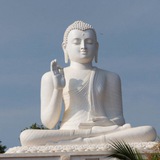
Thinking like fools, they feared no one would teach them anymore. But those who were awakened understood that the Buddha is just this dharma that he has taught us; though he passes away, his teachings are still here. So their spirits were still strong, and they did not lack for means of practice, because they understood that the Buddha does not die.
We can easily see that except for the dharma, there is nothing that will relieve the trouble and distress in the world and cool the fires of beings’ torment. Ordinary people of the world are struggling, fighting, suffering, and dying because they are not following a true spiritual path. So let’s make efforts to devote our minds and bodies to discovering virtue and spirituality, to becoming real human beings who live according to the dharma of humans. We don’t have to look at others and be critical of their lack of virtue. Even when those close to us can’t practice, we should do what we can first. Before we worry about the deficiencies of others, those of us who understand and can practice should do that straightaway.
Outside of the dharma, there isn’t anything that will bring peace and happiness to this world. Outside of dharma, there is only the struggle of winning and losing, envy and ill will. One who enters the dharma lets go of these things and spreads lovingkindness and compassion instead. Even a little bit of such dharma is of great benefit. Whenever an individual has such qualities in the heart, the Buddha’s way is flourishing.
From Everything Arises, Everything Falls Away by Ajahn Chah.
===
Ajahn Chah (1918–1992), a teacher in the Thai forest tradition, founded several monasteries, including Wat Pah Nanachat in Thailand and Cittaviveka in England.
===
Dhammapada, beloved and favorite teachings of the Buddha channel:
https://news.1rj.ru/str/dhammapadas
===
We can easily see that except for the dharma, there is nothing that will relieve the trouble and distress in the world and cool the fires of beings’ torment. Ordinary people of the world are struggling, fighting, suffering, and dying because they are not following a true spiritual path. So let’s make efforts to devote our minds and bodies to discovering virtue and spirituality, to becoming real human beings who live according to the dharma of humans. We don’t have to look at others and be critical of their lack of virtue. Even when those close to us can’t practice, we should do what we can first. Before we worry about the deficiencies of others, those of us who understand and can practice should do that straightaway.
Outside of the dharma, there isn’t anything that will bring peace and happiness to this world. Outside of dharma, there is only the struggle of winning and losing, envy and ill will. One who enters the dharma lets go of these things and spreads lovingkindness and compassion instead. Even a little bit of such dharma is of great benefit. Whenever an individual has such qualities in the heart, the Buddha’s way is flourishing.
From Everything Arises, Everything Falls Away by Ajahn Chah.
===
Ajahn Chah (1918–1992), a teacher in the Thai forest tradition, founded several monasteries, including Wat Pah Nanachat in Thailand and Cittaviveka in England.
===
Dhammapada, beloved and favorite teachings of the Buddha channel:
https://news.1rj.ru/str/dhammapadas
===
Telegram
Dhammapada - Buddha Dharma Teachings
Daily teachings of the Dhammapada, beloved and favorite teachings of the Buddha
❤1👏1🏆1
Forwarded from Words of the Buddha
Free Buddha Dharma ebook
The Intelligent Heart : Five Dhamma Talks, by Phra Ajaan Suwat Suvaco.
A collection of Dhamma talks published to commemorate Ajaan Suwat’s 100th birthday.
Free download here:
https://www.dhammatalks.org/Archive/Writings/Ebooks/TheIntelligentHeart200728.pdf
===
The Intelligent Heart : Five Dhamma Talks, by Phra Ajaan Suwat Suvaco.
A collection of Dhamma talks published to commemorate Ajaan Suwat’s 100th birthday.
Free download here:
https://www.dhammatalks.org/Archive/Writings/Ebooks/TheIntelligentHeart200728.pdf
===
❤1🥰1💯1🤝1
Dhammapada Verses 356, 357, 358 and 359
Ankura Vatthu
Tinadosani khettani
ragadosa ayam paja
tasma hi vitaragesu
dinnam hoti mahapphalam.
Tinadosani khettani
dosadosa ayam paja
tasma hi vitadosesu
dinnam hoti mahapphalam.
Tinadosani khettani
mohadosa ayam paja
tasma hi vitamohesu
dinnam hoti mahapphalam.
Tinadosani khettani
icchadosa ayam paja
tasma hi vigaticchesu
dinnam hoti mahapphalam.
Verse 356: Weeds damage fields; lust spoils all beings. Therefore, giving to those free from lust yields great benefit.
Verse 357: Weeds damage fields; ill will spoils all beings. Therefore, giving to those free from ill will yields great benefit.
Verse 358: Weeds damage fields; ignorance spoils all beings. Therefore, giving to those free from ignorance yields great benefit.
Verse 359: Weeds damage fields; covetousness spoils all beings. Therefore, giving to those free from covetousness yields great benefit.
The Story of Deva Ankura
While on a visit to the Tavatimsa deva realm, the Buddha uttered Verses (356) to (359) of this book, with reference to a deva named Ankura.
The Buddha visited the Tavatimsa deva realm to expound the Abhidhamma to Deva Santusita, who had been his mother. During that time, there was a deva named Indaka in Tavatimsa. Indaka, in his last existence as a man, had offered a little alms-food to Thera Anuruddha. As this good deed was made to a thera within the period of the Buddha's Teaching he was amply rewarded for it. Thus, on his death he was reborn in the Tavatimsa realm and was lavishly bestowed with the luxuries of the deva world. At that time, there was also another deva by the name of Ankura in Tavatimsa who had given much in charity; in fact, many times more than what Indaka had given. But his charity was made outside the period of the Teaching of any of the Buddhas. So, in spite of his lavish and grand charities, he was enjoying the benefits of the life of a deva on a much smaller scale than Indaka, who had offered very little. As the Buddha was then at Tavatimsa, Ankura asked him the reason for the discrepancy in gaining the benefits. To him the Buddha answered, "O deva! When giving charities and donations you should choose whom you give, for acts of charities are just like seeds. Seeds put into fertile soil will grow into strong, vigorous plants or trees and will bear much fruit; but you had sown your seed in poor soil, so you reap poorly."
Then the Buddha spoke in verse as follows:
Verse 356: Weeds damage fields; lust spoils all beings. Therefore, giving to those free from lust yields great benefit.
Verse 357: Weeds damage fields; ill will spoils all beings. Therefore, giving to those free from ill will yields great benefit.
Verse 358: Weeds damage fields; ignorance spoils all beings. Therefore, giving to those free from ignorance yields great benefit.
Verse 359: Weeds damage fields; covetousness spoils all beings. Therefore, giving to those free from covetousness yields great benefit.
End of Chapter Twenty-four: Craving
===
Buddha dharma teachings channel:
https://news.1rj.ru/str/lorddivinebuddha
===
Ankura Vatthu
Tinadosani khettani
ragadosa ayam paja
tasma hi vitaragesu
dinnam hoti mahapphalam.
Tinadosani khettani
dosadosa ayam paja
tasma hi vitadosesu
dinnam hoti mahapphalam.
Tinadosani khettani
mohadosa ayam paja
tasma hi vitamohesu
dinnam hoti mahapphalam.
Tinadosani khettani
icchadosa ayam paja
tasma hi vigaticchesu
dinnam hoti mahapphalam.
Verse 356: Weeds damage fields; lust spoils all beings. Therefore, giving to those free from lust yields great benefit.
Verse 357: Weeds damage fields; ill will spoils all beings. Therefore, giving to those free from ill will yields great benefit.
Verse 358: Weeds damage fields; ignorance spoils all beings. Therefore, giving to those free from ignorance yields great benefit.
Verse 359: Weeds damage fields; covetousness spoils all beings. Therefore, giving to those free from covetousness yields great benefit.
The Story of Deva Ankura
While on a visit to the Tavatimsa deva realm, the Buddha uttered Verses (356) to (359) of this book, with reference to a deva named Ankura.
The Buddha visited the Tavatimsa deva realm to expound the Abhidhamma to Deva Santusita, who had been his mother. During that time, there was a deva named Indaka in Tavatimsa. Indaka, in his last existence as a man, had offered a little alms-food to Thera Anuruddha. As this good deed was made to a thera within the period of the Buddha's Teaching he was amply rewarded for it. Thus, on his death he was reborn in the Tavatimsa realm and was lavishly bestowed with the luxuries of the deva world. At that time, there was also another deva by the name of Ankura in Tavatimsa who had given much in charity; in fact, many times more than what Indaka had given. But his charity was made outside the period of the Teaching of any of the Buddhas. So, in spite of his lavish and grand charities, he was enjoying the benefits of the life of a deva on a much smaller scale than Indaka, who had offered very little. As the Buddha was then at Tavatimsa, Ankura asked him the reason for the discrepancy in gaining the benefits. To him the Buddha answered, "O deva! When giving charities and donations you should choose whom you give, for acts of charities are just like seeds. Seeds put into fertile soil will grow into strong, vigorous plants or trees and will bear much fruit; but you had sown your seed in poor soil, so you reap poorly."
Then the Buddha spoke in verse as follows:
Verse 356: Weeds damage fields; lust spoils all beings. Therefore, giving to those free from lust yields great benefit.
Verse 357: Weeds damage fields; ill will spoils all beings. Therefore, giving to those free from ill will yields great benefit.
Verse 358: Weeds damage fields; ignorance spoils all beings. Therefore, giving to those free from ignorance yields great benefit.
Verse 359: Weeds damage fields; covetousness spoils all beings. Therefore, giving to those free from covetousness yields great benefit.
End of Chapter Twenty-four: Craving
===
Buddha dharma teachings channel:
https://news.1rj.ru/str/lorddivinebuddha
===
Telegram
Buddha
Buddha dharma teachings from the suttas and commentaries
❤1👍1🏆1
Forwarded from Words of the Buddha
Ta Prohm Rajavihara Buddhist temple, Siem Reap, Cambodia built in Bayon style in 12th century by the Khmer King Jayavarman VII.
❤2👍1👏1🤩1💯1
Dhammapada Verses 360 and 361
Pancabhikkhu Vatthu
Cakkhuna samvaro sadhu
sadhu sotena samvaro
ghanena samvaro sadhu
sadhu jivhaya sarmvaro.
Kayena samvaro sadhu
sadhu vacaya samvaro
manasa samvaro sadhu
sadhu sabbattha samvaro
sabattha sambuto bhikkhu
sabbadukkha pamuccati.
Verse 360: Restraint in the eye is good, good is restraint in the ear; restraint in the nose is good, good is restraint in the tongue.
Verse 361: Restraint in body is good, good is restraint in speech; restraint in mind is good, good is restraint in all the senses. A bhikkhu restrained in all the senses is freed from all ills (Samsara dukkha).
The Story of Five Bhikkhus
While residing at the Jetavana monastery, the Buddha uttered Verses (360) and (361) of this book, with reference to five bhikkhus.
Once there were five bhikkhus in Savatthi. Each of them practised restraint of just one out of the five senses and each of them claimed that what he was practising was the most difficult. There were some heated arguments over this and they could not come to an agreement. Finally, they went to the Buddha to ask for his decision. The Buddha said to them, "Each of the senses is just as difficult to control as the other; but all bhikkhus must control all the five senses and not just one. Only those who control all the senses would escape from the round of rebirths."
Then the Buddha spoke in verse as follows:
Verse 360: Restraint in the eye is good, good is restraint in the ear; restraint in the nose is good, good is restraint in the tongue.
Verse 361: Restraint in body is good, good is restraint in speech; restraint in mind is good, good is restraint in all the senses. A bhikkhu restrained in all the senses is freed from all ills (Samsara dukkha).
===
Vajrayana Tantrayana Buddhism channel:
https://news.1rj.ru/str/tantrayanabuddhism
Tibetan Buddhism - Vajrayana, Tantrayana and esoteric Buddhism channel:
https://news.1rj.ru/str/tibetanbuddha
===
Pancabhikkhu Vatthu
Cakkhuna samvaro sadhu
sadhu sotena samvaro
ghanena samvaro sadhu
sadhu jivhaya sarmvaro.
Kayena samvaro sadhu
sadhu vacaya samvaro
manasa samvaro sadhu
sadhu sabbattha samvaro
sabattha sambuto bhikkhu
sabbadukkha pamuccati.
Verse 360: Restraint in the eye is good, good is restraint in the ear; restraint in the nose is good, good is restraint in the tongue.
Verse 361: Restraint in body is good, good is restraint in speech; restraint in mind is good, good is restraint in all the senses. A bhikkhu restrained in all the senses is freed from all ills (Samsara dukkha).
The Story of Five Bhikkhus
While residing at the Jetavana monastery, the Buddha uttered Verses (360) and (361) of this book, with reference to five bhikkhus.
Once there were five bhikkhus in Savatthi. Each of them practised restraint of just one out of the five senses and each of them claimed that what he was practising was the most difficult. There were some heated arguments over this and they could not come to an agreement. Finally, they went to the Buddha to ask for his decision. The Buddha said to them, "Each of the senses is just as difficult to control as the other; but all bhikkhus must control all the five senses and not just one. Only those who control all the senses would escape from the round of rebirths."
Then the Buddha spoke in verse as follows:
Verse 360: Restraint in the eye is good, good is restraint in the ear; restraint in the nose is good, good is restraint in the tongue.
Verse 361: Restraint in body is good, good is restraint in speech; restraint in mind is good, good is restraint in all the senses. A bhikkhu restrained in all the senses is freed from all ills (Samsara dukkha).
===
Vajrayana Tantrayana Buddhism channel:
https://news.1rj.ru/str/tantrayanabuddhism
Tibetan Buddhism - Vajrayana, Tantrayana and esoteric Buddhism channel:
https://news.1rj.ru/str/tibetanbuddha
===
Telegram
Vajrayana Tantrayana Buddhism
Buddha teachings from the Vajrayana, esoteric, secret or Tantrayana vehicle
❤1🙏1👌1
Forwarded from Buddha
Free Buddha Dharma ebook
Practicing the Dhamma with View to Nibbana
By Radhika Abeysekera
Practising Dhamma with a View to Nibbana is written by Radhika Abeysekera. Radhika Abeysekera began teaching and writing about the Dhamma to aid in the reintroduction of Buddhism to non-Buddhist immigrants. The books are constructed in such a way that they can be used to teach Buddhism to a kid by a parent or educator.
Mrs. Abeysekera believes that parents should first study and practice the Dhamma to the best of their ability in order to reap the greatest advantages because you cannot give to your kid what you do not have. The books were also created to promote non-Buddhists’ comprehension of the Dhamma so that peace and harmony might be achieved by understanding and respect for other people’s ideologies and faiths.
Free download available:
https://static.sariputta.com/pdf/tipitaka/745/dhamma-nibbanapdf.pdf
===
Practicing the Dhamma with View to Nibbana
By Radhika Abeysekera
Practising Dhamma with a View to Nibbana is written by Radhika Abeysekera. Radhika Abeysekera began teaching and writing about the Dhamma to aid in the reintroduction of Buddhism to non-Buddhist immigrants. The books are constructed in such a way that they can be used to teach Buddhism to a kid by a parent or educator.
Mrs. Abeysekera believes that parents should first study and practice the Dhamma to the best of their ability in order to reap the greatest advantages because you cannot give to your kid what you do not have. The books were also created to promote non-Buddhists’ comprehension of the Dhamma so that peace and harmony might be achieved by understanding and respect for other people’s ideologies and faiths.
Free download available:
https://static.sariputta.com/pdf/tipitaka/745/dhamma-nibbanapdf.pdf
===
❤1👏1👌1
Dhammapada Verse 362
Hamsaghatakabhikkhu Vatthu
Hatthasamyato padasamyato
vacasamyato samyatuttamo
ajjhattarato samahito
eko santusito tamahu bhikkhum.
Verse 362: He who controls his hand, controls his foot, controls his speech, and has complete control of himself; who finds delight in Insight Development Practice and is calm; who stays alone and is contented; — him they call a bhikkhu.
The Story of a Bhikkhu Who Killed a Swan (Hamsa)
While residing at the Jetavana monastery, the Buddha uttered Verse (362) of this book, with reference to a bhikkhu who killed a swan.
Once there was a bhikkhu who was very skilful in throwing stones; he could even hit fast-moving objects without fail. One day, while sitting with another bhikkhu after having their bath in the Aciravati River, he saw two swans flying at some distance. He told his friend that he would get one of the swans by throwing a stone at it. At that instant, the swan, hearing voices, turned its neck and the bhikkhu threw a pebble at the bird. The pebble went through one eye and came out of the other eye of the bird. The bird cried out in pain and agony and dropped dead at the feet of the young bhikkhu.
Other bhikkhus seeing the incident took the young bhikkhu to the Buddha. The Buddha reprimanded him and said, "My son, why have you killed this bird? Why especially you, a member of my Order, who should be practising loving-kindness to all beings and who should be striving ardently for liberation from the round of rebirths? Even during the period outside the Teaching, the wise practised morality and observed the precepts. A bhikkhu must have control over his hands, his feet and his tongue."
Then the Buddha spoke in verse as follows:
Verse 362: He who controls his hand, controls his foot, controls his speech, and has complete control of himself; who finds delight in Insight Development Practice and is calm; who stays alone and is contented; — him they call a bhikkhu.
===
Words of the Buddha channel:
https://news.1rj.ru/str/wordsofbuddha
===
Hamsaghatakabhikkhu Vatthu
Hatthasamyato padasamyato
vacasamyato samyatuttamo
ajjhattarato samahito
eko santusito tamahu bhikkhum.
Verse 362: He who controls his hand, controls his foot, controls his speech, and has complete control of himself; who finds delight in Insight Development Practice and is calm; who stays alone and is contented; — him they call a bhikkhu.
The Story of a Bhikkhu Who Killed a Swan (Hamsa)
While residing at the Jetavana monastery, the Buddha uttered Verse (362) of this book, with reference to a bhikkhu who killed a swan.
Once there was a bhikkhu who was very skilful in throwing stones; he could even hit fast-moving objects without fail. One day, while sitting with another bhikkhu after having their bath in the Aciravati River, he saw two swans flying at some distance. He told his friend that he would get one of the swans by throwing a stone at it. At that instant, the swan, hearing voices, turned its neck and the bhikkhu threw a pebble at the bird. The pebble went through one eye and came out of the other eye of the bird. The bird cried out in pain and agony and dropped dead at the feet of the young bhikkhu.
Other bhikkhus seeing the incident took the young bhikkhu to the Buddha. The Buddha reprimanded him and said, "My son, why have you killed this bird? Why especially you, a member of my Order, who should be practising loving-kindness to all beings and who should be striving ardently for liberation from the round of rebirths? Even during the period outside the Teaching, the wise practised morality and observed the precepts. A bhikkhu must have control over his hands, his feet and his tongue."
Then the Buddha spoke in verse as follows:
Verse 362: He who controls his hand, controls his foot, controls his speech, and has complete control of himself; who finds delight in Insight Development Practice and is calm; who stays alone and is contented; — him they call a bhikkhu.
===
Words of the Buddha channel:
https://news.1rj.ru/str/wordsofbuddha
===
Telegram
Words of the Buddha
Daily teachings of Buddha Dharma
👍1👌1💯1
Forwarded from Buddha
It was Christmas and the foreign monks had decided to celebrate it. They invited some laypeople as well as Ajahn Chah to join them. The laypeople were generally upset and skeptical. Why, they asked, were Buddhists celebrating Christmas? Ajahn Chah then gave a talk on religion in which he said, "As far as I understand, Christianity teaches people to do good and avoid evil, just as Buddhism does, so what is the problem? However, if people are upset by the idea of celebrating Christmas, that can be easily remedied. We won’t call it Christmas. Let’s call it "Christ-Buddhamas". Anything that inspires us to see what is true and do what is good is proper practice. You may call it any name you like."
Reflection on Life in general
Written by Ven. Ajahn Chah, founder of Theravada Thai Forest Tradition Buddhism Monasteries
Reflection on Life in general
Written by Ven. Ajahn Chah, founder of Theravada Thai Forest Tradition Buddhism Monasteries
☃1🔥1🎅1🎄1
Forwarded from Words of the Buddha
A Mind Like Space
A German-born Bhikkhu on using the notion of space as a powerful tool for actualizing the potential of emptiness.
By Bhikkhu Analayo
The instruction on cultivating a mind like space forms part of a detailed teaching reportedly given by the Buddha to his son, Rāhula. After covering the four elements and the element of space in their internal and external manifestations, the instruction proceeds by encouraging Rāhula to take inspiration from each of these five elements for cultivating a beneficial mental attitude. The part relevant to space proceeds as follows:
Rāhula, just like space, which is not established anywhere, in the same way, Rāhula, you should cultivate meditation that is like space. Rāhula, on cultivating meditation that is indeed like space, arisen agreeable and disagreeable contacts will not remain and overwhelm the mind.
The idea of being able to handle the arising of what is agreeable and disagreeable without becoming overwhelmed could be fleshed out with the help of another Pāli discourse, which in agreement with its Chinese parallel describes how to undertake a cultivation of the sense faculties (indriyabhāvanā). Accomplishment in such practice leads to establishing equanimity at any sense door, with the understanding that whatever arises is conditioned and coarse, whereas equanimity is peaceful. When the eyes see something agreeable or disagreeable, for example, equanimity can in this way become established as swiftly as someone may close or open their eyes. With sounds that are agreeable or disagreeable, the same ability to establish equanimity is comparable to snapping the fingers; with odors it compares to a raindrop rolling off a sloping lotus leaf (which has a superhydrophobic surface and thus is waterproof, wherefore a drop of rain just rolls off); with flavors it is like spitting out a ball of spittle on the tip of the tongue; with tangibles it is like bending an extended arm or extending a bent arm; and with mental objects it is like a few drops of water that land on a thoroughly heated iron plate and evaporate on the spot.
The powerful images provided by this discourse can be of considerable help in actual practice, showing the ease and swiftness with which reactivity to what is agreeable or disagreeable can be avoided. Needless to say, this is a more advanced practice that would build on previous working with defilements by way of relying on antidotes. Such employment of antidotes to particular defilements clearly has its place, but it need not be seen as the only option. Based on some proficiency in the approach of employing antidotes and the resultant familiarity with our own mental tendencies, at times it becomes possible to deal with reactivity in the mind as swiftly and effortlessly as envisaged in these illustrations.
The understanding that something is conditioned and coarse in contrast to the peaceful nature of equanimity could in principle also be cultivated through the instruction given to Rāhula. The basic task would be to keep the mind like space when anything arises at a sense door. The open receptivity of the space-like mind naturally forestalls the onset of reactivity toward what is being experienced, which necessitates a narrow state of mind focused on likes and dislikes. In contrast, although we still clearly notice the initial impact of what is agreeable and disagreeable, the spaciousness of the mind simply allows this to arise and pass away without being turned into another act in the drama of experience. In terms of the terminology employed in the instruction to Rāhula, the agreeable and the disagreeable will not remain and overwhelm the mind.
Cultivating equanimity through maintaining a mind like space is not some form of escapism by way of turning a blind eye to what is happening. Instead, the mind that is like space is simply too vast to be overwhelmed by the pettiness of any contact through the six senses.
A German-born Bhikkhu on using the notion of space as a powerful tool for actualizing the potential of emptiness.
By Bhikkhu Analayo
The instruction on cultivating a mind like space forms part of a detailed teaching reportedly given by the Buddha to his son, Rāhula. After covering the four elements and the element of space in their internal and external manifestations, the instruction proceeds by encouraging Rāhula to take inspiration from each of these five elements for cultivating a beneficial mental attitude. The part relevant to space proceeds as follows:
Rāhula, just like space, which is not established anywhere, in the same way, Rāhula, you should cultivate meditation that is like space. Rāhula, on cultivating meditation that is indeed like space, arisen agreeable and disagreeable contacts will not remain and overwhelm the mind.
The idea of being able to handle the arising of what is agreeable and disagreeable without becoming overwhelmed could be fleshed out with the help of another Pāli discourse, which in agreement with its Chinese parallel describes how to undertake a cultivation of the sense faculties (indriyabhāvanā). Accomplishment in such practice leads to establishing equanimity at any sense door, with the understanding that whatever arises is conditioned and coarse, whereas equanimity is peaceful. When the eyes see something agreeable or disagreeable, for example, equanimity can in this way become established as swiftly as someone may close or open their eyes. With sounds that are agreeable or disagreeable, the same ability to establish equanimity is comparable to snapping the fingers; with odors it compares to a raindrop rolling off a sloping lotus leaf (which has a superhydrophobic surface and thus is waterproof, wherefore a drop of rain just rolls off); with flavors it is like spitting out a ball of spittle on the tip of the tongue; with tangibles it is like bending an extended arm or extending a bent arm; and with mental objects it is like a few drops of water that land on a thoroughly heated iron plate and evaporate on the spot.
The powerful images provided by this discourse can be of considerable help in actual practice, showing the ease and swiftness with which reactivity to what is agreeable or disagreeable can be avoided. Needless to say, this is a more advanced practice that would build on previous working with defilements by way of relying on antidotes. Such employment of antidotes to particular defilements clearly has its place, but it need not be seen as the only option. Based on some proficiency in the approach of employing antidotes and the resultant familiarity with our own mental tendencies, at times it becomes possible to deal with reactivity in the mind as swiftly and effortlessly as envisaged in these illustrations.
The understanding that something is conditioned and coarse in contrast to the peaceful nature of equanimity could in principle also be cultivated through the instruction given to Rāhula. The basic task would be to keep the mind like space when anything arises at a sense door. The open receptivity of the space-like mind naturally forestalls the onset of reactivity toward what is being experienced, which necessitates a narrow state of mind focused on likes and dislikes. In contrast, although we still clearly notice the initial impact of what is agreeable and disagreeable, the spaciousness of the mind simply allows this to arise and pass away without being turned into another act in the drama of experience. In terms of the terminology employed in the instruction to Rāhula, the agreeable and the disagreeable will not remain and overwhelm the mind.
Cultivating equanimity through maintaining a mind like space is not some form of escapism by way of turning a blind eye to what is happening. Instead, the mind that is like space is simply too vast to be overwhelmed by the pettiness of any contact through the six senses.
Telegram
Dhammapada - Buddha Dharma Teachings
Daily teachings of the Dhammapada, beloved and favorite teachings of the Buddha
❤1👏1🤩1
Forwarded from Words of the Buddha
The vastness of space puts things into a wider context; it thereby helps forestall reactions stemming from taking whatever happens too personally and then feeling a need to react, which usually leads to the thriving of defilements. Due to the open receptivity of the mind that is like space, there is certainly plenty of room for deciding to take action whenever this is required. However, the decisive difference is that such action springs from deliberation rather than being a compulsive reaction due to feeling overwhelmed.
There is certainly plenty of room for deciding to take action whenever this is required. However, the decisive difference is that such action springs from deliberation rather than being a compulsive reaction due to feeling overwhelmed.
The same approach applies not only to seeing but of course also to the other senses, including the mind. The agreeable and the disagreeable in the mind can quickly evaporate like water drops falling on a thoroughly heated iron pan. With sufficient training, this approach can be put to good use in relation to thinking activity in general. With a mind that is like space, there is no need to fight thoughts and force the mind into stillness. This is not to devalue thought-free stillness of the mind, but much rather to propose a different approach for arriving at it. Rather than trying to suppress thinking activity, it can simply be noticed as occurring in the vast space of the mind. When thoughts are surrounded by space, as it were, they lose much of their presumed importance and therewith much of their ability to overpower the mind and carry it away. Said differently, arrival at stillness does not require a total absence of thinking activity. Instead, it requires not taking thinking activity so very personally, not identifying with it. When cultivated in this way, the notion of space can become a powerful tool for actualizing the potential of emptiness meditation in relation to the perennial challenge of a distracted mind.
Excerpted and adapted from Abiding in Emptiness: A Guide for Meditative Practice by Bhikkhu Anālayo.
===
Bhikkhu Analayo is a scholar-monk, meditation teacher, and the author of numerous books. He is the co-founder of the Āgama Research Group, resident scholar at the Barre Center for Buddhist Studies, and a retired professor at the Numata Center for Buddhist Studies, University of Hamburg.
===
Dhammapada, beloved and favorite teachings of the Buddha channel:
https://news.1rj.ru/str/dhammapadas
===
There is certainly plenty of room for deciding to take action whenever this is required. However, the decisive difference is that such action springs from deliberation rather than being a compulsive reaction due to feeling overwhelmed.
The same approach applies not only to seeing but of course also to the other senses, including the mind. The agreeable and the disagreeable in the mind can quickly evaporate like water drops falling on a thoroughly heated iron pan. With sufficient training, this approach can be put to good use in relation to thinking activity in general. With a mind that is like space, there is no need to fight thoughts and force the mind into stillness. This is not to devalue thought-free stillness of the mind, but much rather to propose a different approach for arriving at it. Rather than trying to suppress thinking activity, it can simply be noticed as occurring in the vast space of the mind. When thoughts are surrounded by space, as it were, they lose much of their presumed importance and therewith much of their ability to overpower the mind and carry it away. Said differently, arrival at stillness does not require a total absence of thinking activity. Instead, it requires not taking thinking activity so very personally, not identifying with it. When cultivated in this way, the notion of space can become a powerful tool for actualizing the potential of emptiness meditation in relation to the perennial challenge of a distracted mind.
Excerpted and adapted from Abiding in Emptiness: A Guide for Meditative Practice by Bhikkhu Anālayo.
===
Bhikkhu Analayo is a scholar-monk, meditation teacher, and the author of numerous books. He is the co-founder of the Āgama Research Group, resident scholar at the Barre Center for Buddhist Studies, and a retired professor at the Numata Center for Buddhist Studies, University of Hamburg.
===
Dhammapada, beloved and favorite teachings of the Buddha channel:
https://news.1rj.ru/str/dhammapadas
===
Telegram
Dhammapada - Buddha Dharma Teachings
Daily teachings of the Dhammapada, beloved and favorite teachings of the Buddha
👍1😍1