Forwarded from Words of the Buddha
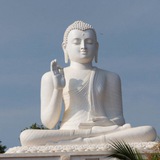
Buddha Sakolsima Mongkhon, Wat Thep Phithak Punnaram Buddhist temple, Klang Dong Subdistrict, Pak Chong District, Nakhon Ratchasima, Thailand.
🥰2🔥1🙏1🤗1
Dhammapada Verse 377
Pancasatabhikkhu Vatthu
Vassika viya pupphani
maddavani pamuncati
evam raganca dosanca
vippamuncetha bhikkhavo.
Verse 377: O bhikkhus! As the jasmine (vassika) plant sheds its withered flowers, so also, should you shed passion and ill will.
The Story of Five Hundred Bhikkhus
While residing at the Jetavana monastery, the Buddha uttered Verse (377) of this book, with reference to five hundred bhikkhus.
Five hundred bhikkhus from Savatthi, after taking a subject of meditation from the Buddha, set out for the forest to practise meditation. There, they noticed that the jasmine flowers which bloomed in the early morning dropped off from the plants onto the ground in the evening. Then the bhikkhus resolved that they would strive hard to free themselves from all moral defilements even before the flowers were shed from the plants. The Buddha, through his supernormal power, saw them from his Perfumed Chamber. He therefore sent forth his radiance to them and made them feel his presence. To them the Buddha said, "Bhikkhus! As the withered flower is shed from the plant, so also, should a bhikkhu strive to free himself from the round of rebirths."
Then the Buddha spoke in verse as follows:
Verse 377: O bhikkhus! As the jasmin (vassika) plant sheds its withered flowers, so also, should you shed passion and ill will.
At the end of the discourse the five hundred bhikkhus attained arahatship.
===
Free Buddhism books, teachings, podcasts and videos from Theravada, Mahayana and Vajrayana traditions:
https://news.1rj.ru/str/buddha_ebooks
===
Pancasatabhikkhu Vatthu
Vassika viya pupphani
maddavani pamuncati
evam raganca dosanca
vippamuncetha bhikkhavo.
Verse 377: O bhikkhus! As the jasmine (vassika) plant sheds its withered flowers, so also, should you shed passion and ill will.
The Story of Five Hundred Bhikkhus
While residing at the Jetavana monastery, the Buddha uttered Verse (377) of this book, with reference to five hundred bhikkhus.
Five hundred bhikkhus from Savatthi, after taking a subject of meditation from the Buddha, set out for the forest to practise meditation. There, they noticed that the jasmine flowers which bloomed in the early morning dropped off from the plants onto the ground in the evening. Then the bhikkhus resolved that they would strive hard to free themselves from all moral defilements even before the flowers were shed from the plants. The Buddha, through his supernormal power, saw them from his Perfumed Chamber. He therefore sent forth his radiance to them and made them feel his presence. To them the Buddha said, "Bhikkhus! As the withered flower is shed from the plant, so also, should a bhikkhu strive to free himself from the round of rebirths."
Then the Buddha spoke in verse as follows:
Verse 377: O bhikkhus! As the jasmin (vassika) plant sheds its withered flowers, so also, should you shed passion and ill will.
At the end of the discourse the five hundred bhikkhus attained arahatship.
===
Free Buddhism books, teachings, podcasts and videos from Theravada, Mahayana and Vajrayana traditions:
https://news.1rj.ru/str/buddha_ebooks
===
Telegram
Buddha Dharma books
Free Buddhism books, teachings, podcasts and videos from Theravada, Mahayana and Vajrayana traditions
👏1🏆1
Forwarded from Buddha Dharma books
Free Buddha Dharma ebook
Itivuttaka: This Was Said by the Buddha By Thanissaro Bhikkhu
The Itivuttaka, a collection of 112 short discourses, takes its name from the statement at the beginning of each of its discourses: this (iti) was said (vutta) by the Blessed One. The collection as a whole is attributed to a laywoman named Khujjuttara, who worked in the palace of King Udena of Kosambı as a servant to one of his queens, Samavati. Because the Queen could not leave the palace to hear the Buddha’s discourses, Khujjuttara went in her place, memorized what the Buddha said, and then returned to the palace to teach the Queen and her 500 ladies-in-waiting. For her efforts, the Buddha cited Khujjuttara as the foremost of his laywomen disciples in terms of her learning. She was also an effective teacher: when the inner apartments of the palace later burned down, killing the Queen and her entourage, the Buddha commented (in Udana 7:10) that all of the women had reached at least the first stage of awakening.
Free download here:
https://www.accesstoinsight.org/tipitaka/kn/iti/iti-than.pdf
===
Itivuttaka: This Was Said by the Buddha By Thanissaro Bhikkhu
The Itivuttaka, a collection of 112 short discourses, takes its name from the statement at the beginning of each of its discourses: this (iti) was said (vutta) by the Blessed One. The collection as a whole is attributed to a laywoman named Khujjuttara, who worked in the palace of King Udena of Kosambı as a servant to one of his queens, Samavati. Because the Queen could not leave the palace to hear the Buddha’s discourses, Khujjuttara went in her place, memorized what the Buddha said, and then returned to the palace to teach the Queen and her 500 ladies-in-waiting. For her efforts, the Buddha cited Khujjuttara as the foremost of his laywomen disciples in terms of her learning. She was also an effective teacher: when the inner apartments of the palace later burned down, killing the Queen and her entourage, the Buddha commented (in Udana 7:10) that all of the women had reached at least the first stage of awakening.
Free download here:
https://www.accesstoinsight.org/tipitaka/kn/iti/iti-than.pdf
===
❤1👍1🔥1🙏1
Forwarded from Words of the Buddha
When Conditions Come Together
By Zen Master Dogen
Enlightenment and clarity of the mind occur only in response to the sustained effort of study and practice. Endeavoring in the way ripens the conditions of your practice. It is not that the sound of the bamboo is sharp or the color of the blossoms is vivid. Although the sound of the bamboo is wondrous, it is heard at the moment when it’s hit by a pebble. Although the color of the blossoms is beautiful, they do not open by themselves but unfold in the light of springtime. Studying the way is like this. You attain the way when conditions come together. Although you have your own capacity, you practice the way with the combined strength of the community. So you should practice and search with one mind with others.
Excerpted from The Essential Dogen: Writings of the Great Zen Master By Zen Master Dogen, Edited by Kazuaki Tanahashi and Peter Levitt, page 53.
By Zen Master Dogen
Enlightenment and clarity of the mind occur only in response to the sustained effort of study and practice. Endeavoring in the way ripens the conditions of your practice. It is not that the sound of the bamboo is sharp or the color of the blossoms is vivid. Although the sound of the bamboo is wondrous, it is heard at the moment when it’s hit by a pebble. Although the color of the blossoms is beautiful, they do not open by themselves but unfold in the light of springtime. Studying the way is like this. You attain the way when conditions come together. Although you have your own capacity, you practice the way with the combined strength of the community. So you should practice and search with one mind with others.
Excerpted from The Essential Dogen: Writings of the Great Zen Master By Zen Master Dogen, Edited by Kazuaki Tanahashi and Peter Levitt, page 53.
🙏2❤1👏1💯1
Dhammapada Verse 378
Santakayatthera Vatthu
Santakayo santavaco
santava susamahito
vantalokamiso bhikkhu
"Upasanto" ti vuccati.
Verse 378: The bhikkhu who is calm in body, calm in speech, and calm in mind, who is well-composed and has given up (lit., vomited) worldly pleasures, is called a "Tranquil One".
The Story of Thera Santakaya
While residing at the Jetavana monastery, the Buddha uttered Verse (378) of this book, with reference to Thera Santakaya.
There was once a Thera named Santakaya, who had been a lion in his past existence. It is said that lions usually go out in search of food one day and then rest in a cave for the next seven days without moving. Thera Santakaya, having been a lion in his last existence, behaved very much like a lion. He moved about very little; his moments were slow and steady; and he was usually calm and composed. Other bhikkhus took his behaviour to be very queer and they reported about him to the Buddha. After hearing the account given by the bhikkhus, the Buddha said to all of them "Bhikkhus! A bhikkhu should be calm and composed; he should behave like Santakaya."
Then the Buddha spoke in verse as follows:
Verse 378: The bhikkhu who is calm in body, calm in speech, and calm in mind, who is well-composed and has given up (lit., vomited) worldly pleasures, is called a "Tranquil One".
At the end of the discourse Thera Santakaya attained arahatship.
===
Buddha dharma teachings channel:
https://news.1rj.ru/str/lorddivinebuddha
===
Santakayatthera Vatthu
Santakayo santavaco
santava susamahito
vantalokamiso bhikkhu
"Upasanto" ti vuccati.
Verse 378: The bhikkhu who is calm in body, calm in speech, and calm in mind, who is well-composed and has given up (lit., vomited) worldly pleasures, is called a "Tranquil One".
The Story of Thera Santakaya
While residing at the Jetavana monastery, the Buddha uttered Verse (378) of this book, with reference to Thera Santakaya.
There was once a Thera named Santakaya, who had been a lion in his past existence. It is said that lions usually go out in search of food one day and then rest in a cave for the next seven days without moving. Thera Santakaya, having been a lion in his last existence, behaved very much like a lion. He moved about very little; his moments were slow and steady; and he was usually calm and composed. Other bhikkhus took his behaviour to be very queer and they reported about him to the Buddha. After hearing the account given by the bhikkhus, the Buddha said to all of them "Bhikkhus! A bhikkhu should be calm and composed; he should behave like Santakaya."
Then the Buddha spoke in verse as follows:
Verse 378: The bhikkhu who is calm in body, calm in speech, and calm in mind, who is well-composed and has given up (lit., vomited) worldly pleasures, is called a "Tranquil One".
At the end of the discourse Thera Santakaya attained arahatship.
===
Buddha dharma teachings channel:
https://news.1rj.ru/str/lorddivinebuddha
===
Telegram
Buddha
Buddha dharma teachings from the suttas and commentaries
❤1💯1🏆1
“Mendicants, there are eight causes and reasons that lead to acquiring the wisdom fundamental to the spiritual life, and to its increase, growth, and full development once it has been acquired. What eight?
5. They’re very learned, remembering and keeping what they’ve learned. These teachings are good in the beginning, good in the middle, and good in the end, meaningful and well-phrased, describing a spiritual practice that’s entirely full and pure. They are very learned in such teachings, remembering them, reinforcing them by recitation, mentally scrutinizing them, and comprehending them theoretically. This is the fifth cause.
8. They meditate observing rise and fall in the five grasping aggregates. ‘Such is form [feeling, perception, choices, consciousness] such is the origin of form [feeling, perception, choices, consciousness], such is the ending of form [feeling, perception, choices, consciousness]. This is the eighth cause.
Partial excerpts from AN 8.2 Paññāsutta: Wisdom
5. They’re very learned, remembering and keeping what they’ve learned. These teachings are good in the beginning, good in the middle, and good in the end, meaningful and well-phrased, describing a spiritual practice that’s entirely full and pure. They are very learned in such teachings, remembering them, reinforcing them by recitation, mentally scrutinizing them, and comprehending them theoretically. This is the fifth cause.
8. They meditate observing rise and fall in the five grasping aggregates. ‘Such is form [feeling, perception, choices, consciousness] such is the origin of form [feeling, perception, choices, consciousness], such is the ending of form [feeling, perception, choices, consciousness]. This is the eighth cause.
Partial excerpts from AN 8.2 Paññāsutta: Wisdom
❤1👍1🥰1🙏1
Forwarded from Words of the Buddha
Now how is mindfulness of in-&-out breathing developed & pursued so as to be of great fruit, of great benefit?
"There is the case where a monk, having gone to the wilderness, to the shade of a tree, or to an empty building, sits down folding his legs crosswise, holding his body erect, and setting mindfulness to the fore. Always mindful, he breathes in; mindful he breathes out.
"Breathing in long, he discerns, 'I am breathing in long'; or breathing out long, he discerns, 'I am breathing out long.' Or breathing in short, he discerns, 'I am breathing in short'; or breathing out short, he discerns, 'I am breathing out short.' He trains himself, 'I will breathe in sensitive to the entire body.'He trains himself, 'I will breathe out sensitive to the entire body.' He trains himself, 'I will breathe in calming bodily fabrication.' He trains himself, 'I will breathe out calming bodily fabrication.'
Partially excerpted from MN 118 : Anapanasati Sutta.
"There is the case where a monk, having gone to the wilderness, to the shade of a tree, or to an empty building, sits down folding his legs crosswise, holding his body erect, and setting mindfulness to the fore. Always mindful, he breathes in; mindful he breathes out.
"Breathing in long, he discerns, 'I am breathing in long'; or breathing out long, he discerns, 'I am breathing out long.' Or breathing in short, he discerns, 'I am breathing in short'; or breathing out short, he discerns, 'I am breathing out short.' He trains himself, 'I will breathe in sensitive to the entire body.'He trains himself, 'I will breathe out sensitive to the entire body.' He trains himself, 'I will breathe in calming bodily fabrication.' He trains himself, 'I will breathe out calming bodily fabrication.'
Partially excerpted from MN 118 : Anapanasati Sutta.
❤1👍1🔥1💯1🤗1
Dhammapada Verses 379 and 380
Nangalakulatthera Vatthu
Attana codayattanam
patimamsetha attana
so attagutto satima
sukham bhikkhu vihahisi.
Atta hi attano natho
(ko hi natho paro siya)1
atta hi attano gati
tasma samyamamattanam
assam bhadramva vanijo.
Verse 379: O bhikkhu, by yourself exhort yourself, and examine yourself; thus guarding yourself and being mindful, you will live in peace.
Verse 380: One indeed is one's own refuge, (how could anyone else be one's refuge?)1 One indeed is one's own heaven; therefore, look after yourself as a horse dealer looks after a thoroughbred.
1. Not found in some foreign versions.
The Story of Thera Nangalakula
While residing at the Jetavana monastery, the Buddha uttered Verses (379) and (380) of this book, with reference to Thera Nangala.
Nangala was a poor field labourer in the service of a farmer. One day, a bhikkhu, seeing him ploughing a field in his old clothes, asked him if he would like to become a bhikkhu. When he replied in the affirmative, the bhikkhu took him along to the monastery and made him a bhikkhu. After the admission to the Order, as instructed by his teacher, he left his plough and his old clothes in a tree not far away from the monastery. Because the poor man had left his plough to join the Order, he was known as Thera Nangala (nangala = plough). Due to better living conditions at the monastery, Thera Nangala became healthier and soon put on weight. However, after some time, he grew tired of the life of a bhikkhu and often felt like returning to home-life. Whenever this feeling arose in him, he would go to the tree near the monastery, the tree where he had left his plough and his old clothes. There he would reproach himself saying, "O you shameless man! Do you still want to put on these old rags and return to the hard, lowly life of a hired labourer ?" After this, his dissatisfaction with the life of a bhikkhu would disappear and he would go back to the monastery. Thus, he went to the tree at an interval of every three or four days, to remind himself of the wretchedness of his old life.
When other bhikkhus asked him about his frequent visits to the tree, he replied, "I have to go to my teacher." In course of time, he attained arahatship and he stopped going to the tree. Other bhikkhus, noticing this, asked him teasingly, "Why don't you go to your teacher now?" To those bhikkhus, he replied, "I used to go to my teacher because I had need of him; but now, I have no need to go to him." The bhikkhus understood what he meant by his answer and they went to the Buddha and reported, "Venerable Sir! Thera Nangala claims to have attained arahatship. It cannot be true; he must be boasting, he must be telling lies." To them the Buddha said, "Bhikkhus! Do not say so; for Nangala is not telling lies. My son Nangala, by reproaching himself and correcting himself, has indeed attained arahatship."
Then the Buddha spoke in verse as follows:
Verse 379: O bhikkhu, by yourself exhort yourself, and examine yourself; thus guarding yourself and being mindful, you will live in peace.
Verse 380: One indeed is one's own refuge, (how could anyone else be one's refuge?) One indeed is one's own heaven; therefore, look after yourself as a horse dealer looks after a thoroughbred.
===
Vajrayana Tantrayana Buddhism channel:
https://news.1rj.ru/str/tantrayanabuddhism
Tibetan Buddhism - Vajrayana, Tantrayana and esoteric Buddhism channel:
https://news.1rj.ru/str/tibetanbuddha
===
Nangalakulatthera Vatthu
Attana codayattanam
patimamsetha attana
so attagutto satima
sukham bhikkhu vihahisi.
Atta hi attano natho
(ko hi natho paro siya)1
atta hi attano gati
tasma samyamamattanam
assam bhadramva vanijo.
Verse 379: O bhikkhu, by yourself exhort yourself, and examine yourself; thus guarding yourself and being mindful, you will live in peace.
Verse 380: One indeed is one's own refuge, (how could anyone else be one's refuge?)1 One indeed is one's own heaven; therefore, look after yourself as a horse dealer looks after a thoroughbred.
1. Not found in some foreign versions.
The Story of Thera Nangalakula
While residing at the Jetavana monastery, the Buddha uttered Verses (379) and (380) of this book, with reference to Thera Nangala.
Nangala was a poor field labourer in the service of a farmer. One day, a bhikkhu, seeing him ploughing a field in his old clothes, asked him if he would like to become a bhikkhu. When he replied in the affirmative, the bhikkhu took him along to the monastery and made him a bhikkhu. After the admission to the Order, as instructed by his teacher, he left his plough and his old clothes in a tree not far away from the monastery. Because the poor man had left his plough to join the Order, he was known as Thera Nangala (nangala = plough). Due to better living conditions at the monastery, Thera Nangala became healthier and soon put on weight. However, after some time, he grew tired of the life of a bhikkhu and often felt like returning to home-life. Whenever this feeling arose in him, he would go to the tree near the monastery, the tree where he had left his plough and his old clothes. There he would reproach himself saying, "O you shameless man! Do you still want to put on these old rags and return to the hard, lowly life of a hired labourer ?" After this, his dissatisfaction with the life of a bhikkhu would disappear and he would go back to the monastery. Thus, he went to the tree at an interval of every three or four days, to remind himself of the wretchedness of his old life.
When other bhikkhus asked him about his frequent visits to the tree, he replied, "I have to go to my teacher." In course of time, he attained arahatship and he stopped going to the tree. Other bhikkhus, noticing this, asked him teasingly, "Why don't you go to your teacher now?" To those bhikkhus, he replied, "I used to go to my teacher because I had need of him; but now, I have no need to go to him." The bhikkhus understood what he meant by his answer and they went to the Buddha and reported, "Venerable Sir! Thera Nangala claims to have attained arahatship. It cannot be true; he must be boasting, he must be telling lies." To them the Buddha said, "Bhikkhus! Do not say so; for Nangala is not telling lies. My son Nangala, by reproaching himself and correcting himself, has indeed attained arahatship."
Then the Buddha spoke in verse as follows:
Verse 379: O bhikkhu, by yourself exhort yourself, and examine yourself; thus guarding yourself and being mindful, you will live in peace.
Verse 380: One indeed is one's own refuge, (how could anyone else be one's refuge?) One indeed is one's own heaven; therefore, look after yourself as a horse dealer looks after a thoroughbred.
===
Vajrayana Tantrayana Buddhism channel:
https://news.1rj.ru/str/tantrayanabuddhism
Tibetan Buddhism - Vajrayana, Tantrayana and esoteric Buddhism channel:
https://news.1rj.ru/str/tibetanbuddha
===
Telegram
Vajrayana Tantrayana Buddhism
Buddha teachings from the Vajrayana, esoteric, secret or Tantrayana vehicle
❤1💯1🏆1
Free Buddhism Dharma ebook
Meditations
Forty Dhamma talks
By Bhikkhu Thanissaro
Free download here:
https://ftp.budaedu.org/ebooks/pdf/EN343.pdf
Free download Keeping the Breath in Mind By Ajahn Lee Dhammadharo:
https://news.1rj.ru/str/buddha_ebooks/1013
===
Meditations
Forty Dhamma talks
By Bhikkhu Thanissaro
Free download here:
https://ftp.budaedu.org/ebooks/pdf/EN343.pdf
Free download Keeping the Breath in Mind By Ajahn Lee Dhammadharo:
https://news.1rj.ru/str/buddha_ebooks/1013
===
❤1🥰1🕊1
Free Buddhism Dharma ebook
Meditations
Forty Dhamma talks
By Bhikkhu Thanissaro
The daily schedule at Metta Forest Monastery includes a group interview in the late afternoon, and a chanting session followed by a group meditation period later in the evening. The Dhamma talks included in this volume were given during the evening meditation sessions, and in many cases covered issues raised at the interviews-either in the questions asked or lurking behind the questions. Often these issues touched on a variety of topics on a variety of different levels in the practice. This explains the range of topics covered in individual talks.
I have edited the talks with an eye to making them readable while at the same time trying to preserve some of the flavor of the spoken word. In a few instances I have added passages or rearranged the material to make the treatment of specific topics more coherent and complete, but for the most part I have kept theediting to a minimum. Don't expect polished essays.
The people listening to these talks were familiar with the meditaiton instructions included in "Method 2" in Keeping the Breath in Mind by Ajaan Lee Dhammadharo; and my own essay, "A Guided Meditation," included in Noble Strategy. If you are not familiar with these instructions, you might want to read through them before reading the talks in this book.
Free download here:
https://ftp.budaedu.org/ebooks/pdf/EN343.pdf
Free download Keeping the Breath in Mind By Ajahn Lee Dhammadharo:
https://news.1rj.ru/str/buddha_ebooks/1013
===
Meditations
Forty Dhamma talks
By Bhikkhu Thanissaro
The daily schedule at Metta Forest Monastery includes a group interview in the late afternoon, and a chanting session followed by a group meditation period later in the evening. The Dhamma talks included in this volume were given during the evening meditation sessions, and in many cases covered issues raised at the interviews-either in the questions asked or lurking behind the questions. Often these issues touched on a variety of topics on a variety of different levels in the practice. This explains the range of topics covered in individual talks.
I have edited the talks with an eye to making them readable while at the same time trying to preserve some of the flavor of the spoken word. In a few instances I have added passages or rearranged the material to make the treatment of specific topics more coherent and complete, but for the most part I have kept theediting to a minimum. Don't expect polished essays.
The people listening to these talks were familiar with the meditaiton instructions included in "Method 2" in Keeping the Breath in Mind by Ajaan Lee Dhammadharo; and my own essay, "A Guided Meditation," included in Noble Strategy. If you are not familiar with these instructions, you might want to read through them before reading the talks in this book.
Free download here:
https://ftp.budaedu.org/ebooks/pdf/EN343.pdf
Free download Keeping the Breath in Mind By Ajahn Lee Dhammadharo:
https://news.1rj.ru/str/buddha_ebooks/1013
===
❤1👍1🏆1
Free Buddhism Dharma ebook
Meditations
Forty Dhamma talks
By Bhikkhu Thanissaro
Free download here:
https://ftp.budaedu.org/ebooks/pdf/EN343.pdf
Free download Keeping the Breath in Mind By Ajahn Lee Dhammadharo:
https://news.1rj.ru/str/buddha_ebooks/1013
===
Meditations
Forty Dhamma talks
By Bhikkhu Thanissaro
Free download here:
https://ftp.budaedu.org/ebooks/pdf/EN343.pdf
Free download Keeping the Breath in Mind By Ajahn Lee Dhammadharo:
https://news.1rj.ru/str/buddha_ebooks/1013
===
❤1🙏1🤗1
Forwarded from Words of the Buddha
Buddha statues under the sea, coast of Gili Meno, between Bali and Lombok islands, Indonesia.
🔥1🤩1😍1😎1
Dhammapada Verse 381
Vakkalitthera Vatthu
Pamojjabahulo bhikkhu
pasanno buddhasasane
adhigacche padam santam
sankharupasamam sukham.
Verse 381: The bhikkhu who frequently feels joy and is devoted to the Teaching of the Buddha will realize Nibbana — the Tranquil, the Unconditioned, the Blissful.
The Story of Thera Vakkali
While residing at the Veluvana monastery, the Buddha uttered Verse (381) of this book, with reference to Thera Vakkali.
Vakkali was a brahmin who lived in Savatthi. One day when he saw the Buddha going on an alms-round in the city, he was very much impressed by the noble appearance of the Buddha. At the same time, he felt much affection and great reverence for the Buddha and asked permission to join the Order just to be near him. As a bhikkhu, Vakkali always kept close to the Buddha; he did not care much about other duties of a bhikkhu and did not at all practise concentration meditation. So, the Buddha said to him, "Vakkali, it will be of no use to you by always keeping close to me, looking at my face. You should practise concentration meditation; for, indeed, only the one who sees the Dhamma sees me. One who does not see the Dhamma does not see me. So, you must leave my presence." When he heard those words Vakkali felt very depressed. He left the Buddha as ordered, and climbed the Gijjhakuta hill with the intention of committing suicide by jumping down from the peak.
The Buddha, knowing full well the extent of Vakkali's grief and despondency, reflected that because of his great sorrow and despondency Vakkali might miss the chance of attaining the Maggas. Accordingly, he sent forth his radiance to Vakkali, made him feel his presence and appeared as if in person to Vakkali. With the Buddha near him, Vakkali soon forgot all his sorrow; he became cheerful and very much heartened.
To him the Buddha spoke in verse as follows:
Verse 381: The bhikkhu who frequently feels joy and is devoted to the Teaching of the Buddha will realize Nibbana — the Tranquil, the Unconditioned, the Blissful.
At the end of the discourse Vakkali attained arahatship.
===
Words of the Buddha channel:
https://news.1rj.ru/str/wordsofbuddha
===
Vakkalitthera Vatthu
Pamojjabahulo bhikkhu
pasanno buddhasasane
adhigacche padam santam
sankharupasamam sukham.
Verse 381: The bhikkhu who frequently feels joy and is devoted to the Teaching of the Buddha will realize Nibbana — the Tranquil, the Unconditioned, the Blissful.
The Story of Thera Vakkali
While residing at the Veluvana monastery, the Buddha uttered Verse (381) of this book, with reference to Thera Vakkali.
Vakkali was a brahmin who lived in Savatthi. One day when he saw the Buddha going on an alms-round in the city, he was very much impressed by the noble appearance of the Buddha. At the same time, he felt much affection and great reverence for the Buddha and asked permission to join the Order just to be near him. As a bhikkhu, Vakkali always kept close to the Buddha; he did not care much about other duties of a bhikkhu and did not at all practise concentration meditation. So, the Buddha said to him, "Vakkali, it will be of no use to you by always keeping close to me, looking at my face. You should practise concentration meditation; for, indeed, only the one who sees the Dhamma sees me. One who does not see the Dhamma does not see me. So, you must leave my presence." When he heard those words Vakkali felt very depressed. He left the Buddha as ordered, and climbed the Gijjhakuta hill with the intention of committing suicide by jumping down from the peak.
The Buddha, knowing full well the extent of Vakkali's grief and despondency, reflected that because of his great sorrow and despondency Vakkali might miss the chance of attaining the Maggas. Accordingly, he sent forth his radiance to Vakkali, made him feel his presence and appeared as if in person to Vakkali. With the Buddha near him, Vakkali soon forgot all his sorrow; he became cheerful and very much heartened.
To him the Buddha spoke in verse as follows:
Verse 381: The bhikkhu who frequently feels joy and is devoted to the Teaching of the Buddha will realize Nibbana — the Tranquil, the Unconditioned, the Blissful.
At the end of the discourse Vakkali attained arahatship.
===
Words of the Buddha channel:
https://news.1rj.ru/str/wordsofbuddha
===
Telegram
Words of the Buddha
Daily teachings of Buddha Dharma
❤1👍1💯1
Forwarded from Words of the Buddha
“There are four persons, ananda, worthy of a stupa. Who are the four? A Tathagata, a Fully Awakened Buddha; a Paccekabuddha; a disciple of the Tathagata who is an Arahant; and a universal monarch (Chakravartin).”
“And why, Ananda, is a stupa for the Tathagata worthy of a stupa? At the thought: ‘This is the stupa of the Tathagata, the Arahant, the Fully Awakened Buddha,’ the hearts of many people are inspired, and they gain in happiness and faith, leading to a good rebirth.”
“And likewise with regard to the other three: a Paccekabuddha, an Arahant disciple of the Tathagata, and a universal monarch. That is why, ananda, there are four persons worthy of a stupa.”
Digha Nikaya, Sutta 16 : Mahaparinibbana Sutta
“And why, Ananda, is a stupa for the Tathagata worthy of a stupa? At the thought: ‘This is the stupa of the Tathagata, the Arahant, the Fully Awakened Buddha,’ the hearts of many people are inspired, and they gain in happiness and faith, leading to a good rebirth.”
“And likewise with regard to the other three: a Paccekabuddha, an Arahant disciple of the Tathagata, and a universal monarch. That is why, ananda, there are four persons worthy of a stupa.”
Digha Nikaya, Sutta 16 : Mahaparinibbana Sutta
❤1🙏1👌1🏆1