Forwarded from Words of the Buddha
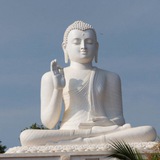
Buddha statues under the sea, coast of Gili Meno, between Bali and Lombok islands, Indonesia.
🔥1🤩1😍1😎1
Dhammapada Verse 381
Vakkalitthera Vatthu
Pamojjabahulo bhikkhu
pasanno buddhasasane
adhigacche padam santam
sankharupasamam sukham.
Verse 381: The bhikkhu who frequently feels joy and is devoted to the Teaching of the Buddha will realize Nibbana — the Tranquil, the Unconditioned, the Blissful.
The Story of Thera Vakkali
While residing at the Veluvana monastery, the Buddha uttered Verse (381) of this book, with reference to Thera Vakkali.
Vakkali was a brahmin who lived in Savatthi. One day when he saw the Buddha going on an alms-round in the city, he was very much impressed by the noble appearance of the Buddha. At the same time, he felt much affection and great reverence for the Buddha and asked permission to join the Order just to be near him. As a bhikkhu, Vakkali always kept close to the Buddha; he did not care much about other duties of a bhikkhu and did not at all practise concentration meditation. So, the Buddha said to him, "Vakkali, it will be of no use to you by always keeping close to me, looking at my face. You should practise concentration meditation; for, indeed, only the one who sees the Dhamma sees me. One who does not see the Dhamma does not see me. So, you must leave my presence." When he heard those words Vakkali felt very depressed. He left the Buddha as ordered, and climbed the Gijjhakuta hill with the intention of committing suicide by jumping down from the peak.
The Buddha, knowing full well the extent of Vakkali's grief and despondency, reflected that because of his great sorrow and despondency Vakkali might miss the chance of attaining the Maggas. Accordingly, he sent forth his radiance to Vakkali, made him feel his presence and appeared as if in person to Vakkali. With the Buddha near him, Vakkali soon forgot all his sorrow; he became cheerful and very much heartened.
To him the Buddha spoke in verse as follows:
Verse 381: The bhikkhu who frequently feels joy and is devoted to the Teaching of the Buddha will realize Nibbana — the Tranquil, the Unconditioned, the Blissful.
At the end of the discourse Vakkali attained arahatship.
===
Words of the Buddha channel:
https://news.1rj.ru/str/wordsofbuddha
===
Vakkalitthera Vatthu
Pamojjabahulo bhikkhu
pasanno buddhasasane
adhigacche padam santam
sankharupasamam sukham.
Verse 381: The bhikkhu who frequently feels joy and is devoted to the Teaching of the Buddha will realize Nibbana — the Tranquil, the Unconditioned, the Blissful.
The Story of Thera Vakkali
While residing at the Veluvana monastery, the Buddha uttered Verse (381) of this book, with reference to Thera Vakkali.
Vakkali was a brahmin who lived in Savatthi. One day when he saw the Buddha going on an alms-round in the city, he was very much impressed by the noble appearance of the Buddha. At the same time, he felt much affection and great reverence for the Buddha and asked permission to join the Order just to be near him. As a bhikkhu, Vakkali always kept close to the Buddha; he did not care much about other duties of a bhikkhu and did not at all practise concentration meditation. So, the Buddha said to him, "Vakkali, it will be of no use to you by always keeping close to me, looking at my face. You should practise concentration meditation; for, indeed, only the one who sees the Dhamma sees me. One who does not see the Dhamma does not see me. So, you must leave my presence." When he heard those words Vakkali felt very depressed. He left the Buddha as ordered, and climbed the Gijjhakuta hill with the intention of committing suicide by jumping down from the peak.
The Buddha, knowing full well the extent of Vakkali's grief and despondency, reflected that because of his great sorrow and despondency Vakkali might miss the chance of attaining the Maggas. Accordingly, he sent forth his radiance to Vakkali, made him feel his presence and appeared as if in person to Vakkali. With the Buddha near him, Vakkali soon forgot all his sorrow; he became cheerful and very much heartened.
To him the Buddha spoke in verse as follows:
Verse 381: The bhikkhu who frequently feels joy and is devoted to the Teaching of the Buddha will realize Nibbana — the Tranquil, the Unconditioned, the Blissful.
At the end of the discourse Vakkali attained arahatship.
===
Words of the Buddha channel:
https://news.1rj.ru/str/wordsofbuddha
===
Telegram
Words of the Buddha
Daily teachings of Buddha Dharma
❤1👍1💯1
Forwarded from Words of the Buddha
“There are four persons, ananda, worthy of a stupa. Who are the four? A Tathagata, a Fully Awakened Buddha; a Paccekabuddha; a disciple of the Tathagata who is an Arahant; and a universal monarch (Chakravartin).”
“And why, Ananda, is a stupa for the Tathagata worthy of a stupa? At the thought: ‘This is the stupa of the Tathagata, the Arahant, the Fully Awakened Buddha,’ the hearts of many people are inspired, and they gain in happiness and faith, leading to a good rebirth.”
“And likewise with regard to the other three: a Paccekabuddha, an Arahant disciple of the Tathagata, and a universal monarch. That is why, ananda, there are four persons worthy of a stupa.”
Digha Nikaya, Sutta 16 : Mahaparinibbana Sutta
“And why, Ananda, is a stupa for the Tathagata worthy of a stupa? At the thought: ‘This is the stupa of the Tathagata, the Arahant, the Fully Awakened Buddha,’ the hearts of many people are inspired, and they gain in happiness and faith, leading to a good rebirth.”
“And likewise with regard to the other three: a Paccekabuddha, an Arahant disciple of the Tathagata, and a universal monarch. That is why, ananda, there are four persons worthy of a stupa.”
Digha Nikaya, Sutta 16 : Mahaparinibbana Sutta
❤1🙏1👌1🏆1
Free Buddha Dharma ebook
The Art of Disappearing
Buddhist path to lasting joy
By Ajahn Brahm
DO NOT READ this book if you want to be a somebody. It will make you a nobody, a no-self.
I did not write this book.
Free download here:
https://static.sariputta.com/pdf/tipitaka/209/Ajahn-Brahm_The-Art-of-Disappearing_pdf.pdf
===
The Art of Disappearing
Buddhist path to lasting joy
By Ajahn Brahm
DO NOT READ this book if you want to be a somebody. It will make you a nobody, a no-self.
I did not write this book.
Free download here:
https://static.sariputta.com/pdf/tipitaka/209/Ajahn-Brahm_The-Art-of-Disappearing_pdf.pdf
===
👍2❤1🏆1😘1
Free Buddha Dharma ebook
The Art of Disappearing
Buddhist path to lasting joy
By Ajahn Brahm
DO NOT READ this book if you want to be a somebody. It will make you a nobody, a no-self.
I did not write this book. They are transcribed talks, edited with all the bad jokes removed. I did not say my bad jokes anyway. The five khandhas, which presumptuously claim to be me, said them. I have the perfect alibi—my self was absent from the scene of the crime!
This book does not tell you what you must do to get enlightened. It is not an instruction manual like Mindfulness, Bliss, and Beyond, which was also written by those pesky five khandhas pretending to be Ajahn Brahm. Doing things like following instructions just makes you more of a person. Instead, this book describes how disappearing happens in spite of you. Moreover, it is not just the “outside” that vanishes. The entire “inside,” all that you take to be you, that also disappears. And that is so much fun it is sheer bliss.
The true purpose of practicing Buddhism is to let go of everything, not to get more things like attainments to show off to your friends. When we let go of something, really let go, then it disappears. We lose it. All successful meditators are losers. They lose their attachments. Enlightened ones lose everything. They truly are the Biggest Loser. At the very least, if you read this book and understand some of it, you may discover the meaning of freedom and, as a consequence, lose all of the hair on your head!
I acknowledge the kind assistance of other nobodies, in particular Ron Storey for transcribing the talks, Ajahn Brahmali for editing the work, and all the empty beings at Wisdom Publications for publishing the book.
May you all Get Lost.
Free download here:
https://static.sariputta.com/pdf/tipitaka/209/Ajahn-Brahm_The-Art-of-Disappearing_pdf.pdf
Free download Mindfulness, Bliss and Beyond By Ajahn Brahm:
https://news.1rj.ru/str/buddha_ebooks/1102
===
The Art of Disappearing
Buddhist path to lasting joy
By Ajahn Brahm
DO NOT READ this book if you want to be a somebody. It will make you a nobody, a no-self.
I did not write this book. They are transcribed talks, edited with all the bad jokes removed. I did not say my bad jokes anyway. The five khandhas, which presumptuously claim to be me, said them. I have the perfect alibi—my self was absent from the scene of the crime!
This book does not tell you what you must do to get enlightened. It is not an instruction manual like Mindfulness, Bliss, and Beyond, which was also written by those pesky five khandhas pretending to be Ajahn Brahm. Doing things like following instructions just makes you more of a person. Instead, this book describes how disappearing happens in spite of you. Moreover, it is not just the “outside” that vanishes. The entire “inside,” all that you take to be you, that also disappears. And that is so much fun it is sheer bliss.
The true purpose of practicing Buddhism is to let go of everything, not to get more things like attainments to show off to your friends. When we let go of something, really let go, then it disappears. We lose it. All successful meditators are losers. They lose their attachments. Enlightened ones lose everything. They truly are the Biggest Loser. At the very least, if you read this book and understand some of it, you may discover the meaning of freedom and, as a consequence, lose all of the hair on your head!
I acknowledge the kind assistance of other nobodies, in particular Ron Storey for transcribing the talks, Ajahn Brahmali for editing the work, and all the empty beings at Wisdom Publications for publishing the book.
May you all Get Lost.
Free download here:
https://static.sariputta.com/pdf/tipitaka/209/Ajahn-Brahm_The-Art-of-Disappearing_pdf.pdf
Free download Mindfulness, Bliss and Beyond By Ajahn Brahm:
https://news.1rj.ru/str/buddha_ebooks/1102
===
❤1🔥1🤗1🆒1
Dhammapada Verse 382
Sumanasamanera Vatthu
Yo have daharo bhikkhu
yunjati buddhasasane
so' mam lokam pabhaseti
abbha muttova candima.
Verse 382: A bhikkhu who, though young, devotes himself to the Teaching of the Buddha lights up the world, as does the moon freed from a cloud.
The Story of Samanera Sumana
While residing at the Pubbarama monastery, the Buddha uttered Verse (382) of this book, with reference to Samanera Sumana.
Samanera Sumana was a pupil of Thera Anuruddha. Although he was only seven years old he was an arahat, endowed with supernormal powers. Once, when his teacher Anuruddha was ill at a monastery in a forest of the Himalayas, he fetched water from the Anotatta lake which was five hundred yojanas away from the monastery. The journey was made not by land but by air through his supernormal power. Later, Thera Anuruddha took Samanera Sumana to the Buddha, who was then sojourning at Pubbarama, the monastery donated by Visakha.
There, other young bhikkhus and samaneras teased him by patting his head, or pulling his ears, nose and arms, and jokingly asked him if he was not feeling bored. The Buddha saw them and thought that he would make those young bhikkhus see the rare qualities of young Samanera Sumana. So it was made known by the Buddha that he wanted some samanera to get a jar of water from the Anotatta lake. The Venerable Ananda searched among the bhikkhus and samaneras of the Pubbarama monastery, but there was none who was able to undertake the job. Finally, the Venerable Ananda asked Samanera Sumana who readily agreed to fetch water from the Anotatta lake. He took a big golden jar front the monastery and soon brought the water from the Anotatta lake for the Buddha. As before, he went to the Anotatta lake and came back by air through his supernormal power.
At the congregation of the bhikkhus in the evening, the bhikkhus told the Buddha about the wonderful trip made by Samanera Sumana. To them the Buddha said, "Bhikkhus, one who practises the Dhamma vigilantly and zealously is capable of attaining supernormal powers, even though he is young."
Then the Buddha spoke in verse as follows:
Verse 382: A bhikkhu who, though young, devotes himself to the Teaching of the Buddha lights up the world, as does the moon freed from a cloud.
End of Chapter Twenty-five: The Bhikkhus
===
Dhammapada, beloved and favorite teachings of the Buddha channel:
https://news.1rj.ru/str/dhammapadas
===
Sumanasamanera Vatthu
Yo have daharo bhikkhu
yunjati buddhasasane
so' mam lokam pabhaseti
abbha muttova candima.
Verse 382: A bhikkhu who, though young, devotes himself to the Teaching of the Buddha lights up the world, as does the moon freed from a cloud.
The Story of Samanera Sumana
While residing at the Pubbarama monastery, the Buddha uttered Verse (382) of this book, with reference to Samanera Sumana.
Samanera Sumana was a pupil of Thera Anuruddha. Although he was only seven years old he was an arahat, endowed with supernormal powers. Once, when his teacher Anuruddha was ill at a monastery in a forest of the Himalayas, he fetched water from the Anotatta lake which was five hundred yojanas away from the monastery. The journey was made not by land but by air through his supernormal power. Later, Thera Anuruddha took Samanera Sumana to the Buddha, who was then sojourning at Pubbarama, the monastery donated by Visakha.
There, other young bhikkhus and samaneras teased him by patting his head, or pulling his ears, nose and arms, and jokingly asked him if he was not feeling bored. The Buddha saw them and thought that he would make those young bhikkhus see the rare qualities of young Samanera Sumana. So it was made known by the Buddha that he wanted some samanera to get a jar of water from the Anotatta lake. The Venerable Ananda searched among the bhikkhus and samaneras of the Pubbarama monastery, but there was none who was able to undertake the job. Finally, the Venerable Ananda asked Samanera Sumana who readily agreed to fetch water from the Anotatta lake. He took a big golden jar front the monastery and soon brought the water from the Anotatta lake for the Buddha. As before, he went to the Anotatta lake and came back by air through his supernormal power.
At the congregation of the bhikkhus in the evening, the bhikkhus told the Buddha about the wonderful trip made by Samanera Sumana. To them the Buddha said, "Bhikkhus, one who practises the Dhamma vigilantly and zealously is capable of attaining supernormal powers, even though he is young."
Then the Buddha spoke in verse as follows:
Verse 382: A bhikkhu who, though young, devotes himself to the Teaching of the Buddha lights up the world, as does the moon freed from a cloud.
End of Chapter Twenty-five: The Bhikkhus
===
Dhammapada, beloved and favorite teachings of the Buddha channel:
https://news.1rj.ru/str/dhammapadas
===
Telegram
Dhammapada - Buddha Dharma Teachings
Daily teachings of the Dhammapada, beloved and favorite teachings of the Buddha
❤2👍1👏1🙏1
Clinging
Untangling the habits that keep us in the loop
By Bhante Henepola Gunaratana
Part 1 of 2
As taught by Venerable Sariputta in The Discourse on Right View, clinging is suffering. Therefore, the origin of suffering is the origin of clinging, the cessation of suffering is the cessation of clinging, and the way leading to the cessation of suffering is the same path leading to the cessation of clinging. After explaining this, Venerable Sariputta addressed the question of the origin of suffering, which is clinging. And the cause of clinging is craving. Thus, with the cessation of craving, clinging ceases. And when clinging ceases, suffering ceases.
Clinging arises from a sequence of dependently arisen mental phenomena. When the senses come into contact with sense-objects, consciousness arises. When the senses, sense-object, and consciousness come together, contact arises. As a result of this, contact feeling arises. Feelings depend on our mental state; objects by themselves do not have pleasantness or unpleasantness. It is the mind that labels them as pleasant or unpleasant. If the object is pleasant, a mental state of craving develops. The wish to sense, again and again, the same object that led to a pleasant feeling ensues. This pattern, reinforced by desire and strengthened by repetition, results in clinging. All these states arise in the mind and cease in the mind. Therefore, we have to look into the mind to find the secret of happiness. The solution to our suffering is not somewhere outside of ourselves but in our own mind.
Desire is reinforced when the same mental state that craves a pleasurable object becomes habitual. A desire that is thus reinforced becomes very powerful. As a result, the mind is as if glued to the object of desire. The longer we pay attention to the object and dwell on it, the stronger our desire and the more tenacious our clinging to it. We cling to sights, sounds, odors, tastes, tangibles, and thoughts—in short, to the world of the six senses. It is as if a world connected to the senses emerges whenever they become active. For instance, when we see something, the world of sight is born. Depending on the quality of the mind, worlds of thoughts arise and uncountable images are formed in the mind.
If we were to see the entire mechanism that leads to clinging, we would understand that there really isn’t anything to cling to.
In every moment, we are born into the visual, auditory, olfactory, gustatory, tactile, and mental worlds. Immersed in these worlds, we cling to the objects they contain. When their content depletes, we miss what we held on to and suffer. These worlds appear and disappear from moment to moment. We cling to them because we are unable to see their perpetual appearance and disappearance due to ignorance. When one sees dependent origination—when this arises, this arises; when this passes away, this passes away—one understands that there really isn’t anything to hold on to.
Clinging arises in the mind when we do not see the underlying mechanics of what is happening. In fact, we do not actually cling to the object but to the thought of the object that arises in our mind, and thus we obsess about it. However, if we were to see the entire mechanism that leads to clinging, we would understand that there really isn’t anything to cling to. But due to ignorance and craving, we fail to see this entire process. Ignorance is so strong that it distorts our senses and convinces us that what we crave will remain and bring us comfort and solace. Seeing with right understanding the mechanism of sensual thoughts arising in the mind, craving cannot arise.
Once we understand with proper wisdom that all that has come to be in the realm of the six senses is subject to passing away, we are able to let go of our grasp on these worlds. Having let go, we soar above lamentation, grief, and sadness to a world of perfect equanimity beyond all suffering.
Untangling the habits that keep us in the loop
By Bhante Henepola Gunaratana
Part 1 of 2
As taught by Venerable Sariputta in The Discourse on Right View, clinging is suffering. Therefore, the origin of suffering is the origin of clinging, the cessation of suffering is the cessation of clinging, and the way leading to the cessation of suffering is the same path leading to the cessation of clinging. After explaining this, Venerable Sariputta addressed the question of the origin of suffering, which is clinging. And the cause of clinging is craving. Thus, with the cessation of craving, clinging ceases. And when clinging ceases, suffering ceases.
Clinging arises from a sequence of dependently arisen mental phenomena. When the senses come into contact with sense-objects, consciousness arises. When the senses, sense-object, and consciousness come together, contact arises. As a result of this, contact feeling arises. Feelings depend on our mental state; objects by themselves do not have pleasantness or unpleasantness. It is the mind that labels them as pleasant or unpleasant. If the object is pleasant, a mental state of craving develops. The wish to sense, again and again, the same object that led to a pleasant feeling ensues. This pattern, reinforced by desire and strengthened by repetition, results in clinging. All these states arise in the mind and cease in the mind. Therefore, we have to look into the mind to find the secret of happiness. The solution to our suffering is not somewhere outside of ourselves but in our own mind.
Desire is reinforced when the same mental state that craves a pleasurable object becomes habitual. A desire that is thus reinforced becomes very powerful. As a result, the mind is as if glued to the object of desire. The longer we pay attention to the object and dwell on it, the stronger our desire and the more tenacious our clinging to it. We cling to sights, sounds, odors, tastes, tangibles, and thoughts—in short, to the world of the six senses. It is as if a world connected to the senses emerges whenever they become active. For instance, when we see something, the world of sight is born. Depending on the quality of the mind, worlds of thoughts arise and uncountable images are formed in the mind.
If we were to see the entire mechanism that leads to clinging, we would understand that there really isn’t anything to cling to.
In every moment, we are born into the visual, auditory, olfactory, gustatory, tactile, and mental worlds. Immersed in these worlds, we cling to the objects they contain. When their content depletes, we miss what we held on to and suffer. These worlds appear and disappear from moment to moment. We cling to them because we are unable to see their perpetual appearance and disappearance due to ignorance. When one sees dependent origination—when this arises, this arises; when this passes away, this passes away—one understands that there really isn’t anything to hold on to.
Clinging arises in the mind when we do not see the underlying mechanics of what is happening. In fact, we do not actually cling to the object but to the thought of the object that arises in our mind, and thus we obsess about it. However, if we were to see the entire mechanism that leads to clinging, we would understand that there really isn’t anything to cling to. But due to ignorance and craving, we fail to see this entire process. Ignorance is so strong that it distorts our senses and convinces us that what we crave will remain and bring us comfort and solace. Seeing with right understanding the mechanism of sensual thoughts arising in the mind, craving cannot arise.
Once we understand with proper wisdom that all that has come to be in the realm of the six senses is subject to passing away, we are able to let go of our grasp on these worlds. Having let go, we soar above lamentation, grief, and sadness to a world of perfect equanimity beyond all suffering.
Telegram
Dhammapada - Buddha Dharma Teachings
Daily teachings of the Dhammapada, beloved and favorite teachings of the Buddha
❤1👌1💯1
Whenever the topic of nonclinging is discussed, the role of desires for the pursuit of activities and occupations necessary to daily life usually comes up. This argument comes from a confusion about the difference between interest and clinging. Of course one must have a desire or interest in pursuing the various activities necessary for our continued existence in the world, but this does not require clinging. The following simile illustrates this point.
Our ancient Buddhist texts tell a story of a legendary war between the devas (deities) and asuras (demons). The asuras lost the war, and Sakka, the king of the devas, ordered his attendant to bind the asura king, Vepacitti. So Vepacitti was bound in five places—his hands, legs, and neck tied by a heavy chain—and dragged to the heavenly realm. But Sakka offered him a deal to regain his freedom: If Vepacitti admitted that the devas were right and the asuras were wrong, he would immediately be freed from his shackles and allowed to stay in the deva realm to enjoy heavenly bliss. Now Vepacitti found himself in quite a predicament. How could he betray his asura people by saying that they were wrong? On the other hand, if he were to go along with Sakka’s request, he could enjoy the pleasures of the heavenly realm. But Vepacitti’s pride kept him from surrendering. In either case, he was bound. His predicament is a riddle illustrating that as long as one is bound by fivefold sensual pleasures, there is no end to suffering.
===
Part 1 of 2:
https://news.1rj.ru/str/dhammapadas/2246
Part 2 of 2:
https://news.1rj.ru/str/wordsofbuddha/3259
===
Dhammapada, beloved and favorite teachings of the Buddha channel:
https://news.1rj.ru/str/dhammapadas
===
Our ancient Buddhist texts tell a story of a legendary war between the devas (deities) and asuras (demons). The asuras lost the war, and Sakka, the king of the devas, ordered his attendant to bind the asura king, Vepacitti. So Vepacitti was bound in five places—his hands, legs, and neck tied by a heavy chain—and dragged to the heavenly realm. But Sakka offered him a deal to regain his freedom: If Vepacitti admitted that the devas were right and the asuras were wrong, he would immediately be freed from his shackles and allowed to stay in the deva realm to enjoy heavenly bliss. Now Vepacitti found himself in quite a predicament. How could he betray his asura people by saying that they were wrong? On the other hand, if he were to go along with Sakka’s request, he could enjoy the pleasures of the heavenly realm. But Vepacitti’s pride kept him from surrendering. In either case, he was bound. His predicament is a riddle illustrating that as long as one is bound by fivefold sensual pleasures, there is no end to suffering.
===
Part 1 of 2:
https://news.1rj.ru/str/dhammapadas/2246
Part 2 of 2:
https://news.1rj.ru/str/wordsofbuddha/3259
===
Dhammapada, beloved and favorite teachings of the Buddha channel:
https://news.1rj.ru/str/dhammapadas
===
Telegram
Dhammapada - Buddha Dharma Teachings
Daily teachings of the Dhammapada, beloved and favorite teachings of the Buddha
❤1👍1👏1🤩1
“Monks, all the ways of making merit leading to future happiness do not equal a sixteenth part of the mind-liberation of loving-kindness. The mind-liberation of loving-kindness surpasses them and shines, blazes, and dazzles.”
“Just as the radiance of all the stars does not equal a sixteenth part of the radiance of the moon, the moon’s radiance surpasses them and shines, blazes, and dazzles, so do all the grounds for making merit leading to future happiness not equal a sixteenth part of the mind-liberation of loving-kindness. The mind-liberation of loving-kindness surpasses them and shines, blazes, and dazzles.”
“Just as in the last stage of the night, not yet dawn, the morning star shines, blazes, and dazzles, so do all the grounds for making merit leading to future happiness do not equal a sixteenth part of the mind-liberation of loving-kindness. The mind-liberation of loving-kindness surpasses them and shines, blazes, and dazzles.
Iti 27 Mettācetovimutti Sutta: The Development of Loving-kindness
“Just as the radiance of all the stars does not equal a sixteenth part of the radiance of the moon, the moon’s radiance surpasses them and shines, blazes, and dazzles, so do all the grounds for making merit leading to future happiness not equal a sixteenth part of the mind-liberation of loving-kindness. The mind-liberation of loving-kindness surpasses them and shines, blazes, and dazzles.”
“Just as in the last stage of the night, not yet dawn, the morning star shines, blazes, and dazzles, so do all the grounds for making merit leading to future happiness do not equal a sixteenth part of the mind-liberation of loving-kindness. The mind-liberation of loving-kindness surpasses them and shines, blazes, and dazzles.
Iti 27 Mettācetovimutti Sutta: The Development of Loving-kindness
❤1👍1🤩1😍1
Forwarded from Buddha Dharma books
Free Buddha Dharma ebook
The Marvellous Companion
Jatakamala - The Life Stories of the Buddha
By Aryasura
The present volume is based on the English translation of Aryasura's Jatakamala by Joseph Speyer, published in England in 1895.
To assure the accuracy of this new version of Aryasura's work, we have carefully compared it to the Tibetan text of the Jatakamala as it appears in the Nyingma Edition of the sDe-dge bsTan-'gyur.
Translated from the Sanskrit in the eighth century by Vidyakarasimha and the Tibetan lotsawa Manjushivarman, the Tibetan version is very close to the Sanskrit text used by Speyer, except that in isolated passages its meaning appears to be clearer.
We are satisfied that the resulting text presented here is generally faithful to Aryagura's original work. Still, there remain difficult passages, and further study and research into the existing manunoscripts of the Jatakamala by qualified scholars may lead to revisions in future editions.
Free download here:
https://wisdomcompassion.org/wp-content/uploads/2019/10/Marvelous-Companion-The-Jatakamala-of-Aryashura.pdf
===
The Marvellous Companion
Jatakamala - The Life Stories of the Buddha
By Aryasura
The present volume is based on the English translation of Aryasura's Jatakamala by Joseph Speyer, published in England in 1895.
To assure the accuracy of this new version of Aryasura's work, we have carefully compared it to the Tibetan text of the Jatakamala as it appears in the Nyingma Edition of the sDe-dge bsTan-'gyur.
Translated from the Sanskrit in the eighth century by Vidyakarasimha and the Tibetan lotsawa Manjushivarman, the Tibetan version is very close to the Sanskrit text used by Speyer, except that in isolated passages its meaning appears to be clearer.
We are satisfied that the resulting text presented here is generally faithful to Aryagura's original work. Still, there remain difficult passages, and further study and research into the existing manunoscripts of the Jatakamala by qualified scholars may lead to revisions in future editions.
Free download here:
https://wisdomcompassion.org/wp-content/uploads/2019/10/Marvelous-Companion-The-Jatakamala-of-Aryashura.pdf
===
👍2❤1🤗1