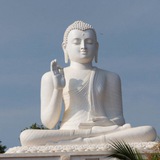
Forwarded from Words of the Buddha
A serene and peaceful life free from clinging is like a hang glider gracefully flying on the horizon, while clinging makes the glider of serenity crash. Learning to fly a hang glider provides a direct simile for how grasping works and how letting go sets one free. One grasps the bars due to fear borne out of a sense of self, or me. The orientation and balance of the wings together with the position of the glider’s nose is what controls its flow through air currents. As soon as one clings to the bars, they become off-balance and the nose tilts downward. When one grasps, the mind is absorbed in holding on tightly, paying no attention to the position of the glider’s nose. When one does not see things as they are, heedfulness is gone due to fear. One trains to barely touch the down bars at liftoff, controlling the glider by the slightest push. With time and effort this becomes natural, and one can easily take off and stay in the air some two hundred feet or more, gently controlling the apparatus with the down bar. The pilot’s success rests in his or her ability to overcome grasping. This little victory over oneself gives a great sense of freedom as one glides through the air. So if flying in a mundane way can give one such a thrill, can you imagine the joy of soaring to the heights of spiritual liberation?
From Dependent Origination in Plain English by Bhante Gunaratana.
===
Bhante Henepola Gunaratana is a Buddhist monk from Sri Lanka and the author of Mindfulness in Plain English. He is president of the Bhavana Society in High View, West Virginia, an organization that promotes meditation and monastic life.
===
Part 1 of 2:
https://news.1rj.ru/str/dhammapadas/2246
Part 2 of 2:
https://news.1rj.ru/str/wordsofbuddha/3259
===
Words of the Buddha channel:
https://news.1rj.ru/str/wordsofbuddha
===
From Dependent Origination in Plain English by Bhante Gunaratana.
===
Bhante Henepola Gunaratana is a Buddhist monk from Sri Lanka and the author of Mindfulness in Plain English. He is president of the Bhavana Society in High View, West Virginia, an organization that promotes meditation and monastic life.
===
Part 1 of 2:
https://news.1rj.ru/str/dhammapadas/2246
Part 2 of 2:
https://news.1rj.ru/str/wordsofbuddha/3259
===
Words of the Buddha channel:
https://news.1rj.ru/str/wordsofbuddha
===
Telegram
Dhammapada - Buddha Dharma Teachings
Clinging
Untangling the habits that keep us in the loop
By Bhante Henepola Gunaratana
Part 1 of 2
As taught by Venerable Sariputta in The Discourse on Right View, clinging is suffering. Therefore, the origin of suffering is the origin of clinging, the…
Untangling the habits that keep us in the loop
By Bhante Henepola Gunaratana
Part 1 of 2
As taught by Venerable Sariputta in The Discourse on Right View, clinging is suffering. Therefore, the origin of suffering is the origin of clinging, the…
❤1👍1🥰1💯1
Dhammapada Verse 383
Pasadabahulabrahmana Vatthu
Chinda sotam parakkamma
kame panuda brahmana
sankharanam khayam natva
akatannusi brahmana.
Verse 383: O Brahmana, cut off the stream of craving with diligence, and abandon sense desires. O Brahmana, perceiving the cessation of the conditioned, be an arahat who realizes Nibbana, the Unconditioned.
The Story of a Brahmin Who Had Great Faith
While residing at the Jetavana monastery, the Buddha uttered Verse (383) of this book, with reference to a brahmin, who showed extreme devotion to some bhikkhus.
Once, in Savatthi, there lived a brahmin who became extremely devoted to the Buddha and his Teaching, after hearing a discourse given by the Buddha. Every day, he invited the bhikkhus to his house for alms-food. When the bhikkhus arrived at his house, he addressed them as "arahats" and respectfully requested them to enter his house. When thus addressed, the puthujjana bhikkhus and the arahats felt embarrassed and they decided not to go to the brahmin's house the next day.
When the brahmin found that the bhikkhus did not come to his house again he felt unhappy. He went to the Buddha and told him about the bhikkhus not coming to his house. The Buddha sent for those bhikkhus and asked for explanation. The bhikkhus told the Buddha about the brahmin addressing all of them as arahats. The Buddha then asked them whether they felt any false pride and undue elation when they were thus addressed. The bhikkhus answered in the negative. To them the Buddha said, "Bhikkhus, if you don't feel any false pride and undue elation when addressed as arahats, you are not guilty of breaking any of the rules of discipline of the bhikkhus. The fact is that the brahmin addressed you so because he was extremely devoted to the arahats. So. my sons, you should strive hard to get rid of craving and attain arahatship."
Then the Buddha spoke in verse as follows:
Verse 383: O Brahmana, cut off the stream of craving with diligence, and abandon sense desires. O Brahmana, perceiving the cessation of the conditioned, be an arahat who realizes Nibbana, the Unconditioned.
===
Buddha dharma teachings channel:
https://invite.viber.com/?g2=AQAKw1y3rv%2F6sk61PI2W4izuIiaEZj8YZujhY1tSzL%2B07s7rFnVFDAd0bAYFaMLw
===
Pasadabahulabrahmana Vatthu
Chinda sotam parakkamma
kame panuda brahmana
sankharanam khayam natva
akatannusi brahmana.
Verse 383: O Brahmana, cut off the stream of craving with diligence, and abandon sense desires. O Brahmana, perceiving the cessation of the conditioned, be an arahat who realizes Nibbana, the Unconditioned.
The Story of a Brahmin Who Had Great Faith
While residing at the Jetavana monastery, the Buddha uttered Verse (383) of this book, with reference to a brahmin, who showed extreme devotion to some bhikkhus.
Once, in Savatthi, there lived a brahmin who became extremely devoted to the Buddha and his Teaching, after hearing a discourse given by the Buddha. Every day, he invited the bhikkhus to his house for alms-food. When the bhikkhus arrived at his house, he addressed them as "arahats" and respectfully requested them to enter his house. When thus addressed, the puthujjana bhikkhus and the arahats felt embarrassed and they decided not to go to the brahmin's house the next day.
When the brahmin found that the bhikkhus did not come to his house again he felt unhappy. He went to the Buddha and told him about the bhikkhus not coming to his house. The Buddha sent for those bhikkhus and asked for explanation. The bhikkhus told the Buddha about the brahmin addressing all of them as arahats. The Buddha then asked them whether they felt any false pride and undue elation when they were thus addressed. The bhikkhus answered in the negative. To them the Buddha said, "Bhikkhus, if you don't feel any false pride and undue elation when addressed as arahats, you are not guilty of breaking any of the rules of discipline of the bhikkhus. The fact is that the brahmin addressed you so because he was extremely devoted to the arahats. So. my sons, you should strive hard to get rid of craving and attain arahatship."
Then the Buddha spoke in verse as follows:
Verse 383: O Brahmana, cut off the stream of craving with diligence, and abandon sense desires. O Brahmana, perceiving the cessation of the conditioned, be an arahat who realizes Nibbana, the Unconditioned.
===
Buddha dharma teachings channel:
https://invite.viber.com/?g2=AQAKw1y3rv%2F6sk61PI2W4izuIiaEZj8YZujhY1tSzL%2B07s7rFnVFDAd0bAYFaMLw
===
Viber
Buddha
Buddha dharma teachings from the suttas and commentaries from Theravada tradition
❤1👏1💯1
Kumbh Mela pilgrimage, purification bathing in the sacred rivers (Ganges, Yamuna, and Saraswati rivers confluence at the Payaga) to cleanse sins and bring spiritual liberation (Moksha).
Buddha mentioned this thousands years old tradition in Vatthupama Sutta telling brahman Sundarika Bharadvaja that bathing in Payaga river will not wash away the negative karma and sins. Only mindfulness, loving kindness and moral conduct can purify an evil-doer from his misdeeds.
MN 7 : Vatthupama Sutta: The Simile of the Cloth :
https://news.1rj.ru/str/wordsofbuddha/3243
=
Buddha mentioned this thousands years old tradition in Vatthupama Sutta telling brahman Sundarika Bharadvaja that bathing in Payaga river will not wash away the negative karma and sins. Only mindfulness, loving kindness and moral conduct can purify an evil-doer from his misdeeds.
MN 7 : Vatthupama Sutta: The Simile of the Cloth :
https://news.1rj.ru/str/wordsofbuddha/3243
=
💯4❤1🙏1🏆1
Forwarded from Words of the Buddha
"Monks, one should pay homage to a stupa (thūpa) or shrine (cetiyagara) with a composed mind. A monk should not disrespect or disregard a stupa, whether it contains relics of the Tathagata, relics of disciples, or is merely symbolic (representing the Buddha). Doing so leads to a fault."
Cullavagga VI.10: Respect for Stupas (Thupas)
Cullavagga VI.10: Respect for Stupas (Thupas)
❤1🏆1
Forwarded from Words of the Buddha
Free Buddha Dharma ebook
Craft of the Heart
By Ajaan Lee Dhammadharo
Ajaan Lee’s first, this book is also his most comprehensive, covering all aspects of the path of practice, from taking the five precepts to the attainment of arahantship. Although his later books made further developments in the positions offered here — such as the treatment of breath meditation in Keeping the Breath in Mind — this book remains one of the best introductions to Ajaan Lee’s teachings as a whole.
Free download here:
https://www.dhammatalks.org/Archive/Writings/Ebooks/TheCraftoftheHeart_181215.pdf
===
Craft of the Heart
By Ajaan Lee Dhammadharo
Ajaan Lee’s first, this book is also his most comprehensive, covering all aspects of the path of practice, from taking the five precepts to the attainment of arahantship. Although his later books made further developments in the positions offered here — such as the treatment of breath meditation in Keeping the Breath in Mind — this book remains one of the best introductions to Ajaan Lee’s teachings as a whole.
Free download here:
https://www.dhammatalks.org/Archive/Writings/Ebooks/TheCraftoftheHeart_181215.pdf
===
❤1👍1🔥1💯1
The Art of Letting Go
As our skill in meditation grows, we can learn the art of letting go and finding a calm center in the midst of our changing sense. As we sit, extraordinary levels of silence and peace can open for us. We can feel as if the whole world had suddenly stopped moving. Our body can become light and transparent like a clear spring sky. The senses and the heart can open in a sweet and delicate way, and a powerful contentment can arise. We can learn how happiness comes from a heart at rest and not from changing outer circumstances.
Excerpted from Seeking the Heart of Wisdom: The Path of Insight Meditation By Joseph Goldstein and Jack Kornfield, pages 92–93.
As our skill in meditation grows, we can learn the art of letting go and finding a calm center in the midst of our changing sense. As we sit, extraordinary levels of silence and peace can open for us. We can feel as if the whole world had suddenly stopped moving. Our body can become light and transparent like a clear spring sky. The senses and the heart can open in a sweet and delicate way, and a powerful contentment can arise. We can learn how happiness comes from a heart at rest and not from changing outer circumstances.
Excerpted from Seeking the Heart of Wisdom: The Path of Insight Meditation By Joseph Goldstein and Jack Kornfield, pages 92–93.
❤2🔥1🥰1🤗1
Dhammapada Verse 384
Sambahulabhikkhu Vatthu
Yada dvayesu dhammesu
paragu hoti brahmano
athassa sabbe samyoga
attham gacchanti janato.
Verse 384: When the brahmana is well-established in the two dhammas (i.e., the practice of Tranquillity and Insight Meditation), then, in that knowing one, all fetters are destroyed.
The Story of Thirty Bhikkhus
While residing at the Jetavana monastery, the Buddha uttered Verse (384) of this book, with reference to thirty bhikkhus.
On one occasion, thirty bhikkhus came to pay homage to the Buddha. The Venerable Sariputta, seeing that time was ripe and proper for those bhikkhus to attain arahatship, approached the Buddha and asked a question, solely for the benefit of those bhikkhus. The question was this: "What are the two dhammas?" To this the Buddha replied, "Sariputta! Tranquillity and Insight Meditation are the two dhammas."
Then the Buddha spoke in verse as follows:
Verse 384: When the brahmana is well-established in the two dhammas (i.e., the practice of Tranquillity and Insight Meditation), then, in that knowing one, all fetters are destroyed.
At the end of the discourse all the thirty bhikkhus attained arahatship.
===
Words of the Buddha channel:
https://invite.viber.com/?g2=AQAFqzqlj7FmI061PX17rxWMAtZ%2BRuso%2FH2KmHKZSgnv7v9DD8X0bDkKnZDr9JDq
===
Sambahulabhikkhu Vatthu
Yada dvayesu dhammesu
paragu hoti brahmano
athassa sabbe samyoga
attham gacchanti janato.
Verse 384: When the brahmana is well-established in the two dhammas (i.e., the practice of Tranquillity and Insight Meditation), then, in that knowing one, all fetters are destroyed.
The Story of Thirty Bhikkhus
While residing at the Jetavana monastery, the Buddha uttered Verse (384) of this book, with reference to thirty bhikkhus.
On one occasion, thirty bhikkhus came to pay homage to the Buddha. The Venerable Sariputta, seeing that time was ripe and proper for those bhikkhus to attain arahatship, approached the Buddha and asked a question, solely for the benefit of those bhikkhus. The question was this: "What are the two dhammas?" To this the Buddha replied, "Sariputta! Tranquillity and Insight Meditation are the two dhammas."
Then the Buddha spoke in verse as follows:
Verse 384: When the brahmana is well-established in the two dhammas (i.e., the practice of Tranquillity and Insight Meditation), then, in that knowing one, all fetters are destroyed.
At the end of the discourse all the thirty bhikkhus attained arahatship.
===
Words of the Buddha channel:
https://invite.viber.com/?g2=AQAFqzqlj7FmI061PX17rxWMAtZ%2BRuso%2FH2KmHKZSgnv7v9DD8X0bDkKnZDr9JDq
===
Viber
Words Of The Buddha
Daily teachings from Buddha Dharma
❤1👍1💯1🏆1
Free Buddha Dharma ebook
Dhammapada For Contemplation
By Ajahn Munindo
Free download here:
https://ftp.budaedu.org/ebooks/pdf/EN356.pdf
===
Dhammapada For Contemplation
By Ajahn Munindo
Free download here:
https://ftp.budaedu.org/ebooks/pdf/EN356.pdf
===
🥰1👏1
Free Buddha Dharma ebook
Dhammapada For Contemplation
By Ajahn Munindo
The collection of sayings called the Dhammapada is a glimpse of the timeless truth offered by the Buddha over two and ahalf millennia ago. Viewed from the East, West, North or South, for the first, second or hundredth time, each occasion of viewing these truths is uniquely rewarding.
It is my hope that the perspective offered here via A Dhammapada for Contemplation will delight those who come across it and serve to encourage still further viewings from different perspectives. I trust that what ever glimpses of truth may be gained, however briefly, encourage all travellers to continue faring on.
Free download here:
https://ftp.budaedu.org/ebooks/pdf/EN356.pdf
===
Dhammapada For Contemplation
By Ajahn Munindo
The collection of sayings called the Dhammapada is a glimpse of the timeless truth offered by the Buddha over two and ahalf millennia ago. Viewed from the East, West, North or South, for the first, second or hundredth time, each occasion of viewing these truths is uniquely rewarding.
It is my hope that the perspective offered here via A Dhammapada for Contemplation will delight those who come across it and serve to encourage still further viewings from different perspectives. I trust that what ever glimpses of truth may be gained, however briefly, encourage all travellers to continue faring on.
Free download here:
https://ftp.budaedu.org/ebooks/pdf/EN356.pdf
===
👍1🙏1💯1
Forwarded from Words of the Buddha
Now, Venerable Bhaddiya, son of the Kaligodhas, used to go to the forest, to the roots of trees & to lonely spots, & while there, cry out: “Oh joy! Oh joy!” Some monks heard him & they thought: “Doubtless, Bhaddiya is discontented with the holy life, seeing as he enjoyed the happiness when he was a royalty.” So those monks went to the Lord & told him of this, & he asked that Bhaddiya come to see him. When he came, the Lord said: “Bhaddiya, is it true as they say that you go to the forest, to the roots of the trees & to lonely spots, & that while there you often utter the cry: ‘Oh joy! Oh joy!’ ”
“It is true, sir.”
“and why do you do this?”
“Formerly, when I enjoyed the happiness of royalty, guards were set inside the palace, outside & even in the area beyond. Yet, although I was well guarded, I lived in fear, I was anxious, trembling & afraid. But now that I lived in the forest, all alone, I am without fear, I am assured, confident & unafraid. That is why I utter the cry: ‘Oh joy! Oh joy!’ ”
Udana 2.10
“It is true, sir.”
“and why do you do this?”
“Formerly, when I enjoyed the happiness of royalty, guards were set inside the palace, outside & even in the area beyond. Yet, although I was well guarded, I lived in fear, I was anxious, trembling & afraid. But now that I lived in the forest, all alone, I am without fear, I am assured, confident & unafraid. That is why I utter the cry: ‘Oh joy! Oh joy!’ ”
Udana 2.10
❤1👍1🏆1
Dhammapada Verse 385
Mara Vatthu
Yassa param aparam va
paraparam na vijjati
Vitaddaram visamyuttam
tamaham brumi brahmanam.
Verse 385: Him I call a brahmana who has for him neither this shore (i.e., the sense-bases) nor the other shore (i.e., the sense objects), and who is undistressed and free from moral defilements1.
1. 'This shore' and 'the other shore' are used in the sense of the internal and the external ayatanas. The internal ayatanas are the sense bases, viz, the eye, the ear, the nose, the tongue, the body and the mind; the external ayatanas are the sense objects, viz., visible object, sound, odour, taste, touch and mind-object.
For a true Brahmana (i.e., arahat) there is neither 'this shore' nor 'the other shore' which means that the senses of the arahat are calmed, and his passions extinguished.
The Story of Mara
While residing at the Jetavana monastery, the Buddha uttered Verse (385) of this book, with reference to Mara.
On one occasion, Mara came to the Buddha disguised as a man and asked him, "Venerable Sir, You often say the word 'param'. What is the meaning of that word?" The Buddha, knowing that it was Mara who was asking that question, chided him, "O wicked Mara! The words 'param' and 'aparam' have nothing to do with you. 'Param' which means 'the other shore' can be reached only by the arahats who are free from moral defilements."
Then the Buddha spoke in verse as follows:
Verse 385: Him I call a brahmana who has for him neither this shore (i.e., the sense-bases) nor the other shore (i.e., the sense objects ), and who is undistressed and free from moral defilements.
===
Dhammapada, beloved and favorite teachings of the Buddha channel:
https://invite.viber.com/?g2=AQBLD6phsgvP%2F061YjEM3K%2BNeH1Yb372b9mtfQX2EmuBpgoLUoc99BDMfzHghrme
===
Mara Vatthu
Yassa param aparam va
paraparam na vijjati
Vitaddaram visamyuttam
tamaham brumi brahmanam.
Verse 385: Him I call a brahmana who has for him neither this shore (i.e., the sense-bases) nor the other shore (i.e., the sense objects), and who is undistressed and free from moral defilements1.
1. 'This shore' and 'the other shore' are used in the sense of the internal and the external ayatanas. The internal ayatanas are the sense bases, viz, the eye, the ear, the nose, the tongue, the body and the mind; the external ayatanas are the sense objects, viz., visible object, sound, odour, taste, touch and mind-object.
For a true Brahmana (i.e., arahat) there is neither 'this shore' nor 'the other shore' which means that the senses of the arahat are calmed, and his passions extinguished.
The Story of Mara
While residing at the Jetavana monastery, the Buddha uttered Verse (385) of this book, with reference to Mara.
On one occasion, Mara came to the Buddha disguised as a man and asked him, "Venerable Sir, You often say the word 'param'. What is the meaning of that word?" The Buddha, knowing that it was Mara who was asking that question, chided him, "O wicked Mara! The words 'param' and 'aparam' have nothing to do with you. 'Param' which means 'the other shore' can be reached only by the arahats who are free from moral defilements."
Then the Buddha spoke in verse as follows:
Verse 385: Him I call a brahmana who has for him neither this shore (i.e., the sense-bases) nor the other shore (i.e., the sense objects ), and who is undistressed and free from moral defilements.
===
Dhammapada, beloved and favorite teachings of the Buddha channel:
https://invite.viber.com/?g2=AQBLD6phsgvP%2F061YjEM3K%2BNeH1Yb372b9mtfQX2EmuBpgoLUoc99BDMfzHghrme
===
Viber
Dhammapada - Buddha Dharma Teachings
Daily teachings of the Dhammapada, beloved and favorite teachings of the Buddha
❤1🔥1💯1🏆1
Forwarded from Words of the Buddha
King Milinda asks:
"What is the benefit of building stupas and paying respect to them? The Buddha has passed away, so how can such acts bring merit?"
Nagasena replies:
"Great king, even though the Buddha has passed away, his relics remain as a focus of veneration. When people build stupas or offer respect to them, they create merit. Just as the fragrance of a flower spreads with the wind, the act of reverence brings joy and spiritual benefit to the devotees."
He further explains:
"The stupa is like a great rain cloud, bringing blessings and relief to those who seek it. By honoring the stupa, one honors the Buddha, his teachings, and the Sangha, cultivating wholesome qualities and a peaceful mind."
Milindapanha, Chapter 4 (Veneration of Stupas)
"What is the benefit of building stupas and paying respect to them? The Buddha has passed away, so how can such acts bring merit?"
Nagasena replies:
"Great king, even though the Buddha has passed away, his relics remain as a focus of veneration. When people build stupas or offer respect to them, they create merit. Just as the fragrance of a flower spreads with the wind, the act of reverence brings joy and spiritual benefit to the devotees."
He further explains:
"The stupa is like a great rain cloud, bringing blessings and relief to those who seek it. By honoring the stupa, one honors the Buddha, his teachings, and the Sangha, cultivating wholesome qualities and a peaceful mind."
Milindapanha, Chapter 4 (Veneration of Stupas)
❤1👍1💯1🏆1
“Monks, if while walking, a thought of sense desire or ill will or harmfulness arises in a monk, and if he allows it to stay and does not reject it, does not quickly abandon it, does not get rid of it, and does not bring it to an end, that monk— lacking in energy and unafraid of wrongdoing—is often and continually called lazy and weak in his effort.
Whether walking, standing, sitting, or lying down, a monk who has evil thoughts related to sense pleasures is following a wrong path. Infatuated with delusory things, he is not capable of achieving supreme enlightenment.
Whether walking, standing, sitting, or lying down, a monk who overcomes evil thoughts and delights in the stilling of thoughts is capable of achieving supreme enlightenment.
Partially excerpted from Itivuttaka 110 : Carasutta
Whether walking, standing, sitting, or lying down, a monk who has evil thoughts related to sense pleasures is following a wrong path. Infatuated with delusory things, he is not capable of achieving supreme enlightenment.
Whether walking, standing, sitting, or lying down, a monk who overcomes evil thoughts and delights in the stilling of thoughts is capable of achieving supreme enlightenment.
Partially excerpted from Itivuttaka 110 : Carasutta
❤2👍1🏆1
Anapanasati Mindfulness With Breathing
By Buddhadasa Bhikkhu
Part 1 of 2:
Today we will summarize all of the inquiries into Anapanasati covered by these lectures. We will summarize the sixteen steps in terms of their essential characters, their value or benefits, and the means of realizing those benefits. Please commit yourselves to listening carefully. Then you will be able to make use of those benefits in their fullest sense.
Do not forget that we are talking about nature, about four aspects of nature and the law of nature manifest in them: kaya, vedana, citta, and Dhamma. Nature pure and simple. So please understand the word "dhamma-jati." It is both the law of nature and follows the law of nature; nature and its law can never be separated. As living creatures, our duty is to understand and use nature for our highest benefit. Although we cannot control it, we can use it to our advantage when we act correctly according to its law. We know these four natures for just this benefit, for the benefit of our very own lives however long they may last.
KAYA: COOLING EMOTIONS
The first subject in the practice of mindfulness with breathing is the kaya, the body or bodies. We all understand its importance in life without needing explanations. The body is the foundation for the mind. We require a kaya which is ready to maintain and support itself and the mind in ways beneficial for life. Further, we need to understand how to control kaya according to our needs through regulating the breath. There are many advantages in knowing how to regulate the breath. By doing so we can change our moods and emotions. For example, when we are angry, we can let go of that anger quickly by breathing long. By breathing long the anger will disappear. When we are worried and unable to think straight, we breathe longer and longer to force that worry away. Or if we want to change from one train of thought to another, we can do so by breathing long in order to wipe out the unwanted thoughts or emotions and replace them with something more orderly and normal. Then we will be able to think what needs to be thought. So there is more to kaya than just the flesh body, it carries over to the citta, also.
The breath alone is well worth knowing, even if only in terms of health. We will have good health if we know how to breathe properly. Thus, the body and the various things associated with the body such as, the breath, the emotions, and health are considered to be one most important subject. I hope that all of you are able to get the fullest advantage from this stage of Anapanasati.
VEDANA: STOPPING THE SPINNING
The feelings are the second item. If you are not aware of these things you will think they are unimportant. In reality, they are of the highest importance to human beings in that they spin people around at will. Further, they spin the whole world around. Whatever feelings we desire - and everyone craves them we are incited to all kinds of behavior accordingly. Everyone is chasing after pleasant feelings and running away from unpleasant feelings. This is how the vedana can keep the whole world spinning. The feelings in people are the cause of all the new, strange inventions and creations which humanity has produced. Art, culture, and technology were discovered and produced for the sake of feelings, which have such great power to force us to follow them. Vedana causes desire. Want is born out of feeling and follows feeling. Then, we act according to our desires. Thereby, all the many things happen. Even our search for money is a response to vedana, whether from sensuality and sex, or merely from the ordinary feeling of being at ease.
Please get to know the things that dominate humanity. Vedana have tremendous power and influence over us. If we cannot control feelings, we must rise and fall at their whim, which is dukkha. And we will act out of vedana which are trapped in ignorance (avijja) and are incorrect. The same is true for animals. They too are directed and compelled by feelings.
By Buddhadasa Bhikkhu
Part 1 of 2:
Today we will summarize all of the inquiries into Anapanasati covered by these lectures. We will summarize the sixteen steps in terms of their essential characters, their value or benefits, and the means of realizing those benefits. Please commit yourselves to listening carefully. Then you will be able to make use of those benefits in their fullest sense.
Do not forget that we are talking about nature, about four aspects of nature and the law of nature manifest in them: kaya, vedana, citta, and Dhamma. Nature pure and simple. So please understand the word "dhamma-jati." It is both the law of nature and follows the law of nature; nature and its law can never be separated. As living creatures, our duty is to understand and use nature for our highest benefit. Although we cannot control it, we can use it to our advantage when we act correctly according to its law. We know these four natures for just this benefit, for the benefit of our very own lives however long they may last.
KAYA: COOLING EMOTIONS
The first subject in the practice of mindfulness with breathing is the kaya, the body or bodies. We all understand its importance in life without needing explanations. The body is the foundation for the mind. We require a kaya which is ready to maintain and support itself and the mind in ways beneficial for life. Further, we need to understand how to control kaya according to our needs through regulating the breath. There are many advantages in knowing how to regulate the breath. By doing so we can change our moods and emotions. For example, when we are angry, we can let go of that anger quickly by breathing long. By breathing long the anger will disappear. When we are worried and unable to think straight, we breathe longer and longer to force that worry away. Or if we want to change from one train of thought to another, we can do so by breathing long in order to wipe out the unwanted thoughts or emotions and replace them with something more orderly and normal. Then we will be able to think what needs to be thought. So there is more to kaya than just the flesh body, it carries over to the citta, also.
The breath alone is well worth knowing, even if only in terms of health. We will have good health if we know how to breathe properly. Thus, the body and the various things associated with the body such as, the breath, the emotions, and health are considered to be one most important subject. I hope that all of you are able to get the fullest advantage from this stage of Anapanasati.
VEDANA: STOPPING THE SPINNING
The feelings are the second item. If you are not aware of these things you will think they are unimportant. In reality, they are of the highest importance to human beings in that they spin people around at will. Further, they spin the whole world around. Whatever feelings we desire - and everyone craves them we are incited to all kinds of behavior accordingly. Everyone is chasing after pleasant feelings and running away from unpleasant feelings. This is how the vedana can keep the whole world spinning. The feelings in people are the cause of all the new, strange inventions and creations which humanity has produced. Art, culture, and technology were discovered and produced for the sake of feelings, which have such great power to force us to follow them. Vedana causes desire. Want is born out of feeling and follows feeling. Then, we act according to our desires. Thereby, all the many things happen. Even our search for money is a response to vedana, whether from sensuality and sex, or merely from the ordinary feeling of being at ease.
Please get to know the things that dominate humanity. Vedana have tremendous power and influence over us. If we cannot control feelings, we must rise and fall at their whim, which is dukkha. And we will act out of vedana which are trapped in ignorance (avijja) and are incorrect. The same is true for animals. They too are directed and compelled by feelings.
Telegram
Words of the Buddha
Daily teachings of Buddha Dharma
❤2👍1👏1