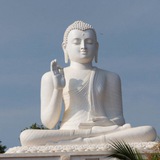
Dhammapada Verse 413
Candabhatthera Vatthu
Candamva vimalam suddham
vippasannamanavilam
nandibhavaparikkhinam1
tamaham brumi brahmanam.
Verse 413: Him I call a brahmana, who, like the moon (in a cloudless sky), is pure, clear and serene, and in whom craving for existence is extinct.
1. nandibhavaparikkhinam: one in whom craving far continued existence either in the current sensual existence or in a better and higher plane of existence in the rupa (fine material) or arupa (non-material) brahma realms, is extinct.
The Story of Thera Candabha
While residing at the Jetavana monastery, the Buddha uttered Verse (413) of this book, with reference to Thera Candabha.
Candabha had, in a previous existence, made offerings of sandalwood to a stupa where the relics of Kassapa Buddha were enshrined. For this good deed, he was reborn in a brahmin family in Savatthi. He was born with a distinguishing mark, viz., a circle of light radiating from around his navel. As this circle of light resembled the moon he came to be known as Candabha. Some brahmins, taking advantage of this unusual feature, put him on a cart and took him round the town for exhibition and only those who paid a hundred or a thousand were allowed to touch him. On one occasion, they stopped at a place between the town and the Jetavana monastery. To ariyas going to the Jetavana monastery, they said, 'What is the use of your going to the Buddha and listening to his discourses? There is no one who is as powerful as Candabha. One who touches him will get rich; why don't you come and see ?" The ariyas then said to them, "Only our teacher is powerful; he is unrivalled and matchless."
Then the brahmins took Candabha to the Jetavana monastery to compete with the Buddha. But when Candabha was in the presence of the Buddha, the ring of light went out by itself. When Candabha was taken out of sight of the Buddha, the ring of light returned automatically; it again disappeared when taken back to the presence of the Buddha. Candabha then asked the Buddha to give him the mantra (words of incantation) that would make the ring of light disappear from around his navel. The Buddha told him that the mantra could be given only to a member of his Order. Candabha told the brahmins that he was getting a mantra from the Buddha and that after mastering the mantra he would be the greatest person in the whole of Jambudipa. So the brahmins waited outside the monastery.
Meanwhile, Candabha became a bhikkhu. He was instructed to contemplate the body, i.e., to reflect on the repulsiveness and impurity of the thirty-two constituents of the body. Within a few days, Candabha attained arahatship. When the brahmins who were waiting outside the monastery came to enquire whether he had acquired the mantra, Candabha replied. "You people had better go back now; as for me I am no longer in a position to go along with you." Other bhikkhus, hearing him, went to the Buddha and said, "Candabha is falsely claiming that he has become an arahat." To them the Buddha replied, "Candabha speaks the truth; he has eradicated all moral intoxicants."
Then the Buddha spoke in verse as follows:
Verse 413: Him I call a brahmana, who, like the moon (in a cloudless sky), is pure, clear and serene, and in whom craving for existence is extinct.
===
Dhammapada, beloved and favorite teachings of the Buddha channel:
https://invite.viber.com/?g2=AQBLD6phsgvP%2F061YjEM3K%2BNeH1Yb372b9mtfQX2EmuBpgoLUoc99BDMfzHghrme
===
Candabhatthera Vatthu
Candamva vimalam suddham
vippasannamanavilam
nandibhavaparikkhinam1
tamaham brumi brahmanam.
Verse 413: Him I call a brahmana, who, like the moon (in a cloudless sky), is pure, clear and serene, and in whom craving for existence is extinct.
1. nandibhavaparikkhinam: one in whom craving far continued existence either in the current sensual existence or in a better and higher plane of existence in the rupa (fine material) or arupa (non-material) brahma realms, is extinct.
The Story of Thera Candabha
While residing at the Jetavana monastery, the Buddha uttered Verse (413) of this book, with reference to Thera Candabha.
Candabha had, in a previous existence, made offerings of sandalwood to a stupa where the relics of Kassapa Buddha were enshrined. For this good deed, he was reborn in a brahmin family in Savatthi. He was born with a distinguishing mark, viz., a circle of light radiating from around his navel. As this circle of light resembled the moon he came to be known as Candabha. Some brahmins, taking advantage of this unusual feature, put him on a cart and took him round the town for exhibition and only those who paid a hundred or a thousand were allowed to touch him. On one occasion, they stopped at a place between the town and the Jetavana monastery. To ariyas going to the Jetavana monastery, they said, 'What is the use of your going to the Buddha and listening to his discourses? There is no one who is as powerful as Candabha. One who touches him will get rich; why don't you come and see ?" The ariyas then said to them, "Only our teacher is powerful; he is unrivalled and matchless."
Then the brahmins took Candabha to the Jetavana monastery to compete with the Buddha. But when Candabha was in the presence of the Buddha, the ring of light went out by itself. When Candabha was taken out of sight of the Buddha, the ring of light returned automatically; it again disappeared when taken back to the presence of the Buddha. Candabha then asked the Buddha to give him the mantra (words of incantation) that would make the ring of light disappear from around his navel. The Buddha told him that the mantra could be given only to a member of his Order. Candabha told the brahmins that he was getting a mantra from the Buddha and that after mastering the mantra he would be the greatest person in the whole of Jambudipa. So the brahmins waited outside the monastery.
Meanwhile, Candabha became a bhikkhu. He was instructed to contemplate the body, i.e., to reflect on the repulsiveness and impurity of the thirty-two constituents of the body. Within a few days, Candabha attained arahatship. When the brahmins who were waiting outside the monastery came to enquire whether he had acquired the mantra, Candabha replied. "You people had better go back now; as for me I am no longer in a position to go along with you." Other bhikkhus, hearing him, went to the Buddha and said, "Candabha is falsely claiming that he has become an arahat." To them the Buddha replied, "Candabha speaks the truth; he has eradicated all moral intoxicants."
Then the Buddha spoke in verse as follows:
Verse 413: Him I call a brahmana, who, like the moon (in a cloudless sky), is pure, clear and serene, and in whom craving for existence is extinct.
===
Dhammapada, beloved and favorite teachings of the Buddha channel:
https://invite.viber.com/?g2=AQBLD6phsgvP%2F061YjEM3K%2BNeH1Yb372b9mtfQX2EmuBpgoLUoc99BDMfzHghrme
===
Viber
Dhammapada - Buddha Dharma Teachings
Daily teachings of the Dhammapada, beloved and favorite teachings of the Buddha
❤1👏1🙏1
Forwarded from Buddha Dharma books
Free Buddhism Dharma ebook
Collection of Buddhist Wisdom Verses
By Venerable Rerukane Candavimala Mahānāhimi, Anandajoti Bhikkhu
Free download here:
https://ftp.budaedu.org/ebooks/pdf/EN358.pdf
===
Collection of Buddhist Wisdom Verses
By Venerable Rerukane Candavimala Mahānāhimi, Anandajoti Bhikkhu
Free download here:
https://ftp.budaedu.org/ebooks/pdf/EN358.pdf
===
❤1🔥1🙏1😘1
Forwarded from Buddha Dharma books
Free Buddhism Dharma ebook
Collection of Buddhist Wisdom Verses
By Venerable Rerukane Candavimala Mahānāhimi, Anandajoti Bhikkhu
This collection of verses, made by one of the leading scholar monks in Sri Lanka in the 20th century, is one of the most useful compilations on the moral life of the layman that can befound.
Drawn mainly from the great verses collections in the Pali Nikayas almost all aspects of the lay life have been covered, and it brings together in a fairly comprehensive way many teachings that would otherwise be lost in obscurity.
Throughout the book it is possible to find teachings on all matters of the ethical life, that will help guide anyone to make better life-choices whether it be at business and work, or in the home life and their various relationships.
Around two-thirds of the verses are drawn from the Jataka stories, and it was this great storehouse of wisdom stories that formed the ethical thinking of most of the Buddhist societies in the Middle Ages, but which now has gone out of fashion.
The great heroes of those days, in such strong contrast to the present day, were the Bodhisatta, the penitant hermits in the woods, the great Kings who ruled justly, and the clever and mischievous animals who had a moral to illustrate, and who all came alive on the greater canvas of the moral universe.
Free download here:
https://ftp.budaedu.org/ebooks/pdf/EN358.pdf
===
Collection of Buddhist Wisdom Verses
By Venerable Rerukane Candavimala Mahānāhimi, Anandajoti Bhikkhu
This collection of verses, made by one of the leading scholar monks in Sri Lanka in the 20th century, is one of the most useful compilations on the moral life of the layman that can befound.
Drawn mainly from the great verses collections in the Pali Nikayas almost all aspects of the lay life have been covered, and it brings together in a fairly comprehensive way many teachings that would otherwise be lost in obscurity.
Throughout the book it is possible to find teachings on all matters of the ethical life, that will help guide anyone to make better life-choices whether it be at business and work, or in the home life and their various relationships.
Around two-thirds of the verses are drawn from the Jataka stories, and it was this great storehouse of wisdom stories that formed the ethical thinking of most of the Buddhist societies in the Middle Ages, but which now has gone out of fashion.
The great heroes of those days, in such strong contrast to the present day, were the Bodhisatta, the penitant hermits in the woods, the great Kings who ruled justly, and the clever and mischievous animals who had a moral to illustrate, and who all came alive on the greater canvas of the moral universe.
Free download here:
https://ftp.budaedu.org/ebooks/pdf/EN358.pdf
===
❤1🤩1🫡1
"How should we act, Lord, respecting the body of the Tathagata?"
"Do not hinder yourselves, Ananda, to honor the body of the Tathagata... At a crossroads also a stupa should be raised for the Tathagata. And whosoever shall bring to that place garlands or incense or sandalpaste, or pay reverence, and whose mind becomes calm there — it will be to his well being and happiness for a long time."
Partial excerpt from DN 16 : Maha-parinibbana Sutta
"Do not hinder yourselves, Ananda, to honor the body of the Tathagata... At a crossroads also a stupa should be raised for the Tathagata. And whosoever shall bring to that place garlands or incense or sandalpaste, or pay reverence, and whose mind becomes calm there — it will be to his well being and happiness for a long time."
Partial excerpt from DN 16 : Maha-parinibbana Sutta
👍3❤1😁1🤩1
Dhammapada Verse 414
Sivalitthera Vatthu
Yo'mam palipatham duggam
samsaram mohamaccaga
tinno parangato jhayi
anejo akathamkathi
anupadaya nibbuto
tamaham brumi brahmanam.
Verse 414: Him I call a brahmana, who, having traversed this dangerous swamp (of passion), this difficult road (of moral defilements), the ocean of life (samsara) and the darkness of ignorance (moha), and having crossed the fourfold Flood, has reached the other shore (Nibbana); who practises Tranquility and Insight Meditation, who is free from craving and from doubt, who clings to nothing and remains in perfect peace.
The Story of Thera Sivali
While residing in the Kundadhana forest near the city of Kundakoliya, the Buddha uttered Verse (414) of this book, with reference to Thera Sivali.
Princess Suppavasa of Kundakoliya was in pregnancy for seven years and then for seven days she was in labour pains. She kept contemplating the unique qualities of the Buddha, the Dhamma and the Samgha and in the end she sent her husband to the Buddha to pay obeisance to him on her behalf and to inform him of her condition. When informed of the condition of the princess, the Buddha said, "May Suppavasa be free from danger and from sorrow; may she give birth to a healthy noble son in safety." As these words were being spoken, Suppavasa gave birth to her son at her house. On that very day, soon after the birth of the child, the Buddha and some bhikkhus were invited to the house. Alms-food was offered there and the newly born child offered filtered water to the Buddha and the bhikkhus. To celebrate the birth of the child, the parents invited the Buddha and the bhikkhus to their house to offer food for seven days.
When the child grew up he was admitted to the Order and as a bhikkhu he was known as Sivali. He attained arahatship as soon as his head was shaved off. Later, he became famous as the bhikkhu who received the largest amount of offerings. As a recipient of offerings he was unsurpassed.
On one occasion, the bhikkhus asked the Buddha why Sivali, with the qualifications to become an arahat, was confined in his mother's womb for seven years. To them the Buddha replied, "Bhikkhus! In a previous existence, Sivali was the son of a king who lost his kingdom to another king. In trying to regain their kingdom he had besieged the city on the advice of his mother. As a result, the people in the city were without food or water for seven days. It was for this evil deed that Sivali was imprisoned in his mother's womb for seven years. But now, Sivali has come to the end of all dukkha; he has realized Nibbana."
Then the Buddha spoke in verse as follows:
Verse 414: Him I call a brahmana, who, having traversed this dangerous swamp (of passion), this difficult road (of moral defilements), the ocean of life (samsara) and the darkness of ignorance (moha), and having crossed the fourfold Flood, has reached the other shore (Nibbana); who practises Tranquility and Insight Meditation, who is free from craving and from doubt, who clings to nothing and remains in perfect peace.
===
Ajahn Chah, Buddhist teacher of Thai forest meditation of Theravada Buddhism channel:
https://news.1rj.ru/str/ajahnchah_buddhism
===
Sivalitthera Vatthu
Yo'mam palipatham duggam
samsaram mohamaccaga
tinno parangato jhayi
anejo akathamkathi
anupadaya nibbuto
tamaham brumi brahmanam.
Verse 414: Him I call a brahmana, who, having traversed this dangerous swamp (of passion), this difficult road (of moral defilements), the ocean of life (samsara) and the darkness of ignorance (moha), and having crossed the fourfold Flood, has reached the other shore (Nibbana); who practises Tranquility and Insight Meditation, who is free from craving and from doubt, who clings to nothing and remains in perfect peace.
The Story of Thera Sivali
While residing in the Kundadhana forest near the city of Kundakoliya, the Buddha uttered Verse (414) of this book, with reference to Thera Sivali.
Princess Suppavasa of Kundakoliya was in pregnancy for seven years and then for seven days she was in labour pains. She kept contemplating the unique qualities of the Buddha, the Dhamma and the Samgha and in the end she sent her husband to the Buddha to pay obeisance to him on her behalf and to inform him of her condition. When informed of the condition of the princess, the Buddha said, "May Suppavasa be free from danger and from sorrow; may she give birth to a healthy noble son in safety." As these words were being spoken, Suppavasa gave birth to her son at her house. On that very day, soon after the birth of the child, the Buddha and some bhikkhus were invited to the house. Alms-food was offered there and the newly born child offered filtered water to the Buddha and the bhikkhus. To celebrate the birth of the child, the parents invited the Buddha and the bhikkhus to their house to offer food for seven days.
When the child grew up he was admitted to the Order and as a bhikkhu he was known as Sivali. He attained arahatship as soon as his head was shaved off. Later, he became famous as the bhikkhu who received the largest amount of offerings. As a recipient of offerings he was unsurpassed.
On one occasion, the bhikkhus asked the Buddha why Sivali, with the qualifications to become an arahat, was confined in his mother's womb for seven years. To them the Buddha replied, "Bhikkhus! In a previous existence, Sivali was the son of a king who lost his kingdom to another king. In trying to regain their kingdom he had besieged the city on the advice of his mother. As a result, the people in the city were without food or water for seven days. It was for this evil deed that Sivali was imprisoned in his mother's womb for seven years. But now, Sivali has come to the end of all dukkha; he has realized Nibbana."
Then the Buddha spoke in verse as follows:
Verse 414: Him I call a brahmana, who, having traversed this dangerous swamp (of passion), this difficult road (of moral defilements), the ocean of life (samsara) and the darkness of ignorance (moha), and having crossed the fourfold Flood, has reached the other shore (Nibbana); who practises Tranquility and Insight Meditation, who is free from craving and from doubt, who clings to nothing and remains in perfect peace.
===
Ajahn Chah, Buddhist teacher of Thai forest meditation of Theravada Buddhism channel:
https://news.1rj.ru/str/ajahnchah_buddhism
===
Telegram
Ajahn Chah - Theravada Thailand Buddhism
Collection of teachings of Venerable Ajahn Chah, a foremost meditation and Buddhist teacher from Thailand
❤1👍1🔥1🙏1
Forwarded from Buddha
Directed and Undirected Meditation
The Bhikkhunivasako Sutta explains how to incorporate different approaches to meditation into our practice.
Translation and commentary by Andrew Olendzki
Part 1 of 2
While many contemporary Buddhist teachers work diligently to make meditation instructions accessible to a modern audience, we can sometimes lose sight of the practices’ origins in classical Buddhist texts. One way to reconnect with those roots is by reading the suttas (Sanskrit, sutras), the discourses of the Buddha collected by his disciples in the Pali Canon, which contains some of the earliest-dated Buddhist texts.
Many of the suttas contain practical meditation instruction. The Satipatthana Sutta, for example, covers the Buddha’s teachings on mindfulness, and is widely known and taught.
Below, Buddhist scholar Andrew Olendzki introduces the lesser-known Bhikkhunivasako Sutta (SN 47.10; Thai, Bhikkhunupassaya). As Olendzki points out, this sutta offers instructions for using “directed” and “undirected” meditation practices. In directed meditation, a practitioner focuses on a particular object (recalling an image of the Buddha, for example). In undirected meditation, which is sometimes called “open awareness” meditation, the practitioner focuses their mind on whatever naturally arises in experience, shifting attention from one object to another.
What the Buddha says here about directed and undirected meditation is particularly interesting in light of the modern integration of metta [lovingkindness] practice with vipassana [insight] practice. The Buddha seems to acknowledge that mindful awareness is sometimes difficult to come by, and that there are times when one’s “mind becomes scattered” by the arising of challenging mind states. (Has this ever happened to you?)
His response here is not the warrior’s tone sometimes found in the texts, whereby the practitioner should just overcome the unwholesome thoughts and rouse up sufficient heroic energy to re-establish mindfulness. Nor is it the gentler response we often hear in the dhamma [dharma] hall, to just be aware of what is arising, without judgment of any kind, gently returning our attention to the breath or other primary object of meditation. Rather, the Buddha’s suggestion is a deliberate redirection of our attention to a “satisfactory image.”
The Pali words here are pasadaniya nimitta. A nimitta is an image or manifestation that appears in the mind—something akin to a sign, a vision, or an appearance of an object in the “mind’s eye.” It is the term used in visualization meditations, and even has a slight connotation of “conjuring up” something in the mind.
The adjective pasadaniya is translated by F. L. Woodward in the Pali Text Society edition as “pleasurable,” but this sort of term is too easily misconstrued in Buddhist contexts. I don’t think the Buddha is suggesting here that we seek something pleasant in order to avoid the arising discomfort. Rather he is suggesting a short-term strategy for the practical disarming of the mind’s defense mechanisms.
The 5th-century Indian Theravada Buddhist commentator Buddhaghosa suggests that the image of the Buddha might be an example of a satisfactory image, but probably anything wholesome and that will not produce a strong craving (of attachment or aversion) will do. The idea is just to redirect the mind to flow around the obstacle that has appeared, but not to use something that will itself become another obstacle.
The practical effect of this redirection of attention is the natural calming of the mind and relaxation of the body. Only from tranquillity can true alertness arise—otherwise the mind’s attentiveness is just busy or restless.
But as the ensuing passage confirms, this excursion into the deliberate cultivation of a specific image can be abandoned as soon as its mission, the restoration of concentration, has been fulfilled. Insight meditation has never been about cultivating blissful states of mind or body for their own sake.
The Bhikkhunivasako Sutta explains how to incorporate different approaches to meditation into our practice.
Translation and commentary by Andrew Olendzki
Part 1 of 2
While many contemporary Buddhist teachers work diligently to make meditation instructions accessible to a modern audience, we can sometimes lose sight of the practices’ origins in classical Buddhist texts. One way to reconnect with those roots is by reading the suttas (Sanskrit, sutras), the discourses of the Buddha collected by his disciples in the Pali Canon, which contains some of the earliest-dated Buddhist texts.
Many of the suttas contain practical meditation instruction. The Satipatthana Sutta, for example, covers the Buddha’s teachings on mindfulness, and is widely known and taught.
Below, Buddhist scholar Andrew Olendzki introduces the lesser-known Bhikkhunivasako Sutta (SN 47.10; Thai, Bhikkhunupassaya). As Olendzki points out, this sutta offers instructions for using “directed” and “undirected” meditation practices. In directed meditation, a practitioner focuses on a particular object (recalling an image of the Buddha, for example). In undirected meditation, which is sometimes called “open awareness” meditation, the practitioner focuses their mind on whatever naturally arises in experience, shifting attention from one object to another.
What the Buddha says here about directed and undirected meditation is particularly interesting in light of the modern integration of metta [lovingkindness] practice with vipassana [insight] practice. The Buddha seems to acknowledge that mindful awareness is sometimes difficult to come by, and that there are times when one’s “mind becomes scattered” by the arising of challenging mind states. (Has this ever happened to you?)
His response here is not the warrior’s tone sometimes found in the texts, whereby the practitioner should just overcome the unwholesome thoughts and rouse up sufficient heroic energy to re-establish mindfulness. Nor is it the gentler response we often hear in the dhamma [dharma] hall, to just be aware of what is arising, without judgment of any kind, gently returning our attention to the breath or other primary object of meditation. Rather, the Buddha’s suggestion is a deliberate redirection of our attention to a “satisfactory image.”
The Pali words here are pasadaniya nimitta. A nimitta is an image or manifestation that appears in the mind—something akin to a sign, a vision, or an appearance of an object in the “mind’s eye.” It is the term used in visualization meditations, and even has a slight connotation of “conjuring up” something in the mind.
The adjective pasadaniya is translated by F. L. Woodward in the Pali Text Society edition as “pleasurable,” but this sort of term is too easily misconstrued in Buddhist contexts. I don’t think the Buddha is suggesting here that we seek something pleasant in order to avoid the arising discomfort. Rather he is suggesting a short-term strategy for the practical disarming of the mind’s defense mechanisms.
The 5th-century Indian Theravada Buddhist commentator Buddhaghosa suggests that the image of the Buddha might be an example of a satisfactory image, but probably anything wholesome and that will not produce a strong craving (of attachment or aversion) will do. The idea is just to redirect the mind to flow around the obstacle that has appeared, but not to use something that will itself become another obstacle.
The practical effect of this redirection of attention is the natural calming of the mind and relaxation of the body. Only from tranquillity can true alertness arise—otherwise the mind’s attentiveness is just busy or restless.
But as the ensuing passage confirms, this excursion into the deliberate cultivation of a specific image can be abandoned as soon as its mission, the restoration of concentration, has been fulfilled. Insight meditation has never been about cultivating blissful states of mind or body for their own sake.
Telegram
Buddha
Buddha dharma teachings from the suttas and commentaries
👍2❤1💯1
Forwarded from Buddha
As a skillful means for helping our understanding “become ever greater and more excellent,” it seems to be a useful technique. I think we need to rely upon the guidance of experienced meditation teachers, however, to help us discern when it is appropriate to apply this strategy. The mind is so capricious: it may turn to a more pleasurable object of awareness just to escape the growing pains of evolving insight; or it may mislead itself into thinking it is practicing undirected meditation when it is actually just spacing out.
===
Buddha dharma teachings channel:
https://news.1rj.ru/str/lorddivinebuddha
===
===
Buddha dharma teachings channel:
https://news.1rj.ru/str/lorddivinebuddha
===
Telegram
Buddha
Buddha dharma teachings from the suttas and commentaries
❤1👌1🏆1
Pabhassara citta
“Pabhassaram idaṁ, bhikkhave, cittaṁ. Tañca kho āgantukehi upakkilesehi upakkiliṭṭhaṁ.
Pabhassaram idaṁ, bhikkhave, cittaṁ. Tañca kho āgantukehi upakkilesehi vippamuttaṁ.”
“Bhikkhus, this mind is luminous, but it is defiled by incoming defilements.
Bhikkhus, this mind is luminous, and it is free from incoming defilements.”
Anguttara Nikaya 1.49–52
“Pabhassaram idaṁ, bhikkhave, cittaṁ. Tañca kho āgantukehi upakkilesehi upakkiliṭṭhaṁ.
Pabhassaram idaṁ, bhikkhave, cittaṁ. Tañca kho āgantukehi upakkilesehi vippamuttaṁ.”
“Bhikkhus, this mind is luminous, but it is defiled by incoming defilements.
Bhikkhus, this mind is luminous, and it is free from incoming defilements.”
Anguttara Nikaya 1.49–52
🙏2❤1🥰1😇1
Directed and Undirected Meditation
The Bhikkhunivasako Sutta explains how to incorporate different approaches to meditation into our practice.
Translation and commentary by Andrew Olendzki
Part 2 of 2
One important thing to notice about this passage is that the undirected meditation is occurring squarely within the context of the foundations of mindfulness [body, feeling, mind, and mental states]. This is not “object-less awareness” (which is not even possible in the early Buddhist models of mind), or the “awareness of awareness itself” that is mentioned in some traditions.
The meditator understands his awareness to be free and undirected, while contemplating body as body, feeling as feeling, mind as mind, and mental states as mental states. What distinguishes undirected meditation from directed meditation is simply the role of intention in the process.
Another interesting aspect of this sutta is that the framing story shows clearly that women were diligent and successful practitioners of insight meditation in the Buddha’s time, and that they were well-supported in this pursuit. Ananda, the Buddha’s cousin and lifelong assistant, was a great champion of the nuns’ cause and would often visit communities of nuns to encourage their dhamma practice. The Buddha seems to take the opportunity of Ananda’s report to expound on some of the details of mindfulness technique.
—Andrew Olendzki
Bhikkhunivasako Sutta – At the Nuns’ Residence
The venerable Ananda arose early one morning, and taking up his robe and bowl approached a certain settlement of nuns, where he sat down on a seat that had been prepared. A number of nuns approached the venerable Ananda, and after greeting him, sat down to one side. So seated, these nuns said this to the venerable Ananda: “There are here, Ananda sir, a number of nuns who abide with minds well established in the four foundations of mindfulness. Their understanding is becoming ever greater and more excellent.”
“So it is, Sisters, so it is!” replied Ananda. “Indeed for anybody, Sisters, whether monk or nun, who abides with a mind well established in the four foundations of mindfulness—it is to be expected that their understanding becomes ever greater and more excellent.”
[Ananda later relates this exchange to the Buddha, who approves of his response and then elaborates:]
Here, Ananda, a monk abides contemplating body as body—ardent, fully aware, mindful—leading away the unhappiness that comes from wanting the things of the world. And for one who is abiding contemplating body as body, a bodily object arises, or bodily distress, or mental sluggishness, that scatters his mind outward. [This passage is repeated for the other three foundations of mindfulness: feelings as feelings; mind as mind; mental states as mental states.] Then the monk should direct his mind to some satisfactory image. When the mind is directed to some satisfactory image, happiness is born. From this happiness, joy is then born. With a joyful mind, the body relaxes. A relaxed body feels content, and the mind of one content becomes concentrated. He then reflects: “The purpose for which I directed my my mind has been accomplished. So now I shall withdraw [directed attention from the image].” He withdraws, and no longer thinks upon or thinks about [the image]. He understands: “I am not thinking upon or thinking about [anything]. Inwardly mindful, I am content.” This is directed meditation.
And what is undirected meditation? Not directing his mind outward, a monk understands: “My mind is not directed outward.” He understands: “Not focused on before or after; free; undirected.” And he understands: “I abide observing body as body—ardent, fully aware, mindful—I am content.” This is undirected meditation.
And so, Ananda, I have taught directed meditation; and I have taught undirected meditation. Whatever is to be done by a teacher with compassion for the welfare of students, that has been done by me out of compassion for you. Here are the roots of trees. Here are empty places. Get down and meditate. Don’t be lazy.
The Bhikkhunivasako Sutta explains how to incorporate different approaches to meditation into our practice.
Translation and commentary by Andrew Olendzki
Part 2 of 2
One important thing to notice about this passage is that the undirected meditation is occurring squarely within the context of the foundations of mindfulness [body, feeling, mind, and mental states]. This is not “object-less awareness” (which is not even possible in the early Buddhist models of mind), or the “awareness of awareness itself” that is mentioned in some traditions.
The meditator understands his awareness to be free and undirected, while contemplating body as body, feeling as feeling, mind as mind, and mental states as mental states. What distinguishes undirected meditation from directed meditation is simply the role of intention in the process.
Another interesting aspect of this sutta is that the framing story shows clearly that women were diligent and successful practitioners of insight meditation in the Buddha’s time, and that they were well-supported in this pursuit. Ananda, the Buddha’s cousin and lifelong assistant, was a great champion of the nuns’ cause and would often visit communities of nuns to encourage their dhamma practice. The Buddha seems to take the opportunity of Ananda’s report to expound on some of the details of mindfulness technique.
—Andrew Olendzki
Bhikkhunivasako Sutta – At the Nuns’ Residence
The venerable Ananda arose early one morning, and taking up his robe and bowl approached a certain settlement of nuns, where he sat down on a seat that had been prepared. A number of nuns approached the venerable Ananda, and after greeting him, sat down to one side. So seated, these nuns said this to the venerable Ananda: “There are here, Ananda sir, a number of nuns who abide with minds well established in the four foundations of mindfulness. Their understanding is becoming ever greater and more excellent.”
“So it is, Sisters, so it is!” replied Ananda. “Indeed for anybody, Sisters, whether monk or nun, who abides with a mind well established in the four foundations of mindfulness—it is to be expected that their understanding becomes ever greater and more excellent.”
[Ananda later relates this exchange to the Buddha, who approves of his response and then elaborates:]
Here, Ananda, a monk abides contemplating body as body—ardent, fully aware, mindful—leading away the unhappiness that comes from wanting the things of the world. And for one who is abiding contemplating body as body, a bodily object arises, or bodily distress, or mental sluggishness, that scatters his mind outward. [This passage is repeated for the other three foundations of mindfulness: feelings as feelings; mind as mind; mental states as mental states.] Then the monk should direct his mind to some satisfactory image. When the mind is directed to some satisfactory image, happiness is born. From this happiness, joy is then born. With a joyful mind, the body relaxes. A relaxed body feels content, and the mind of one content becomes concentrated. He then reflects: “The purpose for which I directed my my mind has been accomplished. So now I shall withdraw [directed attention from the image].” He withdraws, and no longer thinks upon or thinks about [the image]. He understands: “I am not thinking upon or thinking about [anything]. Inwardly mindful, I am content.” This is directed meditation.
And what is undirected meditation? Not directing his mind outward, a monk understands: “My mind is not directed outward.” He understands: “Not focused on before or after; free; undirected.” And he understands: “I abide observing body as body—ardent, fully aware, mindful—I am content.” This is undirected meditation.
And so, Ananda, I have taught directed meditation; and I have taught undirected meditation. Whatever is to be done by a teacher with compassion for the welfare of students, that has been done by me out of compassion for you. Here are the roots of trees. Here are empty places. Get down and meditate. Don’t be lazy.
Telegram
Dhammapada - Buddha Dharma Teachings
Daily teachings of the Dhammapada, beloved and favorite teachings of the Buddha
🥰2❤1👍1
Don’t become one who is later remorseful. This is my instruction to you.
This translation available at www.dhammatalks.org
===
Part 1 of 2:
https://news.1rj.ru/str/lorddivinebuddha/2925
Part 2 of 2:
https://news.1rj.ru/str/dhammapadas/2508
===
Andrew Olendzki is a professor at Lesley University and the director of its graduate program in Mindfulness Studies. He teaches two Tricycle Online Courses: Going Forth and Living in Harmony, and he created the daily email course Dhamma Wheel.
===
Dhammapada, beloved and favorite teachings of the Buddha channel:
https://news.1rj.ru/str/dhammapadas
===
This translation available at www.dhammatalks.org
===
Part 1 of 2:
https://news.1rj.ru/str/lorddivinebuddha/2925
Part 2 of 2:
https://news.1rj.ru/str/dhammapadas/2508
===
Andrew Olendzki is a professor at Lesley University and the director of its graduate program in Mindfulness Studies. He teaches two Tricycle Online Courses: Going Forth and Living in Harmony, and he created the daily email course Dhamma Wheel.
===
Dhammapada, beloved and favorite teachings of the Buddha channel:
https://news.1rj.ru/str/dhammapadas
===
❤1🔥1💯1🤝1
Dhammapada Verse 415
Sundarasamuddatthera Vatthu
Yo'dha kime pahantvana
anagaro paribbaje
kamabhavaparikkhinam
tamaham brumi brahmanam.
Verse 415: Him I call a brahmana, who, in this world, has given up sensual pleasures, and leaving the home-life has become a bhikkhu; who has eradicated sensual desires and has come to the end of existence.
The Story of Thera Sundarasamudda
While residing at the Jetavana monastery, the Buddha uttered Verse (415) of this book, with reference to Thera Sundarasamudda.
Sundarasamudda was the son of a rich man from Savatthi. After he had entered the Order, he left for Rajagaha, which was forty-five yojanas away from Savatthi, to practise meditation. One day, while some festivities were going on in Savatthi, the parents of Sundarasamudda missed him very much; they also felt sorry for their son who was missing all the enjoyment and they wept. As they were weeping, a courtesan came to them and asked what the matter was. On hearing about their son, the courtesan said, "If I could make your son leave the Order and return to the life of a lay man how would you reward me?" The parents answered that they would make her rich. The courtesan then asked for a large sum of money and left for Rajagaha with a number of followers.
At Rajagaha, she rented a house with seven-tiered pinnacles on the route where Thera Sundarasamudda would come on his alms-round. She prepared good food and waited for him. On the first few days, she offered alms-food to the thera at the door of her house. Later, she invited him to come inside. Meanwhile, she paid money to some children to come and play just outside the house about the time the thera usually came on his alms-round. This gave her the excuse that it was very dusty and noisy on the ground floor; with this excuse she invited the thera to the top floor to have his alms-food. The thera consented and went up and as soon as he had entered the room, the courtesan closed the door. Then she started seducing the thera. She said to the thera, "Venerable Sir! Please be my youthful and energetic husband, and I will be your dearly beloved wife. After our long and happy wedded life we can both leave it to enter the Order and strive our very best to attain Nibbana." When he heard these words the thera suddenly realized his mistake and got alarmed. Then he said to himself, "Indeed, by being negligent and unmindful I have made a great mistake."
At that instant, the Buddha saw from his Perfumed Chamber what was happening to Thera Sundarasamudda at Rajagaha. He called the Venerable Ananda and said to him, "Ananda! On an upper storey of a pinnacled building in Rajagaha, there now goes on a struggle between Sundarasamudda and a courtesan; but in the end the thera will be the winner." After saying this to Ananda, the Buddha sent forth his radiance to the thera, made him feel his presence, and said, "My son! Be resolute and get rid of love of wealth and sensual pleasures."
Then the Buddha spoke in verse as follows:
Verse 415: Him I call a brahmana, who, in this world, has given up sensual pleasures, and leaving the home-life has become a bhikkhu; who has eradicated sensual desires and has come to the end of existence.
At the end of the discourse the thera attained arahatship, and by supernormal power passed through the roof into the sky and went to the Buddha.
===
Free Buddhism books, teachings, podcasts and videos from Theravada, Mahayana and Vajrayana traditions:
https://news.1rj.ru/str/buddha_ebooks
===
Sundarasamuddatthera Vatthu
Yo'dha kime pahantvana
anagaro paribbaje
kamabhavaparikkhinam
tamaham brumi brahmanam.
Verse 415: Him I call a brahmana, who, in this world, has given up sensual pleasures, and leaving the home-life has become a bhikkhu; who has eradicated sensual desires and has come to the end of existence.
The Story of Thera Sundarasamudda
While residing at the Jetavana monastery, the Buddha uttered Verse (415) of this book, with reference to Thera Sundarasamudda.
Sundarasamudda was the son of a rich man from Savatthi. After he had entered the Order, he left for Rajagaha, which was forty-five yojanas away from Savatthi, to practise meditation. One day, while some festivities were going on in Savatthi, the parents of Sundarasamudda missed him very much; they also felt sorry for their son who was missing all the enjoyment and they wept. As they were weeping, a courtesan came to them and asked what the matter was. On hearing about their son, the courtesan said, "If I could make your son leave the Order and return to the life of a lay man how would you reward me?" The parents answered that they would make her rich. The courtesan then asked for a large sum of money and left for Rajagaha with a number of followers.
At Rajagaha, she rented a house with seven-tiered pinnacles on the route where Thera Sundarasamudda would come on his alms-round. She prepared good food and waited for him. On the first few days, she offered alms-food to the thera at the door of her house. Later, she invited him to come inside. Meanwhile, she paid money to some children to come and play just outside the house about the time the thera usually came on his alms-round. This gave her the excuse that it was very dusty and noisy on the ground floor; with this excuse she invited the thera to the top floor to have his alms-food. The thera consented and went up and as soon as he had entered the room, the courtesan closed the door. Then she started seducing the thera. She said to the thera, "Venerable Sir! Please be my youthful and energetic husband, and I will be your dearly beloved wife. After our long and happy wedded life we can both leave it to enter the Order and strive our very best to attain Nibbana." When he heard these words the thera suddenly realized his mistake and got alarmed. Then he said to himself, "Indeed, by being negligent and unmindful I have made a great mistake."
At that instant, the Buddha saw from his Perfumed Chamber what was happening to Thera Sundarasamudda at Rajagaha. He called the Venerable Ananda and said to him, "Ananda! On an upper storey of a pinnacled building in Rajagaha, there now goes on a struggle between Sundarasamudda and a courtesan; but in the end the thera will be the winner." After saying this to Ananda, the Buddha sent forth his radiance to the thera, made him feel his presence, and said, "My son! Be resolute and get rid of love of wealth and sensual pleasures."
Then the Buddha spoke in verse as follows:
Verse 415: Him I call a brahmana, who, in this world, has given up sensual pleasures, and leaving the home-life has become a bhikkhu; who has eradicated sensual desires and has come to the end of existence.
At the end of the discourse the thera attained arahatship, and by supernormal power passed through the roof into the sky and went to the Buddha.
===
Free Buddhism books, teachings, podcasts and videos from Theravada, Mahayana and Vajrayana traditions:
https://news.1rj.ru/str/buddha_ebooks
===
Telegram
Buddha Dharma books
Free Buddhism books, teachings, podcasts and videos from Theravada, Mahayana and Vajrayana traditions
❤2👍2🥰1🙏1
Forwarded from Words of the Buddha
Buddham Saranam Gacchami
Dhammam Saranam Gacchami
Sangham Saranam Gacchami
I go to the Buddha for refuge.
I go to the Dhamma for refuge.
I go to the Sangha for refuge.
बुद्धं शरणं गच्छामि। धर्मं शरणं गच्छामि। संघं शरणं गच्छामि।
Dhammam Saranam Gacchami
Sangham Saranam Gacchami
I go to the Buddha for refuge.
I go to the Dhamma for refuge.
I go to the Sangha for refuge.
बुद्धं शरणं गच्छामि। धर्मं शरणं गच्छामि। संघं शरणं गच्छामि।
❤1🙏1👌1😇1
Forwarded from Buddha Dharma books
Free Buddha Dharma ebook
Awareness Itself
By Ajaan Fuang Jotiko
A collection of teachings spanning the whole range of practice by Ajaan Lee’s principal student and Ṭhānissaro Bhikkhu’s teacher.
Free download here:
https://www.dhammatalks.org/Archive/Writings/Ebooks/AwarenessItself_181215.pdf
===
Awareness Itself
By Ajaan Fuang Jotiko
A collection of teachings spanning the whole range of practice by Ajaan Lee’s principal student and Ṭhānissaro Bhikkhu’s teacher.
Free download here:
https://www.dhammatalks.org/Archive/Writings/Ebooks/AwarenessItself_181215.pdf
===
❤1👍1🕊1
Forwarded from Buddha Dharma books
Free Buddha Dharma ebook
Awareness Itself
By Ajaan Fuang Jotiko
A collection of teachings spanning the whole range of practice by Ajaan Lee’s principal student and Ṭhānissaro Bhikkhu’s teacher.
Free download here:
https://www.dhammatalks.org/Archive/Writings/Ebooks/AwarenessItself_181215.pdf
===
Awareness Itself
By Ajaan Fuang Jotiko
A collection of teachings spanning the whole range of practice by Ajaan Lee’s principal student and Ṭhānissaro Bhikkhu’s teacher.
Free download here:
https://www.dhammatalks.org/Archive/Writings/Ebooks/AwarenessItself_181215.pdf
===
❤1🥰1🤝1