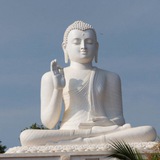
Forwarded from Buddha
“Ānanda, there are these 8 causes for a great earthquake.
This great earth is grounded on water, the water is grounded on air, and the air stands in space. At a time when a great wind blows, it stirs the water, and the water stirs the earth. This is the first cause..
..there is an brahmin or a powerful god that developed a limited perception of earth and a limitless perception of water. They make the earth shake and rock and tremble. This is the 2nd..
..when the being intent on awakening passes away from the host of joyful gods, he’s conceived in his mother’s belly, mindful and aware.. The 3rd .. [..when comes out of his mother’s belly mindful and aware..The 4th ..]
..when the Realized One realizes the supreme perfect awakening.. The 5th .. [..when rolls forth the supreme Wheel of Dhamma..The 6th..] [..when mindful and aware, surrenders the life force..The 7th ..] [..when becomes fully extinguished in the element of extinguishment with no residue..The 8th..]
Partial excerpts from AN 8.70: Bhūmicālasutta
This great earth is grounded on water, the water is grounded on air, and the air stands in space. At a time when a great wind blows, it stirs the water, and the water stirs the earth. This is the first cause..
..there is an brahmin or a powerful god that developed a limited perception of earth and a limitless perception of water. They make the earth shake and rock and tremble. This is the 2nd..
..when the being intent on awakening passes away from the host of joyful gods, he’s conceived in his mother’s belly, mindful and aware.. The 3rd .. [..when comes out of his mother’s belly mindful and aware..The 4th ..]
..when the Realized One realizes the supreme perfect awakening.. The 5th .. [..when rolls forth the supreme Wheel of Dhamma..The 6th..] [..when mindful and aware, surrenders the life force..The 7th ..] [..when becomes fully extinguished in the element of extinguishment with no residue..The 8th..]
Partial excerpts from AN 8.70: Bhūmicālasutta
😢1🙏1👌1🕊1
Dhammapada Verses 419 and 420
Vangisatthera Vatthu
Cutim yo vedi sattanam
upapattinca sabbaso
asattam sugatam buddham
tamaham brumi brahmanam.
Yassa gatim na jananti
deva gandhabbamanusa
khinasavam arahantam
tamaham brumi brahmanam.
Verse 419: Him I call a brahmana, who knows the death and rebirth of beings in every detail, who is detached, who follows the good practice and knows the Four Noble Truths.
Verse 420: Him I call a brahmana, whose destination the devas or gandhabbas or men do not know who has eradicated moral intoxicants and is an arahat.
The Story of Thera Vangisa
While residing at the Jetavana monastery, the Buddha uttered Verses (419) and (420) of this book, with reference to Thera Vangisa.
Once, in Rajagaha, there was a brahmin by the name of Vangisa who by simply tapping on the skull of a dead person could tell whether that person was reborn in the world of the devas, or of the human beings, or in one of the four lower worlds (apayas). The brahmins took Vangisa to many villages and people flocked to him and paid him ten, twenty or a hundred to find out from him where their various dead relatives were reborn.
On one occasion, Vangisa and his party came to a place not far from the Jetavana monastery. Seeing those people who were going to the Buddha, the brahmins invited them to come to Vangisa who could tell where their relatives had been reborn. But the Buddha's disciples said to them, "Our teacher is one without a rival, he only is the Enlightened One." The brahmins took that statement as a challenge and took Vangisa along with them to the Jetavana monastery to compete with the Buddha. The Buddha, knowing their intention, instructed the bhikkhus to bring the skulls of a person reborn in niraya, of a person reborn in the animal world, of a person reborn in the human world, of a person reborn in the deva world and also of an arahat. The five were then placed in a row. When Vangisa was shown those skulls he could tell where the owners of the first four skulls were reborn but when he came to the skull of the arahat he was at a loss. Then the Buddha said, "Vangisa, don't you know? I do know where the owner of that skull is." Vangisa then asked the Buddha to let him have the magical incantation (mantra) by which he could thus know; but the Buddha told him that the mantra could be given only to a bhikkhu. Vangisa then told the brahmins to wait outside the monastery while he was being taught the mantra. Thus, Vangisa became a bhikkhu and as a bhikkhu, he was instructed by the Buddha to contemplate the thirty-two constituents of the body. Vangisa diligently practised meditation as instructed by the Buddha and attained arahatship within a short time.
When the brahmins who were waiting outside the monastery came to ask Vangisa whether he had acquired the mantra, Vangisa said, "You all had better go now; as for me, I should no longer go along with you." Other bhikkhus hearing him thought he was telling lies, so they went to the Buddha and said, "Venerable Sir! Vangisa is falsely claiming to have attained arahatship." To them the Buddha said, "Bhikkhus! Vangisa really knows the death and rebirth of beings."
Then the Buddha spoke in verse as follows:
Verse 419: Him I call a brahmana, who knows the death and rebirth of beings in every detail, who is detached, who follows the good practice and knows the Four Noble Truths.
Verse 420: Him I call a brahmana, whose destination the devas or gandhabbas or men do not know who has eradicated moral intoxicants and is an arahat.
===
Buddha dharma teachings channel:
https://invite.viber.com/?g2=AQAKw1y3rv%2F6sk61PI2W4izuIiaEZj8YZujhY1tSzL%2B07s7rFnVFDAd0bAYFaMLw
===
Vangisatthera Vatthu
Cutim yo vedi sattanam
upapattinca sabbaso
asattam sugatam buddham
tamaham brumi brahmanam.
Yassa gatim na jananti
deva gandhabbamanusa
khinasavam arahantam
tamaham brumi brahmanam.
Verse 419: Him I call a brahmana, who knows the death and rebirth of beings in every detail, who is detached, who follows the good practice and knows the Four Noble Truths.
Verse 420: Him I call a brahmana, whose destination the devas or gandhabbas or men do not know who has eradicated moral intoxicants and is an arahat.
The Story of Thera Vangisa
While residing at the Jetavana monastery, the Buddha uttered Verses (419) and (420) of this book, with reference to Thera Vangisa.
Once, in Rajagaha, there was a brahmin by the name of Vangisa who by simply tapping on the skull of a dead person could tell whether that person was reborn in the world of the devas, or of the human beings, or in one of the four lower worlds (apayas). The brahmins took Vangisa to many villages and people flocked to him and paid him ten, twenty or a hundred to find out from him where their various dead relatives were reborn.
On one occasion, Vangisa and his party came to a place not far from the Jetavana monastery. Seeing those people who were going to the Buddha, the brahmins invited them to come to Vangisa who could tell where their relatives had been reborn. But the Buddha's disciples said to them, "Our teacher is one without a rival, he only is the Enlightened One." The brahmins took that statement as a challenge and took Vangisa along with them to the Jetavana monastery to compete with the Buddha. The Buddha, knowing their intention, instructed the bhikkhus to bring the skulls of a person reborn in niraya, of a person reborn in the animal world, of a person reborn in the human world, of a person reborn in the deva world and also of an arahat. The five were then placed in a row. When Vangisa was shown those skulls he could tell where the owners of the first four skulls were reborn but when he came to the skull of the arahat he was at a loss. Then the Buddha said, "Vangisa, don't you know? I do know where the owner of that skull is." Vangisa then asked the Buddha to let him have the magical incantation (mantra) by which he could thus know; but the Buddha told him that the mantra could be given only to a bhikkhu. Vangisa then told the brahmins to wait outside the monastery while he was being taught the mantra. Thus, Vangisa became a bhikkhu and as a bhikkhu, he was instructed by the Buddha to contemplate the thirty-two constituents of the body. Vangisa diligently practised meditation as instructed by the Buddha and attained arahatship within a short time.
When the brahmins who were waiting outside the monastery came to ask Vangisa whether he had acquired the mantra, Vangisa said, "You all had better go now; as for me, I should no longer go along with you." Other bhikkhus hearing him thought he was telling lies, so they went to the Buddha and said, "Venerable Sir! Vangisa is falsely claiming to have attained arahatship." To them the Buddha said, "Bhikkhus! Vangisa really knows the death and rebirth of beings."
Then the Buddha spoke in verse as follows:
Verse 419: Him I call a brahmana, who knows the death and rebirth of beings in every detail, who is detached, who follows the good practice and knows the Four Noble Truths.
Verse 420: Him I call a brahmana, whose destination the devas or gandhabbas or men do not know who has eradicated moral intoxicants and is an arahat.
===
Buddha dharma teachings channel:
https://invite.viber.com/?g2=AQAKw1y3rv%2F6sk61PI2W4izuIiaEZj8YZujhY1tSzL%2B07s7rFnVFDAd0bAYFaMLw
===
Viber
Buddha
Buddha dharma teachings from the suttas and commentaries from Theravada tradition
👍1🥰1
Forwarded from Words of the Buddha
So I have heard. At Sāvatthī.
“Mendicants, form, feeling, perception, choices, and consciousness are impermanent.
Seeing this, a learned noble disciple grows disillusioned with form, feeling, perception, choices, and consciousness. Being disillusioned, desire fades away. When desire fades away they’re freed. When they’re freed, they know they’re freed.
They understand: ‘Rebirth is ended, the spiritual journey has been completed, what had to be done has been done, there is nothing further for this place.’”
SN 22.12 : Aniccasutta
“Mendicants, form, feeling, perception, choices, and consciousness are impermanent.
Seeing this, a learned noble disciple grows disillusioned with form, feeling, perception, choices, and consciousness. Being disillusioned, desire fades away. When desire fades away they’re freed. When they’re freed, they know they’re freed.
They understand: ‘Rebirth is ended, the spiritual journey has been completed, what had to be done has been done, there is nothing further for this place.’”
SN 22.12 : Aniccasutta
🙏3👏1🕊1
Forwarded from Buddha
Free Buddha Dharma ebook
Fistful of Sand & The Light of Discernment: Teachings of Phra Ajaan Suwat Suvaco, translated by Ṭhānissaro Bhikkhu.
Free download available:
https://www.dhammatalks.org/Archive/Writings/Ebooks/FistfulofSand_181215.pdf
===
Fistful of Sand & The Light of Discernment: Teachings of Phra Ajaan Suwat Suvaco, translated by Ṭhānissaro Bhikkhu.
Free download available:
https://www.dhammatalks.org/Archive/Writings/Ebooks/FistfulofSand_181215.pdf
===
❤1🤗1
Forwarded from Buddha
Free Buddha Dharma ebook
Fistful of Sand & The Light of Discernment: Teachings of Phra Ajaan Suwat Suvaco, translated by Ṭhānissaro Bhikkhu.
In 1989 Ajaan Suwat, the founder of Metta Forest Monastery, guided a meditation retreat for Westerners at Insight Meditation Society in Barre, MA. Fistful of Sand contains the translations of the Dhamma talks and question and answer sessions from that retreat. The Light of Discernment is a collection of translations of Dhamma talks by Luang Pu Suwat given at Metta Forest Monastery.
Free download available:
https://www.dhammatalks.org/Archive/Writings/Ebooks/FistfulofSand_181215.pdf
===
Fistful of Sand & The Light of Discernment: Teachings of Phra Ajaan Suwat Suvaco, translated by Ṭhānissaro Bhikkhu.
In 1989 Ajaan Suwat, the founder of Metta Forest Monastery, guided a meditation retreat for Westerners at Insight Meditation Society in Barre, MA. Fistful of Sand contains the translations of the Dhamma talks and question and answer sessions from that retreat. The Light of Discernment is a collection of translations of Dhamma talks by Luang Pu Suwat given at Metta Forest Monastery.
Free download available:
https://www.dhammatalks.org/Archive/Writings/Ebooks/FistfulofSand_181215.pdf
===
👏1💯1
Forwarded from Words of the Buddha
Lessons from Life’s Low Point
A Korean Buddhist monk perspective when you hit the low points in life.
Using our struggles to harness compassion.
By Haemin Sunim
Early last year I was contacted by Shin-soo Choo, a Major League Baseball player for the Texas Rangers. He had read my first book, The Things You Can See Only When You Slow Down, and wanted to meet me. Since then, we have formed a close bond, exchanging occasional messages and phone calls. If he had a game in New York, sometimes I would go to cheer him on. In the first half of the year, his batting average wasn’t as high as it had been, so he asked me how he might try to get out of his slump. I worried about him, struggling alone in a foreign country like I did, as if he were my younger brother. He was under enormous pressure to help his team win games and live up to the fans’ expectations. When I told him what he might consider doing, he said he’d already tried everything he could think of, including my suggestions, but had been unable to find the exact cause of the slump. All of this was weighing heavily on him.
Each of us will experience something similar in our lives—a situation in which nothing seems to improve, despite our best efforts. I’d recently had a similar experience myself, related to my health. After suffering from a severe cold the previous winter, most of the symptoms had disappeared, but the pain in my throat still lingered. I gargled with salt water and took various medications prescribed by my doctor, including antibiotics, but nothing seemed to help. After several months of this, I even had a CT scan and acupuncture, but the pain still didn’t go away, and no one could say exactly why.
Many people who ask me questions via social media or after a public talk find themselves in similar circumstances. When your grades don’t improve even though you study hard; when you’ve spent months putting all your efforts into your business but it doesn’t take off; when you’ve made efforts to improve your relationships at home and at work but nothing changes; when you’ve done everything the doctor recommended but your illness persists—at such times it’s inevitable that we become frustrated and depressed.
We may try going to church, temple, mosque, or synagogue, to pray for help and ask advice, but this doesn’t result in the quick fix we were hoping for. When advice like “Just do your best and things will turn out fine” no longer brings us comfort, what should we do?
First, we need to take a step back and get a broader perspective. There are times when the sea is rough, and other times when it’s smooth. There are days when the sun shines bright, and days of torrential rain. Why do we consider good weather to be the norm that bad weather disrupts? Why should the sun always shine on us? The bumpy patch you’re on is part of a longer road; we have to learn to take the rough with the smooth, and see both as equal parts of our lives. When we take a broader view, the present slump can be seen as the trough of a wave, which sinks down to gather the energy it needs in order to rise again. It’s thanks to these low points that, when we’re again riding the crest of the wave, we’re able to be humble rather than arrogant, and to have the wisdom not to get carried away.
It is also important to make setbacks an opportunity for cultivating compassion. When our life is progressing smoothly, it’s easy to credit our efforts and talent. When we see someone who’s not doing as well as we are, in their work or in their relationships, we naturally assume it’s at least partly their own fault. If their relationships aren’t going well, we think it must be due to some flaw in their character; if they can’t get a promotion, it’s easy to think it must be because they don’t work hard enough.
===
Words of the Buddha channel:
https://news.1rj.ru/str/wordsofbuddha
===
A Korean Buddhist monk perspective when you hit the low points in life.
Using our struggles to harness compassion.
By Haemin Sunim
Early last year I was contacted by Shin-soo Choo, a Major League Baseball player for the Texas Rangers. He had read my first book, The Things You Can See Only When You Slow Down, and wanted to meet me. Since then, we have formed a close bond, exchanging occasional messages and phone calls. If he had a game in New York, sometimes I would go to cheer him on. In the first half of the year, his batting average wasn’t as high as it had been, so he asked me how he might try to get out of his slump. I worried about him, struggling alone in a foreign country like I did, as if he were my younger brother. He was under enormous pressure to help his team win games and live up to the fans’ expectations. When I told him what he might consider doing, he said he’d already tried everything he could think of, including my suggestions, but had been unable to find the exact cause of the slump. All of this was weighing heavily on him.
Each of us will experience something similar in our lives—a situation in which nothing seems to improve, despite our best efforts. I’d recently had a similar experience myself, related to my health. After suffering from a severe cold the previous winter, most of the symptoms had disappeared, but the pain in my throat still lingered. I gargled with salt water and took various medications prescribed by my doctor, including antibiotics, but nothing seemed to help. After several months of this, I even had a CT scan and acupuncture, but the pain still didn’t go away, and no one could say exactly why.
Many people who ask me questions via social media or after a public talk find themselves in similar circumstances. When your grades don’t improve even though you study hard; when you’ve spent months putting all your efforts into your business but it doesn’t take off; when you’ve made efforts to improve your relationships at home and at work but nothing changes; when you’ve done everything the doctor recommended but your illness persists—at such times it’s inevitable that we become frustrated and depressed.
We may try going to church, temple, mosque, or synagogue, to pray for help and ask advice, but this doesn’t result in the quick fix we were hoping for. When advice like “Just do your best and things will turn out fine” no longer brings us comfort, what should we do?
First, we need to take a step back and get a broader perspective. There are times when the sea is rough, and other times when it’s smooth. There are days when the sun shines bright, and days of torrential rain. Why do we consider good weather to be the norm that bad weather disrupts? Why should the sun always shine on us? The bumpy patch you’re on is part of a longer road; we have to learn to take the rough with the smooth, and see both as equal parts of our lives. When we take a broader view, the present slump can be seen as the trough of a wave, which sinks down to gather the energy it needs in order to rise again. It’s thanks to these low points that, when we’re again riding the crest of the wave, we’re able to be humble rather than arrogant, and to have the wisdom not to get carried away.
It is also important to make setbacks an opportunity for cultivating compassion. When our life is progressing smoothly, it’s easy to credit our efforts and talent. When we see someone who’s not doing as well as we are, in their work or in their relationships, we naturally assume it’s at least partly their own fault. If their relationships aren’t going well, we think it must be due to some flaw in their character; if they can’t get a promotion, it’s easy to think it must be because they don’t work hard enough.
===
Words of the Buddha channel:
https://news.1rj.ru/str/wordsofbuddha
===
Telegram
Words of the Buddha
Daily teachings of Buddha Dharma
👌1🏆1
Forwarded from Words of the Buddha
But the world is like a great web, where everything is connected to everything else, no matter how far apart; so how can anything be due solely to one person’s shortcomings? Isn’t it possible that some problems can’t be solved even with the greatest determination; that people’s given situation or background makes some things inherently harder for them than for others? Your will isn’t enough to turn your circumstances around; isn’t it possible that other people’s efforts were no less than yours, yet they, too, were unable to solve their problems? Try making your own slump an opportunity to be more compassionate toward others who are also struggling.
Your efforts, however small, are never in vain.
Finally, know that your continuous and accumulated efforts will eventually help to turn your circumstances around. The pitcher Chan Ho Park, the first Korean-born Major League Baseball player, once told me something that sums this up: Whether you are in a slump or riding high, whether fans are cheering or heckling, the only thing you can control is the ball you are about to throw. And though no single ball can do much on its own, taken together, all the balls you throw are enough to bring about a big change.
Your efforts, however small, are never in vain. Even the most vicious storm runs its course eventually; as long as you hold on and don’t give up, you’ll be able to see the sun come out again. Right now, in the middle of writing this essay, I hear that Shin-soo Choo is on a winning streak. We can do it, all of us!
From Love For Imperfect Things by Haemin Sunim, published by Penguin Life, an imprint of Penguin Publishing Group, a division of Penguin Random House, LLC.
===
Haemin Sunim is the founder of the School for Broken Hearts in Seoul, a nonprofit that helps people in difficulty through group counseling and meditation. His first book, The Things You Can See Only When You Slow Down has sold more than three million copies worldwide, and his latest book, Love for Imperfect Things: How to Accept Yourself in a World Striving for Perfection has received widespread acclaim.
===
Buddha dharma teachings channel:
https://news.1rj.ru/str/lorddivinebuddha
===
Your efforts, however small, are never in vain.
Finally, know that your continuous and accumulated efforts will eventually help to turn your circumstances around. The pitcher Chan Ho Park, the first Korean-born Major League Baseball player, once told me something that sums this up: Whether you are in a slump or riding high, whether fans are cheering or heckling, the only thing you can control is the ball you are about to throw. And though no single ball can do much on its own, taken together, all the balls you throw are enough to bring about a big change.
Your efforts, however small, are never in vain. Even the most vicious storm runs its course eventually; as long as you hold on and don’t give up, you’ll be able to see the sun come out again. Right now, in the middle of writing this essay, I hear that Shin-soo Choo is on a winning streak. We can do it, all of us!
From Love For Imperfect Things by Haemin Sunim, published by Penguin Life, an imprint of Penguin Publishing Group, a division of Penguin Random House, LLC.
===
Haemin Sunim is the founder of the School for Broken Hearts in Seoul, a nonprofit that helps people in difficulty through group counseling and meditation. His first book, The Things You Can See Only When You Slow Down has sold more than three million copies worldwide, and his latest book, Love for Imperfect Things: How to Accept Yourself in a World Striving for Perfection has received widespread acclaim.
===
Buddha dharma teachings channel:
https://news.1rj.ru/str/lorddivinebuddha
===
Telegram
Buddha
Buddha dharma teachings from the suttas and commentaries
🙏1💯1
Dhammapada Verse 421
Dhammadinna Theri Vatthu
Yassa pure ca paccha ca
majjhe ca natthi kincanam
akincanam anadnam
tamaham brumi brahmanam.
Verse 421: Him I call a brahmana, who does not cling to the past, future and present khandha aggregates and who is free from moral defilements and attachment.
The Story of Theri Dhammadinna
While residing at the Veluvana monastery, the Buddha uttered Verse (421) of this book, with reference to Theri Dhammadinna.
Once, there was a lay-disciple of the Buddha named Visakha in Rajagaha. After hearing the Buddha's discourses again and again Visakha attained Anagami Fruition and he said to his wife, "Please accept all my property; from today, I'm not going to take part in any of the affairs of the house." His wife Dhammadinna retorted, "Who would swallow the spittle you have thrown up?" Then she asked permission from him to enter the Order and became a bhikkhuni. After becoming a bhikkhuni she went to a monastery in a small village in the company of other bhikkhunis to practise meditation. Within a short time, she attained arahatship and returned to Rajagaha.
Visakha, hearing that Dhammadinna had returned, went to see her and asked her some questions. When he asked her about the first three maggas she answered him; but when he asked her questions on the arahatta magga and phala she said, "O lay-disciple! This matter is out of your depth; if you want, you may go and ask the Buddha." When Visakha asked the Buddha, the Buddha said, "Dhammadinna has already answered your question. If you ask me I shall have to give the same answer." Saying this the Buddha confirmed the fact that Dhammadinna had attained arahatship.
Then the Buddha spoke in verse as follows:
Verse 421: Him I call a brahmana, who does not cling to the past, future and present khandha aggregates and who is free from moral defilements and attachment.
===
Words of the Buddha channel:
https://invite.viber.com/?g2=AQAFqzqlj7FmI061PX17rxWMAtZ%2BRuso%2FH2KmHKZSgnv7v9DD8X0bDkKnZDr9JDq
===
Dhammadinna Theri Vatthu
Yassa pure ca paccha ca
majjhe ca natthi kincanam
akincanam anadnam
tamaham brumi brahmanam.
Verse 421: Him I call a brahmana, who does not cling to the past, future and present khandha aggregates and who is free from moral defilements and attachment.
The Story of Theri Dhammadinna
While residing at the Veluvana monastery, the Buddha uttered Verse (421) of this book, with reference to Theri Dhammadinna.
Once, there was a lay-disciple of the Buddha named Visakha in Rajagaha. After hearing the Buddha's discourses again and again Visakha attained Anagami Fruition and he said to his wife, "Please accept all my property; from today, I'm not going to take part in any of the affairs of the house." His wife Dhammadinna retorted, "Who would swallow the spittle you have thrown up?" Then she asked permission from him to enter the Order and became a bhikkhuni. After becoming a bhikkhuni she went to a monastery in a small village in the company of other bhikkhunis to practise meditation. Within a short time, she attained arahatship and returned to Rajagaha.
Visakha, hearing that Dhammadinna had returned, went to see her and asked her some questions. When he asked her about the first three maggas she answered him; but when he asked her questions on the arahatta magga and phala she said, "O lay-disciple! This matter is out of your depth; if you want, you may go and ask the Buddha." When Visakha asked the Buddha, the Buddha said, "Dhammadinna has already answered your question. If you ask me I shall have to give the same answer." Saying this the Buddha confirmed the fact that Dhammadinna had attained arahatship.
Then the Buddha spoke in verse as follows:
Verse 421: Him I call a brahmana, who does not cling to the past, future and present khandha aggregates and who is free from moral defilements and attachment.
===
Words of the Buddha channel:
https://invite.viber.com/?g2=AQAFqzqlj7FmI061PX17rxWMAtZ%2BRuso%2FH2KmHKZSgnv7v9DD8X0bDkKnZDr9JDq
===
Viber
Words Of The Buddha
Daily teachings from Buddha Dharma
🥰1🙏1🕊1
Forwarded from Buddha Dharma books
Free Buddha Dharma ebook
Transcendental Dependent Arising
An Exposition of the Upanisa Sutta
By Bhikkhu Bodhi
Free download here:
https://static.sariputta.com/pdf/tipitaka/738/upanisa_suttapdf.pdf
===
Transcendental Dependent Arising
An Exposition of the Upanisa Sutta
By Bhikkhu Bodhi
Free download here:
https://static.sariputta.com/pdf/tipitaka/738/upanisa_suttapdf.pdf
===
👍1🙏1💯1
Forwarded from Buddha Dharma books
Free Buddha Dharma ebook
Transcendental Dependent Arising
An Exposition of the Upanisa Sutta
By Bhikkhu Bodhi
TUCKED AWAY in the Samyutta Nikaya among the “connected sayings on causality” (Nidanasamyutta) is a short formalized text ennoscriptd the Upanisa Sutta, the “Discourse on Supporting Conditions.” Though at first glance hardly conspicuous among the many interesting suttas in this collection, this little discourse turns out upon repeated examination to be of tremendous doctrinal importance. Its great significance derives from the striking juxtaposition it makes of two applications of “dependent arising” (paticcasamuppada), the principle of conditionality which lies at the heart of the Buddha’s doctrine.
Free download here:
https://static.sariputta.com/pdf/tipitaka/738/upanisa_suttapdf.pdf
===
Transcendental Dependent Arising
An Exposition of the Upanisa Sutta
By Bhikkhu Bodhi
TUCKED AWAY in the Samyutta Nikaya among the “connected sayings on causality” (Nidanasamyutta) is a short formalized text ennoscriptd the Upanisa Sutta, the “Discourse on Supporting Conditions.” Though at first glance hardly conspicuous among the many interesting suttas in this collection, this little discourse turns out upon repeated examination to be of tremendous doctrinal importance. Its great significance derives from the striking juxtaposition it makes of two applications of “dependent arising” (paticcasamuppada), the principle of conditionality which lies at the heart of the Buddha’s doctrine.
Free download here:
https://static.sariputta.com/pdf/tipitaka/738/upanisa_suttapdf.pdf
===
👌1🏆1