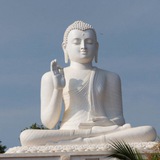
Yamaka Vagga
The Twin Verses
3. Akkocchi mam avadhi mam
ajini mam ahasi me
Ye tam upanayhanti
veram tesam na sammati.
4. Akkocchi mam avadhi mam
ajini mam ahasi me
Ye tam na upanayhanti
veram tesupasammati.
RETALIATION DOES NOT LEAD TO PEACE
3. "He abused me, he beat me, he defeated me, he robbed me", in those who harbour such thoughts hatred is not appeased.
4. "He abused me, he beat me, he defeated me, he robbed me", in those who do not harbour such thoughts hatred is appeased.
Story
The Venerable Tissa, proud of being a cousin of the Buddha, did not pay due respect to the senior monks. When they resented his improper conduct, he took offence and, threatening them, went up to the Buddha and made a complaint. The Buddha, who understood the position, advised him to apologize, but the Venerable Tissa was obstinate. The Buddha then related a story to show that Tissa had done likewise in a previous birth. Later, the Venerable Tissa was compelled to seek pardon from the senior monks.
===
Vajrayana Tantrayana Buddhism channel:
https://news.1rj.ru/str/tantrayanabuddhism
Tibetan Buddhism - Vajrayana, Tantrayana and esoteric Buddhism channel:
https://news.1rj.ru/str/tibetanbuddha
===
The Twin Verses
3. Akkocchi mam avadhi mam
ajini mam ahasi me
Ye tam upanayhanti
veram tesam na sammati.
4. Akkocchi mam avadhi mam
ajini mam ahasi me
Ye tam na upanayhanti
veram tesupasammati.
RETALIATION DOES NOT LEAD TO PEACE
3. "He abused me, he beat me, he defeated me, he robbed me", in those who harbour such thoughts hatred is not appeased.
4. "He abused me, he beat me, he defeated me, he robbed me", in those who do not harbour such thoughts hatred is appeased.
Story
The Venerable Tissa, proud of being a cousin of the Buddha, did not pay due respect to the senior monks. When they resented his improper conduct, he took offence and, threatening them, went up to the Buddha and made a complaint. The Buddha, who understood the position, advised him to apologize, but the Venerable Tissa was obstinate. The Buddha then related a story to show that Tissa had done likewise in a previous birth. Later, the Venerable Tissa was compelled to seek pardon from the senior monks.
===
Vajrayana Tantrayana Buddhism channel:
https://news.1rj.ru/str/tantrayanabuddhism
Tibetan Buddhism - Vajrayana, Tantrayana and esoteric Buddhism channel:
https://news.1rj.ru/str/tibetanbuddha
===
Telegram
Vajrayana Tantrayana Buddhism
Buddha teachings from the Vajrayana, esoteric, secret or Tantrayana vehicle
❤1👏1🤗1
Bhikkhus, there are these five defilements of gold, defiled by which gold is not malleable, wieldy, and luminous, but brittle and not properly fit for work. What five? Iron, copper, tin, lead, and silver. But when gold is freed from these five defilements, it is malleable, wieldy, and luminous, pliant and properly fit for work. Then whatever kind of ornament one wishes to make from it—whether a bracelet, earrings, a necklace, or a golden garland—one can achieve one’s purpose.
“So too, bhikkhus, there are these five defilements of the mind, defiled by which the mind is not malleable, wieldy, and luminous, but brittle and not properly concentrated for the destruction of the taints. What five? Sensual desire, ill will, dullness and drowsiness, restlessness and remorse, and doubt. But when the mind is freed from these five defilements, it becomes malleable, wieldy, and luminous, pliant and properly concentrated for the destruction of the taints.
Partially excerpted from AN 5.23 Upakkilesasutta : Defilements
“So too, bhikkhus, there are these five defilements of the mind, defiled by which the mind is not malleable, wieldy, and luminous, but brittle and not properly concentrated for the destruction of the taints. What five? Sensual desire, ill will, dullness and drowsiness, restlessness and remorse, and doubt. But when the mind is freed from these five defilements, it becomes malleable, wieldy, and luminous, pliant and properly concentrated for the destruction of the taints.
Partially excerpted from AN 5.23 Upakkilesasutta : Defilements
❤2👍1🥰1
Yamaka Vagga
The Twin Verses
5. Na hi verena verani
sammanti'dha kudacanam
Averena ca sammanti
esa dhammo sanantano.
ANGER IS CONQUERED BY LOVE
5. Hatreds never cease through hatred in this world; through love 8 alone they cease. This is an eternal law.
Story
A husband had two wives, one barren, the other fruitful. The former, actuated by jealousy, mixed a drug in her rival's food and caused two successive abortions. On the third occasion the potion caused the death both of the mother and of the child. The dying woman willed vengeance on her rival and her offspring, and she carried out her resolve. The other too did likewise. Thus both women avenged themselves in the course of two successive births. In their third birth circumstances, however, compelled both to meet the Buddha, who pacified them by advising them not to retaliate.
===
Words of the Buddha channel:
https://news.1rj.ru/str/wordsofbuddha
===
The Twin Verses
5. Na hi verena verani
sammanti'dha kudacanam
Averena ca sammanti
esa dhammo sanantano.
ANGER IS CONQUERED BY LOVE
5. Hatreds never cease through hatred in this world; through love 8 alone they cease. This is an eternal law.
Story
A husband had two wives, one barren, the other fruitful. The former, actuated by jealousy, mixed a drug in her rival's food and caused two successive abortions. On the third occasion the potion caused the death both of the mother and of the child. The dying woman willed vengeance on her rival and her offspring, and she carried out her resolve. The other too did likewise. Thus both women avenged themselves in the course of two successive births. In their third birth circumstances, however, compelled both to meet the Buddha, who pacified them by advising them not to retaliate.
===
Words of the Buddha channel:
https://news.1rj.ru/str/wordsofbuddha
===
Telegram
Words of the Buddha
Daily teachings of Buddha Dharma
❤2🏆1
Forwarded from Words of the Buddha
Phaya Si Mukda Maha Muni Nilapala Nakkharat, giant King of Naga Dragon protecting the Buddha in subduing Maras gesture, Wat Roi Phra Phutthabat Phu Manorom Buddhist temple, Amphoe Mueang Mukdahan, Thailand.
❤1🫡1🆒1
Forwarded from Buddha Dharma books
Free Buddha Dharma ebook
Into The Stream
A study guide for the first stage of Awakening
By Thanissaro Bhikkhu
Free download available:
https://ftp.budaedu.org/ebooks/pdf/EN383.pdf
===
Into The Stream
A study guide for the first stage of Awakening
By Thanissaro Bhikkhu
Free download available:
https://ftp.budaedu.org/ebooks/pdf/EN383.pdf
===
❤2😘1
Forwarded from Buddha Dharma books
Free Buddha Dharma ebook
Into The Stream
A study guide for the first stage of Awakening
By Thanissaro Bhikkhu
The Pali Canon recognizes four levels of Awakening, the first of which is called stream entry. This gains its name from the fact that a person who has attained this level has entered the “stream” flowing inevitably to nibbana.
He/she is guaranteed to achieve full awakening within seven lifetimes at most, and in the interim will not be reborn in any of the lower realms.
This study guide on stream entry is divided into two parts. The first deals with the practices leading to stream entry; the second, with the experience of stream entry and its results.
Free download available:
https://ftp.budaedu.org/ebooks/pdf/EN383.pdf
===
Into The Stream
A study guide for the first stage of Awakening
By Thanissaro Bhikkhu
The Pali Canon recognizes four levels of Awakening, the first of which is called stream entry. This gains its name from the fact that a person who has attained this level has entered the “stream” flowing inevitably to nibbana.
He/she is guaranteed to achieve full awakening within seven lifetimes at most, and in the interim will not be reborn in any of the lower realms.
This study guide on stream entry is divided into two parts. The first deals with the practices leading to stream entry; the second, with the experience of stream entry and its results.
Free download available:
https://ftp.budaedu.org/ebooks/pdf/EN383.pdf
===
❤1👍1💯1
Buddha Sāsanaṃ Ciraṃ Tiṭṭhatu
"So long, Ānanda, as the monks, the nuns, the male lay followers, and the female lay followers live according to the Dhamma, practice the Dhamma properly, and act in accordance with the Dhamma, then the Buddha’s dispensation will last long."
DN 16, Mahāparinibbāna Sutta
"So long, Ānanda, as the monks, the nuns, the male lay followers, and the female lay followers live according to the Dhamma, practice the Dhamma properly, and act in accordance with the Dhamma, then the Buddha’s dispensation will last long."
DN 16, Mahāparinibbāna Sutta
❤2🙏1💯1🤝1
Forwarded from Words of the Buddha
These Are Not “Your” Thoughts
Insight meditation teacher Joseph Goldstein explains how to treat consciousness as the object of meditation.
By Joseph Goldstein
It is important to make thoughts the object of mindfulness.If we remain unaware of thoughts as they arise, it is difficult to develop insight into their impersonal nature and into our own deep-rooted and subtle identification with the thought process. This identification reinforces the illusion of self, of some “one” who is thinking. To meditate upon thoughts is simply to be aware, as thoughts arise, that the mind is thinking, without getting involved in the content: not going off on a train of association, not analyzing the thought and why it came, but merely to be aware that at the particular moment “thinking” is happening. It is helpful to make a mental note of “thinking, thinking” every time a thought arises; observe the thought without judgment, without reaction to the content, without identifying with it, without taking the thought to be I, or self, or mine. The thought is the thinker. There is no one behind it. The thought is thinking itself. It comes uninvited. You will see that when there is a strong detachment from the thought process, thoughts don’t last long. As soon as you are mindful of a thought, it disappears, and the attention returns to the breath. Some people may find it helpful to label the thinking process in a more precise way, to note different kinds of thoughts, whether “planning” or “imagining” or “remembering.” This sharpens the focus of attention. Otherwise, the simple note of “thinking, thinking” will serve the purpose. Try to be aware of the thought as soon as it arises, rather than some minutes afterward. When they are noticed with precision and balance they have no power to disturb the mind.
Thoughts should not be treated as obstacles or hindrances. They are just another object of mindfulness, another object of meditation. Don’t let the mind become lazy and drift along. Make the effort for a great deal of clarity with respect to what’s happening in the moment.
Suzuki Roshi in Zen Mind, Beginner’s Mind writes:
When you are practicing zazen meditation do not try to stop your thinking. Let it stop by itself. If something comes into your mind, let it come in and let it go out. It will not stay long. When you try to stop your thinking, it means you are bothered by it. Do not be bothered by anything. It appears that the something comes from outside your mind, but actually it is only the waves of your mind and if you are not bothered by the waves, gradually they will become calmer and calmer . . . Many sensations come, many thoughts or images arise but they are just waves from your own mind. Nothing comes from outside your mind . . . If you leave your mind as it is, it will become calm. This mind is called big mind.
Just let things happen as they do. Let all images and thoughts and sensations arise and pass away without being bothered, without reacting, without judging, without clinging, without identifying with them. Become one with the big mind, observing carefully, microscopically, all the waves coming and going. This attitude will quickly bring about a state of balance and calm. Don’t let the mind get out of focus. Keep the mind sharply aware, moment to moment, of what is happening, whether the in-out breath, the rising-falling, sensations, or thoughts. In each instant be focused on the object with a balanced and relaxed mind.
Instruction: Consciousness
One of the foundations of mindfulness is consciousness, the knowing faculty. [The four foundations of mindfulness are outlined in the Satipatthana Sutta. The other three are the body’s sense objects, feelings of pleasantness or aversion, and mental qualities.] One way to develop mindfulness of knowing is to treat consciousness itself as the object of meditation. In any movement of the body, you can begin to sense the knowing faculty, because the physical object is so apparent. Relax the mind and try to sense the knowing faculty arising at the same time as the movement.
Insight meditation teacher Joseph Goldstein explains how to treat consciousness as the object of meditation.
By Joseph Goldstein
It is important to make thoughts the object of mindfulness.If we remain unaware of thoughts as they arise, it is difficult to develop insight into their impersonal nature and into our own deep-rooted and subtle identification with the thought process. This identification reinforces the illusion of self, of some “one” who is thinking. To meditate upon thoughts is simply to be aware, as thoughts arise, that the mind is thinking, without getting involved in the content: not going off on a train of association, not analyzing the thought and why it came, but merely to be aware that at the particular moment “thinking” is happening. It is helpful to make a mental note of “thinking, thinking” every time a thought arises; observe the thought without judgment, without reaction to the content, without identifying with it, without taking the thought to be I, or self, or mine. The thought is the thinker. There is no one behind it. The thought is thinking itself. It comes uninvited. You will see that when there is a strong detachment from the thought process, thoughts don’t last long. As soon as you are mindful of a thought, it disappears, and the attention returns to the breath. Some people may find it helpful to label the thinking process in a more precise way, to note different kinds of thoughts, whether “planning” or “imagining” or “remembering.” This sharpens the focus of attention. Otherwise, the simple note of “thinking, thinking” will serve the purpose. Try to be aware of the thought as soon as it arises, rather than some minutes afterward. When they are noticed with precision and balance they have no power to disturb the mind.
Thoughts should not be treated as obstacles or hindrances. They are just another object of mindfulness, another object of meditation. Don’t let the mind become lazy and drift along. Make the effort for a great deal of clarity with respect to what’s happening in the moment.
Suzuki Roshi in Zen Mind, Beginner’s Mind writes:
When you are practicing zazen meditation do not try to stop your thinking. Let it stop by itself. If something comes into your mind, let it come in and let it go out. It will not stay long. When you try to stop your thinking, it means you are bothered by it. Do not be bothered by anything. It appears that the something comes from outside your mind, but actually it is only the waves of your mind and if you are not bothered by the waves, gradually they will become calmer and calmer . . . Many sensations come, many thoughts or images arise but they are just waves from your own mind. Nothing comes from outside your mind . . . If you leave your mind as it is, it will become calm. This mind is called big mind.
Just let things happen as they do. Let all images and thoughts and sensations arise and pass away without being bothered, without reacting, without judging, without clinging, without identifying with them. Become one with the big mind, observing carefully, microscopically, all the waves coming and going. This attitude will quickly bring about a state of balance and calm. Don’t let the mind get out of focus. Keep the mind sharply aware, moment to moment, of what is happening, whether the in-out breath, the rising-falling, sensations, or thoughts. In each instant be focused on the object with a balanced and relaxed mind.
Instruction: Consciousness
One of the foundations of mindfulness is consciousness, the knowing faculty. [The four foundations of mindfulness are outlined in the Satipatthana Sutta. The other three are the body’s sense objects, feelings of pleasantness or aversion, and mental qualities.] One way to develop mindfulness of knowing is to treat consciousness itself as the object of meditation. In any movement of the body, you can begin to sense the knowing faculty, because the physical object is so apparent. Relax the mind and try to sense the knowing faculty arising at the same time as the movement.
Telegram
Words of the Buddha
Daily teachings of Buddha Dharma
❤1👏1🙏1
Forwarded from Words of the Buddha
It is important to remember that knowing and the object arise simultaneously. You cannot separate consciousness from the object. But it is possible to distinguish the two processes, to see that the flow of objects is one process and the flow of consciousness is another. They are happening simultaneously, with two different functions. Do not try to pinpoint the consciousness, to precisely define it or limit it. It is a very subtle, immaterial object. But with a relaxed mind, we can begin to sense the process of consciousness. Because it is so subtle an object, it will force the mind to be very attentive. It is impossible to experience clearly if the mind is lax or lazy.
Sometimes in sitting you might turn the attention to the knowing. The breath experienced as the in-out or rising-falling is a material process only. The knowing of it is the mind, consciousness. When you are silent and centered, turn the mindfulness toward the “knowing.” Don’t strain to find it or try to locate it somewhere in the body. Simply be aware in an easy way of the knowing process going on.
One of the factors of enlightenment is investigation of the dharma, which means that investigative quality of the mind which examines, which explores just how the elements of the mind work. Don’t be afraid to use the mind in that way, to investigate. But not with words, not with thoughts, not with concepts. Try to get a feel, a sense of the process of consciousness happening together with the object. This experience brings freedom from identification with the observer. Insight comes from the realization that observation is going on without an observer, witnessing without a witness.
From The Experience of Insight by Joseph Goldstein.
===
Joseph Goldstein is cofounder and a guiding teacher of the Insight Meditation Society in Barre, Massachusetts, and its Forest Refuge program, and helped establish the Barre Center for Buddhist Studies. His books include A Heart Full of Peace, One Dharma: The Emerging Western Buddhism, and Mindfulness: A Practical Guide to Awakening.
===
Words of the Buddha channel:
https://news.1rj.ru/str/wordsofbuddha
===
Sometimes in sitting you might turn the attention to the knowing. The breath experienced as the in-out or rising-falling is a material process only. The knowing of it is the mind, consciousness. When you are silent and centered, turn the mindfulness toward the “knowing.” Don’t strain to find it or try to locate it somewhere in the body. Simply be aware in an easy way of the knowing process going on.
One of the factors of enlightenment is investigation of the dharma, which means that investigative quality of the mind which examines, which explores just how the elements of the mind work. Don’t be afraid to use the mind in that way, to investigate. But not with words, not with thoughts, not with concepts. Try to get a feel, a sense of the process of consciousness happening together with the object. This experience brings freedom from identification with the observer. Insight comes from the realization that observation is going on without an observer, witnessing without a witness.
From The Experience of Insight by Joseph Goldstein.
===
Joseph Goldstein is cofounder and a guiding teacher of the Insight Meditation Society in Barre, Massachusetts, and its Forest Refuge program, and helped establish the Barre Center for Buddhist Studies. His books include A Heart Full of Peace, One Dharma: The Emerging Western Buddhism, and Mindfulness: A Practical Guide to Awakening.
===
Words of the Buddha channel:
https://news.1rj.ru/str/wordsofbuddha
===
Telegram
Words of the Buddha
Daily teachings of Buddha Dharma
👌1🏆1
Yamaka Vagga
The Twin Verses
6. Pare ca na vijananti
mayamettha yamamase
Ye ca tattha vijananti
tato sammanti medhaga.
QUARRELS CEASE THROUGH RIGHT THINKING
6. The others know not that in this quarrel we perish; those of them who realize it, have their quarrels calmed thereby.
Story
A trivial incident led to an unfortunate dispute amongst the monks in the city of Kosambi. The quarrelsome monks did not listen even to the Buddha. In the end the Buddha retired to a forest and spent the rainy season there. Owing to pressure brought on them by the laity, the monks approached the Buddha and, imploring His pardon, invited Him to the city. The Buddha then admonished them.
===
Dhammapada, beloved and favorite teachings of the Buddha channel:
https://news.1rj.ru/str/dhammapadas
===
The Twin Verses
6. Pare ca na vijananti
mayamettha yamamase
Ye ca tattha vijananti
tato sammanti medhaga.
QUARRELS CEASE THROUGH RIGHT THINKING
6. The others know not that in this quarrel we perish; those of them who realize it, have their quarrels calmed thereby.
Story
A trivial incident led to an unfortunate dispute amongst the monks in the city of Kosambi. The quarrelsome monks did not listen even to the Buddha. In the end the Buddha retired to a forest and spent the rainy season there. Owing to pressure brought on them by the laity, the monks approached the Buddha and, imploring His pardon, invited Him to the city. The Buddha then admonished them.
===
Dhammapada, beloved and favorite teachings of the Buddha channel:
https://news.1rj.ru/str/dhammapadas
===
Telegram
Dhammapada - Buddha Dharma Teachings
Daily teachings of the Dhammapada, beloved and favorite teachings of the Buddha
👍1🤗1
Forwarded from Words of the Buddha
Sanghanussati Bhavana is the recollection on the qualities of the community of Ariya sangha.
Supatipanno Bhagavato savakasangho, ²ujupatipanno Bhagavato savakasangho, ³nayapatipanno Bhagavato savakasangho, 4samicipatpanno Bhagavato savakasangho; yadidam cattari purisa yugani attha purisa puggala, esa Bhagavato savakasangho, 5ahuneyyo, 6pahuneyyo, 7dakkhineyyo, 8anjali karaniyo, 9anuttaram punnakkhettam lokassa ti.”
“ 1Well attained is the Order of the Blessed One’s disciples, 2upright is the Order of the Blessed One’s disciples, 3true is the Order of the Blessed One’s disciples,4proper is the Order of the Blessed One’s disciples. That is, the four pairs of persons, the eight individual persons, this is the Order of the Blessed One’s disciples; 5worthy of gifts, 6worthy of hospitality, 7worthy of offerings, 8worthy of salutations, 9an incomparable field of merits for the world. ”
Supatipanno Bhagavato savakasangho, ²ujupatipanno Bhagavato savakasangho, ³nayapatipanno Bhagavato savakasangho, 4samicipatpanno Bhagavato savakasangho; yadidam cattari purisa yugani attha purisa puggala, esa Bhagavato savakasangho, 5ahuneyyo, 6pahuneyyo, 7dakkhineyyo, 8anjali karaniyo, 9anuttaram punnakkhettam lokassa ti.”
“ 1Well attained is the Order of the Blessed One’s disciples, 2upright is the Order of the Blessed One’s disciples, 3true is the Order of the Blessed One’s disciples,4proper is the Order of the Blessed One’s disciples. That is, the four pairs of persons, the eight individual persons, this is the Order of the Blessed One’s disciples; 5worthy of gifts, 6worthy of hospitality, 7worthy of offerings, 8worthy of salutations, 9an incomparable field of merits for the world. ”
🙏1😇1
Free Buddha Dharma ebook
Positive Response: How to Meet Evil With Good
By Acharya Buddharakkhita
Free download here:
https://www.accesstoinsight.org/lib/authors/buddharakkhita/bl109.pdf
===
Positive Response: How to Meet Evil With Good
By Acharya Buddharakkhita
Free download here:
https://www.accesstoinsight.org/lib/authors/buddharakkhita/bl109.pdf
===
🥰1👏1🏆1
Free Buddha Dharma ebook
Positive Response: How to Meet Evil With Good
By Acharya Buddharakkhita
This booklet contains a collection of short suttas spoken by the Buddha and a passage from the Visuddhimagga, each preceded by a brief introduction by the translator. The unifying theme of these pieces may be called a positive response in dealing with provocative people and situations. The texts set forth practical techniques taught by the Buddha for overcoming resentment, hatred and other such pollutants, and for cultivating such elevating mental qualities as good will, amity and compassion. For anyone intent on spiritual development these practical instructions will help to cleanse the mind and to unfold its great hidden potentials.
Free download here:
https://www.accesstoinsight.org/lib/authors/buddharakkhita/bl109.pdf
===
Positive Response: How to Meet Evil With Good
By Acharya Buddharakkhita
This booklet contains a collection of short suttas spoken by the Buddha and a passage from the Visuddhimagga, each preceded by a brief introduction by the translator. The unifying theme of these pieces may be called a positive response in dealing with provocative people and situations. The texts set forth practical techniques taught by the Buddha for overcoming resentment, hatred and other such pollutants, and for cultivating such elevating mental qualities as good will, amity and compassion. For anyone intent on spiritual development these practical instructions will help to cleanse the mind and to unfold its great hidden potentials.
Free download here:
https://www.accesstoinsight.org/lib/authors/buddharakkhita/bl109.pdf
===
🙏1🤗1
Forwarded from Words of the Buddha
Thus I heard: At one time the Gracious One was dwelling near Sāvatthī, in Jeta’s Wood, at Anāthapiṇḍika’s monastery. Then at that time the Gracious One was instructing, rousing, enthusing, and cheering the monks with a Dhamma talk connected with Emancipation. Those monks, after making it their goal, applying their minds, considering it with all their mind, were listening to Dhamma with an attentive ear.
Then the Gracious One, having understood the significance of it, on that occasion uttered this exalted utterance:
“There is, monks, an unborn, unbecome, unmade, unconditioned. If, monks there were not that unborn, unbecome, unmade, unconditioned, you could not know an escape here from the born, become, made, and conditioned. But because there is an unborn, unbecome, unmade, unconditioned, therefore you do know an escape from the born, become, made, and conditioned.”
Udana 8.3 : Tatiya nibbānapaṭi saṁyuttasutta
Then the Gracious One, having understood the significance of it, on that occasion uttered this exalted utterance:
“There is, monks, an unborn, unbecome, unmade, unconditioned. If, monks there were not that unborn, unbecome, unmade, unconditioned, you could not know an escape here from the born, become, made, and conditioned. But because there is an unborn, unbecome, unmade, unconditioned, therefore you do know an escape from the born, become, made, and conditioned.”
Udana 8.3 : Tatiya nibbānapaṭi saṁyuttasutta
👍1🙏1👌1