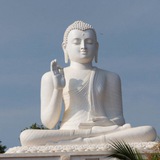
Yamaka Vagga
The Twin Verses
17. Idha tappati pecca tappati
papakari ubhayattha tappati
Papam me katan ti tappati
bhiyyo tappati duggatim gato.
THE EVIL-DOER LAMENTS HERE AND HEREAFTER
17. Here he suffers, hereafter he suffers. In both states the evil-doer suffers. "Evil have I done" (thinking thus), he suffers. Furthermore, he suffers, having gone to a woeful state.
Story
The Venerable Devadatta made an unsuccessful attempt to kill the Buddha. In his old age he repented and desired to see the Buddha. While he was being carried on a litter to see the Buddha, he died on the way under tragic circumstances.
===
Buddha dharma teachings channel:
https://news.1rj.ru/str/lorddivinebuddha
===
The Twin Verses
17. Idha tappati pecca tappati
papakari ubhayattha tappati
Papam me katan ti tappati
bhiyyo tappati duggatim gato.
THE EVIL-DOER LAMENTS HERE AND HEREAFTER
17. Here he suffers, hereafter he suffers. In both states the evil-doer suffers. "Evil have I done" (thinking thus), he suffers. Furthermore, he suffers, having gone to a woeful state.
Story
The Venerable Devadatta made an unsuccessful attempt to kill the Buddha. In his old age he repented and desired to see the Buddha. While he was being carried on a litter to see the Buddha, he died on the way under tragic circumstances.
===
Buddha dharma teachings channel:
https://news.1rj.ru/str/lorddivinebuddha
===
Telegram
Buddha
Buddha dharma teachings from the suttas and commentaries
❤1🤗1
Forwarded from Words of the Buddha
Three Giant Standing Buddha, Buddhavas of Anatta Universe Buddhist temple, Muang Boran, Thailand.
🏆2😁1🤩1🆒1
“In the wilderness, at a tree’s root, or an empty hut, O mendicants, recollect the Buddha, and no fear will come to you.
If you can’t recollect the Buddha—the eldest in the world, the chief of men—then recollect the teaching, emancipating, well taught.
If you can’t recollect the teaching—emancipating, well taught—then recollect the Saṅgha, the supreme field of merit.
Thus recollecting the Buddha, the teaching, and the Saṅgha, mendicants, fear and terror and goosebumps will be no more.”
SN 11.3 : Dhajaggasutta
If you can’t recollect the Buddha—the eldest in the world, the chief of men—then recollect the teaching, emancipating, well taught.
If you can’t recollect the teaching—emancipating, well taught—then recollect the Saṅgha, the supreme field of merit.
Thus recollecting the Buddha, the teaching, and the Saṅgha, mendicants, fear and terror and goosebumps will be no more.”
SN 11.3 : Dhajaggasutta
❤2🙏1🕊1😇1
Free Buddha Dharma ebook
An Iridescence on the Water: The Teachings of Chao Khun Nararatana Rajamanit
By Chao Khun Nararatana Rajamanit
Free download here:
https://www.dhammatalks.org/Archive/Writings/ThaiAjaans/ChaoKhunNararatana.pdf
===
An Iridescence on the Water: The Teachings of Chao Khun Nararatana Rajamanit
By Chao Khun Nararatana Rajamanit
Free download here:
https://www.dhammatalks.org/Archive/Writings/ThaiAjaans/ChaoKhunNararatana.pdf
===
🤩1😍1
Free Buddha Dharma ebook
An Iridescence on the Water: The Teachings of Chao Khun Nararatana Rajamanit
By Chao Khun Nararatana Rajamanit
Chao Khun Nararatana, prior to his ordination, was a member of King Rama VI’s personal staff, and was so trusted by the king that he received the rank of chao phraya—the highest Thai rank of conferred nobility—when he was only 25. After the king’s death in 1926, he ordained at Wat Thepsirin in Bangkok, and remained a monk until passing away from cancer in 1971. From the year 1936 until his death, he never left the wat compound. Even though the wat was one of the most lavishly endowed temples in Bangkok, Chao Khun Nararatana lived a life of exemplary austerity and was well known for his meditative powers. He left no personal students, however, and very few writings. The following piece is a synopsis of some very basic teachings he would give to lay visitors. These teachings are especially suitable for young people.
Free download here:
https://www.dhammatalks.org/Archive/Writings/ThaiAjaans/ChaoKhunNararatana.pdf
===
An Iridescence on the Water: The Teachings of Chao Khun Nararatana Rajamanit
By Chao Khun Nararatana Rajamanit
Chao Khun Nararatana, prior to his ordination, was a member of King Rama VI’s personal staff, and was so trusted by the king that he received the rank of chao phraya—the highest Thai rank of conferred nobility—when he was only 25. After the king’s death in 1926, he ordained at Wat Thepsirin in Bangkok, and remained a monk until passing away from cancer in 1971. From the year 1936 until his death, he never left the wat compound. Even though the wat was one of the most lavishly endowed temples in Bangkok, Chao Khun Nararatana lived a life of exemplary austerity and was well known for his meditative powers. He left no personal students, however, and very few writings. The following piece is a synopsis of some very basic teachings he would give to lay visitors. These teachings are especially suitable for young people.
Free download here:
https://www.dhammatalks.org/Archive/Writings/ThaiAjaans/ChaoKhunNararatana.pdf
===
👍1🙏1💯1
Forwarded from Words of the Buddha
Cheng'en Buddhist temple, Fanjingshan sacred mountain, China, the place where world's largest gold statue of Metteya Buddha is kept.
🏆1😎1
Forwarded from Buddha
Love as the Expression of Emptiness
Joseph Goldstein describes the benefits and means of letting go of the mind’s habits of attachment and delusion.
By Joseph Goldstein
Part 1 of 2:
It seems to me that all those who enter a spiritual path have very similar goals, though these goals may not always be articulated. These might be described, in the broadest strokes, as love, as peace, as freedom from suffering—that is, as a happiness that is fulfilling in the most complete sense. This is, I think, a universal aspiration.
The question, then, that follows from this is: What are those forces that keep us from experiencing this kind of happiness? In Buddhism, these forces are called the defilements of mind, the afflictive emotions such as fear, greed, jealousy, and hatred, which are all rooted in ignorance and delusion. Although various paths speak of the afflictive emotions in their own distinct ways, all share the understanding that we need some means to purify the heart and free the mind. While it may be addressed differently in different traditions, on the spiritual path there is really only one issue: extricating ourselves from those forces in the mind by which we are bound. This is not esoteric; it’s not mysterious. It’s simply the challenge of our everyday experience.
In Buddhism, our particular way of addressing these matters is to say that the root of the problem is the delusion of selfhood. Because we are living in this delusion, this prison of self, we identify with the afflictive emotions, thereby feeding and encouraging them. And whether we practice as householders engaged with family and work or as monks in the forest, the question is the same: Does what we do strengthen the sense of self through those habits of mind—fixation, contraction, identification—that prevent our aspiration for the highest happiness from being fulfilled, or does it work to purify the heart and free the mind from those qualities? This is the only question that really matters.
Debates about the relative merits of different approaches to the spiritual life are often framed in a way that is misleading. To speak, for example, of one approach as being life-affirming and another as life-denying misses the point, because the path is not about affirming life or denying it—it’s about emerging from delusion. If one’s practice as a householder comes from a place of self, a place of attachment, desire, and identification, then that is not a path of liberation. Similarly, if one’s monastic practice is done from a place of fear or aversion, then that also is not the way. The reference point for examining our lives and the choices we make is the quality of heart and mind out of which they come. Skillful choices about the best circumstances and styles of practice will naturally vary according to the needs and the situation at particular times in people’s lives.
For example, one traditional Buddhist practice that Westerners sometimes find troubling is the contemplation of the non-beautiful aspects of the body. The problem is partly one of translation. The Pali word asuba is generally translated as “loathsome,” “repulsive,” or “disgusting.” But the actual meaning of the word is simply “not beautiful,” a term with far fewer negative associations. But even when the language is cleaned up, for many the problem remains. Meditating on decaying corpses or on the “non-beautiful” aspects of our living bodies seems weird or out of balance. It seems to go against the belief that we should be learning to respect and honor the beauty of the body. It is crucial to understand that such objections miss the point of these practices, which is to release the mind from identification with the body. This is one of our most deeply rooted attachments and the cause of tremendous suffering.
Joseph Goldstein describes the benefits and means of letting go of the mind’s habits of attachment and delusion.
By Joseph Goldstein
Part 1 of 2:
It seems to me that all those who enter a spiritual path have very similar goals, though these goals may not always be articulated. These might be described, in the broadest strokes, as love, as peace, as freedom from suffering—that is, as a happiness that is fulfilling in the most complete sense. This is, I think, a universal aspiration.
The question, then, that follows from this is: What are those forces that keep us from experiencing this kind of happiness? In Buddhism, these forces are called the defilements of mind, the afflictive emotions such as fear, greed, jealousy, and hatred, which are all rooted in ignorance and delusion. Although various paths speak of the afflictive emotions in their own distinct ways, all share the understanding that we need some means to purify the heart and free the mind. While it may be addressed differently in different traditions, on the spiritual path there is really only one issue: extricating ourselves from those forces in the mind by which we are bound. This is not esoteric; it’s not mysterious. It’s simply the challenge of our everyday experience.
In Buddhism, our particular way of addressing these matters is to say that the root of the problem is the delusion of selfhood. Because we are living in this delusion, this prison of self, we identify with the afflictive emotions, thereby feeding and encouraging them. And whether we practice as householders engaged with family and work or as monks in the forest, the question is the same: Does what we do strengthen the sense of self through those habits of mind—fixation, contraction, identification—that prevent our aspiration for the highest happiness from being fulfilled, or does it work to purify the heart and free the mind from those qualities? This is the only question that really matters.
Debates about the relative merits of different approaches to the spiritual life are often framed in a way that is misleading. To speak, for example, of one approach as being life-affirming and another as life-denying misses the point, because the path is not about affirming life or denying it—it’s about emerging from delusion. If one’s practice as a householder comes from a place of self, a place of attachment, desire, and identification, then that is not a path of liberation. Similarly, if one’s monastic practice is done from a place of fear or aversion, then that also is not the way. The reference point for examining our lives and the choices we make is the quality of heart and mind out of which they come. Skillful choices about the best circumstances and styles of practice will naturally vary according to the needs and the situation at particular times in people’s lives.
For example, one traditional Buddhist practice that Westerners sometimes find troubling is the contemplation of the non-beautiful aspects of the body. The problem is partly one of translation. The Pali word asuba is generally translated as “loathsome,” “repulsive,” or “disgusting.” But the actual meaning of the word is simply “not beautiful,” a term with far fewer negative associations. But even when the language is cleaned up, for many the problem remains. Meditating on decaying corpses or on the “non-beautiful” aspects of our living bodies seems weird or out of balance. It seems to go against the belief that we should be learning to respect and honor the beauty of the body. It is crucial to understand that such objections miss the point of these practices, which is to release the mind from identification with the body. This is one of our most deeply rooted attachments and the cause of tremendous suffering.
Telegram
Buddha
Buddha dharma teachings from the suttas and commentaries
❤1👌1
Forwarded from Buddha
So asuba practice has nothing to do with denying life or hating the body. It is simply one means to free ourselves from the delusion that takes the body to be the self. For some, these techniques will work well; perhaps for others contemplating the impermanent, insubstantial nature of beauty will be the path of freedom. How well any technique works depends on how it is taught and the particular conditioning of the individual who undertakes it. But we err when we extrapolate from a particular method a general characterization of an entire tradition. In all methods, we must understand that which is essential about the transformative process of liberation.
===
Buddha dharma teachings channel:
https://news.1rj.ru/str/lorddivinebuddha
===
===
Buddha dharma teachings channel:
https://news.1rj.ru/str/lorddivinebuddha
===
Telegram
Buddha
Buddha dharma teachings from the suttas and commentaries
👍1🤗1
Yamaka Vagga
The Twin Verses
18. Idha nandati pecca nandati
katapunno ubhayattha nandati
Punnam me katan ti nandati
bhiyyo nandati suggatim gato.
HAPPY ARE THE RIGHTEOUS
18. Here he is happy, hereafter he is happy. In both states the well-doer is happy. "Good have I done" (thinking thus), he is happy. Furthermore, he is happy, having gone to a blissful state.
Story
Sumana the youngest daughter of Anathapiudika, the chief supporter of the Buddha, lying on her death-bed, addressed her father as "young brother" and passed away peacefully. The father was grieved to hear his devout daughter utter such incoherent words at the moment of death. When he mentioned this matter to the Buddha He explained that she addressed him thus because she had attained the second stage of Sainthood - Sakadagami (Once-Returner) while the father had attained only the first stage Sotapatti (Stream Winner).
===
Vajrayana Tantrayana Buddhism channel:
https://news.1rj.ru/str/tantrayanabuddhism
Tibetan Buddhism - Vajrayana, Tantrayana and esoteric Buddhism channel:
https://news.1rj.ru/str/tibetanbuddha
===
The Twin Verses
18. Idha nandati pecca nandati
katapunno ubhayattha nandati
Punnam me katan ti nandati
bhiyyo nandati suggatim gato.
HAPPY ARE THE RIGHTEOUS
18. Here he is happy, hereafter he is happy. In both states the well-doer is happy. "Good have I done" (thinking thus), he is happy. Furthermore, he is happy, having gone to a blissful state.
Story
Sumana the youngest daughter of Anathapiudika, the chief supporter of the Buddha, lying on her death-bed, addressed her father as "young brother" and passed away peacefully. The father was grieved to hear his devout daughter utter such incoherent words at the moment of death. When he mentioned this matter to the Buddha He explained that she addressed him thus because she had attained the second stage of Sainthood - Sakadagami (Once-Returner) while the father had attained only the first stage Sotapatti (Stream Winner).
===
Vajrayana Tantrayana Buddhism channel:
https://news.1rj.ru/str/tantrayanabuddhism
Tibetan Buddhism - Vajrayana, Tantrayana and esoteric Buddhism channel:
https://news.1rj.ru/str/tibetanbuddha
===
Telegram
Vajrayana Tantrayana Buddhism
Buddha teachings from the Vajrayana, esoteric, secret or Tantrayana vehicle
❤1👍1
Love as the Expression of Emptiness
Joseph Goldstein describes the benefits and means of letting go of the mind’s habits of attachment and delusion.
By Joseph Goldstein
Part 2 of 2:
Of course, it is not only the body with which we identify. We are continually ensnared by the workings of the mind—its moods, emotions, concepts, opinions, judgments, and so forth. Caught up as we are in the mind’s busyness, it is only in rare moments that we touch that space of open, free awareness that is its true nature. One of the things I love about being on retreat is that it reveals so clearly that so much of the time the mind is in some state—sometimes obvious, sometimes extremely subtle—of attachment or aversion. Trungpa Rinpoche spoke of the meditative path as being one insult after another. This is important to understand because it points to the level of attentiveness we need to cultivate in our lives if we want to fulfill that aspiration for peace, for love, for freedom.
One of the dangers I see among Western practitioners is the enticement to say, “Well, everything I do is my practice,” as if no special effort is required. Theoretically this is a valid point, but is it really true in how we actually live? Staying awake does not come easily. It requires tremendous energy, commitment, and courage. Just look to the examples of the great figures in any spiritual tradition—to the intensity, exertion, and renunciation manifest in their practice. Meditation is very humbling in that it reflects back to us the depth of our attachments and the inspiration and commitment needed to get free of them. Sustained meditation practice makes it more difficult to fool ourselves.
Although renunciation may express itself in outward forms, its essence is the letting go of the mind’s habits of delusion. Even just a moment of such release is powerful, because it provides a reference point, an alternative to the false sense of self we ordinarily experience. The more we taste of this experience of emptiness, the more we can truly make our life our practice, rather than simply holding “life as practice” as a nice idea.
The profound stillness in which the mind’s intrinsic, radiant emptiness is realized is not something apart from spiritual activity in the world. It is its foundation. Each of us acts and abides within a unique set of karmic conditions, which localize us in the specifics of place, social and familial relationships, and all the other circumstances that make up our unfolding life. But these very circumstances are themselves empty. Emptiness and specificity are not in contradiction; they constitute a union. While we accept, open to, and even honor the specifics of our lives, without the recognition of their essential emptiness, we will easily fall into attachment. The fullness of the spiritual path is the understanding that love, that compassion, is the expression of emptiness. These are not two separate things; one is an attribute of the other.
Joseph Goldstein describes the benefits and means of letting go of the mind’s habits of attachment and delusion.
By Joseph Goldstein
Part 2 of 2:
Of course, it is not only the body with which we identify. We are continually ensnared by the workings of the mind—its moods, emotions, concepts, opinions, judgments, and so forth. Caught up as we are in the mind’s busyness, it is only in rare moments that we touch that space of open, free awareness that is its true nature. One of the things I love about being on retreat is that it reveals so clearly that so much of the time the mind is in some state—sometimes obvious, sometimes extremely subtle—of attachment or aversion. Trungpa Rinpoche spoke of the meditative path as being one insult after another. This is important to understand because it points to the level of attentiveness we need to cultivate in our lives if we want to fulfill that aspiration for peace, for love, for freedom.
One of the dangers I see among Western practitioners is the enticement to say, “Well, everything I do is my practice,” as if no special effort is required. Theoretically this is a valid point, but is it really true in how we actually live? Staying awake does not come easily. It requires tremendous energy, commitment, and courage. Just look to the examples of the great figures in any spiritual tradition—to the intensity, exertion, and renunciation manifest in their practice. Meditation is very humbling in that it reflects back to us the depth of our attachments and the inspiration and commitment needed to get free of them. Sustained meditation practice makes it more difficult to fool ourselves.
Although renunciation may express itself in outward forms, its essence is the letting go of the mind’s habits of delusion. Even just a moment of such release is powerful, because it provides a reference point, an alternative to the false sense of self we ordinarily experience. The more we taste of this experience of emptiness, the more we can truly make our life our practice, rather than simply holding “life as practice” as a nice idea.
The profound stillness in which the mind’s intrinsic, radiant emptiness is realized is not something apart from spiritual activity in the world. It is its foundation. Each of us acts and abides within a unique set of karmic conditions, which localize us in the specifics of place, social and familial relationships, and all the other circumstances that make up our unfolding life. But these very circumstances are themselves empty. Emptiness and specificity are not in contradiction; they constitute a union. While we accept, open to, and even honor the specifics of our lives, without the recognition of their essential emptiness, we will easily fall into attachment. The fullness of the spiritual path is the understanding that love, that compassion, is the expression of emptiness. These are not two separate things; one is an attribute of the other.
👍1💯1
In my own practice, this understanding has been greatly enriched by some of the teachings of Tibetan Buddhism. For many years, the bodhisattva vow of Mahayana Buddhism—to practice in order to save all beings—made little sense to me. How in the world would I, or anyone, be able to enlighten all beings? It seemed like a beautiful idea, but an impossibility. What gave the vow meaning to me was the teaching of absolute and relative bodhicitta, or “awakened mind.” Relative bodhicitta is compassion; absolute bodhicitta is emptiness. The compassionate activity expressed by the vow is the manifestation of the realization of emptiness. The energy to save all beings arises in precisely that consciousness that knows that there is no one to save and no one to do the saving. It is here that the spiritual path finds its completeness.
From the Fall 1997 issue of Inquiring Mind by Joseph Goldstein and Inquiring Mind.
===
Joseph Goldstein is cofounder and a guiding teacher of the Insight Meditation Society in Barre, Massachusetts, and its Forest Refuge program, and helped establish the Barre Center for Buddhist Studies. His books include A Heart Full of Peace, One Dharma: The Emerging Western Buddhism, and Mindfulness: A Practical Guide to Awakening.
===
Part 1 of 2:
https://news.1rj.ru/str/lorddivinebuddha/3097
Part 2 of 2:
https://news.1rj.ru/str/dhammapadas/2667
===
Dhammapada, beloved and favorite teachings of the Buddha channel:
https://news.1rj.ru/str/dhammapadas
===
From the Fall 1997 issue of Inquiring Mind by Joseph Goldstein and Inquiring Mind.
===
Joseph Goldstein is cofounder and a guiding teacher of the Insight Meditation Society in Barre, Massachusetts, and its Forest Refuge program, and helped establish the Barre Center for Buddhist Studies. His books include A Heart Full of Peace, One Dharma: The Emerging Western Buddhism, and Mindfulness: A Practical Guide to Awakening.
===
Part 1 of 2:
https://news.1rj.ru/str/lorddivinebuddha/3097
Part 2 of 2:
https://news.1rj.ru/str/dhammapadas/2667
===
Dhammapada, beloved and favorite teachings of the Buddha channel:
https://news.1rj.ru/str/dhammapadas
===
👏1👌1
Forwarded from Buddha
Free Buddha Dharma ebook
Steps Along the Path
By Phra Ajaan Thate Desaransi
Free download available:
https://www.dhammatalks.org/Archive/Writings/ThaiAjaans/AjaanThate_StepsAlong.pdf
===
Steps Along the Path
By Phra Ajaan Thate Desaransi
Free download available:
https://www.dhammatalks.org/Archive/Writings/ThaiAjaans/AjaanThate_StepsAlong.pdf
===
👏1🏆1
Forwarded from Buddha
Free Buddha Dharma ebook
Steps Along the Path
By Phra Ajaan Thate Desaransi
This little book might be of use to those who are interested in practicing meditation, as it is small, easy to carry and read through quickly without taxing the brain. So I have edited it, polishing the style and adding more points—in particular, point 11 and onwards (i.e. how to deal with visions and signs in meditation)—in order to make the book more complete, fit to be a guide to the practice of meditation: showing the worth of meditation, the way to meditate, which ways of meditation are right, which are wrong, and in detail how to correct those things that should be corrected in the practice. I hope this little book will be of use to those who are interested.
Free download available:
https://www.dhammatalks.org/Archive/Writings/ThaiAjaans/AjaanThate_StepsAlong.pdf
===
Steps Along the Path
By Phra Ajaan Thate Desaransi
This little book might be of use to those who are interested in practicing meditation, as it is small, easy to carry and read through quickly without taxing the brain. So I have edited it, polishing the style and adding more points—in particular, point 11 and onwards (i.e. how to deal with visions and signs in meditation)—in order to make the book more complete, fit to be a guide to the practice of meditation: showing the worth of meditation, the way to meditate, which ways of meditation are right, which are wrong, and in detail how to correct those things that should be corrected in the practice. I hope this little book will be of use to those who are interested.
Free download available:
https://www.dhammatalks.org/Archive/Writings/ThaiAjaans/AjaanThate_StepsAlong.pdf
===
🥰1🤗1
Yamaka Vagga
The Twin Verses
19. Bahum pi ce sahitam bhasamano
na takkaro hoti naro pamatto
Gopo'va gavo gauayam paresam
na bhagava samannassa hoti.
20. Appam pi ce sahitam bhasamano
dhammassa hoti anudhammacari
Ragan ca dosan ca pahaya moham
sammappajano suvimuttacitto
Anupadiyano idha va huram va
sa bhagava samannassa hoti.
LEARNING WITHOUT PRACTICE IS OF NO WORTH
19. Though much he recites the Sacred Texts, but acts not accordingly, that heedless man is like a cowherd who counts others' kine. He has no share in the fruits of the Holy Life.
20. Though little he recites the Sacred Texts, but acts in accordance with the teaching, forsaking lust, hatred and ignorance, truly knowing, with mind well freed, clinging to naught here and hereafter, he shares the fruits of the Holy Life.
Story
There were two monks - one a worldling but well-versed in the Dhamma, the other an Arahant though not so erudite. The worldling did not practise what he knew; the one who knew little practised the Dhamma and, realizing Nibbana, enjoyed the fruits of the Holy Life. The scholarly monk desired to embarrass the other by putting some intricate questions in the presence of the Buddha. Knowing well his base motive, the Buddha raised some questions connected with the realization of the Dhamma. The Arahant answered them all from personal experience, but the other could not as he had not attained to any Paths of Sainthood. Thereupon the Buddha praised the Arahant who had practised His teaching, though possessing less knowledge of the Dhamma.
===
Words of the Buddha channel:
https://news.1rj.ru/str/wordsofbuddha
===
The Twin Verses
19. Bahum pi ce sahitam bhasamano
na takkaro hoti naro pamatto
Gopo'va gavo gauayam paresam
na bhagava samannassa hoti.
20. Appam pi ce sahitam bhasamano
dhammassa hoti anudhammacari
Ragan ca dosan ca pahaya moham
sammappajano suvimuttacitto
Anupadiyano idha va huram va
sa bhagava samannassa hoti.
LEARNING WITHOUT PRACTICE IS OF NO WORTH
19. Though much he recites the Sacred Texts, but acts not accordingly, that heedless man is like a cowherd who counts others' kine. He has no share in the fruits of the Holy Life.
20. Though little he recites the Sacred Texts, but acts in accordance with the teaching, forsaking lust, hatred and ignorance, truly knowing, with mind well freed, clinging to naught here and hereafter, he shares the fruits of the Holy Life.
Story
There were two monks - one a worldling but well-versed in the Dhamma, the other an Arahant though not so erudite. The worldling did not practise what he knew; the one who knew little practised the Dhamma and, realizing Nibbana, enjoyed the fruits of the Holy Life. The scholarly monk desired to embarrass the other by putting some intricate questions in the presence of the Buddha. Knowing well his base motive, the Buddha raised some questions connected with the realization of the Dhamma. The Arahant answered them all from personal experience, but the other could not as he had not attained to any Paths of Sainthood. Thereupon the Buddha praised the Arahant who had practised His teaching, though possessing less knowledge of the Dhamma.
===
Words of the Buddha channel:
https://news.1rj.ru/str/wordsofbuddha
===
Telegram
Words of the Buddha
Daily teachings of Buddha Dharma
👏1🤗1