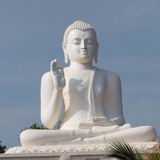
When they give him almsfood, he should lift his upper robe with his left hand, stretch out his bowl with his right hand, and receive the alms while holding the bowl with both hands. He shouldn’t look the donor in the face. He should be attentive to whether they wish to give curry or not. If they take hold of a serving spoon or a vessel, or they tell him to wait, then he should assume they wish to give, and he should wait. When they have given alms, he should cover the bowl with his upper robe, and leave carefully and without hurry.
Partial excerpts from Kd 18 : Chapter on Proper Conduct
Partial excerpts from Kd 18 : Chapter on Proper Conduct
❤1🙏1
Forwarded from Words of the Buddha
Manopubbangama dhamma
manosettha manomaya
manasa ce pasannena
bhasati va karoti va
tato nam sukha manveti
chayava anapayini.
All mental phenomena have mind as their forerunner; they have mind as their chief; they are mind-made. If one speaks or acts with a pure mind, happiness (sukha) follows him like a shadow that never leaves him.
Dhammapada Verse 2 : Matthakundali Vatthu
manosettha manomaya
manasa ce pasannena
bhasati va karoti va
tato nam sukha manveti
chayava anapayini.
All mental phenomena have mind as their forerunner; they have mind as their chief; they are mind-made. If one speaks or acts with a pure mind, happiness (sukha) follows him like a shadow that never leaves him.
Dhammapada Verse 2 : Matthakundali Vatthu
❤1🙏1🕊1
The Brahma-viharas: Head & Heart Together
Thai forest monk Thanissaro Bhikkhu teaches us how to use wisdom to cultivate compassion
Part 2 of 3
But you also have to realize that no matter how unlimited the scope of these positive emotions, their effect is going to run into limits. In other words, regardless of how strong your goodwill or compassion may be, there are bound to be people whose past actions are unskillful and who cannot or will not change their ways in the present. This is why you need equanimity as your reality check. When you encounter areas where you can’t be of help, you learn not to get upset. Think about the universality of the principle of karma: it applies to everyone regardless of whether you like them or not. That puts you in a position where you can see more clearly what can be changed, where you can be of help. In other words, equanimity isn’t a blanket acceptance of things as they are. It’s a tool for helping you to develop discernment as to which kinds of suffering you have to accept and which ones you don’t.
For example, someone in your family may be suffering from Alzheimer’s. If you get upset about the fact of the disease, you’re limiting your ability to be genuinely helpful. To be more effective, you have to use equanimity as a means of letting go of what you want to change and focusing more on what can be changed in the present.
A third lesson from the principle of karma is that developing the brahma-viharas can also help mitigate the results of your past bad actions. The Buddha explains this point with an analogy: If you put a lump of salt into a glass of water, you can’t drink the water in the glass. But if you put that lump of salt into a river, you could then drink the water in the river, because the river contains so much more water than salt. When you develop the four brahma-viharas, your mind is like the river. The skillful karma of developing these attitudes in the present is so expansive that whatever results of past bad actions may arise, you hardly notice them.
A proper understanding of karma also helps to correct the false idea that if people are suffering they deserve to suffer, so you might as well just leave them alone. When you catch yourself thinking in those terms, you have to keep four principles in mind.
First, remember that when you look at people, you can’t see all the karmic seeds from their past actions. They may be experiencing the results of past bad actions, but you don’t know when those seeds will stop sprouting. Also, you have no idea what other seeds, whatever wonderful latent potentials, will sprout in their place.
There’s a saying in some Buddhist circles that if you want to see a person’s past actions, you look at his present condition; if you want to see his future condition, you look at his present actions. This principle, however, is based on a basic misperception: that we each have a single karmic account, and what we see in the present is the current running balance in each person’s account. Actually, no one’s karmic history is a single account. It’s composed of the many different seeds planted in many places through the many different actions we’ve done in the past, each seed maturing at its own rate. Some of these seeds have already sprouted and disappeared; some are sprouting now; some will sprout in the future. This means that a person’s present condition reflects only a small portion of his or her past actions. As for the other seeds, you can’t see them at all.
This reflection helps you when developing compassion, for it reminds you that you never know when the possibility to help somebody can have an effect. The seeds of the other person’s past bad actions may be flowering right now, but they could die at any time. You may happen to be the person who’s there to help when that person is ready to receive help.
Thai forest monk Thanissaro Bhikkhu teaches us how to use wisdom to cultivate compassion
Part 2 of 3
But you also have to realize that no matter how unlimited the scope of these positive emotions, their effect is going to run into limits. In other words, regardless of how strong your goodwill or compassion may be, there are bound to be people whose past actions are unskillful and who cannot or will not change their ways in the present. This is why you need equanimity as your reality check. When you encounter areas where you can’t be of help, you learn not to get upset. Think about the universality of the principle of karma: it applies to everyone regardless of whether you like them or not. That puts you in a position where you can see more clearly what can be changed, where you can be of help. In other words, equanimity isn’t a blanket acceptance of things as they are. It’s a tool for helping you to develop discernment as to which kinds of suffering you have to accept and which ones you don’t.
For example, someone in your family may be suffering from Alzheimer’s. If you get upset about the fact of the disease, you’re limiting your ability to be genuinely helpful. To be more effective, you have to use equanimity as a means of letting go of what you want to change and focusing more on what can be changed in the present.
A third lesson from the principle of karma is that developing the brahma-viharas can also help mitigate the results of your past bad actions. The Buddha explains this point with an analogy: If you put a lump of salt into a glass of water, you can’t drink the water in the glass. But if you put that lump of salt into a river, you could then drink the water in the river, because the river contains so much more water than salt. When you develop the four brahma-viharas, your mind is like the river. The skillful karma of developing these attitudes in the present is so expansive that whatever results of past bad actions may arise, you hardly notice them.
A proper understanding of karma also helps to correct the false idea that if people are suffering they deserve to suffer, so you might as well just leave them alone. When you catch yourself thinking in those terms, you have to keep four principles in mind.
First, remember that when you look at people, you can’t see all the karmic seeds from their past actions. They may be experiencing the results of past bad actions, but you don’t know when those seeds will stop sprouting. Also, you have no idea what other seeds, whatever wonderful latent potentials, will sprout in their place.
There’s a saying in some Buddhist circles that if you want to see a person’s past actions, you look at his present condition; if you want to see his future condition, you look at his present actions. This principle, however, is based on a basic misperception: that we each have a single karmic account, and what we see in the present is the current running balance in each person’s account. Actually, no one’s karmic history is a single account. It’s composed of the many different seeds planted in many places through the many different actions we’ve done in the past, each seed maturing at its own rate. Some of these seeds have already sprouted and disappeared; some are sprouting now; some will sprout in the future. This means that a person’s present condition reflects only a small portion of his or her past actions. As for the other seeds, you can’t see them at all.
This reflection helps you when developing compassion, for it reminds you that you never know when the possibility to help somebody can have an effect. The seeds of the other person’s past bad actions may be flowering right now, but they could die at any time. You may happen to be the person who’s there to help when that person is ready to receive help.
Telegram
Dhammapada - Buddha Dharma Teachings
Daily teachings of the Dhammapada, beloved and favorite teachings of the Buddha
👍1🥰1👏1
The same pattern applies to empathetic joy. Suppose that your neighbor is wealthier than you are. You may resist feeling empathetic joy for him because you think, “He’s already well-off, while I’m still struggling. Why should I wish him to be even happier than he is?” If you find yourself thinking in those terms, remind yourself that you don’t know what your karmic seeds are; you don’t know what his karmic seeds are. Maybe his good karmic seeds are about to die. Do you want them to die any faster? Does his happiness diminish yours? What kind of attitude is that? It’s useful to think in these ways.
The second principle to keep in mind is that, in the Buddha’s teaching, there’s no question of a person’s “deserving” happiness or “deserving” pain. The Buddha simply says that there are actions leading to pleasure and actions leading to pain. Karma is not a respecter of persons; it’s simply an issue of actions and results. Good people may have some bad actions squirreled away in their past. People who seem horrible may have done some wonderful things. You never know. So there’s no question of a person’s deserving or not deserving pleasure or pain. There’s simply the principle that actions have results and that your present experience of pleasure or pain is the combined result of past and present actions. You may have some very unskillful actions in your past, but if you learn to think skillfully when those actions bear fruit in the present, you don’t have to suffer.
A third principle applies to the question of whether the person who’s suffering “deserves” your compassion. You sometimes hear that everyone deserves your compassion because they all have Buddha-nature. But this ignores the primary reason for developing compassion as a brahma-vihara in the first place: you need to make your compassion universal so that you can trust your intentions. If you regard your compassion as so precious that only Buddhas deserve it, you won’t be able to trust yourself when encountering people whose actions are consistently evil.
At the same time, you have to remember that no human being has a totally pure karmic past, so you can’t make a person’s purity the basis for your compassion. Some people resist the idea that, say, children born into a war zone suffering from brutality and starvation are there for a karmic reason. It seems heartless, they say, to attribute these sufferings to karma from past lives. The only heartlessness here, though, is the insistence that people are worthy of compassion only if they are innocent of any wrongdoing. Remember that you don’t have to like or admire someone to feel compassion for that person. All you have to do is wish for that person to be happy. The more you can develop this attitude toward people you know have misbehaved, the more you’ll be able to trust your intentions in any situation.
The Buddha illustrates this point with a graphic analogy: even if bandits attack you and saw off your limbs with a two-handled saw, you have to feel goodwill starting with them and then spreading to include the entire world. If you keep this analogy in mind, it helps to protect you from acting in unskillful ways, no matter how badly provoked.
===
Part 1 of 3:
https://news.1rj.ru/str/wordsofbuddha/3899
Part 2 of 3:
https://news.1rj.ru/str/dhammapadas/2761
Part 3 of 3:
https://news.1rj.ru/str/lorddivinebuddha/3194
===
Dhammapada, beloved and favorite teachings of the Buddha channel:
https://news.1rj.ru/str/dhammapadas
===
The second principle to keep in mind is that, in the Buddha’s teaching, there’s no question of a person’s “deserving” happiness or “deserving” pain. The Buddha simply says that there are actions leading to pleasure and actions leading to pain. Karma is not a respecter of persons; it’s simply an issue of actions and results. Good people may have some bad actions squirreled away in their past. People who seem horrible may have done some wonderful things. You never know. So there’s no question of a person’s deserving or not deserving pleasure or pain. There’s simply the principle that actions have results and that your present experience of pleasure or pain is the combined result of past and present actions. You may have some very unskillful actions in your past, but if you learn to think skillfully when those actions bear fruit in the present, you don’t have to suffer.
A third principle applies to the question of whether the person who’s suffering “deserves” your compassion. You sometimes hear that everyone deserves your compassion because they all have Buddha-nature. But this ignores the primary reason for developing compassion as a brahma-vihara in the first place: you need to make your compassion universal so that you can trust your intentions. If you regard your compassion as so precious that only Buddhas deserve it, you won’t be able to trust yourself when encountering people whose actions are consistently evil.
At the same time, you have to remember that no human being has a totally pure karmic past, so you can’t make a person’s purity the basis for your compassion. Some people resist the idea that, say, children born into a war zone suffering from brutality and starvation are there for a karmic reason. It seems heartless, they say, to attribute these sufferings to karma from past lives. The only heartlessness here, though, is the insistence that people are worthy of compassion only if they are innocent of any wrongdoing. Remember that you don’t have to like or admire someone to feel compassion for that person. All you have to do is wish for that person to be happy. The more you can develop this attitude toward people you know have misbehaved, the more you’ll be able to trust your intentions in any situation.
The Buddha illustrates this point with a graphic analogy: even if bandits attack you and saw off your limbs with a two-handled saw, you have to feel goodwill starting with them and then spreading to include the entire world. If you keep this analogy in mind, it helps to protect you from acting in unskillful ways, no matter how badly provoked.
===
Part 1 of 3:
https://news.1rj.ru/str/wordsofbuddha/3899
Part 2 of 3:
https://news.1rj.ru/str/dhammapadas/2761
Part 3 of 3:
https://news.1rj.ru/str/lorddivinebuddha/3194
===
Dhammapada, beloved and favorite teachings of the Buddha channel:
https://news.1rj.ru/str/dhammapadas
===
Telegram
Dhammapada - Buddha Dharma Teachings
Daily teachings of the Dhammapada, beloved and favorite teachings of the Buddha
🙏1😘1
Chapter 3
Citta Vagga
Mind
(Text and Translation by Ven. Narada)
1. Phandanam capalam cittam
durakkham dunnivarayam
Ujum karoti medhavi
usukaro'va tejanam. 33.
2. Varijo'va thale khitto
okamokata ubbhato
Pariphandati'midam cittam
Maradheyyam pahatave. 34.
STRAIGHTEN YOUR FICKLE MIND
1. The flickering, fickle mind, 1 difficult to guard, difficult to control - the wise person straightens it as a fletcher straightens an arrow. 33.
2. Like a fish that is drawn from its watery abode and thrown upon land, even so does this mind flutter. Hence should the realm of the passions be shunned. 2 34.
Story
A monk was overcome by evil thoughts. The Buddha admonished him to subdue his mind.
===
Dhammapada, beloved and favorite teachings of the Buddha channel:
https://news.1rj.ru/str/dhammapadas
===
Citta Vagga
Mind
(Text and Translation by Ven. Narada)
1. Phandanam capalam cittam
durakkham dunnivarayam
Ujum karoti medhavi
usukaro'va tejanam. 33.
2. Varijo'va thale khitto
okamokata ubbhato
Pariphandati'midam cittam
Maradheyyam pahatave. 34.
STRAIGHTEN YOUR FICKLE MIND
1. The flickering, fickle mind, 1 difficult to guard, difficult to control - the wise person straightens it as a fletcher straightens an arrow. 33.
2. Like a fish that is drawn from its watery abode and thrown upon land, even so does this mind flutter. Hence should the realm of the passions be shunned. 2 34.
Story
A monk was overcome by evil thoughts. The Buddha admonished him to subdue his mind.
===
Dhammapada, beloved and favorite teachings of the Buddha channel:
https://news.1rj.ru/str/dhammapadas
===
Telegram
Dhammapada - Buddha Dharma Teachings
Daily teachings of the Dhammapada, beloved and favorite teachings of the Buddha
❤2👍1🙏1
Forwarded from Words of the Buddha
“Monks, if while walking, a thought of sense desire or ill will or harmfulness arises in a monk, and if he allows it to stay and does not reject it, does not quickly abandon it, does not get rid of it, and does not bring it to an end, that monk— lacking in energy and unafraid of wrongdoing—is often and continually called lazy and weak in his effort.
Whether walking, standing, sitting, or lying down, a monk who has evil thoughts related to sense pleasures is following a wrong path. Infatuated with delusory things, he is not capable of achieving supreme enlightenment.
Whether walking, standing, sitting, or lying down, a monk who overcomes evil thoughts and delights in the stilling of thoughts is capable of achieving supreme enlightenment.
Partially excerpted from Itivuttaka 110 : Carasutta
Whether walking, standing, sitting, or lying down, a monk who has evil thoughts related to sense pleasures is following a wrong path. Infatuated with delusory things, he is not capable of achieving supreme enlightenment.
Whether walking, standing, sitting, or lying down, a monk who overcomes evil thoughts and delights in the stilling of thoughts is capable of achieving supreme enlightenment.
Partially excerpted from Itivuttaka 110 : Carasutta
👍1🙏1👌1💯1
Forwarded from Buddha Dharma books
Free Buddha Dharma ebook
Mt. Kailash, A Pilgrim’s Companion
By Bhante Shravasti Dhammika
Free download available:
https://budblooms.org/2020/07/19/mt-kailash-a-pilgrims-companion/
===
Mt. Kailash, A Pilgrim’s Companion
By Bhante Shravasti Dhammika
Free download available:
https://budblooms.org/2020/07/19/mt-kailash-a-pilgrims-companion/
===
😍1🏆1
Forwarded from Buddha Dharma books
Free Buddha Dharma ebook
Mt. Kailash, A Pilgrim’s Companion
By Bhante Shravasti Dhammika
After Mount Everest, Mount Kailash is the most celebrated mountain in the Himalayas. The name Kailash is derived from the Sanskrit kailāśā meaning ‘crystal’. It is 6,714 meters (22,028 ft.) above sea level and some 2000 meters above the surrounding plain. Technically Mt. Kailash is not in the Himalayas but in what is called either the Gangdise Range or the Kailash Range which runs parallel to the Himalayas. Despite its fame it is by no means the highest mountain in the Himalayas, not even the highest in the region.
Free download available:
https://budblooms.org/2020/07/19/mt-kailash-a-pilgrims-companion/
===
Mt. Kailash, A Pilgrim’s Companion
By Bhante Shravasti Dhammika
After Mount Everest, Mount Kailash is the most celebrated mountain in the Himalayas. The name Kailash is derived from the Sanskrit kailāśā meaning ‘crystal’. It is 6,714 meters (22,028 ft.) above sea level and some 2000 meters above the surrounding plain. Technically Mt. Kailash is not in the Himalayas but in what is called either the Gangdise Range or the Kailash Range which runs parallel to the Himalayas. Despite its fame it is by no means the highest mountain in the Himalayas, not even the highest in the region.
Free download available:
https://budblooms.org/2020/07/19/mt-kailash-a-pilgrims-companion/
===
👏1👌1
Forwarded from Buddha
The Brahma-viharas: Head & Heart Together
Thai forest monk Thanissaro Bhikkhu teaches us how to use wisdom to cultivate compassion
Part 3 of 3
The fourth principle to remember concerns the karma you’re creating right now in reaction to other people’s pleasure and pain. If you’re resentful of somebody else’s happiness, someday when you get happy there’s going to be somebody resentful of yours. Do you want that? Or if you’re hard-hearted toward somebody who’s suffering right now, someday you may face the same sort of suffering. Do you want people to be hard-hearted toward you? Always remember that your reactions are a form of karma, so be mindful to create the kind of karma that gives the results you’d like to see.
When you think in these ways, you see that it really is in your interest to develop the brahma-viharas in all situations. So the question is, how do you do that? This is where another aspect of the Buddha’s teachings on causality plays a role: his teaching on fabrication, or the way you shape your experience.
Fabrication is of three kinds: bodily, verbal, and mental. Bodily fabrication is the way you breathe. Verbal fabrications are thoughts and mental comments on things—your internal speech. In Pali, these thoughts and comments are called vitakka—directed thought, and vicara, evaluation. Mental fabrications are perceptions and feelings: the mental labels you apply to things, and the feelings of pleasure, pain, or neither pleasure nor pain you feel about them.
Any desire or emotion is made up of these three types of fabrication. It starts with thoughts and perceptions, and then it gets into your body through the way you breathe. This is why emotions seem so real, so insistent, so genuinely “you.” But as the Buddha points out, you identify with these things because you fabricate them in ignorance: you don’t know what you’re doing, and you suffer as a result. But if you can fabricate your emotions with knowledge, they can form a path to the end of suffering. And the breath is a good place to start.
If, for example, you’re feeling anger toward someone, ask yourself, “How am I breathing right now? How can I change the way I breathe so that my body can feel more comfortable?” Anger often engenders a sense of discomfort in the body, and you feel you’ve got to get rid of it. The common ways of getting rid of it are two, and they’re both unskillful: either you bottle it up, or you try to get it out of your system by letting it out in your words and deeds.
So the Buddha provides a third, more skillful alternative: Breathe through your discomfort and dissolve it away. Let the breath create physical feelings of ease and fullness, and allow those feelings to saturate your whole body. This physical ease helps put the mind at ease as well. When you’re operating from a sense of ease, it’s easier to fabricate skillful perceptions as you evaluate your response to the issue with which you’re faced.
Here the analogy of the lump of salt is an important perception to keep in mind, as it reminds you to perceive the situation in terms of your need for your own goodwill to protect yourself from bad karma. Part of this protection is to look for the good points of the person you’re angry at. And to help with this perception, the Buddha provides an even more graphic analogy to remind you of why this approach is not mere sentimentality: If you see someone who’s been really nasty to you in his words and deeds but has moments of honesty and goodwill, it’s as if you’re walking through a desert—hot, trembling, thirsty— and you come across a cow footprint with a little bit of water in it. Now what do you do? You can’t scoop the water up with your hand because that would muddy it. Instead you get down on your hands and knees and very carefully slurp it up.
Thai forest monk Thanissaro Bhikkhu teaches us how to use wisdom to cultivate compassion
Part 3 of 3
The fourth principle to remember concerns the karma you’re creating right now in reaction to other people’s pleasure and pain. If you’re resentful of somebody else’s happiness, someday when you get happy there’s going to be somebody resentful of yours. Do you want that? Or if you’re hard-hearted toward somebody who’s suffering right now, someday you may face the same sort of suffering. Do you want people to be hard-hearted toward you? Always remember that your reactions are a form of karma, so be mindful to create the kind of karma that gives the results you’d like to see.
When you think in these ways, you see that it really is in your interest to develop the brahma-viharas in all situations. So the question is, how do you do that? This is where another aspect of the Buddha’s teachings on causality plays a role: his teaching on fabrication, or the way you shape your experience.
Fabrication is of three kinds: bodily, verbal, and mental. Bodily fabrication is the way you breathe. Verbal fabrications are thoughts and mental comments on things—your internal speech. In Pali, these thoughts and comments are called vitakka—directed thought, and vicara, evaluation. Mental fabrications are perceptions and feelings: the mental labels you apply to things, and the feelings of pleasure, pain, or neither pleasure nor pain you feel about them.
Any desire or emotion is made up of these three types of fabrication. It starts with thoughts and perceptions, and then it gets into your body through the way you breathe. This is why emotions seem so real, so insistent, so genuinely “you.” But as the Buddha points out, you identify with these things because you fabricate them in ignorance: you don’t know what you’re doing, and you suffer as a result. But if you can fabricate your emotions with knowledge, they can form a path to the end of suffering. And the breath is a good place to start.
If, for example, you’re feeling anger toward someone, ask yourself, “How am I breathing right now? How can I change the way I breathe so that my body can feel more comfortable?” Anger often engenders a sense of discomfort in the body, and you feel you’ve got to get rid of it. The common ways of getting rid of it are two, and they’re both unskillful: either you bottle it up, or you try to get it out of your system by letting it out in your words and deeds.
So the Buddha provides a third, more skillful alternative: Breathe through your discomfort and dissolve it away. Let the breath create physical feelings of ease and fullness, and allow those feelings to saturate your whole body. This physical ease helps put the mind at ease as well. When you’re operating from a sense of ease, it’s easier to fabricate skillful perceptions as you evaluate your response to the issue with which you’re faced.
Here the analogy of the lump of salt is an important perception to keep in mind, as it reminds you to perceive the situation in terms of your need for your own goodwill to protect yourself from bad karma. Part of this protection is to look for the good points of the person you’re angry at. And to help with this perception, the Buddha provides an even more graphic analogy to remind you of why this approach is not mere sentimentality: If you see someone who’s been really nasty to you in his words and deeds but has moments of honesty and goodwill, it’s as if you’re walking through a desert—hot, trembling, thirsty— and you come across a cow footprint with a little bit of water in it. Now what do you do? You can’t scoop the water up with your hand because that would muddy it. Instead you get down on your hands and knees and very carefully slurp it up.
Telegram
Buddha
Buddha dharma teachings from the suttas and commentaries
👌1😍1
Forwarded from Buddha
Notice your position in this image. It may seem demeaning to have your mouth to the ground like this, but remember: You’re trembling with thirst. You need water. If you focus just on the bad points of other people, you’re going to feel even more oppressed with the heat and the thirst. You’ll get bitter about the human race and see no need to treat it well. But if you can see the good in other people, you’ll find it easier to treat them skillfully. Their good points are like water for your heart. You need to focus on them to nourish your own goodness now and in the future.
If, however, the person you’re angry about has no good qualities at all, then the Buddha recommends another perception: Think of that person as a sick stranger you’ve found on the side of the road, far away from any help. You have to feel compassion for him and do whatever you can to get him to the safety of skillful thoughts, words, and deeds.
What you’ve done here is to use skillful verbal fabrication— thinking about and evaluating the breath—to turn the breath into a skillful bodily fabrication. This in turn creates a healthy mental fabrication—the feeling of ease—that makes it easier to mentally fabricate perceptions that can deconstruct your unskillful reaction and construct a skillful emotion in its place. This is how we use our knowledge of karma and fabrication to shape our emotions in the direction we want— which is why head teachings are needed even in matters of the heart. At the same time, because we’ve sensitized ourselves to the role that the breath plays in shaping emotion, we can make a genuine change in how we physically feel about these matters. We’re not playing make believe. Our change of heart becomes fully embodied, genuinely felt.
This helps to undercut the feeling of hypocrisy that can sometimes envelop the practice of the brahmaviharas. Instead of denying our original feelings of anger or distress in any given situation, smothering them with a mass of cotton candy or marshmallow cream, we actually get more closely in touch with them and learn to skillfully reshape them.
All too often we think that getting in touch with our emotions is a means of tapping into who we really are—that we’ve been divorced from our true nature, and that by getting back in touch with our emotions we’ll reconnect with our true identity. But your emotions are not your true nature; they’re just as fabricated as anything else. Because they’re fabricated, the real issue is to learn how to fabricate them skillfully, so they don’t lead to trouble and can instead lead to a trustworthy happiness.
Remember that emotions cause you to act. They’re paths leading to good or bad karma. When you see them as paths, you can transform them into a path you can trust. As you learn how to deconstruct emotions of ill will, hard-heartedness, resentment, and distress, and reconstruct the brahma-viharas in their place, you don’t simply attain an unlimited heart. You gain practice in mastering the processes of fabrication. As the Buddha says, that mastery leads first to strong and blissful states of concentration. From there it can fabricate all the factors of the path leading to the goal of all the Buddha’s teachings, whether for head or for heart: the total happiness of nirvana, unconditionally true.
If, however, the person you’re angry about has no good qualities at all, then the Buddha recommends another perception: Think of that person as a sick stranger you’ve found on the side of the road, far away from any help. You have to feel compassion for him and do whatever you can to get him to the safety of skillful thoughts, words, and deeds.
What you’ve done here is to use skillful verbal fabrication— thinking about and evaluating the breath—to turn the breath into a skillful bodily fabrication. This in turn creates a healthy mental fabrication—the feeling of ease—that makes it easier to mentally fabricate perceptions that can deconstruct your unskillful reaction and construct a skillful emotion in its place. This is how we use our knowledge of karma and fabrication to shape our emotions in the direction we want— which is why head teachings are needed even in matters of the heart. At the same time, because we’ve sensitized ourselves to the role that the breath plays in shaping emotion, we can make a genuine change in how we physically feel about these matters. We’re not playing make believe. Our change of heart becomes fully embodied, genuinely felt.
This helps to undercut the feeling of hypocrisy that can sometimes envelop the practice of the brahmaviharas. Instead of denying our original feelings of anger or distress in any given situation, smothering them with a mass of cotton candy or marshmallow cream, we actually get more closely in touch with them and learn to skillfully reshape them.
All too often we think that getting in touch with our emotions is a means of tapping into who we really are—that we’ve been divorced from our true nature, and that by getting back in touch with our emotions we’ll reconnect with our true identity. But your emotions are not your true nature; they’re just as fabricated as anything else. Because they’re fabricated, the real issue is to learn how to fabricate them skillfully, so they don’t lead to trouble and can instead lead to a trustworthy happiness.
Remember that emotions cause you to act. They’re paths leading to good or bad karma. When you see them as paths, you can transform them into a path you can trust. As you learn how to deconstruct emotions of ill will, hard-heartedness, resentment, and distress, and reconstruct the brahma-viharas in their place, you don’t simply attain an unlimited heart. You gain practice in mastering the processes of fabrication. As the Buddha says, that mastery leads first to strong and blissful states of concentration. From there it can fabricate all the factors of the path leading to the goal of all the Buddha’s teachings, whether for head or for heart: the total happiness of nirvana, unconditionally true.
🥰1🙏1
Forwarded from Buddha
Which simply goes to show that if you get your head and your heart to respect each other, they can take each other far. Your heart needs the help of your head to generate and act on more skillful emotions. Your head needs your heart to remind you that what’s really important in life is putting an end to suffering. When they learn how to work together, they can make your human mind into an unlimited brahma-mind. And more: They can master the causes of happiness to the point where they transcend themselves, touching an uncaused dimension that the head can’t encompass, and a happiness so true that the heart has no further need for desire.
===
Thanissaro Bhikkhu’s talks, writings, and translations are all freely available at his website:
www.dhammatalks.org
===
Part 1 of 3:
https://news.1rj.ru/str/wordsofbuddha/3899
Part 2 of 3:
https://news.1rj.ru/str/dhammapadas/2761
Part 3 of 3:
https://news.1rj.ru/str/lorddivinebuddha/3194
===
Buddha dharma teachings channel:
https://news.1rj.ru/str/lorddivinebuddha
===
===
Thanissaro Bhikkhu’s talks, writings, and translations are all freely available at his website:
www.dhammatalks.org
===
Part 1 of 3:
https://news.1rj.ru/str/wordsofbuddha/3899
Part 2 of 3:
https://news.1rj.ru/str/dhammapadas/2761
Part 3 of 3:
https://news.1rj.ru/str/lorddivinebuddha/3194
===
Buddha dharma teachings channel:
https://news.1rj.ru/str/lorddivinebuddha
===
Telegram
Buddha
Buddha dharma teachings from the suttas and commentaries
❤1👏1
Chapter 3
Citta Vagga
Mind
CONTROL YOUR MIND
3. Dunniggahassa lahuno
yattha kamanipatino
Cittassa damatho sadhu
cittam dantam sukhavaham. 35.
3. The mind is hard to check, swift, flits wherever it listeth: to control it is good. A controlled mind is conducive to happiness. 35.
Story
A devout woman, receiving instruction from the monks, attained Anagami, the third stage of Sainthood, with supernormal powers such as reading others' thoughts, even before the monks had gained their Deliverance. Understanding the physical needs of the monks, she ministered to them well. Before long they too attained Arahantship. An avaricious monk, hearing of her powers, visited the place. She did everything he desired. The monk, fearing that evil thoughts might arise in him, went to the Buddha and reported the matter. The Buddha advised him to subdue his uncontrollable mind.
===
Buddha dharma teachings channel:
https://invite.viber.com/?g2=AQAKw1y3rv%2F6sk61PI2W4izuIiaEZj8YZujhY1tSzL%2B07s7rFnVFDAd0bAYFaMLw
===
Citta Vagga
Mind
CONTROL YOUR MIND
3. Dunniggahassa lahuno
yattha kamanipatino
Cittassa damatho sadhu
cittam dantam sukhavaham. 35.
3. The mind is hard to check, swift, flits wherever it listeth: to control it is good. A controlled mind is conducive to happiness. 35.
Story
A devout woman, receiving instruction from the monks, attained Anagami, the third stage of Sainthood, with supernormal powers such as reading others' thoughts, even before the monks had gained their Deliverance. Understanding the physical needs of the monks, she ministered to them well. Before long they too attained Arahantship. An avaricious monk, hearing of her powers, visited the place. She did everything he desired. The monk, fearing that evil thoughts might arise in him, went to the Buddha and reported the matter. The Buddha advised him to subdue his uncontrollable mind.
===
Buddha dharma teachings channel:
https://invite.viber.com/?g2=AQAKw1y3rv%2F6sk61PI2W4izuIiaEZj8YZujhY1tSzL%2B07s7rFnVFDAd0bAYFaMLw
===
Viber
Buddha
Buddha dharma teachings from the suttas and commentaries from Theravada tradition
🥰1👌1💯1