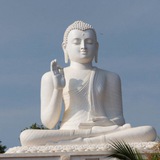
Chapter 3
Citta Vagga
Mind
CONTROL YOUR MIND
3. Dunniggahassa lahuno
yattha kamanipatino
Cittassa damatho sadhu
cittam dantam sukhavaham. 35.
3. The mind is hard to check, swift, flits wherever it listeth: to control it is good. A controlled mind is conducive to happiness. 35.
Story
A devout woman, receiving instruction from the monks, attained Anagami, the third stage of Sainthood, with supernormal powers such as reading others' thoughts, even before the monks had gained their Deliverance. Understanding the physical needs of the monks, she ministered to them well. Before long they too attained Arahantship. An avaricious monk, hearing of her powers, visited the place. She did everything he desired. The monk, fearing that evil thoughts might arise in him, went to the Buddha and reported the matter. The Buddha advised him to subdue his uncontrollable mind.
===
Buddha dharma teachings channel:
https://invite.viber.com/?g2=AQAKw1y3rv%2F6sk61PI2W4izuIiaEZj8YZujhY1tSzL%2B07s7rFnVFDAd0bAYFaMLw
===
Citta Vagga
Mind
CONTROL YOUR MIND
3. Dunniggahassa lahuno
yattha kamanipatino
Cittassa damatho sadhu
cittam dantam sukhavaham. 35.
3. The mind is hard to check, swift, flits wherever it listeth: to control it is good. A controlled mind is conducive to happiness. 35.
Story
A devout woman, receiving instruction from the monks, attained Anagami, the third stage of Sainthood, with supernormal powers such as reading others' thoughts, even before the monks had gained their Deliverance. Understanding the physical needs of the monks, she ministered to them well. Before long they too attained Arahantship. An avaricious monk, hearing of her powers, visited the place. She did everything he desired. The monk, fearing that evil thoughts might arise in him, went to the Buddha and reported the matter. The Buddha advised him to subdue his uncontrollable mind.
===
Buddha dharma teachings channel:
https://invite.viber.com/?g2=AQAKw1y3rv%2F6sk61PI2W4izuIiaEZj8YZujhY1tSzL%2B07s7rFnVFDAd0bAYFaMLw
===
Viber
Buddha
Buddha dharma teachings from the suttas and commentaries from Theravada tradition
🥰1👌1💯1
Forwarded from Buddha Dharma books
Free Buddha Dharma ebook
Volition: an introduction to the law of Kamma
By Sayadaw U Silananda
Free download here:
https://static.sariputta.com/pdf/tipitaka/759/volitionpdf.pdf
===
Volition: an introduction to the law of Kamma
By Sayadaw U Silananda
Free download here:
https://static.sariputta.com/pdf/tipitaka/759/volitionpdf.pdf
===
👏1💯1
Forwarded from Buddha Dharma books
Free Buddha Dharma ebook
Volition: an introduction to the law of Kamma
By Sayadaw U Silananda
WHAT IS kamma? Buddha said: “Oh monks, it is volition that I call kamma.”
The popular meaning of kamma is action or doing, but as a technical term, kamma means volition or will. When you do something, there is volition behind it, and that volition, that mental effort, is called kamma.
Buddha explained that, having willed, one then acts through body, speech, and mind. Whatever you do, there is some kind of kamma, mental effort, will, and volition. Volition is one of the fifty-two mental states which arise together with consciousness.
If you are unfamiliar with the term kamma, then this booklet, Volition, An Introduction to the Law of Kamma – a Dhamma talk given by a well-known Burmese Buddhist monk, Sayadaw U Sãlànanda to students of Vipassana meditation and Abhidhamma in America – might be for you.
Free download here:
https://static.sariputta.com/pdf/tipitaka/759/volitionpdf.pdf
===
Volition: an introduction to the law of Kamma
By Sayadaw U Silananda
WHAT IS kamma? Buddha said: “Oh monks, it is volition that I call kamma.”
The popular meaning of kamma is action or doing, but as a technical term, kamma means volition or will. When you do something, there is volition behind it, and that volition, that mental effort, is called kamma.
Buddha explained that, having willed, one then acts through body, speech, and mind. Whatever you do, there is some kind of kamma, mental effort, will, and volition. Volition is one of the fifty-two mental states which arise together with consciousness.
If you are unfamiliar with the term kamma, then this booklet, Volition, An Introduction to the Law of Kamma – a Dhamma talk given by a well-known Burmese Buddhist monk, Sayadaw U Sãlànanda to students of Vipassana meditation and Abhidhamma in America – might be for you.
Free download here:
https://static.sariputta.com/pdf/tipitaka/759/volitionpdf.pdf
===
❤1👍1💯1
Chapter 3
Citta Vagga
Mind
4. Sududdasam sunipunam
yatthakamanipatinam
Cittam rakkhetha medhavi
cittam guttam sukhavaham. 36.
GUARD YOUR THOUGHTS
4. The mind is very hard to perceive, extremely subtle, flits wherever it listeth. Let the wise person guard it; a guarded mind is conducive to happiness. 36.
Story
A devout follower entered the Order, but soon found the Holy Life too embarrassing, owing to the large number of obligatory rules. The Buddha advised him not to worry about them but to guard only his thoughts.
===
Words of the Buddha channel:
https://invite.viber.com/?g2=AQAFqzqlj7FmI061PX17rxWMAtZ%2BRuso%2FH2KmHKZSgnv7v9DD8X0bDkKnZDr9JDq
===
Citta Vagga
Mind
4. Sududdasam sunipunam
yatthakamanipatinam
Cittam rakkhetha medhavi
cittam guttam sukhavaham. 36.
GUARD YOUR THOUGHTS
4. The mind is very hard to perceive, extremely subtle, flits wherever it listeth. Let the wise person guard it; a guarded mind is conducive to happiness. 36.
Story
A devout follower entered the Order, but soon found the Holy Life too embarrassing, owing to the large number of obligatory rules. The Buddha advised him not to worry about them but to guard only his thoughts.
===
Words of the Buddha channel:
https://invite.viber.com/?g2=AQAFqzqlj7FmI061PX17rxWMAtZ%2BRuso%2FH2KmHKZSgnv7v9DD8X0bDkKnZDr9JDq
===
Viber
Words Of The Buddha
Daily teachings from Buddha Dharma
👌1💯1
Bhikkhus, there are these five defilements of gold, defiled by which gold is not malleable, wieldy, and luminous, but brittle and not properly fit for work. What five? Iron, copper, tin, lead, and silver. But when gold is freed from these five defilements, it is malleable, wieldy, and luminous, pliant and properly fit for work. Then whatever kind of ornament one wishes to make from it—whether a bracelet, earrings, a necklace, or a golden garland—one can achieve one’s purpose.
“So too, bhikkhus, there are these five defilements of the mind, defiled by which the mind is not malleable, wieldy, and luminous, but brittle and not properly concentrated for the destruction of the taints. What five? Sensual desire, ill will, dullness and drowsiness, restlessness and remorse, and doubt. But when the mind is freed from these five defilements, it becomes malleable, wieldy, and luminous, pliant and properly concentrated for the destruction of the taints.
Partially excerpted from AN 5.23 Upakkilesasutta : Defilements
“So too, bhikkhus, there are these five defilements of the mind, defiled by which the mind is not malleable, wieldy, and luminous, but brittle and not properly concentrated for the destruction of the taints. What five? Sensual desire, ill will, dullness and drowsiness, restlessness and remorse, and doubt. But when the mind is freed from these five defilements, it becomes malleable, wieldy, and luminous, pliant and properly concentrated for the destruction of the taints.
Partially excerpted from AN 5.23 Upakkilesasutta : Defilements
❤2🥰1🤩1
Forwarded from Words of the Buddha
Great Victory over King of Dragons Nandopananda
Nandopananda was the king of celestial dragons. By his supernatural power he could assume a very huge form. He could kill other animals by emitting strong fumes blazing fire and violent hot nasal breath. Being a holder of wrong view, he had no respect for the Triple Gems.
One day, in order to enjoy a feast of drinks, he was seated with great pomp and formality on his celestial throne. A white umbrella was placed over him, and his retinue of dragons including female dancers of various ages attended on him.
That morning, when the Buddha looked at the world with his knowledge of Great Compassion, he found Nandopananda who should be liberated from the round of rebirths. So he went to Tavatimsa celestial realm together with five-hundred bhikkhus, passing over Nandopananda and his retinue.
On seeing the Buddha and the bhikkhus, Nandopananda said angrily: “These ascetics used to pass over our heads on going to Tavatimsa. Now, they drop dust from their feet on us as they go up to Tavatimsa. I shall not allow them to go now”. He got up from his throne and went to Mount Meru. He assumed the form of a huge dragon and wound Mt. Meru with his body in seven coils. He covered the Tavatimsa abode with his big hood, creating darkness all over Tavatimsa.
When Mount Meru, the seven surrounding mountains, Tavatimsa celestial abode, Vejayanta mansion with tiered roof and the Sakka’s flag were not visible, the Venerable Ratthapala asked the Buddha for the reason. When the Buddha revealed the true cause to them, Venerable Ratthapala, Venerable Bhaddiya, Venerable Rahula, etc., asked for permission to subdue the dragon. The Buddha turned down their request. However, when the Venerable Moggallana asked for permission, the Buddha assented.
Venerable Moggallana transformed himself into a dragon much larger than Nandopananda. Then he wound himself around Mount Meru in fourteen coils. He placed his huge hood over the dragon’s hood and pressed it against Mt.Meru. When Nandopananda emitted strong fumes and a blaze of fire, Moggallana emitted stronger fumes and a blaze of fire. The fumes and the blaze of fire emitted by Nandopananda did not harm the Venerable Moggallana whereas the former was burnt and hurt by the latter’s.
When Nandopananda knew who his enemy really was, he asked Moggallana to assume his original bhikkhu form. So Venerable Moggallana changed himself into the bhikkhu form. Then he went into the dragon’s left ear and went out of the right ear, and again he went into the right ear and came out of the left ear. Similarly, he entered the head through the nostril and came out of the ears of the dragon king. Besides he entered the dragon’s belly through his mouth and walked up and down in it.
While he was demonstrating thus, the Buddha warned him: “Be careful Moggallana, that dragon is very powerful”. Venerable Moggallana replied: “Venerable Sir, I have proficiently practised the four bases of psychic powers in five skillful ways. Hence I can subdue thousands of dragon kings like Nandopananda”.
While Venerable Moggallana was walking inside the dragon’s belly, Nandopananda thought of chewing him up when he came out. So he asked Venerable Moggallana to come out of his belly. No sooner did the bhikkhu come out than the dragon blew out very hot nasal breath to the bhikkhu. However, Moggallana protected himself by being absorbed in the fourth jhana.
Although other bhikkhus could exercise many miraculous powers, only the Buddha and Venerable Moggallana could protect themselves against such violent hot nasal breath. Thus the Buddha permitted Moggallana to subdue Nandopananda.
Nandopananda was the king of celestial dragons. By his supernatural power he could assume a very huge form. He could kill other animals by emitting strong fumes blazing fire and violent hot nasal breath. Being a holder of wrong view, he had no respect for the Triple Gems.
One day, in order to enjoy a feast of drinks, he was seated with great pomp and formality on his celestial throne. A white umbrella was placed over him, and his retinue of dragons including female dancers of various ages attended on him.
That morning, when the Buddha looked at the world with his knowledge of Great Compassion, he found Nandopananda who should be liberated from the round of rebirths. So he went to Tavatimsa celestial realm together with five-hundred bhikkhus, passing over Nandopananda and his retinue.
On seeing the Buddha and the bhikkhus, Nandopananda said angrily: “These ascetics used to pass over our heads on going to Tavatimsa. Now, they drop dust from their feet on us as they go up to Tavatimsa. I shall not allow them to go now”. He got up from his throne and went to Mount Meru. He assumed the form of a huge dragon and wound Mt. Meru with his body in seven coils. He covered the Tavatimsa abode with his big hood, creating darkness all over Tavatimsa.
When Mount Meru, the seven surrounding mountains, Tavatimsa celestial abode, Vejayanta mansion with tiered roof and the Sakka’s flag were not visible, the Venerable Ratthapala asked the Buddha for the reason. When the Buddha revealed the true cause to them, Venerable Ratthapala, Venerable Bhaddiya, Venerable Rahula, etc., asked for permission to subdue the dragon. The Buddha turned down their request. However, when the Venerable Moggallana asked for permission, the Buddha assented.
Venerable Moggallana transformed himself into a dragon much larger than Nandopananda. Then he wound himself around Mount Meru in fourteen coils. He placed his huge hood over the dragon’s hood and pressed it against Mt.Meru. When Nandopananda emitted strong fumes and a blaze of fire, Moggallana emitted stronger fumes and a blaze of fire. The fumes and the blaze of fire emitted by Nandopananda did not harm the Venerable Moggallana whereas the former was burnt and hurt by the latter’s.
When Nandopananda knew who his enemy really was, he asked Moggallana to assume his original bhikkhu form. So Venerable Moggallana changed himself into the bhikkhu form. Then he went into the dragon’s left ear and went out of the right ear, and again he went into the right ear and came out of the left ear. Similarly, he entered the head through the nostril and came out of the ears of the dragon king. Besides he entered the dragon’s belly through his mouth and walked up and down in it.
While he was demonstrating thus, the Buddha warned him: “Be careful Moggallana, that dragon is very powerful”. Venerable Moggallana replied: “Venerable Sir, I have proficiently practised the four bases of psychic powers in five skillful ways. Hence I can subdue thousands of dragon kings like Nandopananda”.
While Venerable Moggallana was walking inside the dragon’s belly, Nandopananda thought of chewing him up when he came out. So he asked Venerable Moggallana to come out of his belly. No sooner did the bhikkhu come out than the dragon blew out very hot nasal breath to the bhikkhu. However, Moggallana protected himself by being absorbed in the fourth jhana.
Although other bhikkhus could exercise many miraculous powers, only the Buddha and Venerable Moggallana could protect themselves against such violent hot nasal breath. Thus the Buddha permitted Moggallana to subdue Nandopananda.
👍1🏆1
Forwarded from Words of the Buddha
Then Venerable Moggallana, assuming a garuda-form, made a storm break out. When the dragon fled in fear, he chased the dragon closely. As the dragon knew that he could not escape, he assumed the form of a young man and said: “Venerable Sir, I take refuge in you”. Then he paid homage to the thera respectfully. Venerable Moggallana took him to the Buddha.
Nandopananda took refuge in the Three Gems in the presence of the Buddha. In this way Nandopananda became a devotee of Three Gems.
Original story in Visuddhimagga (XII, 106–16)
===
Words of the Buddha channel:
https://news.1rj.ru/str/wordsofbuddha
===
Nandopananda took refuge in the Three Gems in the presence of the Buddha. In this way Nandopananda became a devotee of Three Gems.
Original story in Visuddhimagga (XII, 106–16)
===
Words of the Buddha channel:
https://news.1rj.ru/str/wordsofbuddha
===
Telegram
Words of the Buddha
Daily teachings of Buddha Dharma
👍1🏆1
Chapter 3
Citta Vagga
Mind
5. Duraïgamam ekacaram
asariram guhasayam
Ye cittam saññamessanti
mokkhanti marabandhana. 37.
FREE ARE THEY WHO HAVE CONTROLLED THEIR MINDS
5. Faring far, wandering alone, 3 bodiless, 4 lying in a cave, 5 is the mind. Those who subdue it are freed from the bond of Mara. 37.
Story
An uncle and nephew were leading the Holy Life. One day the nephew received two pieces of cloth and he presented one to his uncle but he declined the offer. He was displeased and planned to leave the Order while fanning his uncle. He thought that he would sell one piece of cloth and buy a she-goat and earn some money. Eventually he would get married and would have a son. Then he would pay a visit to his uncle with his wife and child. On the way his wife would accidentally kill his child and he would get angry and beat his wife. Day dreaming thus he struck his uncle with the fan. The uncle read his thoughts and brought him to his senses. The nephew felt ashamed, dropped the fan and ran away. The monks seized him and brought him to the Buddha's presence. The Buddha described the fleeting nature of the mind.
===
Dhammapada, beloved and favorite teachings of the Buddha channel:
https://invite.viber.com/?g2=AQBLD6phsgvP%2F061YjEM3K%2BNeH1Yb372b9mtfQX2EmuBpgoLUoc99BDMfzHghrme
===
Citta Vagga
Mind
5. Duraïgamam ekacaram
asariram guhasayam
Ye cittam saññamessanti
mokkhanti marabandhana. 37.
FREE ARE THEY WHO HAVE CONTROLLED THEIR MINDS
5. Faring far, wandering alone, 3 bodiless, 4 lying in a cave, 5 is the mind. Those who subdue it are freed from the bond of Mara. 37.
Story
An uncle and nephew were leading the Holy Life. One day the nephew received two pieces of cloth and he presented one to his uncle but he declined the offer. He was displeased and planned to leave the Order while fanning his uncle. He thought that he would sell one piece of cloth and buy a she-goat and earn some money. Eventually he would get married and would have a son. Then he would pay a visit to his uncle with his wife and child. On the way his wife would accidentally kill his child and he would get angry and beat his wife. Day dreaming thus he struck his uncle with the fan. The uncle read his thoughts and brought him to his senses. The nephew felt ashamed, dropped the fan and ran away. The monks seized him and brought him to the Buddha's presence. The Buddha described the fleeting nature of the mind.
===
Dhammapada, beloved and favorite teachings of the Buddha channel:
https://invite.viber.com/?g2=AQBLD6phsgvP%2F061YjEM3K%2BNeH1Yb372b9mtfQX2EmuBpgoLUoc99BDMfzHghrme
===
Viber
Dhammapada - Buddha Dharma Teachings
Daily teachings of the Dhammapada, beloved and favorite teachings of the Buddha
❤1👏1
Forwarded from Buddha
Free Buddha Dharma ebook
Meditation: Buddhism in Practice
By Venerable S.M. Sujano
Free download available:
https://ftp.budaedu.org/ebooks/pdf/EN400.pdf
===
Meditation: Buddhism in Practice
By Venerable S.M. Sujano
Free download available:
https://ftp.budaedu.org/ebooks/pdf/EN400.pdf
===
❤1🙏1
Forwarded from Buddha
Free Buddha Dharma ebook
Meditation: Buddhism in Practice
By Venerable S.M. Sujano
How many times do you ask questions, in particular, who, what, why and how to justify yourself or to search for a solution or to seek an appetite for justification? How many times do you compare yourself to, or have been bossy with things and people? How often do you feel unfairness, injustice or that something is wrong out there? As long as these questions and opinions are resting, chatting and rumouring in your brain, without paying any rent to the self, one cannot find peace and happiness in daily life.
Nevertheless, you are not alone in harbouring these unjust thoughts and constantly getting distracted by normal life. It needs clear observation, acknowledgement and understanding of the nature of the mind. A properly guided mind builds energy and the effort to realise a ruminating mind and bring it to the present moment for better cause in daily life is called meditation.
This book is divided into two parts; meditation and introduction to Buddhism. The first part aims to provide basic concepts of meditation, in particular to the Buddhist point of view on mental cultivation and a simple step by step instruction to find relaxation and to deepen inner peace through insight meditation. There are many kinds of meditation technique based on such as breath, sound, word, visual, light, abdomen, colour, movement, loving kindness, compassion and so on, which are claimed to be based on the discourse on foundation of mindfulness that the Buddha explained. These all techniques are beneficial dependent upon individual preferences according to their mental condition. A number of instruction books are available. On this book, however, the Mindfulness Meditation that taught by the Most Venerable Mahasi Sayadaw will be introduced as a foundation for the development of insight meditation.
The second part introduces an overview of Buddhism and its fundamental teachings mainly based on the Theravada Buddhist tradition. Most of the quotations and sayings are, furthermore, mainly referenced from the Theravada Scripture Tipitaka, the three baskets of teachings, which are written in Pali, a language that is believed to be spoken at the time of the Buddha.
Free download available:
https://ftp.budaedu.org/ebooks/pdf/EN400.pdf
===
Meditation: Buddhism in Practice
By Venerable S.M. Sujano
How many times do you ask questions, in particular, who, what, why and how to justify yourself or to search for a solution or to seek an appetite for justification? How many times do you compare yourself to, or have been bossy with things and people? How often do you feel unfairness, injustice or that something is wrong out there? As long as these questions and opinions are resting, chatting and rumouring in your brain, without paying any rent to the self, one cannot find peace and happiness in daily life.
Nevertheless, you are not alone in harbouring these unjust thoughts and constantly getting distracted by normal life. It needs clear observation, acknowledgement and understanding of the nature of the mind. A properly guided mind builds energy and the effort to realise a ruminating mind and bring it to the present moment for better cause in daily life is called meditation.
This book is divided into two parts; meditation and introduction to Buddhism. The first part aims to provide basic concepts of meditation, in particular to the Buddhist point of view on mental cultivation and a simple step by step instruction to find relaxation and to deepen inner peace through insight meditation. There are many kinds of meditation technique based on such as breath, sound, word, visual, light, abdomen, colour, movement, loving kindness, compassion and so on, which are claimed to be based on the discourse on foundation of mindfulness that the Buddha explained. These all techniques are beneficial dependent upon individual preferences according to their mental condition. A number of instruction books are available. On this book, however, the Mindfulness Meditation that taught by the Most Venerable Mahasi Sayadaw will be introduced as a foundation for the development of insight meditation.
The second part introduces an overview of Buddhism and its fundamental teachings mainly based on the Theravada Buddhist tradition. Most of the quotations and sayings are, furthermore, mainly referenced from the Theravada Scripture Tipitaka, the three baskets of teachings, which are written in Pali, a language that is believed to be spoken at the time of the Buddha.
Free download available:
https://ftp.budaedu.org/ebooks/pdf/EN400.pdf
===
😍1💯1