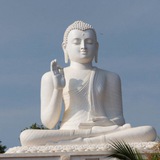
Forwarded from Buddha
A line from an old Japanese samurai poem expresses well this part of the practice: “I make my mind my friend.”
THE PRACTICE OF LOVINGKINDNESS FOR A BENEFACTOR
After strengthening feelings of lovingkindness for ourselves, we send these very same wishes to a benefactor, someone who has aided us in some way in our lives. This may be a parent, a teacher, or even someone we don’t know personally, but whose life has nonetheless had a positive influence on our own. One person who was having difficulty connecting with lovingkindness said that she opened to the feeling of metta most easily when she thought of her dog—a being who always gave her unquestioning love. Benefactors can take many forms.
In this part of the practice, hold the image or sense of that being in your mind, as if you were talking directly to them, and then direct your intention of metta toward him or her: Be happy, be peaceful, be free of suffering. This stage is often easier than directing metta toward ourselves because we usually already have warm and caring feelings for those who have helped us.
THE PRACTICE OF LOVINGKINDNESS FOR ALL
We then move on to other categories of people. We send loving wishes to those very close to us; then to those who are neutral, about whom we have no strong feelings one way or another; and then to “enemies” or difficult people. Finally, we send lovingkindness to all beings everywhere, repeating, May you be happy, may you be peaceful, may you be free of suffering.
It’s important to move through this progression at your own speed. Some categories may be easier than others. Whenever you feel that you’re able to generate genuine feelings of lovingcare for one, move on to the next.
This can be practiced intensively in the solitude of a meditation retreat, in our daily practice at home, or even as we’re walking down the street or driving to work. In all cases, it begins to change how we relate to others in the world.
As an experiment, the next time you are doing an errand, stuck in traffic, or standing in line at the supermarket, instead of being preoccupied with where you’re going or what needs to be done, take a moment to simply send loving wishes to all those around you. Often, there is an immediate and very remarkable shift as we feel more connected and more present.
When I first began the practice of metta, I had an experience that revealed a lot about my mind and the way I was relating to others. I was developing lovingkindness toward a neutral person—although I wasn’t really sure what a “neutral person” meant. My teacher, Anagarika Munindra [1914–2003], simply said to pick someone nearby for whom I didn’t have much feeling, one way or another.
I was in India, and there was an old gardener at the little monastery where I was staying. I saw him every day, but I had never really given him any thought. He was just somebody I noticed in passing. It was quite startling to realize how many such people there were around me, beings for whom I had completely neutral feelings. That in itself was an illuminating discovery.
So every day for weeks, I began visualizing this old gardener in my meditation, repeating phrases like “May you be happy, may you be peaceful, may you be free from suffering.” After a while, I began to feel great warmth and caring for him, and every time we passed my heart just opened. This was a great turning point in my practice. I understood that how I feel about someone is up to me, and that my feelings do not ultimately depend on the person, his or her behavior, or the situation. The gardener remained the same. But because of a turn in my own understanding and practice, my heart began to fill with genuine feelings of kindness and care.
===
Buddha dharma teachings channel:
https://news.1rj.ru/str/lorddivinebuddha
===
THE PRACTICE OF LOVINGKINDNESS FOR A BENEFACTOR
After strengthening feelings of lovingkindness for ourselves, we send these very same wishes to a benefactor, someone who has aided us in some way in our lives. This may be a parent, a teacher, or even someone we don’t know personally, but whose life has nonetheless had a positive influence on our own. One person who was having difficulty connecting with lovingkindness said that she opened to the feeling of metta most easily when she thought of her dog—a being who always gave her unquestioning love. Benefactors can take many forms.
In this part of the practice, hold the image or sense of that being in your mind, as if you were talking directly to them, and then direct your intention of metta toward him or her: Be happy, be peaceful, be free of suffering. This stage is often easier than directing metta toward ourselves because we usually already have warm and caring feelings for those who have helped us.
THE PRACTICE OF LOVINGKINDNESS FOR ALL
We then move on to other categories of people. We send loving wishes to those very close to us; then to those who are neutral, about whom we have no strong feelings one way or another; and then to “enemies” or difficult people. Finally, we send lovingkindness to all beings everywhere, repeating, May you be happy, may you be peaceful, may you be free of suffering.
It’s important to move through this progression at your own speed. Some categories may be easier than others. Whenever you feel that you’re able to generate genuine feelings of lovingcare for one, move on to the next.
This can be practiced intensively in the solitude of a meditation retreat, in our daily practice at home, or even as we’re walking down the street or driving to work. In all cases, it begins to change how we relate to others in the world.
As an experiment, the next time you are doing an errand, stuck in traffic, or standing in line at the supermarket, instead of being preoccupied with where you’re going or what needs to be done, take a moment to simply send loving wishes to all those around you. Often, there is an immediate and very remarkable shift as we feel more connected and more present.
When I first began the practice of metta, I had an experience that revealed a lot about my mind and the way I was relating to others. I was developing lovingkindness toward a neutral person—although I wasn’t really sure what a “neutral person” meant. My teacher, Anagarika Munindra [1914–2003], simply said to pick someone nearby for whom I didn’t have much feeling, one way or another.
I was in India, and there was an old gardener at the little monastery where I was staying. I saw him every day, but I had never really given him any thought. He was just somebody I noticed in passing. It was quite startling to realize how many such people there were around me, beings for whom I had completely neutral feelings. That in itself was an illuminating discovery.
So every day for weeks, I began visualizing this old gardener in my meditation, repeating phrases like “May you be happy, may you be peaceful, may you be free from suffering.” After a while, I began to feel great warmth and caring for him, and every time we passed my heart just opened. This was a great turning point in my practice. I understood that how I feel about someone is up to me, and that my feelings do not ultimately depend on the person, his or her behavior, or the situation. The gardener remained the same. But because of a turn in my own understanding and practice, my heart began to fill with genuine feelings of kindness and care.
===
Buddha dharma teachings channel:
https://news.1rj.ru/str/lorddivinebuddha
===
Telegram
Buddha
Buddha dharma teachings from the suttas and commentaries
🏆1🤗1
9. Aciram vat'ayam kayo
pathavim adhisessati
Chuddho apetaviññano
nirattham'va kalingaram. 41.
9. Before long, alas! this body will lie upon the ground, cast aside, devoid of consciousness, even as a useless charred log. 12 41.
Story
The Buddha ministered to a sick monk, deserted by his co-celibates. He himself washed his stinking body with warm water. Then He sat on his bed and preached to him on the fleeting nature of the body.
===
Buddha dharma teachings channel:
https://news.1rj.ru/str/lorddivinebuddha
===
pathavim adhisessati
Chuddho apetaviññano
nirattham'va kalingaram. 41.
9. Before long, alas! this body will lie upon the ground, cast aside, devoid of consciousness, even as a useless charred log. 12 41.
Story
The Buddha ministered to a sick monk, deserted by his co-celibates. He himself washed his stinking body with warm water. Then He sat on his bed and preached to him on the fleeting nature of the body.
===
Buddha dharma teachings channel:
https://news.1rj.ru/str/lorddivinebuddha
===
Telegram
Buddha
Buddha dharma teachings from the suttas and commentaries
❤1🙏1
Free Buddha Dharma ebook
The Navel of the Earth, The History and Significance of Bodh Gaya
By Bhante Shravasti Dhammika
Free download available:
https://budblooms.org/the-navel-of-the-earth/
===
The Navel of the Earth, The History and Significance of Bodh Gaya
By Bhante Shravasti Dhammika
Free download available:
https://budblooms.org/the-navel-of-the-earth/
===
👍1🥰1
Free Buddha Dharma ebook
The Navel of the Earth, The History and Significance of Bodh Gaya
By Bhante Shravasti Dhammika
India has literally thousands of places that its rich and enduring civilization has adorned with magnificent monuments. Although Bodh Gayā has not attracted as much attention as Agra with its Taj Mahal or Khajuraho’s temples with their erotic sculptures, it is nonetheless one of the most interesting and significant of these places. Bodh Gayā’s historical significance it due to it having a longer and more complete history than almost any other place in the subcontinent, a history supplemented by epigraphical and literary sources from China and Tibet, Burma, Thailand and Sri Lanka. Nor is this history merely an outline of events or a list of doubtful dates, as so often encountered in the study of India’s past. Rather, it includes detailed denoscriptions of Bodh Gayā’s now vanished temples and shrines, accounts of the elaborate ceremonies and doctrinal disputes that once took place there, and even details of how time was kept in its monasteries. This history is also made more interesting by the participation of some of Asia’s greatest personalities, from Asoka to Curzon, from Xuanzang to Anāgārika Dharmapāla.
Free download available:
https://budblooms.org/the-navel-of-the-earth/
===
The Navel of the Earth, The History and Significance of Bodh Gaya
By Bhante Shravasti Dhammika
India has literally thousands of places that its rich and enduring civilization has adorned with magnificent monuments. Although Bodh Gayā has not attracted as much attention as Agra with its Taj Mahal or Khajuraho’s temples with their erotic sculptures, it is nonetheless one of the most interesting and significant of these places. Bodh Gayā’s historical significance it due to it having a longer and more complete history than almost any other place in the subcontinent, a history supplemented by epigraphical and literary sources from China and Tibet, Burma, Thailand and Sri Lanka. Nor is this history merely an outline of events or a list of doubtful dates, as so often encountered in the study of India’s past. Rather, it includes detailed denoscriptions of Bodh Gayā’s now vanished temples and shrines, accounts of the elaborate ceremonies and doctrinal disputes that once took place there, and even details of how time was kept in its monasteries. This history is also made more interesting by the participation of some of Asia’s greatest personalities, from Asoka to Curzon, from Xuanzang to Anāgārika Dharmapāla.
Free download available:
https://budblooms.org/the-navel-of-the-earth/
===
👏1💯1
Forwarded from Words of the Buddha
Triumph of the Heart
Joseph Goldstein teaches that we can improve the way we relate to others—strangers and friends alike.
By Joseph Goldstein
Part 2 of 2
WHAT LEADS TO TRIUMPH OF THE HEART?
There is an important lesson here about the sustaining power of lovingkindness. Because it does not depend on any particular quality in the other person, this kind of love does not transform easily into ill will, anger, or irritation, as love with desire or attachment so often does. Such unconditional love comes only from our own generosity of heart. Although we may recognize the purity and power of this feeling, we may fear or imagine that this kind of love lies beyond our capacity. But metta is not a power that belongs only to the Dalai Lama or Mother Teresa or some extraordinary being categorically different from ourselves. We can all practice it and learn to love in this way. The question for us is, how can we do it? What makes this inclusiveness possible?
A number of years ago, the Harvard Medical Journal included an article about a Tibetan doctor named Tenzin Chodak, who had been a personal physician to the Dalai Lama. In 1959, Dr. Chodak was imprisoned by the Chinese. For seventeen of the twenty-one years he remained in prison, he was beaten and tortured daily—physically and psychologically—and his life was continually threatened. Astonishingly, he emerged from this horror virtually free from signs of post-traumatic stress.
In the article, Dr. Chodak distills the wisdom we need to understand into four points of understanding, which made possible not only his survival—people survive horrendous conditions in many ways—but also the great triumph of his heart. A short biographical sketch of him by Claude Levenson describes him in this way: “Dr. Chodak could easily pass unnoticed, until you meet his gaze—a gaze filled with the perception of one who has seen so much that he has seen everything, seeing beyond the suffering he has experienced, beyond all the evil and the abuses he has witnessed, yet expressing boundless compassion for his fellow human beings.”
FOUR INSIGHTS IN TIMES OF DISTRESS
First, we must endeavor to see every situation in a larger context. Like the Dalai Lama—who often speaks of how one’s enemy teaches one patience—Dr. Chodak saw his enemy as his spiritual teacher, who led him to the wisest and most compassionate place in himself. Accordingly, he felt that even in the most dreadful and deplorable circumstances some human greatness, some greatness of heart could be accomplished. Of course, thinking this is easy; the challenge is to remember and apply this understanding in times of difficulty.
Second, we must see our enemies, or the difficult people in our lives, as human beings like ourselves. Dr. Chodak never forgot the commonality of the human condition. The “law of karma” means that all our actions have consequences: actions bear fruit based on the intentions behind them. People who act cruelly toward us are actually in adverse circumstances, just as we are, creating unwholesome karma that will bring about their own future suffering.
But we mustn’t fall into thinking of karma as “they’ll get theirs,” as a kind of vehicle for cosmic revenge. Rather, seeing the universal human condition can become a wellspring of compassion. The Dalai Lama said, “Your enemies may disagree with you, may be harming you, but in another aspect, they are still human beings like you. They also have the right not to suffer and to find happiness. If your empathy can extend out like that, it is unbiased, genuine compassion.” Understanding karma—that we all reap the fruit of our actions—as a vehicle for compassion is the wisdom we could now integrate into our lives. We’re all in the same situation with regard to the great law of karmic cause and effect.
Lovingkindness is a feeling that blesses others and oneself with the simple wish, “Be happy.”
Joseph Goldstein teaches that we can improve the way we relate to others—strangers and friends alike.
By Joseph Goldstein
Part 2 of 2
WHAT LEADS TO TRIUMPH OF THE HEART?
There is an important lesson here about the sustaining power of lovingkindness. Because it does not depend on any particular quality in the other person, this kind of love does not transform easily into ill will, anger, or irritation, as love with desire or attachment so often does. Such unconditional love comes only from our own generosity of heart. Although we may recognize the purity and power of this feeling, we may fear or imagine that this kind of love lies beyond our capacity. But metta is not a power that belongs only to the Dalai Lama or Mother Teresa or some extraordinary being categorically different from ourselves. We can all practice it and learn to love in this way. The question for us is, how can we do it? What makes this inclusiveness possible?
A number of years ago, the Harvard Medical Journal included an article about a Tibetan doctor named Tenzin Chodak, who had been a personal physician to the Dalai Lama. In 1959, Dr. Chodak was imprisoned by the Chinese. For seventeen of the twenty-one years he remained in prison, he was beaten and tortured daily—physically and psychologically—and his life was continually threatened. Astonishingly, he emerged from this horror virtually free from signs of post-traumatic stress.
In the article, Dr. Chodak distills the wisdom we need to understand into four points of understanding, which made possible not only his survival—people survive horrendous conditions in many ways—but also the great triumph of his heart. A short biographical sketch of him by Claude Levenson describes him in this way: “Dr. Chodak could easily pass unnoticed, until you meet his gaze—a gaze filled with the perception of one who has seen so much that he has seen everything, seeing beyond the suffering he has experienced, beyond all the evil and the abuses he has witnessed, yet expressing boundless compassion for his fellow human beings.”
FOUR INSIGHTS IN TIMES OF DISTRESS
First, we must endeavor to see every situation in a larger context. Like the Dalai Lama—who often speaks of how one’s enemy teaches one patience—Dr. Chodak saw his enemy as his spiritual teacher, who led him to the wisest and most compassionate place in himself. Accordingly, he felt that even in the most dreadful and deplorable circumstances some human greatness, some greatness of heart could be accomplished. Of course, thinking this is easy; the challenge is to remember and apply this understanding in times of difficulty.
Second, we must see our enemies, or the difficult people in our lives, as human beings like ourselves. Dr. Chodak never forgot the commonality of the human condition. The “law of karma” means that all our actions have consequences: actions bear fruit based on the intentions behind them. People who act cruelly toward us are actually in adverse circumstances, just as we are, creating unwholesome karma that will bring about their own future suffering.
But we mustn’t fall into thinking of karma as “they’ll get theirs,” as a kind of vehicle for cosmic revenge. Rather, seeing the universal human condition can become a wellspring of compassion. The Dalai Lama said, “Your enemies may disagree with you, may be harming you, but in another aspect, they are still human beings like you. They also have the right not to suffer and to find happiness. If your empathy can extend out like that, it is unbiased, genuine compassion.” Understanding karma—that we all reap the fruit of our actions—as a vehicle for compassion is the wisdom we could now integrate into our lives. We’re all in the same situation with regard to the great law of karmic cause and effect.
Lovingkindness is a feeling that blesses others and oneself with the simple wish, “Be happy.”
Telegram
Words of the Buddha
Daily teachings of Buddha Dharma
👏1👌1
Forwarded from Words of the Buddha
Third, we must let go of pride and feelings of self-importance. These attitudes, which can arise so easily in times of conflict, become the seeds of even more difficulty. It doesn’t mean that we should adopt a stance of false humility or self-abnegation. Rather, we let go of the tendency toward self-aggrandizement, whether interpersonally or within the framework of our own inner psychology. A story from ancient China uses nature to illustrate the great protection of true humility:
The sage Chuang Tzu was walking with a disciple on a hilltop. They see a crooked, ancient tree without a single straight branch. The disciple says the tree is useless, nothing from it can be used, and Chuang Tzu replies, “That’s the reason it’s ancient. Everyone seems to know how useful it is to be useful. No one seems to know how useful it is to be useless.”
Dr. Chodak actually attributed his survival to the ability to let go of self-importance and self-righteousness. This insight provides a tremendous lesson on the spiritual journey, a lesson that can come up for all of us again and again. Finally, the insight that nourished Dr. Chodak’s amazing triumph of the heart, and one we must truly understand ourselves, is that hatred never ceases through hatred; it ceases only in response to love. Many spiritual traditions acknowledge this truth. In situations of conflict, lovingkindness and compassion grow when we understand them to be the most beneficial motivation for responsive and effective action.
Can we hold these perspectives, even in less trying circumstances? When someone is very angry with you or you’re in some difficult situation, remember that this difficulty itself can strengthen patience and love. In these situations, we can investigate what greatness of heart we might accomplish, remind ourselves that everyone involved shares the common bond of humanity, let go of pride, and understand that, in the end, hatred and enmity will only cease by love.
===
Joseph Goldstein is cofounder and a guiding teacher of the Insight Meditation Society in Barre, Massachusetts, and its Forest Refuge program, and helped establish the Barre Center for Buddhist Studies. His recent books include A Heart Full of Peace and One Dharma: The Emerging Western Buddhism.
===
Part 1 of 2:
https://news.1rj.ru/str/lorddivinebuddha/3237
Part 2 of 2:
https://news.1rj.ru/str/wordsofbuddha/3974
===
Words of the Buddha channel:
https://news.1rj.ru/str/wordsofbuddha
===
The sage Chuang Tzu was walking with a disciple on a hilltop. They see a crooked, ancient tree without a single straight branch. The disciple says the tree is useless, nothing from it can be used, and Chuang Tzu replies, “That’s the reason it’s ancient. Everyone seems to know how useful it is to be useful. No one seems to know how useful it is to be useless.”
Dr. Chodak actually attributed his survival to the ability to let go of self-importance and self-righteousness. This insight provides a tremendous lesson on the spiritual journey, a lesson that can come up for all of us again and again. Finally, the insight that nourished Dr. Chodak’s amazing triumph of the heart, and one we must truly understand ourselves, is that hatred never ceases through hatred; it ceases only in response to love. Many spiritual traditions acknowledge this truth. In situations of conflict, lovingkindness and compassion grow when we understand them to be the most beneficial motivation for responsive and effective action.
Can we hold these perspectives, even in less trying circumstances? When someone is very angry with you or you’re in some difficult situation, remember that this difficulty itself can strengthen patience and love. In these situations, we can investigate what greatness of heart we might accomplish, remind ourselves that everyone involved shares the common bond of humanity, let go of pride, and understand that, in the end, hatred and enmity will only cease by love.
===
Joseph Goldstein is cofounder and a guiding teacher of the Insight Meditation Society in Barre, Massachusetts, and its Forest Refuge program, and helped establish the Barre Center for Buddhist Studies. His recent books include A Heart Full of Peace and One Dharma: The Emerging Western Buddhism.
===
Part 1 of 2:
https://news.1rj.ru/str/lorddivinebuddha/3237
Part 2 of 2:
https://news.1rj.ru/str/wordsofbuddha/3974
===
Words of the Buddha channel:
https://news.1rj.ru/str/wordsofbuddha
===
Telegram
Buddha
Triumph of the Heart
Joseph Goldstein teaches that we can improve the way we relate to others—strangers and friends alike.
By Joseph Goldstein
Part 1 of 2
Love, compassion, and peace—these words are at the heart of spiritual endeavors. Although we intuitively…
Joseph Goldstein teaches that we can improve the way we relate to others—strangers and friends alike.
By Joseph Goldstein
Part 1 of 2
Love, compassion, and peace—these words are at the heart of spiritual endeavors. Although we intuitively…
👍1🏆1
10. Diso disam yam tam kayira
veri va pana verinam
Micchapanihitam cittam
papiyo nam tato kare. 42.
AN ILL-DISPOSED MIND IS THE GREATEST ENEMY
10. Whatever (harm) a foe may do to a foe, or a hater to a hater, an ill-directed mind 13 can do one far greater (harm). 42.
Story
A wealthy herdsman entertained the Buddha. When the Buddha departed he accompanied Him for some distance and turned back. As he was returning he was accidentally killed by a stray arrow. The monks remarked that if the Buddha had not visited that place, the man would not have met with that fatal accident. The Buddha replied that under no circumstances would he have escaped his death owing to a past evil Kamma and added that the internal ill-directed mind would become very inimical to oneself.
===
Vajrayana Tantrayana Buddhism channel:
https://news.1rj.ru/str/tantrayanabuddhism
Tibetan Buddhism - Vajrayana, Tantrayana and esoteric Buddhism channel:
https://news.1rj.ru/str/tibetanbuddha
===
veri va pana verinam
Micchapanihitam cittam
papiyo nam tato kare. 42.
AN ILL-DISPOSED MIND IS THE GREATEST ENEMY
10. Whatever (harm) a foe may do to a foe, or a hater to a hater, an ill-directed mind 13 can do one far greater (harm). 42.
Story
A wealthy herdsman entertained the Buddha. When the Buddha departed he accompanied Him for some distance and turned back. As he was returning he was accidentally killed by a stray arrow. The monks remarked that if the Buddha had not visited that place, the man would not have met with that fatal accident. The Buddha replied that under no circumstances would he have escaped his death owing to a past evil Kamma and added that the internal ill-directed mind would become very inimical to oneself.
===
Vajrayana Tantrayana Buddhism channel:
https://news.1rj.ru/str/tantrayanabuddhism
Tibetan Buddhism - Vajrayana, Tantrayana and esoteric Buddhism channel:
https://news.1rj.ru/str/tibetanbuddha
===
Telegram
Vajrayana Tantrayana Buddhism
Buddha teachings from the Vajrayana, esoteric, secret or Tantrayana vehicle
❤1👍1
Forwarded from Buddha Dharma books
Free Buddha Dharma ebook
The Wind in the Forest
By Bhikkhu Sujiva
Free download here:
https://static.sariputta.com/pdf/tipitaka/225/sujivapoems_pdf.pdf
===
The Wind in the Forest
By Bhikkhu Sujiva
Free download here:
https://static.sariputta.com/pdf/tipitaka/225/sujivapoems_pdf.pdf
===
👌1🕊1
Forwarded from Buddha Dharma books
Free Buddha Dharma ebook
The Wind in the Forest
By Bhikkhu Sujiva
Unlike my other poetry collections, The Wind in the Forest, is not just poetry. Also included are cartoons and short stories. The other difference is an emphasis on our natural environment. I do hope our Malaysian Buddhists can be more aware and concerned about our greens. It had and will play an important role in spirituality. However, the book did not come about for that purpose. I happened to find myself moving in that direction for, as in the past, the forest and the monk go hand in hand.
As for the wind, it’s the Dhamma. When the yogi contemplates on the body and mind as mere processes, they can be perceived just like ‘winds’ — sometimes turbulent, at other times cool and blissful, but nevertheless ungraspable and void. The poem whose noscript the book bears is actually about such a situation. The yogi or monk meditates where he strives to lose himself in Nature. Does not that tattered brown robe camouflage him among the brown tree trunks?
Free download here:
https://static.sariputta.com/pdf/tipitaka/225/sujivapoems_pdf.pdf
===
The Wind in the Forest
By Bhikkhu Sujiva
Unlike my other poetry collections, The Wind in the Forest, is not just poetry. Also included are cartoons and short stories. The other difference is an emphasis on our natural environment. I do hope our Malaysian Buddhists can be more aware and concerned about our greens. It had and will play an important role in spirituality. However, the book did not come about for that purpose. I happened to find myself moving in that direction for, as in the past, the forest and the monk go hand in hand.
As for the wind, it’s the Dhamma. When the yogi contemplates on the body and mind as mere processes, they can be perceived just like ‘winds’ — sometimes turbulent, at other times cool and blissful, but nevertheless ungraspable and void. The poem whose noscript the book bears is actually about such a situation. The yogi or monk meditates where he strives to lose himself in Nature. Does not that tattered brown robe camouflage him among the brown tree trunks?
Free download here:
https://static.sariputta.com/pdf/tipitaka/225/sujivapoems_pdf.pdf
===
👏2🏆1
11. Na tam mata pita kayira
aññe va pi ca ñataka
Samma panihitam cittam
seyyaso nam tato kare. 43.
A WELL-DIRECTED MIND IS FAR GREATER THAN EVEN A MOTHER OR A FATHER
11. What neither mother, nor father, nor any other relative can do, a well-directed mind 14 does and thereby elevates one. 43.
Story
Once a wealthy person harboured a lustful thought on seeing an Arahant. Subsequently he controlled his passion and entered the Order. Before long he attained Arahantship. Hearing of his transformation and attainment, the Buddha praised him and added that a well-directed mind could bestow great blessings such as would not be within the power of even a mother or a father to confer.
===
Words of the Buddha channel:
https://news.1rj.ru/str/wordsofbuddha
===
aññe va pi ca ñataka
Samma panihitam cittam
seyyaso nam tato kare. 43.
A WELL-DIRECTED MIND IS FAR GREATER THAN EVEN A MOTHER OR A FATHER
11. What neither mother, nor father, nor any other relative can do, a well-directed mind 14 does and thereby elevates one. 43.
Story
Once a wealthy person harboured a lustful thought on seeing an Arahant. Subsequently he controlled his passion and entered the Order. Before long he attained Arahantship. Hearing of his transformation and attainment, the Buddha praised him and added that a well-directed mind could bestow great blessings such as would not be within the power of even a mother or a father to confer.
===
Words of the Buddha channel:
https://news.1rj.ru/str/wordsofbuddha
===
Telegram
Words of the Buddha
Daily teachings of Buddha Dharma
👏1🙏1💯1
Chapter 4
Puppha Vagga
Flowers
(Text and Translation by Ven. Narada)
1. Ko imam pathavim vijessati
yamalokan ca imam sadevakam
Ko dhammapadam sudesitam
kusalo puppham'iva pacessati 44.
2. Sekho pathavim vijessati
yamalokan ca imam sadevakam.
Sekho dhammapadam sudesitam
kusalo puppham'iva pacessati 45.
THE NOBLE DISCIPLE WILL CONQUER THIS SELF
1. Who will comprehend 1 this earth (self 2), and this realm of Yama, 3 and this world 4 together with the devas? 5 Who will investigate the well taught Path of Virtue 6, even as an expert (garland maker) will pick flowers? 44.
2. A disciple in training (sekha 7), will comprehend this earth, and this realm of Yama together with the realm of the devas. A disciple in training will investigate the well-taught Path of Virtue even as an expert (garland-maker) will pick flowers. 45.
Story
On hearing that His monks were discussing the extent of the earth, the Buddha advised them to meditate on the personal earth-element.
===
Dhammapada, beloved and favorite teachings of the Buddha channel:
https://news.1rj.ru/str/dhammapadas
===
Puppha Vagga
Flowers
(Text and Translation by Ven. Narada)
1. Ko imam pathavim vijessati
yamalokan ca imam sadevakam
Ko dhammapadam sudesitam
kusalo puppham'iva pacessati 44.
2. Sekho pathavim vijessati
yamalokan ca imam sadevakam.
Sekho dhammapadam sudesitam
kusalo puppham'iva pacessati 45.
THE NOBLE DISCIPLE WILL CONQUER THIS SELF
1. Who will comprehend 1 this earth (self 2), and this realm of Yama, 3 and this world 4 together with the devas? 5 Who will investigate the well taught Path of Virtue 6, even as an expert (garland maker) will pick flowers? 44.
2. A disciple in training (sekha 7), will comprehend this earth, and this realm of Yama together with the realm of the devas. A disciple in training will investigate the well-taught Path of Virtue even as an expert (garland-maker) will pick flowers. 45.
Story
On hearing that His monks were discussing the extent of the earth, the Buddha advised them to meditate on the personal earth-element.
===
Dhammapada, beloved and favorite teachings of the Buddha channel:
https://news.1rj.ru/str/dhammapadas
===
Telegram
Dhammapada - Buddha Dharma Teachings
Daily teachings of the Dhammapada, beloved and favorite teachings of the Buddha
👍1💯1