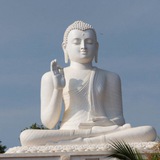
Forwarded from Words of the Buddha
Jayagiri Victory Mountain Buddhist temple, known as the Bayon, the state temple of King Jayavarman VII of the kingdom of Khmer, Cambodia, famous for the thousands faces of Lokesvara.
👍1👏1🙏1💯1
Forwarded from Buddha
Noticing Space
The spacious mind has room for everything
By Ajahn Sumedho
Part 1 of 2
In meditation, we can be alert and attentive; it’s like listening. What we are doing is just bringing into awareness the way it is, noticing space and form. For example, we can notice space in a room. Most people probably wouldn’t notice the space; they would notice the things in it—the people, the walls, the floor, the furniture. But in order to notice the space, what do we do? We withdraw our attention from the things and bring our attention to the space. This does not mean getting rid of things, or denying the things their right to be there. It merely means not concentrating on them, not going from one thing to another.
The space in a room is peaceful. The objects in the room can excite, repel, or attract, but the space has no such quality. However, even though the space does not attract our attention, we can be fully aware of it, and we become aware of it when we are no longer absorbed by the objects in the room. When we reflect on the space in the room, we feel a sense of calm because all space is the same; the space around you and the space around me is no different. It is not mine. I can’t say “This space belongs to me” or “That space belongs to you.”
Space is always present. It makes it possible for us to be together, contained within a room, in a space that is limited by walls. Space is also outside the room; it contains the whole building, the whole world. So space is not bound by objects in any way; it is not bound by anything. If we wish, we can view space as limited in a room, but really, space is unlimited.
Noticing the space around people and things provides a different way of looking at them, and developing this spacious view is a way of opening oneself. When one has a spacious mind, there is room for everything. When one has a narrow mind, there is room for only a few things. Everything has to be manipulated and controlled; the rest is just to be pushed out.
Life with a narrow view is suppressed and constricted; it is a struggle. There is always tension involved in it, because it takes an enormous amount of energy to keep everything in order all the time. If you have a narrow view of life, the disorder of life has to be ordered for you, so you are always busy manipulating the mind and rejecting things or holding on to them. This is the dukkha of ignorance, which comes from not understanding the way it is.
The silence of the mind is like the space in a room.
The spacious mind has room for everything. It is like the space in a room, which is never harmed by what goes in and out of it. In fact, we say “the space in this room,” but actually, the room is in the space, the whole building is in the space. When the building has gone, the space will still be there. The space surrounds the building, and right now we are containing space in a room. With this view we can develop a new perspective. We can see that there are walls creating the shape of the room, and there is the space. Looking at it one way, the walls limit the space in the room. But looking at it another way, we see that space is limitless.
We can apply this perspective to the mind, using the “I” consciousness to see space as an object. In the mind, we can see that there are thoughts and emotions—the mental conditions that arise and cease. Usually, we are dazzled, repelled, or bound by these thoughts and emotions. We go from one thing to another, reacting, controlling, manipulating, or trying to get rid of them. So we never have any perspective in our lives. We become obsessed with either repressing or indulging in these mental conditions; we are caught in these two extremes.
===
Buddha dharma teachings channel:
https://news.1rj.ru/str/lorddivinebuddha
===
The spacious mind has room for everything
By Ajahn Sumedho
Part 1 of 2
In meditation, we can be alert and attentive; it’s like listening. What we are doing is just bringing into awareness the way it is, noticing space and form. For example, we can notice space in a room. Most people probably wouldn’t notice the space; they would notice the things in it—the people, the walls, the floor, the furniture. But in order to notice the space, what do we do? We withdraw our attention from the things and bring our attention to the space. This does not mean getting rid of things, or denying the things their right to be there. It merely means not concentrating on them, not going from one thing to another.
The space in a room is peaceful. The objects in the room can excite, repel, or attract, but the space has no such quality. However, even though the space does not attract our attention, we can be fully aware of it, and we become aware of it when we are no longer absorbed by the objects in the room. When we reflect on the space in the room, we feel a sense of calm because all space is the same; the space around you and the space around me is no different. It is not mine. I can’t say “This space belongs to me” or “That space belongs to you.”
Space is always present. It makes it possible for us to be together, contained within a room, in a space that is limited by walls. Space is also outside the room; it contains the whole building, the whole world. So space is not bound by objects in any way; it is not bound by anything. If we wish, we can view space as limited in a room, but really, space is unlimited.
Noticing the space around people and things provides a different way of looking at them, and developing this spacious view is a way of opening oneself. When one has a spacious mind, there is room for everything. When one has a narrow mind, there is room for only a few things. Everything has to be manipulated and controlled; the rest is just to be pushed out.
Life with a narrow view is suppressed and constricted; it is a struggle. There is always tension involved in it, because it takes an enormous amount of energy to keep everything in order all the time. If you have a narrow view of life, the disorder of life has to be ordered for you, so you are always busy manipulating the mind and rejecting things or holding on to them. This is the dukkha of ignorance, which comes from not understanding the way it is.
The silence of the mind is like the space in a room.
The spacious mind has room for everything. It is like the space in a room, which is never harmed by what goes in and out of it. In fact, we say “the space in this room,” but actually, the room is in the space, the whole building is in the space. When the building has gone, the space will still be there. The space surrounds the building, and right now we are containing space in a room. With this view we can develop a new perspective. We can see that there are walls creating the shape of the room, and there is the space. Looking at it one way, the walls limit the space in the room. But looking at it another way, we see that space is limitless.
We can apply this perspective to the mind, using the “I” consciousness to see space as an object. In the mind, we can see that there are thoughts and emotions—the mental conditions that arise and cease. Usually, we are dazzled, repelled, or bound by these thoughts and emotions. We go from one thing to another, reacting, controlling, manipulating, or trying to get rid of them. So we never have any perspective in our lives. We become obsessed with either repressing or indulging in these mental conditions; we are caught in these two extremes.
===
Buddha dharma teachings channel:
https://news.1rj.ru/str/lorddivinebuddha
===
Telegram
Buddha
Buddha dharma teachings from the suttas and commentaries
👍1🏆1
Forwarded from Buddha Dharma books
Free Buddha Dharma ebook
Buddha and His Disciples
By Bhante Shravasti Dhammika
The life of the Buddha is more than an account of one man’s quest for and realization of the truth; it is also about the people who encountered that man during his forty five year career and how their encounter trans-formed them. If the Buddha’s quest and his encounters with others is set against the backdrop of the world in which these events were acted out, a world with its unique customs, its political intrigue and its religious ferment, it becomes one of the most fascinating stories ever told.
Free download available:
https://budblooms.org/2020/05/11/747/
===
Buddha and His Disciples
By Bhante Shravasti Dhammika
The life of the Buddha is more than an account of one man’s quest for and realization of the truth; it is also about the people who encountered that man during his forty five year career and how their encounter trans-formed them. If the Buddha’s quest and his encounters with others is set against the backdrop of the world in which these events were acted out, a world with its unique customs, its political intrigue and its religious ferment, it becomes one of the most fascinating stories ever told.
Free download available:
https://budblooms.org/2020/05/11/747/
===
❤1👏1💯1
Forwarded from Buddha Dharma books
Free Buddha Dharma ebook
Buddha and His Disciples
By Bhante Shravasti Dhammika
The life of the Buddha is more than an account of one man’s quest for and realization of the truth; it is also about the people who encountered that man during his forty five year career and how their encounter trans-formed them. If the Buddha’s quest and his encounters with others is set against the backdrop of the world in which these events were acted out, a world with its unique customs, its political intrigue and its religious ferment, it becomes one of the most fascinating stories ever told.
Free download available:
https://budblooms.org/2020/05/11/747/
===
Buddha and His Disciples
By Bhante Shravasti Dhammika
The life of the Buddha is more than an account of one man’s quest for and realization of the truth; it is also about the people who encountered that man during his forty five year career and how their encounter trans-formed them. If the Buddha’s quest and his encounters with others is set against the backdrop of the world in which these events were acted out, a world with its unique customs, its political intrigue and its religious ferment, it becomes one of the most fascinating stories ever told.
Free download available:
https://budblooms.org/2020/05/11/747/
===
❤2👏1😘1
Forwarded from Words of the Buddha
Noticing Space
The spacious mind has room for everything
By Ajahn Sumedho
Part 2 of 2
With meditation, we have the opportunity to contemplate the mind. The silence of the mind is like the space in a room. Take the simple sentence “I am” and begin to notice, contemplate, and reflect on the space around those two words. Rather than looking for something else, sustain attention on the space around the words. Look at thinking itself, really examine and investigate it. Now, you can’t watch yourself habitually thinking, because as soon as you notice that you’re thinking, the thinking stops. You might be going along worrying, “I wonder if this will happen. What if that happens? Oh, I’m thinking,” and it stops.
To examine the thinking process, deliberately think something: take just one ordinary thought, such as “I am a human being,” and just look at it. If you look at the beginning of it, you can see that just before you say “I,” there is a kind of empty space. Then, if you think in your mind, “I—am—a—human—being,” you will see space between the words. We are not looking at thought to see whether we have intelligent thoughts or stupid ones. Instead, we are deliberately thinking in order to notice the space around each thought. This way, we begin to have a perspective on the impermanent nature of thinking.
That is just one way of investigating so that we can notice the emptiness when there is no thought in the mind. Try to focus on that space; see if you can concentrate on that space before and after a thought. For how long can you do it? Think, “I am a human being,” and just before you start thinking it, stay in that space just before you say it. Now that’s mindfulness, isn’t it? Your mind is empty, but there is also an intention to think a particular thought. Then think it, and at the end of the thought, try to stay in the space at the end. Does your mind stay empty?
Most of our suffering comes from habitual thinking. If we try to stop it out of aversion to thinking, we can’t; we just go on and on and on. So the important thing is not to get rid of thought, but to understand it. And we do this by concentrating on the space in the mind, rather than on the thought.
Our minds tend to get caught up with thoughts of attraction or aversion to objects, but the space around those thoughts is not attractive or repulsive. The space around an attractive thought and a repulsive thought is not different, is it? Concentrating on the space between thoughts, we become less caught up in our preferences concerning the thoughts. So if you find that an obsessive thought of guilt, self-pity, or passion keeps coming up, then work with it in this way—deliberately think it, really bring it up as a conscious state, and notice the space around it.
It’s like looking at the space in a room: you don’t go looking for the space, do you? You are simply open to it, because it is here all the time. It is not anything you are going to find in the cupboard or in the next room, or under the floor—it is here right now. So you open to its presence; you begin to notice that it is here.
“Noticing Space” was from Ajahn Sumedho’s book The Mind and the Way.
Ajahn Sumedho is a senior monk of the Thai forest tradition and was abbot of Amaravati Buddhist Monastery, UK, from its consecration in 1984 until his retirement in 2010.
===
Part 1 of 2:
https://news.1rj.ru/str/lorddivinebuddha/3321
Part 2 of 2:
https://news.1rj.ru/str/wordsofbuddha/4073
===
Words of the Buddha channel:
https://news.1rj.ru/str/wordsofbuddha
===
The spacious mind has room for everything
By Ajahn Sumedho
Part 2 of 2
With meditation, we have the opportunity to contemplate the mind. The silence of the mind is like the space in a room. Take the simple sentence “I am” and begin to notice, contemplate, and reflect on the space around those two words. Rather than looking for something else, sustain attention on the space around the words. Look at thinking itself, really examine and investigate it. Now, you can’t watch yourself habitually thinking, because as soon as you notice that you’re thinking, the thinking stops. You might be going along worrying, “I wonder if this will happen. What if that happens? Oh, I’m thinking,” and it stops.
To examine the thinking process, deliberately think something: take just one ordinary thought, such as “I am a human being,” and just look at it. If you look at the beginning of it, you can see that just before you say “I,” there is a kind of empty space. Then, if you think in your mind, “I—am—a—human—being,” you will see space between the words. We are not looking at thought to see whether we have intelligent thoughts or stupid ones. Instead, we are deliberately thinking in order to notice the space around each thought. This way, we begin to have a perspective on the impermanent nature of thinking.
That is just one way of investigating so that we can notice the emptiness when there is no thought in the mind. Try to focus on that space; see if you can concentrate on that space before and after a thought. For how long can you do it? Think, “I am a human being,” and just before you start thinking it, stay in that space just before you say it. Now that’s mindfulness, isn’t it? Your mind is empty, but there is also an intention to think a particular thought. Then think it, and at the end of the thought, try to stay in the space at the end. Does your mind stay empty?
Most of our suffering comes from habitual thinking. If we try to stop it out of aversion to thinking, we can’t; we just go on and on and on. So the important thing is not to get rid of thought, but to understand it. And we do this by concentrating on the space in the mind, rather than on the thought.
Our minds tend to get caught up with thoughts of attraction or aversion to objects, but the space around those thoughts is not attractive or repulsive. The space around an attractive thought and a repulsive thought is not different, is it? Concentrating on the space between thoughts, we become less caught up in our preferences concerning the thoughts. So if you find that an obsessive thought of guilt, self-pity, or passion keeps coming up, then work with it in this way—deliberately think it, really bring it up as a conscious state, and notice the space around it.
It’s like looking at the space in a room: you don’t go looking for the space, do you? You are simply open to it, because it is here all the time. It is not anything you are going to find in the cupboard or in the next room, or under the floor—it is here right now. So you open to its presence; you begin to notice that it is here.
“Noticing Space” was from Ajahn Sumedho’s book The Mind and the Way.
Ajahn Sumedho is a senior monk of the Thai forest tradition and was abbot of Amaravati Buddhist Monastery, UK, from its consecration in 1984 until his retirement in 2010.
===
Part 1 of 2:
https://news.1rj.ru/str/lorddivinebuddha/3321
Part 2 of 2:
https://news.1rj.ru/str/wordsofbuddha/4073
===
Words of the Buddha channel:
https://news.1rj.ru/str/wordsofbuddha
===
Telegram
Words of the Buddha
Daily teachings of Buddha Dharma
👍1🏆1
11. Na pupphagandho pativatam eti
na candanam tagaramallika va
Satan ca gandho pativatam eti
sabba disa sappuriso pavati. 54.
12. Candanam tagaram va'pi
uppalam atha vassikã
Etesam gandhajatanam
silagandho anuttaro. 55.
MORAL FRAGRANCE WAFTS EVERYWHERE
11. The perfume of flowers blows not against the wind, nor does the fragrance of sandalwood, tagara 13 and jasmine but the fragrance of the virtuous blows against the wind; the virtuous man pervades every direction. 54.
12. Sandalwood, tagara, lotus, jasmine: above all these kinds of fragrance, the perfume of virtue is by far the best. 55.
Story
The Venerable Ananda wished to know whether there was any fragrance that wafted equally with and against the wind. The Buddha replied that the fragrance of virtue wafts in all directions.
===
Words of the Buddha channel:
https://news.1rj.ru/str/wordsofbuddha
===
na candanam tagaramallika va
Satan ca gandho pativatam eti
sabba disa sappuriso pavati. 54.
12. Candanam tagaram va'pi
uppalam atha vassikã
Etesam gandhajatanam
silagandho anuttaro. 55.
MORAL FRAGRANCE WAFTS EVERYWHERE
11. The perfume of flowers blows not against the wind, nor does the fragrance of sandalwood, tagara 13 and jasmine but the fragrance of the virtuous blows against the wind; the virtuous man pervades every direction. 54.
12. Sandalwood, tagara, lotus, jasmine: above all these kinds of fragrance, the perfume of virtue is by far the best. 55.
Story
The Venerable Ananda wished to know whether there was any fragrance that wafted equally with and against the wind. The Buddha replied that the fragrance of virtue wafts in all directions.
===
Words of the Buddha channel:
https://news.1rj.ru/str/wordsofbuddha
===
Telegram
Words of the Buddha
Daily teachings of Buddha Dharma
❤1🙏1🏆1
Forwarded from Words of the Buddha
If no-one else is found
in front or behind,
it’s extremely pleasant
to be dwelling alone in a forest grove.
Come now, I’ll go alone
to the wilderness praised by the Buddha.
It’s pleasant for a mendicant
to be dwelling alone and resolute.
When will I dwell alone,
without a companion,
in the great wood, so delightful,
my task complete, free of defilements?
This is what I want to do:
may my wish succeed!
I’ll make it happen myself,
for no-one can do another’s duty.
Fastening my armor,
I’ll enter the forest.
I won’t leave
without attaining the end of defilements.
As the cool breeze blows
with fragrant scent,
I’ll split ignorance apart,
sitting on the mountain-peak.
In a forest grove covered with blossoms,
in a cave so very cool,
I take pleasure in the Mountainfold,
happy with the happiness of freedom.
I’ve got all I wished for
like the moon on the fifteenth day.
With the utter ending of all defilements,
now there’ll be no more future lives.
Partially excerpted from Thag 10.2 Ekavihāriyattheragāthā
in front or behind,
it’s extremely pleasant
to be dwelling alone in a forest grove.
Come now, I’ll go alone
to the wilderness praised by the Buddha.
It’s pleasant for a mendicant
to be dwelling alone and resolute.
When will I dwell alone,
without a companion,
in the great wood, so delightful,
my task complete, free of defilements?
This is what I want to do:
may my wish succeed!
I’ll make it happen myself,
for no-one can do another’s duty.
Fastening my armor,
I’ll enter the forest.
I won’t leave
without attaining the end of defilements.
As the cool breeze blows
with fragrant scent,
I’ll split ignorance apart,
sitting on the mountain-peak.
In a forest grove covered with blossoms,
in a cave so very cool,
I take pleasure in the Mountainfold,
happy with the happiness of freedom.
I’ve got all I wished for
like the moon on the fifteenth day.
With the utter ending of all defilements,
now there’ll be no more future lives.
Partially excerpted from Thag 10.2 Ekavihāriyattheragāthā
❤1👍1🙏1🕊1😇1
Forwarded from Words of the Buddha
So I have heard. At Sāvatthī.
“Mendicants, form, feeling, perception, choices, and consciousness are impermanent.
Seeing this, a learned noble disciple grows disillusioned with form, feeling, perception, choices, and consciousness. Being disillusioned, desire fades away. When desire fades away they’re freed. When they’re freed, they know they’re freed.
They understand: ‘Rebirth is ended, the spiritual journey has been completed, what had to be done has been done, there is nothing further for this place.’”
SN 22.12 : Aniccasutta
“Mendicants, form, feeling, perception, choices, and consciousness are impermanent.
Seeing this, a learned noble disciple grows disillusioned with form, feeling, perception, choices, and consciousness. Being disillusioned, desire fades away. When desire fades away they’re freed. When they’re freed, they know they’re freed.
They understand: ‘Rebirth is ended, the spiritual journey has been completed, what had to be done has been done, there is nothing further for this place.’”
SN 22.12 : Aniccasutta
🙏2❤1🕊1
13. Appamatto ayam gandho
ya'yam tagaracandani
Yo ca silavatam gandho
vati devesu uttamo. 56.
THE SCENT OF VIRTUE IS BY FAR THE BEST
13. Of little account is the fragrance of tagara or sandal; the fragrance of the virtuous, which blows even amongst the gods, is supreme. 56.
Story
Sakka king of the gods, disguised as a poor weaver offered alms to the Venerable Kassapa, who had been looking for a poor person to whom he might give the privilege of giving him alms. The Buddha stated that Sakka, attracted by the perfume of virtue of the Venerable Kassapa, gave him alms.
===
Dhammapada, beloved and favorite teachings of the Buddha channel:
https://news.1rj.ru/str/dhammapadas
===
ya'yam tagaracandani
Yo ca silavatam gandho
vati devesu uttamo. 56.
THE SCENT OF VIRTUE IS BY FAR THE BEST
13. Of little account is the fragrance of tagara or sandal; the fragrance of the virtuous, which blows even amongst the gods, is supreme. 56.
Story
Sakka king of the gods, disguised as a poor weaver offered alms to the Venerable Kassapa, who had been looking for a poor person to whom he might give the privilege of giving him alms. The Buddha stated that Sakka, attracted by the perfume of virtue of the Venerable Kassapa, gave him alms.
===
Dhammapada, beloved and favorite teachings of the Buddha channel:
https://news.1rj.ru/str/dhammapadas
===
Telegram
Dhammapada - Buddha Dharma Teachings
Daily teachings of the Dhammapada, beloved and favorite teachings of the Buddha
❤1👏1💯1
Forwarded from Buddha Dharma books
Free Buddha Dharma ebook
With Robes and Bowl
A Glimpse of the Thudong Bhikkhu Life
By Bhikkhu Khantipalo
Free download available:
https://static.sariputta.com/pdf/tipitaka/752/robes-bowl6pdf.pdf
===
With Robes and Bowl
A Glimpse of the Thudong Bhikkhu Life
By Bhikkhu Khantipalo
Free download available:
https://static.sariputta.com/pdf/tipitaka/752/robes-bowl6pdf.pdf
===
👍1😍1
Forwarded from Buddha Dharma books
Free Buddha Dharma ebook
With Robes and Bowl
A Glimpse of the Thudong Bhikkhu Life
By Bhikkhu Khantipalo
In the English language, there are now a number of books describing the life of the last Buddha, Gotama, also many explaining what is meant by the ideal of Buddhahood. Likewise, we have an ever-growing flood of literature, translations, commentaries and so forth, to help us understand what is Dhamma. Much less information, however is to be found on the Sangha, especially upon the bhikkhu-life of the present day. Of course those living in the Buddhist countries where the Sangha is established, will know more about it than will those who follow the Buddha's Path in other lands. It is to give the latter a picture of bhikkhu-life that this book is written, besides keeping before the eyes of those living in Buddhists lands, the best traditions of the Sangha.
Free download available:
https://static.sariputta.com/pdf/tipitaka/752/robes-bowl6pdf.pdf
===
With Robes and Bowl
A Glimpse of the Thudong Bhikkhu Life
By Bhikkhu Khantipalo
In the English language, there are now a number of books describing the life of the last Buddha, Gotama, also many explaining what is meant by the ideal of Buddhahood. Likewise, we have an ever-growing flood of literature, translations, commentaries and so forth, to help us understand what is Dhamma. Much less information, however is to be found on the Sangha, especially upon the bhikkhu-life of the present day. Of course those living in the Buddhist countries where the Sangha is established, will know more about it than will those who follow the Buddha's Path in other lands. It is to give the latter a picture of bhikkhu-life that this book is written, besides keeping before the eyes of those living in Buddhists lands, the best traditions of the Sangha.
Free download available:
https://static.sariputta.com/pdf/tipitaka/752/robes-bowl6pdf.pdf
===
👏1🏆1
Forwarded from Words of the Buddha
Dragon stairs leading to the three doors Candi Bentar temple, Lempuyang temple complex, East Bali, Indonesia.
👏1💯1