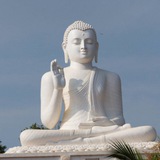
Forwarded from Words of the Buddha
The Story about the Twin Miracle
Yamakapāṭihāriyavatthu
From the Dhammapada Aṭṭhakathā
By E.W. Burlingame and Ānandajoti Bhikkhu
Part 2 of 2
Sakka ordered the Devaputta Vātavalāhaka (Wind-Cloud): “Uproot the pavilion of the sectarians with your winds and throw it into the cesspool.” Devaputta Vātavalāhaka did so. Then Sakka ordered the Devaputta Sun: “Check the course of the sun's disk and scorch them.” The Devaputta Sun did so. Then Sakka again ordered Vātavalāhaka: “Vātavalāhaka, set the chariot of the wind in motion and go forth.” Vātavalāhaka did so. Now the bodies of the sectarians were streaming with sweat, and Vātavalāhaka sprinkled them with a shower of dust until they looked like red ants. Then Sakka again ordered Vātavalāhaka: “Cause countless great drops of rain to fall.” Vātavalāhaka did so, and the sectarians looked like mottled cows. Naked as they were, they fled helter-skelter.
As they were running away, a certain farmer who was a supporter of Pūraṇa Kassapa, thought: “Tomorrow is the day when my noble teachers will perform their miracle; I must go see the miracle.” So unyoking his cattle and taking with him a vessel of broth which he had brought with him early in the morning, and a rope, he set out to return home. When he saw Pūraṇa running away in such wise, he said to him: “Venerable Sir, I set out with the thought in my mind: ―I will go see my noble teachers perform their miracle, "Where are you going?” Pūraṇa replied: “Why should you wish to see a miracle? Give me your waterpot and rope.” The farmer did so. Pūraṇa took the waterpot and rope, and going to the bank of the river, tied the waterpot to his neck with the rope, and threw himself into the stream. There was a splash of water-bubbles, and Pūraṇa died and was reborn in the Avīci Hell.
The Jeweled Walk
The Teacher created a jeweled walk in the air, one end of which rested upon the eastern rim of the world and the other upon the western rim. As the shadows of evening drew on, there assembled a multitude thirty-six leagues in extent. The Teacher, thinking to himself: “This is the time for me to perform the miracle,” came forth from the Perfumed Chamber and stood on the terrace.
At that moment a female lay disciple named Gharaṇī, a woman possessed of psychic power, who had attained the fruition of Non-returning, approached the Teacher and said: “Venerable Sir, so long as you have a daughter like me remaining alive, you will have no occasion to weary yourself; I will perform a miracle.” – “Gharaṇī, what miracle will you perform?” – “Venerable Sir, I will convert the great earth which lies enclosed within the circle of the world into water, and then I will dive into the water like a water-bird and reappear at the eastern rim of the world. Likewise will I reappear at the western rim, and at the northern rim, and at the southern rim of the world, and at the centre. People will ask: ―Who is that? and other people will answer: ―That is Gharaṇī. If such is the supernatural power of a mere woman, what must the supernatural power of a Buddha be like? Under such circumstances the sectarians will flee away without so much as waiting to see you.”
The Teacher replied: “I know very well, Gharaṇī, that you are perfectly able to perform such a miracle as you describe; but this basket of flowers was not prepared for you.” With these words he declined her offer. Gharaṇī said to herself: “The Teacher declines my offer; doubtless there is someone else able to perform a greater miracle than that which I am able to perform.” So saying, she stepped aside.
The Teacher thought to himself: “Thus will the merits of these persons also become manifest; thus will they send up their shouts of applause in the midst of a company thirty-six leagues in extent.” And he asked yet others: “What manner of miracle will you perform?” – “Thus and thus will we perform a miracle, venerable Sir,” they replied; and standing before the Teacher, they sent up shouts of applause.
Yamakapāṭihāriyavatthu
From the Dhammapada Aṭṭhakathā
By E.W. Burlingame and Ānandajoti Bhikkhu
Part 2 of 2
Sakka ordered the Devaputta Vātavalāhaka (Wind-Cloud): “Uproot the pavilion of the sectarians with your winds and throw it into the cesspool.” Devaputta Vātavalāhaka did so. Then Sakka ordered the Devaputta Sun: “Check the course of the sun's disk and scorch them.” The Devaputta Sun did so. Then Sakka again ordered Vātavalāhaka: “Vātavalāhaka, set the chariot of the wind in motion and go forth.” Vātavalāhaka did so. Now the bodies of the sectarians were streaming with sweat, and Vātavalāhaka sprinkled them with a shower of dust until they looked like red ants. Then Sakka again ordered Vātavalāhaka: “Cause countless great drops of rain to fall.” Vātavalāhaka did so, and the sectarians looked like mottled cows. Naked as they were, they fled helter-skelter.
As they were running away, a certain farmer who was a supporter of Pūraṇa Kassapa, thought: “Tomorrow is the day when my noble teachers will perform their miracle; I must go see the miracle.” So unyoking his cattle and taking with him a vessel of broth which he had brought with him early in the morning, and a rope, he set out to return home. When he saw Pūraṇa running away in such wise, he said to him: “Venerable Sir, I set out with the thought in my mind: ―I will go see my noble teachers perform their miracle, "Where are you going?” Pūraṇa replied: “Why should you wish to see a miracle? Give me your waterpot and rope.” The farmer did so. Pūraṇa took the waterpot and rope, and going to the bank of the river, tied the waterpot to his neck with the rope, and threw himself into the stream. There was a splash of water-bubbles, and Pūraṇa died and was reborn in the Avīci Hell.
The Jeweled Walk
The Teacher created a jeweled walk in the air, one end of which rested upon the eastern rim of the world and the other upon the western rim. As the shadows of evening drew on, there assembled a multitude thirty-six leagues in extent. The Teacher, thinking to himself: “This is the time for me to perform the miracle,” came forth from the Perfumed Chamber and stood on the terrace.
At that moment a female lay disciple named Gharaṇī, a woman possessed of psychic power, who had attained the fruition of Non-returning, approached the Teacher and said: “Venerable Sir, so long as you have a daughter like me remaining alive, you will have no occasion to weary yourself; I will perform a miracle.” – “Gharaṇī, what miracle will you perform?” – “Venerable Sir, I will convert the great earth which lies enclosed within the circle of the world into water, and then I will dive into the water like a water-bird and reappear at the eastern rim of the world. Likewise will I reappear at the western rim, and at the northern rim, and at the southern rim of the world, and at the centre. People will ask: ―Who is that? and other people will answer: ―That is Gharaṇī. If such is the supernatural power of a mere woman, what must the supernatural power of a Buddha be like? Under such circumstances the sectarians will flee away without so much as waiting to see you.”
The Teacher replied: “I know very well, Gharaṇī, that you are perfectly able to perform such a miracle as you describe; but this basket of flowers was not prepared for you.” With these words he declined her offer. Gharaṇī said to herself: “The Teacher declines my offer; doubtless there is someone else able to perform a greater miracle than that which I am able to perform.” So saying, she stepped aside.
The Teacher thought to himself: “Thus will the merits of these persons also become manifest; thus will they send up their shouts of applause in the midst of a company thirty-six leagues in extent.” And he asked yet others: “What manner of miracle will you perform?” – “Thus and thus will we perform a miracle, venerable Sir,” they replied; and standing before the Teacher, they sent up shouts of applause.
Telegram
Words of the Buddha
Daily teachings of Buddha Dharma
👍1😍1
Forwarded from Words of the Buddha
It seems that among others Culla Anāthapiṇḍika thought to himself: “So long as the Teacher has a son like me alive, a lay disciple who has attained the fruition of Non-returning, he will have no occasion to weary himself.” Accordingly he said to the Teacher: “Venerable Sir, I will perform a miracle.” – “What manner of miracle will you perform?” asked the Teacher. “Venerable Sir, I will assume a form like that of Mahā Brahma, twelve leagues in size, and in the midst of this company, with a sound like the roar of thunder that accompanies a heavy rainstorm, I will shake the earth even as Mahā Brahma shakes the earth. The multitude will ask: ―What sound is that? and the answer will be: ―That is the sound of an earthquake produced by Culla Anāthapiṇḍika. The sectarians will say: ―If such is the supernatural power of a lay disciple, what must be the supernatural power of a Buddha?, "And they will flee away without so much as waiting to see you.”
The Teacher repeated the answer he had given to Gharaṇī: “I know that you possess this power,” and declined his offer to perform the miracle.
Now a certain seven-year-old girl, a novice named Cīrā, who had attained the analytic knowledges, worshipped the Teacher and said: “Venerable Sir, I will perform a miracle.” – “What miracle will you perform, Cīrā?” –
“Venerable Sir, I will fetch Mount Sineru here, and the range of mountains that encircles the earth, and Himālaya likewise, and I will set them up in a row; and then I will soar like a wild-goose up and over the tops of these mountains without so much as touching them and return here. When the populace see me, they will ask: ―Who is that? and the answer will be: ―That is the female novice Cīrā. The sectarians will say: ―It is a mere seven-year-old novice who possesses this supernatural power; what must the supernatural power of a Buddha be like?
So saying, they will flee away without so much as waiting to see you.”
The same words are to be understood here as occurred in the previous answers.
To her likewise did the Fortunate One reply: “I know your supernatural power,” and declined her offer to perform the miracle.
Now a certain novice named Cunda, who, although he had attained the analytic knowledges and the destruction of the pollutants, yet was only seven years old, worshipped the Teacher and said: “Fortunate One, I will perform a miracle.” –“What miracle will you perform?” asked the Teacher. Cunda replied:
“Venerable Sir, I will take upon my shoulder a great rose-apple tree, which is the emblem of Jambudīpa, and I will wave it back and forth, and I will bring fragments of rose-apple and give to this company to eat thereof, and I will also bring flowers of the coral tree.”
Then the bhikkhunī Uppalavaṇṇā worshipped the Teacher and said: “Venerable Sir, I will perform a miracle.” – “What miracle will you perform?” asked the Teacher. “Venerable Sir,” replied Uppalavaṇṇā: “Before the eyes of a multitude extended twelve leagues on all sides, I will surround myself with a retinue thirty-six leagues round about, and I will take the form of a Universal Monarch and will come to you and will worship you.” The Teacher said: “I know your supernatural power,” and declined her offer to perform the miracle.
Then the Elder Mahā Moggallāna worshipped the Fortunate One and said:
“Venerable Sir, I will perform a miracle.” – “What miracle will you perform?” asked the Teacher. “Venerable Sir, I will put Mount Sineru, king of mountains, between my teeth and crunch it like a kidney-bean.” – “What else will you do?” – “I will roll up this earth like a mat and thrust it between my fingers.” – “What else will you do?” – “I will cause the earth to revolve like a potter's wheel and I will give the multitude the essence of earth to eat.” – “What else will you do?” – “I will place the earth in my left hand, and I will remove all these living beings to another continent.” – “What else will you do?” – “I will use Mount Sineru as an umbrella-stick, uplift the great earth, place it thereon, and taking it in one hand, even as a bhikkhu carries an
The Teacher repeated the answer he had given to Gharaṇī: “I know that you possess this power,” and declined his offer to perform the miracle.
Now a certain seven-year-old girl, a novice named Cīrā, who had attained the analytic knowledges, worshipped the Teacher and said: “Venerable Sir, I will perform a miracle.” – “What miracle will you perform, Cīrā?” –
“Venerable Sir, I will fetch Mount Sineru here, and the range of mountains that encircles the earth, and Himālaya likewise, and I will set them up in a row; and then I will soar like a wild-goose up and over the tops of these mountains without so much as touching them and return here. When the populace see me, they will ask: ―Who is that? and the answer will be: ―That is the female novice Cīrā. The sectarians will say: ―It is a mere seven-year-old novice who possesses this supernatural power; what must the supernatural power of a Buddha be like?
So saying, they will flee away without so much as waiting to see you.”
The same words are to be understood here as occurred in the previous answers.
To her likewise did the Fortunate One reply: “I know your supernatural power,” and declined her offer to perform the miracle.
Now a certain novice named Cunda, who, although he had attained the analytic knowledges and the destruction of the pollutants, yet was only seven years old, worshipped the Teacher and said: “Fortunate One, I will perform a miracle.” –“What miracle will you perform?” asked the Teacher. Cunda replied:
“Venerable Sir, I will take upon my shoulder a great rose-apple tree, which is the emblem of Jambudīpa, and I will wave it back and forth, and I will bring fragments of rose-apple and give to this company to eat thereof, and I will also bring flowers of the coral tree.”
Then the bhikkhunī Uppalavaṇṇā worshipped the Teacher and said: “Venerable Sir, I will perform a miracle.” – “What miracle will you perform?” asked the Teacher. “Venerable Sir,” replied Uppalavaṇṇā: “Before the eyes of a multitude extended twelve leagues on all sides, I will surround myself with a retinue thirty-six leagues round about, and I will take the form of a Universal Monarch and will come to you and will worship you.” The Teacher said: “I know your supernatural power,” and declined her offer to perform the miracle.
Then the Elder Mahā Moggallāna worshipped the Fortunate One and said:
“Venerable Sir, I will perform a miracle.” – “What miracle will you perform?” asked the Teacher. “Venerable Sir, I will put Mount Sineru, king of mountains, between my teeth and crunch it like a kidney-bean.” – “What else will you do?” – “I will roll up this earth like a mat and thrust it between my fingers.” – “What else will you do?” – “I will cause the earth to revolve like a potter's wheel and I will give the multitude the essence of earth to eat.” – “What else will you do?” – “I will place the earth in my left hand, and I will remove all these living beings to another continent.” – “What else will you do?” – “I will use Mount Sineru as an umbrella-stick, uplift the great earth, place it thereon, and taking it in one hand, even as a bhikkhu carries an
🤩1👌1
Forwarded from Words of the Buddha
umbrella in his hand, walk about in the air.”
The Teacher said: “I know your supernatural power,” but declined to permit him to perform the miracles. Moggallāna said: “Doubtless the Teacher knows of someone able to perform a miracle more wonderful than any that I am able to perform.” So saying, he stepped aside.
Then the Teacher said to him: “Moggallāna, this basket of flowers was not prepared for you. The burden which I bear is like the burden of none other; mine is a burden which none other is able to bear. Indeed it is not strange that there is now no one who can bear my burden. In previous states of existence, also, in which, solely through my own volition, I was born as an animal, no one was able to bear my burden.”
When the Teacher had thus spoken, the elder asked him: “When was this, venerable Sir, and how was this?” The Teacher then related in detail.
===
Part 1 of 2:
https://news.1rj.ru/str/dhammapadas/2986
Part 2 of 2:
https://news.1rj.ru/str/wordsofbuddha/4213
===
Words of the Buddha channel:
https://news.1rj.ru/str/wordsofbuddha
===
The Teacher said: “I know your supernatural power,” but declined to permit him to perform the miracles. Moggallāna said: “Doubtless the Teacher knows of someone able to perform a miracle more wonderful than any that I am able to perform.” So saying, he stepped aside.
Then the Teacher said to him: “Moggallāna, this basket of flowers was not prepared for you. The burden which I bear is like the burden of none other; mine is a burden which none other is able to bear. Indeed it is not strange that there is now no one who can bear my burden. In previous states of existence, also, in which, solely through my own volition, I was born as an animal, no one was able to bear my burden.”
When the Teacher had thus spoken, the elder asked him: “When was this, venerable Sir, and how was this?” The Teacher then related in detail.
===
Part 1 of 2:
https://news.1rj.ru/str/dhammapadas/2986
Part 2 of 2:
https://news.1rj.ru/str/wordsofbuddha/4213
===
Words of the Buddha channel:
https://news.1rj.ru/str/wordsofbuddha
===
🥰1💯1
11. Mase mase kusaggena
balo bhuñjetha bhojanam
Na so saïkhatadhammanam
kalam agghati soëasim. 70.
REALIZATION IS FAR SUPERIOR TO MERE FASTING
11. Month after month a fool may eat only as much food as can be picked up on the tip of a kusa grass blade; 5 but he is not worth a sixteenth part of them who have comprehended the Truth. 6 70.
Story
An ascetic, as the result of a past evil action, used to live on excreta. One day, with the tip of a blade of grass, he placed on the tip of his tongue a little butter and honey. The Buddha visited him and made him attain Arahantship.
===
Ajahn Chah, Buddhist teacher of Thai forest meditation of Theravada Buddhism channel:
https://news.1rj.ru/str/ajahnchah_buddhism
===
balo bhuñjetha bhojanam
Na so saïkhatadhammanam
kalam agghati soëasim. 70.
REALIZATION IS FAR SUPERIOR TO MERE FASTING
11. Month after month a fool may eat only as much food as can be picked up on the tip of a kusa grass blade; 5 but he is not worth a sixteenth part of them who have comprehended the Truth. 6 70.
Story
An ascetic, as the result of a past evil action, used to live on excreta. One day, with the tip of a blade of grass, he placed on the tip of his tongue a little butter and honey. The Buddha visited him and made him attain Arahantship.
===
Ajahn Chah, Buddhist teacher of Thai forest meditation of Theravada Buddhism channel:
https://news.1rj.ru/str/ajahnchah_buddhism
===
Telegram
Ajahn Chah - Theravada Thailand Buddhism
Collection of teachings of Venerable Ajahn Chah, a foremost meditation and Buddhist teacher from Thailand
❤1👍1👏1
Forwarded from Words of the Buddha
Buddham Saranam Gacchami
Dhammam Saranam Gacchami
Sangham Saranam Gacchami
I go to the Buddha for refuge.
I go to the Dhamma for refuge.
I go to the Sangha for refuge.
बुद्धं शरणं गच्छामि। धर्मं शरणं गच्छामि। संघं शरणं गच्छामि।
Dhammam Saranam Gacchami
Sangham Saranam Gacchami
I go to the Buddha for refuge.
I go to the Dhamma for refuge.
I go to the Sangha for refuge.
बुद्धं शरणं गच्छामि। धर्मं शरणं गच्छामि। संघं शरणं गच्छामि।
🙏1👌1
If you find an alert companion, an attentive friend to live happily together, then, overcoming all adversities, wander with them, joyful and mindful.
If you find no alert companion, an attentive friend to live happily together, then, like a king who flees his conquered realm, wander alone like a tusker in the wilds.
Partial excepts from Snp 1.3 : Khaggavisāṇasutta
If you find no alert companion, an attentive friend to live happily together, then, like a king who flees his conquered realm, wander alone like a tusker in the wilds.
Partial excepts from Snp 1.3 : Khaggavisāṇasutta
❤1🤗1
Free Buddha Dharma ebook
Good Question, Good Answer
By Bhante Shravasti Dhammika
Free download available:
https://budblooms.org/good-question/
===
Good Question, Good Answer
By Bhante Shravasti Dhammika
Free download available:
https://budblooms.org/good-question/
===
👏1💯1
Free Buddha Dharma ebook
Good Question, Good Answer
By Bhante Shravasti Dhammika
QUESTION: What is Buddhism?
ANSWER: The name Buddhism comes from the word budhi which means ‘to wake up’ and thus Buddhism can be said to be the philosophy of awakening. This philosophy has its origins in the experience of the man Siddhattha Gotama, known as the Buddha, who was himself awakened at the age of 35. Buddhism is now more than 2,500 years old and has about 380 million followers worldwide. Until a hundred years ago Buddhism was mainly an Asian philosophy but increasingly it is gaining adherents in Europe, Australia and the Americas.
Free download available:
https://budblooms.org/good-question/
===
Good Question, Good Answer
By Bhante Shravasti Dhammika
QUESTION: What is Buddhism?
ANSWER: The name Buddhism comes from the word budhi which means ‘to wake up’ and thus Buddhism can be said to be the philosophy of awakening. This philosophy has its origins in the experience of the man Siddhattha Gotama, known as the Buddha, who was himself awakened at the age of 35. Buddhism is now more than 2,500 years old and has about 380 million followers worldwide. Until a hundred years ago Buddhism was mainly an Asian philosophy but increasingly it is gaining adherents in Europe, Australia and the Americas.
Free download available:
https://budblooms.org/good-question/
===
❤2👍1🙏1🏆1
Forwarded from Words of the Buddha
Grande Buda de Ibiraçu, gigantic Buddha statue located in Morro da Vargem Zen Buddhism Monastery,
Ibiraçu, Espírito Santo, Brazil, the largest Buddha statue in America continent.
Ibiraçu, Espírito Santo, Brazil, the largest Buddha statue in America continent.
🙏2👏1🤩1
12. Na hi papam katam kammam
sajju kharam'va muccati
ôahantam balam anveti
bhasmacchanno'va pavako. 71.
EVIL TAKES EFFECT AT THE OPPORTUNE MOMENT
12. Verily, an evil deed committed does not immediately bear fruit, just as milk curdles not at once; smouldering, it follows the fool like fire covered with ashes. 71.
Story
An indignant farmer set fire to the hut of a Private Buddha and was born as a Peta resembling a snake. The Buddha related why he was born in such a state and commented on the effects of evil deeds.
===
Free Buddhism books, teachings, podcasts and videos from Theravada, Mahayana and Vajrayana traditions:
https://news.1rj.ru/str/buddha_ebooks
===
sajju kharam'va muccati
ôahantam balam anveti
bhasmacchanno'va pavako. 71.
EVIL TAKES EFFECT AT THE OPPORTUNE MOMENT
12. Verily, an evil deed committed does not immediately bear fruit, just as milk curdles not at once; smouldering, it follows the fool like fire covered with ashes. 71.
Story
An indignant farmer set fire to the hut of a Private Buddha and was born as a Peta resembling a snake. The Buddha related why he was born in such a state and commented on the effects of evil deeds.
===
Free Buddhism books, teachings, podcasts and videos from Theravada, Mahayana and Vajrayana traditions:
https://news.1rj.ru/str/buddha_ebooks
===
Telegram
Buddha Dharma books
Free Buddhism books, teachings, podcasts and videos from Theravada, Mahayana and Vajrayana traditions
❤1🏆1
Forwarded from Words of the Buddha
Wat Arun Ratchawararam Ratchawaramahawihan Buddhist temple, Thonburi, on the west bank of the Chao Phraya River, Bangkok, Thailand.
👍2❤1🤩1😍1
Then the Holy One, the Teacher, went on to say:
“When an ethical person with trusting heart gives a proper gift to unethical persons, trusting in the ample fruit of deeds, that offering is purified by the giver.
When an unethical and untrusting person, gives an improper gift to ethical persons, not trusting in the ample fruit of deeds, that offering is purified by the receivers.
When an unethical and untrusting person, gives an improper gift to unethical persons, not trusting in the ample fruit of deeds, I declare that gift is not very fruitful.
When an ethical person with trusting heart gives a proper gift to ethical persons, trusting in the ample fruit of deeds, I declare that gift is abundantly fruitful.
But when a passionless one gives to the passionless a proper gift with trusting heart, trusting in the ample fruit of deeds, that’s truly the best of material gifts.”
Partial excerpts from MN 142 : Dakkhiṇāvibhaṅgasutta
“When an ethical person with trusting heart gives a proper gift to unethical persons, trusting in the ample fruit of deeds, that offering is purified by the giver.
When an unethical and untrusting person, gives an improper gift to ethical persons, not trusting in the ample fruit of deeds, that offering is purified by the receivers.
When an unethical and untrusting person, gives an improper gift to unethical persons, not trusting in the ample fruit of deeds, I declare that gift is not very fruitful.
When an ethical person with trusting heart gives a proper gift to ethical persons, trusting in the ample fruit of deeds, I declare that gift is abundantly fruitful.
But when a passionless one gives to the passionless a proper gift with trusting heart, trusting in the ample fruit of deeds, that’s truly the best of material gifts.”
Partial excerpts from MN 142 : Dakkhiṇāvibhaṅgasutta
❤2👍1🍾1🤗1
Forwarded from Words of the Buddha
Dragon Temple, Amphoe Sam Phran, Nakhon Pathom province, Thailand. The dragon's body is the stairs leading to the main Buddhist temple on top of the building.
🤩1😍1
13. Yavadeva anatthaya
ñattam balassa jayati
Hanti balassa sukkamsam
muddham assa vipatayam. 72.
KNOWLEDGE AND FAME TEND TO THE RUIN OF FOOLS
13. To his ruin, indeed, the fool gains knowledge and fame; they destroy his bright lot and cleave his head. 7 72.
Story
A vicious pupil learnt the art of shooting and misused his skill by shooting a stone at a Private Buddha and killing him instantaneously. In consequence of this evil deed he was born as a sledge-hammer Peta. Referring to his past skill, the Buddha remarked that the knowledge of the vicious tends to their own ruin.
===
Buddha dharma teachings channel:
https://news.1rj.ru/str/lorddivinebuddha
===
ñattam balassa jayati
Hanti balassa sukkamsam
muddham assa vipatayam. 72.
KNOWLEDGE AND FAME TEND TO THE RUIN OF FOOLS
13. To his ruin, indeed, the fool gains knowledge and fame; they destroy his bright lot and cleave his head. 7 72.
Story
A vicious pupil learnt the art of shooting and misused his skill by shooting a stone at a Private Buddha and killing him instantaneously. In consequence of this evil deed he was born as a sledge-hammer Peta. Referring to his past skill, the Buddha remarked that the knowledge of the vicious tends to their own ruin.
===
Buddha dharma teachings channel:
https://news.1rj.ru/str/lorddivinebuddha
===
Telegram
Buddha
Buddha dharma teachings from the suttas and commentaries
👏1🤗1
Forwarded from Buddha Dharma books
Free Buddhism ebook
Handful of Leaves
An Anthology from the Sutta Pitaka
By Thanissaro Bhikkhu
Anthology from the Digha Nikaya. This volume is the first in a four-volume anthology of suttas (discourses) drawn from the Sutta Pitaka (Discourse Basket or Repository) of the Pali Canon. This volume contains suttas drawn from the first of the five collections comprising the Sutta Pitaka: the Digha Nikaya, or Long Collection.
Free download available:
https://drive.google.com/file/d/1NU7C-AEfFqAq-uj4gd1X-1dEvhHNkjBd/view?usp=drive_link
===
Handful of Leaves
An Anthology from the Sutta Pitaka
By Thanissaro Bhikkhu
Anthology from the Digha Nikaya. This volume is the first in a four-volume anthology of suttas (discourses) drawn from the Sutta Pitaka (Discourse Basket or Repository) of the Pali Canon. This volume contains suttas drawn from the first of the five collections comprising the Sutta Pitaka: the Digha Nikaya, or Long Collection.
Free download available:
https://drive.google.com/file/d/1NU7C-AEfFqAq-uj4gd1X-1dEvhHNkjBd/view?usp=drive_link
===
👍1😘1
Forwarded from Buddha Dharma books
Free Buddhism ebook
Handful of Leaves
An Anthology from the Sutta Pitaka
By Thanissaro Bhikkhu
Anthology from the Digha Nikaya. This volume is the first in a four-volume anthology of suttas (discourses) drawn from the Sutta Pitaka (Discourse Basket or Repository) of the Pali Canon. This volume contains suttas drawn from the first of the five collections comprising the Sutta Pitaka: the Digha Nikaya, or Long Collection.
Free download available:
https://drive.google.com/file/d/1NU7C-AEfFqAq-uj4gd1X-1dEvhHNkjBd/view?usp=drive_link
===
Handful of Leaves
An Anthology from the Sutta Pitaka
By Thanissaro Bhikkhu
Anthology from the Digha Nikaya. This volume is the first in a four-volume anthology of suttas (discourses) drawn from the Sutta Pitaka (Discourse Basket or Repository) of the Pali Canon. This volume contains suttas drawn from the first of the five collections comprising the Sutta Pitaka: the Digha Nikaya, or Long Collection.
Free download available:
https://drive.google.com/file/d/1NU7C-AEfFqAq-uj4gd1X-1dEvhHNkjBd/view?usp=drive_link
===
❤1🆒1
Now how is mindfulness of in-&-out breathing developed & pursued so as to be of great fruit, of great benefit?
"There is the case where a monk, having gone to the wilderness, to the shade of a tree, or to an empty building, sits down folding his legs crosswise, holding his body erect, and setting mindfulness to the fore. Always mindful, he breathes in; mindful he breathes out.
"Breathing in long, he discerns, 'I am breathing in long'; or breathing out long, he discerns, 'I am breathing out long.' Or breathing in short, he discerns, 'I am breathing in short'; or breathing out short, he discerns, 'I am breathing out short.' He trains himself, 'I will breathe in sensitive to the entire body.'He trains himself, 'I will breathe out sensitive to the entire body.' He trains himself, 'I will breathe in calming bodily fabrication.' He trains himself, 'I will breathe out calming bodily fabrication.'
Partially excerpted from MN 118 : Anapanasati Sutta.
"There is the case where a monk, having gone to the wilderness, to the shade of a tree, or to an empty building, sits down folding his legs crosswise, holding his body erect, and setting mindfulness to the fore. Always mindful, he breathes in; mindful he breathes out.
"Breathing in long, he discerns, 'I am breathing in long'; or breathing out long, he discerns, 'I am breathing out long.' Or breathing in short, he discerns, 'I am breathing in short'; or breathing out short, he discerns, 'I am breathing out short.' He trains himself, 'I will breathe in sensitive to the entire body.'He trains himself, 'I will breathe out sensitive to the entire body.' He trains himself, 'I will breathe in calming bodily fabrication.' He trains himself, 'I will breathe out calming bodily fabrication.'
Partially excerpted from MN 118 : Anapanasati Sutta.
🙏2🕊1😇1
Forwarded from Buddha
The Story about the Twin Miracle
Yamakapāṭihāriyavatthu
From the Dhammapada Aṭṭhakathā
By E W Burlingame and Ānandajoti Bhikkhu
Part 1 of 2
The Birth Story about the Bull Blackie:
In the past when Brahmadatta was reigning in Benares, the Bodhisatta came to life as a bull. And while he was still a young calf, his owners, who had been lodging with an old woman, made him over to her in settlement of their reckoning. She reared him like her own child, feeding him on rice-gruel and rice and on other good cheer. The name he became known by was: “Granny’s Blackie (Ayyikā Kāḷaka).”
Growing up, he used to range about with the other cattle of the village, and was as black as jet. The village urchins used to catch hold of his horns and ears and dewlaps, and have a ride; or they would hold on to his tail in play, and mount on his back.
One day he thought to himself: “My mother is very poor; she has painfully reared me, as if I were her own child. What if I were to earn some money to ease her hard lot?” Thenceforth he was always looking out for a job. Now, one day a young merchant at the head of a caravan came with five hundred wagons to a ford the bottom of which was so rough that his oxen could not pull the wagons through. And even when he took out the five hundred pairs of oxen and yoked the lot together to form one team, they could not get a single cart by itself across the river.
Close by that ford the Bodhisatta was about with the other cattle of the village, and the young merchant, being a judge of cattle, ran his eye over the herd to see whether among them there was a thoroughbred bull who could pull the wagons across. When his eye fell on the Bodhisatta, he felt sure he would do so; and, to find out the Bodhisatta’s owner, he said to the herdsmen: “Who owns this animal? If I could yoke him on and get my wagons across, I would pay for his services.” They said: “Take him and harness him, then; he has got no master hereabouts.”
But when the young merchant slipped a cord through the Bodhisatta’s nose and tried to lead him off, the bull would not budge. For, we are told, the Bodhisatta would not go till his pay was fixed. Understanding his meaning, the merchant said: “Master, if you will pull these five hundred wagons across, I will pay you two coins per cart, or a thousand coins in all.”
It now required no force to get the Bodhisatta to come. Away he went, and the men harnessed him to the carts. The first he dragged over with a single pull, and landed it high and dry; and in like manner he dealt with the whole string of wagons.
The young merchant tied round the Bodhisatta’s neck a bundle containing five hundred coins, or at the rate of only one for each cart. Thought the Bodhisatta to himself: “This fellow is not paying me according to contract! I won’t let him move on!” So he stood across the path of the foremost wagon and blocked the way. And try as they would, they could not get him out of the way. “I suppose he knows I’ve paid him short,” thought the merchant; and he wrapped up a thousand coins in a bundle, which he tied round the Bodhisatta’s neck, saying:
“Here’s your pay for pulling the wagons across.” And away went the Bodhisatta with the thousand coins to his mother.
“What’s that round the neck of Kāḷaka?” cried the children of the village, running up to him. But the Bodhisatta made at them from afar and made them scamper off, so that he reached his mother all right. Now he appeared worn out, with his eyes bloodshot, from dragging all those five hundred wagons over the river. The pious woman, finding a thousand coins round his neck, cried out: “Where did you get this, my child?” Learning from the herdsmen what had happened, she exclaimed: “Have I any wish to live on your earnings, my child? Why did you go through all this fatigue?” So saying, she washed the Bodhisatta with warm water and rubbed him all over with oil; she gave him drink and regaled him with due victuals. And when her life closed, she passed away, with the Bodhisatta, to fare according to her deeds.
Yamakapāṭihāriyavatthu
From the Dhammapada Aṭṭhakathā
By E W Burlingame and Ānandajoti Bhikkhu
Part 1 of 2
The Birth Story about the Bull Blackie:
In the past when Brahmadatta was reigning in Benares, the Bodhisatta came to life as a bull. And while he was still a young calf, his owners, who had been lodging with an old woman, made him over to her in settlement of their reckoning. She reared him like her own child, feeding him on rice-gruel and rice and on other good cheer. The name he became known by was: “Granny’s Blackie (Ayyikā Kāḷaka).”
Growing up, he used to range about with the other cattle of the village, and was as black as jet. The village urchins used to catch hold of his horns and ears and dewlaps, and have a ride; or they would hold on to his tail in play, and mount on his back.
One day he thought to himself: “My mother is very poor; she has painfully reared me, as if I were her own child. What if I were to earn some money to ease her hard lot?” Thenceforth he was always looking out for a job. Now, one day a young merchant at the head of a caravan came with five hundred wagons to a ford the bottom of which was so rough that his oxen could not pull the wagons through. And even when he took out the five hundred pairs of oxen and yoked the lot together to form one team, they could not get a single cart by itself across the river.
Close by that ford the Bodhisatta was about with the other cattle of the village, and the young merchant, being a judge of cattle, ran his eye over the herd to see whether among them there was a thoroughbred bull who could pull the wagons across. When his eye fell on the Bodhisatta, he felt sure he would do so; and, to find out the Bodhisatta’s owner, he said to the herdsmen: “Who owns this animal? If I could yoke him on and get my wagons across, I would pay for his services.” They said: “Take him and harness him, then; he has got no master hereabouts.”
But when the young merchant slipped a cord through the Bodhisatta’s nose and tried to lead him off, the bull would not budge. For, we are told, the Bodhisatta would not go till his pay was fixed. Understanding his meaning, the merchant said: “Master, if you will pull these five hundred wagons across, I will pay you two coins per cart, or a thousand coins in all.”
It now required no force to get the Bodhisatta to come. Away he went, and the men harnessed him to the carts. The first he dragged over with a single pull, and landed it high and dry; and in like manner he dealt with the whole string of wagons.
The young merchant tied round the Bodhisatta’s neck a bundle containing five hundred coins, or at the rate of only one for each cart. Thought the Bodhisatta to himself: “This fellow is not paying me according to contract! I won’t let him move on!” So he stood across the path of the foremost wagon and blocked the way. And try as they would, they could not get him out of the way. “I suppose he knows I’ve paid him short,” thought the merchant; and he wrapped up a thousand coins in a bundle, which he tied round the Bodhisatta’s neck, saying:
“Here’s your pay for pulling the wagons across.” And away went the Bodhisatta with the thousand coins to his mother.
“What’s that round the neck of Kāḷaka?” cried the children of the village, running up to him. But the Bodhisatta made at them from afar and made them scamper off, so that he reached his mother all right. Now he appeared worn out, with his eyes bloodshot, from dragging all those five hundred wagons over the river. The pious woman, finding a thousand coins round his neck, cried out: “Where did you get this, my child?” Learning from the herdsmen what had happened, she exclaimed: “Have I any wish to live on your earnings, my child? Why did you go through all this fatigue?” So saying, she washed the Bodhisatta with warm water and rubbed him all over with oil; she gave him drink and regaled him with due victuals. And when her life closed, she passed away, with the Bodhisatta, to fare according to her deeds.
Telegram
Buddha
Buddha dharma teachings from the suttas and commentaries
💯2🤩1