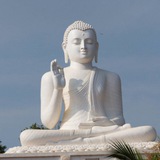
Forwarded from Buddha
Thus I heard: At one time the Gracious One was dwelling near Sāvatthī, in Jeta’s Wood, at Anāthapiṇḍika’s monastery. Then at that time the Gracious One was instructing, rousing, enthusing, and cheering the monks with a Dhamma talk connected with Emancipation. Those monks, after making it their goal, applying their minds, considering it with all their mind, were listening to Dhamma with an attentive ear.
Then the Gracious One, having understood the significance of it, on that occasion uttered this exalted utterance:
“There is, monks, an unborn, unbecome, unmade, unconditioned. If, monks there were not that unborn, unbecome, unmade, unconditioned, you could not know an escape here from the born, become, made, and conditioned. But because there is an unborn, unbecome, unmade, unconditioned, therefore you do know an escape from the born, become, made, and conditioned.”
Udana 8.3 : Tatiya nibbānapaṭi saṁyuttasutta
Then the Gracious One, having understood the significance of it, on that occasion uttered this exalted utterance:
“There is, monks, an unborn, unbecome, unmade, unconditioned. If, monks there were not that unborn, unbecome, unmade, unconditioned, you could not know an escape here from the born, become, made, and conditioned. But because there is an unborn, unbecome, unmade, unconditioned, therefore you do know an escape from the born, become, made, and conditioned.”
Udana 8.3 : Tatiya nibbānapaṭi saṁyuttasutta
🙏1👌1🕊1
Atanatiya Paritta
Homage to the Seven Past Buddhas
Homage to Vipassi, possessed of vision & splendor.
Homage to Sikhi, sympathetic to all beings.
Homage to Vesabhu, cleansed, austere.
Homage to Kakusandha, crusher of Mara’s host.
Homage to Konagamana, the Brahman who lived the life perfected.
Homage to Kassapa, everywhere released.
Homage to Aṅgirasa, splendid son of the Sakyans,
who taught this Dhamma—the dispelling of all stress.
Those unbound in the world, who have seen things as they have come to be,
Great Ones of gentle speech, thoroughly mature:
Even they pay homage to Gotama, the benefit of human & heavenly beings,
consummate in knowledge & conduct, the Great One, thoroughly mature.
We revere the Buddha Gotama, consummate in knowledge & conduct.
Homage to the Seven Past Buddhas
Homage to Vipassi, possessed of vision & splendor.
Homage to Sikhi, sympathetic to all beings.
Homage to Vesabhu, cleansed, austere.
Homage to Kakusandha, crusher of Mara’s host.
Homage to Konagamana, the Brahman who lived the life perfected.
Homage to Kassapa, everywhere released.
Homage to Aṅgirasa, splendid son of the Sakyans,
who taught this Dhamma—the dispelling of all stress.
Those unbound in the world, who have seen things as they have come to be,
Great Ones of gentle speech, thoroughly mature:
Even they pay homage to Gotama, the benefit of human & heavenly beings,
consummate in knowledge & conduct, the Great One, thoroughly mature.
We revere the Buddha Gotama, consummate in knowledge & conduct.
❤1🙏1👌1💯1
Forwarded from Buddha
Ulun Danu Tamblingan Water Temple, Lake Tamblingan, Munduk highlands, North Bali, Indonesia. Tamblingan means to heal the soul.
❤1🤩1😍1
7. Yatha'pi rahado gambhiro
vippasanno anavilo
Evam dhammani sutvana
vippasidanti pandita. 82.
THE WISE ARE PEACEFUL
7. Just as a deep lake is clear and still, even so, on hearing the teachings, the wise become exceedingly peaceful. 2 82.
Story
A young woman was rejected by her suitor as her mother sent her to him empty-handed, having spent every thing she had on the monks. The disappointed woman reviled the monks. The Buddha preached the Dhamma to her and her mind was pacified.
===
Buddha dharma teachings channel:
https://news.1rj.ru/str/lorddivinebuddha
===
vippasanno anavilo
Evam dhammani sutvana
vippasidanti pandita. 82.
THE WISE ARE PEACEFUL
7. Just as a deep lake is clear and still, even so, on hearing the teachings, the wise become exceedingly peaceful. 2 82.
Story
A young woman was rejected by her suitor as her mother sent her to him empty-handed, having spent every thing she had on the monks. The disappointed woman reviled the monks. The Buddha preached the Dhamma to her and her mind was pacified.
===
Buddha dharma teachings channel:
https://news.1rj.ru/str/lorddivinebuddha
===
Telegram
Buddha
Buddha dharma teachings from the suttas and commentaries
🥰1👌1
Forwarded from Buddha
“And what is the origin of suffering? In dependence on the eye & forms, eye-consciousness arises. The meeting of the three is contact. With contact as condition, feeling comes to be; with feeling as condition, craving. This is the origin of suffering.
“In dependence on the ear & sounds …[the nose & odours, the tongue & tastes, the body & tactile objects, the mind & mental phenomena], mind-consciousness arises. The meeting of the three is contact. With contact as condition, feeling comes to be; with feeling as condition, craving. This is the origin of suffering.
“And what , is the passing away of suffering? With the remainderless fading away & cessation of that same craving comes cessation of clinging; with the cessation of clinging, cessation of existence; with the cessation of existence, cessation of birth; with the cessation of birth, aging-and-death, sorrow, lamentation, pain, displeasure, & despair cease. This is the passing away of suffering.
Partial excerpts from SN 12.43: Dukkhasutta
“In dependence on the ear & sounds …[the nose & odours, the tongue & tastes, the body & tactile objects, the mind & mental phenomena], mind-consciousness arises. The meeting of the three is contact. With contact as condition, feeling comes to be; with feeling as condition, craving. This is the origin of suffering.
“And what , is the passing away of suffering? With the remainderless fading away & cessation of that same craving comes cessation of clinging; with the cessation of clinging, cessation of existence; with the cessation of existence, cessation of birth; with the cessation of birth, aging-and-death, sorrow, lamentation, pain, displeasure, & despair cease. This is the passing away of suffering.
Partial excerpts from SN 12.43: Dukkhasutta
🥰1🙏1🕊1
Forwarded from Buddha Dharma books
Free Buddha Dharma ebook
The Supreme Physician
By Bhante Shravasti Dhammika
Free download available:
https://budblooms.org/the-supreme-physician/
===
The Supreme Physician
By Bhante Shravasti Dhammika
Free download available:
https://budblooms.org/the-supreme-physician/
===
👏1🆒1😘1
Forwarded from Buddha Dharma books
Free Buddha Dharma ebook
The Supreme Physician
By Bhante Shravasti Dhammika
During the Buddha’s lifetime he was given numerous epithets in recognition of his outstanding qualities. Some of these include the Happy One, Teacher of Gods and Humans, Lord of Creatures, King of Truth, Teacher, etc. One of the most interesting of these epithets, found in several places in the Tipitaka, is the Supreme Physician (anuttaro bhisakko, It.101). It is usually thought that this refers to the Buddha’s ability to soothe and ultimately heal the afflictions of saṃsāra – birth, death and rebirth, greed, hatred and delusion.
Free download available:
https://budblooms.org/the-supreme-physician/
===
The Supreme Physician
By Bhante Shravasti Dhammika
During the Buddha’s lifetime he was given numerous epithets in recognition of his outstanding qualities. Some of these include the Happy One, Teacher of Gods and Humans, Lord of Creatures, King of Truth, Teacher, etc. One of the most interesting of these epithets, found in several places in the Tipitaka, is the Supreme Physician (anuttaro bhisakko, It.101). It is usually thought that this refers to the Buddha’s ability to soothe and ultimately heal the afflictions of saṃsāra – birth, death and rebirth, greed, hatred and delusion.
Free download available:
https://budblooms.org/the-supreme-physician/
===
❤1👏1💯1
Forwarded from Buddha
The Wheel of Life depicting The twelve links of interdependent origination.
Dependent on ignorance (avijjā) mental formations arise. From mental formations (saṅkhārā), rebirth consciousness arises. Consciousness (viññāṇa) gives rise to mental and physical phenomena. From mental and physical phenomena (nāma rūpa), the spheres of the six senses arise. From the spheres of the six senses (saḷāyatana), contact arises. Contact (phassa) causes sensation. Sensation (vedanā) leads to craving. From craving (taṇhā), attachment results. Attachment (upādāna) produces becoming. From becoming (bhava) birth arises. Finally, birth (jāti) leads to decay (jarā), death (maraṇaṃ), grief (soka), lamentation (parideva), pain (dukkha), sorrow (domanassa), despair (upāyāsa).
Paṭiccasamuppādasutta, Saṁyutta Nikāya 12.1
Dependent on ignorance (avijjā) mental formations arise. From mental formations (saṅkhārā), rebirth consciousness arises. Consciousness (viññāṇa) gives rise to mental and physical phenomena. From mental and physical phenomena (nāma rūpa), the spheres of the six senses arise. From the spheres of the six senses (saḷāyatana), contact arises. Contact (phassa) causes sensation. Sensation (vedanā) leads to craving. From craving (taṇhā), attachment results. Attachment (upādāna) produces becoming. From becoming (bhava) birth arises. Finally, birth (jāti) leads to decay (jarā), death (maraṇaṃ), grief (soka), lamentation (parideva), pain (dukkha), sorrow (domanassa), despair (upāyāsa).
Paṭiccasamuppādasutta, Saṁyutta Nikāya 12.1
👏1💯1🏆1
8. Sabbattha ve sappurisa cajanti
na kamakama lapayanti santo
Sukhena phuññha athava dukhena
na uccavacam pandita dassayanti. 83.
THE WISE ARE NEITHER ELATED NOR DEPRESSED
8. The good give up (attachment for) everything; 3 the saintly prattle not with sensual craving: whether affected by happiness or by pain, the wise show neither elation nor depression. 83.
Story
At the invitation of a brahmin the Buddha and His disciples were once spending the rainy season in Verañja. Though they were neglected and were not well looked after, through forgetfulness on the part of the brahmin, the monks were not displeased. On returning to Savatthi they were well looked after, but were not elated thereby. The Buddha remarked that the wise are neither elated nor depressed.
===
Words of the Buddha channel:
https://news.1rj.ru/str/wordsofbuddha
===
na kamakama lapayanti santo
Sukhena phuññha athava dukhena
na uccavacam pandita dassayanti. 83.
THE WISE ARE NEITHER ELATED NOR DEPRESSED
8. The good give up (attachment for) everything; 3 the saintly prattle not with sensual craving: whether affected by happiness or by pain, the wise show neither elation nor depression. 83.
Story
At the invitation of a brahmin the Buddha and His disciples were once spending the rainy season in Verañja. Though they were neglected and were not well looked after, through forgetfulness on the part of the brahmin, the monks were not displeased. On returning to Savatthi they were well looked after, but were not elated thereby. The Buddha remarked that the wise are neither elated nor depressed.
===
Words of the Buddha channel:
https://news.1rj.ru/str/wordsofbuddha
===
Telegram
Words of the Buddha
Daily teachings of Buddha Dharma
🙏2👌1💯1
Vayadhamma sankhara, Appamadena sampadetha
At one time the Buddha was staying between a pair of sal trees in the sal forest of the Mallas at Upavattana near Kusinārā at the time of his full extinguishment.
Then the Buddha said to the mendicants: “Come now, mendicants, I say to you all: ‘Conditions fall apart. Persist with diligence.’”
These were the Buddha’s last words.
When the Buddha was fully quenched, along with the full extinguishment, the divinity Sahampati recited this verse:
“All creatures in this world must lay down this bag of bones. For even a Teacher such as this, unrivaled in the world, the Realized One, attained to power, the Buddha was fully quenched.”
Ven. Anuruddha recited this verse:
“There was no more breathing for the unaffected one of steady heart. Imperturbable, committed to peace, the Clear-eyed One was fully quenched.
He put up with painful feelings without flinching. The liberation of his heart was like the extinguishing of a lamp.”
SN 6.15: Parinibbānasutta
At one time the Buddha was staying between a pair of sal trees in the sal forest of the Mallas at Upavattana near Kusinārā at the time of his full extinguishment.
Then the Buddha said to the mendicants: “Come now, mendicants, I say to you all: ‘Conditions fall apart. Persist with diligence.’”
These were the Buddha’s last words.
When the Buddha was fully quenched, along with the full extinguishment, the divinity Sahampati recited this verse:
“All creatures in this world must lay down this bag of bones. For even a Teacher such as this, unrivaled in the world, the Realized One, attained to power, the Buddha was fully quenched.”
Ven. Anuruddha recited this verse:
“There was no more breathing for the unaffected one of steady heart. Imperturbable, committed to peace, the Clear-eyed One was fully quenched.
He put up with painful feelings without flinching. The liberation of his heart was like the extinguishing of a lamp.”
SN 6.15: Parinibbānasutta
🙏1🕊1
Forwarded from Buddha
Arhat Sivali
17. Rakkhantā sīla tejena
Dhanavanto yasassino
Evaṃ tejānu-bhāvena
Sadā rakkhatu Sīvali
Through the power of his moral strength and great merit of generosity, may Arahant Sīvali
who is affluent and glorious, protect us always.
18. Kappaṭṭhāyiti Buddhassa
Bodhimūle nisīdiya
Mārasenappamaddanto
Sadā rakkhatu Sīvali
This way the Buddha, seated at the foot of the Bodhi Tree, vanquished death (Mara) will
remain for an aeon. May Arahant Sīvali protect us.
Sivali paritta
17. Rakkhantā sīla tejena
Dhanavanto yasassino
Evaṃ tejānu-bhāvena
Sadā rakkhatu Sīvali
Through the power of his moral strength and great merit of generosity, may Arahant Sīvali
who is affluent and glorious, protect us always.
18. Kappaṭṭhāyiti Buddhassa
Bodhimūle nisīdiya
Mārasenappamaddanto
Sadā rakkhatu Sīvali
This way the Buddha, seated at the foot of the Bodhi Tree, vanquished death (Mara) will
remain for an aeon. May Arahant Sīvali protect us.
Sivali paritta
👍1🏆1
Forwarded from Buddha Dharma books
Free Buddha Dharma ebook
Poems of the Elders
Anthology from the Theragatha and Therigatha
By Thanissaro Bhikkhu
"Poems of the Elders" is an anthology translated by Thanissaro Bhikkhu, featuring verses from the Theragatha (Poems of the Elder Monks) and Therīgāthā (Poems of the Elder Nuns). These texts are part of the Khuddaka Nikaya, the last collection within the Sutta Pitaka of the Pali Canon. The anthology includes 88 poems from the Theragatha and 32 from the Therīgāthā.
Free download here:
https://drive.google.com/file/d/1Tb00wyiCvgms0qql1QbNPp6L6phPu4iL/view?usp=drive_link
===
Poems of the Elders
Anthology from the Theragatha and Therigatha
By Thanissaro Bhikkhu
"Poems of the Elders" is an anthology translated by Thanissaro Bhikkhu, featuring verses from the Theragatha (Poems of the Elder Monks) and Therīgāthā (Poems of the Elder Nuns). These texts are part of the Khuddaka Nikaya, the last collection within the Sutta Pitaka of the Pali Canon. The anthology includes 88 poems from the Theragatha and 32 from the Therīgāthā.
Free download here:
https://drive.google.com/file/d/1Tb00wyiCvgms0qql1QbNPp6L6phPu4iL/view?usp=drive_link
===
❤1👍1
Forwarded from Buddha Dharma books
Free Buddha Dharma ebook
Poems of the Elders
Anthology from the Theragatha and Therigatha
By Thanissaro Bhikkhu
"Poems of the Elders" is an anthology translated by Thanissaro Bhikkhu, featuring verses from the Theragatha (Poems of the Elder Monks) and Therīgāthā (Poems of the Elder Nuns). These texts are part of the Khuddaka Nikaya, the last collection within the Sutta Pitaka of the Pali Canon. The anthology includes 88 poems from the Theragatha and 32 from the Therīgāthā.
Free download here:
https://drive.google.com/file/d/1Tb00wyiCvgms0qql1QbNPp6L6phPu4iL/view?usp=drive_link
===
Poems of the Elders
Anthology from the Theragatha and Therigatha
By Thanissaro Bhikkhu
"Poems of the Elders" is an anthology translated by Thanissaro Bhikkhu, featuring verses from the Theragatha (Poems of the Elder Monks) and Therīgāthā (Poems of the Elder Nuns). These texts are part of the Khuddaka Nikaya, the last collection within the Sutta Pitaka of the Pali Canon. The anthology includes 88 poems from the Theragatha and 32 from the Therīgāthā.
Free download here:
https://drive.google.com/file/d/1Tb00wyiCvgms0qql1QbNPp6L6phPu4iL/view?usp=drive_link
===
🆒1😘1
Things as They Can Be
What happens in awakening
By Thanissaro Bhikkhu
Part 1 of 3
There are instances in the canon where the Buddha teaches his listeners to analyze experience into the five aggregates of form, feeling, perception, thought-fabrication, and consciousness, and to view those aggregates in terms of what Buddhist tradition has named the three characteristics, or what the Buddha himself called “perceptions,” or “labels”—(sanna): the perceptions of inconstancy, stress, and not-self. There are other instances in which he teaches his listeners to apply the same perceptions to the six sense media: the eye, ear, nose, tongue, body, and intellect. In both cases, his listeners, on adopting these perceptions, often gain awakening: either their first glimpse of awakening, called the arising of the dhamma eye, or the total awakening that brings about, once and for all, the end of birth, death, and the total mass of suffering and stress.
Frequently, the arising of the dhamma eye is expressed as a realization often translated as “Whatever is subject to arising is all subject to passing away.” This sounds like an affirmation of the perception of inconstancy: You see that, yes, all things that arise pass away.
This interpretation of what’s seen by the dhamma eye is reinforced by a compound often used to describe all the different stages of awakening: yatha-bhuta-nana-dassana. This compound is typically translated as “knowledge and vision of things as they are.” Here again, this sounds as if awakening comes when you affirm, based on your own vision and knowledge, that the three perceptions really are true.
The question is, if this interpretation is correct, then what kind of experience would count as a valid affirmation of the three perceptions? After all, everyone can see that things in general are impermanent. What’s so special about the dhamma eye? And why would the canon say that it has a huge impact on the mind of the person to whom it arises?
On top of that, is the statement about “whatever is subject to arising” really a valid generalization? No one has seen everything that arises, so how can they make a legitimate statement about everything subject to arising? Sometimes we’re told that the dhamma eye comes as a result of deep reflection on the implications of the three perceptions, but what kind of reflection? And how deep? And does this denoscription fit in with the Buddha’s own standards of what counts as a valid affirmation of the truth?
There are two reasons to think not.
The first is based on the Buddha’s own statements about the truth of perceptions: They’re insubstantial, he says, like mirages. They show, at best, only partial view of what they reflect. Perceptions are representations, and no representation can give all the details of what it represents. It’s true only to the extent that the partial view it gives can adequately serve our purposes.
The unreliability of perceptions in general means that the knowledge and vision that constitutes awakening can’t be mediated by perceptions.
In addition, perceptions are fabricated through intentions, and we know how unreliable intentions can be. The Buddha himself noted that even though the three perceptions are always true, they’re not always beneficial. In other words, there are times when holding to them can interfere with the path to the end of suffering. And the perception of stress, for one, doesn’t tell the whole story about the aggregates, because the aggregates have their pleasant side as well. If it weren’t for that pleasant side, the Buddha tells us, we wouldn’t fall for them, as we do again and again.
So it would seem that awakening, at least by the Buddha’s standards, should not be seen as an act of assenting to the truth of perceptions, inasmuch as even the most enlightening perceptions are only partial representations of the truth.
What happens in awakening
By Thanissaro Bhikkhu
Part 1 of 3
There are instances in the canon where the Buddha teaches his listeners to analyze experience into the five aggregates of form, feeling, perception, thought-fabrication, and consciousness, and to view those aggregates in terms of what Buddhist tradition has named the three characteristics, or what the Buddha himself called “perceptions,” or “labels”—(sanna): the perceptions of inconstancy, stress, and not-self. There are other instances in which he teaches his listeners to apply the same perceptions to the six sense media: the eye, ear, nose, tongue, body, and intellect. In both cases, his listeners, on adopting these perceptions, often gain awakening: either their first glimpse of awakening, called the arising of the dhamma eye, or the total awakening that brings about, once and for all, the end of birth, death, and the total mass of suffering and stress.
Frequently, the arising of the dhamma eye is expressed as a realization often translated as “Whatever is subject to arising is all subject to passing away.” This sounds like an affirmation of the perception of inconstancy: You see that, yes, all things that arise pass away.
This interpretation of what’s seen by the dhamma eye is reinforced by a compound often used to describe all the different stages of awakening: yatha-bhuta-nana-dassana. This compound is typically translated as “knowledge and vision of things as they are.” Here again, this sounds as if awakening comes when you affirm, based on your own vision and knowledge, that the three perceptions really are true.
The question is, if this interpretation is correct, then what kind of experience would count as a valid affirmation of the three perceptions? After all, everyone can see that things in general are impermanent. What’s so special about the dhamma eye? And why would the canon say that it has a huge impact on the mind of the person to whom it arises?
On top of that, is the statement about “whatever is subject to arising” really a valid generalization? No one has seen everything that arises, so how can they make a legitimate statement about everything subject to arising? Sometimes we’re told that the dhamma eye comes as a result of deep reflection on the implications of the three perceptions, but what kind of reflection? And how deep? And does this denoscription fit in with the Buddha’s own standards of what counts as a valid affirmation of the truth?
There are two reasons to think not.
The first is based on the Buddha’s own statements about the truth of perceptions: They’re insubstantial, he says, like mirages. They show, at best, only partial view of what they reflect. Perceptions are representations, and no representation can give all the details of what it represents. It’s true only to the extent that the partial view it gives can adequately serve our purposes.
The unreliability of perceptions in general means that the knowledge and vision that constitutes awakening can’t be mediated by perceptions.
In addition, perceptions are fabricated through intentions, and we know how unreliable intentions can be. The Buddha himself noted that even though the three perceptions are always true, they’re not always beneficial. In other words, there are times when holding to them can interfere with the path to the end of suffering. And the perception of stress, for one, doesn’t tell the whole story about the aggregates, because the aggregates have their pleasant side as well. If it weren’t for that pleasant side, the Buddha tells us, we wouldn’t fall for them, as we do again and again.
So it would seem that awakening, at least by the Buddha’s standards, should not be seen as an act of assenting to the truth of perceptions, inasmuch as even the most enlightening perceptions are only partial representations of the truth.
Telegram
Dhammapada - Buddha Dharma Teachings
Daily teachings of the Dhammapada, beloved and favorite teachings of the Buddha
❤1👌1😘1
The unreliability of perceptions in general means that the knowledge and vision that constitutes awakening can’t be mediated by perceptions, but that raises a further question: What kind of knowledge and vision would that be? Everything known through the senses involves labels and perceptions.
Then there’s the second reason for thinking that awakening, viewed as the affirmation of the truth of the three perceptions, wouldn’t meet the Buddha’s own standards for what counts as a reliable way of arriving at the truth. This reason is based on his discussions of the invalid ways in which people commonly become convinced of the truth of a particular view or teaching. These ways include:
logic—reasoning deductively from general principles,
inference—reasoning inductively from individual experiences to general principles,
analogies—seeing how something unfamiliar has parallels with something familiar, and what the Buddha termed “agreement through pondering views”—thinking seriously about a teaching until you decide that it makes sense, in that it fits in with your experience or what you already believe.
None of these ways of arriving at the truth, the Buddha states, is really trustworthy. As he notes, beliefs supported by these reasons could turn out to be true or they could be false, which means that, on their own, they can’t serve as reliable methods for ascertaining the truth.
Now, if awakening meant assenting to the truth of the three perceptions, it would fall either under inference or agreement through pondering views—or both: You ponder until you infer from your limited range of personal experience that all things that arise pass away. But again: If this is awakening, it wouldn’t meet the Buddha’s standards for what counts as a reliable basis for affirming the truth. The texts say that one of the attributes of people who have gained the dhamma eye is that their confidence in the dhamma has been verified, but this type of “awakening,” from his point of view, would verify nothing.
The question is, did the Buddha think that awakening happened in this way, that it meant affirming the truth of the three perceptions? In other words, did he hold to a picture of awakening that, unbeknownst to him, didn’t meet his own standards for what’s a reliable guide to the truth?
His words as reported in the canon suggest two main reasons for why the answer is no. These reasons have to do with (1) the larger context of how he describes awakening in the rest of the discourses and (2) questions of translation. The view that awakening means affirming the truth of the three perceptions is based on taking a few passages out of context and on mistranslating some key terms: what is seen by the dhamma eye and what kind of knowledge and vision constitutes awakening. Because the correct translation of these terms becomes clear when taken in the larger context, we have to look at the context first.
===
Part 1 of 3:
https://news.1rj.ru/str/dhammapadas/3100
Part 2 of 3:
https://news.1rj.ru/str/wordsofbuddha/4351
Part 3 of 3:
https://news.1rj.ru/str/lorddivinebuddha/3556
===
Dhammapada, beloved and favorite teachings of the Buddha channel:
https://news.1rj.ru/str/dhammapadas
===
Then there’s the second reason for thinking that awakening, viewed as the affirmation of the truth of the three perceptions, wouldn’t meet the Buddha’s own standards for what counts as a reliable way of arriving at the truth. This reason is based on his discussions of the invalid ways in which people commonly become convinced of the truth of a particular view or teaching. These ways include:
logic—reasoning deductively from general principles,
inference—reasoning inductively from individual experiences to general principles,
analogies—seeing how something unfamiliar has parallels with something familiar, and what the Buddha termed “agreement through pondering views”—thinking seriously about a teaching until you decide that it makes sense, in that it fits in with your experience or what you already believe.
None of these ways of arriving at the truth, the Buddha states, is really trustworthy. As he notes, beliefs supported by these reasons could turn out to be true or they could be false, which means that, on their own, they can’t serve as reliable methods for ascertaining the truth.
Now, if awakening meant assenting to the truth of the three perceptions, it would fall either under inference or agreement through pondering views—or both: You ponder until you infer from your limited range of personal experience that all things that arise pass away. But again: If this is awakening, it wouldn’t meet the Buddha’s standards for what counts as a reliable basis for affirming the truth. The texts say that one of the attributes of people who have gained the dhamma eye is that their confidence in the dhamma has been verified, but this type of “awakening,” from his point of view, would verify nothing.
The question is, did the Buddha think that awakening happened in this way, that it meant affirming the truth of the three perceptions? In other words, did he hold to a picture of awakening that, unbeknownst to him, didn’t meet his own standards for what’s a reliable guide to the truth?
His words as reported in the canon suggest two main reasons for why the answer is no. These reasons have to do with (1) the larger context of how he describes awakening in the rest of the discourses and (2) questions of translation. The view that awakening means affirming the truth of the three perceptions is based on taking a few passages out of context and on mistranslating some key terms: what is seen by the dhamma eye and what kind of knowledge and vision constitutes awakening. Because the correct translation of these terms becomes clear when taken in the larger context, we have to look at the context first.
===
Part 1 of 3:
https://news.1rj.ru/str/dhammapadas/3100
Part 2 of 3:
https://news.1rj.ru/str/wordsofbuddha/4351
Part 3 of 3:
https://news.1rj.ru/str/lorddivinebuddha/3556
===
Dhammapada, beloved and favorite teachings of the Buddha channel:
https://news.1rj.ru/str/dhammapadas
===
Telegram
Dhammapada - Buddha Dharma Teachings
Daily teachings of the Dhammapada, beloved and favorite teachings of the Buddha
❤1💯1