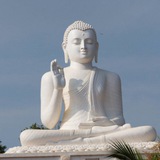
Vayadhamma sankhara, Appamadena sampadetha
At one time the Buddha was staying between a pair of sal trees in the sal forest of the Mallas at Upavattana near Kusinārā at the time of his full extinguishment.
Then the Buddha said to the mendicants: “Come now, mendicants, I say to you all: ‘Conditions fall apart. Persist with diligence.’”
These were the Buddha’s last words.
When the Buddha was fully quenched, along with the full extinguishment, the divinity Sahampati recited this verse:
“All creatures in this world must lay down this bag of bones. For even a Teacher such as this, unrivaled in the world, the Realized One, attained to power, the Buddha was fully quenched.”
Ven. Anuruddha recited this verse:
“There was no more breathing for the unaffected one of steady heart. Imperturbable, committed to peace, the Clear-eyed One was fully quenched.
He put up with painful feelings without flinching. The liberation of his heart was like the extinguishing of a lamp.”
SN 6.15: Parinibbānasutta
At one time the Buddha was staying between a pair of sal trees in the sal forest of the Mallas at Upavattana near Kusinārā at the time of his full extinguishment.
Then the Buddha said to the mendicants: “Come now, mendicants, I say to you all: ‘Conditions fall apart. Persist with diligence.’”
These were the Buddha’s last words.
When the Buddha was fully quenched, along with the full extinguishment, the divinity Sahampati recited this verse:
“All creatures in this world must lay down this bag of bones. For even a Teacher such as this, unrivaled in the world, the Realized One, attained to power, the Buddha was fully quenched.”
Ven. Anuruddha recited this verse:
“There was no more breathing for the unaffected one of steady heart. Imperturbable, committed to peace, the Clear-eyed One was fully quenched.
He put up with painful feelings without flinching. The liberation of his heart was like the extinguishing of a lamp.”
SN 6.15: Parinibbānasutta
🙏1🕊1
Forwarded from Buddha
Arhat Sivali
17. Rakkhantā sīla tejena
Dhanavanto yasassino
Evaṃ tejānu-bhāvena
Sadā rakkhatu Sīvali
Through the power of his moral strength and great merit of generosity, may Arahant Sīvali
who is affluent and glorious, protect us always.
18. Kappaṭṭhāyiti Buddhassa
Bodhimūle nisīdiya
Mārasenappamaddanto
Sadā rakkhatu Sīvali
This way the Buddha, seated at the foot of the Bodhi Tree, vanquished death (Mara) will
remain for an aeon. May Arahant Sīvali protect us.
Sivali paritta
17. Rakkhantā sīla tejena
Dhanavanto yasassino
Evaṃ tejānu-bhāvena
Sadā rakkhatu Sīvali
Through the power of his moral strength and great merit of generosity, may Arahant Sīvali
who is affluent and glorious, protect us always.
18. Kappaṭṭhāyiti Buddhassa
Bodhimūle nisīdiya
Mārasenappamaddanto
Sadā rakkhatu Sīvali
This way the Buddha, seated at the foot of the Bodhi Tree, vanquished death (Mara) will
remain for an aeon. May Arahant Sīvali protect us.
Sivali paritta
👍1🏆1
Forwarded from Buddha Dharma books
Free Buddha Dharma ebook
Poems of the Elders
Anthology from the Theragatha and Therigatha
By Thanissaro Bhikkhu
"Poems of the Elders" is an anthology translated by Thanissaro Bhikkhu, featuring verses from the Theragatha (Poems of the Elder Monks) and Therīgāthā (Poems of the Elder Nuns). These texts are part of the Khuddaka Nikaya, the last collection within the Sutta Pitaka of the Pali Canon. The anthology includes 88 poems from the Theragatha and 32 from the Therīgāthā.
Free download here:
https://drive.google.com/file/d/1Tb00wyiCvgms0qql1QbNPp6L6phPu4iL/view?usp=drive_link
===
Poems of the Elders
Anthology from the Theragatha and Therigatha
By Thanissaro Bhikkhu
"Poems of the Elders" is an anthology translated by Thanissaro Bhikkhu, featuring verses from the Theragatha (Poems of the Elder Monks) and Therīgāthā (Poems of the Elder Nuns). These texts are part of the Khuddaka Nikaya, the last collection within the Sutta Pitaka of the Pali Canon. The anthology includes 88 poems from the Theragatha and 32 from the Therīgāthā.
Free download here:
https://drive.google.com/file/d/1Tb00wyiCvgms0qql1QbNPp6L6phPu4iL/view?usp=drive_link
===
❤1👍1
Forwarded from Buddha Dharma books
Free Buddha Dharma ebook
Poems of the Elders
Anthology from the Theragatha and Therigatha
By Thanissaro Bhikkhu
"Poems of the Elders" is an anthology translated by Thanissaro Bhikkhu, featuring verses from the Theragatha (Poems of the Elder Monks) and Therīgāthā (Poems of the Elder Nuns). These texts are part of the Khuddaka Nikaya, the last collection within the Sutta Pitaka of the Pali Canon. The anthology includes 88 poems from the Theragatha and 32 from the Therīgāthā.
Free download here:
https://drive.google.com/file/d/1Tb00wyiCvgms0qql1QbNPp6L6phPu4iL/view?usp=drive_link
===
Poems of the Elders
Anthology from the Theragatha and Therigatha
By Thanissaro Bhikkhu
"Poems of the Elders" is an anthology translated by Thanissaro Bhikkhu, featuring verses from the Theragatha (Poems of the Elder Monks) and Therīgāthā (Poems of the Elder Nuns). These texts are part of the Khuddaka Nikaya, the last collection within the Sutta Pitaka of the Pali Canon. The anthology includes 88 poems from the Theragatha and 32 from the Therīgāthā.
Free download here:
https://drive.google.com/file/d/1Tb00wyiCvgms0qql1QbNPp6L6phPu4iL/view?usp=drive_link
===
🆒1😘1
Things as They Can Be
What happens in awakening
By Thanissaro Bhikkhu
Part 1 of 3
There are instances in the canon where the Buddha teaches his listeners to analyze experience into the five aggregates of form, feeling, perception, thought-fabrication, and consciousness, and to view those aggregates in terms of what Buddhist tradition has named the three characteristics, or what the Buddha himself called “perceptions,” or “labels”—(sanna): the perceptions of inconstancy, stress, and not-self. There are other instances in which he teaches his listeners to apply the same perceptions to the six sense media: the eye, ear, nose, tongue, body, and intellect. In both cases, his listeners, on adopting these perceptions, often gain awakening: either their first glimpse of awakening, called the arising of the dhamma eye, or the total awakening that brings about, once and for all, the end of birth, death, and the total mass of suffering and stress.
Frequently, the arising of the dhamma eye is expressed as a realization often translated as “Whatever is subject to arising is all subject to passing away.” This sounds like an affirmation of the perception of inconstancy: You see that, yes, all things that arise pass away.
This interpretation of what’s seen by the dhamma eye is reinforced by a compound often used to describe all the different stages of awakening: yatha-bhuta-nana-dassana. This compound is typically translated as “knowledge and vision of things as they are.” Here again, this sounds as if awakening comes when you affirm, based on your own vision and knowledge, that the three perceptions really are true.
The question is, if this interpretation is correct, then what kind of experience would count as a valid affirmation of the three perceptions? After all, everyone can see that things in general are impermanent. What’s so special about the dhamma eye? And why would the canon say that it has a huge impact on the mind of the person to whom it arises?
On top of that, is the statement about “whatever is subject to arising” really a valid generalization? No one has seen everything that arises, so how can they make a legitimate statement about everything subject to arising? Sometimes we’re told that the dhamma eye comes as a result of deep reflection on the implications of the three perceptions, but what kind of reflection? And how deep? And does this denoscription fit in with the Buddha’s own standards of what counts as a valid affirmation of the truth?
There are two reasons to think not.
The first is based on the Buddha’s own statements about the truth of perceptions: They’re insubstantial, he says, like mirages. They show, at best, only partial view of what they reflect. Perceptions are representations, and no representation can give all the details of what it represents. It’s true only to the extent that the partial view it gives can adequately serve our purposes.
The unreliability of perceptions in general means that the knowledge and vision that constitutes awakening can’t be mediated by perceptions.
In addition, perceptions are fabricated through intentions, and we know how unreliable intentions can be. The Buddha himself noted that even though the three perceptions are always true, they’re not always beneficial. In other words, there are times when holding to them can interfere with the path to the end of suffering. And the perception of stress, for one, doesn’t tell the whole story about the aggregates, because the aggregates have their pleasant side as well. If it weren’t for that pleasant side, the Buddha tells us, we wouldn’t fall for them, as we do again and again.
So it would seem that awakening, at least by the Buddha’s standards, should not be seen as an act of assenting to the truth of perceptions, inasmuch as even the most enlightening perceptions are only partial representations of the truth.
What happens in awakening
By Thanissaro Bhikkhu
Part 1 of 3
There are instances in the canon where the Buddha teaches his listeners to analyze experience into the five aggregates of form, feeling, perception, thought-fabrication, and consciousness, and to view those aggregates in terms of what Buddhist tradition has named the three characteristics, or what the Buddha himself called “perceptions,” or “labels”—(sanna): the perceptions of inconstancy, stress, and not-self. There are other instances in which he teaches his listeners to apply the same perceptions to the six sense media: the eye, ear, nose, tongue, body, and intellect. In both cases, his listeners, on adopting these perceptions, often gain awakening: either their first glimpse of awakening, called the arising of the dhamma eye, or the total awakening that brings about, once and for all, the end of birth, death, and the total mass of suffering and stress.
Frequently, the arising of the dhamma eye is expressed as a realization often translated as “Whatever is subject to arising is all subject to passing away.” This sounds like an affirmation of the perception of inconstancy: You see that, yes, all things that arise pass away.
This interpretation of what’s seen by the dhamma eye is reinforced by a compound often used to describe all the different stages of awakening: yatha-bhuta-nana-dassana. This compound is typically translated as “knowledge and vision of things as they are.” Here again, this sounds as if awakening comes when you affirm, based on your own vision and knowledge, that the three perceptions really are true.
The question is, if this interpretation is correct, then what kind of experience would count as a valid affirmation of the three perceptions? After all, everyone can see that things in general are impermanent. What’s so special about the dhamma eye? And why would the canon say that it has a huge impact on the mind of the person to whom it arises?
On top of that, is the statement about “whatever is subject to arising” really a valid generalization? No one has seen everything that arises, so how can they make a legitimate statement about everything subject to arising? Sometimes we’re told that the dhamma eye comes as a result of deep reflection on the implications of the three perceptions, but what kind of reflection? And how deep? And does this denoscription fit in with the Buddha’s own standards of what counts as a valid affirmation of the truth?
There are two reasons to think not.
The first is based on the Buddha’s own statements about the truth of perceptions: They’re insubstantial, he says, like mirages. They show, at best, only partial view of what they reflect. Perceptions are representations, and no representation can give all the details of what it represents. It’s true only to the extent that the partial view it gives can adequately serve our purposes.
The unreliability of perceptions in general means that the knowledge and vision that constitutes awakening can’t be mediated by perceptions.
In addition, perceptions are fabricated through intentions, and we know how unreliable intentions can be. The Buddha himself noted that even though the three perceptions are always true, they’re not always beneficial. In other words, there are times when holding to them can interfere with the path to the end of suffering. And the perception of stress, for one, doesn’t tell the whole story about the aggregates, because the aggregates have their pleasant side as well. If it weren’t for that pleasant side, the Buddha tells us, we wouldn’t fall for them, as we do again and again.
So it would seem that awakening, at least by the Buddha’s standards, should not be seen as an act of assenting to the truth of perceptions, inasmuch as even the most enlightening perceptions are only partial representations of the truth.
Telegram
Dhammapada - Buddha Dharma Teachings
Daily teachings of the Dhammapada, beloved and favorite teachings of the Buddha
❤1👌1😘1
The unreliability of perceptions in general means that the knowledge and vision that constitutes awakening can’t be mediated by perceptions, but that raises a further question: What kind of knowledge and vision would that be? Everything known through the senses involves labels and perceptions.
Then there’s the second reason for thinking that awakening, viewed as the affirmation of the truth of the three perceptions, wouldn’t meet the Buddha’s own standards for what counts as a reliable way of arriving at the truth. This reason is based on his discussions of the invalid ways in which people commonly become convinced of the truth of a particular view or teaching. These ways include:
logic—reasoning deductively from general principles,
inference—reasoning inductively from individual experiences to general principles,
analogies—seeing how something unfamiliar has parallels with something familiar, and what the Buddha termed “agreement through pondering views”—thinking seriously about a teaching until you decide that it makes sense, in that it fits in with your experience or what you already believe.
None of these ways of arriving at the truth, the Buddha states, is really trustworthy. As he notes, beliefs supported by these reasons could turn out to be true or they could be false, which means that, on their own, they can’t serve as reliable methods for ascertaining the truth.
Now, if awakening meant assenting to the truth of the three perceptions, it would fall either under inference or agreement through pondering views—or both: You ponder until you infer from your limited range of personal experience that all things that arise pass away. But again: If this is awakening, it wouldn’t meet the Buddha’s standards for what counts as a reliable basis for affirming the truth. The texts say that one of the attributes of people who have gained the dhamma eye is that their confidence in the dhamma has been verified, but this type of “awakening,” from his point of view, would verify nothing.
The question is, did the Buddha think that awakening happened in this way, that it meant affirming the truth of the three perceptions? In other words, did he hold to a picture of awakening that, unbeknownst to him, didn’t meet his own standards for what’s a reliable guide to the truth?
His words as reported in the canon suggest two main reasons for why the answer is no. These reasons have to do with (1) the larger context of how he describes awakening in the rest of the discourses and (2) questions of translation. The view that awakening means affirming the truth of the three perceptions is based on taking a few passages out of context and on mistranslating some key terms: what is seen by the dhamma eye and what kind of knowledge and vision constitutes awakening. Because the correct translation of these terms becomes clear when taken in the larger context, we have to look at the context first.
===
Part 1 of 3:
https://news.1rj.ru/str/dhammapadas/3100
Part 2 of 3:
https://news.1rj.ru/str/wordsofbuddha/4351
Part 3 of 3:
https://news.1rj.ru/str/lorddivinebuddha/3556
===
Dhammapada, beloved and favorite teachings of the Buddha channel:
https://news.1rj.ru/str/dhammapadas
===
Then there’s the second reason for thinking that awakening, viewed as the affirmation of the truth of the three perceptions, wouldn’t meet the Buddha’s own standards for what counts as a reliable way of arriving at the truth. This reason is based on his discussions of the invalid ways in which people commonly become convinced of the truth of a particular view or teaching. These ways include:
logic—reasoning deductively from general principles,
inference—reasoning inductively from individual experiences to general principles,
analogies—seeing how something unfamiliar has parallels with something familiar, and what the Buddha termed “agreement through pondering views”—thinking seriously about a teaching until you decide that it makes sense, in that it fits in with your experience or what you already believe.
None of these ways of arriving at the truth, the Buddha states, is really trustworthy. As he notes, beliefs supported by these reasons could turn out to be true or they could be false, which means that, on their own, they can’t serve as reliable methods for ascertaining the truth.
Now, if awakening meant assenting to the truth of the three perceptions, it would fall either under inference or agreement through pondering views—or both: You ponder until you infer from your limited range of personal experience that all things that arise pass away. But again: If this is awakening, it wouldn’t meet the Buddha’s standards for what counts as a reliable basis for affirming the truth. The texts say that one of the attributes of people who have gained the dhamma eye is that their confidence in the dhamma has been verified, but this type of “awakening,” from his point of view, would verify nothing.
The question is, did the Buddha think that awakening happened in this way, that it meant affirming the truth of the three perceptions? In other words, did he hold to a picture of awakening that, unbeknownst to him, didn’t meet his own standards for what’s a reliable guide to the truth?
His words as reported in the canon suggest two main reasons for why the answer is no. These reasons have to do with (1) the larger context of how he describes awakening in the rest of the discourses and (2) questions of translation. The view that awakening means affirming the truth of the three perceptions is based on taking a few passages out of context and on mistranslating some key terms: what is seen by the dhamma eye and what kind of knowledge and vision constitutes awakening. Because the correct translation of these terms becomes clear when taken in the larger context, we have to look at the context first.
===
Part 1 of 3:
https://news.1rj.ru/str/dhammapadas/3100
Part 2 of 3:
https://news.1rj.ru/str/wordsofbuddha/4351
Part 3 of 3:
https://news.1rj.ru/str/lorddivinebuddha/3556
===
Dhammapada, beloved and favorite teachings of the Buddha channel:
https://news.1rj.ru/str/dhammapadas
===
Telegram
Dhammapada - Buddha Dharma Teachings
Daily teachings of the Dhammapada, beloved and favorite teachings of the Buddha
❤1💯1
9. Na attahetu na parassa hetu
na puttamicche na dhanam na raññham
Na iccheyya adhammena samiddhim attano
sa silava paññava dhammiko siya. 84.
SUCCESS SHOULD NOT BE SOUGHT BY WRONGFUL MEANS
9. Neither for the sake of oneself nor for the sake of another (does a wise person do any wrong); he should not desire son, wealth or kingdom (by doing wrong): by unjust means he should not seek his own success. Then (only) such a one is indeed virtuous, wise and righteous. 84.
Story
A righteous person desired to leave the world and enter the Order. Although his wife tried to dissuade him each time he sought her permission, he joined the Order, and before long attained Arahantship. Subsequently his wife and son also entered the Order and attained Arahantship. Buddha spoke in praise of them.
===
Dhammapada, beloved and favorite teachings of the Buddha channel:
https://news.1rj.ru/str/dhammapadas
===
na puttamicche na dhanam na raññham
Na iccheyya adhammena samiddhim attano
sa silava paññava dhammiko siya. 84.
SUCCESS SHOULD NOT BE SOUGHT BY WRONGFUL MEANS
9. Neither for the sake of oneself nor for the sake of another (does a wise person do any wrong); he should not desire son, wealth or kingdom (by doing wrong): by unjust means he should not seek his own success. Then (only) such a one is indeed virtuous, wise and righteous. 84.
Story
A righteous person desired to leave the world and enter the Order. Although his wife tried to dissuade him each time he sought her permission, he joined the Order, and before long attained Arahantship. Subsequently his wife and son also entered the Order and attained Arahantship. Buddha spoke in praise of them.
===
Dhammapada, beloved and favorite teachings of the Buddha channel:
https://news.1rj.ru/str/dhammapadas
===
Telegram
Dhammapada - Buddha Dharma Teachings
Daily teachings of the Dhammapada, beloved and favorite teachings of the Buddha
👏1😍1
Forwarded from Buddha
Dambulla cave temple also known as the Golden Temple of Dambulla is a World Heritage Site in Sri Lanka. Dambulla is the largest and best-preserved cave temple complex in Sri Lanka.
❤1👏1👌1
Forwarded from Words of the Buddha
Things as They Can Be
What happens in awakening
By Thanissaro Bhikkhu
Part 2 of 3
Context
Admittedly, it’s true that the Buddha uses logic, inference, and analogy in presenting the dhamma to others, and he does advise his listeners to ponder the teaching until they agree that it makes enough sense for them to want to put it into practice. But those are just preliminary steps before actually getting on the path. You arrive at awakening only when you exert right effort based on what you’ve learned. In other words, awakening is based not on what you agree to as right but on what you do and what you experience as a result of what you do.
This point is shown clearly by the Buddha’s denoscription of the event on which all other denoscriptions of awakening are based: his own experience of awakening. In none of his autobiographical accounts of the awakening experience does he mention the three perceptions. Instead, all of his accounts center on either of two themes:
understanding and fulfilling the duties of the four noble truths or
understanding cause and effect as they play out in the steps of dependent coarising leading to suffering, and then using that knowledge to put an end to those steps.
In both cases, these themes focus not just on things as they are but, more primarily, on things as they function: how, through the principles of cause and effect, they have the potential to lead either to suffering or to the end of suffering. We can call this “things as they can be.”
Take the duties of the four noble truths. The four truths are the truths of suffering, its origination (samudaya), its cessation (nirodha), and the path to its cessation. Each truth has its own duty: (1) You have to comprehend that suffering is the act of clinging—with desire and passion—to the five aggregates. (2) You have to abandon, through dispassion, the origination of that clinging, which is craving. (3) You have to realize the cessation of suffering through dispassion for craving. (4) And to arrive at that dispassion, you have to develop the eight factors of the noble path.
Awakening is based not on what you agree to as right but on what you do and what you experience as a result of what you do.
The Buddha often describes the first glimpse of awakening as seeing, in your immediate experience, that “This is suffering,” “This is the origination of suffering,” “This is the cessation of suffering,” and “This is the path to the cessation of suffering.” The way these statements are phrased, with the repeated emphasis on “this,” “this,” “this,” suggests that the Buddha is talking about a direct experience of these things. In other words, you’ve done some of the work. You’ve developed the path enough to have a glimpse of the cessation of suffering.
The suggestion that this experience includes direct knowledge of the path is confirmed by the fact that the other main term for the arising of the dhamma eye—entry into the stream—defines the stream as all eight factors of the noble eightfold path. You’ve seen all the factors, from right view through right concentration, come together in the mind.
The suggestion that this experience includes direct knowledge of cessation is confirmed by several passages in the canon. MN 48 notes that one of the prerequisites for verifying that you’ve had your first glimpse of awakening is when you can answer yes to this question: “When I cultivate, develop, and pursue this view, do I personally obtain tranquility, do I personally obtain unbinding (nibbana)?” MN 1 adds that those who have attained the dhamma eye—in its terminology, those who have become ”learners”—have directly known unbinding. When Sariputta, after the arising of the dhamma eye, was asked by his friend Moggallana if he had reached the deathless, he replied, “Yes, I have.”
It’s this direct experience—beyond the six senses and unmediated by perceptions or any mental fabrications—that can actually verify your conviction in the dhamma.
What happens in awakening
By Thanissaro Bhikkhu
Part 2 of 3
Context
Admittedly, it’s true that the Buddha uses logic, inference, and analogy in presenting the dhamma to others, and he does advise his listeners to ponder the teaching until they agree that it makes enough sense for them to want to put it into practice. But those are just preliminary steps before actually getting on the path. You arrive at awakening only when you exert right effort based on what you’ve learned. In other words, awakening is based not on what you agree to as right but on what you do and what you experience as a result of what you do.
This point is shown clearly by the Buddha’s denoscription of the event on which all other denoscriptions of awakening are based: his own experience of awakening. In none of his autobiographical accounts of the awakening experience does he mention the three perceptions. Instead, all of his accounts center on either of two themes:
understanding and fulfilling the duties of the four noble truths or
understanding cause and effect as they play out in the steps of dependent coarising leading to suffering, and then using that knowledge to put an end to those steps.
In both cases, these themes focus not just on things as they are but, more primarily, on things as they function: how, through the principles of cause and effect, they have the potential to lead either to suffering or to the end of suffering. We can call this “things as they can be.”
Take the duties of the four noble truths. The four truths are the truths of suffering, its origination (samudaya), its cessation (nirodha), and the path to its cessation. Each truth has its own duty: (1) You have to comprehend that suffering is the act of clinging—with desire and passion—to the five aggregates. (2) You have to abandon, through dispassion, the origination of that clinging, which is craving. (3) You have to realize the cessation of suffering through dispassion for craving. (4) And to arrive at that dispassion, you have to develop the eight factors of the noble path.
Awakening is based not on what you agree to as right but on what you do and what you experience as a result of what you do.
The Buddha often describes the first glimpse of awakening as seeing, in your immediate experience, that “This is suffering,” “This is the origination of suffering,” “This is the cessation of suffering,” and “This is the path to the cessation of suffering.” The way these statements are phrased, with the repeated emphasis on “this,” “this,” “this,” suggests that the Buddha is talking about a direct experience of these things. In other words, you’ve done some of the work. You’ve developed the path enough to have a glimpse of the cessation of suffering.
The suggestion that this experience includes direct knowledge of the path is confirmed by the fact that the other main term for the arising of the dhamma eye—entry into the stream—defines the stream as all eight factors of the noble eightfold path. You’ve seen all the factors, from right view through right concentration, come together in the mind.
The suggestion that this experience includes direct knowledge of cessation is confirmed by several passages in the canon. MN 48 notes that one of the prerequisites for verifying that you’ve had your first glimpse of awakening is when you can answer yes to this question: “When I cultivate, develop, and pursue this view, do I personally obtain tranquility, do I personally obtain unbinding (nibbana)?” MN 1 adds that those who have attained the dhamma eye—in its terminology, those who have become ”learners”—have directly known unbinding. When Sariputta, after the arising of the dhamma eye, was asked by his friend Moggallana if he had reached the deathless, he replied, “Yes, I have.”
It’s this direct experience—beyond the six senses and unmediated by perceptions or any mental fabrications—that can actually verify your conviction in the dhamma.
Telegram
Words of the Buddha
Daily teachings of Buddha Dharma
🥰1💯1
Forwarded from Words of the Buddha
So there’s more going on in awakening than just assenting to right view. You have to follow through with the duties assigned by right view until you’ve reached a level of dispassion strong enough to bring about a glimpse of unbinding. Instead of simply affirming that things arise and pass away, you make the right path arise and you make the wrong path pass away, and in doing so you don’t just affirm the principle of inconstancy. You discover that some inconstant things have the potential to lead you to something you’ve never experienced before: a permanent dimension (SN 43) that lies entirely beyond inconstancy.
It lies even beyond the path. After all, the path is composed of aggregates, and so it, too, is inconstant. This is why SN 48:3 notes that those who have gained the dhamma eye have seen the escape from the factors of the path as expressed under the five faculties of conviction, persistence, mindfulness, concentration, and discernment. It’s also why Anathapinḍika, a lay follower who had gained the dhamma eye, said that by pursuing right view he saw the escape from it.
Some inconstant things have the potential to lead you to something you’ve never experienced before: a permanent dimension.
So gaining the dhamma eye is not just a matter of affirming the perceptions that go into right view. It means using those perceptions as tools, and then putting them aside when they’ve done their work in showing not just things as they are but as they can be made to be. You’ve discovered the potentials within those things, if you use them right, to lead beyond themselves.
This is precisely how the three perceptions—and perceptions in general—function in the Buddha’s denoscriptions of awakening.
Here we have to remember the Buddha’s own standards for what he would teach. For him to make a statement, it had to be not only true but also beneficial. The same standards applied to the perceptions he would have you apply to your experiences. As he noted when stating that the aggregates have both their pleasant and their unpleasant side, if you get obsessed with perceiving them as pleasant, it leads to infatuation, captivation, and defilement. In other words, even though the perception of pleasure may be true in some contexts, it’s not beneficial when viewed in the context of the duties of the four noble truths. Instead of getting you to abandon passion, it leads you to develop more passion, and to cause more suffering.
If, however, you focus on the unpleasant side of the aggregates—as when you apply the three perceptions to them—it leads to disenchantment, dispassion, and purification. This would be in line with the duties of the four noble truths—to induce dispassion—so the result will lead to the end of suffering.
This corresponds to how the Buddha explicitly describes how the three perceptions function in leading to awakening: When a listener sees in line with these perceptions that all aggregates—past, present, future; near or far; blatant or subtle—are inconstant, stressful, and not-self—the Buddha doesn’t say that the listener simply agrees with those perceptions. He says that the listener grows disenchanted with the aggregates, and so becomes dispassionate. From that dispassion comes release: in other words, a direct experience of the third noble truth.
So, here again, these perceptions are used not only because they’re true representations of the truth but also because they perform: They have a liberating effect on the mind.
That’s how the role of the three perceptions in leading to awakening should be understood: They function as aids in performing the duties appropriate to the four noble truths. Like all perceptions, they’re fabricated for a purpose. Here their purpose is the highest one possible: bringing about the dispassion that brings total release.
It lies even beyond the path. After all, the path is composed of aggregates, and so it, too, is inconstant. This is why SN 48:3 notes that those who have gained the dhamma eye have seen the escape from the factors of the path as expressed under the five faculties of conviction, persistence, mindfulness, concentration, and discernment. It’s also why Anathapinḍika, a lay follower who had gained the dhamma eye, said that by pursuing right view he saw the escape from it.
Some inconstant things have the potential to lead you to something you’ve never experienced before: a permanent dimension.
So gaining the dhamma eye is not just a matter of affirming the perceptions that go into right view. It means using those perceptions as tools, and then putting them aside when they’ve done their work in showing not just things as they are but as they can be made to be. You’ve discovered the potentials within those things, if you use them right, to lead beyond themselves.
This is precisely how the three perceptions—and perceptions in general—function in the Buddha’s denoscriptions of awakening.
Here we have to remember the Buddha’s own standards for what he would teach. For him to make a statement, it had to be not only true but also beneficial. The same standards applied to the perceptions he would have you apply to your experiences. As he noted when stating that the aggregates have both their pleasant and their unpleasant side, if you get obsessed with perceiving them as pleasant, it leads to infatuation, captivation, and defilement. In other words, even though the perception of pleasure may be true in some contexts, it’s not beneficial when viewed in the context of the duties of the four noble truths. Instead of getting you to abandon passion, it leads you to develop more passion, and to cause more suffering.
If, however, you focus on the unpleasant side of the aggregates—as when you apply the three perceptions to them—it leads to disenchantment, dispassion, and purification. This would be in line with the duties of the four noble truths—to induce dispassion—so the result will lead to the end of suffering.
This corresponds to how the Buddha explicitly describes how the three perceptions function in leading to awakening: When a listener sees in line with these perceptions that all aggregates—past, present, future; near or far; blatant or subtle—are inconstant, stressful, and not-self—the Buddha doesn’t say that the listener simply agrees with those perceptions. He says that the listener grows disenchanted with the aggregates, and so becomes dispassionate. From that dispassion comes release: in other words, a direct experience of the third noble truth.
So, here again, these perceptions are used not only because they’re true representations of the truth but also because they perform: They have a liberating effect on the mind.
That’s how the role of the three perceptions in leading to awakening should be understood: They function as aids in performing the duties appropriate to the four noble truths. Like all perceptions, they’re fabricated for a purpose. Here their purpose is the highest one possible: bringing about the dispassion that brings total release.
🤗1🆒1
Forwarded from Words of the Buddha
Given that that’s the context for understanding how the three perceptions actually function in the steps leading to awakening, we can see that awakening, as the Buddha describes it, is not simply a matter of assenting to the truth of these perceptions.
===
Words of the Buddha channel:
https://news.1rj.ru/str/wordsofbuddha
===
===
Words of the Buddha channel:
https://news.1rj.ru/str/wordsofbuddha
===
Telegram
Words of the Buddha
Daily teachings of Buddha Dharma
👌1😘1
If I have harmed anyone in any way either knowingly or unknowingly
through my own confusions I ask their forgiveness.
If anyone has harmed me in any way either knowingly or unknowingly
through their own confusions I forgive them.
And if there is a situation I am not yet ready to forgive
I forgive myself for that.
For all the ways that I harm myself, negate, doubt, belittle myself,
judge or be unkind to myself through my own confusions
I forgive myself.
"Asking for forgiveness" Buddhist prayer
through my own confusions I ask their forgiveness.
If anyone has harmed me in any way either knowingly or unknowingly
through their own confusions I forgive them.
And if there is a situation I am not yet ready to forgive
I forgive myself for that.
For all the ways that I harm myself, negate, doubt, belittle myself,
judge or be unkind to myself through my own confusions
I forgive myself.
"Asking for forgiveness" Buddhist prayer
🙏2🕊1😇1
Forwarded from Buddha
Things as They Can Be
What happens in awakening
By Thanissaro Bhikkhu
Part 3 of 3
Translation
As for questions of translation: When we look carefully at the original Pali version of the statement expressing what’s seen by the dhamma eye, we can see that to translate it as “Whatever is subject to arising is all subject to passing away” is clearly a mistake. And when we look at the phrase “knowledge and vision of things as they are” in the larger context of the discourses, we can see that while that may be a possible translation of the term yatha-bhuta-nana-dassana, it misses many of the implications contained in that larger context. In other words, the translations used to support the idea that awakening is simply a matter of affirming the truth of right view are not accurate representations of what the discourses have to say about awakening.
First, the dhamma eye: The correct translation is “Whatever is subject to origination (samudaya-dhamma) is all subject to cessation (nirodha-dhamma).” Now, as we’ve seen in the context of the four noble truths, origination is not just a matter of arising. It’s a matter of causation. And in almost every case where the discourses use the word ”origination,” it denotes causes coming from within the mind. In the context of the four noble truths, that’s always the case.
Similarly with cessation: It doesn’t mean just “passing away.” It means total ending. And in the context of the four noble truths, it means ending through dispassion.
So what the sentence is actually saying is that anything that arises through acts of the mind can all be brought to cessation through dispassion. Because the aggregates and sense media are all experienced through acts of the mind—as the Buddha said, all phenomena are rooted in desire—then when there’s thorough dispassion for them, there’s nothing to keep them going. So they all cease. That’s when unbinding is experienced, inasmuch as unbinding is the end of all phenomena. What’s revealed at that point is consciousness “without surface,” limitless, reflecting off of no object, totally independent of the six senses, unmediated by any perceptions or thought constructs at all.
It’s in this way that the expression of what’s seen by the dhamma eye is entirely in line with the fact that those who have gained the dhamma eye have seen unbinding. That expression is not a mere denoscription of things as they exist on their own, affirming the principle of inconstancy. It’s a statement of possibilities: If you practice properly, putting the aggregates into the form of the correct path, you can bring about the dispassion that leads to release.
As for the compound, “knowledge and vision of things as they are” (yatha-bhuta-nana-dassana), this has a similar meaning. The key word in the compound is bhuta. This word can either be a noun meaning “truth” or “reality” on the one hand, or a past participle meaning “has come to be” or “has come into being” on the other. The first set of meanings yields the translation of the whole compound as “knowledge and vision of things as they are,” indicating that you see things simply as they actually exist. The second set yields “knowledge and vision of things as they have come to be,” indicating that you see the causal processes by which things come about. On their own, both renderings are plausible, but SN 12:31 gives preference to the second.
There the Buddha asks Ven. Sariputta, “Do you see, ‘This bhuta?” Sariputta answers, not with a denoscription of the three perceptions but with an account of how things come into being based on “nutriment”: another way of saying how they arise and subsist based on causes.
He notes that both a learner—one who has gained the dhamma eye—and the fully awakened arahant see that “this” comes into being based on nutriment, and that it is subject to cessation based on the cessation of that nutriment. MN 9 indicates that “this,” here, denotes suffering and any of the factors of the four noble truths and dependent coarising that lead to suffering.
What happens in awakening
By Thanissaro Bhikkhu
Part 3 of 3
Translation
As for questions of translation: When we look carefully at the original Pali version of the statement expressing what’s seen by the dhamma eye, we can see that to translate it as “Whatever is subject to arising is all subject to passing away” is clearly a mistake. And when we look at the phrase “knowledge and vision of things as they are” in the larger context of the discourses, we can see that while that may be a possible translation of the term yatha-bhuta-nana-dassana, it misses many of the implications contained in that larger context. In other words, the translations used to support the idea that awakening is simply a matter of affirming the truth of right view are not accurate representations of what the discourses have to say about awakening.
First, the dhamma eye: The correct translation is “Whatever is subject to origination (samudaya-dhamma) is all subject to cessation (nirodha-dhamma).” Now, as we’ve seen in the context of the four noble truths, origination is not just a matter of arising. It’s a matter of causation. And in almost every case where the discourses use the word ”origination,” it denotes causes coming from within the mind. In the context of the four noble truths, that’s always the case.
Similarly with cessation: It doesn’t mean just “passing away.” It means total ending. And in the context of the four noble truths, it means ending through dispassion.
So what the sentence is actually saying is that anything that arises through acts of the mind can all be brought to cessation through dispassion. Because the aggregates and sense media are all experienced through acts of the mind—as the Buddha said, all phenomena are rooted in desire—then when there’s thorough dispassion for them, there’s nothing to keep them going. So they all cease. That’s when unbinding is experienced, inasmuch as unbinding is the end of all phenomena. What’s revealed at that point is consciousness “without surface,” limitless, reflecting off of no object, totally independent of the six senses, unmediated by any perceptions or thought constructs at all.
It’s in this way that the expression of what’s seen by the dhamma eye is entirely in line with the fact that those who have gained the dhamma eye have seen unbinding. That expression is not a mere denoscription of things as they exist on their own, affirming the principle of inconstancy. It’s a statement of possibilities: If you practice properly, putting the aggregates into the form of the correct path, you can bring about the dispassion that leads to release.
As for the compound, “knowledge and vision of things as they are” (yatha-bhuta-nana-dassana), this has a similar meaning. The key word in the compound is bhuta. This word can either be a noun meaning “truth” or “reality” on the one hand, or a past participle meaning “has come to be” or “has come into being” on the other. The first set of meanings yields the translation of the whole compound as “knowledge and vision of things as they are,” indicating that you see things simply as they actually exist. The second set yields “knowledge and vision of things as they have come to be,” indicating that you see the causal processes by which things come about. On their own, both renderings are plausible, but SN 12:31 gives preference to the second.
There the Buddha asks Ven. Sariputta, “Do you see, ‘This bhuta?” Sariputta answers, not with a denoscription of the three perceptions but with an account of how things come into being based on “nutriment”: another way of saying how they arise and subsist based on causes.
He notes that both a learner—one who has gained the dhamma eye—and the fully awakened arahant see that “this” comes into being based on nutriment, and that it is subject to cessation based on the cessation of that nutriment. MN 9 indicates that “this,” here, denotes suffering and any of the factors of the four noble truths and dependent coarising that lead to suffering.
Telegram
Buddha
Buddha dharma teachings from the suttas and commentaries
❤1👏1💯1🤗1