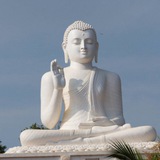
Then with the passing of those seven days, the Gracious One arose from that concentration. Then the Naga King Mucalinda, having understood that the sky was now clear without a cloud, having unravelled his coils from the Gracious One’s body, and after withdrawing his own form, and creating the appearance of a young brahmana, stood in front of the Gracious One, revering the Gracious One with raised hands.
Then the Gracious One, having understood the significance of it, on that occasion uttered this exalted utterance:
“There is happiness and detachment for the one who is satisfied,
who has heard the Dhamma, and who sees,
There is happiness for him who is free from ill-will in the world,
who is restrained towards breathing beings.
“The state of dispassion in the world is happiness,
the complete transcending of sense desires,
But for he who has removed the conceit ‘I am’—
this is indeed the highest happiness.”
Udana 2.1
Mucalindasuttam 11
Then the Gracious One, having understood the significance of it, on that occasion uttered this exalted utterance:
“There is happiness and detachment for the one who is satisfied,
who has heard the Dhamma, and who sees,
There is happiness for him who is free from ill-will in the world,
who is restrained towards breathing beings.
“The state of dispassion in the world is happiness,
the complete transcending of sense desires,
But for he who has removed the conceit ‘I am’—
this is indeed the highest happiness.”
Udana 2.1
Mucalindasuttam 11
👏1🙏1🏆1
12. Kanham dhammam vippahaya
sukkam bhavetha pandito
Oka anokam agamma
viveke yattha duramam. 87.
13. Tatrabhiratim iccheyya
hitva kame akiñcano
Pariyodapeyya attanam
cittaklesehi pandito. 88.
14. Yesam sambodhiangesu
samma cittam subhavitam
âdanapañinissagge
anupadaya ye rata
Khinasava jutimanto
te loke parinibbuta. 89.
GIVE UP EVIL, CULTIVATE GOOD
SEEK HAPPINESS IN SOLITUDE
THE NON-ATTACHED ARE PEACEFUL
12-13. Coming from home to the homeless, the wise man should abandon dark states 6 and cultivate the bright. He should seek great delight in detachment (Nibbana), so hard to enjoy. Giving up sensual pleasures, with no impediments, 7 the wise man should cleanse himself of the impurities of the mind. 87-88.
14. Whose minds are well perfected in the Factors of Enlightenment, 8 who, without clinging, delight in "the giving up of grasping" 9 (i.e., Nibbana), they, the corruption-free, shining ones, have attained Nibbana even in this world. 89.
Story
Five hundred monks visited the Buddha and He admonished them.
===
Buddha dharma teachings channel:
https://invite.viber.com/?g2=AQAKw1y3rv%2F6sk61PI2W4izuIiaEZj8YZujhY1tSzL%2B07s7rFnVFDAd0bAYFaMLw
===
sukkam bhavetha pandito
Oka anokam agamma
viveke yattha duramam. 87.
13. Tatrabhiratim iccheyya
hitva kame akiñcano
Pariyodapeyya attanam
cittaklesehi pandito. 88.
14. Yesam sambodhiangesu
samma cittam subhavitam
âdanapañinissagge
anupadaya ye rata
Khinasava jutimanto
te loke parinibbuta. 89.
GIVE UP EVIL, CULTIVATE GOOD
SEEK HAPPINESS IN SOLITUDE
THE NON-ATTACHED ARE PEACEFUL
12-13. Coming from home to the homeless, the wise man should abandon dark states 6 and cultivate the bright. He should seek great delight in detachment (Nibbana), so hard to enjoy. Giving up sensual pleasures, with no impediments, 7 the wise man should cleanse himself of the impurities of the mind. 87-88.
14. Whose minds are well perfected in the Factors of Enlightenment, 8 who, without clinging, delight in "the giving up of grasping" 9 (i.e., Nibbana), they, the corruption-free, shining ones, have attained Nibbana even in this world. 89.
Story
Five hundred monks visited the Buddha and He admonished them.
===
Buddha dharma teachings channel:
https://invite.viber.com/?g2=AQAKw1y3rv%2F6sk61PI2W4izuIiaEZj8YZujhY1tSzL%2B07s7rFnVFDAd0bAYFaMLw
===
Viber
Buddha
Buddha dharma teachings from the suttas and commentaries from Theravada tradition
❤1👍1🙏1
Jetavanaramaya stupa, ancient city of Anuradhapura, Sri Lanka, enshrine a part of a sash worn by Buddha. Constructed by King Mahasena of Anuradhapura in the 3rd century AD, ancient world's tallest stupa and the third tallest structure globally, surpassed only by the Great Pyramid of Giza and the Pyramid of Khafre. A UNESCO world heritage.
👏2💯1🏆1
Chapter 7
Arahatta Vagga 1
The Worthy
(Text and Translation by Ven. Narada)
1. Gataddhino visokassa
vippamuttassa sabbadhi
Sabbaganthappahinassa
parilaho na vijjati. 90.
NO SUFFERING FOR THE EMANCIPATED
1. For him who has completed the journey, 2 for him who is sorrowless, for him who from everything 3 is wholly free, 4 for him who has destroyed all Ties, 5 the fever (of passion) exists not. 6 90.
Story
The Venerable Devadatta attempted to kill the Buddha by hurling a stone from a rock above. It struck against another rock and a flying splinter hit His foot, causing intense physical pain. Jivaka the physician dressed the wound and left, saying that he would return to undress it after seeing a patient in the city. He could not return in due time as the city gate was closed. He was worried that the Buddha would be subject to intense pain. The Buddha read his thought and ordered the Venerable Ananda to remove the dressing. On the following morning Jivaka hurried to the monastery and inquired whether the Buddha was subject to much pain. Then the Buddha explained the mental attitude of an Emancipated One.
===
Words of the Buddha channel:
https://invite.viber.com/?g2=AQAFqzqlj7FmI061PX17rxWMAtZ%2BRuso%2FH2KmHKZSgnv7v9DD8X0bDkKnZDr9JDq
===
Arahatta Vagga 1
The Worthy
(Text and Translation by Ven. Narada)
1. Gataddhino visokassa
vippamuttassa sabbadhi
Sabbaganthappahinassa
parilaho na vijjati. 90.
NO SUFFERING FOR THE EMANCIPATED
1. For him who has completed the journey, 2 for him who is sorrowless, for him who from everything 3 is wholly free, 4 for him who has destroyed all Ties, 5 the fever (of passion) exists not. 6 90.
Story
The Venerable Devadatta attempted to kill the Buddha by hurling a stone from a rock above. It struck against another rock and a flying splinter hit His foot, causing intense physical pain. Jivaka the physician dressed the wound and left, saying that he would return to undress it after seeing a patient in the city. He could not return in due time as the city gate was closed. He was worried that the Buddha would be subject to intense pain. The Buddha read his thought and ordered the Venerable Ananda to remove the dressing. On the following morning Jivaka hurried to the monastery and inquired whether the Buddha was subject to much pain. Then the Buddha explained the mental attitude of an Emancipated One.
===
Words of the Buddha channel:
https://invite.viber.com/?g2=AQAFqzqlj7FmI061PX17rxWMAtZ%2BRuso%2FH2KmHKZSgnv7v9DD8X0bDkKnZDr9JDq
===
Viber
Words Of The Buddha
Daily teachings from Buddha Dharma
👍1🤗1
Forwarded from Words of the Buddha
Free Buddhism ebook
Sotapattimagga
The Path of the Sotapanna
By Ajahn Anan Akincano
Free download here:
https://www.lotuslibrary.com/wp-content/uploads/2024/12/2048-sotapattimagga_Akincano.pdf
===
Sotapattimagga
The Path of the Sotapanna
By Ajahn Anan Akincano
Free download here:
https://www.lotuslibrary.com/wp-content/uploads/2024/12/2048-sotapattimagga_Akincano.pdf
===
🙏2😇1
Forwarded from Words of the Buddha
Free Buddhism ebook
Sotapattimagga
The Path of the Sotapanna
By Ajahn Anan Akincano
This collection of talks was originally given to the monastic community at Wat Marp Jan. As these talks were specifically directed to monastics, they often refer to many of the fundamental practices and routines of monastic life. In addition, one can find details on the higher levels of practice. Though these talks were not originally aimed towards those in the lay life, laypeople dedicated to the practice are sure to find inspiration and benefit nevertheless.
Free download here:
https://www.lotuslibrary.com/wp-content/uploads/2024/12/2048-sotapattimagga_Akincano.pdf
===
Sotapattimagga
The Path of the Sotapanna
By Ajahn Anan Akincano
This collection of talks was originally given to the monastic community at Wat Marp Jan. As these talks were specifically directed to monastics, they often refer to many of the fundamental practices and routines of monastic life. In addition, one can find details on the higher levels of practice. Though these talks were not originally aimed towards those in the lay life, laypeople dedicated to the practice are sure to find inspiration and benefit nevertheless.
Free download here:
https://www.lotuslibrary.com/wp-content/uploads/2024/12/2048-sotapattimagga_Akincano.pdf
===
🙏1💯1🤗1
Forwarded from Words of the Buddha
A Tough But Not Impossible Act to Follow
Can we awaken in this very life?
By Andrew Olendzki
I believe that awakening is possible in this very lifetime. I know this is one of the ideas we, as modern secular Buddhists, are invited to discard, along with belief in rebirth, heavenly beings, and miraculous powers. I prefer to suspend judgment and remain agnostic regarding the latter three, saying neither “If the Buddha said so, it must be so” nor “It can’t be, therefore it isn’t.” But awakening is another story. I think it can be possible for a person, even a rather ordinary person, to awaken. Furthermore, I think it is a goal to which we can all aspire.
Awakening (aka enlightenment, but this latter term is not a good translation of bodhi) is understood in the early discourses as a process of gradual mental purification culminating in a profound psychological transformation. This happened to the Buddha while he was seated under the Bodhi tree in Uruvela (now Bodhgaya), and it is important to distinguish this event from what happened to him 45 years later as he lay on his right side between two sal trees in Kusinara.
I have no idea how to understand the Buddha’s parinirvana, his final passing away after 80 years as a human being. Lots of people asked him beforehand what happens to a Tathagata (Buddha) beyond death, and he refused to answer. When pressed to say why he would not answer, he gave explanations ranging from “You wouldn’t understand” to “There is no way of expressing it” to “You don’t need to know” to (loosely paraphrased) “You have your hands full understanding what is happening in your own experience here and now—so get back to work meditating and stop asking irrelevant questions.”
I am actually fine with his silent response and am happy to leave the matter of “what happened to him” to the Buddhist theologians who tackled it in the centuries after his last days. But getting some handle on what happened to the Buddha under the Bodhi tree is more accessible, particularly since he talked about it quite a lot in language both empirical and psychological. In the earliest strata of Buddhist discourse, awakening is not about transcending this life as much as it is about accessing the deepest levels of inherent well-being, here and now.
Simply put, there are emotional and behavioral habits within us, many deeply embedded, which are toxic and cause suffering. Greed, hatred, and delusion, along with the emotions they engender, may sometimes be gratifying and even useful in the short term, but they invariably cause harm to oneself or others (or both). Think of common chemical toxins such as caffeine, sugar, nicotine, or alcohol, which can have pleasurable immediate effects but cause damage to our biological health over time. Psychological health is not unlike physical health, which can be diminished or augmented by behaviorally adjusting the levels of pollutants and nutriments in the system.
The Buddha showed us through his example that it is possible to become radically healthy and then live out one’s life in this world. His awakening consisted of so transforming his mind that toxic states rooted in greed, hatred, and delusion no longer occurred, while a full range of healthy emotions and other cognitive capabilities remained active and were even enhanced. Is this such an impossible act to follow? Many of his followers apparently succeeded in freeing their minds by following his instructions, leaving us in their own words compelling images of a person deeply at peace. Why should we not aspire to the same thing?
We know we are all capable of generous actions, compassionate words, and insightful thoughts. We also know that when we commit a selfish act, speak a hurtful word, or indulge the wishful thinking of a deluded thought, we are not entirely compelled to do so. We have some influence on what we choose to experience from moment to moment, and can, through conscious intervention, make a healthier choice even in the presence of a toxic tendency.
Can we awaken in this very life?
By Andrew Olendzki
I believe that awakening is possible in this very lifetime. I know this is one of the ideas we, as modern secular Buddhists, are invited to discard, along with belief in rebirth, heavenly beings, and miraculous powers. I prefer to suspend judgment and remain agnostic regarding the latter three, saying neither “If the Buddha said so, it must be so” nor “It can’t be, therefore it isn’t.” But awakening is another story. I think it can be possible for a person, even a rather ordinary person, to awaken. Furthermore, I think it is a goal to which we can all aspire.
Awakening (aka enlightenment, but this latter term is not a good translation of bodhi) is understood in the early discourses as a process of gradual mental purification culminating in a profound psychological transformation. This happened to the Buddha while he was seated under the Bodhi tree in Uruvela (now Bodhgaya), and it is important to distinguish this event from what happened to him 45 years later as he lay on his right side between two sal trees in Kusinara.
I have no idea how to understand the Buddha’s parinirvana, his final passing away after 80 years as a human being. Lots of people asked him beforehand what happens to a Tathagata (Buddha) beyond death, and he refused to answer. When pressed to say why he would not answer, he gave explanations ranging from “You wouldn’t understand” to “There is no way of expressing it” to “You don’t need to know” to (loosely paraphrased) “You have your hands full understanding what is happening in your own experience here and now—so get back to work meditating and stop asking irrelevant questions.”
I am actually fine with his silent response and am happy to leave the matter of “what happened to him” to the Buddhist theologians who tackled it in the centuries after his last days. But getting some handle on what happened to the Buddha under the Bodhi tree is more accessible, particularly since he talked about it quite a lot in language both empirical and psychological. In the earliest strata of Buddhist discourse, awakening is not about transcending this life as much as it is about accessing the deepest levels of inherent well-being, here and now.
Simply put, there are emotional and behavioral habits within us, many deeply embedded, which are toxic and cause suffering. Greed, hatred, and delusion, along with the emotions they engender, may sometimes be gratifying and even useful in the short term, but they invariably cause harm to oneself or others (or both). Think of common chemical toxins such as caffeine, sugar, nicotine, or alcohol, which can have pleasurable immediate effects but cause damage to our biological health over time. Psychological health is not unlike physical health, which can be diminished or augmented by behaviorally adjusting the levels of pollutants and nutriments in the system.
The Buddha showed us through his example that it is possible to become radically healthy and then live out one’s life in this world. His awakening consisted of so transforming his mind that toxic states rooted in greed, hatred, and delusion no longer occurred, while a full range of healthy emotions and other cognitive capabilities remained active and were even enhanced. Is this such an impossible act to follow? Many of his followers apparently succeeded in freeing their minds by following his instructions, leaving us in their own words compelling images of a person deeply at peace. Why should we not aspire to the same thing?
We know we are all capable of generous actions, compassionate words, and insightful thoughts. We also know that when we commit a selfish act, speak a hurtful word, or indulge the wishful thinking of a deluded thought, we are not entirely compelled to do so. We have some influence on what we choose to experience from moment to moment, and can, through conscious intervention, make a healthier choice even in the presence of a toxic tendency.
Telegram
Words of the Buddha
Daily teachings of Buddha Dharma
🙏1😘1
Forwarded from Words of the Buddha
Is it such a stretch to think that this modest fulcrum point might be made to move the world, given a lever of sufficient length? If we can somehow manage to be kind instead of cruel in this moment, why not the next?
There are many good-hearted people in this world. There are many who are truthful and trustworthy, who do what is right more often than not, who sacrifice for the sake of others, who spontaneously feel kindness and compassion. There are some who understand that everything is moving and flowing around them, and that one thrives by letting go rather than holding on. There are those at peace, who are deeply well, even in challenging circumstances. We may not be able to point to any one person and say they are perfectly awakened, their minds free forever from the three poisons, but surely we can recognize moments of awakened behavior when we see them.
Though the Buddha woke up suddenly and unshakably, I don’t think we need to regard awakening in such an all-or-nothing way. Life is a series of mind moments, each one a new creation. Every moment we inherit something from our past, transform it in our present experience, and thereby seed the consequences of our future. At each moment the toxins we encounter may be either compounded or abandoned. A moment without greed, hatred, or delusion is an awakened moment. A person may not be considered awakened unless the toxins are thoroughly eliminated, but even an unawakened person can have an awakened moment. As the Buddha says,
If one shows kindness with a clear mind—
Even once!—for living creatures
By that one becomes wholesome.
(Itivuttaka 1.27)
My suggestion is simply this: As we walk the path, let us not look up so much at the destination, high above in the mist, but carefully place one foot in front of the other. A path keeps us centered, guiding us from veering right or left into dangerous territory. It may also deliver us to the summit, but only if each step is well taken. Every mindful moment in which generosity displaces greed, compassion takes the place of hatred, and insight dislodges delusion, is a moment in which we are awake. If we can manage one moment of wisdom, why not another?
===
Andrew Olendzki is a professor at Lesley University and the director of its graduate program in Mindfulness Studies.
===
Words of the Buddha channel:
https://news.1rj.ru/str/wordsofbuddha
===
There are many good-hearted people in this world. There are many who are truthful and trustworthy, who do what is right more often than not, who sacrifice for the sake of others, who spontaneously feel kindness and compassion. There are some who understand that everything is moving and flowing around them, and that one thrives by letting go rather than holding on. There are those at peace, who are deeply well, even in challenging circumstances. We may not be able to point to any one person and say they are perfectly awakened, their minds free forever from the three poisons, but surely we can recognize moments of awakened behavior when we see them.
Though the Buddha woke up suddenly and unshakably, I don’t think we need to regard awakening in such an all-or-nothing way. Life is a series of mind moments, each one a new creation. Every moment we inherit something from our past, transform it in our present experience, and thereby seed the consequences of our future. At each moment the toxins we encounter may be either compounded or abandoned. A moment without greed, hatred, or delusion is an awakened moment. A person may not be considered awakened unless the toxins are thoroughly eliminated, but even an unawakened person can have an awakened moment. As the Buddha says,
If one shows kindness with a clear mind—
Even once!—for living creatures
By that one becomes wholesome.
(Itivuttaka 1.27)
My suggestion is simply this: As we walk the path, let us not look up so much at the destination, high above in the mist, but carefully place one foot in front of the other. A path keeps us centered, guiding us from veering right or left into dangerous territory. It may also deliver us to the summit, but only if each step is well taken. Every mindful moment in which generosity displaces greed, compassion takes the place of hatred, and insight dislodges delusion, is a moment in which we are awake. If we can manage one moment of wisdom, why not another?
===
Andrew Olendzki is a professor at Lesley University and the director of its graduate program in Mindfulness Studies.
===
Words of the Buddha channel:
https://news.1rj.ru/str/wordsofbuddha
===
Telegram
Words of the Buddha
Daily teachings of Buddha Dharma
❤1🆒1
2. Uyyunjanti satimanto
na nikete ramanti te
Hamsa' va pallalam hitva
okam okam jahanti te. 91.
ARAHANTS ARE FREE FROM ATTACHMENT
2. The mindful exert themselves. To no abode are they attached. Like swans that quit their pools, home after home they abandon (and go). 7 91.
Story
Some monks misconstrued the conduct of the Venerable Kassapa and discussed amongst themselves that he still had attachment to his supporters and kinsmen. The Buddha heard their talk and remarked that the Venerable Kassapa was free from attachment.
===
Dhammapada, beloved and favorite teachings of the Buddha channel:
https://invite.viber.com/?g2=AQBLD6phsgvP%2F061YjEM3K%2BNeH1Yb372b9mtfQX2EmuBpgoLUoc99BDMfzHghrme
===
na nikete ramanti te
Hamsa' va pallalam hitva
okam okam jahanti te. 91.
ARAHANTS ARE FREE FROM ATTACHMENT
2. The mindful exert themselves. To no abode are they attached. Like swans that quit their pools, home after home they abandon (and go). 7 91.
Story
Some monks misconstrued the conduct of the Venerable Kassapa and discussed amongst themselves that he still had attachment to his supporters and kinsmen. The Buddha heard their talk and remarked that the Venerable Kassapa was free from attachment.
===
Dhammapada, beloved and favorite teachings of the Buddha channel:
https://invite.viber.com/?g2=AQBLD6phsgvP%2F061YjEM3K%2BNeH1Yb372b9mtfQX2EmuBpgoLUoc99BDMfzHghrme
===
Viber
Dhammapada - Buddha Dharma Teachings
Daily teachings of the Dhammapada, beloved and favorite teachings of the Buddha
❤1👍1🆒1
“But Vaccha, suppose they were to ask you: ‘This fire in front of you that is quenched: in what direction did it go—east, south, west, or north?’ How would you answer?”
“It doesn’t apply, worthy Gotama. The fire depended on grass and logs as fuel. When that runs out, and no more fuel is added, the fire is reckoned to have become quenched due to lack of fuel.”
“In the same way, Vaccha, any form [feeling … perception … choices … consciousness] by which a realized one might be described has been given up, cut off at the root, made like a palm stump, obliterated, and unable to arise in the future. A realized one is freed from reckoning in terms of form [feeling … perception … choices … consciousness]. They’re deep, immeasurable, and hard to fathom, like the ocean. ‘They’re reborn’, ‘they’re not reborn’, ‘they’re both reborn and not reborn’, ‘they’re neither reborn nor not reborn’—none of these apply.
Partial excerpts from MN 72: Aggivacchasutta
“It doesn’t apply, worthy Gotama. The fire depended on grass and logs as fuel. When that runs out, and no more fuel is added, the fire is reckoned to have become quenched due to lack of fuel.”
“In the same way, Vaccha, any form [feeling … perception … choices … consciousness] by which a realized one might be described has been given up, cut off at the root, made like a palm stump, obliterated, and unable to arise in the future. A realized one is freed from reckoning in terms of form [feeling … perception … choices … consciousness]. They’re deep, immeasurable, and hard to fathom, like the ocean. ‘They’re reborn’, ‘they’re not reborn’, ‘they’re both reborn and not reborn’, ‘they’re neither reborn nor not reborn’—none of these apply.
Partial excerpts from MN 72: Aggivacchasutta
❤1🔥1👏1
Free Buddha Dharma ebook
Shape of Suffering, The: A Study of Dependent Co-arising
By Thanissaro Bhikkhu
Free download available:
https://www.accesstoinsight.org/lib/authors/thanissaro/shapeofsuffering.pdf
===
Shape of Suffering, The: A Study of Dependent Co-arising
By Thanissaro Bhikkhu
Free download available:
https://www.accesstoinsight.org/lib/authors/thanissaro/shapeofsuffering.pdf
===
❤1👍1