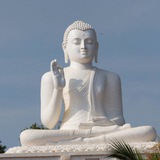
“They adorned the Blessed One’s body with all kinds of ornaments, anointed it with perfumes, and honored it with their bodies—showing respect and reverence. They consecrated the stupa with dances, songs, music, garlands, perfumes, and ointments. After circumambulating the stupa clockwise, they paid homage and departed.”
DN 16: Maha Parinibbana sutta
DN 16: Maha Parinibbana sutta
🙏3🫡1
Forwarded from Buddha
“Bhikkhus, all is burning. And what, bhikkhus, is the all that is burning? The eye is burning, forms are burning, eye-consciousness is burning, eye-contact is burning, and whatever feeling arises with eye-contact as condition—whether pleasant or painful or neither-painful-nor-pleasant—that too is burning. Burning with what? Burning with the fire of lust, with the fire of hatred, with the fire of delusion; burning with birth, aging, and death; with sorrow, lamentation, pain, displeasure, and despair, I say.....Experiencing revulsion, he becomes dispassionate. Through dispassion his mind is liberated. When it is liberated there comes the knowledge: ‘It’s liberated.’ He understands: ‘Destroyed is birth, the holy life has been lived, what had to be done has been done, there is no more for this state of being.’”
Partial excerpts from SN 35.28 : Ādittasutta
Partial excerpts from SN 35.28 : Ādittasutta
🔥1🙏1🍓1
Forwarded from Buddha
Free from the Burden of Holding On
By Ajahn Jayasaro
Part 3 of 3
Often people come to spiritual practice and meditation, thinking, “I don’t like who I am. I’d like to be a different person.” This idea that you are somebody you don’t really like, and you would like to be somebody else, is mistaken and ultimately frustrating. Instead, when you look closely, your intention should be to see and learn from what is present. Then you will recognize that those ideas of being “somebody” are just things that arise and pass away. There’s nothing substantial to them at all.
You can’t live without perceptions and memories—you have to let go from within them. And you do that by seeing memory and perception as just what they are. It’s just this way. That’s the way the mind is, and that’s all right.
The fourth khandha is sankhara. It’s the khandha of kamma.
We can talk about the five khandhas in different ways. Of the five khandhas, rupa (body), vedana (feelings), sahha (perception), and vihhana (sense experience) are vipaka, the results of kamma in the past. Sankhara khandha, on the other hand, is led by volition. It is the khandha of kamma creation: kusala kammas and akusala kam- mas, wholesome and unwholesome actions. And volition, thought, and intention are the dhammas that we need to let go of.
Here, we make a distinction between kusala and akusala. We let go of certain kinds of volition by refusing to pay attention to them. There are certain volitions, certain trains of thought that are so poisonous that we don’t dare allow the mind to indulge in them at all. When the mind becomes aware that these kinds of poisonous dhammas—thoughts of violence, of hurting or taking advantage of others, for instance—are in the mind, this calls for sharpness, for the warrior-like cutting off of those selfish, lustful, angry, destructive kinds of volitions. Here, the letting go is much more forceful. With the wholesome volitions, meanwhile, it’s a matter of taking them on but not identifying with them. We take on the practices of mindfulness, take on development of loving-kindness, take on the practice of patient endurance, of constant, unremitting effort. These are tasks we take upon ourselves, but without creating a new “self” or a new “being” out of them. Thus we are letting go—we are not allowing our minds to be pulled around by how things “should be.” Once you have an idea of how things should be, you will be affronted or disturbed by all the things that are not that way.
Why do you consider certain people’s behavior to be so offensive? Usually it’s because you have an idea that they shouldn’t be like that. So when the mind dwells on “should” and “shouldn’t,” you’re setting yourself up for suffering. Why shouldn’t people be selfish? Why shouldn’t they be aggressive? Why shouldn’t they do all the terrible things they do? Why not? If their minds are like that, if they look at things like that, have that kind of view, those kinds of values, why not? Such behavior is then perfectly natural. When the causes and conditions are like that, the conduct will be like that.
The more you can see things in terms of causes and conditions, the more you can let go. If somebody speaks very harshly, you see it stems from their way of looking at things. Perhaps they’ve developed that kind of habit; perhaps they’ve always spoken like that. The more you can see the conditions underlying the behavior, the more you can let go.
Where does our sense of uniqueness lie? We say, “This is who I really am. This is what makes me different from everyone else.” That’s where delusion lies. That’s where attachment lies. This neurotic need to be different, to stand out from the crowd or sink into the shadows—these are reactions to the basic need to create a safe haven, a refuge in the wrong place. We look for refuge, for something that is stable, permanent, happy, but we seek it in that which is impermanent and unstable. There is nothing wrong with body, nothing wrong with feelings, perceptions, thoughts, seeing, hearing, tasting, all these things.
By Ajahn Jayasaro
Part 3 of 3
Often people come to spiritual practice and meditation, thinking, “I don’t like who I am. I’d like to be a different person.” This idea that you are somebody you don’t really like, and you would like to be somebody else, is mistaken and ultimately frustrating. Instead, when you look closely, your intention should be to see and learn from what is present. Then you will recognize that those ideas of being “somebody” are just things that arise and pass away. There’s nothing substantial to them at all.
You can’t live without perceptions and memories—you have to let go from within them. And you do that by seeing memory and perception as just what they are. It’s just this way. That’s the way the mind is, and that’s all right.
The fourth khandha is sankhara. It’s the khandha of kamma.
We can talk about the five khandhas in different ways. Of the five khandhas, rupa (body), vedana (feelings), sahha (perception), and vihhana (sense experience) are vipaka, the results of kamma in the past. Sankhara khandha, on the other hand, is led by volition. It is the khandha of kamma creation: kusala kammas and akusala kam- mas, wholesome and unwholesome actions. And volition, thought, and intention are the dhammas that we need to let go of.
Here, we make a distinction between kusala and akusala. We let go of certain kinds of volition by refusing to pay attention to them. There are certain volitions, certain trains of thought that are so poisonous that we don’t dare allow the mind to indulge in them at all. When the mind becomes aware that these kinds of poisonous dhammas—thoughts of violence, of hurting or taking advantage of others, for instance—are in the mind, this calls for sharpness, for the warrior-like cutting off of those selfish, lustful, angry, destructive kinds of volitions. Here, the letting go is much more forceful. With the wholesome volitions, meanwhile, it’s a matter of taking them on but not identifying with them. We take on the practices of mindfulness, take on development of loving-kindness, take on the practice of patient endurance, of constant, unremitting effort. These are tasks we take upon ourselves, but without creating a new “self” or a new “being” out of them. Thus we are letting go—we are not allowing our minds to be pulled around by how things “should be.” Once you have an idea of how things should be, you will be affronted or disturbed by all the things that are not that way.
Why do you consider certain people’s behavior to be so offensive? Usually it’s because you have an idea that they shouldn’t be like that. So when the mind dwells on “should” and “shouldn’t,” you’re setting yourself up for suffering. Why shouldn’t people be selfish? Why shouldn’t they be aggressive? Why shouldn’t they do all the terrible things they do? Why not? If their minds are like that, if they look at things like that, have that kind of view, those kinds of values, why not? Such behavior is then perfectly natural. When the causes and conditions are like that, the conduct will be like that.
The more you can see things in terms of causes and conditions, the more you can let go. If somebody speaks very harshly, you see it stems from their way of looking at things. Perhaps they’ve developed that kind of habit; perhaps they’ve always spoken like that. The more you can see the conditions underlying the behavior, the more you can let go.
Where does our sense of uniqueness lie? We say, “This is who I really am. This is what makes me different from everyone else.” That’s where delusion lies. That’s where attachment lies. This neurotic need to be different, to stand out from the crowd or sink into the shadows—these are reactions to the basic need to create a safe haven, a refuge in the wrong place. We look for refuge, for something that is stable, permanent, happy, but we seek it in that which is impermanent and unstable. There is nothing wrong with body, nothing wrong with feelings, perceptions, thoughts, seeing, hearing, tasting, all these things.
Telegram
Buddha
Buddha dharma teachings from the suttas and commentaries
💯1🆒1
Forwarded from Buddha
Those things are just that way. But problems arise when we demand, hope, crave for those things to provide that which they cannot provide. What we desperately seek are permanence, happiness, and stability, and those things can only be found in freedom from attachments, from penetrating the four noble truths.
The Buddha didn’t want us to believe in his teachings. This isn’t a belief system. He has given us tools to use to penetrate the nature of our lives, and to align ourselves more and more clearly, more and more authentically, with what is really going on here and now.
So we let go and see what a burden it is to hold on to things—how heavy and limiting and dark it is to hold on to body, feelings, perceptions, all these aggregates, hoping and praying that they will give us something they can never provide.
In the Pali texts we find an interesting pair of words, abamkara and mamankara, that may be translated as “I-making” and “minemaking.” They point to a sense that “I” and “mine” are not inherent in the mind but are created, moment by moment, through ignorance. Letting go within action requires us to learn how to fulfill our responsibilities to ourselves and others without falling into the grasping, frustrating world of “I” and “mine.”
The more we let go, the lighter we feel, the happier we feel. It’s through the happiness of letting go that the mind becomes brave enough, and has the power, to penetrate the way things are. Without that inner stability of concentration, the unhappy mind is weak and scattered. It’s only through the ability to let go of indulgences like thoughts of the past or future, along with the renunciation of very small, rather trivial pleasant feelings, that the mind can penetrate into that which is more profound.
===
Ajahn Jayasaro was ordained as a monk by Ajahn Chah in 1980. From 1997 to 2002 he served as abbot of Wat Pah Nanachat, an international monastery in the Thai Forest Tradition. Currently he lives in a hermitage in central Thailand.
===
Part 1 of 3:
https://news.1rj.ru/str/wordsofbuddha/4575
Part 2 of 3:
https://news.1rj.ru/str/dhammapadas/3285
Part 3 of 3:
https://news.1rj.ru/str/lorddivinebuddha/3740
===
Buddha dharma teachings channel:
https://news.1rj.ru/str/lorddivinebuddha
===
The Buddha didn’t want us to believe in his teachings. This isn’t a belief system. He has given us tools to use to penetrate the nature of our lives, and to align ourselves more and more clearly, more and more authentically, with what is really going on here and now.
So we let go and see what a burden it is to hold on to things—how heavy and limiting and dark it is to hold on to body, feelings, perceptions, all these aggregates, hoping and praying that they will give us something they can never provide.
In the Pali texts we find an interesting pair of words, abamkara and mamankara, that may be translated as “I-making” and “minemaking.” They point to a sense that “I” and “mine” are not inherent in the mind but are created, moment by moment, through ignorance. Letting go within action requires us to learn how to fulfill our responsibilities to ourselves and others without falling into the grasping, frustrating world of “I” and “mine.”
The more we let go, the lighter we feel, the happier we feel. It’s through the happiness of letting go that the mind becomes brave enough, and has the power, to penetrate the way things are. Without that inner stability of concentration, the unhappy mind is weak and scattered. It’s only through the ability to let go of indulgences like thoughts of the past or future, along with the renunciation of very small, rather trivial pleasant feelings, that the mind can penetrate into that which is more profound.
===
Ajahn Jayasaro was ordained as a monk by Ajahn Chah in 1980. From 1997 to 2002 he served as abbot of Wat Pah Nanachat, an international monastery in the Thai Forest Tradition. Currently he lives in a hermitage in central Thailand.
===
Part 1 of 3:
https://news.1rj.ru/str/wordsofbuddha/4575
Part 2 of 3:
https://news.1rj.ru/str/dhammapadas/3285
Part 3 of 3:
https://news.1rj.ru/str/lorddivinebuddha/3740
===
Buddha dharma teachings channel:
https://news.1rj.ru/str/lorddivinebuddha
===
Telegram
Buddha
Buddha dharma teachings from the suttas and commentaries
👍1🏆1
15. Yo ca vassasatam jive
apassam amatam padam
Ekaham jivitam seyyo
passato amatam padam. 114.
ONE DAY OF PERCEIVING THE DEATHLESS IS BETTER THAN A CENTURY WITHOUT SUCH AN EXPERIENCE
15. Though one should live a hundred years without seeing the Deathless State, 12 yet better, indeed, is a single day's life of one who sees the Deathless State. 114.
Story
A young mother named Kisa Gotami, lost her only child. As she had never come across an instance of death she carried the corpse on her hip believing the child to be ill and searching for a remedy. A wise man directed her to the Buddha who advised her to collect some mustard seed from a household where none had died. She got mustard but found no household where none had died. The Truth dawned upon her. When she returned, the Buddha preached the Dhamma to her. She became a nun. One day she observed the flickering of a lamp and reflected on the impermanence of life. The Buddha projected His image before her and uttered this stanza comparing life to a flickering lamp.
===
Buddha dharma teachings channel:
https://news.1rj.ru/str/lorddivinebuddha
===
apassam amatam padam
Ekaham jivitam seyyo
passato amatam padam. 114.
ONE DAY OF PERCEIVING THE DEATHLESS IS BETTER THAN A CENTURY WITHOUT SUCH AN EXPERIENCE
15. Though one should live a hundred years without seeing the Deathless State, 12 yet better, indeed, is a single day's life of one who sees the Deathless State. 114.
Story
A young mother named Kisa Gotami, lost her only child. As she had never come across an instance of death she carried the corpse on her hip believing the child to be ill and searching for a remedy. A wise man directed her to the Buddha who advised her to collect some mustard seed from a household where none had died. She got mustard but found no household where none had died. The Truth dawned upon her. When she returned, the Buddha preached the Dhamma to her. She became a nun. One day she observed the flickering of a lamp and reflected on the impermanence of life. The Buddha projected His image before her and uttered this stanza comparing life to a flickering lamp.
===
Buddha dharma teachings channel:
https://news.1rj.ru/str/lorddivinebuddha
===
Telegram
Buddha
Buddha dharma teachings from the suttas and commentaries
❤2👌1💯1
Forwarded from Buddha Dharma books
Free Buddha Dharma ebook
The Food of Awakening
By Bhante Shravasti Dhammika
Free download available:
https://budblooms.org/the-food-of-awakening/
===
The Food of Awakening
By Bhante Shravasti Dhammika
Free download available:
https://budblooms.org/the-food-of-awakening/
===
👍2❤1
Forwarded from Buddha Dharma books
Free Buddha Dharma ebook
The Food of Awakening
By Bhante Shravasti Dhammika
A great deal of discussion has been given to the last meal the Buddha ate before he passed into final Nirvana. The Mahaparinibbana Sutta specifically records that the blacksmith Cunda offered the Buddha a dish called sukaramaddava and that this was the last thing the Buddha ever ate. The compound sukaramaddava can be translated as boar’s softness or boar’s mildness and it has been translated as ‘tender pork’. However, the meaning of the term is by no means clear.
Free download available:
https://budblooms.org/the-food-of-awakening/
===
The Food of Awakening
By Bhante Shravasti Dhammika
A great deal of discussion has been given to the last meal the Buddha ate before he passed into final Nirvana. The Mahaparinibbana Sutta specifically records that the blacksmith Cunda offered the Buddha a dish called sukaramaddava and that this was the last thing the Buddha ever ate. The compound sukaramaddava can be translated as boar’s softness or boar’s mildness and it has been translated as ‘tender pork’. However, the meaning of the term is by no means clear.
Free download available:
https://budblooms.org/the-food-of-awakening/
===
🆒1😘1
16. Yo ca vassasatam jive
apassam dhammamuttamam
Ekaham jivitam seyyo
passato dhammamuttamam. 115.
ONE DAY OF PERCEIVING THE DHAMMA IS BETTER THAN A CENTURY WITHOUT SUCH PERCEPTION
16. Though one should live a hundred years not seeing the Truth Sublime, 13 yet better, indeed, is a single day's life of one who sees the Truth Sublime. 115.
Story
A wealthy widow had several sons and daughters. At the request of the children, who promised to support her she distributed her property amongst them. But the ungrateful children neglected her. Greatly disappointed, she became a nun. constantly she reflected on the Dhamma. The Buddha preached to her on the importance of the Dhamma and she attained Arahantship.
===
Vajrayana Tantrayana Buddhism channel:
https://news.1rj.ru/str/tantrayanabuddhism
Tibetan Buddhism - Vajrayana, Tantrayana and esoteric Buddhism channel:
https://news.1rj.ru/str/tibetanbuddha
===
apassam dhammamuttamam
Ekaham jivitam seyyo
passato dhammamuttamam. 115.
ONE DAY OF PERCEIVING THE DHAMMA IS BETTER THAN A CENTURY WITHOUT SUCH PERCEPTION
16. Though one should live a hundred years not seeing the Truth Sublime, 13 yet better, indeed, is a single day's life of one who sees the Truth Sublime. 115.
Story
A wealthy widow had several sons and daughters. At the request of the children, who promised to support her she distributed her property amongst them. But the ungrateful children neglected her. Greatly disappointed, she became a nun. constantly she reflected on the Dhamma. The Buddha preached to her on the importance of the Dhamma and she attained Arahantship.
===
Vajrayana Tantrayana Buddhism channel:
https://news.1rj.ru/str/tantrayanabuddhism
Tibetan Buddhism - Vajrayana, Tantrayana and esoteric Buddhism channel:
https://news.1rj.ru/str/tibetanbuddha
===
Telegram
Vajrayana Tantrayana Buddhism
Buddha teachings from the Vajrayana, esoteric, secret or Tantrayana vehicle
❤1🙏1👌1💯1
Symbolic meanings of a stupa:
Structure and the Path to Enlightenment
Base: Represents the earth and the foundation of mindfulness.
Dome: Symbolizes water and the vastness of the cosmos.
Square Harmika: Represents air and the spiritual focus; it holds the relics of the Buddha or other revered figures.
Spire or Pinnacle: Represents fire and the stages of enlightenment.
Umbrella (Chattras): Represents the highest level of spiritual attainment and protection from evil.
Lotus Throne: Symbolizes purity, enlightenment, and detachment from material existence.
Structure and the Path to Enlightenment
Base: Represents the earth and the foundation of mindfulness.
Dome: Symbolizes water and the vastness of the cosmos.
Square Harmika: Represents air and the spiritual focus; it holds the relics of the Buddha or other revered figures.
Spire or Pinnacle: Represents fire and the stages of enlightenment.
Umbrella (Chattras): Represents the highest level of spiritual attainment and protection from evil.
Lotus Throne: Symbolizes purity, enlightenment, and detachment from material existence.
🙏1💯1🫡1
Forwarded from Buddha
Big Buddha Dordenma, made of bronze and gilded in gold, Kuenselphodrang palace, Thimphu, Bhutan.
👏2🤩1😍1
Forwarded from Words of the Buddha
Free Buddha Dharma ebook
Teaching and Training
At Pa Auk Forest Monastery
By Bhikkhu Moneyya
Free download here:
https://www.lotuslibrary.com/wp-content/uploads/2024/12/2032-teaching-and-training_Moneyya.pdf
===
Teaching and Training
At Pa Auk Forest Monastery
By Bhikkhu Moneyya
Free download here:
https://www.lotuslibrary.com/wp-content/uploads/2024/12/2032-teaching-and-training_Moneyya.pdf
===
👍1💯1
Forwarded from Words of the Buddha
Free Buddha Dharma ebook
Teaching and Training
At Pa Auk Forest Monastery
By Bhikkhu Moneyya
The system of meditation taught at Pa-Auk Forest Monastery in Myanmar is based on the Tipitaka (The Three Baskets, or main divisions, of the Pali Canon) and its commentaries. For clarity, the subject matter in this book has been organized into an outline format, using the three trainings of sila (morality), samadhi (concentration) and pañña (wisdom) as its main headings. The three trainings are then further subdivided into the seven stages of purification, originally described in the “Rathavinita Sutta” (“Relay Chariots Discourse”) of the Majjhima Nikaya and later expounded in the Visuddhimagga (The Path of Purification), a widely respected commentary, compiled by Bhadantacariya Buddhaghosa around AD 400. The seven stages of purification provide a step-by-step formula for systematically purifying one’s body (physical actions), speech and mind of defilements in order to realize Nibbana in this lifetime.
Free download here:
https://www.lotuslibrary.com/wp-content/uploads/2024/12/2032-teaching-and-training_Moneyya.pdf
===
Teaching and Training
At Pa Auk Forest Monastery
By Bhikkhu Moneyya
The system of meditation taught at Pa-Auk Forest Monastery in Myanmar is based on the Tipitaka (The Three Baskets, or main divisions, of the Pali Canon) and its commentaries. For clarity, the subject matter in this book has been organized into an outline format, using the three trainings of sila (morality), samadhi (concentration) and pañña (wisdom) as its main headings. The three trainings are then further subdivided into the seven stages of purification, originally described in the “Rathavinita Sutta” (“Relay Chariots Discourse”) of the Majjhima Nikaya and later expounded in the Visuddhimagga (The Path of Purification), a widely respected commentary, compiled by Bhadantacariya Buddhaghosa around AD 400. The seven stages of purification provide a step-by-step formula for systematically purifying one’s body (physical actions), speech and mind of defilements in order to realize Nibbana in this lifetime.
Free download here:
https://www.lotuslibrary.com/wp-content/uploads/2024/12/2032-teaching-and-training_Moneyya.pdf
===
👍1🙏1🆒1
Chapter 9
Pàpa Vagga
Evil
(Text and Translation by Ven. Nàrada)
1. Abhittharetha kalyane
pàpà cittam nivàraye
Dandham hi karoto puññam
pàpasmim ramatã mano. 116.
BE QUICK IN DOING GOOD; SUPPRESS EVIL
1. Make haste in doing good; 1 check your mind from evil; 2 for the mind of him who is slow in doing meritorious actions 3 delights in evil. 116.
Story
A husband and wife had only one under garment each and only one upper garment between the two of them. One day the husband heard the Dhamma from the Buddha and desired to offer to Him his only upper garment, but selfishness overcame him. Throughout the night he battled with his selfishness. Finally he offered the garment and exclaimed, "I have won! I have won!" Hearing his story, the king rewarded him handsomely.
===
Words of the Buddha channel:
https://news.1rj.ru/str/wordsofbuddha
===
Pàpa Vagga
Evil
(Text and Translation by Ven. Nàrada)
1. Abhittharetha kalyane
pàpà cittam nivàraye
Dandham hi karoto puññam
pàpasmim ramatã mano. 116.
BE QUICK IN DOING GOOD; SUPPRESS EVIL
1. Make haste in doing good; 1 check your mind from evil; 2 for the mind of him who is slow in doing meritorious actions 3 delights in evil. 116.
Story
A husband and wife had only one under garment each and only one upper garment between the two of them. One day the husband heard the Dhamma from the Buddha and desired to offer to Him his only upper garment, but selfishness overcame him. Throughout the night he battled with his selfishness. Finally he offered the garment and exclaimed, "I have won! I have won!" Hearing his story, the king rewarded him handsomely.
===
Words of the Buddha channel:
https://news.1rj.ru/str/wordsofbuddha
===
Telegram
Words of the Buddha
Daily teachings of Buddha Dharma
👍1👌1