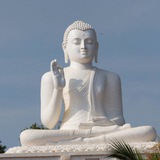
Shrine for pure gold sitting Sakyamuni Buddha at Brahma Palace, Ling Shan scenic area, the most expensive Buddhist compound in modern history. The large complex has world tallest standing bronze Amitabha Buddha statue, world largest Buddha's hand square, Indian style gigantic Brahma Palace, Tibetan style Five Mudras Mandala Palace, Nine Dragons Buddha bathing fountain, Maitreya Buddha with 100 children, Xiangfu Buddhist temple, Thai style Flying Dragon stupas, Buddha's footprints altar and two man-made lakes.
👏3🤩1🏆1
Forwarded from Buddha
As a rocky mountain
is unwavering and well grounded,
so when delusion ends,
a monk, like a mountain, doesn’t tremble.
To the man who has not a blemish
who is always seeking purity,
even a hair-tip of evil
seems as big as a cloud.
As a frontier city
is guarded inside and out,
so you should ward yourselves—
don’t let the moment pass you by.
I don’t long for death;
I don’t long for life;
I await my time,
like a worker waiting for their wages.
I don’t long for death;
I don’t long for life;
I await my time,
aware and mindful.
I’ve served the teacher
and fulfilled the Buddha’s instructions.
The heavy burden is laid down,
the conduit to rebirth is eradicated.
I’ve attained the goal
for the sake of which I went forth
from the lay life to homelessness—
the ending of all fetters.
Persist with diligence:
this is my instruction.
Come, I’ll be fully extinguished—
I’m liberated in every way.
Partial excerpts from Thag 14.1 Khadiravaniyarevatattheragāthā: Khadiravaniyarevata
is unwavering and well grounded,
so when delusion ends,
a monk, like a mountain, doesn’t tremble.
To the man who has not a blemish
who is always seeking purity,
even a hair-tip of evil
seems as big as a cloud.
As a frontier city
is guarded inside and out,
so you should ward yourselves—
don’t let the moment pass you by.
I don’t long for death;
I don’t long for life;
I await my time,
like a worker waiting for their wages.
I don’t long for death;
I don’t long for life;
I await my time,
aware and mindful.
I’ve served the teacher
and fulfilled the Buddha’s instructions.
The heavy burden is laid down,
the conduit to rebirth is eradicated.
I’ve attained the goal
for the sake of which I went forth
from the lay life to homelessness—
the ending of all fetters.
Persist with diligence:
this is my instruction.
Come, I’ll be fully extinguished—
I’m liberated in every way.
Partial excerpts from Thag 14.1 Khadiravaniyarevatattheragāthā: Khadiravaniyarevata
🙏2🕊1😇1
9. Pàuimhi ce vauo n'àssa
hareyya pàuinà visam
Nàbbauam visam anveti
natthi pàpam akubbato. 124.
NO EVIL TO THOSE WHO HAVE NO BAD INTENTION
9. If no wound there be in one's hand, one may carry poison in it. Poison does not affect one who has no wound. There is no ill for him who does no wrong. 7 124.
Story
A rich man's daughter, who was a Stream-Winner, fell in love with a hunter owing to past association, and eloped with him. She gave birth to several sons. The wife, although a Sotàpanna, was in the habit of giving bows and arrows to the husband to go hunting. Amongst the monks a question arose whether she committed an evil by doing so. The Buddha explained that she was blameless as she did so in obedience to her husband and having no evil intention.
===
Buddha dharma teachings channel:
https://news.1rj.ru/str/lorddivinebuddha
===
hareyya pàuinà visam
Nàbbauam visam anveti
natthi pàpam akubbato. 124.
NO EVIL TO THOSE WHO HAVE NO BAD INTENTION
9. If no wound there be in one's hand, one may carry poison in it. Poison does not affect one who has no wound. There is no ill for him who does no wrong. 7 124.
Story
A rich man's daughter, who was a Stream-Winner, fell in love with a hunter owing to past association, and eloped with him. She gave birth to several sons. The wife, although a Sotàpanna, was in the habit of giving bows and arrows to the husband to go hunting. Amongst the monks a question arose whether she committed an evil by doing so. The Buddha explained that she was blameless as she did so in obedience to her husband and having no evil intention.
===
Buddha dharma teachings channel:
https://news.1rj.ru/str/lorddivinebuddha
===
Telegram
Buddha
Buddha dharma teachings from the suttas and commentaries
💯1🆒1
Free Buddha Dharma ebook
Commentary to the Cariyapitaka
By Acariya Dhammapala, translated from the Pali by Bhikkhu Bodhi
Free download here:
https://www.accesstoinsight.org/lib/authors/bodhi/wheel409.pdf
===
Commentary to the Cariyapitaka
By Acariya Dhammapala, translated from the Pali by Bhikkhu Bodhi
Free download here:
https://www.accesstoinsight.org/lib/authors/bodhi/wheel409.pdf
===
👍1👏1🕊1
Free Buddha Dharma ebook
Commentary to the Cariyapitaka
By Acariya Dhammapala, translated from the Pali by Bhikkhu Bodhi
In its earliest phase, as represented by the four main collections of the Sutta Pitaka, the focal concern of Buddhism was the attainment of nibbåna by the practice of the Noble Eightfold Path. In these collections the Buddha teaches his doctrine as a direct path to deliverance, and perhaps no feature of the presentation is so striking as the urgency he enjoins on his disciples in bringing their spiritual work to completion by reaching the final goal. Just as a man who discovers his turban to be in flames would immediately seek to extinguish it, so should the earnest disciple strive to extinguish the flames of craving in order to reach the state of security, the consummate peace of nibbana.
Free download here:
https://www.accesstoinsight.org/lib/authors/bodhi/wheel409.pdf
===
Commentary to the Cariyapitaka
By Acariya Dhammapala, translated from the Pali by Bhikkhu Bodhi
In its earliest phase, as represented by the four main collections of the Sutta Pitaka, the focal concern of Buddhism was the attainment of nibbåna by the practice of the Noble Eightfold Path. In these collections the Buddha teaches his doctrine as a direct path to deliverance, and perhaps no feature of the presentation is so striking as the urgency he enjoins on his disciples in bringing their spiritual work to completion by reaching the final goal. Just as a man who discovers his turban to be in flames would immediately seek to extinguish it, so should the earnest disciple strive to extinguish the flames of craving in order to reach the state of security, the consummate peace of nibbana.
Free download here:
https://www.accesstoinsight.org/lib/authors/bodhi/wheel409.pdf
===
👌1💯1
The Third and a Half Noble Truth
Theravada monk Thanissaro Bhikkhu provides a timeless teaching on searching for happiness in areas tethered to suffering.
By Thanissaro Bhikkhu
Part 1 of 2
The Buddha’s teachings are like a buffet table, with lots of different things you can take from it: how to live happily in this life, how to prepare for a happy life in the next life, and how to get out of lives altogether, which doesn’t mean death—because death is a part of life—but there’s an escape from both life and death, which the Buddha said is the ultimate happiness. Yet that’s the part of the buffet table to which a lot of people say, “I’m not ready for that yet.” So there are other things you can take.
His teaching on how to find happiness in this life basically comes down to learning how to be hardworking, taking initiative, realizing that if you’re going to make a living happily, you have to choose an honest livelihood and put forth the effort to do it well.
Then when you’ve gained things rightly, you take care of them.
Third, you spend in line with your income. In other words, you’re not too miserly, yet at the same time you’re not too spendthrift. We would expect the Buddha to say, “Don’t be a spendthrift,” but interestingly, he says not to be too miserly, either. He says to get some enjoyment out of the wealth you gain from your work, because if you can’t enjoy your wealth, you turn into a very shriveled kind of person. You resent the pleasures that other people find in life.
Then, finally, have good friends. Admirable friends. People who would keep you steered in the right direction. They have four qualities that he enumerates, and it turns out the four qualities are the qualities that also lead to a good life in a future rebirth. In other words, look for friends you can take as examples of how to live in a way that keeps you happy now and in lives to come.
Those qualities start with conviction, which means conviction in the Buddha’s awakening. What does that mean for you? It means that through the power of your own actions, you can make a difference in your life—your happiness depends on your actions, and the quality of your intention is what shapes the results of each action. That doesn’t mean having just good intentions. A really high-quality intention is also free of delusion, which means you have to be very reflective in what you do: looking carefully at what you do, looking at the results, learning from your mistakes, and always aiming at long-term happiness.
We talked briefly today about when to take a stand and when not to take a stand on an issue, and it has nothing to do with your feelings about the issue. It has everything to do with what you anticipate will be the long-term consequences of what you do or don’t do. All too often we have weak conviction in that principle, because it’s too easy to go for short-term gratification, the quick fix, the things that are immediately to hand. But the Buddha wants you to adopt a larger perspective, because that’s one of the messages of his awakening: There is this possibility that you can be reborn in line with your actions. So what does that tell you about your actions, how much attention you should give to them, how much care you should take?
That’s the first quality of a good friend and the first quality that leads to happiness in future lifetimes.
The second quality is virtue: the desire to be harmless in your words and your deeds. This basically comes down to looking after your intentions, because the intention is what determines the quality of the action, as we said. So make sure that your intentions are harmless.
When the Buddha was teaching his son, he basically said, “If you think that the act you intend to do could cause any harm, don’t do it. Act only on your best intentions.” It’s when you act on your best intentions that you learn. If you know you’re acting on unskillful intentions and you get bad results, you haven’t learned much.
Theravada monk Thanissaro Bhikkhu provides a timeless teaching on searching for happiness in areas tethered to suffering.
By Thanissaro Bhikkhu
Part 1 of 2
The Buddha’s teachings are like a buffet table, with lots of different things you can take from it: how to live happily in this life, how to prepare for a happy life in the next life, and how to get out of lives altogether, which doesn’t mean death—because death is a part of life—but there’s an escape from both life and death, which the Buddha said is the ultimate happiness. Yet that’s the part of the buffet table to which a lot of people say, “I’m not ready for that yet.” So there are other things you can take.
His teaching on how to find happiness in this life basically comes down to learning how to be hardworking, taking initiative, realizing that if you’re going to make a living happily, you have to choose an honest livelihood and put forth the effort to do it well.
Then when you’ve gained things rightly, you take care of them.
Third, you spend in line with your income. In other words, you’re not too miserly, yet at the same time you’re not too spendthrift. We would expect the Buddha to say, “Don’t be a spendthrift,” but interestingly, he says not to be too miserly, either. He says to get some enjoyment out of the wealth you gain from your work, because if you can’t enjoy your wealth, you turn into a very shriveled kind of person. You resent the pleasures that other people find in life.
Then, finally, have good friends. Admirable friends. People who would keep you steered in the right direction. They have four qualities that he enumerates, and it turns out the four qualities are the qualities that also lead to a good life in a future rebirth. In other words, look for friends you can take as examples of how to live in a way that keeps you happy now and in lives to come.
Those qualities start with conviction, which means conviction in the Buddha’s awakening. What does that mean for you? It means that through the power of your own actions, you can make a difference in your life—your happiness depends on your actions, and the quality of your intention is what shapes the results of each action. That doesn’t mean having just good intentions. A really high-quality intention is also free of delusion, which means you have to be very reflective in what you do: looking carefully at what you do, looking at the results, learning from your mistakes, and always aiming at long-term happiness.
We talked briefly today about when to take a stand and when not to take a stand on an issue, and it has nothing to do with your feelings about the issue. It has everything to do with what you anticipate will be the long-term consequences of what you do or don’t do. All too often we have weak conviction in that principle, because it’s too easy to go for short-term gratification, the quick fix, the things that are immediately to hand. But the Buddha wants you to adopt a larger perspective, because that’s one of the messages of his awakening: There is this possibility that you can be reborn in line with your actions. So what does that tell you about your actions, how much attention you should give to them, how much care you should take?
That’s the first quality of a good friend and the first quality that leads to happiness in future lifetimes.
The second quality is virtue: the desire to be harmless in your words and your deeds. This basically comes down to looking after your intentions, because the intention is what determines the quality of the action, as we said. So make sure that your intentions are harmless.
When the Buddha was teaching his son, he basically said, “If you think that the act you intend to do could cause any harm, don’t do it. Act only on your best intentions.” It’s when you act on your best intentions that you learn. If you know you’re acting on unskillful intentions and you get bad results, you haven’t learned much.
Telegram
Dhammapada - Buddha Dharma Teachings
Daily teachings of the Dhammapada, beloved and favorite teachings of the Buddha
👍1🫡1
In fact, sometimes you pretend that you didn’t have those bad intentions to begin with, which means they go underground. Reflecting on your actions works only if you act on your best intentions. If they get bad results, you can say, “There’s something new I have to learn here.” If you can’t figure it out on your own, go to others for advice.
Reflecting on your actions works only if you act on your best intentions.
We usually hear about virtue in terms of the five precepts, but it’s also expressed in qualities of the heart, qualities of the character—things like contentment, the willingness to go out of your way to be helpful to other people, the willingness not to be burdensome. Those are all parts of virtue as well.
The third quality you look for in an admirable friend is generosity—people who like to share what they have. After all, if they’re intent on sharing, that means they probably won’t try to take things away from you unfairly. You benefit from their generosity and you also benefit from their example as a good friend, as someone who reminds you that the best things in life are not material objects—they’re qualities of the heart.
===
Part 1 of 2:
https://news.1rj.ru/str/dhammapadas/3354
Part 2 of 2:
https://news.1rj.ru/str/wordsofbuddha/4684
===
Dhammapada, beloved and favorite teachings of the Buddha channel:
https://news.1rj.ru/str/dhammapadas
===
Reflecting on your actions works only if you act on your best intentions.
We usually hear about virtue in terms of the five precepts, but it’s also expressed in qualities of the heart, qualities of the character—things like contentment, the willingness to go out of your way to be helpful to other people, the willingness not to be burdensome. Those are all parts of virtue as well.
The third quality you look for in an admirable friend is generosity—people who like to share what they have. After all, if they’re intent on sharing, that means they probably won’t try to take things away from you unfairly. You benefit from their generosity and you also benefit from their example as a good friend, as someone who reminds you that the best things in life are not material objects—they’re qualities of the heart.
===
Part 1 of 2:
https://news.1rj.ru/str/dhammapadas/3354
Part 2 of 2:
https://news.1rj.ru/str/wordsofbuddha/4684
===
Dhammapada, beloved and favorite teachings of the Buddha channel:
https://news.1rj.ru/str/dhammapadas
===
Telegram
Dhammapada - Buddha Dharma Teachings
Daily teachings of the Dhammapada, beloved and favorite teachings of the Buddha
👏1😇1
Forwarded from Words of the Buddha
The Third and a Half Noble Truth
Theravada monk Thanissaro Bhikkhu provides a timeless teaching on searching for happiness in areas tethered to suffering.
By Thanissaro Bhikkhu
Part 2 of 2
The final quality to look for, discernment, is defined as “penetrative knowledge of arising and passing away.” At first glance, that sounds simply like seeing things coming and going, but when the Buddha adds that adjective, “penetrative,” he means that you have a good sense of when something arises, whether it’s arising for good or for bad. Where does it come from? Where is it going? What things should be encouraged and which things should not be encouraged? This kind of penetrative discernment goes together with right effort.
Those are the qualities you look for in a friend: the friends you share your life with, the people you go to for advice. You want them to be good people because they’ll keep you on the right path. I’ve seen cases where people are industrious, they have a lot of initiative, they gain wealth, but then they start hanging around with wealthy people, using wealth as the measure of whom they’re going to take as their friends. That’s not a reliable guide for who’s going to be a trustworthy friend at all.
Some of the best friends are not necessarily the ones who are the most brilliant conversationalists or the most successful in material terms. You want people you can take as good examples.
These are some of the Buddha’s recommendations on how to live happily in this lifetime, and then also in future lifetimes. Someone once called this the third and a half noble truth. Instead of the truth of the cessation of suffering, it’s the truth of the management of suffering. If you don’t plan to go all the way on the path, you have to realize that wherever you set your sights, there’s going to be disappointment at some point. A lot of people say, “I’m not ready for the ultimate goal yet,” but you’ve got to be forewarned that any happiness that falls short of the goal is going to leave you.
There’s that story of the man who had lost his little son. He went to the cemetery every day to cry, and he called out again and again, “Where have you gone, my little son? Where have you gone, my little son?” He comes back from the cemetery one day, stops off to see the Buddha, and the Buddha says, “Where have you been? You look like someone who’s deranged, out of his mind.” And the man says, “How can I not feel that way? I’ve lost my only son.” The Buddha says, “Yes, there’s a lot of suffering that comes from those who are dear.” The man immediately objects, “No, it’s happiness that comes from those who are dear.” You hear so many times that when people listen to the Buddha’s talks, they’re gratified and delighted. Well, he wasn’t gratified or delighted at all. He just left. He then goes and meets up with a group of gamblers. He tells them what the Buddha said, and the gamblers agree with him: Those who are dear bring happiness.
It’s an interesting touch on the story that that’s the attitude of gamblers: Trying to find happiness short of nirvana is a gamble.
Think about it: In the relationships we have with people who are dear to us, we’re feeding off of them, they’re feeding off of us. When the relationship goes well, you’re OK with the idea that they’re feeding off of you because you get some satisfaction feeding off of them in return. But then they die, or something happens, and somebody decides that it’s an unfair feeding arrangement and they want to put a stop to it—which is why divorce court is the most violent of all the courts in the country.
So you have to be clear-eyed about the fact that if this is where you’re looking for your happiness, there’s going to be trouble. You’ve got to be prepared.
You have to find something inside that you’re going to feed on when the food of relationships is either taken away from you or turns spoiled.
Theravada monk Thanissaro Bhikkhu provides a timeless teaching on searching for happiness in areas tethered to suffering.
By Thanissaro Bhikkhu
Part 2 of 2
The final quality to look for, discernment, is defined as “penetrative knowledge of arising and passing away.” At first glance, that sounds simply like seeing things coming and going, but when the Buddha adds that adjective, “penetrative,” he means that you have a good sense of when something arises, whether it’s arising for good or for bad. Where does it come from? Where is it going? What things should be encouraged and which things should not be encouraged? This kind of penetrative discernment goes together with right effort.
Those are the qualities you look for in a friend: the friends you share your life with, the people you go to for advice. You want them to be good people because they’ll keep you on the right path. I’ve seen cases where people are industrious, they have a lot of initiative, they gain wealth, but then they start hanging around with wealthy people, using wealth as the measure of whom they’re going to take as their friends. That’s not a reliable guide for who’s going to be a trustworthy friend at all.
Some of the best friends are not necessarily the ones who are the most brilliant conversationalists or the most successful in material terms. You want people you can take as good examples.
These are some of the Buddha’s recommendations on how to live happily in this lifetime, and then also in future lifetimes. Someone once called this the third and a half noble truth. Instead of the truth of the cessation of suffering, it’s the truth of the management of suffering. If you don’t plan to go all the way on the path, you have to realize that wherever you set your sights, there’s going to be disappointment at some point. A lot of people say, “I’m not ready for the ultimate goal yet,” but you’ve got to be forewarned that any happiness that falls short of the goal is going to leave you.
There’s that story of the man who had lost his little son. He went to the cemetery every day to cry, and he called out again and again, “Where have you gone, my little son? Where have you gone, my little son?” He comes back from the cemetery one day, stops off to see the Buddha, and the Buddha says, “Where have you been? You look like someone who’s deranged, out of his mind.” And the man says, “How can I not feel that way? I’ve lost my only son.” The Buddha says, “Yes, there’s a lot of suffering that comes from those who are dear.” The man immediately objects, “No, it’s happiness that comes from those who are dear.” You hear so many times that when people listen to the Buddha’s talks, they’re gratified and delighted. Well, he wasn’t gratified or delighted at all. He just left. He then goes and meets up with a group of gamblers. He tells them what the Buddha said, and the gamblers agree with him: Those who are dear bring happiness.
It’s an interesting touch on the story that that’s the attitude of gamblers: Trying to find happiness short of nirvana is a gamble.
Think about it: In the relationships we have with people who are dear to us, we’re feeding off of them, they’re feeding off of us. When the relationship goes well, you’re OK with the idea that they’re feeding off of you because you get some satisfaction feeding off of them in return. But then they die, or something happens, and somebody decides that it’s an unfair feeding arrangement and they want to put a stop to it—which is why divorce court is the most violent of all the courts in the country.
So you have to be clear-eyed about the fact that if this is where you’re looking for your happiness, there’s going to be trouble. You’ve got to be prepared.
You have to find something inside that you’re going to feed on when the food of relationships is either taken away from you or turns spoiled.
Telegram
Words of the Buddha
Daily teachings of Buddha Dharma
👌1🫡1
Forwarded from Words of the Buddha
Have a lot of compassion; have a lot of empathy. Develop patience, equanimity, goodwill, kindness, and learn to be wise. That teaching on the discernment of arising and passing away applies very much to the happiness we have in this round of rebirth. When people die, you have to remind yourself: When does it ever happen that people who are born don’t die? Their arising holds the seeds for their passing away. You’ve got to be prepared for that. The more you prepare yourself, the less you’re going to suffer. Which means that you have to find something inside that you’re going to feed on when the food of relationships is either taken away from you or turns spoiled. You want to have something deep inside that you can fall back on.
This is why meditation is such an important part of the training. In the Buddha’s denoscriptions of the path to the end of suffering, concentration lies at the heart. You may have noticed in the chant that describes the different factors of the path, the section on right concentration is the longest, because it’s the most complex and the hardest to master. But it’s also the most important, after right view.
So try to have this as your fallback, as part of that truth of the management of suffering. That way, you’ll be prepared when looking for happiness in areas where there’s going to be disappointment so that the disappointment doesn’t weigh you down.
This piece was excerpted and adapted from a dhamma talk given on March 19, 2025, originally noscriptd “The Management of Suffering.”
===
Thanissaro Bhikkhu is an American Theravada Buddhist monk trained in the Thai forest tradition. Thanissaro Bhikkhu’s talks, writings, and translations are all freely available at his website:
www.dhammatalks.org
===
Part 1 of 2:
https://news.1rj.ru/str/dhammapadas/3354
Part 2 of 2:
https://news.1rj.ru/str/wordsofbuddha/4684
===
Words of the Buddha channel:
https://news.1rj.ru/str/wordsofbuddha
===
This is why meditation is such an important part of the training. In the Buddha’s denoscriptions of the path to the end of suffering, concentration lies at the heart. You may have noticed in the chant that describes the different factors of the path, the section on right concentration is the longest, because it’s the most complex and the hardest to master. But it’s also the most important, after right view.
So try to have this as your fallback, as part of that truth of the management of suffering. That way, you’ll be prepared when looking for happiness in areas where there’s going to be disappointment so that the disappointment doesn’t weigh you down.
This piece was excerpted and adapted from a dhamma talk given on March 19, 2025, originally noscriptd “The Management of Suffering.”
===
Thanissaro Bhikkhu is an American Theravada Buddhist monk trained in the Thai forest tradition. Thanissaro Bhikkhu’s talks, writings, and translations are all freely available at his website:
www.dhammatalks.org
===
Part 1 of 2:
https://news.1rj.ru/str/dhammapadas/3354
Part 2 of 2:
https://news.1rj.ru/str/wordsofbuddha/4684
===
Words of the Buddha channel:
https://news.1rj.ru/str/wordsofbuddha
===
Telegram
Words of the Buddha
Daily teachings of Buddha Dharma
🤝1🆒1
10. Yo appaduññhassa narassa dussati
suddhassa posassa anaïganassa
Tam eva bàlam pacceti pàpam
sukhumo rajo pañivàtam' va khitto. 125.
WHO HARMS THE INNOCENT COMES TO GRIEF
10. Whoever harms a harmless person, one pure and guiltless, upon that very fool the evil recoils like fine dust thrown against the wind. 125.
Story
A hunter went hunting with his dogs. On the way he met a monk. The hunter could not bag any game. While returning he met the same monk. He thought that his failure to bag any game was due to having met the monk. So he set his dogs upon him. The innocent monk climbed a tree to save himself. The hunter pierced his soles with his arrows. As the monk was struggling in pain his robe fell upon the hunter, covering him. The dogs; thinking that it was the monk that had fallen, bit him to death. The monk approached the Buddha and wished to know whether he had done any wrong. The Buddha cleared his doubts and described the evil consequences that accrue to one who harms an innocent person.
===
Vajrayana Tantrayana Buddhism channel:
https://news.1rj.ru/str/tantrayanabuddhism
Tibetan Buddhism - Vajrayana, Tantrayana and esoteric Buddhism channel:
https://news.1rj.ru/str/tibetanbuddha
===
suddhassa posassa anaïganassa
Tam eva bàlam pacceti pàpam
sukhumo rajo pañivàtam' va khitto. 125.
WHO HARMS THE INNOCENT COMES TO GRIEF
10. Whoever harms a harmless person, one pure and guiltless, upon that very fool the evil recoils like fine dust thrown against the wind. 125.
Story
A hunter went hunting with his dogs. On the way he met a monk. The hunter could not bag any game. While returning he met the same monk. He thought that his failure to bag any game was due to having met the monk. So he set his dogs upon him. The innocent monk climbed a tree to save himself. The hunter pierced his soles with his arrows. As the monk was struggling in pain his robe fell upon the hunter, covering him. The dogs; thinking that it was the monk that had fallen, bit him to death. The monk approached the Buddha and wished to know whether he had done any wrong. The Buddha cleared his doubts and described the evil consequences that accrue to one who harms an innocent person.
===
Vajrayana Tantrayana Buddhism channel:
https://news.1rj.ru/str/tantrayanabuddhism
Tibetan Buddhism - Vajrayana, Tantrayana and esoteric Buddhism channel:
https://news.1rj.ru/str/tibetanbuddha
===
Telegram
Vajrayana Tantrayana Buddhism
Buddha teachings from the Vajrayana, esoteric, secret or Tantrayana vehicle
❤1🏆1
Forwarded from Buddha
Dhammapada Verses 54 and 55
Anandattherapanha Vatthu
Na pupphagandho pativatameti
na candanam tagara mallika va
satanca gandho pativatameti
sabba disa sappuriso pavayati.
Cadanam tagaram vapi
uppalam atha vassiki
etesam gandhajatanam
silagandho anuttaro.
Verse 54: The scent of flowers cannot go against the wind; nor the scent of sandalwood, nor of rhododendron (tagara), nor of jasmin (mallika); only the reputation of good people can go against the wind. The reputation of the virtuous ones (sappurisa) is wafted abroad in all directions.
Verse 55: There are the scents of sandalwood, rhododendron, lotus and jasmin (vassika); but the scent of virtue surpasses all scents.
Anandattherapanha Vatthu
Na pupphagandho pativatameti
na candanam tagara mallika va
satanca gandho pativatameti
sabba disa sappuriso pavayati.
Cadanam tagaram vapi
uppalam atha vassiki
etesam gandhajatanam
silagandho anuttaro.
Verse 54: The scent of flowers cannot go against the wind; nor the scent of sandalwood, nor of rhododendron (tagara), nor of jasmin (mallika); only the reputation of good people can go against the wind. The reputation of the virtuous ones (sappurisa) is wafted abroad in all directions.
Verse 55: There are the scents of sandalwood, rhododendron, lotus and jasmin (vassika); but the scent of virtue surpasses all scents.
🙏2🥰1👌1
Forwarded from Words of the Buddha
Free Buddha Dharma ebook
KAMMA VIPAKA
By Ven. Ridiyagama Sudhammabhivaṃsa Translated by Ven. Silagama Nanasiri
Free download here:
https://ftp.budaedu.org/ebooks/pdf/EN470.pdf
===
KAMMA VIPAKA
By Ven. Ridiyagama Sudhammabhivaṃsa Translated by Ven. Silagama Nanasiri
Free download here:
https://ftp.budaedu.org/ebooks/pdf/EN470.pdf
===
👍2👌1