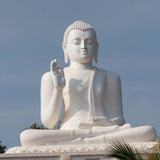
Forwarded from Words of the Buddha
Have a lot of compassion; have a lot of empathy. Develop patience, equanimity, goodwill, kindness, and learn to be wise. That teaching on the discernment of arising and passing away applies very much to the happiness we have in this round of rebirth. When people die, you have to remind yourself: When does it ever happen that people who are born don’t die? Their arising holds the seeds for their passing away. You’ve got to be prepared for that. The more you prepare yourself, the less you’re going to suffer. Which means that you have to find something inside that you’re going to feed on when the food of relationships is either taken away from you or turns spoiled. You want to have something deep inside that you can fall back on.
This is why meditation is such an important part of the training. In the Buddha’s denoscriptions of the path to the end of suffering, concentration lies at the heart. You may have noticed in the chant that describes the different factors of the path, the section on right concentration is the longest, because it’s the most complex and the hardest to master. But it’s also the most important, after right view.
So try to have this as your fallback, as part of that truth of the management of suffering. That way, you’ll be prepared when looking for happiness in areas where there’s going to be disappointment so that the disappointment doesn’t weigh you down.
This piece was excerpted and adapted from a dhamma talk given on March 19, 2025, originally noscriptd “The Management of Suffering.”
===
Thanissaro Bhikkhu is an American Theravada Buddhist monk trained in the Thai forest tradition. Thanissaro Bhikkhu’s talks, writings, and translations are all freely available at his website:
www.dhammatalks.org
===
Part 1 of 2:
https://news.1rj.ru/str/dhammapadas/3354
Part 2 of 2:
https://news.1rj.ru/str/wordsofbuddha/4684
===
Words of the Buddha channel:
https://news.1rj.ru/str/wordsofbuddha
===
This is why meditation is such an important part of the training. In the Buddha’s denoscriptions of the path to the end of suffering, concentration lies at the heart. You may have noticed in the chant that describes the different factors of the path, the section on right concentration is the longest, because it’s the most complex and the hardest to master. But it’s also the most important, after right view.
So try to have this as your fallback, as part of that truth of the management of suffering. That way, you’ll be prepared when looking for happiness in areas where there’s going to be disappointment so that the disappointment doesn’t weigh you down.
This piece was excerpted and adapted from a dhamma talk given on March 19, 2025, originally noscriptd “The Management of Suffering.”
===
Thanissaro Bhikkhu is an American Theravada Buddhist monk trained in the Thai forest tradition. Thanissaro Bhikkhu’s talks, writings, and translations are all freely available at his website:
www.dhammatalks.org
===
Part 1 of 2:
https://news.1rj.ru/str/dhammapadas/3354
Part 2 of 2:
https://news.1rj.ru/str/wordsofbuddha/4684
===
Words of the Buddha channel:
https://news.1rj.ru/str/wordsofbuddha
===
Telegram
Words of the Buddha
Daily teachings of Buddha Dharma
🤝1🆒1
10. Yo appaduññhassa narassa dussati
suddhassa posassa anaïganassa
Tam eva bàlam pacceti pàpam
sukhumo rajo pañivàtam' va khitto. 125.
WHO HARMS THE INNOCENT COMES TO GRIEF
10. Whoever harms a harmless person, one pure and guiltless, upon that very fool the evil recoils like fine dust thrown against the wind. 125.
Story
A hunter went hunting with his dogs. On the way he met a monk. The hunter could not bag any game. While returning he met the same monk. He thought that his failure to bag any game was due to having met the monk. So he set his dogs upon him. The innocent monk climbed a tree to save himself. The hunter pierced his soles with his arrows. As the monk was struggling in pain his robe fell upon the hunter, covering him. The dogs; thinking that it was the monk that had fallen, bit him to death. The monk approached the Buddha and wished to know whether he had done any wrong. The Buddha cleared his doubts and described the evil consequences that accrue to one who harms an innocent person.
===
Vajrayana Tantrayana Buddhism channel:
https://news.1rj.ru/str/tantrayanabuddhism
Tibetan Buddhism - Vajrayana, Tantrayana and esoteric Buddhism channel:
https://news.1rj.ru/str/tibetanbuddha
===
suddhassa posassa anaïganassa
Tam eva bàlam pacceti pàpam
sukhumo rajo pañivàtam' va khitto. 125.
WHO HARMS THE INNOCENT COMES TO GRIEF
10. Whoever harms a harmless person, one pure and guiltless, upon that very fool the evil recoils like fine dust thrown against the wind. 125.
Story
A hunter went hunting with his dogs. On the way he met a monk. The hunter could not bag any game. While returning he met the same monk. He thought that his failure to bag any game was due to having met the monk. So he set his dogs upon him. The innocent monk climbed a tree to save himself. The hunter pierced his soles with his arrows. As the monk was struggling in pain his robe fell upon the hunter, covering him. The dogs; thinking that it was the monk that had fallen, bit him to death. The monk approached the Buddha and wished to know whether he had done any wrong. The Buddha cleared his doubts and described the evil consequences that accrue to one who harms an innocent person.
===
Vajrayana Tantrayana Buddhism channel:
https://news.1rj.ru/str/tantrayanabuddhism
Tibetan Buddhism - Vajrayana, Tantrayana and esoteric Buddhism channel:
https://news.1rj.ru/str/tibetanbuddha
===
Telegram
Vajrayana Tantrayana Buddhism
Buddha teachings from the Vajrayana, esoteric, secret or Tantrayana vehicle
❤1🏆1
Forwarded from Buddha
Dhammapada Verses 54 and 55
Anandattherapanha Vatthu
Na pupphagandho pativatameti
na candanam tagara mallika va
satanca gandho pativatameti
sabba disa sappuriso pavayati.
Cadanam tagaram vapi
uppalam atha vassiki
etesam gandhajatanam
silagandho anuttaro.
Verse 54: The scent of flowers cannot go against the wind; nor the scent of sandalwood, nor of rhododendron (tagara), nor of jasmin (mallika); only the reputation of good people can go against the wind. The reputation of the virtuous ones (sappurisa) is wafted abroad in all directions.
Verse 55: There are the scents of sandalwood, rhododendron, lotus and jasmin (vassika); but the scent of virtue surpasses all scents.
Anandattherapanha Vatthu
Na pupphagandho pativatameti
na candanam tagara mallika va
satanca gandho pativatameti
sabba disa sappuriso pavayati.
Cadanam tagaram vapi
uppalam atha vassiki
etesam gandhajatanam
silagandho anuttaro.
Verse 54: The scent of flowers cannot go against the wind; nor the scent of sandalwood, nor of rhododendron (tagara), nor of jasmin (mallika); only the reputation of good people can go against the wind. The reputation of the virtuous ones (sappurisa) is wafted abroad in all directions.
Verse 55: There are the scents of sandalwood, rhododendron, lotus and jasmin (vassika); but the scent of virtue surpasses all scents.
🙏2🥰1👌1
Forwarded from Words of the Buddha
Free Buddha Dharma ebook
KAMMA VIPAKA
By Ven. Ridiyagama Sudhammabhivaṃsa Translated by Ven. Silagama Nanasiri
Free download here:
https://ftp.budaedu.org/ebooks/pdf/EN470.pdf
===
KAMMA VIPAKA
By Ven. Ridiyagama Sudhammabhivaṃsa Translated by Ven. Silagama Nanasiri
Free download here:
https://ftp.budaedu.org/ebooks/pdf/EN470.pdf
===
👍2👌1
Forwarded from Words of the Buddha
Free Buddha Dharma ebook
KAMMA VIPAKA
By Ven. Ridiyagama Sudhammabhivaṃsa Translated by Ven. Silagama Manasiri
Kamma Vipāka is an informative guide on the nature, maturation, and ethical implications of kamma in Buddhism—highlighting both its power over existence and the mindful path to liberation.
Ultimate Responsibility: Every individual creates their own destiny through intentional actions—“Beings are heirs of their deeds.”
Complex Maturation: Kamma doesn’t ripen predictably; it arises through multi-layered processes across lifetimes.
Ethical Compass Over Fatalism: Teachings encourage mindful moral conduct without clinging to outcomes—emphasizing the Noble Eightfold Path rather than speculative vipaka.
Free download here:
https://ftp.budaedu.org/ebooks/pdf/EN470.pdf
===
KAMMA VIPAKA
By Ven. Ridiyagama Sudhammabhivaṃsa Translated by Ven. Silagama Manasiri
Kamma Vipāka is an informative guide on the nature, maturation, and ethical implications of kamma in Buddhism—highlighting both its power over existence and the mindful path to liberation.
Ultimate Responsibility: Every individual creates their own destiny through intentional actions—“Beings are heirs of their deeds.”
Complex Maturation: Kamma doesn’t ripen predictably; it arises through multi-layered processes across lifetimes.
Ethical Compass Over Fatalism: Teachings encourage mindful moral conduct without clinging to outcomes—emphasizing the Noble Eightfold Path rather than speculative vipaka.
Free download here:
https://ftp.budaedu.org/ebooks/pdf/EN470.pdf
===
🫡1🆒1
11. Gabbham eke uppajjanti
nirayam pàpakammino
Saggam sugatino yanti
parinibbanti anàsavà. 126.
BIRTH DEPENDS ON ACTIONS
11. Some are born 8 in a womb; evil-doers (are born) in woeful states; 9 the well-conducted go to blissful states; 10 the Undefiled Ones 11 pass away into Nibbàna. 126.
Story
Daily a monk used to visit the house of a lapidary, whose wife prepared alms for him. One day in the presence of the monk a bird that was being reared in the house swallowed a gem when the lapidary had gone inside. The lapidary, not finding the gem, inquired about it of the monk, who denied having taken it. But the lapidary, suspected the monk and mercilessly tortured him. Blood flowed from his body. The bird came to drink the blood. The lapidary kicked the bird and it died. Then the monk revealed what had happened. The lapidary ripped up the stomach of the bird and discovered the gem. He begged pardon from the monk. When the monks inquired the Buddha stated that actions determine birth.
===
Words of the Buddha channel:
https://news.1rj.ru/str/wordsofbuddha
===
nirayam pàpakammino
Saggam sugatino yanti
parinibbanti anàsavà. 126.
BIRTH DEPENDS ON ACTIONS
11. Some are born 8 in a womb; evil-doers (are born) in woeful states; 9 the well-conducted go to blissful states; 10 the Undefiled Ones 11 pass away into Nibbàna. 126.
Story
Daily a monk used to visit the house of a lapidary, whose wife prepared alms for him. One day in the presence of the monk a bird that was being reared in the house swallowed a gem when the lapidary had gone inside. The lapidary, not finding the gem, inquired about it of the monk, who denied having taken it. But the lapidary, suspected the monk and mercilessly tortured him. Blood flowed from his body. The bird came to drink the blood. The lapidary kicked the bird and it died. Then the monk revealed what had happened. The lapidary ripped up the stomach of the bird and discovered the gem. He begged pardon from the monk. When the monks inquired the Buddha stated that actions determine birth.
===
Words of the Buddha channel:
https://news.1rj.ru/str/wordsofbuddha
===
Telegram
Words of the Buddha
Daily teachings of Buddha Dharma
❤1🫡1
Forwarded from Buddha
When you’ve given up five mental obstacles, and expelled all corruptions, and cut off affection and hate, being independent, live alone like a horned rhino.
When you’ve put pleasure and pain behind you, and former happiness and sadness, and gained equanimity serene and pure, live alone like a horned rhino.
Not neglecting retreat and absorption, always living in line with the teachings, comprehending the danger in rebirths, live alone like a horned rhino.
One whose aim is the ending of craving—diligent, clever, learned, mindful, resolute—who has appraised the teaching and is bound for awakening, should live alone like a horned rhino.
Partial excepts from Snp 1.3 : Khaggavisāṇasutta
===
When you’ve put pleasure and pain behind you, and former happiness and sadness, and gained equanimity serene and pure, live alone like a horned rhino.
Not neglecting retreat and absorption, always living in line with the teachings, comprehending the danger in rebirths, live alone like a horned rhino.
One whose aim is the ending of craving—diligent, clever, learned, mindful, resolute—who has appraised the teaching and is bound for awakening, should live alone like a horned rhino.
Partial excepts from Snp 1.3 : Khaggavisāṇasutta
===
❤1👏1👌1🕊1
Forwarded from Buddha Dharma books
Free Buddha Dharma ebook
The Sublime Attitudes
A Study Guide on the Brahmaviharas
By Thanissaro Bhikkhu
Free download here:
https://www.lotuslibrary.com/wp-content/uploads/2024/12/2041-sublim-attitudes_Thanissaro.pdf
===
The Sublime Attitudes
A Study Guide on the Brahmaviharas
By Thanissaro Bhikkhu
Free download here:
https://www.lotuslibrary.com/wp-content/uploads/2024/12/2041-sublim-attitudes_Thanissaro.pdf
===
👍1👌1
Forwarded from Buddha Dharma books
Free Buddha Dharma ebook
The Sublime Attitudes
A Study Guide on the Brahmaviharas
By Thanissaro Bhikkhu
The sublime attitudes (brahmavihāras) are the Buddha’s primary heart teachings—the ones that connect most directly with our desire for true happiness. They’re the qualities of heart that motivated the Buddha to find awakening and then to teach the path of awakening to others. At the same time, they function as part of the path itself. This means that the wisdom of the Buddha’s teachings—its “head” aspect—has to be understood in terms of these heart qualities. At the same time, though, these heart qualities have to be understood in terms of the “head” teachings on how cause and effect, in our actions, can bring about genuine happiness. Only when head and heart are brought together in this way can the path yield its full results.
Free download here:
https://www.lotuslibrary.com/wp-content/uploads/2024/12/2041-sublim-attitudes_Thanissaro.pdf
===
The Sublime Attitudes
A Study Guide on the Brahmaviharas
By Thanissaro Bhikkhu
The sublime attitudes (brahmavihāras) are the Buddha’s primary heart teachings—the ones that connect most directly with our desire for true happiness. They’re the qualities of heart that motivated the Buddha to find awakening and then to teach the path of awakening to others. At the same time, they function as part of the path itself. This means that the wisdom of the Buddha’s teachings—its “head” aspect—has to be understood in terms of these heart qualities. At the same time, though, these heart qualities have to be understood in terms of the “head” teachings on how cause and effect, in our actions, can bring about genuine happiness. Only when head and heart are brought together in this way can the path yield its full results.
Free download here:
https://www.lotuslibrary.com/wp-content/uploads/2024/12/2041-sublim-attitudes_Thanissaro.pdf
===
❤1😘1
12. Na antaëikkhe na samuddamajjhe
na pabbatànam vivaram pavissa
Na vijjati so jagatippadeso
yatthaññhito muñceyya pàpakammà. 127.
NOBODY IS EXEMPT FROM THE EFFECTS OF EVIL KAMMA
12. Not in the sky, nor in mid-ocean, nor in a mountain cave, is found that place on earth where abiding one may escape from (the consequences) of one's evil deed. 12 127.
Story
Three groups of monks went to see the Buddha. On their way one group saw a flying crow being burnt to death. Another group saw a woman being drowned in mid-ocean. The other group saw seven monks imprisoned in a cave for seven days. All of them wanted to know from the Buddha the reason for these occurrences. The Buddha related that the crow, as a farmer in a previous birth, had burnt a lazy ox to death, the woman had drowned a dog, and the monks, as cowherds in a previous life, had imprisoned an iguana in an anthill for seven days. The Buddha added that no one is exempt from the consequences of his or her past evil deeds.
===
Dhammapada, beloved and favorite teachings of the Buddha channel:
https://news.1rj.ru/str/dhammapadas
===
na pabbatànam vivaram pavissa
Na vijjati so jagatippadeso
yatthaññhito muñceyya pàpakammà. 127.
NOBODY IS EXEMPT FROM THE EFFECTS OF EVIL KAMMA
12. Not in the sky, nor in mid-ocean, nor in a mountain cave, is found that place on earth where abiding one may escape from (the consequences) of one's evil deed. 12 127.
Story
Three groups of monks went to see the Buddha. On their way one group saw a flying crow being burnt to death. Another group saw a woman being drowned in mid-ocean. The other group saw seven monks imprisoned in a cave for seven days. All of them wanted to know from the Buddha the reason for these occurrences. The Buddha related that the crow, as a farmer in a previous birth, had burnt a lazy ox to death, the woman had drowned a dog, and the monks, as cowherds in a previous life, had imprisoned an iguana in an anthill for seven days. The Buddha added that no one is exempt from the consequences of his or her past evil deeds.
===
Dhammapada, beloved and favorite teachings of the Buddha channel:
https://news.1rj.ru/str/dhammapadas
===
Telegram
Dhammapada - Buddha Dharma Teachings
Daily teachings of the Dhammapada, beloved and favorite teachings of the Buddha
🙏1😇1
Forwarded from Buddha
So I have heard. At one time the Buddha was staying near Sāvatthī in Jeta’s Grove, Anāthapiṇḍika’s monastery. The Buddha said this:
“There are 32 marks of a great man. A great man who possesses these has only two possible destinies, no other. If he stays at home he becomes a king, a wheel-turning monarch, a just and principled king. [...] He has the following seven treasures: the wheel, the elephant, the horse, the jewel, the woman, the householder, and the commander as the seventh treasure. He has over a thousand sons who are valiant and heroic, crushing the armies of his enemies. After conquering this land girt by sea, he reigns by principle, without rod or sword. But if he goes forth from the lay life to homelessness, he becomes a perfected one, a fully awakened Buddha, who draws back the veil from the world.
And what are the 32 marks?
He is golden colored; his skin shines like lustrous gold.
Partial excerpts from DN 30 : Lakkhanasutta : Marks of a Great Man
“There are 32 marks of a great man. A great man who possesses these has only two possible destinies, no other. If he stays at home he becomes a king, a wheel-turning monarch, a just and principled king. [...] He has the following seven treasures: the wheel, the elephant, the horse, the jewel, the woman, the householder, and the commander as the seventh treasure. He has over a thousand sons who are valiant and heroic, crushing the armies of his enemies. After conquering this land girt by sea, he reigns by principle, without rod or sword. But if he goes forth from the lay life to homelessness, he becomes a perfected one, a fully awakened Buddha, who draws back the veil from the world.
And what are the 32 marks?
He is golden colored; his skin shines like lustrous gold.
Partial excerpts from DN 30 : Lakkhanasutta : Marks of a Great Man
👏1🏆1
Forwarded from Buddha
Free Buddhism ebook
The Only Way for the Realization of Nibbana
By Pa-Auk Tawya Sayadaw
The only way, bhikkhus, is this path, for beings' purification, for sorrow and lamentation's overcoming, for pain and displeasure's disappearance, for the true way's attainment, for Nibbāna's realization: that is, the four foundations of mindfulness(cattāro sati∙paṭṭhānā).
'Mahā∙Sati∙Paṭṭhāna∙Suttaṃ' ('The Great Mindfulness-Foundation Sutta')
In The Only Way for the Realization of Nibbāna, the Most Venerable Sayadaw gives a brief summary of the practice necessary for such realization, namely samatha and vipassanā. He bases his discussion on the first section of the ‘Mahā∙Sati∙Paṭṭhāṇa Sutta’, the in&out-breath section of ‘The Great Mindfulness-Foundation Sutta’.
Free download here:
https://drive.google.com/open?id=0B7p0UB1QfBmvS3ZaSzdEOE1Vdnc
===
The Only Way for the Realization of Nibbana
By Pa-Auk Tawya Sayadaw
The only way, bhikkhus, is this path, for beings' purification, for sorrow and lamentation's overcoming, for pain and displeasure's disappearance, for the true way's attainment, for Nibbāna's realization: that is, the four foundations of mindfulness(cattāro sati∙paṭṭhānā).
'Mahā∙Sati∙Paṭṭhāna∙Suttaṃ' ('The Great Mindfulness-Foundation Sutta')
In The Only Way for the Realization of Nibbāna, the Most Venerable Sayadaw gives a brief summary of the practice necessary for such realization, namely samatha and vipassanā. He bases his discussion on the first section of the ‘Mahā∙Sati∙Paṭṭhāṇa Sutta’, the in&out-breath section of ‘The Great Mindfulness-Foundation Sutta’.
Free download here:
https://drive.google.com/open?id=0B7p0UB1QfBmvS3ZaSzdEOE1Vdnc
===
❤1🆒1
Forwarded from Buddha
Free Buddhism ebook
The Only Way for the Realization of Nibbana
By Pa-Auk Tawya Sayadaw
The only way, bhikkhus, is this path, for beings' purification, for sorrow and lamentation's overcoming, for pain and displeasure's disappearance, for the true way's attainment, for Nibbāna's realization: that is, the four foundations of mindfulness(cattāro sati∙paṭṭhānā).
'Mahā∙Sati∙Paṭṭhāna∙Suttaṃ' ('The Great Mindfulness-Foundation Sutta')
In The Only Way for the Realization of Nibbāna, the Most Venerable Sayadaw gives a brief summary of the practice necessary for such realization, namely samatha and vipassanā. He bases his discussion on the first section of the ‘Mahā∙Sati∙Paṭṭhāṇa Sutta’, the in&out-breath section of ‘The Great Mindfulness-Foundation Sutta’.
Free download here:
https://drive.google.com/open?id=0B7p0UB1QfBmvS3ZaSzdEOE1Vdnc
===
The Only Way for the Realization of Nibbana
By Pa-Auk Tawya Sayadaw
The only way, bhikkhus, is this path, for beings' purification, for sorrow and lamentation's overcoming, for pain and displeasure's disappearance, for the true way's attainment, for Nibbāna's realization: that is, the four foundations of mindfulness(cattāro sati∙paṭṭhānā).
'Mahā∙Sati∙Paṭṭhāna∙Suttaṃ' ('The Great Mindfulness-Foundation Sutta')
In The Only Way for the Realization of Nibbāna, the Most Venerable Sayadaw gives a brief summary of the practice necessary for such realization, namely samatha and vipassanā. He bases his discussion on the first section of the ‘Mahā∙Sati∙Paṭṭhāṇa Sutta’, the in&out-breath section of ‘The Great Mindfulness-Foundation Sutta’.
Free download here:
https://drive.google.com/open?id=0B7p0UB1QfBmvS3ZaSzdEOE1Vdnc
===
👌1😘1