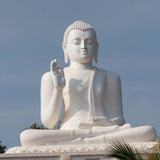
“Mendicants, in some past lives the Realized One was reborn as a human being. ... Due to performing those deeds he was reborn in a heavenly realm. When he came back to this place he obtained this mark: he is golden colored; his skin shines like lustrous gold.
On this it is said:
“Fixated on good will, he gave gifts. In an earlier life he poured forth cloth fine and soft to touch, like a god pouring rain on this broad earth.
So doing he passed from here to heaven, where he enjoyed the fruits of deeds well done. Here he wins a figure shining like honey-yellow gold, like Indra, the finest of gods.
If that man stays in the house, not wishing to go forth, he conquers and rules this vast, broad earth. He obtains abundant excellent cloth, so fine and soft to touch.
He receives robes, cloth, and the finest garments. if he chooses the life gone forth. For he still partakes of past deed’s fruit; what’s been done is never lost.”
Partial excerpts from DN 30 : Pathikavagga
On this it is said:
“Fixated on good will, he gave gifts. In an earlier life he poured forth cloth fine and soft to touch, like a god pouring rain on this broad earth.
So doing he passed from here to heaven, where he enjoyed the fruits of deeds well done. Here he wins a figure shining like honey-yellow gold, like Indra, the finest of gods.
If that man stays in the house, not wishing to go forth, he conquers and rules this vast, broad earth. He obtains abundant excellent cloth, so fine and soft to touch.
He receives robes, cloth, and the finest garments. if he chooses the life gone forth. For he still partakes of past deed’s fruit; what’s been done is never lost.”
Partial excerpts from DN 30 : Pathikavagga
🙏1😇1🫡1
7. Màvamaññetha puññassa
na mam tam àgamissati.
Udabindunipàtena
udakumbho' pi purati
Purati dhãro puññassa
thokathokam pi àcinam. 122.
THINK NOT LIGHTLY OF GOOD
7. Do not disregard merit, saying "It will not come nigh unto me"; by the falling of drops even a water-jar is filled; likewise the wise man, gathering little by little, fills himself with good. 122.
Story
A wise man, hearing the Buddha preach on the giving of alms, induced a whole village to give alms to the Buddha and the Sangha according to their means. When he went collecting provisions a rich man, misconstruing his motive, contributed a very small amount. While thanks were being offered to the various donors the rich man went there with the object of killing the wise man if he should speak disparagingly of him. The wise man on the contrary thanked all equally and wished them a great reward. The rich man felt remorse and sought his pardon.
Hearing the story, the Buddha discoursed on the value of even a small gift.
===
Vajrayana Tantrayana Buddhism channel:
https://news.1rj.ru/str/tantrayanabuddhism
Tibetan Buddhism - Vajrayana, Tantrayana and esoteric Buddhism channel:
https://news.1rj.ru/str/tibetanbuddha
===
na mam tam àgamissati.
Udabindunipàtena
udakumbho' pi purati
Purati dhãro puññassa
thokathokam pi àcinam. 122.
THINK NOT LIGHTLY OF GOOD
7. Do not disregard merit, saying "It will not come nigh unto me"; by the falling of drops even a water-jar is filled; likewise the wise man, gathering little by little, fills himself with good. 122.
Story
A wise man, hearing the Buddha preach on the giving of alms, induced a whole village to give alms to the Buddha and the Sangha according to their means. When he went collecting provisions a rich man, misconstruing his motive, contributed a very small amount. While thanks were being offered to the various donors the rich man went there with the object of killing the wise man if he should speak disparagingly of him. The wise man on the contrary thanked all equally and wished them a great reward. The rich man felt remorse and sought his pardon.
Hearing the story, the Buddha discoursed on the value of even a small gift.
===
Vajrayana Tantrayana Buddhism channel:
https://news.1rj.ru/str/tantrayanabuddhism
Tibetan Buddhism - Vajrayana, Tantrayana and esoteric Buddhism channel:
https://news.1rj.ru/str/tibetanbuddha
===
Telegram
Vajrayana Tantrayana Buddhism
Buddha teachings from the Vajrayana, esoteric, secret or Tantrayana vehicle
👏1🏆1
Forwarded from Words of the Buddha
Listening to Our Ancestors
Three practices for listening mindfully—to ourselves and others
Thich Nhat Hanh
Part 1 of 2
Listening deeply to another is a form of meditation. We follow our breathing and practice concentration, and we learn things about the other person that we never knew before. When we practice deep listening, we can help the person we’re listening to remove the perceptions that are making them suffer. We can restore harmony in our partnerships, our friendships, our family, our community, our nation, and between nations. It is that powerful.
Before we can listen to another person well, we need to spend time listening to ourselves. Sometimes when we attempt to listen to someone else, we can’t hear what they are saying at all because our own strong emotions and thoughts are too loud in us, crying out for our attention. We should be able to sit with ourselves, come home to ourselves, and listen to what emotions are rising up without judging or interrupting them. We can listen to whatever thoughts come up as well and then let them pass without holding on to them. When we’ve spent some time listening to ourselves, we can listen to those around us.
When we listen deeply to ourselves, we can understand ourselves, accept ourselves, love ourselves, and start to touch peace. Perhaps we have not yet accepted ourselves because we don’t understand who we are; we don’t know how to listen to our own suffering. So, we must first of all practice listening to our own suffering. We must be with it, feel it, and embrace it in order to understand it and allow it to gradually transform. Perhaps our own suffering carries within it the suffering of our father, our mother, the whole line of our ancestors, or a whole country. Listening to ourselves, we can understand our suffering—the suffering of our ancestors, our father, and our mother—and we feel a sense of release.
When we’ve spent some time listening to ourselves, we can listen to those around us.
When we stop the busyness of the mind and come back to ourselves, our suffering can seem very intense. This is because we are so used to ignoring it and distracting ourselves from the pain. With distractions, we may succeed in numbing ourselves for a little while, but the suffering inside wants our attention, and it will fester and churn away until it gets it. That’s why the first practice is to stop running, come home to our bodies, and recognize our feelings of suffering—our anger, our anxiety, our fear. Suffering is one energy. Mindfulness is another energy that we can call on to embrace the suffering. The function of mindfulness is first to recognize the suffering and then to embrace it.
The practice is not to fight or suppress the feeling but rather to cradle it with tenderness.
When a mother embraces her child—even if she doesn’t understand at first why the child is suffering—that energy of tenderness can already bring relief. If we can recognize and cradle the suffering while we breathe mindfully, there is relief already.
Your suffering is trying to get your attention, to tell you something, and now you can take the opportunity to listen.
Three Practices for Listening
Listening to the Bell
Sometimes we need a sound to remind us to return to our conscious breathing. We call these sounds “bells of mindfulness.” In Plum Village and the other practice centers in my tradition, we stop and listen whenever we hear the telephone ringing, the clock chiming, or the monastery bell sounding. These are our bells of mindfulness. When we hear the sound of the bell, we stop talking and stop moving. We relax our body and become aware of our breathing. We do it naturally, with enjoyment, and without solemnity or stiffness. When we stop to breathe and restore our calm and our peace, we become free, our work becomes more enjoyable, and the friend in front of us becomes more real.
Sometimes our bodies may be home, but we’re not truly home. Our mind is elsewhere.
Three practices for listening mindfully—to ourselves and others
Thich Nhat Hanh
Part 1 of 2
Listening deeply to another is a form of meditation. We follow our breathing and practice concentration, and we learn things about the other person that we never knew before. When we practice deep listening, we can help the person we’re listening to remove the perceptions that are making them suffer. We can restore harmony in our partnerships, our friendships, our family, our community, our nation, and between nations. It is that powerful.
Before we can listen to another person well, we need to spend time listening to ourselves. Sometimes when we attempt to listen to someone else, we can’t hear what they are saying at all because our own strong emotions and thoughts are too loud in us, crying out for our attention. We should be able to sit with ourselves, come home to ourselves, and listen to what emotions are rising up without judging or interrupting them. We can listen to whatever thoughts come up as well and then let them pass without holding on to them. When we’ve spent some time listening to ourselves, we can listen to those around us.
When we listen deeply to ourselves, we can understand ourselves, accept ourselves, love ourselves, and start to touch peace. Perhaps we have not yet accepted ourselves because we don’t understand who we are; we don’t know how to listen to our own suffering. So, we must first of all practice listening to our own suffering. We must be with it, feel it, and embrace it in order to understand it and allow it to gradually transform. Perhaps our own suffering carries within it the suffering of our father, our mother, the whole line of our ancestors, or a whole country. Listening to ourselves, we can understand our suffering—the suffering of our ancestors, our father, and our mother—and we feel a sense of release.
When we’ve spent some time listening to ourselves, we can listen to those around us.
When we stop the busyness of the mind and come back to ourselves, our suffering can seem very intense. This is because we are so used to ignoring it and distracting ourselves from the pain. With distractions, we may succeed in numbing ourselves for a little while, but the suffering inside wants our attention, and it will fester and churn away until it gets it. That’s why the first practice is to stop running, come home to our bodies, and recognize our feelings of suffering—our anger, our anxiety, our fear. Suffering is one energy. Mindfulness is another energy that we can call on to embrace the suffering. The function of mindfulness is first to recognize the suffering and then to embrace it.
The practice is not to fight or suppress the feeling but rather to cradle it with tenderness.
When a mother embraces her child—even if she doesn’t understand at first why the child is suffering—that energy of tenderness can already bring relief. If we can recognize and cradle the suffering while we breathe mindfully, there is relief already.
Your suffering is trying to get your attention, to tell you something, and now you can take the opportunity to listen.
Three Practices for Listening
Listening to the Bell
Sometimes we need a sound to remind us to return to our conscious breathing. We call these sounds “bells of mindfulness.” In Plum Village and the other practice centers in my tradition, we stop and listen whenever we hear the telephone ringing, the clock chiming, or the monastery bell sounding. These are our bells of mindfulness. When we hear the sound of the bell, we stop talking and stop moving. We relax our body and become aware of our breathing. We do it naturally, with enjoyment, and without solemnity or stiffness. When we stop to breathe and restore our calm and our peace, we become free, our work becomes more enjoyable, and the friend in front of us becomes more real.
Sometimes our bodies may be home, but we’re not truly home. Our mind is elsewhere.
Telegram
Words of the Buddha
Daily teachings of Buddha Dharma
🤗1🆒1
Forwarded from Words of the Buddha
The bell can help bring the mind back to the body. Because the bell can help us to go back to ourselves, back to the present moment, we consider the bell to be like a bodhisattva, a friend that helps us to wake up to ourselves again. With just three conscious breaths, we can release the tension in our body and mind and return to a cool, clear state of being.
The sound of the bell is the voice of the Buddha calling you back to yourself, back to the present moment, to your true home.
In our tradition, we don’t say “striking” the bell; we say, “inviting the bell to sound.” The person who invites the bell is the bell master. We call the wooden stick that invites the bell, “the inviter.” There are many kinds of bells: big bells that can be heard by the whole village or neighborhood; smaller bells that announce activities and can be heard all over the practice center; the bowl bell in the meditation hall that helps us with the practice of breathing and sitting; and the mini bell, a pocket-sized bell that we can bring along wherever we go.
===
Words of the Buddha channel:
https://news.1rj.ru/str/wordsofbuddha
===
The sound of the bell is the voice of the Buddha calling you back to yourself, back to the present moment, to your true home.
In our tradition, we don’t say “striking” the bell; we say, “inviting the bell to sound.” The person who invites the bell is the bell master. We call the wooden stick that invites the bell, “the inviter.” There are many kinds of bells: big bells that can be heard by the whole village or neighborhood; smaller bells that announce activities and can be heard all over the practice center; the bowl bell in the meditation hall that helps us with the practice of breathing and sitting; and the mini bell, a pocket-sized bell that we can bring along wherever we go.
===
Words of the Buddha channel:
https://news.1rj.ru/str/wordsofbuddha
===
Telegram
Words of the Buddha
Daily teachings of Buddha Dharma
🙏1😍1
Forwarded from Buddha Dharma books
Free Buddha Dharma ebook
Is it Really Possible to Transfer of Merit?
The transference of merit is the belief that it is possible to do good and then ‘transfer’ the kammic result (vipāka) of that good to a person who has passed away. This belief is current in all countries where Theravada prevails, is almost universally believed but clearly and seriously contradicts the Buddha’s teachings.
By Bhante Shravasti Dhammika
Free download available:
https://budblooms.org/is-it-really-possible-to-transfer-of-merit/
===
Is it Really Possible to Transfer of Merit?
The transference of merit is the belief that it is possible to do good and then ‘transfer’ the kammic result (vipāka) of that good to a person who has passed away. This belief is current in all countries where Theravada prevails, is almost universally believed but clearly and seriously contradicts the Buddha’s teachings.
By Bhante Shravasti Dhammika
Free download available:
https://budblooms.org/is-it-really-possible-to-transfer-of-merit/
===
👍1🤝1
Forwarded from Buddha Dharma books
Free Buddha Dharma ebook
Is it Really Possible to Transfer of Merit?
The transference of merit is the belief that it is possible to do good and then ‘transfer’ the kammic result (vipāka) of that good to a person who has passed away. This belief is current in all countries where Theravada prevails, is almost universally believed but clearly and seriously contradicts the Buddha’s teachings.
By Bhante Shravasti Dhammika
Free download available:
https://budblooms.org/is-it-really-possible-to-transfer-of-merit/
===
Is it Really Possible to Transfer of Merit?
The transference of merit is the belief that it is possible to do good and then ‘transfer’ the kammic result (vipāka) of that good to a person who has passed away. This belief is current in all countries where Theravada prevails, is almost universally believed but clearly and seriously contradicts the Buddha’s teachings.
By Bhante Shravasti Dhammika
Free download available:
https://budblooms.org/is-it-really-possible-to-transfer-of-merit/
===
👏1👌1
Forwarded from Buddha
Listening to Our Ancestors
Three practices for listening mindfully—to ourselves and others
Thich Nhat Hanh
Part 2 of 2
Inviting the bell to sound, you breathe in and out deeply three times. If you enjoy breathing in and enjoy breathing out, then after three in-breaths and three out-breaths you become relaxed, calm, serene, mindful. You can recite this poem to yourself as you breathe in and out:
Listen, listen.
This wonderful sound brings me back to my true home.
“Listen, listen” means listen with all your heart when you breathe in. “My true home” is life, with all its wonders that are available in the here and the now. If you practice well, the Kingdom of God and the Pure Land of the Buddha will be available whenever you go home to yourself with the sound of the bell.
If we’re solid, awake, free, and mindful, then the sound of the bell that we offer can help people touch what is deepest within them.
Body, speech, and mind in perfect oneness,
I send my heart along with the sound of this bell.
May the hearers awaken from forgetfulness and transcend the path of anxiety and sorrow.
The sound of the bell is the voice of the Buddha calling you back to yourself, back to the present moment, to your true home. Every time you hear it, you touch the buddhanature within you. We take refuge in the present moment, in the island of self. We become more solid, more stable, and suffer less right away.
Listening to Our Inner Child
When we speak of listening with compassion, we usually think of listening to someone else. But we must also listen to the wounded child inside of us. Sometimes the wounded child in us needs all our attention. That little child might emerge from the depths of your consciousness and ask for your attention. If you are mindful, you will hear their voice calling for help. At that moment, instead of paying attention to whatever is in front of you, find a quiet place to go back and tenderly embrace the wounded child. You can talk directly to the child with the language of love, saying, “In the past, I left you alone. I went away from you. Now, I am very sorry. I am going to embrace you.”
You can say, “Darling, I am here for you. I will take good care of you. I know that you suffer so much. I have been so busy. I have neglected you, and now I have learned a way to come back to you.” Listen, and if necessary, you can cry together with that child.
Whenever you need to, you can sit and breathe with the child. “Breathing in, I go back to my wounded child; breathing out, I take good care of my wounded child.”
You have to talk to your child several times a day. Only then can healing take place.
Embracing your child tenderly, you reassure him that you will never let him down again or leave him unattended. The little child has been left alone for so long. That is why you need to begin this practice right away.
If you don’t do it now, when will you do it?
Listening to Our Ancestors’ Voices
With practice, we can see that our wounded child is not only us. Our wounded child may represent several generations.
Our mother may have suffered throughout her life. Our father may have suffered.
Perhaps our parents weren’t able to look after the wounded child in themselves. So, when we’re embracing the wounded child in us, we’re embracing all the wounded children of our past generations. This practice is not a practice for ourselves alone but for numberless generations of ancestors and descendants.
Your body needs you, your feelings need you, your perceptions need you. The wounded child in you needs you. Your suffering needs you to listen and acknowledge it. Go home and be there for all these things.
Our ancestors may not have known how to care for their wounded child within, so they transmitted their wounded child to us. Our practice is to end this cycle. The people around us, our family and friends, may also have a severely wounded child inside. If we’ve managed to help ourselves, we can also help them. When we’ve healed ourselves, our relationships with others become much easier.
Three practices for listening mindfully—to ourselves and others
Thich Nhat Hanh
Part 2 of 2
Inviting the bell to sound, you breathe in and out deeply three times. If you enjoy breathing in and enjoy breathing out, then after three in-breaths and three out-breaths you become relaxed, calm, serene, mindful. You can recite this poem to yourself as you breathe in and out:
Listen, listen.
This wonderful sound brings me back to my true home.
“Listen, listen” means listen with all your heart when you breathe in. “My true home” is life, with all its wonders that are available in the here and the now. If you practice well, the Kingdom of God and the Pure Land of the Buddha will be available whenever you go home to yourself with the sound of the bell.
If we’re solid, awake, free, and mindful, then the sound of the bell that we offer can help people touch what is deepest within them.
Body, speech, and mind in perfect oneness,
I send my heart along with the sound of this bell.
May the hearers awaken from forgetfulness and transcend the path of anxiety and sorrow.
The sound of the bell is the voice of the Buddha calling you back to yourself, back to the present moment, to your true home. Every time you hear it, you touch the buddhanature within you. We take refuge in the present moment, in the island of self. We become more solid, more stable, and suffer less right away.
Listening to Our Inner Child
When we speak of listening with compassion, we usually think of listening to someone else. But we must also listen to the wounded child inside of us. Sometimes the wounded child in us needs all our attention. That little child might emerge from the depths of your consciousness and ask for your attention. If you are mindful, you will hear their voice calling for help. At that moment, instead of paying attention to whatever is in front of you, find a quiet place to go back and tenderly embrace the wounded child. You can talk directly to the child with the language of love, saying, “In the past, I left you alone. I went away from you. Now, I am very sorry. I am going to embrace you.”
You can say, “Darling, I am here for you. I will take good care of you. I know that you suffer so much. I have been so busy. I have neglected you, and now I have learned a way to come back to you.” Listen, and if necessary, you can cry together with that child.
Whenever you need to, you can sit and breathe with the child. “Breathing in, I go back to my wounded child; breathing out, I take good care of my wounded child.”
You have to talk to your child several times a day. Only then can healing take place.
Embracing your child tenderly, you reassure him that you will never let him down again or leave him unattended. The little child has been left alone for so long. That is why you need to begin this practice right away.
If you don’t do it now, when will you do it?
Listening to Our Ancestors’ Voices
With practice, we can see that our wounded child is not only us. Our wounded child may represent several generations.
Our mother may have suffered throughout her life. Our father may have suffered.
Perhaps our parents weren’t able to look after the wounded child in themselves. So, when we’re embracing the wounded child in us, we’re embracing all the wounded children of our past generations. This practice is not a practice for ourselves alone but for numberless generations of ancestors and descendants.
Your body needs you, your feelings need you, your perceptions need you. The wounded child in you needs you. Your suffering needs you to listen and acknowledge it. Go home and be there for all these things.
Our ancestors may not have known how to care for their wounded child within, so they transmitted their wounded child to us. Our practice is to end this cycle. The people around us, our family and friends, may also have a severely wounded child inside. If we’ve managed to help ourselves, we can also help them. When we’ve healed ourselves, our relationships with others become much easier.
Telegram
Buddha
Buddha dharma teachings from the suttas and commentaries
👍1💯1
Forwarded from Buddha
There’s more peace and more love in us.
Go back and take care of yourself. Your body needs you, your feelings need you, your perceptions need you. The wounded child in you needs you. Your suffering needs you to listen and acknowledge it. Go home and be there for all these things. Practice mindful walking and mindful breathing. Do everything in mindfulness so you can really be there, so you can love.
From How to Listen (2024) by Thich Nhat Hanh.
===
Thich Nhat Hanh (1926–2022) was a Vietnamese Buddhist monk, author, and peace activist who was nominated for the Nobel Peace Prize by Martin Luther King Jr. He was a pioneer of engaged Buddhism, founded the Plum Village sangha, and popularized mindfulness around the world. He authored over 100 books, founded nine monasteries and dozens of affiliated dharma centers, and inspired thousands of mindfulness communities. This renowned teacher died on January 22, 2022.
===
Part 1 of 2:
https://news.1rj.ru/str/wordsofbuddha/4778
Part 2 of 2:
https://news.1rj.ru/str/lorddivinebuddha/3894
===
Buddha dharma teachings channel:
https://news.1rj.ru/str/lorddivinebuddha
===
Go back and take care of yourself. Your body needs you, your feelings need you, your perceptions need you. The wounded child in you needs you. Your suffering needs you to listen and acknowledge it. Go home and be there for all these things. Practice mindful walking and mindful breathing. Do everything in mindfulness so you can really be there, so you can love.
From How to Listen (2024) by Thich Nhat Hanh.
===
Thich Nhat Hanh (1926–2022) was a Vietnamese Buddhist monk, author, and peace activist who was nominated for the Nobel Peace Prize by Martin Luther King Jr. He was a pioneer of engaged Buddhism, founded the Plum Village sangha, and popularized mindfulness around the world. He authored over 100 books, founded nine monasteries and dozens of affiliated dharma centers, and inspired thousands of mindfulness communities. This renowned teacher died on January 22, 2022.
===
Part 1 of 2:
https://news.1rj.ru/str/wordsofbuddha/4778
Part 2 of 2:
https://news.1rj.ru/str/lorddivinebuddha/3894
===
Buddha dharma teachings channel:
https://news.1rj.ru/str/lorddivinebuddha
===
Telegram
Buddha
Buddha dharma teachings from the suttas and commentaries
👏1🙏1
8. Vàuijo' va bhayam maggam
appasattho mahaddhano
Visam jãvitukàmo' va
pàpàni parivajjaye. 123.
SHUN EVIL LIKE A PERILOUS PATH
8. Just as a merchant, with a small escort and great wealth, avoids a perilous route, just as one desiring to live avoids poison, even so should one shun evil things. 123.
Story
A merchant, accompanied by many monks, set out with a caravan. Some robbers tried to waylay him but failed in their attempt. The monks left the merchant and went to the Buddha and told Him of the attempt of the robbers. Thereupon the Buddha uttered this verse.
===
Words of the Buddha channel:
https://news.1rj.ru/str/wordsofbuddha
===
appasattho mahaddhano
Visam jãvitukàmo' va
pàpàni parivajjaye. 123.
SHUN EVIL LIKE A PERILOUS PATH
8. Just as a merchant, with a small escort and great wealth, avoids a perilous route, just as one desiring to live avoids poison, even so should one shun evil things. 123.
Story
A merchant, accompanied by many monks, set out with a caravan. Some robbers tried to waylay him but failed in their attempt. The monks left the merchant and went to the Buddha and told Him of the attempt of the robbers. Thereupon the Buddha uttered this verse.
===
Words of the Buddha channel:
https://news.1rj.ru/str/wordsofbuddha
===
Telegram
Words of the Buddha
Daily teachings of Buddha Dharma
🙏2💯1🫡1
“Bhikkhus, all is burning. And what, bhikkhus, is the all that is burning? The eye is burning, forms are burning, eye-consciousness is burning, eye-contact is burning, and whatever feeling arises with eye-contact as condition—whether pleasant or painful or neither-painful-nor-pleasant—that too is burning. Burning with what? Burning with the fire of lust, with the fire of hatred, with the fire of delusion; burning with birth, aging, and death; with sorrow, lamentation, pain, displeasure, and despair, I say.....Experiencing revulsion, he becomes dispassionate. Through dispassion his mind is liberated. When it is liberated there comes the knowledge: ‘It’s liberated.’ He understands: ‘Destroyed is birth, the holy life has been lived, what had to be done has been done, there is no more for this state of being.’”
Partial excerpts from SN 35.28 : Ādittasutta
Partial excerpts from SN 35.28 : Ādittasutta
👏2❤1👌1😇1🤝1
Forwarded from Buddha
Wat Phrathat Pu Jae Buddhist temple near Huai Mae Toek lake in Phrae province, Thailand.
👍1🤩1🙏1😍1
9. Pàuimhi ce vauo n'àssa
hareyya pàuinà visam
Nàbbauam visam anveti
natthi pàpam akubbato. 124.
NO EVIL TO THOSE WHO HAVE NO BAD INTENTION
9. If no wound there be in one's hand, one may carry poison in it. Poison does not affect one who has no wound. There is no ill for him who does no wrong. 7 124.
Story
A rich man's daughter, who was a Stream-Winner, fell in love with a hunter owing to past association, and eloped with him. She gave birth to several sons. The wife, although a Sotàpanna, was in the habit of giving bows and arrows to the husband to go hunting. Amongst the monks a question arose whether she committed an evil by doing so. The Buddha explained that she was blameless as she did so in obedience to her husband and having no evil intention.
===
Dhammapada, beloved and favorite teachings of the Buddha channel:
https://news.1rj.ru/str/dhammapadas
===
hareyya pàuinà visam
Nàbbauam visam anveti
natthi pàpam akubbato. 124.
NO EVIL TO THOSE WHO HAVE NO BAD INTENTION
9. If no wound there be in one's hand, one may carry poison in it. Poison does not affect one who has no wound. There is no ill for him who does no wrong. 7 124.
Story
A rich man's daughter, who was a Stream-Winner, fell in love with a hunter owing to past association, and eloped with him. She gave birth to several sons. The wife, although a Sotàpanna, was in the habit of giving bows and arrows to the husband to go hunting. Amongst the monks a question arose whether she committed an evil by doing so. The Buddha explained that she was blameless as she did so in obedience to her husband and having no evil intention.
===
Dhammapada, beloved and favorite teachings of the Buddha channel:
https://news.1rj.ru/str/dhammapadas
===
Telegram
Dhammapada - Buddha Dharma Teachings
Daily teachings of the Dhammapada, beloved and favorite teachings of the Buddha
👏1🏆1
Forwarded from Buddha
Theravadin monks circumambulate clockwise or Pradakshina around Borobudur temple, Java island, Indonesia.
🙏2🤗1