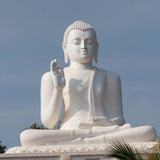
Buddhanussati, one of the four protective meditation, is recollections of the qualities of the Buddha, namely, araham (the perfect one who has eliminated all the defilements, or someone who has reached the state of great purity and perfection), Sammasambuddho (fully enlightened), Vijjacarana-sampanno (impeccable in conduct and understanding), Sugato (well farer), Lokavidu (the knower of the worlds), Anuttaro purisadamma-sarathi (who is unrivalled in taming those who are untamed), Sattha deva-manussanam (teacher of gods and humans), buddho (awake) and bhagava (the Blessed One).
👏1🙏1👌1🫡1
10. Yo appaduññhassa narassa dussati
suddhassa posassa anaïganassa
Tam eva bàlam pacceti pàpam
sukhumo rajo pañivàtam' va khitto. 125.
WHO HARMS THE INNOCENT COMES TO GRIEF
10. Whoever harms a harmless person, one pure and guiltless, upon that very fool the evil recoils like fine dust thrown against the wind. 125.
Story
A hunter went hunting with his dogs. On the way he met a monk. The hunter could not bag any game. While returning he met the same monk. He thought that his failure to bag any game was due to having met the monk. So he set his dogs upon him. The innocent monk climbed a tree to save himself. The hunter pierced his soles with his arrows. As the monk was struggling in pain his robe fell upon the hunter, covering him. The dogs; thinking that it was the monk that had fallen, bit him to death. The monk approached the Buddha and wished to know whether he had done any wrong. The Buddha cleared his doubts and described the evil consequences that accrue to one who harms an innocent person.
===
Buddha dharma teachings channel:
https://invite.viber.com/?g2=AQAKw1y3rv%2F6sk61PI2W4izuIiaEZj8YZujhY1tSzL%2B07s7rFnVFDAd0bAYFaMLw
===
suddhassa posassa anaïganassa
Tam eva bàlam pacceti pàpam
sukhumo rajo pañivàtam' va khitto. 125.
WHO HARMS THE INNOCENT COMES TO GRIEF
10. Whoever harms a harmless person, one pure and guiltless, upon that very fool the evil recoils like fine dust thrown against the wind. 125.
Story
A hunter went hunting with his dogs. On the way he met a monk. The hunter could not bag any game. While returning he met the same monk. He thought that his failure to bag any game was due to having met the monk. So he set his dogs upon him. The innocent monk climbed a tree to save himself. The hunter pierced his soles with his arrows. As the monk was struggling in pain his robe fell upon the hunter, covering him. The dogs; thinking that it was the monk that had fallen, bit him to death. The monk approached the Buddha and wished to know whether he had done any wrong. The Buddha cleared his doubts and described the evil consequences that accrue to one who harms an innocent person.
===
Buddha dharma teachings channel:
https://invite.viber.com/?g2=AQAKw1y3rv%2F6sk61PI2W4izuIiaEZj8YZujhY1tSzL%2B07s7rFnVFDAd0bAYFaMLw
===
Viber
Buddha
Buddha dharma teachings from the suttas and commentaries from Theravada tradition
👏1🙏1💯1
Forwarded from Words of the Buddha
Free Buddha Dharma ebook
The Flavour of Dhamma
By Ajahn Thate Desaransi
Free download available:
https://drive.google.com/file/d/105i8z9Dw2V0LbbCDcm-1mIsd3yxM13OU/view?usp=drive_link
===
The Flavour of Dhamma
By Ajahn Thate Desaransi
Free download available:
https://drive.google.com/file/d/105i8z9Dw2V0LbbCDcm-1mIsd3yxM13OU/view?usp=drive_link
===
👍1🙏1🤗1
Forwarded from Words of the Buddha
Free Buddha Dharma ebook
The Flavour of Dhamma
By Ajahn Thate Desaransi
"The Flavour of Dhamma" refers to the direct, experiential understanding of the Dhamma, which is the Buddhist teaching about the nature of reality. It emphasizes a practical, meditative approach, where one directly experiences the truth of the Buddha's teachings through personal practice. This experience is characterized by a purified mind, free from defilements and the cycle of suffering, ultimately leading to Nibbana (Nirvana).
Free download available:
https://drive.google.com/file/d/105i8z9Dw2V0LbbCDcm-1mIsd3yxM13OU/view?usp=drive_link
===
The Flavour of Dhamma
By Ajahn Thate Desaransi
"The Flavour of Dhamma" refers to the direct, experiential understanding of the Dhamma, which is the Buddhist teaching about the nature of reality. It emphasizes a practical, meditative approach, where one directly experiences the truth of the Buddha's teachings through personal practice. This experience is characterized by a purified mind, free from defilements and the cycle of suffering, ultimately leading to Nibbana (Nirvana).
Free download available:
https://drive.google.com/file/d/105i8z9Dw2V0LbbCDcm-1mIsd3yxM13OU/view?usp=drive_link
===
👏2😘1
Forwarded from Words of the Buddha
The Supreme Dhamma of Unconcoctability
This unusual word holds an important place in the teachings.
By Buddhadasa Bhikkhu
The highest dhamma, the supreme dhamma to be known and realized, is called unconcoctability (atammayatā). I suppose this is a strange word for you; it is unlikely that you’ve heard of it before. Although it appears in the Tipitaka, nobody ever talks about unconcoctability or teaches it. Nonetheless, this is the most important dhamma. Unconcoctability is very powerful because it means that neither positive nor negative can be concocted. With atammayatā (unconcoctability) mind is in a state or condition that nothing can affect or concoct. We call this “unconcoctability.” There is nothing taken or regarded as positive or negative such that it can affect, condition, or concoct thoughts, moods, and reactions in mind. If doubt is finished, there is no concocting. If doubt remains there will be continual concocting via positive and negative and there will not be unconcoctability, the state of being that is so free that positive and negative can never affect or concoct. Usually, there is this condition or that situation concocting, spicing, decorating, and spinning us round. Please aim for the highest freedom wherein positive and negative cannot concoct and stir up mind. That is unconcoctability.
We have checked through the dictionaries of Buddhism that have been published in the West and none of them seem to say anything about unconcoctability (atammayatā). This is really quite surprising, because in the noscriptures this word has an important place. That the Western scholars who compiled these dictionaries have left out this important word shows that their understanding of Buddhism was deficient in this respect. Please do not make the same mistake of overlooking this word unconcoctability and its supreme meaning, which leads us to the highest realization. The state of unconcoctability is the state of mind in which nothing can concoct or create messes of positivity or negativity. With this as your objective, you will meet the new life that is most excellent and peaceful.
When there is unconcoctability as both insight and realization, when life is above all influence of positive and negative, concepts of self and soul cannot arise. Feelings of positive and negative cannot occur in a mind that is unconcoctable. Thoughts of I and mine, he and she, hers and his, cannot happen with unconcoctability. Currently, lacking unconcoctability, we must live with all the problems and distress that come with self and ego, with I and mine, with he and hers. Suffering occurs due to these concepts of self, because we believe we are separate individuals and then this individualism grows into selfishness. Such selfishness inevitably causes suffering in life. Yet we only become selfish because we do not see unconcoctability.
Feelings of positive and negative cannot occur in a mind that is unconcoctable. Thoughts of I and mine, he and she, hers and his, cannot happen with unconcoctability.
When you lack understanding of unconcoctability (atammayatā) and cannot live with a mind free of positive and negative influences, you may travel around the world however many times you wish without ever finding a place to rest. So please consider the “resting place of struggling souls”—unconcoctability. Our lives are constantly embattled and struggling. Desperately searching for a place of peace, they never succeed in finding one. But as soon as you discover unconcoctability here and now, you will be able to find rest and peace in atammayatā.
Do not think of atammayata as something negative or lacking in something important; unconcoctability is beyond positivity and negativity. It is emptiness-reality empty and free of self. This is the resting place of the soul that has struggled without let up, afflicted by disturbance, conflict, and distress. Mind will be free, beyond concocting by positive and negative, beyond all ego and selfishness, unaffected by all things that once disturbed, hurt, and annoyed.
This unusual word holds an important place in the teachings.
By Buddhadasa Bhikkhu
The highest dhamma, the supreme dhamma to be known and realized, is called unconcoctability (atammayatā). I suppose this is a strange word for you; it is unlikely that you’ve heard of it before. Although it appears in the Tipitaka, nobody ever talks about unconcoctability or teaches it. Nonetheless, this is the most important dhamma. Unconcoctability is very powerful because it means that neither positive nor negative can be concocted. With atammayatā (unconcoctability) mind is in a state or condition that nothing can affect or concoct. We call this “unconcoctability.” There is nothing taken or regarded as positive or negative such that it can affect, condition, or concoct thoughts, moods, and reactions in mind. If doubt is finished, there is no concocting. If doubt remains there will be continual concocting via positive and negative and there will not be unconcoctability, the state of being that is so free that positive and negative can never affect or concoct. Usually, there is this condition or that situation concocting, spicing, decorating, and spinning us round. Please aim for the highest freedom wherein positive and negative cannot concoct and stir up mind. That is unconcoctability.
We have checked through the dictionaries of Buddhism that have been published in the West and none of them seem to say anything about unconcoctability (atammayatā). This is really quite surprising, because in the noscriptures this word has an important place. That the Western scholars who compiled these dictionaries have left out this important word shows that their understanding of Buddhism was deficient in this respect. Please do not make the same mistake of overlooking this word unconcoctability and its supreme meaning, which leads us to the highest realization. The state of unconcoctability is the state of mind in which nothing can concoct or create messes of positivity or negativity. With this as your objective, you will meet the new life that is most excellent and peaceful.
When there is unconcoctability as both insight and realization, when life is above all influence of positive and negative, concepts of self and soul cannot arise. Feelings of positive and negative cannot occur in a mind that is unconcoctable. Thoughts of I and mine, he and she, hers and his, cannot happen with unconcoctability. Currently, lacking unconcoctability, we must live with all the problems and distress that come with self and ego, with I and mine, with he and hers. Suffering occurs due to these concepts of self, because we believe we are separate individuals and then this individualism grows into selfishness. Such selfishness inevitably causes suffering in life. Yet we only become selfish because we do not see unconcoctability.
Feelings of positive and negative cannot occur in a mind that is unconcoctable. Thoughts of I and mine, he and she, hers and his, cannot happen with unconcoctability.
When you lack understanding of unconcoctability (atammayatā) and cannot live with a mind free of positive and negative influences, you may travel around the world however many times you wish without ever finding a place to rest. So please consider the “resting place of struggling souls”—unconcoctability. Our lives are constantly embattled and struggling. Desperately searching for a place of peace, they never succeed in finding one. But as soon as you discover unconcoctability here and now, you will be able to find rest and peace in atammayatā.
Do not think of atammayata as something negative or lacking in something important; unconcoctability is beyond positivity and negativity. It is emptiness-reality empty and free of self. This is the resting place of the soul that has struggled without let up, afflicted by disturbance, conflict, and distress. Mind will be free, beyond concocting by positive and negative, beyond all ego and selfishness, unaffected by all things that once disturbed, hurt, and annoyed.
Telegram
Words of the Buddha
Daily teachings of Buddha Dharma
❤2🥰1🫡1
Forwarded from Words of the Buddha
This is the essence or heart of Buddhism, so please give this word your special attention: unconcoctability.
Under the Bodhi Tree: Buddha’s Original Vision of Dependent Co-arising by Ajahn Buddhadasa.
===
Buddhadasa Bhikkhu (1906–1993) was a famous and influential Thai Buddhist philosopher and the founder of Suan Mokkh, the first modern forest monastery in Thailand.
===
Words of the Buddha channel:
https://news.1rj.ru/str/wordsofbuddha
===
Under the Bodhi Tree: Buddha’s Original Vision of Dependent Co-arising by Ajahn Buddhadasa.
===
Buddhadasa Bhikkhu (1906–1993) was a famous and influential Thai Buddhist philosopher and the founder of Suan Mokkh, the first modern forest monastery in Thailand.
===
Words of the Buddha channel:
https://news.1rj.ru/str/wordsofbuddha
===
Telegram
Words of the Buddha
Daily teachings of Buddha Dharma
❤1🥰1👏1💯1
11. Gabbham eke uppajjanti
nirayam pàpakammino
Saggam sugatino yanti
parinibbanti anàsavà. 126.
BIRTH DEPENDS ON ACTIONS
11. Some are born 8 in a womb; evil-doers (are born) in woeful states; 9 the well-conducted go to blissful states; 10 the Undefiled Ones 11 pass away into Nibbàna. 126.
Story
Daily a monk used to visit the house of a lapidary, whose wife prepared alms for him. One day in the presence of the monk a bird that was being reared in the house swallowed a gem when the lapidary had gone inside. The lapidary, not finding the gem, inquired about it of the monk, who denied having taken it. But the lapidary, suspected the monk and mercilessly tortured him. Blood flowed from his body. The bird came to drink the blood. The lapidary kicked the bird and it died. Then the monk revealed what had happened. The lapidary ripped up the stomach of the bird and discovered the gem. He begged pardon from the monk. When the monks inquired the Buddha stated that actions determine birth.
===
Words of the Buddha channel:
https://invite.viber.com/?g2=AQAFqzqlj7FmI061PX17rxWMAtZ%2BRuso%2FH2KmHKZSgnv7v9DD8X0bDkKnZDr9JDq
===
nirayam pàpakammino
Saggam sugatino yanti
parinibbanti anàsavà. 126.
BIRTH DEPENDS ON ACTIONS
11. Some are born 8 in a womb; evil-doers (are born) in woeful states; 9 the well-conducted go to blissful states; 10 the Undefiled Ones 11 pass away into Nibbàna. 126.
Story
Daily a monk used to visit the house of a lapidary, whose wife prepared alms for him. One day in the presence of the monk a bird that was being reared in the house swallowed a gem when the lapidary had gone inside. The lapidary, not finding the gem, inquired about it of the monk, who denied having taken it. But the lapidary, suspected the monk and mercilessly tortured him. Blood flowed from his body. The bird came to drink the blood. The lapidary kicked the bird and it died. Then the monk revealed what had happened. The lapidary ripped up the stomach of the bird and discovered the gem. He begged pardon from the monk. When the monks inquired the Buddha stated that actions determine birth.
===
Words of the Buddha channel:
https://invite.viber.com/?g2=AQAFqzqlj7FmI061PX17rxWMAtZ%2BRuso%2FH2KmHKZSgnv7v9DD8X0bDkKnZDr9JDq
===
Viber
Words Of The Buddha
Daily teachings from Buddha Dharma
❤1👏1🙏1
12. Na antaëikkhe na samuddamajjhe
na pabbatànam vivaram pavissa
Na vijjati so jagatippadeso
yatthaññhito muñceyya pàpakammà. 127.
NOBODY IS EXEMPT FROM THE EFFECTS OF EVIL KAMMA
12. Not in the sky, nor in mid-ocean, nor in a mountain cave, is found that place on earth where abiding one may escape from (the consequences) of one's evil deed. 12 127.
Story
Three groups of monks went to see the Buddha. On their way one group saw a flying crow being burnt to death. Another group saw a woman being drowned in mid-ocean. The other group saw seven monks imprisoned in a cave for seven days. All of them wanted to know from the Buddha the reason for these occurrences. The Buddha related that the crow, as a farmer in a previous birth, had burnt a lazy ox to death, the woman had drowned a dog, and the monks, as cowherds in a previous life, had imprisoned an iguana in an anthill for seven days. The Buddha added that no one is exempt from the consequences of his or her past evil deeds.
===
Dhammapada, beloved and favorite teachings of the Buddha channel:
https://invite.viber.com/?g2=AQBLD6phsgvP%2F061YjEM3K%2BNeH1Yb372b9mtfQX2EmuBpgoLUoc99BDMfzHghrme
===
na pabbatànam vivaram pavissa
Na vijjati so jagatippadeso
yatthaññhito muñceyya pàpakammà. 127.
NOBODY IS EXEMPT FROM THE EFFECTS OF EVIL KAMMA
12. Not in the sky, nor in mid-ocean, nor in a mountain cave, is found that place on earth where abiding one may escape from (the consequences) of one's evil deed. 12 127.
Story
Three groups of monks went to see the Buddha. On their way one group saw a flying crow being burnt to death. Another group saw a woman being drowned in mid-ocean. The other group saw seven monks imprisoned in a cave for seven days. All of them wanted to know from the Buddha the reason for these occurrences. The Buddha related that the crow, as a farmer in a previous birth, had burnt a lazy ox to death, the woman had drowned a dog, and the monks, as cowherds in a previous life, had imprisoned an iguana in an anthill for seven days. The Buddha added that no one is exempt from the consequences of his or her past evil deeds.
===
Dhammapada, beloved and favorite teachings of the Buddha channel:
https://invite.viber.com/?g2=AQBLD6phsgvP%2F061YjEM3K%2BNeH1Yb372b9mtfQX2EmuBpgoLUoc99BDMfzHghrme
===
Viber
Dhammapada - Buddha Dharma Teachings
Daily teachings of the Dhammapada, beloved and favorite teachings of the Buddha
❤1🙏1💯1
Free Buddha Dharma ebook
Ten Perfections, The: A Study Guide
By Ajaan Lee Dhammadaro
Free download available:
https://www.accesstoinsight.org/lib/study/perfections.pdf
===
Ten Perfections, The: A Study Guide
By Ajaan Lee Dhammadaro
Free download available:
https://www.accesstoinsight.org/lib/study/perfections.pdf
===
👍1😇1🤝1
Free Buddha Dharma ebook
Ten Perfections, The: A Study Guide
By Ajaan Lee Dhammadaro
For people in the modern world facing the issue of how to practice the Dhamma in daily life, the ten perfections provide a useful framework for how to do it. When you view life as an opportunity to develop these ten qualities— generosity, virtue, renunciation, discernment, persistence, endurance, truth, determination, good will, and equanimity—you develop a fruitful attitude toward your daily activities so that any skillful activity or relationship, undertaken wisely and in a balanced way, becomes part of the practice.
The perfections also provide one of the few reliable ways of measuring the accomplishments of one’s life. “Accomplishments” in the realm of work and relationships have a way of turning into dust, but perfections of the character, once developed, are dependable and lasting, carrying one over and beyond the vicissitudes of daily living. Thus they deserve to take high priority in the way we plan our lives. These two facts are reflected in the two etymologies offered for the word perfection (parami): They carry one across to the further shore (para); and they are of foremost (parama) importance in formulating the purpose of one’s life.
Free download available:
https://www.accesstoinsight.org/lib/study/perfections.pdf
===
Ten Perfections, The: A Study Guide
By Ajaan Lee Dhammadaro
For people in the modern world facing the issue of how to practice the Dhamma in daily life, the ten perfections provide a useful framework for how to do it. When you view life as an opportunity to develop these ten qualities— generosity, virtue, renunciation, discernment, persistence, endurance, truth, determination, good will, and equanimity—you develop a fruitful attitude toward your daily activities so that any skillful activity or relationship, undertaken wisely and in a balanced way, becomes part of the practice.
The perfections also provide one of the few reliable ways of measuring the accomplishments of one’s life. “Accomplishments” in the realm of work and relationships have a way of turning into dust, but perfections of the character, once developed, are dependable and lasting, carrying one over and beyond the vicissitudes of daily living. Thus they deserve to take high priority in the way we plan our lives. These two facts are reflected in the two etymologies offered for the word perfection (parami): They carry one across to the further shore (para); and they are of foremost (parama) importance in formulating the purpose of one’s life.
Free download available:
https://www.accesstoinsight.org/lib/study/perfections.pdf
===
❤1👍1💯1