Forwarded from Buddha
Wat Arun Ratchawararam Ratchawaramahawihan Buddhist temple, Thonburi, on the west bank of the Chao Phraya River, Bangkok, Thailand.
😍2🤩1
Forwarded from Buddha Dharma books
Free Buddha Dharma ebook
Abundant Exalted Immeasurable
By Bhikkhu Pasanno
This book is a collection of Ajahn Pasanno’s teachings on the subject of mettā, or loving-kindness in the Buddha’s teachings.
Free download available:
https://www.lotuslibrary.com/wp-content/uploads/2024/11/1986-abundant_exalted_immeasurable-Pasanno.pdf
===
Abundant Exalted Immeasurable
By Bhikkhu Pasanno
This book is a collection of Ajahn Pasanno’s teachings on the subject of mettā, or loving-kindness in the Buddha’s teachings.
Free download available:
https://www.lotuslibrary.com/wp-content/uploads/2024/11/1986-abundant_exalted_immeasurable-Pasanno.pdf
===
👍1💯1
Forwarded from Buddha Dharma books
Free Buddha Dharma ebook
Abundant Exalted Immeasurable
By Bhikkhu Pasanno
This book is a collection of Ajahn Pasanno’s teachings on the subject of mettā, or loving-kindness in the Buddha’s teachings.
Free download available:
https://www.lotuslibrary.com/wp-content/uploads/2024/11/1986-abundant_exalted_immeasurable-Pasanno.pdf
===
Abundant Exalted Immeasurable
By Bhikkhu Pasanno
This book is a collection of Ajahn Pasanno’s teachings on the subject of mettā, or loving-kindness in the Buddha’s teachings.
Free download available:
https://www.lotuslibrary.com/wp-content/uploads/2024/11/1986-abundant_exalted_immeasurable-Pasanno.pdf
===
👏1🫡1🆒1
5. Attanà' va katam pàpam
attajam attasambhavam
Abhimanthati dummedham
vajiram v'asmamayam mauim. 161.
ONE IS RESPONSIBLE FOR ONE'S EVIL
5. By oneself alone is evil done; it is self-born, it is self-caused. Evil grinds the unwise as a diamond grinds a hard gem. 161.
Story
A devout layman, hearing the doctrine throughout the night, was washing his face at a pond in the morning. At that time a thief who was being pursued by others, threw his stolen goods near this man and fled. People, mistaking him for the thief beat the innocent man to death. Hearing the sad story, the Buddha stated that although the man was absolutely innocent he had experienced such a tragic death owing to a past evil Kamma and thereafter the Buddha spoke on self-responsibility.
===
Words of the Buddha channel:
https://invite.viber.com/?g2=AQAFqzqlj7FmI061PX17rxWMAtZ%2BRuso%2FH2KmHKZSgnv7v9DD8X0bDkKnZDr9JDq
===
attajam attasambhavam
Abhimanthati dummedham
vajiram v'asmamayam mauim. 161.
ONE IS RESPONSIBLE FOR ONE'S EVIL
5. By oneself alone is evil done; it is self-born, it is self-caused. Evil grinds the unwise as a diamond grinds a hard gem. 161.
Story
A devout layman, hearing the doctrine throughout the night, was washing his face at a pond in the morning. At that time a thief who was being pursued by others, threw his stolen goods near this man and fled. People, mistaking him for the thief beat the innocent man to death. Hearing the sad story, the Buddha stated that although the man was absolutely innocent he had experienced such a tragic death owing to a past evil Kamma and thereafter the Buddha spoke on self-responsibility.
===
Words of the Buddha channel:
https://invite.viber.com/?g2=AQAFqzqlj7FmI061PX17rxWMAtZ%2BRuso%2FH2KmHKZSgnv7v9DD8X0bDkKnZDr9JDq
===
Viber
Words Of The Buddha
Daily teachings from Buddha Dharma
🙏1👌1💯1
Forwarded from Buddha
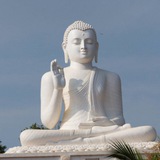
Giant White Buddha statue contains the holy relics, Wat Phra That Pu Jae Buddhist temple, Phrae province, Thailand.
👏1🙏1🏆1🤝1
6. Yassa accantadussãlyam
màluvà sàlam iv' otatam
Karoti so tatha' ttànam
yathà nam icchatã diso. 162.
THE CORRUPT BRING ABOUT THEIR OWN RUIN
6. He who is exceedingly corrupt, like a màluvà creeper strangling a sal tree, does to himself what even an enemy would wish for him. 162.
Story
The Buddha uttered this verse concerning the evil nature of the Venerable Devadatta, who had made several unsuccessful attempts to kill Him.
===
Dhammapada, beloved and favorite teachings of the Buddha channel:
https://invite.viber.com/?g2=AQBLD6phsgvP%2F061YjEM3K%2BNeH1Yb372b9mtfQX2EmuBpgoLUoc99BDMfzHghrme
===
màluvà sàlam iv' otatam
Karoti so tatha' ttànam
yathà nam icchatã diso. 162.
THE CORRUPT BRING ABOUT THEIR OWN RUIN
6. He who is exceedingly corrupt, like a màluvà creeper strangling a sal tree, does to himself what even an enemy would wish for him. 162.
Story
The Buddha uttered this verse concerning the evil nature of the Venerable Devadatta, who had made several unsuccessful attempts to kill Him.
===
Dhammapada, beloved and favorite teachings of the Buddha channel:
https://invite.viber.com/?g2=AQBLD6phsgvP%2F061YjEM3K%2BNeH1Yb372b9mtfQX2EmuBpgoLUoc99BDMfzHghrme
===
Viber
Dhammapada - Buddha Dharma Teachings
Daily teachings of the Dhammapada, beloved and favorite teachings of the Buddha
🙏2👍1💯1
Forwarded from Words of the Buddha
Free Buddha Dharma ebook
Dhamma, Kamma and Natural Disasters
By Bhante Shravasti Dhammika
Free download available:
https://budblooms.org/dhamma-kamma-and-natural-disasters/
===
Dhamma, Kamma and Natural Disasters
By Bhante Shravasti Dhammika
Free download available:
https://budblooms.org/dhamma-kamma-and-natural-disasters/
===
❤2👌1
Forwarded from Words of the Buddha
Free Buddha Dharma ebook
Dhamma, Kamma and Natural Disasters
By Bhante Shravasti Dhammika
Buddhism teaches causation, that the whole universe is a web of interrelated causes and effects. There are two types of causation – natural causation and moral causation. Natural causation has nothing to do with people being good or bad, it is simply a matter of the various forces in the universe acting on each other. A rainstorm or crops ripening would be examples of natural causation. Natural causes can of course have an effect on us – being caught in a rainstorm can give us a bad cold. But suffering from a cold has nothing to do with moral or immoral past actions – it would be a natural effect of a natural cause. Moral causation is about how people think, speak and act and how they feel as a result. The Buddha’s teaching of kamma is only concerned with moral causation. Being helpful to someone, having them thank you and feeling happiness because of that; stealing something, getting caught and then experiencing embarrassment or shame, would be examples of moral causation. The person’s happiness or discomfort are a direct result of how they have acted. The person is not being ‘rewarded’ or ‘punished’ for their actions, their happiness or discomfort is simply a result of their actions. Now let us have a look at the recent tsunami in the light of the doctrine of kamma.
Free download available:
https://budblooms.org/dhamma-kamma-and-natural-disasters/
===
Dhamma, Kamma and Natural Disasters
By Bhante Shravasti Dhammika
Buddhism teaches causation, that the whole universe is a web of interrelated causes and effects. There are two types of causation – natural causation and moral causation. Natural causation has nothing to do with people being good or bad, it is simply a matter of the various forces in the universe acting on each other. A rainstorm or crops ripening would be examples of natural causation. Natural causes can of course have an effect on us – being caught in a rainstorm can give us a bad cold. But suffering from a cold has nothing to do with moral or immoral past actions – it would be a natural effect of a natural cause. Moral causation is about how people think, speak and act and how they feel as a result. The Buddha’s teaching of kamma is only concerned with moral causation. Being helpful to someone, having them thank you and feeling happiness because of that; stealing something, getting caught and then experiencing embarrassment or shame, would be examples of moral causation. The person’s happiness or discomfort are a direct result of how they have acted. The person is not being ‘rewarded’ or ‘punished’ for their actions, their happiness or discomfort is simply a result of their actions. Now let us have a look at the recent tsunami in the light of the doctrine of kamma.
Free download available:
https://budblooms.org/dhamma-kamma-and-natural-disasters/
===
💯2🆒1
When the Realized One understands the supreme perfect awakening. And then—in this world with its gods, Māras, and divinities, this population with its ascetics and brahmins, gods and humans—an immeasurable, magnificent light appears, surpassing the glory of the gods. Even in the boundless void of interstellar space—so utterly dark that even the light of the moon and the sun, so mighty and powerful, makes no impression—an immeasurable, magnificent light appears, surpassing the glory of the gods. And the sentient beings reborn there recognize each other by that light: ‘So, it seems other sentient beings have been reborn here!’ This is the third incredible and amazing thing that appears with the appearance of a Realized One.
Partial excerpts from AN 4.127: Paṭhamatathāgataacchariyasutta
Partial excerpts from AN 4.127: Paṭhamatathāgataacchariyasutta
👏2🙏1😇1
7. Sukaràni asàdhuni
attano ahitàni ca
Yam 've hitañ ca sàdhuñ ca
tam ve paramadukkaram. 163.
EVIL IS EASY BUT GOOD IS DIFFICULT
7. Easy to do are things that are hard and not beneficial to oneself, but very, very, difficult indeed, to do is that which is beneficial and good. 163.
Story
This verse was uttered by the Buddha when He heard that the Venerable Devadatta has decided to cause a schism in the Order.
===
Ajahn Chah, Buddhist teacher of Thai forest meditation of Theravada Buddhism channel:
https://news.1rj.ru/str/ajahnchah_buddhism
===
attano ahitàni ca
Yam 've hitañ ca sàdhuñ ca
tam ve paramadukkaram. 163.
EVIL IS EASY BUT GOOD IS DIFFICULT
7. Easy to do are things that are hard and not beneficial to oneself, but very, very, difficult indeed, to do is that which is beneficial and good. 163.
Story
This verse was uttered by the Buddha when He heard that the Venerable Devadatta has decided to cause a schism in the Order.
===
Ajahn Chah, Buddhist teacher of Thai forest meditation of Theravada Buddhism channel:
https://news.1rj.ru/str/ajahnchah_buddhism
===
Telegram
Ajahn Chah - Theravada Thailand Buddhism
Collection of teachings of Venerable Ajahn Chah, a foremost meditation and Buddhist teacher from Thailand
🙏2👍1🏆1
Forwarded from Buddha
Free Buddhism ebook
Drop by Drop
The Buddhas Path to True Happiness
By Bhikkhu Buddharakkhita
Free download available:
https://ugandabuddhistcenter.org/wp-content/uploads/2022/02/Drop-by-Drop-Bhante-Buddharakkhita.pdf
===
Drop by Drop
The Buddhas Path to True Happiness
By Bhikkhu Buddharakkhita
Free download available:
https://ugandabuddhistcenter.org/wp-content/uploads/2022/02/Drop-by-Drop-Bhante-Buddharakkhita.pdf
===
👌2👍1🤝1
Forwarded from Buddha
Free Buddhism ebook
Drop by Drop
The Buddhas Path to True Happiness
By Bhikkhu Buddharakkhita
At the end of a meditation retreat, people come to me and ask a very important question: What do I do now? They think it is impossible to practice the Dhamma in the modern world. They want desperately to bring what they've been practicing back home with them, but they're afraid that the Buddha's teachings won't fit in a high-tech world of air conditioning, computers, cars, iPhones, and countless other modern trappings.
This fear is understandable. Most of us live a busy life full of constant melodrama. We have to earn a living, keep up our house, and deal with people both friendly and rude. We watch what we eat and drink. As compulsive shoppers, we spend most of our time in front of the TV or with a catalogue in hand, checking out the latest products for sale. In today's world, we deal with a million little things every minute of the day. It's no wonder that so many of us have a hard time believing that the Buddha's words can have anything to say about our lives today and an even harder time making time to find out!
Free download available:
https://ugandabuddhistcenter.org/wp-content/uploads/2022/02/Drop-by-Drop-Bhante-Buddharakkhita.pdf
===
Drop by Drop
The Buddhas Path to True Happiness
By Bhikkhu Buddharakkhita
At the end of a meditation retreat, people come to me and ask a very important question: What do I do now? They think it is impossible to practice the Dhamma in the modern world. They want desperately to bring what they've been practicing back home with them, but they're afraid that the Buddha's teachings won't fit in a high-tech world of air conditioning, computers, cars, iPhones, and countless other modern trappings.
This fear is understandable. Most of us live a busy life full of constant melodrama. We have to earn a living, keep up our house, and deal with people both friendly and rude. We watch what we eat and drink. As compulsive shoppers, we spend most of our time in front of the TV or with a catalogue in hand, checking out the latest products for sale. In today's world, we deal with a million little things every minute of the day. It's no wonder that so many of us have a hard time believing that the Buddha's words can have anything to say about our lives today and an even harder time making time to find out!
Free download available:
https://ugandabuddhistcenter.org/wp-content/uploads/2022/02/Drop-by-Drop-Bhante-Buddharakkhita.pdf
===
✍1🥰1👏1
8. Yo sàsanam arahatam
ariyànam dhammajãvinam
Pañikkosati dummedho
diññhim nissàya pàpikam
Phalàni kaññhakass' eva
attaghaññàya phallati. 164.
SCORN NOT THE NOBLE
8. The stupid man, who, on account of false views, scorns the teaching of the Arahants, the Noble Ones, and the Righteous, ripens like the fruit of the kàshta reed, only for his own destruction. 164.
Story
A jealous monk tried to dissuade his woman supporter from hearing the Dhamma from the Buddha. In spite of his attempts at dissuasion the woman went to see the Buddha. The monk, hearing of her visit went to the Buddha and suggested that He modify His sermon and preach on charity and morality. The Buddha, perceiving his bad intention, uttered this verse.
===
Free Buddhism books, teachings, podcasts and videos from Theravada, Mahayana and Vajrayana traditions:
https://news.1rj.ru/str/buddha_ebooks
===
ariyànam dhammajãvinam
Pañikkosati dummedho
diññhim nissàya pàpikam
Phalàni kaññhakass' eva
attaghaññàya phallati. 164.
SCORN NOT THE NOBLE
8. The stupid man, who, on account of false views, scorns the teaching of the Arahants, the Noble Ones, and the Righteous, ripens like the fruit of the kàshta reed, only for his own destruction. 164.
Story
A jealous monk tried to dissuade his woman supporter from hearing the Dhamma from the Buddha. In spite of his attempts at dissuasion the woman went to see the Buddha. The monk, hearing of her visit went to the Buddha and suggested that He modify His sermon and preach on charity and morality. The Buddha, perceiving his bad intention, uttered this verse.
===
Free Buddhism books, teachings, podcasts and videos from Theravada, Mahayana and Vajrayana traditions:
https://news.1rj.ru/str/buddha_ebooks
===
Telegram
Buddha Dharma books
Free Buddhism books, teachings, podcasts and videos from Theravada, Mahayana and Vajrayana traditions
❤1🥰1🙏1
Forwarded from Buddha
Pacchima-vaca:
Vaya-dhamma sankhara,
appamadena sampadetha.
All compounded things are subject to vanish. Strive with earnestness!
~ Digha Nikaya 16, Maha Parinibbana Sutta
Vaya-dhamma sankhara,
appamadena sampadetha.
All compounded things are subject to vanish. Strive with earnestness!
~ Digha Nikaya 16, Maha Parinibbana Sutta
🙏2👌1🕊1😇1