8. Yo sàsanam arahatam
ariyànam dhammajãvinam
Pañikkosati dummedho
diññhim nissàya pàpikam
Phalàni kaññhakass' eva
attaghaññàya phallati. 164.
SCORN NOT THE NOBLE
8. The stupid man, who, on account of false views, scorns the teaching of the Arahants, the Noble Ones, and the Righteous, ripens like the fruit of the kàshta reed, only for his own destruction. 164.
Story
A jealous monk tried to dissuade his woman supporter from hearing the Dhamma from the Buddha. In spite of his attempts at dissuasion the woman went to see the Buddha. The monk, hearing of her visit went to the Buddha and suggested that He modify His sermon and preach on charity and morality. The Buddha, perceiving his bad intention, uttered this verse.
===
Free Buddhism books, teachings, podcasts and videos from Theravada, Mahayana and Vajrayana traditions:
https://news.1rj.ru/str/buddha_ebooks
===
ariyànam dhammajãvinam
Pañikkosati dummedho
diññhim nissàya pàpikam
Phalàni kaññhakass' eva
attaghaññàya phallati. 164.
SCORN NOT THE NOBLE
8. The stupid man, who, on account of false views, scorns the teaching of the Arahants, the Noble Ones, and the Righteous, ripens like the fruit of the kàshta reed, only for his own destruction. 164.
Story
A jealous monk tried to dissuade his woman supporter from hearing the Dhamma from the Buddha. In spite of his attempts at dissuasion the woman went to see the Buddha. The monk, hearing of her visit went to the Buddha and suggested that He modify His sermon and preach on charity and morality. The Buddha, perceiving his bad intention, uttered this verse.
===
Free Buddhism books, teachings, podcasts and videos from Theravada, Mahayana and Vajrayana traditions:
https://news.1rj.ru/str/buddha_ebooks
===
Telegram
Buddha Dharma books
Free Buddhism books, teachings, podcasts and videos from Theravada, Mahayana and Vajrayana traditions
❤1🥰1🙏1
Forwarded from Buddha
Pacchima-vaca:
Vaya-dhamma sankhara,
appamadena sampadetha.
All compounded things are subject to vanish. Strive with earnestness!
~ Digha Nikaya 16, Maha Parinibbana Sutta
Vaya-dhamma sankhara,
appamadena sampadetha.
All compounded things are subject to vanish. Strive with earnestness!
~ Digha Nikaya 16, Maha Parinibbana Sutta
🙏2👌1🕊1😇1
King Milinda asks:
"What is the benefit of building stupas and paying respect to them? The Buddha has passed away, so how can such acts bring merit?"
Nagasena replies:
"Great king, even though the Buddha has passed away, his relics remain as a focus of veneration. When people build stupas or offer respect to them, they create merit. Just as the fragrance of a flower spreads with the wind, the act of reverence brings joy and spiritual benefit to the devotees."
He further explains:
"The stupa is like a great rain cloud, bringing blessings and relief to those who seek it. By honoring the stupa, one honors the Buddha, his teachings, and the Sangha, cultivating wholesome qualities and a peaceful mind."
Milindapanha, Chapter 4 (Veneration of Stupas)
"What is the benefit of building stupas and paying respect to them? The Buddha has passed away, so how can such acts bring merit?"
Nagasena replies:
"Great king, even though the Buddha has passed away, his relics remain as a focus of veneration. When people build stupas or offer respect to them, they create merit. Just as the fragrance of a flower spreads with the wind, the act of reverence brings joy and spiritual benefit to the devotees."
He further explains:
"The stupa is like a great rain cloud, bringing blessings and relief to those who seek it. By honoring the stupa, one honors the Buddha, his teachings, and the Sangha, cultivating wholesome qualities and a peaceful mind."
Milindapanha, Chapter 4 (Veneration of Stupas)
🙏5👍1👏1🫡1
Forwarded from Buddha
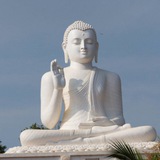
Giant Buddha in Bhoomisparsha Mudra, Kande Vihara Buddhist temple, Kalutara, Sri Lanka.
🙏2🏆1🤝1
9. Attanà' va katam pàpam
attanà samkilissati
Attanà akatam pàpam
attanà' va visujjhati
Suddhi asuddhi paccattam
n' âñño añño visodhaye. 165.
PURITY AND IMPURITY DEPEND ON ONESELF
9. By oneself, indeed, is evil done; by oneself is one defiled. By oneself is evil left undone; by oneself indeed, is one purified. Purity and impurity depend on oneself. No one purifies another. 165.
Story
A devout layman, having listened to the doctrine throughout the night, went in the morning to a pond to wash his face. At that moment a thief, who was being pursued by people, threw his stolen goods near him and fled. People molested him mistaking him for the thief. Some courtesans, who were passing that way, saved him. Hearing his sad story, the Buddha uttered this verse.
===
Buddha dharma teachings channel:
https://news.1rj.ru/str/lorddivinebuddha
===
attanà samkilissati
Attanà akatam pàpam
attanà' va visujjhati
Suddhi asuddhi paccattam
n' âñño añño visodhaye. 165.
PURITY AND IMPURITY DEPEND ON ONESELF
9. By oneself, indeed, is evil done; by oneself is one defiled. By oneself is evil left undone; by oneself indeed, is one purified. Purity and impurity depend on oneself. No one purifies another. 165.
Story
A devout layman, having listened to the doctrine throughout the night, went in the morning to a pond to wash his face. At that moment a thief, who was being pursued by people, threw his stolen goods near him and fled. People molested him mistaking him for the thief. Some courtesans, who were passing that way, saved him. Hearing his sad story, the Buddha uttered this verse.
===
Buddha dharma teachings channel:
https://news.1rj.ru/str/lorddivinebuddha
===
Telegram
Buddha
Buddha dharma teachings from the suttas and commentaries
❤2👏1🙏1
Free Buddha Dharma ebook
With Each and Every Breath - A Guide to Meditation
By Thanissaro Bhikkhu
Free download available:
https://www.dhammatalks.org/Archive/Writings/Ebooks/WithEachAndEveryBreath_210603.pdf
===
With Each and Every Breath - A Guide to Meditation
By Thanissaro Bhikkhu
Free download available:
https://www.dhammatalks.org/Archive/Writings/Ebooks/WithEachAndEveryBreath_210603.pdf
===
👌1😇1
Free Buddha Dharma ebook
With Each and Every Breath - A Guide to Meditation
By Thanissaro Bhikkhu
The meditation technique described here is drawn from two sources. The first source is the Buddha’s set of instructions on how to use the breath in training the mind. These instructions are found in the Pali Canon, the oldest extant record of the Buddha’s teachings. As the Canon states, the Buddha found the breath to be a restful meditation topic—both for body and mind—as well as an ideal topic for developing mindfulness, concentration, and discernment. In fact, it was the topic he himself used on the path to his awakening. That’s why he recommended it to more people and taught it in more detail than any other topic of meditation.
The second source is a method of breath meditation developed in the last century by Ajaan Lee Dhammadharo, a master of a branch of Buddhism known in Thailand as the Wilderness Tradition. Ajaan Lee’s method builds on the Buddha’s instructions, explaining in detail many of the points that the Buddha left in a condensed form. I trained in this technique for ten years under Ajaan Fuang Jotiko, one of Ajaan Lee’s students, so some of the insights here come from my training with Ajaan Fuang as well.
I’ve followed these sources in focusing on the breath as the main topic of meditation because it’s the safest of all meditation topics. The technique described here brings the body and mind to a balanced state of well-being. This in turn allows the mind to gain balanced insights into its own workings, so that it can see the ways in which it’s causing stress and suffering, and let them go effectively.
This technique is part of a comprehensive path of mind training that involves not only meditation but also the development of generosity and virtue. The basic approach in each part of this training is the same: to understand all your actions as part of a chain of causes and effects, so that you can direct the causes in a more positive direction. With every action in thought, word, or deed, you reflect on what you’re doing while you’re doing it. You look for the motivation leading to your actions, and the results your actions give rise to.
Free download available:
https://www.dhammatalks.org/Archive/Writings/Ebooks/WithEachAndEveryBreath_210603.pdf
===
With Each and Every Breath - A Guide to Meditation
By Thanissaro Bhikkhu
The meditation technique described here is drawn from two sources. The first source is the Buddha’s set of instructions on how to use the breath in training the mind. These instructions are found in the Pali Canon, the oldest extant record of the Buddha’s teachings. As the Canon states, the Buddha found the breath to be a restful meditation topic—both for body and mind—as well as an ideal topic for developing mindfulness, concentration, and discernment. In fact, it was the topic he himself used on the path to his awakening. That’s why he recommended it to more people and taught it in more detail than any other topic of meditation.
The second source is a method of breath meditation developed in the last century by Ajaan Lee Dhammadharo, a master of a branch of Buddhism known in Thailand as the Wilderness Tradition. Ajaan Lee’s method builds on the Buddha’s instructions, explaining in detail many of the points that the Buddha left in a condensed form. I trained in this technique for ten years under Ajaan Fuang Jotiko, one of Ajaan Lee’s students, so some of the insights here come from my training with Ajaan Fuang as well.
I’ve followed these sources in focusing on the breath as the main topic of meditation because it’s the safest of all meditation topics. The technique described here brings the body and mind to a balanced state of well-being. This in turn allows the mind to gain balanced insights into its own workings, so that it can see the ways in which it’s causing stress and suffering, and let them go effectively.
This technique is part of a comprehensive path of mind training that involves not only meditation but also the development of generosity and virtue. The basic approach in each part of this training is the same: to understand all your actions as part of a chain of causes and effects, so that you can direct the causes in a more positive direction. With every action in thought, word, or deed, you reflect on what you’re doing while you’re doing it. You look for the motivation leading to your actions, and the results your actions give rise to.
Free download available:
https://www.dhammatalks.org/Archive/Writings/Ebooks/WithEachAndEveryBreath_210603.pdf
===
🫡2❤1💯1🤝1
10. Attadattham paratthena
bahunà' pi na hàpaye
Attadattham abhiññàya
sadatthapasuto siyà. 166.
STRIVE FOR YOUR SPIRITUAL WELFARE
10. For the sake of others' welfare, however great, let not one neglect one's own welfare. 3 Clearly perceiving one's own welfare, let one be intent on one's own goal. 166.
Story
As the Buddha was about to pass away His disciples flocked from far and near to pay their last respects to Him. A monk named Attadattha instead of joining them, retired to his cell and meditated. The other monks reported this matter to the Buddha. When questioned as to his conduct. the monk replied. "Lord, as you would be passing away three months hence I thought the best way to honour you would be by attaining Arahantship during your lifetime itself." The Buddha praised him for his exemplary conduct and remarked that one's spiritual welfare should not be abandoned for the sake of others.
===
Words of the Buddha channel:
https://news.1rj.ru/str/wordsofbuddha
===
bahunà' pi na hàpaye
Attadattham abhiññàya
sadatthapasuto siyà. 166.
STRIVE FOR YOUR SPIRITUAL WELFARE
10. For the sake of others' welfare, however great, let not one neglect one's own welfare. 3 Clearly perceiving one's own welfare, let one be intent on one's own goal. 166.
Story
As the Buddha was about to pass away His disciples flocked from far and near to pay their last respects to Him. A monk named Attadattha instead of joining them, retired to his cell and meditated. The other monks reported this matter to the Buddha. When questioned as to his conduct. the monk replied. "Lord, as you would be passing away three months hence I thought the best way to honour you would be by attaining Arahantship during your lifetime itself." The Buddha praised him for his exemplary conduct and remarked that one's spiritual welfare should not be abandoned for the sake of others.
===
Words of the Buddha channel:
https://news.1rj.ru/str/wordsofbuddha
===
Telegram
Words of the Buddha
Daily teachings of Buddha Dharma
🙏2👏1🏆1
Forwarded from Buddha Dharma books
Free Buddhism ebook
Roots and Currents
By Ajahn Amaro
Free download here:
https://drive.google.com/file/d/1EulaF7kiOKcm99F-NSDuiu4a1jEFfXoJ/view?usp=drive_link
===
Roots and Currents
By Ajahn Amaro
Free download here:
https://drive.google.com/file/d/1EulaF7kiOKcm99F-NSDuiu4a1jEFfXoJ/view?usp=drive_link
===
👍1👏1💯1
Forwarded from Buddha Dharma books
Free Buddhism ebook
Roots and Currents
By Ajahn Amaro
This book contains a miscellany of my writings, rather than transcribed talks, from throughout my life as an ajahn in the Western Thai Forest sangha. The first part, ‘Roots’, is mainly historical; its chapters introduce Ajahn Chah, our founder and inspiration, and Ajahn Sumedho who led us to the UK and beyond, and then describes various events in our Western history. The second part,
‘Currents’, contains both teachings and personal reminiscences, accounts of some of my recent travels. Of course, in both parts of the book teachings mingle with history, and history with teachings.
Many of the chapters were originally written as much as twenty years ago and hence are inevitably somewhat out-of-date. I have made some adaptations with a view to rendering them timeless or making them more topical; but sometimes it seemed better just to leave them in more or less their original state. Any historical account of a movement such as our sangha is likely to become out-of-date even before it is published. So lists of monasteries and numbers of monastics may no longer be relevant; what really matters is that our sangha continues to grow and flourish, for the benefit of humans and all beings.
Free download here:
https://drive.google.com/file/d/1EulaF7kiOKcm99F-NSDuiu4a1jEFfXoJ/view?usp=drive_link
===
Roots and Currents
By Ajahn Amaro
This book contains a miscellany of my writings, rather than transcribed talks, from throughout my life as an ajahn in the Western Thai Forest sangha. The first part, ‘Roots’, is mainly historical; its chapters introduce Ajahn Chah, our founder and inspiration, and Ajahn Sumedho who led us to the UK and beyond, and then describes various events in our Western history. The second part,
‘Currents’, contains both teachings and personal reminiscences, accounts of some of my recent travels. Of course, in both parts of the book teachings mingle with history, and history with teachings.
Many of the chapters were originally written as much as twenty years ago and hence are inevitably somewhat out-of-date. I have made some adaptations with a view to rendering them timeless or making them more topical; but sometimes it seemed better just to leave them in more or less their original state. Any historical account of a movement such as our sangha is likely to become out-of-date even before it is published. So lists of monasteries and numbers of monastics may no longer be relevant; what really matters is that our sangha continues to grow and flourish, for the benefit of humans and all beings.
Free download here:
https://drive.google.com/file/d/1EulaF7kiOKcm99F-NSDuiu4a1jEFfXoJ/view?usp=drive_link
===
🏆1🦄1
Forwarded from Buddha Dharma books
Free Buddha Dharma ebook
Myself, Yourself, No-Self
By Bhante Shravasti Dhammika
Free download available:
https://budblooms.org/myself-yourself-no-self/
===
Myself, Yourself, No-Self
By Bhante Shravasti Dhammika
Free download available:
https://budblooms.org/myself-yourself-no-self/
===
👍1👌1😘1
Forwarded from Buddha Dharma books
Free Buddha Dharma ebook
Myself, Yourself, No-Self
By Bhante Shravasti Dhammika
Recently there has been some discussion in the newspaper about the Buddhist doctrine of anatta. In one letter written in response to an article by Prof. Carlo Fonseka, Mr. Leo Fernando mentioned that he failed “to comprehend the logic of the theory” despite reading many books on the subject (The Island, 24, Feb. 2019). I sympathise with him completely. As a monk who strives to explain Buddhism to others I find that many inquirers and new-comers to the religion often express this same bewilderment. As anatta is not just central to the Dhamma but unique to it also, this is seeming a pity. People who otherwise are attracted to the Dhamma sometimes lose interest in it specifically over this doctrine. However, I feel that the problem is not so much the doctrine itself but how it is often presented. I would like to look at three aspects of the anatta that I find is all too often badly presented and causes confusion and doubt.
Free download available:
https://budblooms.org/myself-yourself-no-self/
===
Myself, Yourself, No-Self
By Bhante Shravasti Dhammika
Recently there has been some discussion in the newspaper about the Buddhist doctrine of anatta. In one letter written in response to an article by Prof. Carlo Fonseka, Mr. Leo Fernando mentioned that he failed “to comprehend the logic of the theory” despite reading many books on the subject (The Island, 24, Feb. 2019). I sympathise with him completely. As a monk who strives to explain Buddhism to others I find that many inquirers and new-comers to the religion often express this same bewilderment. As anatta is not just central to the Dhamma but unique to it also, this is seeming a pity. People who otherwise are attracted to the Dhamma sometimes lose interest in it specifically over this doctrine. However, I feel that the problem is not so much the doctrine itself but how it is often presented. I would like to look at three aspects of the anatta that I find is all too often badly presented and causes confusion and doubt.
Free download available:
https://budblooms.org/myself-yourself-no-self/
===
❤1👍1💯1
Chapter 13
Loka Vagga
The World
(Text and Translation by Ven. Nàrada)
1. Hãnam dhammam na seveyya
pamàdena na samvase
Micchàdiññhim na seveyya
na siyà lokavaddhano. 167.
GIVE UP BASE DESIRES
1. Do not serve mean ends, 1 Do not live in heedlessness. Do not embrace false views. Do not be a world-upholder. 2 167.
Story
A young novice was offended at being called a shaveling. Nobody was able to pacify him. The Buddha adopted a conciliatory attitude and won his heart. On that occasion the Buddha uttered this verse.
===
Dhammapada, beloved and favorite teachings of the Buddha channel:
https://news.1rj.ru/str/dhammapadas
===
Loka Vagga
The World
(Text and Translation by Ven. Nàrada)
1. Hãnam dhammam na seveyya
pamàdena na samvase
Micchàdiññhim na seveyya
na siyà lokavaddhano. 167.
GIVE UP BASE DESIRES
1. Do not serve mean ends, 1 Do not live in heedlessness. Do not embrace false views. Do not be a world-upholder. 2 167.
Story
A young novice was offended at being called a shaveling. Nobody was able to pacify him. The Buddha adopted a conciliatory attitude and won his heart. On that occasion the Buddha uttered this verse.
===
Dhammapada, beloved and favorite teachings of the Buddha channel:
https://news.1rj.ru/str/dhammapadas
===
Telegram
Dhammapada - Buddha Dharma Teachings
Daily teachings of the Dhammapada, beloved and favorite teachings of the Buddha
❤1👍1🙏1🏆1