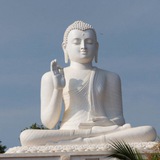
Dhammapada Verse 49
Macchariyakosiyasetthi Vatthu
Yathipi bhamaro puppham
vannagandhamahethayam
paleti rasamadaya
evam game muni care.
Verse 49: As the bee collects nectar and flies away without damaging the flower or its colour or its scent, so also, let the bhikkhu dwell and act in the village (without affecting the faith and generosity or the wealth of the villagers).
The Story of Kosiya, the Miserly Rich Man
While residing at the Jetavana monastery, the Buddha uttered Verse (49) of this book, with reference to the Chief Disciple Maha Moggallana and the miserly rich man, Kosiya.
In the village of Sakkara, near Rajagaha, there lived a miserly rich man by the name of Kosiya, who was very reluctant to give away even the tiniest part of anything belonging to him. One day, to avoid sharing with others, the rich man and his wife were making some pancakes in the uppermost storey of their house, where no one would see them.
Early in the morning, on that day, the Buddha through his supernormal power, saw the rich man and his wife in his vision, and knew that both of them would soon attain Sotapatti Fruition. So he sent his Chief Disciple Maha Moggallana to the house of the rich man, with instructions to bring the couple to the Jetavana monastery in time for the midday meal. The Chief Disciple, by supernormal power, reached Kosiya's house in an instant and stood at the window. The rich man saw him and asked him to leave; the Venerable Maha Moggallana just stood there without saying anything. In the end, Kosiya said to his wife, "Make a very small pancake and give it to the bhikkhu." So she took just a little amount of dough and put it in the pan, and the cake filled up the whole pan. Kosiya thought his wife must have put in too much, so he took just a pinch of dough and put it into the pan; his pancake also swelled into a big one. It so happened that however little dough they might put in, they were unable to make small pancakes. At last, Kosiya asked his wife to offer one from the basket to the bhikkhu. When she tried to take out one from the basket it would not come off because all the pancakes were sticking together and could not be separated. By this time Kosiya has lost all appetite for pancakes and offered the whole basket of pancakes to Maha Moggallana. The Chief Disciple then delivered a discourse on charity to the rich man and his wife. He also told the couple about how the Buddha was waiting with five hundred bhikkhus at the Jetavana monastery in Savatthi, forty-five yojanas away from Rajagaha. Maha Moggallana, by his supernormal power, then took both Kosiya and his wife together with their basket of pancakes, to the presence of the Buddha. There, they offered the pancakes to the Buddha and the five hundred bhikkhus. At the end of the meal, the Buddha delivered a discourse on charity, and both Kosiya and his wife attained Sotapatti Fruition.
Next evening, while the bhikkhus were talking in praise of Maha Moggallana, the Buddha came to them and said, "Bhikkhus, you should also dwell and act in the village like Maha Moggallana, receiving the offerings of the villagers without affecting their faith and generosity, or their wealth."
Then the Buddha spoke in verse as follows:
Verse 49: As the bee collects nectar and flies away without damaging the flower or its colour or its scent, so also, let the bhikkhu dwell and act in the village (without affecting the faith and generosity or the wealth of the villagers).
Buddha dharma teachings channel:
https://news.1rj.ru/str/lorddivinebuddha
====================
Macchariyakosiyasetthi Vatthu
Yathipi bhamaro puppham
vannagandhamahethayam
paleti rasamadaya
evam game muni care.
Verse 49: As the bee collects nectar and flies away without damaging the flower or its colour or its scent, so also, let the bhikkhu dwell and act in the village (without affecting the faith and generosity or the wealth of the villagers).
The Story of Kosiya, the Miserly Rich Man
While residing at the Jetavana monastery, the Buddha uttered Verse (49) of this book, with reference to the Chief Disciple Maha Moggallana and the miserly rich man, Kosiya.
In the village of Sakkara, near Rajagaha, there lived a miserly rich man by the name of Kosiya, who was very reluctant to give away even the tiniest part of anything belonging to him. One day, to avoid sharing with others, the rich man and his wife were making some pancakes in the uppermost storey of their house, where no one would see them.
Early in the morning, on that day, the Buddha through his supernormal power, saw the rich man and his wife in his vision, and knew that both of them would soon attain Sotapatti Fruition. So he sent his Chief Disciple Maha Moggallana to the house of the rich man, with instructions to bring the couple to the Jetavana monastery in time for the midday meal. The Chief Disciple, by supernormal power, reached Kosiya's house in an instant and stood at the window. The rich man saw him and asked him to leave; the Venerable Maha Moggallana just stood there without saying anything. In the end, Kosiya said to his wife, "Make a very small pancake and give it to the bhikkhu." So she took just a little amount of dough and put it in the pan, and the cake filled up the whole pan. Kosiya thought his wife must have put in too much, so he took just a pinch of dough and put it into the pan; his pancake also swelled into a big one. It so happened that however little dough they might put in, they were unable to make small pancakes. At last, Kosiya asked his wife to offer one from the basket to the bhikkhu. When she tried to take out one from the basket it would not come off because all the pancakes were sticking together and could not be separated. By this time Kosiya has lost all appetite for pancakes and offered the whole basket of pancakes to Maha Moggallana. The Chief Disciple then delivered a discourse on charity to the rich man and his wife. He also told the couple about how the Buddha was waiting with five hundred bhikkhus at the Jetavana monastery in Savatthi, forty-five yojanas away from Rajagaha. Maha Moggallana, by his supernormal power, then took both Kosiya and his wife together with their basket of pancakes, to the presence of the Buddha. There, they offered the pancakes to the Buddha and the five hundred bhikkhus. At the end of the meal, the Buddha delivered a discourse on charity, and both Kosiya and his wife attained Sotapatti Fruition.
Next evening, while the bhikkhus were talking in praise of Maha Moggallana, the Buddha came to them and said, "Bhikkhus, you should also dwell and act in the village like Maha Moggallana, receiving the offerings of the villagers without affecting their faith and generosity, or their wealth."
Then the Buddha spoke in verse as follows:
Verse 49: As the bee collects nectar and flies away without damaging the flower or its colour or its scent, so also, let the bhikkhu dwell and act in the village (without affecting the faith and generosity or the wealth of the villagers).
Buddha dharma teachings channel:
https://news.1rj.ru/str/lorddivinebuddha
====================
Telegram
Buddha
Buddha dharma teachings from the suttas and commentaries
❤1👍1
Free Buddha Dharma ebook
Bhara Sutta
Commentaries by Mahasi Sayadaw Gyi
The Venerable Mahasi Sayadawgyi had delivered the discourse on Bhara Sutta of Khandha Vagga in Samyhtta Nikaya at the Mahasi Meditation Centre on the full moon day of Tazaungmon, 1328 Burmese Era (27th November 1966), The discourse was tape-recorded and U Thein Aung, the then secretary of the Buddha Sasana Nuggaha Organization had compiled a written draft which was edited by Mahasi Sayadaw, and the first Myanmar edition was published in 1330 B.E. (1968). Up to now there have been six Myanmar Editions.
Mahasi Sayadawgyi in delivering this discourse, made reference to various commentaries and sub-commentaries concerned in tune with the original Sutta. Sayadawgyi had discussed this Sutta with various stories and examples, with the aim of yogis and meditators realising Nibbana, by relinquishing the burden (Bhara) of the aggregates of Khandha by insight meditation.
The teachings of lord Buddha were relevant to the past, present and future times and Mahasi Sayadawgyi discourses, in consonant with the present times, were delivered in such a way as to be easy of comprehension by all listeners.
Free download here:
http://www.mediafire.com/file/07wk1rj4ab1kd02/
=============
Bhara Sutta
Commentaries by Mahasi Sayadaw Gyi
The Venerable Mahasi Sayadawgyi had delivered the discourse on Bhara Sutta of Khandha Vagga in Samyhtta Nikaya at the Mahasi Meditation Centre on the full moon day of Tazaungmon, 1328 Burmese Era (27th November 1966), The discourse was tape-recorded and U Thein Aung, the then secretary of the Buddha Sasana Nuggaha Organization had compiled a written draft which was edited by Mahasi Sayadaw, and the first Myanmar edition was published in 1330 B.E. (1968). Up to now there have been six Myanmar Editions.
Mahasi Sayadawgyi in delivering this discourse, made reference to various commentaries and sub-commentaries concerned in tune with the original Sutta. Sayadawgyi had discussed this Sutta with various stories and examples, with the aim of yogis and meditators realising Nibbana, by relinquishing the burden (Bhara) of the aggregates of Khandha by insight meditation.
The teachings of lord Buddha were relevant to the past, present and future times and Mahasi Sayadawgyi discourses, in consonant with the present times, were delivered in such a way as to be easy of comprehension by all listeners.
Free download here:
http://www.mediafire.com/file/07wk1rj4ab1kd02/
=============
❤1👍1
Dhammapada Verse 50
Paveyya ajivaka Vatthu
Na paresam vilomani
na paresam katakatam
attanova avekkheyya
katani akatani ca.
Verse 50: One should not consider the faults of others, nor their doing or not doing good or bad deeds. One should consider only whether one has done or not done good or bad deeds.
The Story of the Ascetic Paveyya
While residing at the Jetavana monastery, the Buddha uttered Verse (50) of this book, with reference to the ascetic Paveyya and a rich lady.
A rich lady of Savatthi had adopted Paveyya, an ascetic, as a son and was looking after his needs. When she heard her neighbours talking in praise of the Buddha, she wished very much to invite him to her house to offer him alms-food. So, the Buddha was invited and choice food was offered. As the Buddha was expressing appreciation (anumodana), Paveyya, who was in the next room, fumed with rage. He blamed and cursed the lady for venerating the Buddha. The lady heard him cursing and shouting and felt so ashamed that she could not concentrate on what the Buddha was saying. The Buddha told her not to be concerned about those curses and threats, but to concentrate only on her own good and bad deeds.
Then the Buddha spoke in verse as follows:
Verse 50: One should not consider the faults of others, nor their doing or not doing good or bad deeds. One should consider only whether one has done or not done good or bad deeds.
At the end of the discourse the rich lady attained Sotapatti Fruition.
Tibetan Buddhism - Vajrayana, Tantrayana and esoteric Buddhism channel:
https://news.1rj.ru/str/tibetanbuddha
Vajrayana Tantrayana Buddhism channel:
https://news.1rj.ru/str/tantrayanabuddhism
====================
Paveyya ajivaka Vatthu
Na paresam vilomani
na paresam katakatam
attanova avekkheyya
katani akatani ca.
Verse 50: One should not consider the faults of others, nor their doing or not doing good or bad deeds. One should consider only whether one has done or not done good or bad deeds.
The Story of the Ascetic Paveyya
While residing at the Jetavana monastery, the Buddha uttered Verse (50) of this book, with reference to the ascetic Paveyya and a rich lady.
A rich lady of Savatthi had adopted Paveyya, an ascetic, as a son and was looking after his needs. When she heard her neighbours talking in praise of the Buddha, she wished very much to invite him to her house to offer him alms-food. So, the Buddha was invited and choice food was offered. As the Buddha was expressing appreciation (anumodana), Paveyya, who was in the next room, fumed with rage. He blamed and cursed the lady for venerating the Buddha. The lady heard him cursing and shouting and felt so ashamed that she could not concentrate on what the Buddha was saying. The Buddha told her not to be concerned about those curses and threats, but to concentrate only on her own good and bad deeds.
Then the Buddha spoke in verse as follows:
Verse 50: One should not consider the faults of others, nor their doing or not doing good or bad deeds. One should consider only whether one has done or not done good or bad deeds.
At the end of the discourse the rich lady attained Sotapatti Fruition.
Tibetan Buddhism - Vajrayana, Tantrayana and esoteric Buddhism channel:
https://news.1rj.ru/str/tibetanbuddha
Vajrayana Tantrayana Buddhism channel:
https://news.1rj.ru/str/tantrayanabuddhism
====================
Telegram
Tibetan Buddhism Vajrayana Tantrayana esoteric tradition
Buddha Dharma teachings from the esoteric Vajrayana or Tantrayana Buddhism, includes all major schools Nyingma, Kagyu, Gelug, Sakya, Jonang and Bonpo.
❤2👍1
Dhammapada Verses 51 and 52
Chattapani upasaka Vatthu
Yathapi ruciram puppham
vannavantam agandhakam
evam subhasita vaca
aphala hoti akubbato.
Yathapi ruciram puppham
vannavantam sagandhakam
evam subhasita vaca
saphala hoti kubbato.
Verse 51: Just as a beautiful flower, lacking in scent, cannot give the wearer the benefit of its scent, so also, the well-preached words of the Buddha cannot benefit one who does not practise the Dhamma.
Verse 52: Just as a flower, beautiful as well as fragrant, will give the wearer the benefit of its scent, so also, the well-preached words of the Buddha will benefit one who practises the Dhamma.
The Story of Chattapani, a Lay Disciple
While residing at the Jetavana monastery, the Buddha uttered Verses (51) and (52) of this book, with reference to the lay disciple Chattapani and the two queens of King Pasenadi of Kosala.
A lay disciple named Chattapani who was an anagami* lived in Savatthi. On one occasion, Chattapani was with the Buddha at the Jetavana monastery respectfully and attentively listening to a religious discourse, when King Pasenadi also came to the Buddha. Chattapani did not stand up because he thought that by standing up, it might mean that he was paying respect to the king, but not paying due respect to the Buddha. The king took that as an insult and was very much offended. The Buddha knew exactly how the king was feeling; so he spoke in praise of Chattapani, who was well-versed in the Dhamma and had also attained the Anagami Fruition. On hearing this, the king was impressed and favourably inclined towards Chattapani.
When the king next met Chattapani he said, "You are so learned; could you please come to the palace and give lessons of the Dhamma to my two queens?" Chattapani declined but he suggested that the king should request the Buddha to assign a bhikkhu for this purpose. So, the king approached the Buddha in connection with this, and the Buddha directed the Venerable Ananda to go regularly to the palace and teach the Dhamma to Queen Mallika and Queen Vasabhakhattiya. After some time, the Buddha asked the Venerable Ananda about the progress of the two queens. The Venerable Ananda answered that although Mallika was learning the Dhamma seriously, Vasabhakhattiya was not paying proper attention. On hearing this the Buddha said that the Dhamma could be of benefit only to those who learn it seriously with due respect and proper attention and then practise diligently what was taught.
Then the Buddha spoke in verse as follows:
Verse 51: Just as a beautiful flower, lacking in scent, cannot give the wearer the benefit of its scent, so also, the well-preached words of the Buddha cannot benefit one who does not practise the Dhamma.
Verse 52: Just as a flower, beautiful as well as fragrant, will give the wearer the benefit of its scent, so also, the well-preached words of the Buddha will benefit one who practises the Dhamma.
*Anagami: one who has attained the third Magga.
Words of the Buddha channel:
https://news.1rj.ru/str/wordsofbuddha
====================
Chattapani upasaka Vatthu
Yathapi ruciram puppham
vannavantam agandhakam
evam subhasita vaca
aphala hoti akubbato.
Yathapi ruciram puppham
vannavantam sagandhakam
evam subhasita vaca
saphala hoti kubbato.
Verse 51: Just as a beautiful flower, lacking in scent, cannot give the wearer the benefit of its scent, so also, the well-preached words of the Buddha cannot benefit one who does not practise the Dhamma.
Verse 52: Just as a flower, beautiful as well as fragrant, will give the wearer the benefit of its scent, so also, the well-preached words of the Buddha will benefit one who practises the Dhamma.
The Story of Chattapani, a Lay Disciple
While residing at the Jetavana monastery, the Buddha uttered Verses (51) and (52) of this book, with reference to the lay disciple Chattapani and the two queens of King Pasenadi of Kosala.
A lay disciple named Chattapani who was an anagami* lived in Savatthi. On one occasion, Chattapani was with the Buddha at the Jetavana monastery respectfully and attentively listening to a religious discourse, when King Pasenadi also came to the Buddha. Chattapani did not stand up because he thought that by standing up, it might mean that he was paying respect to the king, but not paying due respect to the Buddha. The king took that as an insult and was very much offended. The Buddha knew exactly how the king was feeling; so he spoke in praise of Chattapani, who was well-versed in the Dhamma and had also attained the Anagami Fruition. On hearing this, the king was impressed and favourably inclined towards Chattapani.
When the king next met Chattapani he said, "You are so learned; could you please come to the palace and give lessons of the Dhamma to my two queens?" Chattapani declined but he suggested that the king should request the Buddha to assign a bhikkhu for this purpose. So, the king approached the Buddha in connection with this, and the Buddha directed the Venerable Ananda to go regularly to the palace and teach the Dhamma to Queen Mallika and Queen Vasabhakhattiya. After some time, the Buddha asked the Venerable Ananda about the progress of the two queens. The Venerable Ananda answered that although Mallika was learning the Dhamma seriously, Vasabhakhattiya was not paying proper attention. On hearing this the Buddha said that the Dhamma could be of benefit only to those who learn it seriously with due respect and proper attention and then practise diligently what was taught.
Then the Buddha spoke in verse as follows:
Verse 51: Just as a beautiful flower, lacking in scent, cannot give the wearer the benefit of its scent, so also, the well-preached words of the Buddha cannot benefit one who does not practise the Dhamma.
Verse 52: Just as a flower, beautiful as well as fragrant, will give the wearer the benefit of its scent, so also, the well-preached words of the Buddha will benefit one who practises the Dhamma.
*Anagami: one who has attained the third Magga.
Words of the Buddha channel:
https://news.1rj.ru/str/wordsofbuddha
====================
Telegram
Words of the Buddha
Daily teachings of Buddha Dharma
❤3👍2
Dhammapada Verse 53
Visakha Vatthu
Yathapi puppharasimha
kayira malagune bahu
evam jatena maccena
kattabbam kusalam bahum1.
Verse 53: As from a collection of flowers many a garland can be made by an expert florist, so also, much good can be done (with wealth, out of faith and generosity) by one subject to birth and death.
1. kattabbam kusalam bahum: much good may be done. According to the Commentary, it means many deeds of merit should be done with wealth, out of faith and generosity.
The Story of Visakha
While residing at the Pubbarama monastery in Savatthi, the Buddha uttered Verse (53) of this book, with reference to Visakha, the famous donor of the Pubbarama monastery.
Visakha was the daughter of a rich man of Bhaddiya, named Danancaya, and his wife Sumanadevi, and the granddaughter of Mendaka, one of the five extremely wealthy men of King Bimbisara's dominions. When Visakha was seven years old, the Buddha came on a tour to Bhaddiya. On that occasion, the rich man Mendaka took Visakha and her five hundred companions with him to pay homage to the Buddha. After hearing the discourse given by the Buddha, Visakha, her grandfather and all her five hundred companions attained Sotapatti Fruition.
When Visakha came of age, she married Punnavadahana, son of Migara, a fairly rich man from Savatthi. One day, while Migara was having his meal, a bhikkhu stopped for alms at his house; but Migara completely ignored the bhikkhu. Visakha, seeing this, said to the bhikkhu, "I am sorry, your reverence, my father-in-law only eats leftovers." On hearing this, Migara flew into a rage and told her to leave his house. But Visakha said she was not going away, and that she would send for the eight elderly rich men who were sent by her father to accompany her and to advise her. It was for them to decide whether she was guilty or not. When the elders came, Migara said to them, "While I was having my rice-with-milk in a golden bowl, Visakha said that I was taking only dirt and filth. For this offence, I'm sending her away." Thereupon, Visakha explained as follows: "When I saw my father-in-law completely ignoring the bhikkhu standing for alms-food, I thought to myself that my father-in-law was not doing any meritorious deed in this existence. he was only eating the fruits of his past good deeds. So, I said, 'My father-in-law only eats leftovers.' Now Sirs, what do you think, am I guilty?" The elders decided that Visakha was not guilty. Visakha then said that she was one who had absolute and unshakable faith in the Teaching of the Buddha and so could not stay where the bhikkhus were not welcome; and also, that if she was not given permission to invite the bhikkhus to the house to offer alms-food and make other offerings, she would leave the house. So permission was granted to her to invite the Buddha and his bhikkhus to the house.
The next day, the Buddha and his disciples were invited to the house of Visakha. When alms-food was about to be offered, she sent word to her father-in-law to join her in offering food; but he did not come. When the meal was over, again she sent a message, this time requesting her father-in-law to join her in hearing the discourse that would soon be given by the Buddha. Her father-in-law felt that he should not refuse for a second time. But his ascetic teachers, the Niganthas, would not let him go; however, they conceded that he could listen from behind a curtain. After hearing the Buddha's discourse Migara attained Sotapatti Fruition. He felt very thankful to the Buddha and also to his daughter-in-law. Being so thankful, he declared that henceforth Visakha would be like a mother to him, and Visakha came to be known as Migaramata.
Visakha gave birth to ten sons and ten daughters, and ten sons and ten daughters each were born to everyone of her children and grand-children. Visakha possessed an immensely valuable gem-encrusted cloak given by her father as a wedding present. One day, Visakha went to the Jetavana monastery with her entourage.
Visakha Vatthu
Yathapi puppharasimha
kayira malagune bahu
evam jatena maccena
kattabbam kusalam bahum1.
Verse 53: As from a collection of flowers many a garland can be made by an expert florist, so also, much good can be done (with wealth, out of faith and generosity) by one subject to birth and death.
1. kattabbam kusalam bahum: much good may be done. According to the Commentary, it means many deeds of merit should be done with wealth, out of faith and generosity.
The Story of Visakha
While residing at the Pubbarama monastery in Savatthi, the Buddha uttered Verse (53) of this book, with reference to Visakha, the famous donor of the Pubbarama monastery.
Visakha was the daughter of a rich man of Bhaddiya, named Danancaya, and his wife Sumanadevi, and the granddaughter of Mendaka, one of the five extremely wealthy men of King Bimbisara's dominions. When Visakha was seven years old, the Buddha came on a tour to Bhaddiya. On that occasion, the rich man Mendaka took Visakha and her five hundred companions with him to pay homage to the Buddha. After hearing the discourse given by the Buddha, Visakha, her grandfather and all her five hundred companions attained Sotapatti Fruition.
When Visakha came of age, she married Punnavadahana, son of Migara, a fairly rich man from Savatthi. One day, while Migara was having his meal, a bhikkhu stopped for alms at his house; but Migara completely ignored the bhikkhu. Visakha, seeing this, said to the bhikkhu, "I am sorry, your reverence, my father-in-law only eats leftovers." On hearing this, Migara flew into a rage and told her to leave his house. But Visakha said she was not going away, and that she would send for the eight elderly rich men who were sent by her father to accompany her and to advise her. It was for them to decide whether she was guilty or not. When the elders came, Migara said to them, "While I was having my rice-with-milk in a golden bowl, Visakha said that I was taking only dirt and filth. For this offence, I'm sending her away." Thereupon, Visakha explained as follows: "When I saw my father-in-law completely ignoring the bhikkhu standing for alms-food, I thought to myself that my father-in-law was not doing any meritorious deed in this existence. he was only eating the fruits of his past good deeds. So, I said, 'My father-in-law only eats leftovers.' Now Sirs, what do you think, am I guilty?" The elders decided that Visakha was not guilty. Visakha then said that she was one who had absolute and unshakable faith in the Teaching of the Buddha and so could not stay where the bhikkhus were not welcome; and also, that if she was not given permission to invite the bhikkhus to the house to offer alms-food and make other offerings, she would leave the house. So permission was granted to her to invite the Buddha and his bhikkhus to the house.
The next day, the Buddha and his disciples were invited to the house of Visakha. When alms-food was about to be offered, she sent word to her father-in-law to join her in offering food; but he did not come. When the meal was over, again she sent a message, this time requesting her father-in-law to join her in hearing the discourse that would soon be given by the Buddha. Her father-in-law felt that he should not refuse for a second time. But his ascetic teachers, the Niganthas, would not let him go; however, they conceded that he could listen from behind a curtain. After hearing the Buddha's discourse Migara attained Sotapatti Fruition. He felt very thankful to the Buddha and also to his daughter-in-law. Being so thankful, he declared that henceforth Visakha would be like a mother to him, and Visakha came to be known as Migaramata.
Visakha gave birth to ten sons and ten daughters, and ten sons and ten daughters each were born to everyone of her children and grand-children. Visakha possessed an immensely valuable gem-encrusted cloak given by her father as a wedding present. One day, Visakha went to the Jetavana monastery with her entourage.
❤1👍1
On arrival at the monastery, she found that her bejeweled cloak was too heavy. So, she took it off, wrapped it up in her shawl, and gave it to the maid to hold it and take care of it. The maid absentmindedly left it at the monastery. It was the custom for the Venerable Ananda to look after the things left by any one of the lay disciples. Visakha sent the maid back to the monastery saying, "Go and look for the bejeweled cloak, but if the Venerable Ananda had already found it and kept it in a place do not bring it back; I donate the bejeweled cloak to the Venerable Ananda." But the Venerable Ananda did not accept her donation. So Visakha decided to sell the bejeweled cloak and donate the sale proceeds. But there was no one who could afford to buy that bejeweled cloak. So Visakha bought it back for nine crores and one lakh. With this money, she built a monastery on the eastern side of the city; this monastery came to be known as Pubbarama.
After the libation ceremony she called all her family to her and on that night she told them that all her wishes had been fulfilled and that she had nothing more to desire. Then reciting five verses of exultation she went round and round the monastery. Some bhikkhus hearing her, thought she was singing and reported to the Buddha that Visakha was not like before, and that she was going round and round the monastery, singing. "Could it be that she had gone off her head?" they asked the Buddha. To this question, the Buddha replied, "Today, Visakha had all her wishes of the past and present existences fulfilled and on account of that sense of achievement, she was feeling elated and contented; Visakha was just reciting some verses of exultation; she certainly had not gone off her head. Visakha, throughout her previous existences, had always been a generous donor and an ardent promoter of the Doctrine of successive Buddhas. She was most strongly inclined to do good deeds and had done much good in her previous existences, just as an expert florist makes many garlands from a collection of flowers."
Then the Buddha spoke in verse as follows:
Verse 53: As from a collection of flowers many a garland can be made by an expert florist, so also, much good can be done (with wealth, out of faith and generosity) by one subject to birth and death.
Dhammapada, beloved and favorite teachings of the Buddha channel:
https://news.1rj.ru/str/dhammapadas
====================
After the libation ceremony she called all her family to her and on that night she told them that all her wishes had been fulfilled and that she had nothing more to desire. Then reciting five verses of exultation she went round and round the monastery. Some bhikkhus hearing her, thought she was singing and reported to the Buddha that Visakha was not like before, and that she was going round and round the monastery, singing. "Could it be that she had gone off her head?" they asked the Buddha. To this question, the Buddha replied, "Today, Visakha had all her wishes of the past and present existences fulfilled and on account of that sense of achievement, she was feeling elated and contented; Visakha was just reciting some verses of exultation; she certainly had not gone off her head. Visakha, throughout her previous existences, had always been a generous donor and an ardent promoter of the Doctrine of successive Buddhas. She was most strongly inclined to do good deeds and had done much good in her previous existences, just as an expert florist makes many garlands from a collection of flowers."
Then the Buddha spoke in verse as follows:
Verse 53: As from a collection of flowers many a garland can be made by an expert florist, so also, much good can be done (with wealth, out of faith and generosity) by one subject to birth and death.
Dhammapada, beloved and favorite teachings of the Buddha channel:
https://news.1rj.ru/str/dhammapadas
====================
Telegram
Dhammapada - Buddha Dharma Teachings
Daily teachings of the Dhammapada, beloved and favorite teachings of the Buddha
❤1👍1
The Need of the Hour
By Ven. Bhikkhu Bodhi
A new vision and scale of values are necessary measures for safeguarding our world.
It’s hardly a secret that human recklessness is reaching a critical mass, threatening not only our collective sanity but even our long-term survival. Ever more powerful and impersonal weaponry, endless warfare, super-quick changes in technology, a volatile global economy, the widening gap between the ultrarich and everyone else, climate disasters, species extinction, and ecological devastation: these crises are escalating out of control, and even what was once the most idyllic South Pacific island offers no escape. We’ve got to find ways to put our house in order, and we’ve got to do so fast; otherwise the rapid descent of our civilization towards collapse seems unavoidable.
The critical problems that loom over us—economic, political, and ecological—can be dealt with in either of two ways. One is the symptomatic approach favored by policy wonks and conventional liberal politicians, who view each problem as distinct and propose tackling them through more finely tuned policies. The other approach is holistic. It looks at these problems as interwoven and mutually reinforcing, seeing them as objectifications of our subjective propensities mirroring back to us the distorted ways we relate to ourselves, other people, and the natural world. From this angle, any effective solution requires that we make fundamental changes in ourselves—in our views, attitudes, and intentions. These can then ripple out, coalesce, and inspire transformative action.
I suggest that it is the task of religion—understood broadly as comprising forms of spirituality that don’t necessarily constitute an organized faith—to offer us guidance in making those redemptive changes. In trying to implement them we can expect to meet hardened resistance both from mainstream culture and our own entrenched habits. To understand the necessity of change, we must consider not only our short-term personal advantage but also the long-range impact our choices have on others we will never know or see: on people living in remote lands, on generations as yet unborn, and on the other species that share our planet.
What is required of us is to adopt a panoramic ethical point of view that takes us far beyond the bounds of mere expediency. By connecting us to the deepest sources of ethics, religious consciousness can play a pivotal role in promoting the inner transformations needed to ward off collapse. But for religion to guide us through the approaching storms, the scope of religious consciousness must itself be extended and deepened. We have to draw out from classical spiritual teachings fresh implications and applications seen against the cultural and intellectual horizons of our time.
I have found that by balancing fidelity to tradition with relevance to the present, the classical teachings of Buddhism can be newly formulated to meet the challenges of the historical moment. Classical Buddhism at its core is a path of personal liberation, but its rich array of principles and practices offer powerful tools for accelerating the type of inner growth that can promote outer transformation. Specifically, Buddhism offers us two complementary perspectives that can guide us in our engagement with the world. One pertains to our way of understanding ourselves, the other to our relationship with other living beings. These two perspectives are, respectively, the wisdom of selflessness and universal compassion. Though distinct, the two are closely bound, and in their unity they provide a potent antidote to our current perilous drift.
The wisdom of selflessness, according to the Buddha’s teaching, is the necessary remedy for the false sense of personal identity that normally hovers in the background of our minds. This misplaced sense of personal identity has harmful ramifications on at least three fronts: in relation to material things, in relation to ourselves, and in relation to other people.
By Ven. Bhikkhu Bodhi
A new vision and scale of values are necessary measures for safeguarding our world.
It’s hardly a secret that human recklessness is reaching a critical mass, threatening not only our collective sanity but even our long-term survival. Ever more powerful and impersonal weaponry, endless warfare, super-quick changes in technology, a volatile global economy, the widening gap between the ultrarich and everyone else, climate disasters, species extinction, and ecological devastation: these crises are escalating out of control, and even what was once the most idyllic South Pacific island offers no escape. We’ve got to find ways to put our house in order, and we’ve got to do so fast; otherwise the rapid descent of our civilization towards collapse seems unavoidable.
The critical problems that loom over us—economic, political, and ecological—can be dealt with in either of two ways. One is the symptomatic approach favored by policy wonks and conventional liberal politicians, who view each problem as distinct and propose tackling them through more finely tuned policies. The other approach is holistic. It looks at these problems as interwoven and mutually reinforcing, seeing them as objectifications of our subjective propensities mirroring back to us the distorted ways we relate to ourselves, other people, and the natural world. From this angle, any effective solution requires that we make fundamental changes in ourselves—in our views, attitudes, and intentions. These can then ripple out, coalesce, and inspire transformative action.
I suggest that it is the task of religion—understood broadly as comprising forms of spirituality that don’t necessarily constitute an organized faith—to offer us guidance in making those redemptive changes. In trying to implement them we can expect to meet hardened resistance both from mainstream culture and our own entrenched habits. To understand the necessity of change, we must consider not only our short-term personal advantage but also the long-range impact our choices have on others we will never know or see: on people living in remote lands, on generations as yet unborn, and on the other species that share our planet.
What is required of us is to adopt a panoramic ethical point of view that takes us far beyond the bounds of mere expediency. By connecting us to the deepest sources of ethics, religious consciousness can play a pivotal role in promoting the inner transformations needed to ward off collapse. But for religion to guide us through the approaching storms, the scope of religious consciousness must itself be extended and deepened. We have to draw out from classical spiritual teachings fresh implications and applications seen against the cultural and intellectual horizons of our time.
I have found that by balancing fidelity to tradition with relevance to the present, the classical teachings of Buddhism can be newly formulated to meet the challenges of the historical moment. Classical Buddhism at its core is a path of personal liberation, but its rich array of principles and practices offer powerful tools for accelerating the type of inner growth that can promote outer transformation. Specifically, Buddhism offers us two complementary perspectives that can guide us in our engagement with the world. One pertains to our way of understanding ourselves, the other to our relationship with other living beings. These two perspectives are, respectively, the wisdom of selflessness and universal compassion. Though distinct, the two are closely bound, and in their unity they provide a potent antidote to our current perilous drift.
The wisdom of selflessness, according to the Buddha’s teaching, is the necessary remedy for the false sense of personal identity that normally hovers in the background of our minds. This misplaced sense of personal identity has harmful ramifications on at least three fronts: in relation to material things, in relation to ourselves, and in relation to other people.
❤1👍1
In relation to things, it gives rise to inordinate greed and acquisitiveness. In relation to ourselves, it leads to attempts to enhance our self-image by acquiring wealth and status. In relation to other people, it engenders envy, competitiveness, and lust for power.
The Buddha says that these compulsions, the causes of our suffering, originate because we implicitly take ourselves to possess a truly existent self. The wisdom of selflessness is designed to dispel the delusion of self and thereby free us from suffering. To develop this wisdom, we closely examine the factors around which the idea of self congeals, the “five aggregates” of bodily form, feeling, perception, volitional activities, and consciousness. By mindfully attending to them, we see that all the aggregates—the factors of our being—are impermanent, composite, and ever changing. Each lacks the persistency essential to selfhood and thus turns out to be selfless. Insight into the selfless nature of the five aggregates breaks the bondage of craving, enabling us to realize transcendent liberation, nirvana.
While classical Buddhism proposes insight into the selfless nature of personal identity as the key to liberation, this same insight can be given an extended application to purge us of the greed, lust for domination, and complacency responsible for our current predicament. To extend the wisdom of selflessness, we shift its focus from an analysis of the composite nature of personal identity to an exploration of the wide web of conditionality. If things lack substantial existence because they are impermanent and composite, they also lack substantial existence because they arise and persist in dependence on an intricate network of conditions. Insight into the interdependency of phenomena reveals that the very being of things is a system of relations. Things exist not as self-sufficient entities but as temporary nodules in a fluid current of energies.
Reflection on conditionality begins with oneself. We consider how our own body is constituted of the food we eat, which depends on soil, water, and sunshine; on the labor of those who grow the food and the transport that brings it to market. Our body depends on air, water, and heat. We wear clothes made from cotton and wool and synthetics. The cotton depends on cotton fields, and on those who work the fields, and those who weave it into threads and turn the threads into fabric and the fabric into clothes. Our own bodies are the end product of an evolutionary chain that goes back to the Big Bang, to the stars, galaxies, and stardust. This body encapsulates every stage in the long march of evolution, from the first cells that appeared billions of years ago in the ancient oceans. Every organ, tissue, and cell records in its DNA the entire history of life. Our culture is the end product of human civilization, from the first groups of hunter-gatherers to the first settled agrarian communities to the mighty empires of the ancient world, all the way up through the science, art, and technology of the 21st century. All the inhabitants of this planet are intertwined, from corporate CEOs in the skyscrapers of Manhattan to factory workers in China to farmers in Iowa to meatpackers in Wisconsin to the techno-wizards of Bangalore to the armed kids in the Congo to the indigenous peoples of Brazil and Borneo.
From the human realm we can move outward in widening circles until our insight encompasses all forms of sentient and nonsentient life. Seeing how all living beings are bound together in the most intricate symbiotic relationships, we respect all forms of life. Seeing how all living beings are engaged in a continuous exchange of materials with their surroundings, we regard the environment as sacrosanct—precious for its instrumental value, as the sphere in which life unfolds, and precious for its intrinsic value, as a domain of mysterious intelligence, beauty, and wonder.
The Buddha says that these compulsions, the causes of our suffering, originate because we implicitly take ourselves to possess a truly existent self. The wisdom of selflessness is designed to dispel the delusion of self and thereby free us from suffering. To develop this wisdom, we closely examine the factors around which the idea of self congeals, the “five aggregates” of bodily form, feeling, perception, volitional activities, and consciousness. By mindfully attending to them, we see that all the aggregates—the factors of our being—are impermanent, composite, and ever changing. Each lacks the persistency essential to selfhood and thus turns out to be selfless. Insight into the selfless nature of the five aggregates breaks the bondage of craving, enabling us to realize transcendent liberation, nirvana.
While classical Buddhism proposes insight into the selfless nature of personal identity as the key to liberation, this same insight can be given an extended application to purge us of the greed, lust for domination, and complacency responsible for our current predicament. To extend the wisdom of selflessness, we shift its focus from an analysis of the composite nature of personal identity to an exploration of the wide web of conditionality. If things lack substantial existence because they are impermanent and composite, they also lack substantial existence because they arise and persist in dependence on an intricate network of conditions. Insight into the interdependency of phenomena reveals that the very being of things is a system of relations. Things exist not as self-sufficient entities but as temporary nodules in a fluid current of energies.
Reflection on conditionality begins with oneself. We consider how our own body is constituted of the food we eat, which depends on soil, water, and sunshine; on the labor of those who grow the food and the transport that brings it to market. Our body depends on air, water, and heat. We wear clothes made from cotton and wool and synthetics. The cotton depends on cotton fields, and on those who work the fields, and those who weave it into threads and turn the threads into fabric and the fabric into clothes. Our own bodies are the end product of an evolutionary chain that goes back to the Big Bang, to the stars, galaxies, and stardust. This body encapsulates every stage in the long march of evolution, from the first cells that appeared billions of years ago in the ancient oceans. Every organ, tissue, and cell records in its DNA the entire history of life. Our culture is the end product of human civilization, from the first groups of hunter-gatherers to the first settled agrarian communities to the mighty empires of the ancient world, all the way up through the science, art, and technology of the 21st century. All the inhabitants of this planet are intertwined, from corporate CEOs in the skyscrapers of Manhattan to factory workers in China to farmers in Iowa to meatpackers in Wisconsin to the techno-wizards of Bangalore to the armed kids in the Congo to the indigenous peoples of Brazil and Borneo.
From the human realm we can move outward in widening circles until our insight encompasses all forms of sentient and nonsentient life. Seeing how all living beings are bound together in the most intricate symbiotic relationships, we respect all forms of life. Seeing how all living beings are engaged in a continuous exchange of materials with their surroundings, we regard the environment as sacrosanct—precious for its instrumental value, as the sphere in which life unfolds, and precious for its intrinsic value, as a domain of mysterious intelligence, beauty, and wonder.
❤1👍1
This is not abstract theory but the groundwork for a transformative discipline. To see into the interconnectedness of all living things is to see how all living things are part of a unified field that contains all, and at the same time to see that this entire field is embodied by each being, constituted of its cells, organs, nervous system, and consciousness. Correct cognition entails appropriate action. It issues in an ethic that bids us consider the long-term effects our deeds exert on other people, on all beings endowed with sentience, and on the entire biosphere.
In minimal terms, this means that we cannot tolerate behavior that endangers vast sections of the world’s population. We cannot use the earth’s resources in ways that result in the mass extinction of species, with unpredictable results. We cannot spend billions on the fratricidal activity of war, while a billion people suffer from hunger, sleep on the streets, and die from easily curable illnesses. We cannot burn fuels that irreversibly alter the climate, or discharge toxic substances into our water and air, without initiating chain reactions that will eventually poison ourselves.
For the spiritual life to unleash its full potential as a fountainhead of grace and blessings, the wisdom of selflessness on its own is not sufficient. Wisdom has to be joined with another force that can galvanize the will to act. The force needed to empower wisdom is compassion. Both wisdom and compassion shift our sense of identity away from ourselves toward the wider human, biotic, and cosmic community to which we belong. But where wisdom involves a cognitive grasp of this fact, compassion operates viscerally.
The systematic development of compassion begins with the cultivation of lovingkindness. Lovingkindness is said to be the basis for compassion because, in order to sympathize with those in pain, we first must empathize with them and desire their welfare. The feeling of love for beings—ourselves included—makes us care about their happiness and well-being. Then, when they meet suffering, our hearts are stirred and we reach out to help them.
Compassion evolves from lovingkindness by narrowing the focus from beings in a generic sense to those afflicted by suffering. To develop compassion systematically, one brings to mind people in pain and distress, generating the wish “May they be free from suffering.” Perhaps the most suitable type of people with which to begin the practice are children. They should be real people, not imaginary, and one should choose specific individuals. If you don’t personally know such children, choose a few you may have read about in the news: the girl in Sri Lanka who lost her parents in the 2004 tsunami; the boy in the Congo forced to fight in armed conflict; the young woman in Cambodia sold into the sex trade; the neighbor’s son who is beset by an incurable illness. Feel each child as your own, and inwardly share their plight.
To expand the feeling of compassion, we next bring to mind a few mature people undergoing different forms of suffering. Again, these can be people one knows personally or has read about in the news. But we should avoid individuals whose misfortune will arouse indignation and those whose suffering is likely to cause worry and dejection. Having selected four or five people, we identify deeply with each, sincerely wishing that they be free from suffering. We repeat this process again and again, taking each person in turn, until compassion spontaneously swells up in our hearts. Then, in graded steps, we extend compassion over the whole earth and finally to afflicted beings in all realms of existence.
Traditional Buddhism describes boundless love and compassion as liberations of the heart (Pali, cetovimutti) that free us from ill will, cruelty, and indifference. They are called divine dwellings (brahmaviharas) because those who practice them radiate holy wishes for the welfare, happiness, and security of all beings.
In minimal terms, this means that we cannot tolerate behavior that endangers vast sections of the world’s population. We cannot use the earth’s resources in ways that result in the mass extinction of species, with unpredictable results. We cannot spend billions on the fratricidal activity of war, while a billion people suffer from hunger, sleep on the streets, and die from easily curable illnesses. We cannot burn fuels that irreversibly alter the climate, or discharge toxic substances into our water and air, without initiating chain reactions that will eventually poison ourselves.
For the spiritual life to unleash its full potential as a fountainhead of grace and blessings, the wisdom of selflessness on its own is not sufficient. Wisdom has to be joined with another force that can galvanize the will to act. The force needed to empower wisdom is compassion. Both wisdom and compassion shift our sense of identity away from ourselves toward the wider human, biotic, and cosmic community to which we belong. But where wisdom involves a cognitive grasp of this fact, compassion operates viscerally.
The systematic development of compassion begins with the cultivation of lovingkindness. Lovingkindness is said to be the basis for compassion because, in order to sympathize with those in pain, we first must empathize with them and desire their welfare. The feeling of love for beings—ourselves included—makes us care about their happiness and well-being. Then, when they meet suffering, our hearts are stirred and we reach out to help them.
Compassion evolves from lovingkindness by narrowing the focus from beings in a generic sense to those afflicted by suffering. To develop compassion systematically, one brings to mind people in pain and distress, generating the wish “May they be free from suffering.” Perhaps the most suitable type of people with which to begin the practice are children. They should be real people, not imaginary, and one should choose specific individuals. If you don’t personally know such children, choose a few you may have read about in the news: the girl in Sri Lanka who lost her parents in the 2004 tsunami; the boy in the Congo forced to fight in armed conflict; the young woman in Cambodia sold into the sex trade; the neighbor’s son who is beset by an incurable illness. Feel each child as your own, and inwardly share their plight.
To expand the feeling of compassion, we next bring to mind a few mature people undergoing different forms of suffering. Again, these can be people one knows personally or has read about in the news. But we should avoid individuals whose misfortune will arouse indignation and those whose suffering is likely to cause worry and dejection. Having selected four or five people, we identify deeply with each, sincerely wishing that they be free from suffering. We repeat this process again and again, taking each person in turn, until compassion spontaneously swells up in our hearts. Then, in graded steps, we extend compassion over the whole earth and finally to afflicted beings in all realms of existence.
Traditional Buddhism describes boundless love and compassion as liberations of the heart (Pali, cetovimutti) that free us from ill will, cruelty, and indifference. They are called divine dwellings (brahmaviharas) because those who practice them radiate holy wishes for the welfare, happiness, and security of all beings.
❤2👍1
Given, however, the gravity of the crisis that confronts us today, it is questionable whether the merely inward cultivation of such virtues is sufficient. If love and compassion don’t find expression in concrete action, they could remain purely subjective states, lofty and sublime but inert, unable to exert any beneficial influence on others. While able to lift us to the heights, they might bind us there, limiting our ability to descend and pour out their blessing power into the troubled, anxious world in which we live. In my understanding, the crisis of our age requires that wisdom and compassion jointly acquire an immanent, transformative function that can give a new direction to our collective life. The key to this transformation is what I call “conscientious compassion.” This is a compassion that does not confine itself to passively wishing good for others but courageously takes the steps necessary to help them: to remove their suffering and bring them real happiness. This is a compassion informed by the voice of conscience, which continually reminds us that too many of our fellow beings, human and animal alike, are unjustly condemned to lives of misery. Conscientious compassion boldly enters the fray of action, not afraid to engage with politics, economics, and programs of social uplift. It tells us that we need to treat people as ends rather than as means, ensuring that they are protected against exploitation and injustice. It is at once a compassion that acts and a sense of conscience that remains ever open to the pain of the world.
The spur to conscientious compassion is a keen recognition of our own responsibility for transfiguring life on earth. When we feel, deep inside, that others are not essentially different from us, our lives will undergo a sea change. Convinced that we can make a difference, we will actually exert ourselves to make that difference. We will then live, not for our narrow ends rooted in egocentric grasping, but for the welfare and happiness of the whole. While pursuing the transcendent good, we won’t neglect the ethical and cosmic good. Inspired by a wide and profound vision of our ultimate potential, we will work unflinchingly within this conditioned realm to build a global community committed to social justice, pledged to peace, and respectful of other forms of sentient life.
To shift gears from contemplative compassion to conscientious compassion, we have to find a personal calling, a task that enables us to change the world for the better. Each of us has some task, some way to practice conscientious compassion. The question is: How do we find that task? To find it, a specific method can be prescribed (for which I am indebted to my friend Andrew Harvey). At the outset, practice the usual meditation on compassion, perhaps for 20 or 30 minutes. Then focus your attention on several of the formidable problems that loom before humanity today: futile and self-destructive wars, rampant military spending, global warming, violations of human rights, poverty and global hunger, the exploitation of women, our treatment of animals, the abuse of the environment, or any other concern that comes to mind. Reflect briefly on these problems, one by one, aware of how you respond to them. You can repeat this procedure for several days, even daily for a week. At some point, you will start to recognize that one of these problems, more than the others, tugs at the strings of your heart. These inner pangs suggest that this is the particular issue to which you should dedicate your time and energy.
But don’t be hasty in drawing this conclusion. Rather, continue to explore the issue cautiously and carefully, asking yourself: “Does this issue break my heart open and cause a downpour of compassion? Does this urge gnaw at my vital organs? Does it point the finger to the door and tell me to do something?” If your answer to these questions is “Yes,” that is your vocation, that is your sacred calling, that’s where you should put conscientious compassion into action. This doesn’t mean you neglect other issues.
The spur to conscientious compassion is a keen recognition of our own responsibility for transfiguring life on earth. When we feel, deep inside, that others are not essentially different from us, our lives will undergo a sea change. Convinced that we can make a difference, we will actually exert ourselves to make that difference. We will then live, not for our narrow ends rooted in egocentric grasping, but for the welfare and happiness of the whole. While pursuing the transcendent good, we won’t neglect the ethical and cosmic good. Inspired by a wide and profound vision of our ultimate potential, we will work unflinchingly within this conditioned realm to build a global community committed to social justice, pledged to peace, and respectful of other forms of sentient life.
To shift gears from contemplative compassion to conscientious compassion, we have to find a personal calling, a task that enables us to change the world for the better. Each of us has some task, some way to practice conscientious compassion. The question is: How do we find that task? To find it, a specific method can be prescribed (for which I am indebted to my friend Andrew Harvey). At the outset, practice the usual meditation on compassion, perhaps for 20 or 30 minutes. Then focus your attention on several of the formidable problems that loom before humanity today: futile and self-destructive wars, rampant military spending, global warming, violations of human rights, poverty and global hunger, the exploitation of women, our treatment of animals, the abuse of the environment, or any other concern that comes to mind. Reflect briefly on these problems, one by one, aware of how you respond to them. You can repeat this procedure for several days, even daily for a week. At some point, you will start to recognize that one of these problems, more than the others, tugs at the strings of your heart. These inner pangs suggest that this is the particular issue to which you should dedicate your time and energy.
But don’t be hasty in drawing this conclusion. Rather, continue to explore the issue cautiously and carefully, asking yourself: “Does this issue break my heart open and cause a downpour of compassion? Does this urge gnaw at my vital organs? Does it point the finger to the door and tell me to do something?” If your answer to these questions is “Yes,” that is your vocation, that is your sacred calling, that’s where you should put conscientious compassion into action. This doesn’t mean you neglect other issues.
❤1👍1
You remain open and responsive to other concerns, but you focus on the issue that tugs at your heart and bids you to act.
This enlargement of mission, I believe, may well mark the next decisive step in the evolution of Buddhism and of human spirituality in its wider dimensions. I see this as a shared endeavor that transcends specific faiths and provides a broad canopy under which different religions and spiritual movements (including secular humanism) can gather in harmony. In my thinking, for human spirituality to evolve to the next level it must resolve the sharp dualisms that prevail in older spiritual traditions: between worldly life and world-transcendence, outer activity and inner peace, cosmos and eternity, creation and God. Instead of devaluing one in favor of the other, the progression to a more complete stage of spirituality—one corresponding to our present understanding of life and the universe—calls for integration rather than separation. Our need is to embody the realization of enlightened truth securely within the horizons of humanity’s historical and cosmic adventure. Our mission is to enact enlightened truth in a way that contributes to the human and universal good.
Does this issue break my heart open and cause a downpour of compassion? Does this urge gnaw at my vital organs? Does it point the finger to the door and tell me to do something? If your answer to these questions is “Yes,” that is your vocation, that is your sacred calling, that’s where you should put conscientious compassion into action.
In making such a statement, I am aware that I am going beyond the boundary posts of traditional Buddhist doctrine, whether Theravada or Mahayana. However, I believe that any religion, including Buddhism, best preserves its vitality through an organic process of growth, and I don’t see such growth as necessarily entailing a fall from a primal state of perfection. While remaining faithful to its seminal intuitions, a spiritual tradition can absorb, digest, and assimilate new insights supplied by its intellectual and cultural milieu and by the advancing edge of knowledge. These influences can draw forth potentials implicit in the older teaching that could not emerge until the appropriate cultural transformations evoked them and allowed them to flower.
In a world torn by violence, oppressed too long by projects aimed at domination, I believe that a conscientious compassion guided by wisdom is the most urgent need of the hour. In adopting this integral approach to spirituality, however, I see our task as involving more than merely avoiding environmental devastation, providing others with enough food to eat, and paving the way to respect for human rights. In my understanding, our larger task is to give birth to a new vision and scale of values that replaces division with integration, exploitation with cooperation, and domination with mutually respectful partnership. The overcoming of clinging through the wisdom of selflessness, the development of empathic love, and the expression of both in conscientious compassion have today become imperatives. They are no longer mere spiritual options, but necessary measures for safeguarding the world and for allowing humankind’s finest potentials to flourish.
Ven. Bhikkhu Bodhi lives and teaches at Chuang Yen Monastery in Carmel, New York. He is a translator of texts from the Pali canon and the cofounder of Buddhist Global Relief.
This enlargement of mission, I believe, may well mark the next decisive step in the evolution of Buddhism and of human spirituality in its wider dimensions. I see this as a shared endeavor that transcends specific faiths and provides a broad canopy under which different religions and spiritual movements (including secular humanism) can gather in harmony. In my thinking, for human spirituality to evolve to the next level it must resolve the sharp dualisms that prevail in older spiritual traditions: between worldly life and world-transcendence, outer activity and inner peace, cosmos and eternity, creation and God. Instead of devaluing one in favor of the other, the progression to a more complete stage of spirituality—one corresponding to our present understanding of life and the universe—calls for integration rather than separation. Our need is to embody the realization of enlightened truth securely within the horizons of humanity’s historical and cosmic adventure. Our mission is to enact enlightened truth in a way that contributes to the human and universal good.
Does this issue break my heart open and cause a downpour of compassion? Does this urge gnaw at my vital organs? Does it point the finger to the door and tell me to do something? If your answer to these questions is “Yes,” that is your vocation, that is your sacred calling, that’s where you should put conscientious compassion into action.
In making such a statement, I am aware that I am going beyond the boundary posts of traditional Buddhist doctrine, whether Theravada or Mahayana. However, I believe that any religion, including Buddhism, best preserves its vitality through an organic process of growth, and I don’t see such growth as necessarily entailing a fall from a primal state of perfection. While remaining faithful to its seminal intuitions, a spiritual tradition can absorb, digest, and assimilate new insights supplied by its intellectual and cultural milieu and by the advancing edge of knowledge. These influences can draw forth potentials implicit in the older teaching that could not emerge until the appropriate cultural transformations evoked them and allowed them to flower.
In a world torn by violence, oppressed too long by projects aimed at domination, I believe that a conscientious compassion guided by wisdom is the most urgent need of the hour. In adopting this integral approach to spirituality, however, I see our task as involving more than merely avoiding environmental devastation, providing others with enough food to eat, and paving the way to respect for human rights. In my understanding, our larger task is to give birth to a new vision and scale of values that replaces division with integration, exploitation with cooperation, and domination with mutually respectful partnership. The overcoming of clinging through the wisdom of selflessness, the development of empathic love, and the expression of both in conscientious compassion have today become imperatives. They are no longer mere spiritual options, but necessary measures for safeguarding the world and for allowing humankind’s finest potentials to flourish.
Ven. Bhikkhu Bodhi lives and teaches at Chuang Yen Monastery in Carmel, New York. He is a translator of texts from the Pali canon and the cofounder of Buddhist Global Relief.
❤1👍1
Dhammapada Verses 54 and 55
Anandattherapanha Vatthu
Na pupphagandho pativatameti
na candanam tagara mallika va
satanca gandho pativatameti
sabba disa sappuriso1pavayati.
Cadanam tagaram vapi
uppalam atha vassiki
etesam gandhajatanam
silagandho anuttaro.
Verse 54: The scent of flowers cannot go against the wind; nor the scent of sandalwood, nor of rhododendron (tagara), nor of jasmin (mallika)2; only the reputation of good people can go against the wind. The reputation of the virtuous ones (sappurisa) is wafted abroad in all directions.
Verse 55: There are the scents of sandalwood, rhododendron, lotus and jasmin (vassika)3; but the scent of virtue surpasses all scents.
1. sappuriso/sappurisa: good and pious people; virtuous persons. The virtuous are the Noble Ones (the ariyas) and the virtuous worldlings (kalyana puthujjana).
2. mallika: Arabian jasmin.
3. vassika: Spanish jasmin.
The Story of the Question Raised by the Venerable Ananda
While residing at the Jetavana monastery, the Buddha uttered Verses (54) and (55) of this book, with reference to a question raised by the Venerable Ananda.
While the Venerable Ananda was sitting by himself one evening, the problem relating to scents and perfumes came to his mind and he pondered: "The scent of wood, the scent of flowers, and the scent of roots all spread with the current of wind but not against it. Is there no scent which would spread with the current of wind as well as against it? Is there no scent which would pervade every part of the world?" Without answering the question himself, the Venerable Ananda approached the Buddha and solicited an answer from him. The Buddha said, "Ananda, supposing, there is one who takes refuge in the Three Gems (the Buddha, the Dhamma, the Samgha), who observes the five moral precepts, who is generous and not avaricious; such a man is truly virtuous and truly worthy of praise. The reputation of that virtuous one would spread far and wide, and bhikkhus, brahmins and laymen all alike would speak in praise of him, wherever he lives."
Then the Buddha spoke in verse as follows:
Verse 54: The scent of flowers cannot go against the wind; nor the scent of sandalwood, nor of rhododendron (tagara), nor of jasmin (mallika); only the reputation of good people can go against the wind. The reputation of the virtuous ones (sappurisa) is wafted abroad in all directions.
Verse 55: There are the scents of sandalwood, rhododendron, lotus and jasmin (vassika); but the scent of virtue surpasses all scents.
Buddha dharma teachings channel:
https://invite.viber.com/?g2=AQAKw1y3rv%2F6sk61PI2W4izuIiaEZj8YZujhY1tSzL%2B07s7rFnVFDAd0bAYFaMLw
====================
Anandattherapanha Vatthu
Na pupphagandho pativatameti
na candanam tagara mallika va
satanca gandho pativatameti
sabba disa sappuriso1pavayati.
Cadanam tagaram vapi
uppalam atha vassiki
etesam gandhajatanam
silagandho anuttaro.
Verse 54: The scent of flowers cannot go against the wind; nor the scent of sandalwood, nor of rhododendron (tagara), nor of jasmin (mallika)2; only the reputation of good people can go against the wind. The reputation of the virtuous ones (sappurisa) is wafted abroad in all directions.
Verse 55: There are the scents of sandalwood, rhododendron, lotus and jasmin (vassika)3; but the scent of virtue surpasses all scents.
1. sappuriso/sappurisa: good and pious people; virtuous persons. The virtuous are the Noble Ones (the ariyas) and the virtuous worldlings (kalyana puthujjana).
2. mallika: Arabian jasmin.
3. vassika: Spanish jasmin.
The Story of the Question Raised by the Venerable Ananda
While residing at the Jetavana monastery, the Buddha uttered Verses (54) and (55) of this book, with reference to a question raised by the Venerable Ananda.
While the Venerable Ananda was sitting by himself one evening, the problem relating to scents and perfumes came to his mind and he pondered: "The scent of wood, the scent of flowers, and the scent of roots all spread with the current of wind but not against it. Is there no scent which would spread with the current of wind as well as against it? Is there no scent which would pervade every part of the world?" Without answering the question himself, the Venerable Ananda approached the Buddha and solicited an answer from him. The Buddha said, "Ananda, supposing, there is one who takes refuge in the Three Gems (the Buddha, the Dhamma, the Samgha), who observes the five moral precepts, who is generous and not avaricious; such a man is truly virtuous and truly worthy of praise. The reputation of that virtuous one would spread far and wide, and bhikkhus, brahmins and laymen all alike would speak in praise of him, wherever he lives."
Then the Buddha spoke in verse as follows:
Verse 54: The scent of flowers cannot go against the wind; nor the scent of sandalwood, nor of rhododendron (tagara), nor of jasmin (mallika); only the reputation of good people can go against the wind. The reputation of the virtuous ones (sappurisa) is wafted abroad in all directions.
Verse 55: There are the scents of sandalwood, rhododendron, lotus and jasmin (vassika); but the scent of virtue surpasses all scents.
Buddha dharma teachings channel:
https://invite.viber.com/?g2=AQAKw1y3rv%2F6sk61PI2W4izuIiaEZj8YZujhY1tSzL%2B07s7rFnVFDAd0bAYFaMLw
====================
Viber
Buddha
Buddha dharma teachings from the suttas and commentaries from Theravada tradition
❤1👍1
Free Buddha Dharma ebook
Vammika Sutta
Commentaries by Mahasi Sayadaw Gyi
This discourse of Vammika Sutta was delivered by the Venerable Mahasi Sayadaw on the 6th , 7th , 8th of November 1964 at San Mya Yaung Chi Sasana Yeiktha, Monywa.
The compilation of this discourse was made by U Nyo Maung. For the foreign yogis, this discourse the Mahasi Buddha Sasana Nauggha Organization had entrusted U Min Swe, the then Secretary of the Buddha Sasana Nauggha Organization to translate into English and it was translated in 1982. The first impression was out of print for quite sometimes and now Buddha Sasana Nauggha Organization has republished it after thirty-three years as the Second Edition. In this Edition, it included the photograph of Mahasi Sayadawgyi and his brief biography.
This gift of Dhamma has been made to the Buddhist followers in order for them to understand the teachings of the Buddha. The details of how a meditator will develop stage by stage of the Vipassana Naña, to the extent of attaining Arahatship and were explained follow achieving the realization of Nibbana, In this discourses.
Free download available:
http://www.mediafire.com/file/hji6m5z8j1cu2aw/
=============
Vammika Sutta
Commentaries by Mahasi Sayadaw Gyi
This discourse of Vammika Sutta was delivered by the Venerable Mahasi Sayadaw on the 6th , 7th , 8th of November 1964 at San Mya Yaung Chi Sasana Yeiktha, Monywa.
The compilation of this discourse was made by U Nyo Maung. For the foreign yogis, this discourse the Mahasi Buddha Sasana Nauggha Organization had entrusted U Min Swe, the then Secretary of the Buddha Sasana Nauggha Organization to translate into English and it was translated in 1982. The first impression was out of print for quite sometimes and now Buddha Sasana Nauggha Organization has republished it after thirty-three years as the Second Edition. In this Edition, it included the photograph of Mahasi Sayadawgyi and his brief biography.
This gift of Dhamma has been made to the Buddhist followers in order for them to understand the teachings of the Buddha. The details of how a meditator will develop stage by stage of the Vipassana Naña, to the extent of attaining Arahatship and were explained follow achieving the realization of Nibbana, In this discourses.
Free download available:
http://www.mediafire.com/file/hji6m5z8j1cu2aw/
=============
❤1👍1