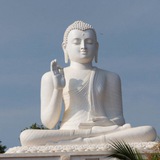
Dhammapada Verse 62
Anandasetthi Vatthu
Putta1 ma'tthi dhanam ma' tthi
iti balo vihannati
atta hi attano natthi
kuto putta kuto dhanam.
Verse 62: "I have sons, I have wealth"; with this (feeling of attachment) the fool is afflicted. Indeed, he himself is not his own, how can sons and wealth be his?
1. putta: sons also means both son and daughter.
The Story of Ananda, the Rich Man
While residing at the Jetavana monastery, the Buddha uttered Verse (62) of this book, with reference to a miserly rich man, named Ananda.
There was once a very wealthy man named Ananda in Savatthi. Although he possessed eighty crores, he was very reluctant to give anything in charity. To his son, Mulasiri, he used to say, "Don't think the wealth we have now is very much. Do not give away anything from what you have, for you must make it grow. Otherwise your wealth will dwindle away." This rich man had five pots of gold buried in his house and he died without revealing their location to his son.
Ananda, the rich man, was reborn in a village of beggars, not far from Savatthi. From the time his mother was pregnant, the income of the beggars decreased; the villagers thought there must be a wicked and unlucky one amongst them. By dividing themselves up into groups and by the process of elimination, they came to the conclusion that the pregnant beggar woman must be the unfortunate one. Thus, she was driven out of the village. When her son was born, the son proved to be extremely ugly and repulsive. If she went out begging by herself, she would get as before, but if she went out with her son she would get nothing. So, when the boy could go out by himself, his mother placed a plate in his hand and left him. As he wandered about in Savatthi, he remembered his old house and his past existence. So he went into the house. When the sons of his son Mulasiri saw him, they were frightened by his ugly looks and began to cry. The servants then beat him and threw him out of the house.
The Buddha who was on his alms-round saw the incident and asked the Venerable Ananda to fetch Mulasiri. When Mulasiri came, the Buddha told him that the young beggar was his own father in his previous existence. But Mulasiri could not believe it. So, the Buddha directed the beggar boy to show where he had buried his five pots of gold. Then only, Mulasiri accepted the truth and from that time he became a devoted lay-disciple of the Buddha.
Then the Buddha spoke in verse as follows:
Verse 62: "I have sons, I have wealth"; with this (feeling of attachment) the fool is afflicted. Indeed, he himself is not his own, how can sons and wealth be his?
Words of the Buddha channel:
https://news.1rj.ru/str/wordsofbuddha
====================
Anandasetthi Vatthu
Putta1 ma'tthi dhanam ma' tthi
iti balo vihannati
atta hi attano natthi
kuto putta kuto dhanam.
Verse 62: "I have sons, I have wealth"; with this (feeling of attachment) the fool is afflicted. Indeed, he himself is not his own, how can sons and wealth be his?
1. putta: sons also means both son and daughter.
The Story of Ananda, the Rich Man
While residing at the Jetavana monastery, the Buddha uttered Verse (62) of this book, with reference to a miserly rich man, named Ananda.
There was once a very wealthy man named Ananda in Savatthi. Although he possessed eighty crores, he was very reluctant to give anything in charity. To his son, Mulasiri, he used to say, "Don't think the wealth we have now is very much. Do not give away anything from what you have, for you must make it grow. Otherwise your wealth will dwindle away." This rich man had five pots of gold buried in his house and he died without revealing their location to his son.
Ananda, the rich man, was reborn in a village of beggars, not far from Savatthi. From the time his mother was pregnant, the income of the beggars decreased; the villagers thought there must be a wicked and unlucky one amongst them. By dividing themselves up into groups and by the process of elimination, they came to the conclusion that the pregnant beggar woman must be the unfortunate one. Thus, she was driven out of the village. When her son was born, the son proved to be extremely ugly and repulsive. If she went out begging by herself, she would get as before, but if she went out with her son she would get nothing. So, when the boy could go out by himself, his mother placed a plate in his hand and left him. As he wandered about in Savatthi, he remembered his old house and his past existence. So he went into the house. When the sons of his son Mulasiri saw him, they were frightened by his ugly looks and began to cry. The servants then beat him and threw him out of the house.
The Buddha who was on his alms-round saw the incident and asked the Venerable Ananda to fetch Mulasiri. When Mulasiri came, the Buddha told him that the young beggar was his own father in his previous existence. But Mulasiri could not believe it. So, the Buddha directed the beggar boy to show where he had buried his five pots of gold. Then only, Mulasiri accepted the truth and from that time he became a devoted lay-disciple of the Buddha.
Then the Buddha spoke in verse as follows:
Verse 62: "I have sons, I have wealth"; with this (feeling of attachment) the fool is afflicted. Indeed, he himself is not his own, how can sons and wealth be his?
Words of the Buddha channel:
https://news.1rj.ru/str/wordsofbuddha
====================
Telegram
Words of the Buddha
Daily teachings of Buddha Dharma
❤3👍1
Dhammapada Verse 63
Ganthibhedakacora Vatthu
Ya balo mannati balyam
panditovapi tena so
balo ca panditamani
sa ve baloti vuccati.
Verse 63: The fool who knows that he is a fool can, for that reason, be a wise man; but the fool who thinks that he is wise is, indeed, called a fool.
The Story of Two Pick-Pockets
While residing at the Jetavana monastery, the Buddha uttered Verse (63) of this book, with reference to two pick-pockets.
On one occasion, two pick-pockets joined a group of lay-disciples going to the Jetavana monastery, where the Buddha was giving a discourse. One of them listened attentively to the discourse and soon attained Sotapatti Fruition. However, the second thief did not attend to the discourse as he was bent on stealing only; and he managed to snatch a small sum of money from one of the lay-disciples. After the discourse they went back and cooked their meal at the house of the second thief, the one who managed to get some money. The wife of the second thief taunted the first thief, "You are so wise, you don't even have anything to cook at your house." Hearing this remark, the first thief thought to himself, "This one is so foolish that she thinks she is being very smart." Then, together with some relatives, he went to the Buddha and related the matter to him.
To the man, the Buddha spoke in verse as follows:
Verse 63: The fool who knows that he is a fool can, for that reason, be a wise man; but the fool who thinks that he is wise is, indeed, called a fool.
At the end of the discourse, all the relatives of the man attained Sotapatti Fruition.
Dhammapada, beloved and favorite teachings of the Buddha channel:
https://news.1rj.ru/str/dhammapadas
====================
Ganthibhedakacora Vatthu
Ya balo mannati balyam
panditovapi tena so
balo ca panditamani
sa ve baloti vuccati.
Verse 63: The fool who knows that he is a fool can, for that reason, be a wise man; but the fool who thinks that he is wise is, indeed, called a fool.
The Story of Two Pick-Pockets
While residing at the Jetavana monastery, the Buddha uttered Verse (63) of this book, with reference to two pick-pockets.
On one occasion, two pick-pockets joined a group of lay-disciples going to the Jetavana monastery, where the Buddha was giving a discourse. One of them listened attentively to the discourse and soon attained Sotapatti Fruition. However, the second thief did not attend to the discourse as he was bent on stealing only; and he managed to snatch a small sum of money from one of the lay-disciples. After the discourse they went back and cooked their meal at the house of the second thief, the one who managed to get some money. The wife of the second thief taunted the first thief, "You are so wise, you don't even have anything to cook at your house." Hearing this remark, the first thief thought to himself, "This one is so foolish that she thinks she is being very smart." Then, together with some relatives, he went to the Buddha and related the matter to him.
To the man, the Buddha spoke in verse as follows:
Verse 63: The fool who knows that he is a fool can, for that reason, be a wise man; but the fool who thinks that he is wise is, indeed, called a fool.
At the end of the discourse, all the relatives of the man attained Sotapatti Fruition.
Dhammapada, beloved and favorite teachings of the Buddha channel:
https://news.1rj.ru/str/dhammapadas
====================
Telegram
Dhammapada - Buddha Dharma Teachings
Daily teachings of the Dhammapada, beloved and favorite teachings of the Buddha
❤1👍1
Forwarded from Buddha Dharma books
Free Buddha Dharma ebook
Hemavata Sutta
A dhamma discourse by Mahasi Sayadaw Gyi
Hemavata Sutta is the second sermon delivered by Lord Buddha on the night, also the first sermon ‘Dhammacakka Sutta’ was preached to five ascetics after the attainment of Buddhahood. Lord Buddha became enlightened on full moon day of Kason (May) of 623 BC and these two sermons were delivered on full moon day of Waso (July) in the same year, which is 2368 years ago.
Free download available:
http://www.mediafire.com/file/gsjpfd5xnxkbgya/
=============
Hemavata Sutta
A dhamma discourse by Mahasi Sayadaw Gyi
Hemavata Sutta is the second sermon delivered by Lord Buddha on the night, also the first sermon ‘Dhammacakka Sutta’ was preached to five ascetics after the attainment of Buddhahood. Lord Buddha became enlightened on full moon day of Kason (May) of 623 BC and these two sermons were delivered on full moon day of Waso (July) in the same year, which is 2368 years ago.
Free download available:
http://www.mediafire.com/file/gsjpfd5xnxkbgya/
=============
❤1👍1
Dhammapada Verse 64
Udayitthera Vatthu
Yavajivampi ce balo
panditam payirupasati
na so dhammam vijanati
dabbi suparasam yatha.
Verse 64: A fool, even though he is associated with a wise man all his life, does not understand the Dhamma, just as a ladle does not know the taste of soup.
The Story of Thera Udayi
While residing at tho Jetavana monastery, the Buddha uttered Verse (64) of this book, with reference to Thera Udayi, a pretentious bhikkhu.
Thera Udayi would often go and sit on the platform from which learned theras delivered their discourses. On one occasion, some visiting bhikkhus, taking him for a very learned thera, put to him some questions on the five aggregates (khandhas). Thera Udayi could not answer, because he did not know anything of the dhamma. The visiting bhikkhus were greatly astonished to find that one staying in the same monastery with the Buddha knew so very little about the khandhas and the ayatanas (sense-bases and sense-objects).
To them, the Buddha spoke in verse as follows:
Verse 64: A fool, even though he is associated with a wise man all his life, does not understand the Dhamma, just as a ladle does not know the taste of soup.
At the end of the discourse, all the visiting bhikkhus attained arahatship.
Buddha dharma teachings channel:
https://invite.viber.com/?g2=AQAKw1y3rv%2F6sk61PI2W4izuIiaEZj8YZujhY1tSzL%2B07s7rFnVFDAd0bAYFaMLw
====================
Udayitthera Vatthu
Yavajivampi ce balo
panditam payirupasati
na so dhammam vijanati
dabbi suparasam yatha.
Verse 64: A fool, even though he is associated with a wise man all his life, does not understand the Dhamma, just as a ladle does not know the taste of soup.
The Story of Thera Udayi
While residing at tho Jetavana monastery, the Buddha uttered Verse (64) of this book, with reference to Thera Udayi, a pretentious bhikkhu.
Thera Udayi would often go and sit on the platform from which learned theras delivered their discourses. On one occasion, some visiting bhikkhus, taking him for a very learned thera, put to him some questions on the five aggregates (khandhas). Thera Udayi could not answer, because he did not know anything of the dhamma. The visiting bhikkhus were greatly astonished to find that one staying in the same monastery with the Buddha knew so very little about the khandhas and the ayatanas (sense-bases and sense-objects).
To them, the Buddha spoke in verse as follows:
Verse 64: A fool, even though he is associated with a wise man all his life, does not understand the Dhamma, just as a ladle does not know the taste of soup.
At the end of the discourse, all the visiting bhikkhus attained arahatship.
Buddha dharma teachings channel:
https://invite.viber.com/?g2=AQAKw1y3rv%2F6sk61PI2W4izuIiaEZj8YZujhY1tSzL%2B07s7rFnVFDAd0bAYFaMLw
====================
Viber
Buddha
Buddha dharma teachings from the suttas and commentaries from Theravada tradition
❤1👍1
Forwarded from Buddha Dharma books
Free Buddha Dharma ebook
What Buddhist Believe
By Venerable K. Sri Dhammananda
This book is written with a specific aim in mind: to introduce the original teaching clearly and without recourse to exaggeration, cultural implications or disparaging of particular schools of Buddhism, so that the reader can understand the Buddha Dhamma its modern context. There is a growing interest in Buddhism the world over because many informed people have grown rather weary of religious dogmatism and superstition, on one hand, and greed and selfishness arising from materialism, on the other. Buddhism can teach humanity to walk the Middle Path of moderation and have a better understanding on how to lead a richer life of peace and happiness.
Free download available:
http://ftp.budaedu.org/ebooks/pdf/EN049.pdf
=============
What Buddhist Believe
By Venerable K. Sri Dhammananda
This book is written with a specific aim in mind: to introduce the original teaching clearly and without recourse to exaggeration, cultural implications or disparaging of particular schools of Buddhism, so that the reader can understand the Buddha Dhamma its modern context. There is a growing interest in Buddhism the world over because many informed people have grown rather weary of religious dogmatism and superstition, on one hand, and greed and selfishness arising from materialism, on the other. Buddhism can teach humanity to walk the Middle Path of moderation and have a better understanding on how to lead a richer life of peace and happiness.
Free download available:
http://ftp.budaedu.org/ebooks/pdf/EN049.pdf
=============
❤2👍1
The Five Mindfulness Trainings
by Thich Nhat Hanh
The five mindfulness trainings are an expression of the five precepts, the core of Buddhist ethics. Thich Nhat Hanh offers a down-to-earth method of practicing mindfulness in daily life.
The Five Mindfulness Trainings represent the Buddhist vision for a global spirituality and ethic. They are a concrete expression of the Buddha’s teachings on the Four Noble Truths and the Noble Eightfold Path, the path of right understanding and true love, leading to healing, transformation, and happiness for ourselves and for the world. To practice the Five Mindfulness Trainings is to cultivate the insight of interbeing, or Right View, which can remove all discrimination, intolerance, anger, fear, and despair. If we live according to the Five Mindfulness Trainings, we are already on the path of a bodhisattva. Knowing we are on that path, we are not lost in confusion about our life in the present or in fears about the future.
1. Reverence For Life
Aware of the suffering caused by the destruction of life, I am committed to cultivating the insight of interbeing and compassion and learning ways to protect the lives of people, animals, plants, and minerals. I am determined not to kill, not to let others kill, and not to support any act of killing in the world, in my thinking, or in my way of life. Seeing that harmful actions arise from anger, fear, greed, and intolerance, which in turn come from dualistic and discriminative thinking, I will cultivate openness, non-discrimination, and non-attachment to views in order to transform violence, fanaticism, and dogmatism in myself and in the world.
2. True Happiness
Aware of the suffering caused by exploitation, social injustice, stealing, and oppression, I am committed to practicing generosity in my thinking, speaking, and acting. I am determined not to steal and not to possess anything that should belong to others; and I will share my time, energy, and material resources with those who are in need. I will practice looking deeply to see that the happiness and suffering of others are not separate from my own happiness and suffering; that true happiness is not possible without understanding and compassion; and that running after wealth, fame, power and sensual pleasures can bring much suffering and despair. I am aware that happiness depends on my mental attitude and not on external conditions, and that I can live happily in the present moment simply by remembering that I already have more than enough conditions to be happy. I am committed to practicing Right Livelihood so that I can help reduce the suffering of living beings on Earth and reverse the process of global warming.
3. True Love
Aware of the suffering caused by sexual misconduct, I am committed to cultivating responsibility and learning ways to protect the safety and integrity of individuals, couples, families, and society. Knowing that sexual desire is not love, and that sexual activity motivated by craving always harms myself as well as others, I am determined not to engage in sexual relations without true love and a deep, long-term commitment made known to my family and friends. I will do everything in my power to protect children from sexual abuse and to prevent couples and families from being broken by sexual misconduct. Seeing that body and mind are one, I am committed to learning appropriate ways to take care of my sexual energy and cultivating loving kindness, compassion, joy and inclusiveness – which are the four basic elements of true love – for my greater happiness and the greater happiness of others. Practicing true love, we know that we will continue beautifully into the future.
4. Loving Speech and Deep Listening
Aware of the suffering caused by unmindful speech and the inability to listen to others, I am committed to cultivating loving speech and compassionate listening in order to relieve suffering and to promote reconciliation and peace in myself and among other people, ethnic and religious groups, and nations.
by Thich Nhat Hanh
The five mindfulness trainings are an expression of the five precepts, the core of Buddhist ethics. Thich Nhat Hanh offers a down-to-earth method of practicing mindfulness in daily life.
The Five Mindfulness Trainings represent the Buddhist vision for a global spirituality and ethic. They are a concrete expression of the Buddha’s teachings on the Four Noble Truths and the Noble Eightfold Path, the path of right understanding and true love, leading to healing, transformation, and happiness for ourselves and for the world. To practice the Five Mindfulness Trainings is to cultivate the insight of interbeing, or Right View, which can remove all discrimination, intolerance, anger, fear, and despair. If we live according to the Five Mindfulness Trainings, we are already on the path of a bodhisattva. Knowing we are on that path, we are not lost in confusion about our life in the present or in fears about the future.
1. Reverence For Life
Aware of the suffering caused by the destruction of life, I am committed to cultivating the insight of interbeing and compassion and learning ways to protect the lives of people, animals, plants, and minerals. I am determined not to kill, not to let others kill, and not to support any act of killing in the world, in my thinking, or in my way of life. Seeing that harmful actions arise from anger, fear, greed, and intolerance, which in turn come from dualistic and discriminative thinking, I will cultivate openness, non-discrimination, and non-attachment to views in order to transform violence, fanaticism, and dogmatism in myself and in the world.
2. True Happiness
Aware of the suffering caused by exploitation, social injustice, stealing, and oppression, I am committed to practicing generosity in my thinking, speaking, and acting. I am determined not to steal and not to possess anything that should belong to others; and I will share my time, energy, and material resources with those who are in need. I will practice looking deeply to see that the happiness and suffering of others are not separate from my own happiness and suffering; that true happiness is not possible without understanding and compassion; and that running after wealth, fame, power and sensual pleasures can bring much suffering and despair. I am aware that happiness depends on my mental attitude and not on external conditions, and that I can live happily in the present moment simply by remembering that I already have more than enough conditions to be happy. I am committed to practicing Right Livelihood so that I can help reduce the suffering of living beings on Earth and reverse the process of global warming.
3. True Love
Aware of the suffering caused by sexual misconduct, I am committed to cultivating responsibility and learning ways to protect the safety and integrity of individuals, couples, families, and society. Knowing that sexual desire is not love, and that sexual activity motivated by craving always harms myself as well as others, I am determined not to engage in sexual relations without true love and a deep, long-term commitment made known to my family and friends. I will do everything in my power to protect children from sexual abuse and to prevent couples and families from being broken by sexual misconduct. Seeing that body and mind are one, I am committed to learning appropriate ways to take care of my sexual energy and cultivating loving kindness, compassion, joy and inclusiveness – which are the four basic elements of true love – for my greater happiness and the greater happiness of others. Practicing true love, we know that we will continue beautifully into the future.
4. Loving Speech and Deep Listening
Aware of the suffering caused by unmindful speech and the inability to listen to others, I am committed to cultivating loving speech and compassionate listening in order to relieve suffering and to promote reconciliation and peace in myself and among other people, ethnic and religious groups, and nations.
Telegram
Ajahn Chah - Theravada Thailand Buddhism
Collection of teachings of Venerable Ajahn Chah, a foremost meditation and Buddhist teacher from Thailand
❤1👍1
Knowing that words can create happiness or suffering, I am committed to speaking truthfully using words that inspire confidence, joy, and hope. When anger is manifesting in me, I am determined not to speak. I will practice mindful breathing and walking in order to recognize and to look deeply into my anger. I know that the roots of anger can be found in my wrong perceptions and lack of understanding of the suffering in myself and in the other person. I will speak and listen in a way that can help myself and the other person to transform suffering and see the way out of difficult situations. I am determined not to spread news that I do not know to be certain and not to utter words that can cause division or discord. I will practice Right Diligence to nourish my capacity for understanding, love, joy, and inclusiveness, and gradually transform anger, violence, and fear that lie deep in my consciousness.
5. Nourishment and Healing
Aware of the suffering caused by unmindful consumption, I am committed to cultivating good health, both physical and mental, for myself, my family, and my society by practicing mindful eating, drinking, and consuming. I will practice looking deeply into how I consume the Four Kinds of Nutriments, namely edible foods, sense impressions, volition, and consciousness. I am determined not to gamble, or to use alcohol, drugs, or any other products which contain toxins, such as certain websites, electronic games, TV programs, films, magazines, books, and conversations. I will practice coming back to the present moment to be in touch with the refreshing, healing and nourishing elements in me and around me, not letting regrets and sorrow drag me back into the past nor letting anxieties, fear, or craving pull me out of the present moment. I am determined not to try to cover up loneliness, anxiety, or other suffering by losing myself in consumption. I will contemplate interbeing and consume in a way that preserves peace, joy, and well-being in my body and consciousness, and in the collective body and consciousness of my family, my society and the Earth.
About Thich Nhat Hanh
Thich Nhat Hanh (1926-2022) was a renowned Zen teacher and poet, the founder of the Engaged Buddhist movement, and the founder of nine monastic communities, including Plum Village Monastery in France. He was also the author of At Home in the World, The Other Shore, and more than a hundred other books that have sold millions of copies worldwide.
Ajahn Chah, Buddhist teacher of Thai forest meditation of Theravada Buddhism channel:
https://news.1rj.ru/str/ajahnchah_buddhism
5. Nourishment and Healing
Aware of the suffering caused by unmindful consumption, I am committed to cultivating good health, both physical and mental, for myself, my family, and my society by practicing mindful eating, drinking, and consuming. I will practice looking deeply into how I consume the Four Kinds of Nutriments, namely edible foods, sense impressions, volition, and consciousness. I am determined not to gamble, or to use alcohol, drugs, or any other products which contain toxins, such as certain websites, electronic games, TV programs, films, magazines, books, and conversations. I will practice coming back to the present moment to be in touch with the refreshing, healing and nourishing elements in me and around me, not letting regrets and sorrow drag me back into the past nor letting anxieties, fear, or craving pull me out of the present moment. I am determined not to try to cover up loneliness, anxiety, or other suffering by losing myself in consumption. I will contemplate interbeing and consume in a way that preserves peace, joy, and well-being in my body and consciousness, and in the collective body and consciousness of my family, my society and the Earth.
About Thich Nhat Hanh
Thich Nhat Hanh (1926-2022) was a renowned Zen teacher and poet, the founder of the Engaged Buddhist movement, and the founder of nine monastic communities, including Plum Village Monastery in France. He was also the author of At Home in the World, The Other Shore, and more than a hundred other books that have sold millions of copies worldwide.
Ajahn Chah, Buddhist teacher of Thai forest meditation of Theravada Buddhism channel:
https://news.1rj.ru/str/ajahnchah_buddhism
Telegram
Ajahn Chah - Theravada Thailand Buddhism
Collection of teachings of Venerable Ajahn Chah, a foremost meditation and Buddhist teacher from Thailand
❤1👍1
Dhammapada Verse 65
Timsapaveyyakabhikkhu Vatthu
Muhuttamapi ce vinnu
panditam payirupasati
khippam dhammam vijanati
jivha suparasam yatha.
Verse 65: An intelligent man, even though he is associated with a wise man only for a moment, quickly understands the Dhamma, just as the tongue knows the taste of soup.
The Story of Thirty Bhikkhus from Paveyyaka
While residing at the Jetavana monastery, the Buddha uttered Verse (65) of this book, with reference to thirty bhikkhus from Paveyyaka.
Thirty youths from Paveyyaka were, on one occasion, enjoying themselves with a prostitute in a forest, when the prostitute stole some of their valuable ornaments and ran away. While searching for her in the forest, they met the Buddha on the way. As the Buddha delivered them a discourse the youths attained Sotapatti Fruition, and all of them joined the Order of the Buddha and followed him to the Jetavana monastery. While staying at the monastery, they strictly observed the austerity or purification practice (dhutanga). Later, when the Buddha delivered the Anamatagga Sutta (Discourse on Countless Existences), all those bhikkhus attained arahatship.
When other bhikkhus commented that Paveyyaka bhikkhus were very quick in attaining arahatship, the Buddha replied to them in verse, as follows:
Verse 65: An intelligent man, even though he is associated with a wise man only for a moment, quickly understands the Dhamma, just as the tongue knows the taste of soup.
Words of the Buddha channel:
https://invite.viber.com/?g2=AQAFqzqlj7FmI061PX17rxWMAtZ%2BRuso%2FH2KmHKZSgnv7v9DD8X0bDkKnZDr9JDq
====================
Timsapaveyyakabhikkhu Vatthu
Muhuttamapi ce vinnu
panditam payirupasati
khippam dhammam vijanati
jivha suparasam yatha.
Verse 65: An intelligent man, even though he is associated with a wise man only for a moment, quickly understands the Dhamma, just as the tongue knows the taste of soup.
The Story of Thirty Bhikkhus from Paveyyaka
While residing at the Jetavana monastery, the Buddha uttered Verse (65) of this book, with reference to thirty bhikkhus from Paveyyaka.
Thirty youths from Paveyyaka were, on one occasion, enjoying themselves with a prostitute in a forest, when the prostitute stole some of their valuable ornaments and ran away. While searching for her in the forest, they met the Buddha on the way. As the Buddha delivered them a discourse the youths attained Sotapatti Fruition, and all of them joined the Order of the Buddha and followed him to the Jetavana monastery. While staying at the monastery, they strictly observed the austerity or purification practice (dhutanga). Later, when the Buddha delivered the Anamatagga Sutta (Discourse on Countless Existences), all those bhikkhus attained arahatship.
When other bhikkhus commented that Paveyyaka bhikkhus were very quick in attaining arahatship, the Buddha replied to them in verse, as follows:
Verse 65: An intelligent man, even though he is associated with a wise man only for a moment, quickly understands the Dhamma, just as the tongue knows the taste of soup.
Words of the Buddha channel:
https://invite.viber.com/?g2=AQAFqzqlj7FmI061PX17rxWMAtZ%2BRuso%2FH2KmHKZSgnv7v9DD8X0bDkKnZDr9JDq
====================
Viber
Words Of The Buddha
Daily teachings from Buddha Dharma
❤2👍1
I have heard that on one occasion the Blessed One was staying near Savatthi in Jeta's Grove, Anathapindika's monastery. There Ven. Sariputta addressed the monks, saying, "Friend monks!"
"Yes, friend," the monks responded.
Ven. Sariputta said: "Friends, just as the footprints of all legged animals are encompassed by the footprint of the elephant, and the elephant's footprint is reckoned the foremost among them in terms of size; in the same way, all skillful qualities are gathered under the four noble truths. Under which four? Under the noble truth of sufferings, under the noble truth of the origination of sufferings, under the noble truth of the cessation of sufferings, and under the noble truth of the path of practice leading to the cessation of sufferings.
Maha-hatthipadopama Sutta: The Great Elephant Footprint Simile.
MN 28
"Yes, friend," the monks responded.
Ven. Sariputta said: "Friends, just as the footprints of all legged animals are encompassed by the footprint of the elephant, and the elephant's footprint is reckoned the foremost among them in terms of size; in the same way, all skillful qualities are gathered under the four noble truths. Under which four? Under the noble truth of sufferings, under the noble truth of the origination of sufferings, under the noble truth of the cessation of sufferings, and under the noble truth of the path of practice leading to the cessation of sufferings.
Maha-hatthipadopama Sutta: The Great Elephant Footprint Simile.
MN 28
❤2👍1🏆1
Dhammapada Verse 66
Suppabuddhakutthi Vatthu
Caranti bala dummedha
amitteneva attana
karonta papakam kammam
yam hoti katukapphalam.
Verse 66: With themselves as their own enemies, fools lacking in intelligence, move about doing evil deeds, which bear bitter fruits.
The Story of Suppabuddha, the Leper
While residing at the Jetavana monastery, the Buddha uttered Verse (66) of this book, with reference to Suppabuddha, a leper.
Suppabuddha, the leper, while sitting at the back of the crowd and listening attentively to the discourse given by the Buddha, attained Sotapatti Fruition. When the crowd had dispersed, he followed the Buddha to the monastery as he wished to tell the Buddha about his attainment of Sotapatti Fruition. Sakka, king of the devas, wishing to test the leper's faith in the Buddha, the Dhamma and the Samgha, appeared to him and said, "You are only a poor man, living on what you get by begging, with no one to fall back on. I can give you immense wealth if you deny the Buddha, the Dhamma and the Samgha and say that you have no use for them." To this, Suppabuddha replied. "I am certainly not a poor man, with no one to rely on. I am a rich man; I possess the seven attributes which the ariyas possess; I have faith (saddha), morality (sila), sense of shame to do evil (hiri), sense of fear to do evil (ottappa), learning (sula), generosity (caga) and knowledge (panna).
Then, Sakka went to the Buddha ahead of Suppabuddha and related the conversation between himself and Suppabuddha. To him the Buddha replied that it would not be easy even for a hundred or a thousand Sakkas to coax Suppabuddha away from the Buddha, the Dhamma and the Samgha. Soon after this, Suppabuddha arrived at the monastery and reported to the Buddha about his attainment of Sotapatti Fruition. On his way back from the Jetavana monastery, Suppabuddha was gored to death by an infuriated cow, who, in fact, was an ogress assuming the form of a cow. This ogress was none other than the prostitute who was killed by Suppabuddha in one of his previous existences and who had vowed to have her revenge on him.
When the news of Suppabuddha's death reached the Jetavana monastery, the bhikkhus asked the Buddha where Suppabuddha was reborn and the Buddha replied to them that Suppabuddha was reborn in Tavatimsa deva realm. The Buddha also explained to them that Suppabuddha was born a leper because, in one of his previous existences, he had spat upon a paccekabuddha.
Then the Buddha spoke in verse as follows:
Verse 66: With themselves as their own enemies, fools lacking in intelligence, move about doing evil deeds, which bear bitter fruits.
Dhammapada, beloved and favorite teachings of the Buddha channel:
https://invite.viber.com/?g2=AQBLD6phsgvP%2F061YjEM3K%2BNeH1Yb372b9mtfQX2EmuBpgoLUoc99BDMfzHghrme
====================
Suppabuddhakutthi Vatthu
Caranti bala dummedha
amitteneva attana
karonta papakam kammam
yam hoti katukapphalam.
Verse 66: With themselves as their own enemies, fools lacking in intelligence, move about doing evil deeds, which bear bitter fruits.
The Story of Suppabuddha, the Leper
While residing at the Jetavana monastery, the Buddha uttered Verse (66) of this book, with reference to Suppabuddha, a leper.
Suppabuddha, the leper, while sitting at the back of the crowd and listening attentively to the discourse given by the Buddha, attained Sotapatti Fruition. When the crowd had dispersed, he followed the Buddha to the monastery as he wished to tell the Buddha about his attainment of Sotapatti Fruition. Sakka, king of the devas, wishing to test the leper's faith in the Buddha, the Dhamma and the Samgha, appeared to him and said, "You are only a poor man, living on what you get by begging, with no one to fall back on. I can give you immense wealth if you deny the Buddha, the Dhamma and the Samgha and say that you have no use for them." To this, Suppabuddha replied. "I am certainly not a poor man, with no one to rely on. I am a rich man; I possess the seven attributes which the ariyas possess; I have faith (saddha), morality (sila), sense of shame to do evil (hiri), sense of fear to do evil (ottappa), learning (sula), generosity (caga) and knowledge (panna).
Then, Sakka went to the Buddha ahead of Suppabuddha and related the conversation between himself and Suppabuddha. To him the Buddha replied that it would not be easy even for a hundred or a thousand Sakkas to coax Suppabuddha away from the Buddha, the Dhamma and the Samgha. Soon after this, Suppabuddha arrived at the monastery and reported to the Buddha about his attainment of Sotapatti Fruition. On his way back from the Jetavana monastery, Suppabuddha was gored to death by an infuriated cow, who, in fact, was an ogress assuming the form of a cow. This ogress was none other than the prostitute who was killed by Suppabuddha in one of his previous existences and who had vowed to have her revenge on him.
When the news of Suppabuddha's death reached the Jetavana monastery, the bhikkhus asked the Buddha where Suppabuddha was reborn and the Buddha replied to them that Suppabuddha was reborn in Tavatimsa deva realm. The Buddha also explained to them that Suppabuddha was born a leper because, in one of his previous existences, he had spat upon a paccekabuddha.
Then the Buddha spoke in verse as follows:
Verse 66: With themselves as their own enemies, fools lacking in intelligence, move about doing evil deeds, which bear bitter fruits.
Dhammapada, beloved and favorite teachings of the Buddha channel:
https://invite.viber.com/?g2=AQBLD6phsgvP%2F061YjEM3K%2BNeH1Yb372b9mtfQX2EmuBpgoLUoc99BDMfzHghrme
====================
Viber
Dhammapada - Buddha Dharma Teachings
Daily teachings of the Dhammapada, beloved and favorite teachings of the Buddha
❤2👍1
Suffering and the End of Suffering
Did the Buddha only teach one thing?
By Thanissaro Bhikkhu
There’s a fake Buddha quote you may have heard. It quotes the Buddha as saying, “I teach one thing and one thing only: suffering and the end of suffering.” The fake part is the “one thing and one thing only.” He did say, “All I teach is suffering and the end of suffering,” but people tend to focus on the “one thing only.”
I’ve read some teachers interpret this, saying that there’s a subtle teaching here: that suffering and the end of suffering are the same thing. From there, they go on to say, “What this means is that if you learn to accept the fact of suffering, then there’s no more suffering,” which is a pretty bleak teaching. It goes together with the One Method and One Method Only teaching, i.e., that the basic teaching is simply to watch things arising and passing away, and that’s all you have to do. Learn not to get involved and everything will be okay. That’s the highest happiness you can expect.
Again, the Buddha didn’t teach that. Suffering is one thing; the end of suffering is something else. They both come from actions—different actions—which makes all the difference in the world. If there’s only one thing to do, such as just passively accepting whatever’s going on, then you’re let off the hook. There wouldn’t be a need for very much discernment to go into the path because there wouldn’t be many choices made. In fact, you’d be learning how not to make choices—trying to develop choiceless awareness.
But the fact is that you’re making choices all the time, and what you’re experiencing right now is the result of choices you’ve made in the past plus choices you’re making right now. A major part of the path is learning how to accept that fact and then to work with it—to do something positive with it. In other words, if there’s suffering right now, you’ve been making some bad choices in the past and you’re making some bad choices right now. If you weren’t making bad choices right now, there wouldn’t be any suffering. So wherever there’s any stress or dukkha in any of its forms, you’ve got to look into what you’re doing. Then you can change what you’re doing and shape a different present: that’s the positive point.
Now, because what you’re experiencing right now is a combination of different factors, that means you have to look and look again. Those pleasures and pains don’t come marked with a country of origin, i.e., past karma or present karma. A large part of the meditation is learning how to sort that out: which things are coming from past intentions and which things are coming from present intentions. And what are your present intentions right now? This throws all the responsibility on you. The teacher’s here to give advice, to see if you’re going off course and to help with a little course correction. But then again, you have to be responsible for deciding whether you want to take the advice or not.
This is the hard part of the path, and it’s one of the reasons why people like to hear that there’s a One Size Fits All meditation method, and the method itself has just one option: accept. It takes the responsibility off their shoulders. But you’re not going to gain discernment that way. You gain discernment from making choices and then learning how to read them. It’s not the case that you’ll go immediately to total understanding of what’s the past karma you’re experiencing right now and what’s the present karma. You learn bit by bit.
Start by trying to get the mind as still as possible. This is the basic pattern in all the tetrads of the breath meditation. You sensitize yourself to what you’re doing, and then you try to do it in a way that leads to greater calm, to more subtle forms of concentration and more subtle levels of pleasure. You work through this process of sensitizing and refinement step by step by step, which means that you have to be very observant.
Did the Buddha only teach one thing?
By Thanissaro Bhikkhu
There’s a fake Buddha quote you may have heard. It quotes the Buddha as saying, “I teach one thing and one thing only: suffering and the end of suffering.” The fake part is the “one thing and one thing only.” He did say, “All I teach is suffering and the end of suffering,” but people tend to focus on the “one thing only.”
I’ve read some teachers interpret this, saying that there’s a subtle teaching here: that suffering and the end of suffering are the same thing. From there, they go on to say, “What this means is that if you learn to accept the fact of suffering, then there’s no more suffering,” which is a pretty bleak teaching. It goes together with the One Method and One Method Only teaching, i.e., that the basic teaching is simply to watch things arising and passing away, and that’s all you have to do. Learn not to get involved and everything will be okay. That’s the highest happiness you can expect.
Again, the Buddha didn’t teach that. Suffering is one thing; the end of suffering is something else. They both come from actions—different actions—which makes all the difference in the world. If there’s only one thing to do, such as just passively accepting whatever’s going on, then you’re let off the hook. There wouldn’t be a need for very much discernment to go into the path because there wouldn’t be many choices made. In fact, you’d be learning how not to make choices—trying to develop choiceless awareness.
But the fact is that you’re making choices all the time, and what you’re experiencing right now is the result of choices you’ve made in the past plus choices you’re making right now. A major part of the path is learning how to accept that fact and then to work with it—to do something positive with it. In other words, if there’s suffering right now, you’ve been making some bad choices in the past and you’re making some bad choices right now. If you weren’t making bad choices right now, there wouldn’t be any suffering. So wherever there’s any stress or dukkha in any of its forms, you’ve got to look into what you’re doing. Then you can change what you’re doing and shape a different present: that’s the positive point.
Now, because what you’re experiencing right now is a combination of different factors, that means you have to look and look again. Those pleasures and pains don’t come marked with a country of origin, i.e., past karma or present karma. A large part of the meditation is learning how to sort that out: which things are coming from past intentions and which things are coming from present intentions. And what are your present intentions right now? This throws all the responsibility on you. The teacher’s here to give advice, to see if you’re going off course and to help with a little course correction. But then again, you have to be responsible for deciding whether you want to take the advice or not.
This is the hard part of the path, and it’s one of the reasons why people like to hear that there’s a One Size Fits All meditation method, and the method itself has just one option: accept. It takes the responsibility off their shoulders. But you’re not going to gain discernment that way. You gain discernment from making choices and then learning how to read them. It’s not the case that you’ll go immediately to total understanding of what’s the past karma you’re experiencing right now and what’s the present karma. You learn bit by bit.
Start by trying to get the mind as still as possible. This is the basic pattern in all the tetrads of the breath meditation. You sensitize yourself to what you’re doing, and then you try to do it in a way that leads to greater calm, to more subtle forms of concentration and more subtle levels of pleasure. You work through this process of sensitizing and refinement step by step by step, which means that you have to be very observant.
Telegram
Buddha Dharma books
Free Buddhism books, teachings, podcasts and videos from Theravada, Mahayana and Vajrayana traditions
❤2👍1🏆1
The Buddha gives you some guidance. If you notice that things are inconstant in the mind, especially if the level of stress or ease in the mind is inconstant, look at what you’re doing. When the level of stress goes up, what did you do? When it goes down, what did you do? When things seem to be perfectly still and perfectly at ease, try to maintain that stillness and see if you can begin to sensitize yourself to more subtle ups and downs.
This keeps throwing the responsibility back on you. The Buddha’s there with guidance. He gives you lots of different meditation methods to deal with specific problems as they come up. Breath meditation is your home base because it’s a method that sensitizes you directly to bodily, verbal, and mental fabrication, and points you in the direction of learning how to calm these things.
But sometimes issues come up in the mind that are a lot more blatant than that. That’s when you need contemplation of the body, contemplation of death, contemplation of the principle of karma, reflections on the Buddha, the Dharma, and the Sangha: all of these things are there to help you with whatever the specific problem that’s coming up, whether it’s laziness or lack of self-confidence. There are ways of thinking that can get you around those problems, all with the purpose of getting you back to the breath—because it’s when you’re with the breath that you can see your subtle intentions most clearly.
Those are the troublemakers. Those are the things you want to see more and more clearly so that you can figure out exactly where you’re making choices right now, and who, in the bureaucracy of your mind, is making the choice. Sometimes decisions get sent up to the top, and you realize that there’s an issue you have to deal with. But there are a lot of lower-level management people who will make quick decisions and send things back down again without consulting you. If there weren’t, your mind would be totally flooded with all kinds of stuff. The problem is, though, that some of those middle-level decisions are not very wise. So you’ve got to get the mind more and more still to see where the subtle decisions are being made and if they’re actually in your best interest.
So suffering is not the same thing as the end of suffering. The Buddha didn’t teach just one thing; he didn’t teach just one method. The mind, after all, is a complex thing, and you need lots of approaches to work with it. Which is why we need all this time to meditate: to get to know things, to stick with something for a while until you can see where you’re doing it wrong. Then you can do a course correction.
So, accept the fact that there will be some right and some wrong in what you’re doing all the time. You have to approach this with a certain amount of humility: Okay, yup, you are doing something wrong. But you’ve also got some rightness, too, and a lot of the practice is learning to figure out which is which so that you can increase the rightness. It’ll be up to you to make the distinction. After all, when awakening comes, nobody else does it for you. That’s a matter of your powers of observation, your discernment, and your sensitivity to the choices the mind is making. This gets more subtle with practice as you take on the responsibility.
You say, “Okay, there’s suffering there, I know. I’m not going to blame anybody else.” But blaming yourself doesn’t mean that you’re a bad person—simply that there’s been a lack of skill, and that’s something that can be corrected. This will take time; it requires patience. Just as the Buddha said that to get to know someone well, you have to spend time with that person and be with them in lots of different situations to get a rounded view, the same principle applies to your mind. To get a rounded view of what’s going on in your mind—where there’s suffering and stress, and what’s causing it—you have to spend time and be observant.
This keeps throwing the responsibility back on you. The Buddha’s there with guidance. He gives you lots of different meditation methods to deal with specific problems as they come up. Breath meditation is your home base because it’s a method that sensitizes you directly to bodily, verbal, and mental fabrication, and points you in the direction of learning how to calm these things.
But sometimes issues come up in the mind that are a lot more blatant than that. That’s when you need contemplation of the body, contemplation of death, contemplation of the principle of karma, reflections on the Buddha, the Dharma, and the Sangha: all of these things are there to help you with whatever the specific problem that’s coming up, whether it’s laziness or lack of self-confidence. There are ways of thinking that can get you around those problems, all with the purpose of getting you back to the breath—because it’s when you’re with the breath that you can see your subtle intentions most clearly.
Those are the troublemakers. Those are the things you want to see more and more clearly so that you can figure out exactly where you’re making choices right now, and who, in the bureaucracy of your mind, is making the choice. Sometimes decisions get sent up to the top, and you realize that there’s an issue you have to deal with. But there are a lot of lower-level management people who will make quick decisions and send things back down again without consulting you. If there weren’t, your mind would be totally flooded with all kinds of stuff. The problem is, though, that some of those middle-level decisions are not very wise. So you’ve got to get the mind more and more still to see where the subtle decisions are being made and if they’re actually in your best interest.
So suffering is not the same thing as the end of suffering. The Buddha didn’t teach just one thing; he didn’t teach just one method. The mind, after all, is a complex thing, and you need lots of approaches to work with it. Which is why we need all this time to meditate: to get to know things, to stick with something for a while until you can see where you’re doing it wrong. Then you can do a course correction.
So, accept the fact that there will be some right and some wrong in what you’re doing all the time. You have to approach this with a certain amount of humility: Okay, yup, you are doing something wrong. But you’ve also got some rightness, too, and a lot of the practice is learning to figure out which is which so that you can increase the rightness. It’ll be up to you to make the distinction. After all, when awakening comes, nobody else does it for you. That’s a matter of your powers of observation, your discernment, and your sensitivity to the choices the mind is making. This gets more subtle with practice as you take on the responsibility.
You say, “Okay, there’s suffering there, I know. I’m not going to blame anybody else.” But blaming yourself doesn’t mean that you’re a bad person—simply that there’s been a lack of skill, and that’s something that can be corrected. This will take time; it requires patience. Just as the Buddha said that to get to know someone well, you have to spend time with that person and be with them in lots of different situations to get a rounded view, the same principle applies to your mind. To get a rounded view of what’s going on in your mind—where there’s suffering and stress, and what’s causing it—you have to spend time and be observant.
❤2👍1👏1