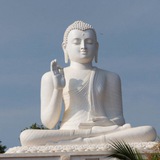
Dhammapada Verse 68
Sumanamalakara Vatthu
Tanca kammam katam sadhu
yam katva nanutappati
yassa patito sumano
vipikam patisevati.
Verse 68: That deed is well done if one has not to repent for having done it, and if one is delightful and happy with the result of that deed.
The Story of Sumana, the Florist
While residing at the Jetavana monastery, the Buddha uttered Verse (68) of this book, with reference to Sumana the florist.
A florist, named Sumana, had to supply King Bimbisara of Rajagaha with jasmin flowers every morning. One day, as he was going to the king's palace he saw the Buddha, with a halo of light-rays radiating from him, coming into town for alms-food accompanied by many bhikkhus. Seeing the Buddha in his resplendent glory, the florist Sumana felt a strong desire to offer his flowers to the Buddha. Then and there, he decided that even if the king were to drive him out of the country or to kill him, he would not offer the flowers to the king for that day. Thus, he threw up the flowers to the sides, to the back and over and above the head of the Buddha. The flowers remained hanging in the air; those over the head formed a canopy of flowers and those at the back and the sides formed walls of flowers. These flowers followed the Buddha in this position as he moved on, and stopped when the Buddha stopped. As the Buddha proceeded, surrounded by walls of flowers, and a canopy of flowers, with the six-coloured rays radiating from his body, followed by a large entourage, thousands of people inside and outside of Rajagaha came out of their houses to pay obeisance to the Buddha. As for Sumana, his entire body was suffused with delightful satisfaction (Piti).
The wife of the florist Sumana then went to the king and said that she had nothing to do with her husband failing to supply the king with flowers for that day. The king, being a Sotapanna himself, felt quite happy about the flowers. He came out to see the wonderful sight and paid obeisance to the Buddha. The king also took the opportunity to offer alms-food to the Buddha and his disciples. After the meal, the Buddha returned in the Jetavana monastery and the king followed him for some distance. On arrival back at the palace King Bimbisara sent for Sumana and offered him a reward of eight elephants, eight horses, eight male slaves, eight female slaves, eight maidens and eight thousand in cash.
At the Jetavana monastery, the Venerable Ananda asked the Buddha what benefits Sumana would gain by his good deed done on that day. The Buddha answered that Sumana, having given to the Buddha without any consideration for his life, would not be born in any of the four lower worlds (Apaya) for the next one hundred thousand worlds and that eventually he would become a paccekabuddha. After that, as the Buddha entered the Perfumed Hall (Gandhakuti) the flowers dropped off of their own accord.
That night, at the end of the usual discourse, the Buddha spoke in verse as follows:
Verse 68: That deed is well done if one has not to repent for having done it, and if one is delightful and happy with the result of that deed.
Buddha dharma teachings channel:
https://news.1rj.ru/str/lorddivinebuddha
====================
Sumanamalakara Vatthu
Tanca kammam katam sadhu
yam katva nanutappati
yassa patito sumano
vipikam patisevati.
Verse 68: That deed is well done if one has not to repent for having done it, and if one is delightful and happy with the result of that deed.
The Story of Sumana, the Florist
While residing at the Jetavana monastery, the Buddha uttered Verse (68) of this book, with reference to Sumana the florist.
A florist, named Sumana, had to supply King Bimbisara of Rajagaha with jasmin flowers every morning. One day, as he was going to the king's palace he saw the Buddha, with a halo of light-rays radiating from him, coming into town for alms-food accompanied by many bhikkhus. Seeing the Buddha in his resplendent glory, the florist Sumana felt a strong desire to offer his flowers to the Buddha. Then and there, he decided that even if the king were to drive him out of the country or to kill him, he would not offer the flowers to the king for that day. Thus, he threw up the flowers to the sides, to the back and over and above the head of the Buddha. The flowers remained hanging in the air; those over the head formed a canopy of flowers and those at the back and the sides formed walls of flowers. These flowers followed the Buddha in this position as he moved on, and stopped when the Buddha stopped. As the Buddha proceeded, surrounded by walls of flowers, and a canopy of flowers, with the six-coloured rays radiating from his body, followed by a large entourage, thousands of people inside and outside of Rajagaha came out of their houses to pay obeisance to the Buddha. As for Sumana, his entire body was suffused with delightful satisfaction (Piti).
The wife of the florist Sumana then went to the king and said that she had nothing to do with her husband failing to supply the king with flowers for that day. The king, being a Sotapanna himself, felt quite happy about the flowers. He came out to see the wonderful sight and paid obeisance to the Buddha. The king also took the opportunity to offer alms-food to the Buddha and his disciples. After the meal, the Buddha returned in the Jetavana monastery and the king followed him for some distance. On arrival back at the palace King Bimbisara sent for Sumana and offered him a reward of eight elephants, eight horses, eight male slaves, eight female slaves, eight maidens and eight thousand in cash.
At the Jetavana monastery, the Venerable Ananda asked the Buddha what benefits Sumana would gain by his good deed done on that day. The Buddha answered that Sumana, having given to the Buddha without any consideration for his life, would not be born in any of the four lower worlds (Apaya) for the next one hundred thousand worlds and that eventually he would become a paccekabuddha. After that, as the Buddha entered the Perfumed Hall (Gandhakuti) the flowers dropped off of their own accord.
That night, at the end of the usual discourse, the Buddha spoke in verse as follows:
Verse 68: That deed is well done if one has not to repent for having done it, and if one is delightful and happy with the result of that deed.
Buddha dharma teachings channel:
https://news.1rj.ru/str/lorddivinebuddha
====================
Telegram
Buddha
Buddha dharma teachings from the suttas and commentaries
❤1👍1🥰1
Forwarded from Buddha Dharma books
Free Buddhism ebook
Esoteric Theravada
The Story of the Forgotten Meditation Tradition of Southeast Asia
By Kate Crosby
Theravada Buddhism, often understood as the school that most carefully preserved the practices taught by the Buddha, has undergone tremendous change over time. Prior to Western colonialism in Asia—which brought Western and modernist intellectual concerns, such as the separation of science and religion, to bear on Buddhism—there existed a tradition of embodied, esoteric, and culturally regional Theravada meditation practices. This once-dominant traditional meditation system, known as borān kammaṭṭhāna, is related to—yet remarkably distinct from—Vipassana and other Buddhist and secular mindfulness practices that would become the hallmark of Theravada Buddhism in the twentieth century. Drawing on a quarter century of research, scholar Kate Crosby offers the first holistic discussion of borān kammaṭṭhāna, illuminating the historical events and cultural processes by which the practice has been marginalized in the modern era.
Free download here:
https://zlibrary.to/dl/esoteric-theravada-the-story-of-the-forgotten-meditation-tradition-of-southeast-asia
Esoteric Theravada
The Story of the Forgotten Meditation Tradition of Southeast Asia
By Kate Crosby
Theravada Buddhism, often understood as the school that most carefully preserved the practices taught by the Buddha, has undergone tremendous change over time. Prior to Western colonialism in Asia—which brought Western and modernist intellectual concerns, such as the separation of science and religion, to bear on Buddhism—there existed a tradition of embodied, esoteric, and culturally regional Theravada meditation practices. This once-dominant traditional meditation system, known as borān kammaṭṭhāna, is related to—yet remarkably distinct from—Vipassana and other Buddhist and secular mindfulness practices that would become the hallmark of Theravada Buddhism in the twentieth century. Drawing on a quarter century of research, scholar Kate Crosby offers the first holistic discussion of borān kammaṭṭhāna, illuminating the historical events and cultural processes by which the practice has been marginalized in the modern era.
Free download here:
https://zlibrary.to/dl/esoteric-theravada-the-story-of-the-forgotten-meditation-tradition-of-southeast-asia
zlibrary.to
Esoteric Theravada: The Story of the Forgotten Meditation Tradition of Southeast Asia PDF
Read & Download PDF Esoteric Theravada: The Story of the Forgotten Meditation Tradition of Southeast Asia Free, Update the latest version with high-quality. Try NOW!
👍2❤1
Forwarded from Buddha Dharma books
Free Buddha Dharma ebook
Buddhist Dictionary
Manuals of Buddhist Terms and Doctrines
By Nyanatiloka
Free download here:
http://ftp.budaedu.org/ebooks/pdf/EN012.pdf
=============
Buddhist Dictionary
Manuals of Buddhist Terms and Doctrines
By Nyanatiloka
Free download here:
http://ftp.budaedu.org/ebooks/pdf/EN012.pdf
=============
❤1👍1
Dhammapada Verse 69
Uppalavannattheri Vatthu
Madhumva mannati balo
yava papam na paccati
yada ca paccati papam
atha dukkham nigacchati.
Verse 69: As long as the evil deed does not bear fruit, the fool thinks it is sweet like honey; but when his evil deed does bear fruit, the fool suffers for it.
The Story of Theri Uppalavanna
While residing at the Jetavana monastery, the Buddha uttered Verse (69) of this book, with reference to Theri Uppalavanna.
Once there was a young daughter of a rich man in Savatthi. Because she was so beautiful, with looks so tender and sweet, like a blue lotus flower, she was called "Uppalavanna", the blue lotus. The fame of her beauty spread far and wide and there were many suitors: princes, rich men and many others. But she decided that it would be better for her to become a bhikkhuni, a female member of the Buddhist Order. One day, after lighting a lamp, she kept her mind fixed on the flame and meditating on the fire kasina (object of concentration) she soon achieved Magga Insight and finally attained arahatship.
Some time later, she moved to the 'Dark Forest' (Andhavana) and lived in solitude. While Theri Uppalavanna was out on her alms-round, Nanda, the son of her uncle, came to her monastery and hid himself underneath her couch. Nanda had fallen in love with Uppalavanna before she became a bhikkhuni; his intention obviously was to take her by force. When Uppalavanna returned she saw Nanda and said, "You fool! Do no harm, do not molest." But he would not be stopped. After satisfying himself, he left her. As soon as he stepped on the ground, the earth opened wide and he was swallowed up.
Hearing about this, the Buddha spoke in verse as follows:
Verse 69: As long as the evil deed does not bear fruit, the fool thinks it is sweet like honey; but when his evil deed does bear fruit, the fool suffers for it.
At the end of the discourse, many attained Sotapatti Fruition.
The Buddha next sent for King Pasenadi of Kosala and told him about the dangers that bhikkhunis living in forests had to face from irresponsible persons obsessed with sex. The king then promised to build monasteries for bhikkhunis only in towns or close to the towns.
Tibetan Buddhism - Vajrayana, Tantrayana and esoteric Buddhism channel:
https://news.1rj.ru/str/tibetanbuddha
Vajrayana Tantrayana Buddhism channel:
https://news.1rj.ru/str/tantrayanabuddhism
====================
Uppalavannattheri Vatthu
Madhumva mannati balo
yava papam na paccati
yada ca paccati papam
atha dukkham nigacchati.
Verse 69: As long as the evil deed does not bear fruit, the fool thinks it is sweet like honey; but when his evil deed does bear fruit, the fool suffers for it.
The Story of Theri Uppalavanna
While residing at the Jetavana monastery, the Buddha uttered Verse (69) of this book, with reference to Theri Uppalavanna.
Once there was a young daughter of a rich man in Savatthi. Because she was so beautiful, with looks so tender and sweet, like a blue lotus flower, she was called "Uppalavanna", the blue lotus. The fame of her beauty spread far and wide and there were many suitors: princes, rich men and many others. But she decided that it would be better for her to become a bhikkhuni, a female member of the Buddhist Order. One day, after lighting a lamp, she kept her mind fixed on the flame and meditating on the fire kasina (object of concentration) she soon achieved Magga Insight and finally attained arahatship.
Some time later, she moved to the 'Dark Forest' (Andhavana) and lived in solitude. While Theri Uppalavanna was out on her alms-round, Nanda, the son of her uncle, came to her monastery and hid himself underneath her couch. Nanda had fallen in love with Uppalavanna before she became a bhikkhuni; his intention obviously was to take her by force. When Uppalavanna returned she saw Nanda and said, "You fool! Do no harm, do not molest." But he would not be stopped. After satisfying himself, he left her. As soon as he stepped on the ground, the earth opened wide and he was swallowed up.
Hearing about this, the Buddha spoke in verse as follows:
Verse 69: As long as the evil deed does not bear fruit, the fool thinks it is sweet like honey; but when his evil deed does bear fruit, the fool suffers for it.
At the end of the discourse, many attained Sotapatti Fruition.
The Buddha next sent for King Pasenadi of Kosala and told him about the dangers that bhikkhunis living in forests had to face from irresponsible persons obsessed with sex. The king then promised to build monasteries for bhikkhunis only in towns or close to the towns.
Tibetan Buddhism - Vajrayana, Tantrayana and esoteric Buddhism channel:
https://news.1rj.ru/str/tibetanbuddha
Vajrayana Tantrayana Buddhism channel:
https://news.1rj.ru/str/tantrayanabuddhism
====================
Telegram
Tibetan Buddhism Vajrayana Tantrayana esoteric tradition
Buddha Dharma teachings from the esoteric Vajrayana or Tantrayana Buddhism, includes all major schools Nyingma, Kagyu, Gelug, Sakya, Jonang and Bonpo.
❤2👍1
Dhammapada Verse 70
Jambukatthera Vatthu
Mase mase kusaggena
balo bhunjeyya bhojanam
na so sankhatadhammanam
kalam agghati solasim.
Verse 70: Even though, month after month, the fool (living in austerity) takes his food sparingly with the tip of a grass blade, he is not worth even one-sixteenth part of those who have comprehended the Truth (i.e., the ariyas).
The Story of Thera Jambuka
While residing at the Jetavana monastery, the Buddha uttered Verse (70) of this book, with reference to Thera Jambuka.
Jambuka was the son of a rich man in Savatthi. Due to his past evil deeds he was born with very peculiar habits. As a child, he wanted to sleep on the floor with no proper bed, and to take his own excreta for food instead of rice. When he grew older, his parents sent him to the Ajivakas, the naked ascetics. When those ascetics found out about his peculiar food habits they drove him away. At nights he ate human excreta and in the day time stood still on one leg and kept his mouth open. He used to say that he kept his mouth open because he only lived on air and that he stood on one leg because it would otherwise be too heavy for the earth to bear him. "I never sit down, I never go to sleep," he boasted and on account of this, he was known as Jambuka, a 'jackal'.
Many people believed him and some would come to him with offerings of choice food. Then Jambuka would refuse and say, "I do not take any food except air." When pressed, he would take just a little of the food with the tip of a blade of grass and say, "Now go, this little will give you enough merit." In this way, Jambuka lived for fifty-five years, naked and taking only excreta.
One day, the Buddha saw in his vision that Jambuka was due to attain arahatship within a short time. So, in the evening, the Buddha went to where Jambuka was staying and asked for some place to spend the night. Jambuka pointed out to him a mountain-cave not far from the stone slab on which he himself was staying. During the first, second and third watches of the night, the Catumaharajika devas, Sakka and Mahabrahma came to pay homage to the Buddha in turn. On all the three occasions, the forest was lit up and Jambuka saw the light three times. In the morning, he walked over to the Buddha and enquired about the lights.
When told about the devas, Sakka and Mahabrahma coming to pay homage to the Buddha, Jambuka was very much impressed, and said to the Buddha, "You must, indeed, be a wonderfully great person for the devas, Sakka and Mahabrahma to come and pay homage to you. As for me, even though I have practised austerely for fifty-five years, living only on air and standing only on one leg, none of the devas, nor Sakka, nor Mahabrahma has ever came to me" To him, the Buddha replied, "O Jambuka! You have been deceiving other people, but you cannot deceive me. I know that for fifty-five years you have been eating excreta and sleeping on the ground."
Furthermore, the Buddha explained to him how in one of his past existences during the time of Kassapa Buddha, Jambuka had prevented a thera from going with him to the house of a lay-disciple where alms-food was being offered and how he had also thrown away the food that was sent along with him for that thera. It was for those evil deeds that Jambuka had to be eating excreta and sleeping on the ground. Hearing that account, Jambuka was horrified and terror-stricken, and repented for having done evil and for having deceived other people. He went down on his knees and the Buddha gave him a piece of cloth to put on. The Buddha then proceeded to deliver a discourse; at the end of the discourse Jambuka attained arahatship and joined the Buddhist Order on the spot.
Soon after this, Jambuka's pupils from Anga and Magadha arrived and they were surprised to see their teacher with the Buddha. Thera Jambuka then explained to his pupils that he had joined the Buddhist Order and that he was now only a disciple of the Buddha.
Jambukatthera Vatthu
Mase mase kusaggena
balo bhunjeyya bhojanam
na so sankhatadhammanam
kalam agghati solasim.
Verse 70: Even though, month after month, the fool (living in austerity) takes his food sparingly with the tip of a grass blade, he is not worth even one-sixteenth part of those who have comprehended the Truth (i.e., the ariyas).
The Story of Thera Jambuka
While residing at the Jetavana monastery, the Buddha uttered Verse (70) of this book, with reference to Thera Jambuka.
Jambuka was the son of a rich man in Savatthi. Due to his past evil deeds he was born with very peculiar habits. As a child, he wanted to sleep on the floor with no proper bed, and to take his own excreta for food instead of rice. When he grew older, his parents sent him to the Ajivakas, the naked ascetics. When those ascetics found out about his peculiar food habits they drove him away. At nights he ate human excreta and in the day time stood still on one leg and kept his mouth open. He used to say that he kept his mouth open because he only lived on air and that he stood on one leg because it would otherwise be too heavy for the earth to bear him. "I never sit down, I never go to sleep," he boasted and on account of this, he was known as Jambuka, a 'jackal'.
Many people believed him and some would come to him with offerings of choice food. Then Jambuka would refuse and say, "I do not take any food except air." When pressed, he would take just a little of the food with the tip of a blade of grass and say, "Now go, this little will give you enough merit." In this way, Jambuka lived for fifty-five years, naked and taking only excreta.
One day, the Buddha saw in his vision that Jambuka was due to attain arahatship within a short time. So, in the evening, the Buddha went to where Jambuka was staying and asked for some place to spend the night. Jambuka pointed out to him a mountain-cave not far from the stone slab on which he himself was staying. During the first, second and third watches of the night, the Catumaharajika devas, Sakka and Mahabrahma came to pay homage to the Buddha in turn. On all the three occasions, the forest was lit up and Jambuka saw the light three times. In the morning, he walked over to the Buddha and enquired about the lights.
When told about the devas, Sakka and Mahabrahma coming to pay homage to the Buddha, Jambuka was very much impressed, and said to the Buddha, "You must, indeed, be a wonderfully great person for the devas, Sakka and Mahabrahma to come and pay homage to you. As for me, even though I have practised austerely for fifty-five years, living only on air and standing only on one leg, none of the devas, nor Sakka, nor Mahabrahma has ever came to me" To him, the Buddha replied, "O Jambuka! You have been deceiving other people, but you cannot deceive me. I know that for fifty-five years you have been eating excreta and sleeping on the ground."
Furthermore, the Buddha explained to him how in one of his past existences during the time of Kassapa Buddha, Jambuka had prevented a thera from going with him to the house of a lay-disciple where alms-food was being offered and how he had also thrown away the food that was sent along with him for that thera. It was for those evil deeds that Jambuka had to be eating excreta and sleeping on the ground. Hearing that account, Jambuka was horrified and terror-stricken, and repented for having done evil and for having deceived other people. He went down on his knees and the Buddha gave him a piece of cloth to put on. The Buddha then proceeded to deliver a discourse; at the end of the discourse Jambuka attained arahatship and joined the Buddhist Order on the spot.
Soon after this, Jambuka's pupils from Anga and Magadha arrived and they were surprised to see their teacher with the Buddha. Thera Jambuka then explained to his pupils that he had joined the Buddhist Order and that he was now only a disciple of the Buddha.
👍2❤1
To them, the Buddha said that although their teacher had lived austerely by taking food very sparingly, it was not worth even one-sixteenth part of his present practice and achievement.
Then the Buddha spoke in verse as follows:
Verse 70: Even though, month after month, the fool (living in austerity) takes his food sparingly with the tip of a grass blade, he is not worth even one-sixteenth part of those who have comprehended the Truth (i.e., the ariyas).
Words of the Buddha channel:
https://news.1rj.ru/str/wordsofbuddha
====================
Then the Buddha spoke in verse as follows:
Verse 70: Even though, month after month, the fool (living in austerity) takes his food sparingly with the tip of a grass blade, he is not worth even one-sixteenth part of those who have comprehended the Truth (i.e., the ariyas).
Words of the Buddha channel:
https://news.1rj.ru/str/wordsofbuddha
====================
Telegram
Words of the Buddha
Daily teachings of Buddha Dharma
❤1👍1
The enso symbolizes absolute enlightenment, strength, elegance, the universe, and emptiness in Japanese Zen Buddhism.
The circle may be open or closed. An open circle symbolises the state of incomplete, allowing for movement and development and the perfection of all things. Zen practitioners relate the idea to wabi-sabi, the beauty of imperfection. When the circle is closed, it represents perfection
The circle may be open or closed. An open circle symbolises the state of incomplete, allowing for movement and development and the perfection of all things. Zen practitioners relate the idea to wabi-sabi, the beauty of imperfection. When the circle is closed, it represents perfection
❤1👍1👌1
Unlocking the Wisdom of the Heart Sutra
by Venerable Guan Cheng
The Heart Sutra is a pithy, powerful text. If you understand it, says Ven. Guan Cheng, you understand the Buddha’s teachings.
The Heart of the Perfection of Wisdom Sutra, often just called the Heart Sutra, is very important in Mahayana Buddhism. It’s the summary of the Diamond Sutra, which is itself the summary of the Great Perfection of Wisdom Sutra—a sutra of six hundred volumes.
Though the Heart Sutra is a very short sutra, it contains many Buddhist concepts. If you understand the meaning of the Heart Sutra, then you have a very good grasp of the Buddha’s teachings.
The Heart of the Perfection of Wisdom Sutra is called the Prajnaparamita Hrdaya Sutra in Sanskrit. The first part of the noscript, prajna, can be subdivided into pra and jna, with pra meaning “supreme” and jna meaning “consciousness” or “understanding.” Therefore, prajna means “supreme understanding” or “supreme consciousness.”
The second part of the noscript, paramita, means perfection. The term can be subdivided into parama, meaning “the other shore,” and ita, meaning “that which has arrived.” So, if you follow, study, and practice prajna, you will arrive at the other shore. You will depart from this shore of confusion and suffering, cross the ocean, and get to that perfect shore of enlightenment and nirvana, which is free from suffering and mental defilements.
The last part of the sutra’s noscript, hrdaya, means “heart.” Here, “heart” does not just mean the physical flesh and blood heart, but rather the essence of the Great Perfection of Wisdom Sutra.
The Five Skandhas
In the Heart Sutra, Avalokitesvara Bodhisattva and Shariputra, one of the Buddha’s principle disciples, talk about the fundamental emptiness of all phenomena.
The most important lines of the Heart Sutra are “Avalokitesvara Bodhisattva, when practicing the profound prajnaparamita, perceived that the five skandhas are empty, and thereby became free from all suffering.”
Skandha literally means “heap,” “bundle,” or “aggregate,” because each skandha is a collection of many other things. We are made up of the five skandhas. That is, when they come together, we are created. The five skandhas are form, sensation, perception, volition, and consciousness.
The first skandha, form, is the physical body or materiality of any being or object, including sense organs. The second skandha, sensation, is physical feeling or sensory experience. This encompasses the physical body’s six sense organs (eye, ear, nose, tongue, body, and mind) in contact with the six sense objects (form, sound, smell, taste, bodily impression, and mental objects). Perceiving through our senses leads to the three types of sensations that make up our sensory experience: pleasant, unpleasant, and neutral.
The third skandha is perception or conceptualization—the mental process that recognizes and describes characteristics of form such as shape, color, length, pain, pleasure, etc. The fourth skandha is volition or mental formations. That is, when the six sense organs interact with the outside world, a reaction happens instantly inside your mind. You may not notice it, because it happens so fast, but you instantly interact with and respond to your perceptions, psychologically and emotionally. This mental function becomes the basis for future actions as well as for the arising of craving or desire.
Finally, the fifth skandha is consciousness or cognitive discrimination. This goes beyond perception and involves awareness and recognition, as well as memory, for understanding the six forms of consciousness. The six organs correspond to the six forms of consciousness: eyes see objects and create visual consciousness; ears hear sound and create auditory consciousness; the nose smells odors and creates the olfactory consciousness; the tongue tastes and creates taste consciousness; the body feels touch to create tactile consciousness; and the brain thinks to create mind consciousness.
by Venerable Guan Cheng
The Heart Sutra is a pithy, powerful text. If you understand it, says Ven. Guan Cheng, you understand the Buddha’s teachings.
The Heart of the Perfection of Wisdom Sutra, often just called the Heart Sutra, is very important in Mahayana Buddhism. It’s the summary of the Diamond Sutra, which is itself the summary of the Great Perfection of Wisdom Sutra—a sutra of six hundred volumes.
Though the Heart Sutra is a very short sutra, it contains many Buddhist concepts. If you understand the meaning of the Heart Sutra, then you have a very good grasp of the Buddha’s teachings.
The Heart of the Perfection of Wisdom Sutra is called the Prajnaparamita Hrdaya Sutra in Sanskrit. The first part of the noscript, prajna, can be subdivided into pra and jna, with pra meaning “supreme” and jna meaning “consciousness” or “understanding.” Therefore, prajna means “supreme understanding” or “supreme consciousness.”
The second part of the noscript, paramita, means perfection. The term can be subdivided into parama, meaning “the other shore,” and ita, meaning “that which has arrived.” So, if you follow, study, and practice prajna, you will arrive at the other shore. You will depart from this shore of confusion and suffering, cross the ocean, and get to that perfect shore of enlightenment and nirvana, which is free from suffering and mental defilements.
The last part of the sutra’s noscript, hrdaya, means “heart.” Here, “heart” does not just mean the physical flesh and blood heart, but rather the essence of the Great Perfection of Wisdom Sutra.
The Five Skandhas
In the Heart Sutra, Avalokitesvara Bodhisattva and Shariputra, one of the Buddha’s principle disciples, talk about the fundamental emptiness of all phenomena.
The most important lines of the Heart Sutra are “Avalokitesvara Bodhisattva, when practicing the profound prajnaparamita, perceived that the five skandhas are empty, and thereby became free from all suffering.”
Skandha literally means “heap,” “bundle,” or “aggregate,” because each skandha is a collection of many other things. We are made up of the five skandhas. That is, when they come together, we are created. The five skandhas are form, sensation, perception, volition, and consciousness.
The first skandha, form, is the physical body or materiality of any being or object, including sense organs. The second skandha, sensation, is physical feeling or sensory experience. This encompasses the physical body’s six sense organs (eye, ear, nose, tongue, body, and mind) in contact with the six sense objects (form, sound, smell, taste, bodily impression, and mental objects). Perceiving through our senses leads to the three types of sensations that make up our sensory experience: pleasant, unpleasant, and neutral.
The third skandha is perception or conceptualization—the mental process that recognizes and describes characteristics of form such as shape, color, length, pain, pleasure, etc. The fourth skandha is volition or mental formations. That is, when the six sense organs interact with the outside world, a reaction happens instantly inside your mind. You may not notice it, because it happens so fast, but you instantly interact with and respond to your perceptions, psychologically and emotionally. This mental function becomes the basis for future actions as well as for the arising of craving or desire.
Finally, the fifth skandha is consciousness or cognitive discrimination. This goes beyond perception and involves awareness and recognition, as well as memory, for understanding the six forms of consciousness. The six organs correspond to the six forms of consciousness: eyes see objects and create visual consciousness; ears hear sound and create auditory consciousness; the nose smells odors and creates the olfactory consciousness; the tongue tastes and creates taste consciousness; the body feels touch to create tactile consciousness; and the brain thinks to create mind consciousness.
Telegram
Ajahn Chah - Theravada Thailand Buddhism
Collection of teachings of Venerable Ajahn Chah, a foremost meditation and Buddhist teacher from Thailand
❤1👍1
Only the first skandha, form, is objective; it is the physical matter that exists. As we use our senses, we perceive through them. Sometimes we call the senses perceiving objective matter “empirical” and say that our senses are connecting with objects empirically. However, since the other skandhas are all mental, they are in fact subjective. With the skandhas, the subjective perceives the objective. When you say something objectively exists, it is objective that it exists and has matter. But when we perceive, think about, and analyze it, we do so subjectively.
It’s vital to understand what your senses are and do, because they interact with the outside world. The senses open the doors of your body to the world and open the world to your heart. At the same time, your senses also are the culprits of suffering. Your senses can help you, but they can also ruin you if you misuse them.
Normally, when we use our senses, we attach to what we can touch, see, hear, etc. But empirical evidence can be illusory. While we generally agree with each other, everybody perceives a little differently with their senses. When you see something red, you say, “This is red,” unless you’re colorblind. When a dog barks, you might say, “Oh, a dog is barking!” Yet there are some people who hear the dog’s barking as the howling of a wolf. Everybody’s different; it all depends on how you perceive. So, our senses are not trustworthy.
The skandhas give rise to the ego consciousness (manas vijnana), which interprets the subjective portion of sensation, perception, volition, and consciousness as self. This deluded view of the five skandhas as a “self” leads to ignorance and arrogance. If we see the five skandhas as employees, the ego consciousness is the “mind manager.”
Introspection means always considering that empirical thinking could be wrong. The Buddha said, “We cannot trust our senses. We must go introspectively, to see what we are seeing.” What needs to be considered is not what you see, but rather how you see it, or your process of seeing. The Buddha said, “Don’t just believe in what you see, you have to know how you see it.”
Understanding the process of perception (the process of seeing things, hearing things, etc.) is called experiential thinking. It requires being introspective and understanding your mind. This is what the Buddha meant when he encouraged us to understand the subjective skandhas. To know how your sensation, your perception, your volition, and your consciousness gives rise to the ego, you must turn from empirical thinking to experiential thinking.
The Four Interdependent Functions of Consciousness
There are four interdependent functions of consciousness that reflect the process of the skandhas and the mind manager.
The first interdependent function of consciousness is the object. Let’s take a sheet of paper as an example. The paper itself is an object, the portion that is seen. Second, there’s the subjective or the seeing portion. The subjective is a mental tape measure that’s used to see the sheet’s length and width. Third, there’s the self-witnessing portion, the portion that knows the subject has seen the object. The self-witnessing function cognizes how long and how wide the sheet of paper is. Fourth, there’s the rewitnessing portion, which completes the mental faculty. The rewitnessing function recognizes the accuracy of the measurement (i.e., “Is that correct? Is my tape measure accurate?”).
Though you may not realize it, every conscious effort and interaction involves these four interdependent functions of consciousness. Your eyes see an object, but your eyes are only a seeing function. You must stand behind your eyes to look at your consciousness. In other words, you must not be attached to the subject and the object. You must step back and say, “Is the subject I’m seeing something real?”
It’s vital to understand what your senses are and do, because they interact with the outside world. The senses open the doors of your body to the world and open the world to your heart. At the same time, your senses also are the culprits of suffering. Your senses can help you, but they can also ruin you if you misuse them.
Normally, when we use our senses, we attach to what we can touch, see, hear, etc. But empirical evidence can be illusory. While we generally agree with each other, everybody perceives a little differently with their senses. When you see something red, you say, “This is red,” unless you’re colorblind. When a dog barks, you might say, “Oh, a dog is barking!” Yet there are some people who hear the dog’s barking as the howling of a wolf. Everybody’s different; it all depends on how you perceive. So, our senses are not trustworthy.
The skandhas give rise to the ego consciousness (manas vijnana), which interprets the subjective portion of sensation, perception, volition, and consciousness as self. This deluded view of the five skandhas as a “self” leads to ignorance and arrogance. If we see the five skandhas as employees, the ego consciousness is the “mind manager.”
Introspection means always considering that empirical thinking could be wrong. The Buddha said, “We cannot trust our senses. We must go introspectively, to see what we are seeing.” What needs to be considered is not what you see, but rather how you see it, or your process of seeing. The Buddha said, “Don’t just believe in what you see, you have to know how you see it.”
Understanding the process of perception (the process of seeing things, hearing things, etc.) is called experiential thinking. It requires being introspective and understanding your mind. This is what the Buddha meant when he encouraged us to understand the subjective skandhas. To know how your sensation, your perception, your volition, and your consciousness gives rise to the ego, you must turn from empirical thinking to experiential thinking.
The Four Interdependent Functions of Consciousness
There are four interdependent functions of consciousness that reflect the process of the skandhas and the mind manager.
The first interdependent function of consciousness is the object. Let’s take a sheet of paper as an example. The paper itself is an object, the portion that is seen. Second, there’s the subjective or the seeing portion. The subjective is a mental tape measure that’s used to see the sheet’s length and width. Third, there’s the self-witnessing portion, the portion that knows the subject has seen the object. The self-witnessing function cognizes how long and how wide the sheet of paper is. Fourth, there’s the rewitnessing portion, which completes the mental faculty. The rewitnessing function recognizes the accuracy of the measurement (i.e., “Is that correct? Is my tape measure accurate?”).
Though you may not realize it, every conscious effort and interaction involves these four interdependent functions of consciousness. Your eyes see an object, but your eyes are only a seeing function. You must stand behind your eyes to look at your consciousness. In other words, you must not be attached to the subject and the object. You must step back and say, “Is the subject I’m seeing something real?”
❤1👍1
When you’re seeing someone with hatred and anger, then that rewitnessing portion can stand back and say, “I’m discriminating against this person and seeing them with anger. Could I see them with love?” The rewitnessing portion can also work in harmful ways. For example, your ego consciousness, the mind manager, can assess with your eyes and say, “Hey, here comes John and that guy is bad! He ripped me off, so I’m going to do the same thing to him!” In this case, you’re standing back as a third person, and you’re influencing your subject, yourself, to do negative things. The rewitnessing portion after this interaction is protecting your ego.
The same phenomena can create different conceptualizations. There’s a Japanese poem, where a man claps his hands. What happens? The birds are scared by the sound and fly away because they think somebody is shooting. The koi fish in the pond rush to the water’s surface, because the man always claps when he feeds them. And the man’s maids immediately begin to prepare tea because they think his clapping means he wants to entertain guests.
It’s the same clap of hands, but it creates different sensations: fear in the birds, happiness in the koi, and anticipation in the maids. It also creates different conceptualizations: the birds conceptualize the claps as an attack, the koi as feeding, the maids as a request from their boss to prepare tea.
Indeed, one clap contains all five skandhas. It contains form, sensation, perception, volition, and consciousness.
Emptiness
Let’s turn to another important line in the Heart Sutra that helps us understand why the five skandhas are empty: “Form is none other than emptiness. Emptiness is none other than form.”
Form, one of the five skandhas, refers to anything we can perceive with our senses—not just the form of something we touch, but also, for example, the form of a sound we can hear. Form refers to all phenomena, and in form we find sensation, perception, volition, and consciousness, that is, the other four skandhas. To say “Form is none other than emptiness. Emptiness is none other than form” means that form and emptiness are not different from nor apart from each other.
We ignorantly believe in the inherent substance and permanence of things. Emptiness is a fundamental concept in Buddhism. Emptiness does not mean nothing; in fact, emptiness allows for the existence of all things. Emptiness is full of everything, full of life. Therefore, emptiness does not have a negative connotation.
To be empty does not mean nonexistent. Instead, emptiness means empty of independent existence. Everything exists due to causation and dependent arising. Everything, both material elements and mental elements, are characterized by causation. So, things being empty does not mean that they don’t exist, but rather that they’re nothing but appearances. All things are nonself. They do not have “true reality.” All things are impermanent.
When we say that the five skandhas are empty, we mean that the five skandhas are empty of independent existence. It doesn’t mean that things do not exist, but rather that their existence is dependent on multiple causes and conditions. Nothing has its own inherent self-nature, because everything comes into being and is dependent on conditional causation.
Causation
The law of causation is cause and effect, that is, if there’s a cause, there must be an effect and vice versa. Form arises dependent on causes and conditions.
Forms do not have “own-being” or “own-becoming” (svabhava in Sanskrit). Svabhava is the notion that an object has its own intrinsic nature of coming into being; it does not depend on any condition, has no causes for its becoming, can avoid changing, and can exist permanently. But the existence of any object must belong to an existent reality, which means that it must be conditioned, dependent on other entities, and possessed of causes. Svabhava is by definition unconditioned, not dependent on other entities, and not caused. Thus, the existence of svabhava is impossible.
The same phenomena can create different conceptualizations. There’s a Japanese poem, where a man claps his hands. What happens? The birds are scared by the sound and fly away because they think somebody is shooting. The koi fish in the pond rush to the water’s surface, because the man always claps when he feeds them. And the man’s maids immediately begin to prepare tea because they think his clapping means he wants to entertain guests.
It’s the same clap of hands, but it creates different sensations: fear in the birds, happiness in the koi, and anticipation in the maids. It also creates different conceptualizations: the birds conceptualize the claps as an attack, the koi as feeding, the maids as a request from their boss to prepare tea.
Indeed, one clap contains all five skandhas. It contains form, sensation, perception, volition, and consciousness.
Emptiness
Let’s turn to another important line in the Heart Sutra that helps us understand why the five skandhas are empty: “Form is none other than emptiness. Emptiness is none other than form.”
Form, one of the five skandhas, refers to anything we can perceive with our senses—not just the form of something we touch, but also, for example, the form of a sound we can hear. Form refers to all phenomena, and in form we find sensation, perception, volition, and consciousness, that is, the other four skandhas. To say “Form is none other than emptiness. Emptiness is none other than form” means that form and emptiness are not different from nor apart from each other.
We ignorantly believe in the inherent substance and permanence of things. Emptiness is a fundamental concept in Buddhism. Emptiness does not mean nothing; in fact, emptiness allows for the existence of all things. Emptiness is full of everything, full of life. Therefore, emptiness does not have a negative connotation.
To be empty does not mean nonexistent. Instead, emptiness means empty of independent existence. Everything exists due to causation and dependent arising. Everything, both material elements and mental elements, are characterized by causation. So, things being empty does not mean that they don’t exist, but rather that they’re nothing but appearances. All things are nonself. They do not have “true reality.” All things are impermanent.
When we say that the five skandhas are empty, we mean that the five skandhas are empty of independent existence. It doesn’t mean that things do not exist, but rather that their existence is dependent on multiple causes and conditions. Nothing has its own inherent self-nature, because everything comes into being and is dependent on conditional causation.
Causation
The law of causation is cause and effect, that is, if there’s a cause, there must be an effect and vice versa. Form arises dependent on causes and conditions.
Forms do not have “own-being” or “own-becoming” (svabhava in Sanskrit). Svabhava is the notion that an object has its own intrinsic nature of coming into being; it does not depend on any condition, has no causes for its becoming, can avoid changing, and can exist permanently. But the existence of any object must belong to an existent reality, which means that it must be conditioned, dependent on other entities, and possessed of causes. Svabhava is by definition unconditioned, not dependent on other entities, and not caused. Thus, the existence of svabhava is impossible.
❤1👍1
Therefore, everything is asvabhava, meaning it has “no own-being” or “no own-becoming.” This means that all things are nonself, empty, and without intrinsic existence. All things are changeable and therefore impermanent. Because of this impermanence, we experience suffering.
Let us use waves and water as an example. Waves rise from the water. Waves are not other than the water. Water is not other than the waves. Water and waves have the same nature.
We can also think of emptiness as gold, and jewelry as form. Earrings, rings, bracelets, necklaces, etc., arise from the conditional causation of gold. Ornaments are contained in gold, and gold is contained in ornaments. Because all phenomena arise from the conditional causation of emptiness, form is emptiness. If you want to realize the radiance and beauty of gold, you cannot do so apart from its various forms. Because one cannot experience emptiness without phenomena, emptiness is form.
Emptiness and form cannot be separated from each other. If the bulb and the electricity are separated, the bulb cannot show its functionality, and the electricity has no means to express its energy. Apart from the mind, there’s no phenomena. Apart from phenomena, the mind does not know. That is, phenomena exist because of the mind; the mind is conscious through phenomena.
When we realize this, a simple piece of paper comes to be not just a sheet of paper, but rather the many causes put together to constitute that piece of paper. From a tree, comes pulp; the pulp goes to a factory, which makes it into sheets.
On the other hand, when you burn paper, you may have the illusion of destroying it. You may say, “The paper is dying, because I’m burning it.” But the ashes from the paper will fall to the ground and become part of the soil nourishing new trees.
Therefore, there’s no limit, as far as changeability, as far as the conditional causality of that piece of paper. A limited, restricted view would say it’s merely a piece of paper, but a broad view of it shows that it’s boundless, limitless. How can you put a limit on a piece of paper? In the piece of paper, I see a beautiful tree. I see nourishing soil. I see a cloud. I see rain. I see sunlight.
The Importance of Practice
Commit this sentence to memory: “If we perceive that the five skandhas are empty, we become free from our suffering.” When you realize that the five skandhas are empty, then gradually, you realize an enlightened understanding.
Who am I? I am nothing but my senses. I’m nothing but body and mind reacting to environments, and I exist for a hundred years in the process of this reaction. So, we must understand further beyond these senses, beyond our environments, and what actually is this reaction. To do this, we need more than a superficial understanding.
If you read a book about emptiness and the five skandhas, you can easily understand what it means. But there’s a difference between perceived knowledge and enlightened knowledge. If you read a book, you perceive certain knowledge, but it’s just a perception.
It’s not enough to have an intellectual understanding of the Buddha’s teachings. You have to practice them. Then you get an enlightened understanding. Enlightenment is a deeper understanding through practice.
You’ve got to walk your path, not just talk about it. It doesn’t matter how many dharma books you read or how many dharma YouTube videos you watch. Some people are constant learners: they want to read, they want to listen, but they never practice. Don’t put your fashion clothes on the hanger! Put them on and walk the catwalk. Practice, practice, practice!
Once you understand all the conditions for the senses and the body to exist, contemplate how you use your body. How do you use your senses? What do you use them for? Some people use their body to steal, their tongue to lie, their mind to create harmful weapons.
Let us use waves and water as an example. Waves rise from the water. Waves are not other than the water. Water is not other than the waves. Water and waves have the same nature.
We can also think of emptiness as gold, and jewelry as form. Earrings, rings, bracelets, necklaces, etc., arise from the conditional causation of gold. Ornaments are contained in gold, and gold is contained in ornaments. Because all phenomena arise from the conditional causation of emptiness, form is emptiness. If you want to realize the radiance and beauty of gold, you cannot do so apart from its various forms. Because one cannot experience emptiness without phenomena, emptiness is form.
Emptiness and form cannot be separated from each other. If the bulb and the electricity are separated, the bulb cannot show its functionality, and the electricity has no means to express its energy. Apart from the mind, there’s no phenomena. Apart from phenomena, the mind does not know. That is, phenomena exist because of the mind; the mind is conscious through phenomena.
When we realize this, a simple piece of paper comes to be not just a sheet of paper, but rather the many causes put together to constitute that piece of paper. From a tree, comes pulp; the pulp goes to a factory, which makes it into sheets.
On the other hand, when you burn paper, you may have the illusion of destroying it. You may say, “The paper is dying, because I’m burning it.” But the ashes from the paper will fall to the ground and become part of the soil nourishing new trees.
Therefore, there’s no limit, as far as changeability, as far as the conditional causality of that piece of paper. A limited, restricted view would say it’s merely a piece of paper, but a broad view of it shows that it’s boundless, limitless. How can you put a limit on a piece of paper? In the piece of paper, I see a beautiful tree. I see nourishing soil. I see a cloud. I see rain. I see sunlight.
The Importance of Practice
Commit this sentence to memory: “If we perceive that the five skandhas are empty, we become free from our suffering.” When you realize that the five skandhas are empty, then gradually, you realize an enlightened understanding.
Who am I? I am nothing but my senses. I’m nothing but body and mind reacting to environments, and I exist for a hundred years in the process of this reaction. So, we must understand further beyond these senses, beyond our environments, and what actually is this reaction. To do this, we need more than a superficial understanding.
If you read a book about emptiness and the five skandhas, you can easily understand what it means. But there’s a difference between perceived knowledge and enlightened knowledge. If you read a book, you perceive certain knowledge, but it’s just a perception.
It’s not enough to have an intellectual understanding of the Buddha’s teachings. You have to practice them. Then you get an enlightened understanding. Enlightenment is a deeper understanding through practice.
You’ve got to walk your path, not just talk about it. It doesn’t matter how many dharma books you read or how many dharma YouTube videos you watch. Some people are constant learners: they want to read, they want to listen, but they never practice. Don’t put your fashion clothes on the hanger! Put them on and walk the catwalk. Practice, practice, practice!
Once you understand all the conditions for the senses and the body to exist, contemplate how you use your body. How do you use your senses? What do you use them for? Some people use their body to steal, their tongue to lie, their mind to create harmful weapons.
❤1👍1
Do you appreciate the reality of the senses and do you use them for enlightenment? Do you use them for compassion, for helping, or do you use them for hurting, for selfishness, and for egoistic actions?
Nowadays, what are we searching for? We’re searching for sensual pleasures. We want the eyes to enjoy what we see, the nose to enjoy what it smells, the tongue to enjoy what it tastes. We want to create physical and mental sensual pleasure. But pleasure is impermanent. In the process of searching for it, a lot of mental disturbances come up. So, we’re using our senses to create suffering. Your eyes, ears, nose, tongue, body, and mind are creating suffering for you.
Ask yourself: Have I hurt people in my pursuit of sense pleasure? Have I been conducting my life in the most meaningful way?
The Buddha’s teachings do not say, “Worship me, because I’m the Buddha. I can take you to heaven, to nirvana.” The Buddha’s teachings say, “Learn about the world, learn about yourself—your body and your mind.” The buddhadharma is about understanding yourself; it’s not about faith in the Buddha. The Buddha taught us to realize understanding by first training in meditation. Know your mind and detach yourself from your ego. Analyze your mind. Look at it with enlightenment.
What do you learn from conditional causation? You learn that you must build conditions for yourself to be successful in this life, in this spiritual odyssey, so that you’ll become enlightened. You must build the conditions for you to stop worrying, for improving self-confidence, for being happier.
You are a conditions-builder! Why wait for the future? You can change the present. You can be away from suffering. You can eradicate jealousy, hatred, disappointment, and worry by building up the right conditions. It’s up to you! It’s not up to the Buddha, not up to God. As a meritorious conditions-builder, you build conditions that benefit yourself, society, and all sentient beings by abstaining from stealing, killing, lying, sexual misconduct, and intoxication, as well as resisting being egoistic, angry, hateful, and jealous.
You can build conditions for yourself that benefit yourself, other people, society, and all sentient beings. You just have to explore the teachings, understand them, review them, and practice them. You have that ability.
About Venerable Guan Cheng
Venerable Guan Cheng is the abbot of the International Buddhist Temple in British Columbia, Canada. He has published various books in Chinese, including Commentary on the Heart Sutra and Commentary on the Diamond Sutra.
======
Ajahn Chah, Buddhist teacher of Thai forest meditation of Theravada Buddhism channel:
https://news.1rj.ru/str/ajahnchah_buddhism
Nowadays, what are we searching for? We’re searching for sensual pleasures. We want the eyes to enjoy what we see, the nose to enjoy what it smells, the tongue to enjoy what it tastes. We want to create physical and mental sensual pleasure. But pleasure is impermanent. In the process of searching for it, a lot of mental disturbances come up. So, we’re using our senses to create suffering. Your eyes, ears, nose, tongue, body, and mind are creating suffering for you.
Ask yourself: Have I hurt people in my pursuit of sense pleasure? Have I been conducting my life in the most meaningful way?
The Buddha’s teachings do not say, “Worship me, because I’m the Buddha. I can take you to heaven, to nirvana.” The Buddha’s teachings say, “Learn about the world, learn about yourself—your body and your mind.” The buddhadharma is about understanding yourself; it’s not about faith in the Buddha. The Buddha taught us to realize understanding by first training in meditation. Know your mind and detach yourself from your ego. Analyze your mind. Look at it with enlightenment.
What do you learn from conditional causation? You learn that you must build conditions for yourself to be successful in this life, in this spiritual odyssey, so that you’ll become enlightened. You must build the conditions for you to stop worrying, for improving self-confidence, for being happier.
You are a conditions-builder! Why wait for the future? You can change the present. You can be away from suffering. You can eradicate jealousy, hatred, disappointment, and worry by building up the right conditions. It’s up to you! It’s not up to the Buddha, not up to God. As a meritorious conditions-builder, you build conditions that benefit yourself, society, and all sentient beings by abstaining from stealing, killing, lying, sexual misconduct, and intoxication, as well as resisting being egoistic, angry, hateful, and jealous.
You can build conditions for yourself that benefit yourself, other people, society, and all sentient beings. You just have to explore the teachings, understand them, review them, and practice them. You have that ability.
About Venerable Guan Cheng
Venerable Guan Cheng is the abbot of the International Buddhist Temple in British Columbia, Canada. He has published various books in Chinese, including Commentary on the Heart Sutra and Commentary on the Diamond Sutra.
======
Ajahn Chah, Buddhist teacher of Thai forest meditation of Theravada Buddhism channel:
https://news.1rj.ru/str/ajahnchah_buddhism
Telegram
Ajahn Chah - Theravada Thailand Buddhism
Collection of teachings of Venerable Ajahn Chah, a foremost meditation and Buddhist teacher from Thailand
❤1👍1
Dhammapada Verse 71
Ahipeta Vatthu
Na hi papam katam kammam
sajju khiramva muccati
dahantam balarnanveti
bhasmacchannova pavako.
Verse 71: An evil deed does not immediately bear fruit, just as the newly-drawn milk does not curdle at once; but it follows the fool burning him like live coal covered with ashes.
The Story of Ahipeta*
While residing at the Jetavana monastery, the Buddha uttered Verse (71) of this book, with reference to a peta-ghost.
The Chief Disciple Maha Moggallana was on one occasion going on an alms-round with Thera Lakkhana in Rajagaha. On seeing something, he smiled but said nothing. When they were back at the monastery, Thera Maha Moggallana told Thera Lakkhana that he smiled because he saw a peta-ghost with the head of a human being and the body of a snake. The Buddha then said that he himself had seen that very peta-ghost on the day he attained Buddhahood. The Buddha also explained that, a very long time ago, there was a paccekabuddha, who was respected by many. People going to his monastery had to traverse a field. The owner of the field, fearing that his field would be damaged by too many people going to and from the monastery, set fire to it. Consequently, the paccekabuddha had to move to some other place. The disciples of the paccekabuddha, being very angry with the land-owner, beat him and killed him. On his death he was reborn in Avici Niraya. In his present existence, he was serving out the remaining term of the evil consequences (kamma) as a peta-ghost.
In conclusion, the Buddha said, "An evil deed does not bear fruit immediately, but it invariably follows the evil doer. There is no escape from the consequences of an evil deed."
Then the Buddha spoke in verse as follows:
Verse 71: An evil deed does not immediately bear fruit, just as the newly-drawn milk does not curdle at once; but it follows the fool burning him like live coal covered with ashes.
* Ahipeta = Ahi + peta; ahi = snake + peta = peta-ghost, an ever-hungry spirit or ghost. In this instance a ghost with the head of a human being and the body of a snake.
Dhammapada, beloved and favorite teachings of the Buddha channel:
https://news.1rj.ru/str/dhammapadas
===============
Ahipeta Vatthu
Na hi papam katam kammam
sajju khiramva muccati
dahantam balarnanveti
bhasmacchannova pavako.
Verse 71: An evil deed does not immediately bear fruit, just as the newly-drawn milk does not curdle at once; but it follows the fool burning him like live coal covered with ashes.
The Story of Ahipeta*
While residing at the Jetavana monastery, the Buddha uttered Verse (71) of this book, with reference to a peta-ghost.
The Chief Disciple Maha Moggallana was on one occasion going on an alms-round with Thera Lakkhana in Rajagaha. On seeing something, he smiled but said nothing. When they were back at the monastery, Thera Maha Moggallana told Thera Lakkhana that he smiled because he saw a peta-ghost with the head of a human being and the body of a snake. The Buddha then said that he himself had seen that very peta-ghost on the day he attained Buddhahood. The Buddha also explained that, a very long time ago, there was a paccekabuddha, who was respected by many. People going to his monastery had to traverse a field. The owner of the field, fearing that his field would be damaged by too many people going to and from the monastery, set fire to it. Consequently, the paccekabuddha had to move to some other place. The disciples of the paccekabuddha, being very angry with the land-owner, beat him and killed him. On his death he was reborn in Avici Niraya. In his present existence, he was serving out the remaining term of the evil consequences (kamma) as a peta-ghost.
In conclusion, the Buddha said, "An evil deed does not bear fruit immediately, but it invariably follows the evil doer. There is no escape from the consequences of an evil deed."
Then the Buddha spoke in verse as follows:
Verse 71: An evil deed does not immediately bear fruit, just as the newly-drawn milk does not curdle at once; but it follows the fool burning him like live coal covered with ashes.
* Ahipeta = Ahi + peta; ahi = snake + peta = peta-ghost, an ever-hungry spirit or ghost. In this instance a ghost with the head of a human being and the body of a snake.
Dhammapada, beloved and favorite teachings of the Buddha channel:
https://news.1rj.ru/str/dhammapadas
===============
Telegram
Dhammapada - Buddha Dharma Teachings
Daily teachings of the Dhammapada, beloved and favorite teachings of the Buddha
❤1👍1
Namakāra Gāthā
Araham Sammā-Sambuddho Bhagavā,
Buddham Bhagavantam abhivādemi.
Svākkhāto Bhagavatā Dhammo,
Dhammam namassāmi.
Supaṭipanno Bhagavato sāvaka-sangho,
Sangham namāmi.
The Blessed One is the Arahant, the Perfectly and Fully Awakened One;
I pay homage to the Buddha, the Blessed One.
The Dhamma is well-expounded by the Blessed One;
I pay homage to the Dhamma.
The Saṅgha of the Blessed One's disciples has practiced well;
I pay homage to the Saṅgha.
Araham Sammā-Sambuddho Bhagavā,
Buddham Bhagavantam abhivādemi.
Svākkhāto Bhagavatā Dhammo,
Dhammam namassāmi.
Supaṭipanno Bhagavato sāvaka-sangho,
Sangham namāmi.
The Blessed One is the Arahant, the Perfectly and Fully Awakened One;
I pay homage to the Buddha, the Blessed One.
The Dhamma is well-expounded by the Blessed One;
I pay homage to the Dhamma.
The Saṅgha of the Blessed One's disciples has practiced well;
I pay homage to the Saṅgha.
❤4👍1🤗1