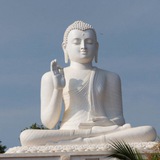
Dhammapada Verse 80
Panditasamanera Vatthu
Udakam hi nayanti nettika
usukara namayanti tejanam
darum namayanti tacchaka
attanam damayanti pandita.
Verse 80: Farmers (lit., makers of irrigation canals ) channel the water; fletchers straighten the arrow; carpenters work the timber; the Wise tame themselves.
The Story of Samanera Pandita
While residing at the Jetavana monastery, the Buddha uttered Verse (80) of this book, with reference to Samanera Pandita.
Pandita was a young son of a rich man of Savatthi. He became a samanera at the age of seven. On the eighth day after becoming a samanera, as he was following Thera Sariputta on an alms-round, he saw some farmers channeling water into their fields and asked the thera, "Can water which has no consciousness be guided to wherever one wishes ?" The thera replied, "Yes, it can be guided to wherever one wishes." As they continued on their way, the samanera next saw some fletchers heating their arrows with fire and straightening them. Further on, he came across some carpenters cutting, sawing and planing timber to make it into things like cart-wheels. Then he pondered, "If water which is without consciousness can be guided to wherever one desires, if a crooked bamboo which is without consciousness can be straightened, and if timber which is without consciousness can be made into useful things, why should I, having consciousness, be unable to tame my mind and practise Tranquillity and Insight Meditation?"
Then and there he asked permission from the thera and returned to his own room in the monastery. There he ardently and diligently practised meditation, contemplating the body. Sakka and the devas also helped him in his meditation by keeping the monastery and its precincts very quiet and still. Before meal time Samanera Pandita attained Anagami Fruition.
At that time Thera Sariputta was bringing food to the samanera. The Buddha saw with his supernormal power that Samanera Pandita had attained Anagami Fruition and also that if he continued to practise meditation he would soon attain arahatship. So the Buddha decided to stop Sariputta from entering the room, where the samanera was. The Buddha went to the door and kept Sariputta engaged by putting some questions to him. While the conversation was taking place, the samanera attained arahatship. Thus, the samanera attained arahatship on the eighth day after becoming a novice.
In this connection, the Buddha said to the bhikkhus of the monastery, "When one is earnestly practising the Dhamma, even Sakka and the devas give protection and keep guard; I myself have kept Thera Sariputta engaged at the door so that Samanera Pandita should not be disturbed. The samanera, having seen the farmers irrigating their fields, the fletchers straightening their arrows, and carpenters making cart-wheels and other things, tames his mind and practises the dhamma; he has now become an arahat."
The Buddha then spoke in verse as follows:
Verse 80: Farmers (lit., makers of irrigation canals) channel the water; fletchers straighten the arrow; carpenters work the timber; the Wise tame themselves.
Tibetan Buddhism - Vajrayana, Tantrayana and esoteric Buddhism channel:
https://news.1rj.ru/str/tibetanbuddha
Vajrayana Tantrayana Buddhism channel:
https://news.1rj.ru/str/tantrayanabuddhism
====================
Panditasamanera Vatthu
Udakam hi nayanti nettika
usukara namayanti tejanam
darum namayanti tacchaka
attanam damayanti pandita.
Verse 80: Farmers (lit., makers of irrigation canals ) channel the water; fletchers straighten the arrow; carpenters work the timber; the Wise tame themselves.
The Story of Samanera Pandita
While residing at the Jetavana monastery, the Buddha uttered Verse (80) of this book, with reference to Samanera Pandita.
Pandita was a young son of a rich man of Savatthi. He became a samanera at the age of seven. On the eighth day after becoming a samanera, as he was following Thera Sariputta on an alms-round, he saw some farmers channeling water into their fields and asked the thera, "Can water which has no consciousness be guided to wherever one wishes ?" The thera replied, "Yes, it can be guided to wherever one wishes." As they continued on their way, the samanera next saw some fletchers heating their arrows with fire and straightening them. Further on, he came across some carpenters cutting, sawing and planing timber to make it into things like cart-wheels. Then he pondered, "If water which is without consciousness can be guided to wherever one desires, if a crooked bamboo which is without consciousness can be straightened, and if timber which is without consciousness can be made into useful things, why should I, having consciousness, be unable to tame my mind and practise Tranquillity and Insight Meditation?"
Then and there he asked permission from the thera and returned to his own room in the monastery. There he ardently and diligently practised meditation, contemplating the body. Sakka and the devas also helped him in his meditation by keeping the monastery and its precincts very quiet and still. Before meal time Samanera Pandita attained Anagami Fruition.
At that time Thera Sariputta was bringing food to the samanera. The Buddha saw with his supernormal power that Samanera Pandita had attained Anagami Fruition and also that if he continued to practise meditation he would soon attain arahatship. So the Buddha decided to stop Sariputta from entering the room, where the samanera was. The Buddha went to the door and kept Sariputta engaged by putting some questions to him. While the conversation was taking place, the samanera attained arahatship. Thus, the samanera attained arahatship on the eighth day after becoming a novice.
In this connection, the Buddha said to the bhikkhus of the monastery, "When one is earnestly practising the Dhamma, even Sakka and the devas give protection and keep guard; I myself have kept Thera Sariputta engaged at the door so that Samanera Pandita should not be disturbed. The samanera, having seen the farmers irrigating their fields, the fletchers straightening their arrows, and carpenters making cart-wheels and other things, tames his mind and practises the dhamma; he has now become an arahat."
The Buddha then spoke in verse as follows:
Verse 80: Farmers (lit., makers of irrigation canals) channel the water; fletchers straighten the arrow; carpenters work the timber; the Wise tame themselves.
Tibetan Buddhism - Vajrayana, Tantrayana and esoteric Buddhism channel:
https://news.1rj.ru/str/tibetanbuddha
Vajrayana Tantrayana Buddhism channel:
https://news.1rj.ru/str/tantrayanabuddhism
====================
Telegram
Tibetan Buddhism Vajrayana Tantrayana esoteric tradition
Buddha Dharma teachings from the esoteric Vajrayana or Tantrayana Buddhism, includes all major schools Nyingma, Kagyu, Gelug, Sakya, Jonang and Bonpo.
❤1👍1💯1
Every kind of delighting or longing,
So often attaching to all kinds of stuff,
Yearned for because of deep-rooted confusion
— All these, with their roots, have been vanquished by me (Buddha)
I'm devoid of attachment, longing, or thirst,
And see clearly amidst all phenomena.
Having gained the sublime, highest awakening,
I meditate in ripened seclusion (a desolate forest)
Katthaharaka Sutta: Buddha in the Forest
Samyutta Nikaya 7.18
So often attaching to all kinds of stuff,
Yearned for because of deep-rooted confusion
— All these, with their roots, have been vanquished by me (Buddha)
I'm devoid of attachment, longing, or thirst,
And see clearly amidst all phenomena.
Having gained the sublime, highest awakening,
I meditate in ripened seclusion (a desolate forest)
Katthaharaka Sutta: Buddha in the Forest
Samyutta Nikaya 7.18
❤3👍1🥰1🙏1🕊1
Dhammapada Verse 81
Lakundakabhaddiyatthera Vatthu
Selo yatha ekaghano
vatena na samirati
evam nindapasamsasu
na saminjanti pandita
Verse 81: As a mountain of rock is unshaken by wind, so also, the wise are unperturbed by blame or by praise.
The Story of Thera Lakundaka Bhaddiya
While residing at the Jetavana monastery, the Buddha uttered Verse (81) of this book, with reference to Thera Bhaddiya.
Bhaddiya was one of the bhikkhus staying at the Jetavana monastery. Because of his short stature he was known as Lakundaka (the dwarf) to other bhikkhus. Lakundaka Bhaddiya was very good natured; even young bhikkhus would often tease him by pulling his nose or his ear, or by patting him on his head. Very often they would jokingly say, "Uncle, how are you? Are you happy, or are you bored with your life here as a bhikkhu?", etc. Lakundaka Bhaddiya never retaliated in anger, or abused them; in fact, even in his heart he did not get angry with them.
When told about the patience of Lakundaka Bhaddiya, the Buddha said, "An arahat never loses his temper, he has no desire to speak harshly or to think ill of others. He is like a mountain of solid rock; as a solid rock is unshaken, so also, an arahat is unperturbed by scorn or by praise."
Then the Buddha spoke in verse as follows:
Verse 81: As a mountain of rock is unshaken by wind, so also, the wise are unperturbed by blame or by praise.
Words of the Buddha channel:
https://news.1rj.ru/str/wordsofbuddha
====================
Lakundakabhaddiyatthera Vatthu
Selo yatha ekaghano
vatena na samirati
evam nindapasamsasu
na saminjanti pandita
Verse 81: As a mountain of rock is unshaken by wind, so also, the wise are unperturbed by blame or by praise.
The Story of Thera Lakundaka Bhaddiya
While residing at the Jetavana monastery, the Buddha uttered Verse (81) of this book, with reference to Thera Bhaddiya.
Bhaddiya was one of the bhikkhus staying at the Jetavana monastery. Because of his short stature he was known as Lakundaka (the dwarf) to other bhikkhus. Lakundaka Bhaddiya was very good natured; even young bhikkhus would often tease him by pulling his nose or his ear, or by patting him on his head. Very often they would jokingly say, "Uncle, how are you? Are you happy, or are you bored with your life here as a bhikkhu?", etc. Lakundaka Bhaddiya never retaliated in anger, or abused them; in fact, even in his heart he did not get angry with them.
When told about the patience of Lakundaka Bhaddiya, the Buddha said, "An arahat never loses his temper, he has no desire to speak harshly or to think ill of others. He is like a mountain of solid rock; as a solid rock is unshaken, so also, an arahat is unperturbed by scorn or by praise."
Then the Buddha spoke in verse as follows:
Verse 81: As a mountain of rock is unshaken by wind, so also, the wise are unperturbed by blame or by praise.
Words of the Buddha channel:
https://news.1rj.ru/str/wordsofbuddha
====================
Telegram
Words of the Buddha
Daily teachings of Buddha Dharma
❤1💯1
Fostering Peace, Inside and Out
A Theravada monk and scholar outlines three steps toward real peace, and the role of our spiritual practice in achieving it.
By Ven. Bhikkhu Bodhi
At the beginning of a new year it is customary for us to express our hopes for peace in the year ahead and to wish each other peace. But to actually achieve peace is by no means an easy task. Real peace is not simply the absence of violent conflict but a state of harmony: harmony between people; harmony between humanity and nature; and harmony within ourselves. Without harmony, the seeds of conflict and violence will always be ready to sprout.
When I reflect on the challenge of achieving peace in today’s world, I have found it useful to treat the subject under three main headings: (1) The Obstacles to Achieving Peace—the barriers that maintain tension and foment conflict; (2) The Prerequisites of Peace—the goals we should pursue to achieve peace; and (3) The Means to Realizing these Goals. Each can in turn be analyzed into three secondary aspects.
The Obstacles to Achieving Peace
(1) Profit-seeking: Driven by the urge to expand profits, global corporations and other mammoth enterprises flood the market with harmful or frivolous commodities. They spend billions on advertising, despoil the natural environment with toxic waste, and scuttle laws that protect workers and consumers. They take wild risks which, when successful, benefit management and shareholders, and when failures, push the costs on to the public. The neoliberal economy has led to wider inequality of incomes and wealth. Recent figures reveal that the richest 70 people now own more wealth than the poorest half of the world, while in the US a mere 40 individuals own as much wealth as the bottom half. High levels of income inequality are associated with economic instability and crisis, whereas more equal societies tend to be more stable and to enjoy longer periods of sustained growth. More unequal societies show higher rates of violent crime and lower levels of social trust; more equal societies have lower crime rates and greater social trust. Greater economic equality thus contributes to peace.
(2) Plunder: Since the dawn of the industrial era we have been plundering nature’s treasures with reckless abandon. Today, this extractionist frame of mind drives us ever closer to the edge of calamity as rapacious economic activity disrupts the natural climate cycles on which human life depends. The big fossil fuel corporations plunder the earth for oil, coal, and gas, clearing ancient forests, blasting mountains to bits, and drilling down into the ocean depths. They transport the substances they extract over vast distances from source to refinery to market. Factories fill the skies with carbon dioxide, particulate matter, and harmful toxins. Extraction operations discharge toxic waste into rivers and lakes, poisoning the water resources on which whole communities depend.
Cumulative carbon emissions are cooking the planet and warming the seas. We’ve already had a taste of the future in the strange weather events that occur with greater frequency: droughts, floods, heat waves, and crop failures. As large regions of the earth turn barren, we will face mass migrations that can raise tensions and ignite violent confrontations. States may fail, unleashing chaos and giving the chance for tyrants to seize power and launch campaigns of conquest.
(3) Power projection: Driven by narrow economic interests, the powerful nations seek to enhance their might by projecting strategies of full-spectrum dominance across the globe. They finance ever more sophisticated weapons systems, spend billions on armaments, and spy on their citizens. They manipulate international protocols to their advantage, heightening tensions among old rivals. Weapons corporations thrive on the tensions, which they regard as new opportunities for profit. Global hostilities boil, and in certain hot spots periodically explode in outbursts of lethal violence.
The Prerequisites to Achieving Peace
A Theravada monk and scholar outlines three steps toward real peace, and the role of our spiritual practice in achieving it.
By Ven. Bhikkhu Bodhi
At the beginning of a new year it is customary for us to express our hopes for peace in the year ahead and to wish each other peace. But to actually achieve peace is by no means an easy task. Real peace is not simply the absence of violent conflict but a state of harmony: harmony between people; harmony between humanity and nature; and harmony within ourselves. Without harmony, the seeds of conflict and violence will always be ready to sprout.
When I reflect on the challenge of achieving peace in today’s world, I have found it useful to treat the subject under three main headings: (1) The Obstacles to Achieving Peace—the barriers that maintain tension and foment conflict; (2) The Prerequisites of Peace—the goals we should pursue to achieve peace; and (3) The Means to Realizing these Goals. Each can in turn be analyzed into three secondary aspects.
The Obstacles to Achieving Peace
(1) Profit-seeking: Driven by the urge to expand profits, global corporations and other mammoth enterprises flood the market with harmful or frivolous commodities. They spend billions on advertising, despoil the natural environment with toxic waste, and scuttle laws that protect workers and consumers. They take wild risks which, when successful, benefit management and shareholders, and when failures, push the costs on to the public. The neoliberal economy has led to wider inequality of incomes and wealth. Recent figures reveal that the richest 70 people now own more wealth than the poorest half of the world, while in the US a mere 40 individuals own as much wealth as the bottom half. High levels of income inequality are associated with economic instability and crisis, whereas more equal societies tend to be more stable and to enjoy longer periods of sustained growth. More unequal societies show higher rates of violent crime and lower levels of social trust; more equal societies have lower crime rates and greater social trust. Greater economic equality thus contributes to peace.
(2) Plunder: Since the dawn of the industrial era we have been plundering nature’s treasures with reckless abandon. Today, this extractionist frame of mind drives us ever closer to the edge of calamity as rapacious economic activity disrupts the natural climate cycles on which human life depends. The big fossil fuel corporations plunder the earth for oil, coal, and gas, clearing ancient forests, blasting mountains to bits, and drilling down into the ocean depths. They transport the substances they extract over vast distances from source to refinery to market. Factories fill the skies with carbon dioxide, particulate matter, and harmful toxins. Extraction operations discharge toxic waste into rivers and lakes, poisoning the water resources on which whole communities depend.
Cumulative carbon emissions are cooking the planet and warming the seas. We’ve already had a taste of the future in the strange weather events that occur with greater frequency: droughts, floods, heat waves, and crop failures. As large regions of the earth turn barren, we will face mass migrations that can raise tensions and ignite violent confrontations. States may fail, unleashing chaos and giving the chance for tyrants to seize power and launch campaigns of conquest.
(3) Power projection: Driven by narrow economic interests, the powerful nations seek to enhance their might by projecting strategies of full-spectrum dominance across the globe. They finance ever more sophisticated weapons systems, spend billions on armaments, and spy on their citizens. They manipulate international protocols to their advantage, heightening tensions among old rivals. Weapons corporations thrive on the tensions, which they regard as new opportunities for profit. Global hostilities boil, and in certain hot spots periodically explode in outbursts of lethal violence.
The Prerequisites to Achieving Peace
Telegram
Buddha Dharma books
Free Buddhism books, teachings, podcasts and videos from Theravada, Mahayana and Vajrayana traditions
💯2
(1) Protection: To achieve real peace, we need a global commitment to protecting people everywhere from harm and misery. This commitment must be rooted in a universal perspective that enables us to see all people as brothers and sisters, worthy of care and respect regardless of their ethnic, national, and religious identity. As Americans we can’t go on thinking that American lives are more important than the lives of people elsewhere—in Iraq and Afghanistan, in South America, Africa, and Southeast Asia. We can’t think that only the lives of middle-class people count, but not the lives of black youths in Chicago, herdsmen in Ethiopia, rice farmers in the Philippines, or factory workers in Bangladesh. Rather, we must regard all people as endowed with intrinsic value, which we must affirm by establishing greater economic, social, and political justice.
(2) Preservation. The greatest challenge of our time is to avoid climate chaos. The earth is our irreplaceable home, and if we destroy it, we will have no other place to go. At the rate we’re spitting out greenhouse gases, within a few decades we may raise the earth’s temperature to the point where the planet becomes inhospitable to human life. All the money in the world will be worthless on a planet where the grain belts have withered and oceans have turned deadly acidic.
We need to start making a rapid and full-scale transition to a new economy powered by clean and renewable sources of energy. The sun, wind, and heat of the earth are capable of providing us with all the energy we need. The main obstacle to date has been the lack of political will, whereby a band of powerful corporations, lobbyists, and compliant politicians reject the hard truths of science and even the clear decrees of rational self-interest.
We must stand up against moneyed interests and press our governments and civil groups to expedite the transition to a clean-energy future. Our window of opportunity is closing, and we must act fast before it slams shut. We need a sense of urgency, as if our clothes were on fire, an urge to act to preserve this precious planet—a miracle in a sea of cosmic dust, a blue-green pearl teeming with living forms.
(3) Prosperity. While extreme wealth for a few means misery for many others, prosperity is a good in which we all should be able to share. There is certainly enough wealth in the world to ensure that everyone can obtain sufficient food, clothing, housing, and medical care. The problem is not lack of wealth but its uneven distribution.
To lay the foundations for real peace, both national policies and international institutions must give precedence to uplifting people from the worst extremes of poverty. In today’s world, 900 million people live in perpetual food insecurity, while at least two billion suffer from malnutrition. Six million people a year, over half of them children, die from chronic hunger and related illnesses. The UN estimates that it would take just $30 billion a year to solve world hunger, a small fraction of the $737 billion that the US spent on defense in 2012. Tackling global hunger is not only a moral and ethical obligation but a policy that would have positive economic impacts and promote global solidarity. It could be a giant step in the direction of world peace.
Here in the US, some 50 million people—one out of seven—live in poverty. A half-century ago, the US had a social system that, while far from perfect, excelled in its public services. Over the past 30 years, many of these services have been downgraded or slashed. As the wealthiest country in the world, we can easily provide for the basic needs of all our citizens. But this will require new values. Instead of exalting individualism and ambition, we should prize cooperation and compassion. Instead of inciting competition, we should nurture harmonious communities and social solidarity.
The Means to Realizing these Goals
(2) Preservation. The greatest challenge of our time is to avoid climate chaos. The earth is our irreplaceable home, and if we destroy it, we will have no other place to go. At the rate we’re spitting out greenhouse gases, within a few decades we may raise the earth’s temperature to the point where the planet becomes inhospitable to human life. All the money in the world will be worthless on a planet where the grain belts have withered and oceans have turned deadly acidic.
We need to start making a rapid and full-scale transition to a new economy powered by clean and renewable sources of energy. The sun, wind, and heat of the earth are capable of providing us with all the energy we need. The main obstacle to date has been the lack of political will, whereby a band of powerful corporations, lobbyists, and compliant politicians reject the hard truths of science and even the clear decrees of rational self-interest.
We must stand up against moneyed interests and press our governments and civil groups to expedite the transition to a clean-energy future. Our window of opportunity is closing, and we must act fast before it slams shut. We need a sense of urgency, as if our clothes were on fire, an urge to act to preserve this precious planet—a miracle in a sea of cosmic dust, a blue-green pearl teeming with living forms.
(3) Prosperity. While extreme wealth for a few means misery for many others, prosperity is a good in which we all should be able to share. There is certainly enough wealth in the world to ensure that everyone can obtain sufficient food, clothing, housing, and medical care. The problem is not lack of wealth but its uneven distribution.
To lay the foundations for real peace, both national policies and international institutions must give precedence to uplifting people from the worst extremes of poverty. In today’s world, 900 million people live in perpetual food insecurity, while at least two billion suffer from malnutrition. Six million people a year, over half of them children, die from chronic hunger and related illnesses. The UN estimates that it would take just $30 billion a year to solve world hunger, a small fraction of the $737 billion that the US spent on defense in 2012. Tackling global hunger is not only a moral and ethical obligation but a policy that would have positive economic impacts and promote global solidarity. It could be a giant step in the direction of world peace.
Here in the US, some 50 million people—one out of seven—live in poverty. A half-century ago, the US had a social system that, while far from perfect, excelled in its public services. Over the past 30 years, many of these services have been downgraded or slashed. As the wealthiest country in the world, we can easily provide for the basic needs of all our citizens. But this will require new values. Instead of exalting individualism and ambition, we should prize cooperation and compassion. Instead of inciting competition, we should nurture harmonious communities and social solidarity.
The Means to Realizing these Goals
💯2
(1) Prayer, meditation, and contemplation. People of faith should root transformative action in the spiritual disciplines of prayer, meditation, and contemplation. While traditionally such practices served as stepping stones to the realization of a transcendent goal, today we need a wider spiritual vision that can encompass the divine and the mundane, the transcendent and the immanent, in an integral whole. By bringing us into intimate contact with the transcendent ground of justice and love, practices like meditation and contemplative prayer empower us to bring greater justice and love into the world. By purging the toxins of greed, hatred, and selfishness from our hearts, these practices open us to the universality of suffering, awakening our compassion and inspiring us to become a source of good for others.
(2) Peace. Peace is not only the goal of our efforts but also a means for reaching that goal. Peace belongs to the means because in order to establish peace, we must be peaceful ourselves. If our minds are agitated by anger and resentment, our efforts to promote peace are more likely to create more conflict and perhaps ignite more violence. An angry mind is not a reliable instrument for promoting peace. But when our minds are peaceful, our bodily actions will be peaceful, and we will convey an ambiance of love, care, and mercy, which will help to establish peaceful relations.
(3) Participation. While the pursuit of meditation and other spiritual practices as a private quest for inner awakening and liberation may have fit the worldview of past historical eras, in today’s world our emphasis must shift toward a more participatory kind of spirituality, one that unites the quest for inner peace with the commitment to world peace, human unity, and planetary preservation. Our devotion to contemplative practice can inspire in us a stronger aspiration to promote social and economic justice, to preserve the planet’s vital ecosystems, and to heal long-standing enmities. At the same time, our active commitment to the well-being of others can nurture our own spiritual growth, deepening our compassion and strengthening our moral integrity.
There are many venues through which we can embody participatory spirituality in action. We can support organizations that advocate for poverty alleviation, address climate change, and promote the ethical treatment of animals, immigration rights, and better pay for fast-food workers. We can write to our congressional representatives, expressing our views on the issues that most deeply concern us. Our votes, too, express our values and conscience. Although the electoral process in this country has been badly skewed in favor of Big Money, our votes still count and can make a difference.
To express conscience in action, we can sign petitions, join marches, and participate in demonstrations. In New York this past September, 400,000 people walked peacefully through the streets on the People’s Climate March, demanding that world leaders tackle the climate crisis. In cities across the country, low-wage workers have been demanding better wages and other conditions that will enable them to live with dignity. In many cities as well, people of all ethnic backgrounds have joined hands to protest police brutality against communities of color.
While the endeavor to achieve peace may often be frustrating, we should remember that nothing truly worthy can be achieved without effort. Peace and justice may be slow to arrive, but we will never obtain them without a struggle.
Let us make the new year a year in which we firmly commit ourselves to the pursuit of real peace. Then, a year from now, we can look back and consider our time to have been truly well spent.
Ven. Bhikkhu Bodhi lives and teaches at Chuang Yen Monastery in Carmel, New York. He is a translator of texts from the Pali canon and the cofounder of Buddhist Global Relief.
=====
Free Buddhism books, teachings, podcasts and videos from Theravada, Mahayana and Vajrayana traditions:
https://news.1rj.ru/str/buddha_ebooks
(2) Peace. Peace is not only the goal of our efforts but also a means for reaching that goal. Peace belongs to the means because in order to establish peace, we must be peaceful ourselves. If our minds are agitated by anger and resentment, our efforts to promote peace are more likely to create more conflict and perhaps ignite more violence. An angry mind is not a reliable instrument for promoting peace. But when our minds are peaceful, our bodily actions will be peaceful, and we will convey an ambiance of love, care, and mercy, which will help to establish peaceful relations.
(3) Participation. While the pursuit of meditation and other spiritual practices as a private quest for inner awakening and liberation may have fit the worldview of past historical eras, in today’s world our emphasis must shift toward a more participatory kind of spirituality, one that unites the quest for inner peace with the commitment to world peace, human unity, and planetary preservation. Our devotion to contemplative practice can inspire in us a stronger aspiration to promote social and economic justice, to preserve the planet’s vital ecosystems, and to heal long-standing enmities. At the same time, our active commitment to the well-being of others can nurture our own spiritual growth, deepening our compassion and strengthening our moral integrity.
There are many venues through which we can embody participatory spirituality in action. We can support organizations that advocate for poverty alleviation, address climate change, and promote the ethical treatment of animals, immigration rights, and better pay for fast-food workers. We can write to our congressional representatives, expressing our views on the issues that most deeply concern us. Our votes, too, express our values and conscience. Although the electoral process in this country has been badly skewed in favor of Big Money, our votes still count and can make a difference.
To express conscience in action, we can sign petitions, join marches, and participate in demonstrations. In New York this past September, 400,000 people walked peacefully through the streets on the People’s Climate March, demanding that world leaders tackle the climate crisis. In cities across the country, low-wage workers have been demanding better wages and other conditions that will enable them to live with dignity. In many cities as well, people of all ethnic backgrounds have joined hands to protest police brutality against communities of color.
While the endeavor to achieve peace may often be frustrating, we should remember that nothing truly worthy can be achieved without effort. Peace and justice may be slow to arrive, but we will never obtain them without a struggle.
Let us make the new year a year in which we firmly commit ourselves to the pursuit of real peace. Then, a year from now, we can look back and consider our time to have been truly well spent.
Ven. Bhikkhu Bodhi lives and teaches at Chuang Yen Monastery in Carmel, New York. He is a translator of texts from the Pali canon and the cofounder of Buddhist Global Relief.
=====
Free Buddhism books, teachings, podcasts and videos from Theravada, Mahayana and Vajrayana traditions:
https://news.1rj.ru/str/buddha_ebooks
Telegram
Buddha Dharma books
Free Buddhism books, teachings, podcasts and videos from Theravada, Mahayana and Vajrayana traditions
👍1💯1
Forwarded from Buddha Dharma books
Free Buddha Dharma ebook
Kama Sutta
A dhamma discourse by Mahasi Sayadaw Gyi
Our benefactor, the late Ven. Mahasi Sayadaw had delivered the Kama Sutta in Myanmar language on (25.1.1965) at the phanyin Dhamma Hall in Mahasi Meditation Centre, Yangon, Myanmar. One thousand volumes of the Kama Sutta were distributed as Dhamma gift on (27.3.1974) by the family of U Thein Aung and Daw Sein Tin on the occasion of their ordination ceremony.
Free download here:
http://www.mediafire.com/file/f60m0jghnmev86s/
=============
Kama Sutta
A dhamma discourse by Mahasi Sayadaw Gyi
Our benefactor, the late Ven. Mahasi Sayadaw had delivered the Kama Sutta in Myanmar language on (25.1.1965) at the phanyin Dhamma Hall in Mahasi Meditation Centre, Yangon, Myanmar. One thousand volumes of the Kama Sutta were distributed as Dhamma gift on (27.3.1974) by the family of U Thein Aung and Daw Sein Tin on the occasion of their ordination ceremony.
Free download here:
http://www.mediafire.com/file/f60m0jghnmev86s/
=============
❤1👍1
Dhammapada Verse 82
Kanamata Vatthu
Yathapi rahado gambhiro
vippasanno anavilo
evam dhammani sutvana
vippasidanti pandita.
Verse 82: Like a lake which is deep, clear and calm, the wise after listening to the Teaching (Dhamma) become serene.
The Story of Kanamata
While residing at the Jetavana monastery, the Buddha uttered Verse (82) of this book, with reference to the mother of Kana, Kanamata.
Kanamata was a devoted lay disciple of the Buddha. Her daughter Kana was married to a man from another village. As Kana had been on a visit to her mother for some time, her husband sent a message for her to come home. Her mother told her to wait for one more day as she wanted to send along some sweetmeats with her for her husband. The next day, Kanamata made some sweetmeats, but when four bhikkhus stood at her door for alms, she offered some to them. The four bhikkhus told other bhikkhus about the sweetmeats from Kanamata's house and they also came to stand at the door of Kanamata, as a devotee of the Buddha and his disciples, offered her sweetmeats to the bhikkhus as they came in, one after another. The result was that in the end there was none left for Kana and she did not go home on that day. The same thing happened on the next two days; her mother made some sweetmeats, the bhikkhus stood at her door, she offered her sweetmeats to the bhikkhus, there was nothing left for her daughter to take home, and her daughter did not go home. On the third day, for the third time, her husband sent her a message, which was also an ultimatum stating that if she failed to come home the next day, he would take another wife. But on the next day also Kana was unable to go home because her mother offered all her sweetmeats to the bhikkhus. Kana's husband then took another wife and Kana became very bitter towards the bhikkhus. She used to abuse all bhikkhus so much so that the bhikkhus kept away from the house of Kanamata.
The Buddha heard about Kana and went to the house of Kanamata; there Kanamata offered him some rice gruel. After the meal, the Buddha sent for Kana and asked her, "Did my bhikkhus take what was given them or what was not given them ?" Kana answered that the bhikkhus had taken only what was given them, and then added, "They were not in the wrong; only I was in the wrong." Thus, she owned up her fault and she also paid homage to the Buddha. The Buddha then gave a discourse. At the end of the discourse, Kana attained Sotapatti Fruition.
On the way back to the monastery, the Buddha met King Pasenadi of Kosala. On being told about Kana and her bitter attitude towards the bhikkhus, King Pasenadi asked the Buddha whether he had been able to teach her the Dhamma and, make her see the Truth (Dhamma). The Buddha replied, "Yes, I have taught her the Dhamma, and I have also made her rich in her next existence." Then the king promised the Buddha that he would make Kana rich even in this existence. The king then sent his men with a palanquin to fetch Kana. When she arrived, the king announced to his ministers, "Whoever can keep my daughter Kana in comfort may take her." One of the ministers volunteered to adopt Kana as his daughter, gave her all his wealth, and said to her, "You may give in charity as much as you like." Everyday, Kana made offerings to the bhikkhus at the four city-gates. When told about Kana giving generously in charity, the Buddha said, "Bhikkhus, the mind of Kana which was foggy and muddled was made clear and calm by my words."
Then the Buddha spoke in verse as follows:
Verse 82: Like a lake which is deep, clear and calm, the wise after listening to the Teaching (Dhamma) become serene.
Dhammapada, beloved and favorite teachings of the Buddha channel:
https://news.1rj.ru/str/dhammapadas
====================
Kanamata Vatthu
Yathapi rahado gambhiro
vippasanno anavilo
evam dhammani sutvana
vippasidanti pandita.
Verse 82: Like a lake which is deep, clear and calm, the wise after listening to the Teaching (Dhamma) become serene.
The Story of Kanamata
While residing at the Jetavana monastery, the Buddha uttered Verse (82) of this book, with reference to the mother of Kana, Kanamata.
Kanamata was a devoted lay disciple of the Buddha. Her daughter Kana was married to a man from another village. As Kana had been on a visit to her mother for some time, her husband sent a message for her to come home. Her mother told her to wait for one more day as she wanted to send along some sweetmeats with her for her husband. The next day, Kanamata made some sweetmeats, but when four bhikkhus stood at her door for alms, she offered some to them. The four bhikkhus told other bhikkhus about the sweetmeats from Kanamata's house and they also came to stand at the door of Kanamata, as a devotee of the Buddha and his disciples, offered her sweetmeats to the bhikkhus as they came in, one after another. The result was that in the end there was none left for Kana and she did not go home on that day. The same thing happened on the next two days; her mother made some sweetmeats, the bhikkhus stood at her door, she offered her sweetmeats to the bhikkhus, there was nothing left for her daughter to take home, and her daughter did not go home. On the third day, for the third time, her husband sent her a message, which was also an ultimatum stating that if she failed to come home the next day, he would take another wife. But on the next day also Kana was unable to go home because her mother offered all her sweetmeats to the bhikkhus. Kana's husband then took another wife and Kana became very bitter towards the bhikkhus. She used to abuse all bhikkhus so much so that the bhikkhus kept away from the house of Kanamata.
The Buddha heard about Kana and went to the house of Kanamata; there Kanamata offered him some rice gruel. After the meal, the Buddha sent for Kana and asked her, "Did my bhikkhus take what was given them or what was not given them ?" Kana answered that the bhikkhus had taken only what was given them, and then added, "They were not in the wrong; only I was in the wrong." Thus, she owned up her fault and she also paid homage to the Buddha. The Buddha then gave a discourse. At the end of the discourse, Kana attained Sotapatti Fruition.
On the way back to the monastery, the Buddha met King Pasenadi of Kosala. On being told about Kana and her bitter attitude towards the bhikkhus, King Pasenadi asked the Buddha whether he had been able to teach her the Dhamma and, make her see the Truth (Dhamma). The Buddha replied, "Yes, I have taught her the Dhamma, and I have also made her rich in her next existence." Then the king promised the Buddha that he would make Kana rich even in this existence. The king then sent his men with a palanquin to fetch Kana. When she arrived, the king announced to his ministers, "Whoever can keep my daughter Kana in comfort may take her." One of the ministers volunteered to adopt Kana as his daughter, gave her all his wealth, and said to her, "You may give in charity as much as you like." Everyday, Kana made offerings to the bhikkhus at the four city-gates. When told about Kana giving generously in charity, the Buddha said, "Bhikkhus, the mind of Kana which was foggy and muddled was made clear and calm by my words."
Then the Buddha spoke in verse as follows:
Verse 82: Like a lake which is deep, clear and calm, the wise after listening to the Teaching (Dhamma) become serene.
Dhammapada, beloved and favorite teachings of the Buddha channel:
https://news.1rj.ru/str/dhammapadas
====================
Telegram
Dhammapada - Buddha Dharma Teachings
Daily teachings of the Dhammapada, beloved and favorite teachings of the Buddha
❤2👍1
After seven days, the Buddha came out from that stillness and went from the goatherd’s banyan tree to a powderpuff tree. There too he sat cross-legged for seven days without moving, experiencing the bliss of freedom.
Just then an unseasonal storm was approaching, bringing seven days of rain, cold winds, and clouds. Mucalinda, the dragon king, came out from his abode. He encircled the body of the Buddha with seven coils and spread his large hood over his head, thinking, “May the Buddha not be hot or cold, nor be bothered by horseflies or mosquitoes, by the wind or the burning sun, or by creeping animals or insects.”
After seven days, when he knew the sky was clear, Mucalinda unraveled his coils from the Buddha’s body and transformed himself into a young brahmin. He then stood in front of the Buddha, raising his joined palms in veneration.
Partial excerpts from Vinaya Pitaka, Mahavagga, Mahakhandhaka 3 : Mucalinda tree
Just then an unseasonal storm was approaching, bringing seven days of rain, cold winds, and clouds. Mucalinda, the dragon king, came out from his abode. He encircled the body of the Buddha with seven coils and spread his large hood over his head, thinking, “May the Buddha not be hot or cold, nor be bothered by horseflies or mosquitoes, by the wind or the burning sun, or by creeping animals or insects.”
After seven days, when he knew the sky was clear, Mucalinda unraveled his coils from the Buddha’s body and transformed himself into a young brahmin. He then stood in front of the Buddha, raising his joined palms in veneration.
Partial excerpts from Vinaya Pitaka, Mahavagga, Mahakhandhaka 3 : Mucalinda tree
❤1👍1🥰1
Dhammapada Verse 83
Pancasatabhikkhu Vatthu
Sabbattha ye sappurisa cajanti
na kamakama lapayanti santo
sukhena phuttha atha va dukhena
na uccavacam pandita dassayanti.
Verse 83: Indeed, the virtuous give up all (i.e., attachment to the five khandhas, etc.); the virtuous (lit., the tranquil) do not talk with sensual desire; when faced with joy or sorrow, the wise do not show elation or depression.
The Story of Five Hundred Bhikkhus
While residing at the Jetavana monastery, the Buddha uttered Verse (83) of this book, with reference to five hundred bhikkhus.
At the request of a brahmin from Veranja, the Buddha was, on one occasion, staying at Veranja with five hundred bhikkhus. While they were at Veranja, the brahmin failed to look after them. The people of Varanja, who were then facing a famine, could offer very little to the bhikkhus when they went on their rounds for alms-food. In spite of all these hardships, the bhikkhus were not disheartened; they were quite contented with the small amount of shrivelled grain which the horse-traders offered them daily. At the end of the vasa, after informing the brahmin from Veranja, the Buddha returned to the Jetavana monastery, accompanied by the five hundred bhikkhus. The people of Savatthi welcomed them back with choice food of all kinds.
A group of people living with the bhikkhus, eating whatever was left over by the bhikkhus, ate greedily like true gluttons and went to sleep after their meals. On waking up, they were shouting, singing and dancing, thus making themselves a thorough nuisance. When the Buddha came in the evening to the congregation of bhikkhus, they reported to him about the behaviour of those unruly persons, and said, "These people living on the leftovers were quite decent and well-behaved when all of us were facing hardship and famine in Veranja. Now that they have enough good food they are going about shouting, singing and dancing, and thus make themselves a thorough nuisance. The bhikkhus, however, behave themselves here just as they were in Veranja".
To them the Buddha replied, "It is in the nature of the foolish to be full of sorrow and feel depressed when things go wrong, and to be full of gladness and feel elated when things go well. The wise, however, can withstand the ups and downs of life."
Then the Buddha spoke in verse as follows:
Verse 83: Indeed, the virtuous give up all (i.e., attachment to the five khandhas, etc.); the virtuous (lit., the tranquil) do not talk with sensual desire; when faced with joy or sorrow, the wise do not show elation or depression.
Buddha dharma teachings channel:
https://invite.viber.com/?g2=AQAKw1y3rv%2F6sk61PI2W4izuIiaEZj8YZujhY1tSzL%2B07s7rFnVFDAd0bAYFaMLw
====================
Pancasatabhikkhu Vatthu
Sabbattha ye sappurisa cajanti
na kamakama lapayanti santo
sukhena phuttha atha va dukhena
na uccavacam pandita dassayanti.
Verse 83: Indeed, the virtuous give up all (i.e., attachment to the five khandhas, etc.); the virtuous (lit., the tranquil) do not talk with sensual desire; when faced with joy or sorrow, the wise do not show elation or depression.
The Story of Five Hundred Bhikkhus
While residing at the Jetavana monastery, the Buddha uttered Verse (83) of this book, with reference to five hundred bhikkhus.
At the request of a brahmin from Veranja, the Buddha was, on one occasion, staying at Veranja with five hundred bhikkhus. While they were at Veranja, the brahmin failed to look after them. The people of Varanja, who were then facing a famine, could offer very little to the bhikkhus when they went on their rounds for alms-food. In spite of all these hardships, the bhikkhus were not disheartened; they were quite contented with the small amount of shrivelled grain which the horse-traders offered them daily. At the end of the vasa, after informing the brahmin from Veranja, the Buddha returned to the Jetavana monastery, accompanied by the five hundred bhikkhus. The people of Savatthi welcomed them back with choice food of all kinds.
A group of people living with the bhikkhus, eating whatever was left over by the bhikkhus, ate greedily like true gluttons and went to sleep after their meals. On waking up, they were shouting, singing and dancing, thus making themselves a thorough nuisance. When the Buddha came in the evening to the congregation of bhikkhus, they reported to him about the behaviour of those unruly persons, and said, "These people living on the leftovers were quite decent and well-behaved when all of us were facing hardship and famine in Veranja. Now that they have enough good food they are going about shouting, singing and dancing, and thus make themselves a thorough nuisance. The bhikkhus, however, behave themselves here just as they were in Veranja".
To them the Buddha replied, "It is in the nature of the foolish to be full of sorrow and feel depressed when things go wrong, and to be full of gladness and feel elated when things go well. The wise, however, can withstand the ups and downs of life."
Then the Buddha spoke in verse as follows:
Verse 83: Indeed, the virtuous give up all (i.e., attachment to the five khandhas, etc.); the virtuous (lit., the tranquil) do not talk with sensual desire; when faced with joy or sorrow, the wise do not show elation or depression.
Buddha dharma teachings channel:
https://invite.viber.com/?g2=AQAKw1y3rv%2F6sk61PI2W4izuIiaEZj8YZujhY1tSzL%2B07s7rFnVFDAd0bAYFaMLw
====================
Viber
Buddha
Buddha dharma teachings from the suttas and commentaries from Theravada tradition
❤1👍1
Forwarded from Buddha Dharma books
Free Buddha Dharma ebook
Mindfulness in Plain English
Bhante "G" Henepola Gunaratana
Since Mindfulness in Plain English was first published in 1994, it has become one of the bestselling — and most influential — books in the field of mindfulness. It’s easy to see why.
Author Bhante Gunaratana, a renowned meditation master, takes us step by step through the myths, realities, and benefits of meditation and the practice of mindfulness. The book showcases Bhante G’s trademark clarity and wit, as he explores the tool of meditation, what it does, and how to make it work.
For anyone who is new to meditation, this is a great resource for learning how to live a more productive and peaceful life.
Free download here:
http://ftp.budaedu.org/ebooks/pdf/EN036.pdf
=============
Mindfulness in Plain English
Bhante "G" Henepola Gunaratana
Since Mindfulness in Plain English was first published in 1994, it has become one of the bestselling — and most influential — books in the field of mindfulness. It’s easy to see why.
Author Bhante Gunaratana, a renowned meditation master, takes us step by step through the myths, realities, and benefits of meditation and the practice of mindfulness. The book showcases Bhante G’s trademark clarity and wit, as he explores the tool of meditation, what it does, and how to make it work.
For anyone who is new to meditation, this is a great resource for learning how to live a more productive and peaceful life.
Free download here:
http://ftp.budaedu.org/ebooks/pdf/EN036.pdf
=============
❤1👍1
Dhammapada Verse 84
Dhammikatthera Vatthu
Na attahetu na parassa hetu
na puttamicche na dhanam na rattham
na iccheyya adhammena samiddhimattano
sa silava pannava dhammiko siya.
Verse 84: For his own sake or for the sake of others, he does no evil; nor does he wish for sons and daughters or for wealth or for a kingdom by doing evil; nor does he wish for success by unfair means; such a one is indeed virtuous, wise and just.
The Story of Thera Dhammika
While residing at the Jetavana monastery, the Buddha uttered Verse (84) of this book, with reference to Thera Dhammika.
Dhammika lived in Savatthi with his wife. One day, he told his pregnant wife that he wished to become a bhikkhu; his wife pleaded with him to wait until after the birth of their child. When the child was born, he again requested his wife to let him go; again, she pleaded with him to wait until the child could walk. Then Dhammika thought to himself, "It will be useless for me to ask my wife for her approval to join the Order; I shall work for my own liberation." Having made a firm decision, he left his house to become a bhikkhu. He took a subject of meditation from the Buddha and practised meditation ardently and diligently and soon became an arahat.
Some years later, he visited his house in order to teach the Dhamma to his son and his wife. His son entered the Order and he too attained arahatship. The wife then thought, "Now that both my husband and my son have left the house, I'd better leave it, too." With this thought she left the house and became a bhikkhuni; eventually, she too attained arahatship.
At the congregation of the bhikkhus, the Buddha was told how Dhammika became a bhikkhu and attained arahatship, and how through him his son and his wife also attained arahatship. To them the Buddha said, "Bhikkhus, a wise man does not wish for wealth and prosperity by doing evil, whether it is for his own sake or for the sake of others. He only works for his own liberation from the round of rebirths (samsara) by comprehending the Dhamma and living according to the Dhamma."
Then the Buddha spoke in verse as follows:
Verse 84: For his own sake or for the sake of others, he does no evil; nor does he wish for sons and daughters or for wealth or for a kingdom by doing evil; nor does he wish for success by unfair means; such a one is indeed virtuous, wise and just.
Words of the Buddha channel:
https://invite.viber.com/?g2=AQAFqzqlj7FmI061PX17rxWMAtZ%2BRuso%2FH2KmHKZSgnv7v9DD8X0bDkKnZDr9JDq
====================
Dhammikatthera Vatthu
Na attahetu na parassa hetu
na puttamicche na dhanam na rattham
na iccheyya adhammena samiddhimattano
sa silava pannava dhammiko siya.
Verse 84: For his own sake or for the sake of others, he does no evil; nor does he wish for sons and daughters or for wealth or for a kingdom by doing evil; nor does he wish for success by unfair means; such a one is indeed virtuous, wise and just.
The Story of Thera Dhammika
While residing at the Jetavana monastery, the Buddha uttered Verse (84) of this book, with reference to Thera Dhammika.
Dhammika lived in Savatthi with his wife. One day, he told his pregnant wife that he wished to become a bhikkhu; his wife pleaded with him to wait until after the birth of their child. When the child was born, he again requested his wife to let him go; again, she pleaded with him to wait until the child could walk. Then Dhammika thought to himself, "It will be useless for me to ask my wife for her approval to join the Order; I shall work for my own liberation." Having made a firm decision, he left his house to become a bhikkhu. He took a subject of meditation from the Buddha and practised meditation ardently and diligently and soon became an arahat.
Some years later, he visited his house in order to teach the Dhamma to his son and his wife. His son entered the Order and he too attained arahatship. The wife then thought, "Now that both my husband and my son have left the house, I'd better leave it, too." With this thought she left the house and became a bhikkhuni; eventually, she too attained arahatship.
At the congregation of the bhikkhus, the Buddha was told how Dhammika became a bhikkhu and attained arahatship, and how through him his son and his wife also attained arahatship. To them the Buddha said, "Bhikkhus, a wise man does not wish for wealth and prosperity by doing evil, whether it is for his own sake or for the sake of others. He only works for his own liberation from the round of rebirths (samsara) by comprehending the Dhamma and living according to the Dhamma."
Then the Buddha spoke in verse as follows:
Verse 84: For his own sake or for the sake of others, he does no evil; nor does he wish for sons and daughters or for wealth or for a kingdom by doing evil; nor does he wish for success by unfair means; such a one is indeed virtuous, wise and just.
Words of the Buddha channel:
https://invite.viber.com/?g2=AQAFqzqlj7FmI061PX17rxWMAtZ%2BRuso%2FH2KmHKZSgnv7v9DD8X0bDkKnZDr9JDq
====================
Viber
Words Of The Buddha
Daily teachings from Buddha Dharma
❤1👍1