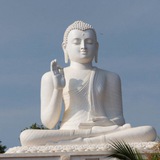
Dhammapada Verse 90
Jivakapanha Vatthu
Gataddhino1 Visokassa
vippamuttassa sabbadhi
sabbaganthappahinassa2
parilaho na vijjati.
Verse 90: For him (an arahat) whose journey is ended, who is free from sorrow and from all (e.g. khandha aggregates), who has destroyed all fetters, there is no more distress.
1. gataddhino: the journey is ended. Here 'the journey' means round of rebirths (samsara).
2. sabbaganthappahinassa: one who has destroyed all fetters. Here 'fetters' means greed, ill will, and wrong view.
The Story of the Question Asked by Jivaka
While residing at the mango-grove monastery of Jivaka, the Buddha uttered Verse (90) of this book, with reference to the question raised by Jivaka to the Buddha.
Devadatta, on one occasion, tried to kill the Buddha by pushing a big rock from the peak of Gijjhakuta mountain (Vulture's Peak). The rock struck a ledge on the side of the mountain and a splinter struck the big toe of the Buddha. The Buddha was taken to the mango-grove monastery of Jivaka. There, Jivaka, the renowned physician, attended on the Buddha; he put some medicine on the toe of the Buddha and bandaged it. Jivaka then left to see another patient in town, but promised to return and remove the bandage in the evening. When Jivaka returned that night, the city-gates were already closed and he could not come to see the Buddha that night. He was very upset because if the bandage was not removed in time, the whole body would become very hot and the Buddha would be very ill.
Just about this time, the Buddha asked Thera Ananda to remove the bandage from his big toe and found that the wound was completely healed. Jivaka came to the monastery early next morning and asked the Buddha whether he felt great pain and distress the previous night. The Buddha replied, "Jivaka! Ever since I attained Buddhahood there has been no pain and distress for me."
Then the Buddha spoke in verse as follows:
Verse 90: For him (an arahat) whose journey is ended, who is free from sorrow and from all (e.g. khandha aggregates), who has destroyed all fetters, there is no more distress.
At the end of the discourse many attained Sotapatti Fruition.
Free Buddhism books, teachings, podcasts and videos from Theravada, Mahayana and Vajrayana traditions:
https://news.1rj.ru/str/buddha_ebooks
====================
Jivakapanha Vatthu
Gataddhino1 Visokassa
vippamuttassa sabbadhi
sabbaganthappahinassa2
parilaho na vijjati.
Verse 90: For him (an arahat) whose journey is ended, who is free from sorrow and from all (e.g. khandha aggregates), who has destroyed all fetters, there is no more distress.
1. gataddhino: the journey is ended. Here 'the journey' means round of rebirths (samsara).
2. sabbaganthappahinassa: one who has destroyed all fetters. Here 'fetters' means greed, ill will, and wrong view.
The Story of the Question Asked by Jivaka
While residing at the mango-grove monastery of Jivaka, the Buddha uttered Verse (90) of this book, with reference to the question raised by Jivaka to the Buddha.
Devadatta, on one occasion, tried to kill the Buddha by pushing a big rock from the peak of Gijjhakuta mountain (Vulture's Peak). The rock struck a ledge on the side of the mountain and a splinter struck the big toe of the Buddha. The Buddha was taken to the mango-grove monastery of Jivaka. There, Jivaka, the renowned physician, attended on the Buddha; he put some medicine on the toe of the Buddha and bandaged it. Jivaka then left to see another patient in town, but promised to return and remove the bandage in the evening. When Jivaka returned that night, the city-gates were already closed and he could not come to see the Buddha that night. He was very upset because if the bandage was not removed in time, the whole body would become very hot and the Buddha would be very ill.
Just about this time, the Buddha asked Thera Ananda to remove the bandage from his big toe and found that the wound was completely healed. Jivaka came to the monastery early next morning and asked the Buddha whether he felt great pain and distress the previous night. The Buddha replied, "Jivaka! Ever since I attained Buddhahood there has been no pain and distress for me."
Then the Buddha spoke in verse as follows:
Verse 90: For him (an arahat) whose journey is ended, who is free from sorrow and from all (e.g. khandha aggregates), who has destroyed all fetters, there is no more distress.
At the end of the discourse many attained Sotapatti Fruition.
Free Buddhism books, teachings, podcasts and videos from Theravada, Mahayana and Vajrayana traditions:
https://news.1rj.ru/str/buddha_ebooks
====================
Telegram
Buddha Dharma books
Free Buddhism books, teachings, podcasts and videos from Theravada, Mahayana and Vajrayana traditions
❤1👍1💯1
Furthermore, I have explained to my disciples a practice that they use to develop the ten universal dimensions of meditation.
Someone perceives the meditation on universal (= kasina) earth above, below, across, undivided and limitless.
They perceive the meditation on universal water … the meditation on universal fire … the meditation on universal air … the meditation on universal blue … the meditation on universal yellow … the meditation on universal red … the meditation on universal white … the meditation on universal space … the meditation on universal consciousness above, below, across, undivided and limitless.
And many of my disciples meditate on that having attained perfection and consummation of insight.
MN 77 : Mahāsakuludāyisutta
Someone perceives the meditation on universal (= kasina) earth above, below, across, undivided and limitless.
They perceive the meditation on universal water … the meditation on universal fire … the meditation on universal air … the meditation on universal blue … the meditation on universal yellow … the meditation on universal red … the meditation on universal white … the meditation on universal space … the meditation on universal consciousness above, below, across, undivided and limitless.
And many of my disciples meditate on that having attained perfection and consummation of insight.
MN 77 : Mahāsakuludāyisutta
❤1🥰1
Dhammapada Verse 91
Mahakassapatthera Vatthu
Uyyunjanti satimanto
na nikete ramanti te
hamsava pallalam hitva
okamokam jahanti te.
Verse 91: The mindful strive diligently (in the Tranquillity and Insight Development Practice); they take no delight in the home (i.e., in the life of sensual pleasures); like swans (hamsa) that forsake the muddy pool, they abandon all home life (i.e., all cravings).
The Story of Thera Mahakassapa
While residing at the Veluvana monastery, the Buddha uttered Verse (91) of this book, with reference to Thera Mahakassapa.
The Buddha once spent the vassa at Rajagaha with a number of bhikkhus. About two weeks before the end of the vassa, the Buddha informed the bhikkhus that they would soon be leaving Rajagaha and told them to prepare for departure. Some bhikkhus stitched and dyed new robes, some washed the old robes. When some bhikkhus saw Mahakassapa washing his robes, they speculated, "There are so many people inside and outside Rajagaha who love and respect Thera Mahakassapa and are constantly looking to all his needs; is it possible that the Thera would leave his lay devotees here and follow the Buddha elsewhere?"
At the end of fifteen days, on the eve of his departure, the Buddha thought that there might be some occasions like alms-food offering ceremonies, initiation of novices, funerals, etc., and so it would not be proper for all the bhikkhus to leave. So he decided that some bhikkhus should remain at the Veluvana monastery and that the most suitable person would be Thera Mahakassapa. Consequently, Thera Mahakassapa remained in Rajagaha with some junior bhikkhus.
Then the other bhikkhus said scornfully, "Mahakassapa has not accompanied the Buddha, just as we have predicted!" The Buddha heard their remark and said to them, "Bhikkhus! Do you wish to say that my son Kassapa is attached to his lay disciples of Rajagaha and to the things they offer him? You are very much mistaken. My son Kassapa remains here under my instruction; he is not attached to anything here."
Then the Buddha spoke in verse as follows:
Verse 91: The mindful strive diligently (in the Tranquillity and Insight Development Practice); they take no delight in the home (i.e., in the life of sensual pleasures); like swans (hamsa) that forsake the muddy pool, they abandon all home life (i.e., all cravings).
Buddha dharma teachings channel:
https://news.1rj.ru/str/lorddivinebuddha
====================
Mahakassapatthera Vatthu
Uyyunjanti satimanto
na nikete ramanti te
hamsava pallalam hitva
okamokam jahanti te.
Verse 91: The mindful strive diligently (in the Tranquillity and Insight Development Practice); they take no delight in the home (i.e., in the life of sensual pleasures); like swans (hamsa) that forsake the muddy pool, they abandon all home life (i.e., all cravings).
The Story of Thera Mahakassapa
While residing at the Veluvana monastery, the Buddha uttered Verse (91) of this book, with reference to Thera Mahakassapa.
The Buddha once spent the vassa at Rajagaha with a number of bhikkhus. About two weeks before the end of the vassa, the Buddha informed the bhikkhus that they would soon be leaving Rajagaha and told them to prepare for departure. Some bhikkhus stitched and dyed new robes, some washed the old robes. When some bhikkhus saw Mahakassapa washing his robes, they speculated, "There are so many people inside and outside Rajagaha who love and respect Thera Mahakassapa and are constantly looking to all his needs; is it possible that the Thera would leave his lay devotees here and follow the Buddha elsewhere?"
At the end of fifteen days, on the eve of his departure, the Buddha thought that there might be some occasions like alms-food offering ceremonies, initiation of novices, funerals, etc., and so it would not be proper for all the bhikkhus to leave. So he decided that some bhikkhus should remain at the Veluvana monastery and that the most suitable person would be Thera Mahakassapa. Consequently, Thera Mahakassapa remained in Rajagaha with some junior bhikkhus.
Then the other bhikkhus said scornfully, "Mahakassapa has not accompanied the Buddha, just as we have predicted!" The Buddha heard their remark and said to them, "Bhikkhus! Do you wish to say that my son Kassapa is attached to his lay disciples of Rajagaha and to the things they offer him? You are very much mistaken. My son Kassapa remains here under my instruction; he is not attached to anything here."
Then the Buddha spoke in verse as follows:
Verse 91: The mindful strive diligently (in the Tranquillity and Insight Development Practice); they take no delight in the home (i.e., in the life of sensual pleasures); like swans (hamsa) that forsake the muddy pool, they abandon all home life (i.e., all cravings).
Buddha dharma teachings channel:
https://news.1rj.ru/str/lorddivinebuddha
====================
Telegram
Buddha
Buddha dharma teachings from the suttas and commentaries
❤1👍1
It was Christmas and the foreign monks had decided to celebrate it. They invited some laypeople as well as Ajahn Chah to join them. The laypeople were generally upset and skeptical. Why, they asked, were Buddhists celebrating Christmas? Ajahn Chah then gave a talk on religion in which he said, "As far as I understand, Christianity teaches people to do good and avoid evil, just as Buddhism does, so what is the problem? However, if people are upset by the idea of celebrating Christmas, that can be easily remedied. We won’t call it Christmas. Let’s call it "Christ-Buddhamas". Anything that inspires us to see what is true and do what is good is proper practice. You may call it any name you like."
Reflection on Life in general
Written by Ven. Ajahn Chah, founder of Theravada Thai Forest Tradition Buddhism Monasteries
Reflection on Life in general
Written by Ven. Ajahn Chah, founder of Theravada Thai Forest Tradition Buddhism Monasteries
❤1💯1
Jesus said, “If those who lead you say to you, ‘Look, the Kingdom is in the sky,’ then the birds of the sky will get there first. If they say, ‘It is in the sea,’ then the fish will get there first. Rather, the Kingdom is inside of you, and it is outside of you. When you come to know yourselves, then you will become known, and you will realize that it is you who are the children of the living Father. But if you will not know yourselves, then you dwell in poverty, and it is you who are that poverty”.
Thích Nhất Hạnh, Living Buddha, Living Christ
Thích Nhất Hạnh, Living Buddha, Living Christ
❤1💯1
Forwarded from Buddha Dharma books
Free Buddha Dharma ebook
The Buddha s Ancient Path
By Piyadassi Thera
Over the years a number of expositions of the Buddha s teachings have been published in English, but many lack authenticity and do not represent what the Buddha taught correctly. Hence the need for this authentic and comprehensive book based on the Four Noble Truths, which are the central conception of Buddhism, and the Noble Eightfold Path, which is Buddhism in practice.
The Buddha s Ancient Path is a book on basic Buddhism with a difference, for it was written by a monk who was a native of Sri Lanka, a scholar and a well-known preacher. He has the Pali Canon and the Commentaries at his fingertips, so that the book is full of apposite stories and quotations of what the Buddha said many of them hard to find elsewhere in English.
The Buddha never claimed to be a saviour who tried to save souls by means of a revealed religion. Through his own perseverance and understanding he proved that infinite possibilities are latent in man and that it must be man s endeavour to develop and unfold these possibilities.
Free download available:
http://ftp.budaedu.org/ebooks/pdf/EN046.pdf
=============
The Buddha s Ancient Path
By Piyadassi Thera
Over the years a number of expositions of the Buddha s teachings have been published in English, but many lack authenticity and do not represent what the Buddha taught correctly. Hence the need for this authentic and comprehensive book based on the Four Noble Truths, which are the central conception of Buddhism, and the Noble Eightfold Path, which is Buddhism in practice.
The Buddha s Ancient Path is a book on basic Buddhism with a difference, for it was written by a monk who was a native of Sri Lanka, a scholar and a well-known preacher. He has the Pali Canon and the Commentaries at his fingertips, so that the book is full of apposite stories and quotations of what the Buddha said many of them hard to find elsewhere in English.
The Buddha never claimed to be a saviour who tried to save souls by means of a revealed religion. Through his own perseverance and understanding he proved that infinite possibilities are latent in man and that it must be man s endeavour to develop and unfold these possibilities.
Free download available:
http://ftp.budaedu.org/ebooks/pdf/EN046.pdf
=============
❤1👍1💯1
Forwarded from Buddha Dharma books
Free Buddha Dharma ebook
Mahasi Abroad (Part-II)
A dhamma discourse by Mahasi Sayadaw Gyi
The original discourses about “Mahasi Abroad” Second Series was published by U Pwint Kaung, the late President of Mahasi Buddha Sasana Nuggaha Organization, also my father and was translated into English by U Nyi Nyi and Bhikkhu U Aggadhamma in 1981.
In this book, it expressed about the discourses given by Mahasi Sayadaw during his visit to Nepal and India around 1960, which can enrich and enhance the qualities of life for every single person. Sayadaw lectured about the teachings of the Buddha, what are the does and don’ts, what are the wholesome and unwholesome deeds, and about the manners, bodily and verbal acts very thoroughly.
Sayadaw especially taught every detail about the fundamentals of the Practice of Vipassana Meditation, which provides great help to the beginners of meditation. Mahasi Sayadaw put great effort and taught effectively both Buddhist thoughts and Buddhist practice. Even he found difficulties linguistically during his travelling abroad to propagate the Buddha Dhamma.
By reading this book, you will find that the late Mahasi Sayadaw is one of the most eminent meditation masters at all time, and a leader in the revival of Satipatthana Vipassana Meditation. Reading this trannoscription of Dhamma Talks, inspire may you to further strive towards the attainment of your spiritual goals.
Free download here:
http://www.mediafire.com/file/se4a0j6ox7dpyjn/
=============
Mahasi Abroad (Part-II)
A dhamma discourse by Mahasi Sayadaw Gyi
The original discourses about “Mahasi Abroad” Second Series was published by U Pwint Kaung, the late President of Mahasi Buddha Sasana Nuggaha Organization, also my father and was translated into English by U Nyi Nyi and Bhikkhu U Aggadhamma in 1981.
In this book, it expressed about the discourses given by Mahasi Sayadaw during his visit to Nepal and India around 1960, which can enrich and enhance the qualities of life for every single person. Sayadaw lectured about the teachings of the Buddha, what are the does and don’ts, what are the wholesome and unwholesome deeds, and about the manners, bodily and verbal acts very thoroughly.
Sayadaw especially taught every detail about the fundamentals of the Practice of Vipassana Meditation, which provides great help to the beginners of meditation. Mahasi Sayadaw put great effort and taught effectively both Buddhist thoughts and Buddhist practice. Even he found difficulties linguistically during his travelling abroad to propagate the Buddha Dhamma.
By reading this book, you will find that the late Mahasi Sayadaw is one of the most eminent meditation masters at all time, and a leader in the revival of Satipatthana Vipassana Meditation. Reading this trannoscription of Dhamma Talks, inspire may you to further strive towards the attainment of your spiritual goals.
Free download here:
http://www.mediafire.com/file/se4a0j6ox7dpyjn/
=============
❤2👍1
Dhammapada Verse 92
Belatthasisatthera Vatthu
Yesam sannicayo1natthi
ye parinnatabhojana2
sunnato3 animitto4 ca
vimokkho5 yesam gocaro
akaseva sakuntnam
gati tesam durannaya6.
Verse 92: Arahats do not hoard (anything); when taking food they reflect well over it (i.e., in accordance with the three parinnas). They have as their object liberation from existence, that is, Nibbana which is Void and Signless. Their destination, like the course of birds in the air, cannot be traced.
1. sannicayo: hoarding. According to the Commentary, it means accumulating either kamma and its effects or any of the four requisites.
2. parinnatabhojana: to take food according to the three parinnas. According to the Commentary, there are three parinnas that the bhikkhu should have concerning food, viz., (a) nataparinna, knowing the exact nature of the food being taken, (b) tiranaparinna, being convinced of the vileness of material food, and (c) pahanaparinna, rejection of all pleasure in eating.
3. sunnata: the Void. According to the Commentary, it means void of craving. It is an epithet of Nibbana.
4. animittam: the Signless. According to the Commentary, it means no sign of craving, ill will and ignorance. It is also an epithet of Nibbana.
5. vimokkho: liberation from existence; Nibbana.
6. gati tesam durannaya: their destination cannot be traced because arahats have eradicated craving and are no more subject to rebirths.
The Story of Thera Belatthasisa
While residing at the Jetavana monastery, the Buddha uttered Verse (92) of this book, with reference to Thera Belatthasisa.
Thera Belatthasisa, after going on an alms-round in the village, stopped on the way and took his food there. After the meal, he continued his round of alms for more food. When he had collected enough food he returned to the monastery, dried up the rice and hoarded it. Thus, there was no need for him to go on an alms-round every day; he then remained in jhana concentration for two or three days. Arising from jhana concentration he ate the dried rice he had stored up, after soaking it in water. Other Bhikkhunis thought ill of the thera on this account, and reported to the Buddha about his hoarding of rice. Since then, the hoarding of food by the bhikkhus has been prohibited.
As for Thera Belatthasisa, since he stored up rice before the ruling on hoarding was made and because he did it not out of greed for food, but only to save time for meditation practice, the Buddha declared that the thera was quite innocent and that he was not to be blamed.
The Buddha then spoke in verse as follows:
Verse 92: Arahats do not hoard (anything); when taking food they reflect well over it (i.e., in accordance with the three parinnas).* They have as their object liberation from existence, that is, Nibbana which is Void and Signless. Their destination, like the course of birds in the air, cannot be traced.
*Parinnatabhojana: to take food according to the three parinnas. According to the Commentary, there are three parinnas that the bhikkhu should have concerning food, viz., (a) nataparinna, knowing the exact nature of the food being taken, (b) tiranaparinna, being convinced of the vileness of material food, and (c) pahanaparrina, rejection of all pleasure in eating.
Tibetan Buddhism - Vajrayana, Tantrayana and esoteric Buddhism channel:
https://news.1rj.ru/str/tibetanbuddha
Vajrayana Tantrayana Buddhism channel:
https://news.1rj.ru/str/tantrayanabuddhism
====================
Belatthasisatthera Vatthu
Yesam sannicayo1natthi
ye parinnatabhojana2
sunnato3 animitto4 ca
vimokkho5 yesam gocaro
akaseva sakuntnam
gati tesam durannaya6.
Verse 92: Arahats do not hoard (anything); when taking food they reflect well over it (i.e., in accordance with the three parinnas). They have as their object liberation from existence, that is, Nibbana which is Void and Signless. Their destination, like the course of birds in the air, cannot be traced.
1. sannicayo: hoarding. According to the Commentary, it means accumulating either kamma and its effects or any of the four requisites.
2. parinnatabhojana: to take food according to the three parinnas. According to the Commentary, there are three parinnas that the bhikkhu should have concerning food, viz., (a) nataparinna, knowing the exact nature of the food being taken, (b) tiranaparinna, being convinced of the vileness of material food, and (c) pahanaparinna, rejection of all pleasure in eating.
3. sunnata: the Void. According to the Commentary, it means void of craving. It is an epithet of Nibbana.
4. animittam: the Signless. According to the Commentary, it means no sign of craving, ill will and ignorance. It is also an epithet of Nibbana.
5. vimokkho: liberation from existence; Nibbana.
6. gati tesam durannaya: their destination cannot be traced because arahats have eradicated craving and are no more subject to rebirths.
The Story of Thera Belatthasisa
While residing at the Jetavana monastery, the Buddha uttered Verse (92) of this book, with reference to Thera Belatthasisa.
Thera Belatthasisa, after going on an alms-round in the village, stopped on the way and took his food there. After the meal, he continued his round of alms for more food. When he had collected enough food he returned to the monastery, dried up the rice and hoarded it. Thus, there was no need for him to go on an alms-round every day; he then remained in jhana concentration for two or three days. Arising from jhana concentration he ate the dried rice he had stored up, after soaking it in water. Other Bhikkhunis thought ill of the thera on this account, and reported to the Buddha about his hoarding of rice. Since then, the hoarding of food by the bhikkhus has been prohibited.
As for Thera Belatthasisa, since he stored up rice before the ruling on hoarding was made and because he did it not out of greed for food, but only to save time for meditation practice, the Buddha declared that the thera was quite innocent and that he was not to be blamed.
The Buddha then spoke in verse as follows:
Verse 92: Arahats do not hoard (anything); when taking food they reflect well over it (i.e., in accordance with the three parinnas).* They have as their object liberation from existence, that is, Nibbana which is Void and Signless. Their destination, like the course of birds in the air, cannot be traced.
*Parinnatabhojana: to take food according to the three parinnas. According to the Commentary, there are three parinnas that the bhikkhu should have concerning food, viz., (a) nataparinna, knowing the exact nature of the food being taken, (b) tiranaparinna, being convinced of the vileness of material food, and (c) pahanaparrina, rejection of all pleasure in eating.
Tibetan Buddhism - Vajrayana, Tantrayana and esoteric Buddhism channel:
https://news.1rj.ru/str/tibetanbuddha
Vajrayana Tantrayana Buddhism channel:
https://news.1rj.ru/str/tantrayanabuddhism
====================
Telegram
Tibetan Buddhism Vajrayana Tantrayana esoteric tradition
Buddha Dharma teachings from the esoteric Vajrayana or Tantrayana Buddhism, includes all major schools Nyingma, Kagyu, Gelug, Sakya, Jonang and Bonpo.
❤1💯1
Dhammapada Verse 93
Anuruddhatthera Vatthu
Yassasa va parikkhina
ahare ca anissito
sunnato animitto ca
vimokkho yassa gocaro
akaseva sakuntanam
padam tassa durannayam.
Verse 93: The arahat is free from moral intoxicants (asavas); he is not attached to food. He has as his object liberation from existence, i.e., Nibbana which is Void and Signless. His path, like that of birds in the air, cannot be traced.
The Story of Thera Anuruddha
While residing at the Jetavana monastery, the Buddha uttered Verse (93) of this book, with reference to Thera Anuruddha.
Thera Anuruddha was one day looking for some discarded pieces of cloth in a rubbish heap to make into a robe as his old robe was getting soiled and torn. Jalini, his wife of a previous existence, who was now in a deva world, saw him. Knowing that he was looking for some cloth, she took three pieces of good deva material and put them in the rubbish heap, making them barely visible. The thera found the pieces of cloth and took them to the monastery. While he was making the robe, the Buddha arrived with his Chief Disciples and senior disciples and they also helped stitch the robe.
Meanwhile, Jalini, assuming the form of a young lady, came to the village and learnt about the arrival of the Buddha and his disciples and also how they were helping Thera Anuruddha. She urged the villagers to send good delicious food to the monastery and consequently there was more than enough for all. Other bhikkhus, seeing so much surplus, put the blame on the thera and said, "Thera Anuruddha should have asked his relatives and lay disciples to send just enough food; may be, he just wanted to show off that he had so many devotees." To those bhikkhus, the Buddha said, "Bhikkhus, do not think my son Anuruddha has asked his relatives and lay disciples to send rice gruel and other foods. My son the thera did not ask for anything; arahats do not talk about such things like food and clothing. The excessive amount of food brought to the monastery this morning was due to the promptings of a celestial being and not of a man."
Then the Buddha spoke in verse as follows:
Verse 93: The arahat is free from moral intoxicants (asavas); he is not attached to food. He has as his object liberation from existence, i.e., Nibbana which is Void and Signless. His path, like that of birds in the air, cannot be traced.
Words of the Buddha channel:
https://news.1rj.ru/str/wordsofbuddha
====================
Anuruddhatthera Vatthu
Yassasa va parikkhina
ahare ca anissito
sunnato animitto ca
vimokkho yassa gocaro
akaseva sakuntanam
padam tassa durannayam.
Verse 93: The arahat is free from moral intoxicants (asavas); he is not attached to food. He has as his object liberation from existence, i.e., Nibbana which is Void and Signless. His path, like that of birds in the air, cannot be traced.
The Story of Thera Anuruddha
While residing at the Jetavana monastery, the Buddha uttered Verse (93) of this book, with reference to Thera Anuruddha.
Thera Anuruddha was one day looking for some discarded pieces of cloth in a rubbish heap to make into a robe as his old robe was getting soiled and torn. Jalini, his wife of a previous existence, who was now in a deva world, saw him. Knowing that he was looking for some cloth, she took three pieces of good deva material and put them in the rubbish heap, making them barely visible. The thera found the pieces of cloth and took them to the monastery. While he was making the robe, the Buddha arrived with his Chief Disciples and senior disciples and they also helped stitch the robe.
Meanwhile, Jalini, assuming the form of a young lady, came to the village and learnt about the arrival of the Buddha and his disciples and also how they were helping Thera Anuruddha. She urged the villagers to send good delicious food to the monastery and consequently there was more than enough for all. Other bhikkhus, seeing so much surplus, put the blame on the thera and said, "Thera Anuruddha should have asked his relatives and lay disciples to send just enough food; may be, he just wanted to show off that he had so many devotees." To those bhikkhus, the Buddha said, "Bhikkhus, do not think my son Anuruddha has asked his relatives and lay disciples to send rice gruel and other foods. My son the thera did not ask for anything; arahats do not talk about such things like food and clothing. The excessive amount of food brought to the monastery this morning was due to the promptings of a celestial being and not of a man."
Then the Buddha spoke in verse as follows:
Verse 93: The arahat is free from moral intoxicants (asavas); he is not attached to food. He has as his object liberation from existence, i.e., Nibbana which is Void and Signless. His path, like that of birds in the air, cannot be traced.
Words of the Buddha channel:
https://news.1rj.ru/str/wordsofbuddha
====================
Telegram
Words of the Buddha
Daily teachings of Buddha Dharma
❤2👍1
The Dharma of Snow
Be patient and persevere: results on the path will come in due time, and sometimes all at once, like the sudden melting of snow.
By Ayya Medhanandi Bhikkhuni
Last winter we had quite a lot of snow. In April, we were still navigating from building to building through narrow pathways dug into snow several feet high. The days were quite bright and sunny, and it was remarkable to us that the snow was still there. One day, after our winter retreat, we were moving a very heavy carpet from one building to the other, which none of us could lift. We managed to get it on a sled and pulled it from the main house to the meditation hall. And then, by that very afternoon, the snow was completely gone. We couldn’t understand how that had happened, literally from morning to afternoon.
One of the nuns at the hermitage, Sister Ahimsa, wrote about it to her son, who is a geophysicist. This is what he wrote back:
You seem very impressed with how the snow melted. I’m sure it was amazing to see. The world transformed overnight.
Melting is a nonlinear process, which means melting begets melting. Also, snow requires a lot of energy to change from ice to water, and this energy does not cause any change in temperature. What this means is that the snow can actually be above freezing without melting. If all the snow gets really warm over a few nice days, then it can melt all at once, really fast. As the melted snow starts to run through the unmelted snow, it helps to speed up the process. Then, when the ground appears, it absorbs much more sunlight and the melting really speeds up. The melting has probably been happening for weeks, unseen, and then the snow layer collapsed all at once.
This sort of regime shifting happens all the time in the earth sciences. Things hold on the way they are, even in very unfavorable conditions, and then at some invisible point something snaps and everything changes. Some scientists are worried our climate may act like that, that it might all of a sudden change dramatically because of the way we are forcing it.
This denoscription is very fitting to our practice. The first parallel that stands out is this: “Melting is a nonlinear process.” In the same way, following the noble eightfold path is a nonlinear process, “which means melting begets melting,” just as waking up begets waking up. As the defilements—greed, hatred, and delusion—melt away, the process of purification speeds up our relinquishment of impurity. The melting of the hindrances, just like the snow, requires a lot of energy to change from ice to water, to change from habit to letting go. But “this energy does not cause any change in temperature.” In other words, the energy in and of itself doesn’t cause the melting to happen completely.
That means that we can still hang on to our poor habits. We can still be stuck in our ignorance, in our delusion, in our greed and our hatred, for a long time. Even if we’ve done years and years of meditation, or weeks and weeks of retreats. Even though we’ve practiced for a long, long time, it can look like nothing has happened. That’s because the defilements can hang on for a long time, “even in very unfavorable conditions.” They don’t like the fact that we are working to melt them. But they hang on anyway, and we get frustrated—which they do like.
The next metaphor is this: “The snow can actually be above freezing without melting. As the melted snow starts to run through unmelted snow, it helps speed up the process.” In the same way, we use effort to sustain mindfulness and diligence, with ardor, devotion, and clear comprehension. We keep working to prevent unwholesome states from continuing. We work to remove them and to encourage wholesome states to arise, and to sustain them. If we continue that process, and give it sustained effort, then when even a little bit of the ground of awakening begins to appear, it also has a profound effect on this process. Just like the sun-warmed ground that appears beneath the snowmelt, shifting and speeding the process dramatically.
Be patient and persevere: results on the path will come in due time, and sometimes all at once, like the sudden melting of snow.
By Ayya Medhanandi Bhikkhuni
Last winter we had quite a lot of snow. In April, we were still navigating from building to building through narrow pathways dug into snow several feet high. The days were quite bright and sunny, and it was remarkable to us that the snow was still there. One day, after our winter retreat, we were moving a very heavy carpet from one building to the other, which none of us could lift. We managed to get it on a sled and pulled it from the main house to the meditation hall. And then, by that very afternoon, the snow was completely gone. We couldn’t understand how that had happened, literally from morning to afternoon.
One of the nuns at the hermitage, Sister Ahimsa, wrote about it to her son, who is a geophysicist. This is what he wrote back:
You seem very impressed with how the snow melted. I’m sure it was amazing to see. The world transformed overnight.
Melting is a nonlinear process, which means melting begets melting. Also, snow requires a lot of energy to change from ice to water, and this energy does not cause any change in temperature. What this means is that the snow can actually be above freezing without melting. If all the snow gets really warm over a few nice days, then it can melt all at once, really fast. As the melted snow starts to run through the unmelted snow, it helps to speed up the process. Then, when the ground appears, it absorbs much more sunlight and the melting really speeds up. The melting has probably been happening for weeks, unseen, and then the snow layer collapsed all at once.
This sort of regime shifting happens all the time in the earth sciences. Things hold on the way they are, even in very unfavorable conditions, and then at some invisible point something snaps and everything changes. Some scientists are worried our climate may act like that, that it might all of a sudden change dramatically because of the way we are forcing it.
This denoscription is very fitting to our practice. The first parallel that stands out is this: “Melting is a nonlinear process.” In the same way, following the noble eightfold path is a nonlinear process, “which means melting begets melting,” just as waking up begets waking up. As the defilements—greed, hatred, and delusion—melt away, the process of purification speeds up our relinquishment of impurity. The melting of the hindrances, just like the snow, requires a lot of energy to change from ice to water, to change from habit to letting go. But “this energy does not cause any change in temperature.” In other words, the energy in and of itself doesn’t cause the melting to happen completely.
That means that we can still hang on to our poor habits. We can still be stuck in our ignorance, in our delusion, in our greed and our hatred, for a long time. Even if we’ve done years and years of meditation, or weeks and weeks of retreats. Even though we’ve practiced for a long, long time, it can look like nothing has happened. That’s because the defilements can hang on for a long time, “even in very unfavorable conditions.” They don’t like the fact that we are working to melt them. But they hang on anyway, and we get frustrated—which they do like.
The next metaphor is this: “The snow can actually be above freezing without melting. As the melted snow starts to run through unmelted snow, it helps speed up the process.” In the same way, we use effort to sustain mindfulness and diligence, with ardor, devotion, and clear comprehension. We keep working to prevent unwholesome states from continuing. We work to remove them and to encourage wholesome states to arise, and to sustain them. If we continue that process, and give it sustained effort, then when even a little bit of the ground of awakening begins to appear, it also has a profound effect on this process. Just like the sun-warmed ground that appears beneath the snowmelt, shifting and speeding the process dramatically.
Telegram
Ajahn Chah - Theravada Thailand Buddhism
Collection of teachings of Venerable Ajahn Chah, a foremost meditation and Buddhist teacher from Thailand
❤2👍1
From underneath, there’s an invisible letting go of those impurities that we may not even notice. Say you have a shirt that’s very badly stained, and then you bleach it or soak it. It will get really clean. But a few stains will still show themselves, and you’ll notice those more than anything. More than all that was washed away, we notice what’s left. So it is with this process. We’ve worked so hard. We’ve made such valiant effort. And still there are impurities that we’re shocked to find. We get discouraged and may even think we should give up. “It doesn’t work!” we think, without recollecting how much we’ve already managed to cleanse, to purify, to settle, to see.
Even when we’ve experienced the most painful thing imaginable, we can still find peace through the practice.
“The melting has probably been happening for weeks unseen.” Yes! Impurities have been melting and melting for months, for years, even. We may even have been doing this for lifetimes. Then suddenly, this layer of encrustation collapses. When the conditions are right and we reach a certain threshold, it falls away. A door opens, an understanding blossoms. There’s a sudden, real, penetrating insight, and a sense of realization. Something deep has been abandoned.
But there’s more work to do.
“Things hold on this way even in very unfavorable conditions.” For the defilements, ethical behavior (sila), concentration (samadhi), and discernment (panna) are most unfavorable. But for awakening, they’re very favorable. We have to remember to be patient, not to have expectations. Then one day we will find ourselves understanding suffering (dukkha), knowing its origins, observing it, and watching it end. Seeing it cease and letting the noble eightfold path rise up in front of us.
Right view, right intention, right speech, right action, right livelihood. How are we spending our time? How do we make our living? Are we doing the practice or are we just sitting? As Ajahn Chah said, “Even chickens sit.” We’ve sat this many hours today, but what kind of work have we been doing? How have we applied the mind during that time? The process itself may be nonlinear, but we must be relentless in our commitment to following the path.
The highest expression of our human nature is to purify our minds. To clear away the clouds, the sheets of snow, the ice that we’re encased in. We’re frozen in our fear, frozen in our anger, in our opinions, in our judgments of ourselves and of each other. We are locked in. We have to find the way to put the key in the lock, even in the dark.
To do this, we need to be able to feel our humanity, to feel our nature from the inside. Not superficially but from within, where the invisible factors of mindfulness, clarity, faith, energy, concentration, and wisdom can dismantle and dissolve years and years of deluded ways of perception, of relating to life. That’s what this practice brings about, given enough patience and diligence and surrendering to the process. It brings about a spiritual transformation. It’s invisible. We don’t know it right away, but after years we begin to see. We see the changes in each other. We see the changes in ourselves. It’s quite remarkable.
When you’re sitting with different states of mind arising and it seems interminable, trust that this process works. In some ways visibly, in other ways invisibly. Like the invisible melting of the snow, beneath the crust of ice. It does work if we keep putting in the causes and conditions for mindfulness to arise, for diligence to arise, for contentment and gratitude to arise, for generosity to be expressed, for concentration to be matured, for wisdom to manifest. The results will take care of themselves. They know exactly when it’s time.
Trusting in the practice is key. We need to trust and persevere with determination. And that involves giving up. Nekkhamma (renunciation) is a giving up. Not just shaving your head and wearing robes. That’s not the real giving up. That’s just on the outside. As a friend of mine once said, you have to shave your heart.
Even when we’ve experienced the most painful thing imaginable, we can still find peace through the practice.
“The melting has probably been happening for weeks unseen.” Yes! Impurities have been melting and melting for months, for years, even. We may even have been doing this for lifetimes. Then suddenly, this layer of encrustation collapses. When the conditions are right and we reach a certain threshold, it falls away. A door opens, an understanding blossoms. There’s a sudden, real, penetrating insight, and a sense of realization. Something deep has been abandoned.
But there’s more work to do.
“Things hold on this way even in very unfavorable conditions.” For the defilements, ethical behavior (sila), concentration (samadhi), and discernment (panna) are most unfavorable. But for awakening, they’re very favorable. We have to remember to be patient, not to have expectations. Then one day we will find ourselves understanding suffering (dukkha), knowing its origins, observing it, and watching it end. Seeing it cease and letting the noble eightfold path rise up in front of us.
Right view, right intention, right speech, right action, right livelihood. How are we spending our time? How do we make our living? Are we doing the practice or are we just sitting? As Ajahn Chah said, “Even chickens sit.” We’ve sat this many hours today, but what kind of work have we been doing? How have we applied the mind during that time? The process itself may be nonlinear, but we must be relentless in our commitment to following the path.
The highest expression of our human nature is to purify our minds. To clear away the clouds, the sheets of snow, the ice that we’re encased in. We’re frozen in our fear, frozen in our anger, in our opinions, in our judgments of ourselves and of each other. We are locked in. We have to find the way to put the key in the lock, even in the dark.
To do this, we need to be able to feel our humanity, to feel our nature from the inside. Not superficially but from within, where the invisible factors of mindfulness, clarity, faith, energy, concentration, and wisdom can dismantle and dissolve years and years of deluded ways of perception, of relating to life. That’s what this practice brings about, given enough patience and diligence and surrendering to the process. It brings about a spiritual transformation. It’s invisible. We don’t know it right away, but after years we begin to see. We see the changes in each other. We see the changes in ourselves. It’s quite remarkable.
When you’re sitting with different states of mind arising and it seems interminable, trust that this process works. In some ways visibly, in other ways invisibly. Like the invisible melting of the snow, beneath the crust of ice. It does work if we keep putting in the causes and conditions for mindfulness to arise, for diligence to arise, for contentment and gratitude to arise, for generosity to be expressed, for concentration to be matured, for wisdom to manifest. The results will take care of themselves. They know exactly when it’s time.
Trusting in the practice is key. We need to trust and persevere with determination. And that involves giving up. Nekkhamma (renunciation) is a giving up. Not just shaving your head and wearing robes. That’s not the real giving up. That’s just on the outside. As a friend of mine once said, you have to shave your heart.
❤1💯1
We shave our heads every week, but the hair grows right back. So we keep on doing it. It’s a constant giving up. Giving up the pleasures of the senses. Wanting another hit, another kind of dessert, another kind of experience, another kind of retreat. Judging, evaluating, wanting, regretting, being angry, grieving—all of it. We constantly turn and twist through the contortions of human life until we find that place where we can see through to our true nature, and the pure mind comes into view like a bright moon.
This is a complete letting go of conditioned things, conditioned experiences, conditions in their worldly way, and giving ourselves to that which is unconditioned, until it rises up within us. We cannot find the unconditioned out in the world. We can only know it in the heart. It arises from this very body, which is death-bound, which must be washed and cleaned and tended to, and that dirties the clothing we wear. Out of this dirt-producing, odor-producing body can come an awakened mind, can come transcendent beauty.
So we use the body. We respect it and honor it for the purpose of spiritual awakening, not as a pleasure-producing entity. Our goal is not to squeeze out every last ounce of joy and pleasure from worldly things, but finally to arrive at that farther shore that we’ve been striving for. This is the meaning of the human journey for those who are willing to trust and stick to the practice.
When we allow the mind to get overexcited, overheated about things that have already happened, or about the future, we’re deepening the groove of our mental bondage. To allow anger to abide in the mind, to allow unwholesome states to pervade the mind, is like allowing Mara to sit on our backs. That won’t help collapse the kilesas, the impurities of the heart.
Everything is contained in these teachings. They’re so vast. My revered teacher Sayadaw U Pandita [the Burmese meditation master] always told me, “Don’t read the books. Read your heart first.” If we study our own hearts, we’ll find that everything is written there. Everything. And if we study the suttas, we can hear the Buddha’s words and they will encourage us to keep practicing.
Even when daggers have been thrust into our hearts, when we’ve experienced the most painful thing imaginable, like a mother and father losing their own child, we can still find peace through the practice. We do this by investigating the very ground of our being and discovering that there is no being in there. No solid being that we can call “me” or “mine.” Even in the face of terrible loss, we can see through the pain to the ending of pain. Not only for ourselves, but for all beings. That’s what our journey represents: the possibility of going to the Everest of the spiritual realm. That might seem impossible from where we sit now, but we have to trust this process. And like the sudden vanishing of the winter snow, it’s nothing short of magnificent.
Adapted from a talk delivered at Chapin Mill, Batavia, New York.
Ayya Medhanandi Bhikkhuni is the founder and guiding teacher of Sati Saraniya Hermitage in Perth, Ontario, Canada.
=====
Ajahn Chah, Buddhist teacher of Thai forest meditation of Theravada Buddhism channel:
https://news.1rj.ru/str/ajahnchah_buddhism
This is a complete letting go of conditioned things, conditioned experiences, conditions in their worldly way, and giving ourselves to that which is unconditioned, until it rises up within us. We cannot find the unconditioned out in the world. We can only know it in the heart. It arises from this very body, which is death-bound, which must be washed and cleaned and tended to, and that dirties the clothing we wear. Out of this dirt-producing, odor-producing body can come an awakened mind, can come transcendent beauty.
So we use the body. We respect it and honor it for the purpose of spiritual awakening, not as a pleasure-producing entity. Our goal is not to squeeze out every last ounce of joy and pleasure from worldly things, but finally to arrive at that farther shore that we’ve been striving for. This is the meaning of the human journey for those who are willing to trust and stick to the practice.
When we allow the mind to get overexcited, overheated about things that have already happened, or about the future, we’re deepening the groove of our mental bondage. To allow anger to abide in the mind, to allow unwholesome states to pervade the mind, is like allowing Mara to sit on our backs. That won’t help collapse the kilesas, the impurities of the heart.
Everything is contained in these teachings. They’re so vast. My revered teacher Sayadaw U Pandita [the Burmese meditation master] always told me, “Don’t read the books. Read your heart first.” If we study our own hearts, we’ll find that everything is written there. Everything. And if we study the suttas, we can hear the Buddha’s words and they will encourage us to keep practicing.
Even when daggers have been thrust into our hearts, when we’ve experienced the most painful thing imaginable, like a mother and father losing their own child, we can still find peace through the practice. We do this by investigating the very ground of our being and discovering that there is no being in there. No solid being that we can call “me” or “mine.” Even in the face of terrible loss, we can see through the pain to the ending of pain. Not only for ourselves, but for all beings. That’s what our journey represents: the possibility of going to the Everest of the spiritual realm. That might seem impossible from where we sit now, but we have to trust this process. And like the sudden vanishing of the winter snow, it’s nothing short of magnificent.
Adapted from a talk delivered at Chapin Mill, Batavia, New York.
Ayya Medhanandi Bhikkhuni is the founder and guiding teacher of Sati Saraniya Hermitage in Perth, Ontario, Canada.
=====
Ajahn Chah, Buddhist teacher of Thai forest meditation of Theravada Buddhism channel:
https://news.1rj.ru/str/ajahnchah_buddhism
Telegram
Ajahn Chah - Theravada Thailand Buddhism
Collection of teachings of Venerable Ajahn Chah, a foremost meditation and Buddhist teacher from Thailand
❤2👍1
Forwarded from Buddha Dharma books
Free Buddha Dharma ebook
The Treasure of the Dhamma
By Venerable K. Sri Dhammananda
The Treasure of the Dhamma is not just a book for the casual reader. This book aims to provide a thorough understanding of the dhamma as enunciated by the Buddha. Unlike an essay, it represents a selection of quotations from the Tripitaka recorded in writing in Pali around 80 B.C., and which was translated into English about a hundred years ago in England. The translations from the Pali language in the past had generally been done in archaic English, and consequently many modern readers encountered difficulties in grasping the real meaning of the sayings. This book attempts to present the quotations in modern-day English as far as possible with emphasis being placed on the spirit behind the sayings.
The quotations are derived from the various discourses delivered by the Buddha and these have been divided into 15 chapters according to subject matter. In addition to the quotations from the Sutras in the Tripitaka, there are also a few quotations from the commentaries on the Pali Canon and few quotations from other essay writings designed to explain certain technical terms and parables found in the texts.
Free download here:
http://ftp.budaedu.org/ebooks/pdf/EN048.pdf
=============
The Treasure of the Dhamma
By Venerable K. Sri Dhammananda
The Treasure of the Dhamma is not just a book for the casual reader. This book aims to provide a thorough understanding of the dhamma as enunciated by the Buddha. Unlike an essay, it represents a selection of quotations from the Tripitaka recorded in writing in Pali around 80 B.C., and which was translated into English about a hundred years ago in England. The translations from the Pali language in the past had generally been done in archaic English, and consequently many modern readers encountered difficulties in grasping the real meaning of the sayings. This book attempts to present the quotations in modern-day English as far as possible with emphasis being placed on the spirit behind the sayings.
The quotations are derived from the various discourses delivered by the Buddha and these have been divided into 15 chapters according to subject matter. In addition to the quotations from the Sutras in the Tripitaka, there are also a few quotations from the commentaries on the Pali Canon and few quotations from other essay writings designed to explain certain technical terms and parables found in the texts.
Free download here:
http://ftp.budaedu.org/ebooks/pdf/EN048.pdf
=============
👍2💯1
"How should we act, Lord, respecting the body of the Tathagata?"
"Do not hinder yourselves, Ananda, to honor the body of the Tathagata... At a crossroads also a stupa should be raised for the Tathagata. And whosoever shall bring to that place garlands or incense or sandalpaste, or pay reverence, and whose mind becomes calm there — it will be to his well being and happiness for a long time."
Partial excerpt from DN 16 : Maha-parinibbana Sutta
"Do not hinder yourselves, Ananda, to honor the body of the Tathagata... At a crossroads also a stupa should be raised for the Tathagata. And whosoever shall bring to that place garlands or incense or sandalpaste, or pay reverence, and whose mind becomes calm there — it will be to his well being and happiness for a long time."
Partial excerpt from DN 16 : Maha-parinibbana Sutta
❤3🥰1🙏1