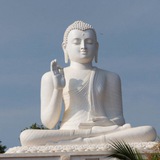
Dhammapada Verse 98
Khadiravaniyarevatatthera Vatthu
Game va yadi varanne
ninne va yadi va thale
yattha arahanto viharanti
tam bhumiramaneyyakam.
Verse 98: In a village or in a forest, in a valley or on a hill, wherever arahats dwell, that place is delightful.
The Story of Thera Revata
While residing at the Jetavana monastery, the Buddha uttered Verse (98) of this book, with reference to Thera Revata of the Acacia (khadira) Forest.
Revata was the youngest brother of the Chief Disciple, Sariputta. He was the only one of the brothers and sisters of Sariputta who had not left home for the homeless life. His parents were very anxious to get him married. Revata was only seven years old when his parents arranged a marriage for him to a young girl. At the wedding reception, he met an old lady who was one hundred and twenty years old, and he realized that all beings are subject to ageing and decay. So, he ran away from the house and went straight to a monastery, where there were thirty bhikkhus. Those bhikkhus had been requested earlier by Thera Sariputta to make his brother a samanera if he should come to them. Accordingly, he was made a samanera and Thera Sariputta was informed about it.
Samanera Revata took a subject of meditation from those bhikkhus and left for an acacia forest, thirty yojanas away from the monastery. At the end of the vassa, the samanera attained arahatship. Thera Sariputta then asked permission from the Buddha to visit his brother, but the Buddha replied that he himself would go there. So the Buddha accompanied by Thera Sariputta, Thera Sivali and five hundred other bhikkhus set out to visit Samanera Revata.
The journey was long, the road was rough and the area was uninhabited by people; but the devas looked to all the needs of the Buddha and the bhikkhus on the way. At an interval of every yojana, a monastery and food were provided, and they travelled at the rate of a yojana a day. Revata, learning about the visit of the Buddha, also made arrangements to welcome him. By supernormal power he created a special monastery for the Buddha and five hundred monasteries for the other bhikkhus, and made them comfortable throughout their stay there.
On their return journey, they travelled at the same rate as before, and came to the Pubbarama monastery on the eastern end of Savatthi at the end of the month. From there, they went to the house of Visakha, who offered them alms-food. After the meal, Visakha asked the Buddha if the place of Revata in the acacia forest was pleasant.
And the Buddha answered in verse as follows:
Verse 98: In a village or in a forest, in a valley or on a hill, wherever arahats dwell, that place is delightful.
Tibetan Buddhism - Vajrayana, Tantrayana and esoteric Buddhism channel:
https://news.1rj.ru/str/tibetanbuddha
Vajrayana Tantrayana Buddhism channel:
https://news.1rj.ru/str/tantrayanabuddhism
====================
Khadiravaniyarevatatthera Vatthu
Game va yadi varanne
ninne va yadi va thale
yattha arahanto viharanti
tam bhumiramaneyyakam.
Verse 98: In a village or in a forest, in a valley or on a hill, wherever arahats dwell, that place is delightful.
The Story of Thera Revata
While residing at the Jetavana monastery, the Buddha uttered Verse (98) of this book, with reference to Thera Revata of the Acacia (khadira) Forest.
Revata was the youngest brother of the Chief Disciple, Sariputta. He was the only one of the brothers and sisters of Sariputta who had not left home for the homeless life. His parents were very anxious to get him married. Revata was only seven years old when his parents arranged a marriage for him to a young girl. At the wedding reception, he met an old lady who was one hundred and twenty years old, and he realized that all beings are subject to ageing and decay. So, he ran away from the house and went straight to a monastery, where there were thirty bhikkhus. Those bhikkhus had been requested earlier by Thera Sariputta to make his brother a samanera if he should come to them. Accordingly, he was made a samanera and Thera Sariputta was informed about it.
Samanera Revata took a subject of meditation from those bhikkhus and left for an acacia forest, thirty yojanas away from the monastery. At the end of the vassa, the samanera attained arahatship. Thera Sariputta then asked permission from the Buddha to visit his brother, but the Buddha replied that he himself would go there. So the Buddha accompanied by Thera Sariputta, Thera Sivali and five hundred other bhikkhus set out to visit Samanera Revata.
The journey was long, the road was rough and the area was uninhabited by people; but the devas looked to all the needs of the Buddha and the bhikkhus on the way. At an interval of every yojana, a monastery and food were provided, and they travelled at the rate of a yojana a day. Revata, learning about the visit of the Buddha, also made arrangements to welcome him. By supernormal power he created a special monastery for the Buddha and five hundred monasteries for the other bhikkhus, and made them comfortable throughout their stay there.
On their return journey, they travelled at the same rate as before, and came to the Pubbarama monastery on the eastern end of Savatthi at the end of the month. From there, they went to the house of Visakha, who offered them alms-food. After the meal, Visakha asked the Buddha if the place of Revata in the acacia forest was pleasant.
And the Buddha answered in verse as follows:
Verse 98: In a village or in a forest, in a valley or on a hill, wherever arahats dwell, that place is delightful.
Tibetan Buddhism - Vajrayana, Tantrayana and esoteric Buddhism channel:
https://news.1rj.ru/str/tibetanbuddha
Vajrayana Tantrayana Buddhism channel:
https://news.1rj.ru/str/tantrayanabuddhism
====================
Telegram
Tibetan Buddhism Vajrayana Tantrayana esoteric tradition
Buddha Dharma teachings from the esoteric Vajrayana or Tantrayana Buddhism, includes all major schools Nyingma, Kagyu, Gelug, Sakya, Jonang and Bonpo.
❤1💯1
Forwarded from Buddha Dharma books
Free Buddha Dharma ebook
Exhortation
By Mahasi Sayadaw Gyi
Mahasi Sayadawgyi delivered relevant and useful Exhortations at the Annual Exhortations and Puja Ceremonies, every year held around full moon of Nattaw months (December/ January), and also at the Annual meeting of the Buddha Sasana Nuggaha Organization.
These Exhortations were usually published in the Annual Report of the Buddha Sasana Nuggaha Organization. The first Exhortation in this edition was delivered at the 23rd Annual ceremony held on 24th December 1972 and the second one at the 27th Annual meeting of the Buddha Sasana Nuggaha Organization held in 1975/ 1976.
The first dealt with the instructions given to the meditation instructors and senior administrators of the meditation centres, and the second dealt with the instructions for the members and leaders of the Buddha Sasana Nuggaha Organization to follow six virtues of a leader and four factors of the Sangaha Dhamma. These two Exhortations are important guidelines for Buddha Sasana Nuggaha Organization and meditation centres. The first Exhortation was first published in Myanmar in 1973.
Free download here:
http://www.mediafire.com/file/24c0xamronyahqw/
=============
Exhortation
By Mahasi Sayadaw Gyi
Mahasi Sayadawgyi delivered relevant and useful Exhortations at the Annual Exhortations and Puja Ceremonies, every year held around full moon of Nattaw months (December/ January), and also at the Annual meeting of the Buddha Sasana Nuggaha Organization.
These Exhortations were usually published in the Annual Report of the Buddha Sasana Nuggaha Organization. The first Exhortation in this edition was delivered at the 23rd Annual ceremony held on 24th December 1972 and the second one at the 27th Annual meeting of the Buddha Sasana Nuggaha Organization held in 1975/ 1976.
The first dealt with the instructions given to the meditation instructors and senior administrators of the meditation centres, and the second dealt with the instructions for the members and leaders of the Buddha Sasana Nuggaha Organization to follow six virtues of a leader and four factors of the Sangaha Dhamma. These two Exhortations are important guidelines for Buddha Sasana Nuggaha Organization and meditation centres. The first Exhortation was first published in Myanmar in 1973.
Free download here:
http://www.mediafire.com/file/24c0xamronyahqw/
=============
👍1💯1
Forwarded from Dhammapada - Buddha Dharma Teachings
Free Buddha Dharma ebook
Mindfulness of Breathing (Ānāpāna·Ssati) (Second Revised Edition)
By Pa Auk Tawya Sayadaw
In accordance with The Buddha's series of instructions, the Sayadaw first describes how the yogi develops samatha with mindfulness of breathing, until there appears the light of wisdom and the sign of concentration, the nimitta. Then the Sayadaw explains how the yogi develops the gained concentration, until the attainment of the fourth jhāna. Afterwards, the Sayadaw explains how the yogi uses the light of wisdom to discern ultimate materiality, ultimate mentality, and their dependent origination, in order then to develop vipassanā. Finally, the Sayadaw explains how the yogi progresses through the series of insight knowledges until there is realization of Nibbāna. In each case, the Sayadaw explains how the yogi's gradual development fulfils the thirty-seven requisites of enlightenment: in samatha, in vipassanā, and in the realization of Nibbāna.
Free download available:
https://drive.google.com/open?id=0B7p0UB1QfBmvcl8ycFE1N0xXNGc
Mindfulness of Breathing (Ānāpāna·Ssati) (Second Revised Edition)
By Pa Auk Tawya Sayadaw
In accordance with The Buddha's series of instructions, the Sayadaw first describes how the yogi develops samatha with mindfulness of breathing, until there appears the light of wisdom and the sign of concentration, the nimitta. Then the Sayadaw explains how the yogi develops the gained concentration, until the attainment of the fourth jhāna. Afterwards, the Sayadaw explains how the yogi uses the light of wisdom to discern ultimate materiality, ultimate mentality, and their dependent origination, in order then to develop vipassanā. Finally, the Sayadaw explains how the yogi progresses through the series of insight knowledges until there is realization of Nibbāna. In each case, the Sayadaw explains how the yogi's gradual development fulfils the thirty-seven requisites of enlightenment: in samatha, in vipassanā, and in the realization of Nibbāna.
Free download available:
https://drive.google.com/open?id=0B7p0UB1QfBmvcl8ycFE1N0xXNGc
❤1👍1💯1
Dhammapada Verse 99
Annatara itthi Vatthu
Ramaniyani arannani
yaittha na ramati jano
vitaraga ramissanti
na te kamagavesino.
Verse 99: Forests are delightful, but the worldlings find no delight in them; only those who are free from passion will find delight in them, for they do not seek sensual pleasures.
The Story of a Woman
While residing at the Jetavana monastery, the Buddha uttered Verse (99) of this book, with reference to a woman of doubtful character.
A bhikkhu, after taking a subject of meditation from the Buddha, was practising meditation in an old garden. A woman of doubtful character came into the garden and, seeing the bhikkhu, tried to attract his attention and seduce him. The thera got frightened; at the same time, his whole body was diffused with some kind of delightful satisfaction. The Buddha saw him from his monastery, and with his supernormal power, sent rays of light to him, and the bhikkhu received this message, which said, "My son, where worldlings seek sensual pleasures is not the place for bhikkhus; bhikkhus should take delight in forests where worldlings find no pleasure."
Then the Buddha spoke in verse as follows:
Verse 99: Forests are delightful, but the worldlings find no delight in them; only those who are free from passion will find delight in them, for they do not seek sensual pleasures.
End of Chapter Seven: The Arahat (Arahantavagga)
Words of the Buddha channel:
https://news.1rj.ru/str/wordsofbuddha
====================
Annatara itthi Vatthu
Ramaniyani arannani
yaittha na ramati jano
vitaraga ramissanti
na te kamagavesino.
Verse 99: Forests are delightful, but the worldlings find no delight in them; only those who are free from passion will find delight in them, for they do not seek sensual pleasures.
The Story of a Woman
While residing at the Jetavana monastery, the Buddha uttered Verse (99) of this book, with reference to a woman of doubtful character.
A bhikkhu, after taking a subject of meditation from the Buddha, was practising meditation in an old garden. A woman of doubtful character came into the garden and, seeing the bhikkhu, tried to attract his attention and seduce him. The thera got frightened; at the same time, his whole body was diffused with some kind of delightful satisfaction. The Buddha saw him from his monastery, and with his supernormal power, sent rays of light to him, and the bhikkhu received this message, which said, "My son, where worldlings seek sensual pleasures is not the place for bhikkhus; bhikkhus should take delight in forests where worldlings find no pleasure."
Then the Buddha spoke in verse as follows:
Verse 99: Forests are delightful, but the worldlings find no delight in them; only those who are free from passion will find delight in them, for they do not seek sensual pleasures.
End of Chapter Seven: The Arahat (Arahantavagga)
Words of the Buddha channel:
https://news.1rj.ru/str/wordsofbuddha
====================
Telegram
Words of the Buddha
Daily teachings of Buddha Dharma
❤1💯1
Forwarded from Dhammapada - Buddha Dharma Teachings
Free Buddha Dharma ebook
Gifts He Left Behind
The Dhamma Legacy of Ajaan Dune Atulo
compiled by Phra Bodhinandamuni
translated from the Thai by Thanissaro Bhikkhu
Many people have asked for Luang Pu's Dhamma talks, out of a desire to read them or listen to them, and I have to confess frankly that Luang Pu's Dhamma talks are extremely rare. This is because he never gave any formal sermons or discoursed at any great length. He simply taught meditation, admonished his students, answered questions, or discussed the Dhamma with other elder monks. He would speak in a way that was brief, careful, and to the point. In addition, he never gave sermons at formal ceremonies.
So in response to the desire and interest that many people have shown in Luang Pu's Dhamma, I have compiled this book of his short teachings — pure truths at the highest level, lessons and admonishments he gave his students, answers to questions, and passages from the Buddha's words in the Canon that he always liked to quote. Because I lived for a long time with him, to the end of his days, I have gathered these passages from memory or from notes in my journal. I have also included the events, locations, and people who were involved, to help make the passages easier to understand and more inviting to read.
Free download available:
https://static.sariputta.com/pdf/tipitaka/1229/Gifts%20He%20Left%20Behind-dikonversi.pdf
=============
Gifts He Left Behind
The Dhamma Legacy of Ajaan Dune Atulo
compiled by Phra Bodhinandamuni
translated from the Thai by Thanissaro Bhikkhu
Many people have asked for Luang Pu's Dhamma talks, out of a desire to read them or listen to them, and I have to confess frankly that Luang Pu's Dhamma talks are extremely rare. This is because he never gave any formal sermons or discoursed at any great length. He simply taught meditation, admonished his students, answered questions, or discussed the Dhamma with other elder monks. He would speak in a way that was brief, careful, and to the point. In addition, he never gave sermons at formal ceremonies.
So in response to the desire and interest that many people have shown in Luang Pu's Dhamma, I have compiled this book of his short teachings — pure truths at the highest level, lessons and admonishments he gave his students, answers to questions, and passages from the Buddha's words in the Canon that he always liked to quote. Because I lived for a long time with him, to the end of his days, I have gathered these passages from memory or from notes in my journal. I have also included the events, locations, and people who were involved, to help make the passages easier to understand and more inviting to read.
Free download available:
https://static.sariputta.com/pdf/tipitaka/1229/Gifts%20He%20Left%20Behind-dikonversi.pdf
=============
👍1💯1
Forwarded from Buddha Dharma books
Free Buddha Dharma ebook
Mindfulness: The Path To The Death
Venerable Ajahn Sumedho
The aim of this book is to provide a clear instruction in and reflection on Buddhist meditation as taught by Ajahn Sumedho, a bhikkhu (monk) of the Theravadin tradition. The following chapters are edited from longer talks Ajahn Sumedho has given to meditators as a practical approach to the wisdom of Buddhism. This wisdom is otherwise known as Dhamma, or 'the way things are'.
You are invited to use this book as a step-by-step manual. The first chapter tries to make the practice of meditation clear in a general way and the subsequent sections can be taken one at a time and followed by a period of meditation. The third chapter is a reflection on the understanding that meditation develops. The book concludes with the means of taking the Refuges and Precepts which place the practice of meditation within the larger framework of mind-cultivation. These can be requested formally from ordained Buddhists (Sarigha) or personally determined. They form the foundation of the means whereby spiritual values are brought into the world.
Free download here:
http://ftp.budaedu.org/ebooks/pdf/EN051.pdf
=============
Mindfulness: The Path To The Death
Venerable Ajahn Sumedho
The aim of this book is to provide a clear instruction in and reflection on Buddhist meditation as taught by Ajahn Sumedho, a bhikkhu (monk) of the Theravadin tradition. The following chapters are edited from longer talks Ajahn Sumedho has given to meditators as a practical approach to the wisdom of Buddhism. This wisdom is otherwise known as Dhamma, or 'the way things are'.
You are invited to use this book as a step-by-step manual. The first chapter tries to make the practice of meditation clear in a general way and the subsequent sections can be taken one at a time and followed by a period of meditation. The third chapter is a reflection on the understanding that meditation develops. The book concludes with the means of taking the Refuges and Precepts which place the practice of meditation within the larger framework of mind-cultivation. These can be requested formally from ordained Buddhists (Sarigha) or personally determined. They form the foundation of the means whereby spiritual values are brought into the world.
Free download here:
http://ftp.budaedu.org/ebooks/pdf/EN051.pdf
=============
👍2💯1
Dhammapada Verse 100
Tambadathika Coraghataka Vatthu
Sahassamapi ce vaca
anatthapadasamhita
ekam atthapadam seyyo
yam sutva upasammati.
Verse 100: Better than a thousand words that are senseless and unconnected with the realization of Nibbana, is a single word of sense, if on hearing it one is calmed.
The Story of Tambadathika
While residing at the Jetavana monastery, the Buddha uttered Verse (100) of this book, with reference to Tambadathika, the executioner of thieves.
Tambadathika served the king as an executioner of thieves for fifty-five years; he had just retired from that post. One day, after preparing rice gruel at his house, he went to the river for a bath; he had intended to take the specially prepared rice gruel on his return. As he was about to take the rice gruel, Thera Sariputta, who had just arisen from sustained absorption in Concentration (jhana samapatti), stood at his door for alms-food. Seeing the thera, Tambadathika thought to himself, "Throughout my life, I have been executing thieves; now I should offer this food to the thera." So, he invited Thera Sariputta to come in and respectfully offered the rice gruel.
After the meal, the thera taught him the Dhamma, but Tambadathika could not pay attention, because he was so agitated as he recollected his past life as an executioner. When the thera knew this, he decided to ask Tambadathika tactfully whether he killed the thieves because he wished to kill them or because he was ordered to do so. Tambadathika answered that he was ordered to kill them by the king and that he had no wish to kill. Then the thera asked, "If that is so, would you be guilty or not ?" Tambadathika then concluded that, as he was not responsible for the evil deeds, he was not guilty. He, therefore, calmed down, and requested the thera to continue his exposition. As he listened to the Dhamma with proper attention, he came very close to attaining Sotapatti Magga, and reached as far as anuloma nana.* After the discourse, Tambadathika accompanied Thera Sariputta for some distance and then returned home. On his way home a cow (actually a demon in the guise of a cow) gored him to death.
When the Buddha came to the congregation of the bhikkhus in the evening, they informed him about the death of Tambadathika. When asked where Tambadathika was reborn, the Buddha told them that although Tambadathika had committed evil deeds throughout his life, because he comprehended the Dhamma after hearing it from Thera Sariputta and had already attained anuloma nana before he died, he was reborn in the Tusita deva world. The bhikkhus wondered how such an evil-doer could have such great benefit after listening to the Dhamma just once. To them the Buddha said that the length of a discourse is of no consequence, for one single word of sense can produce much benefit.
Then the Buddha spoke in verse as follows:
Verse 100: Better than a thousand words that are senseless and unconnected with the realization of Nibbana, is a single word of sense, if on hearing it one is calmed.
*anuloma nana: Vipassana Insight which causes the namarupa process of the yogi to become fully adapted for Magga Insight.
Dhammapada, beloved and favorite teachings of the Buddha channel:
https://news.1rj.ru/str/dhammapadas
====================
Tambadathika Coraghataka Vatthu
Sahassamapi ce vaca
anatthapadasamhita
ekam atthapadam seyyo
yam sutva upasammati.
Verse 100: Better than a thousand words that are senseless and unconnected with the realization of Nibbana, is a single word of sense, if on hearing it one is calmed.
The Story of Tambadathika
While residing at the Jetavana monastery, the Buddha uttered Verse (100) of this book, with reference to Tambadathika, the executioner of thieves.
Tambadathika served the king as an executioner of thieves for fifty-five years; he had just retired from that post. One day, after preparing rice gruel at his house, he went to the river for a bath; he had intended to take the specially prepared rice gruel on his return. As he was about to take the rice gruel, Thera Sariputta, who had just arisen from sustained absorption in Concentration (jhana samapatti), stood at his door for alms-food. Seeing the thera, Tambadathika thought to himself, "Throughout my life, I have been executing thieves; now I should offer this food to the thera." So, he invited Thera Sariputta to come in and respectfully offered the rice gruel.
After the meal, the thera taught him the Dhamma, but Tambadathika could not pay attention, because he was so agitated as he recollected his past life as an executioner. When the thera knew this, he decided to ask Tambadathika tactfully whether he killed the thieves because he wished to kill them or because he was ordered to do so. Tambadathika answered that he was ordered to kill them by the king and that he had no wish to kill. Then the thera asked, "If that is so, would you be guilty or not ?" Tambadathika then concluded that, as he was not responsible for the evil deeds, he was not guilty. He, therefore, calmed down, and requested the thera to continue his exposition. As he listened to the Dhamma with proper attention, he came very close to attaining Sotapatti Magga, and reached as far as anuloma nana.* After the discourse, Tambadathika accompanied Thera Sariputta for some distance and then returned home. On his way home a cow (actually a demon in the guise of a cow) gored him to death.
When the Buddha came to the congregation of the bhikkhus in the evening, they informed him about the death of Tambadathika. When asked where Tambadathika was reborn, the Buddha told them that although Tambadathika had committed evil deeds throughout his life, because he comprehended the Dhamma after hearing it from Thera Sariputta and had already attained anuloma nana before he died, he was reborn in the Tusita deva world. The bhikkhus wondered how such an evil-doer could have such great benefit after listening to the Dhamma just once. To them the Buddha said that the length of a discourse is of no consequence, for one single word of sense can produce much benefit.
Then the Buddha spoke in verse as follows:
Verse 100: Better than a thousand words that are senseless and unconnected with the realization of Nibbana, is a single word of sense, if on hearing it one is calmed.
*anuloma nana: Vipassana Insight which causes the namarupa process of the yogi to become fully adapted for Magga Insight.
Dhammapada, beloved and favorite teachings of the Buddha channel:
https://news.1rj.ru/str/dhammapadas
====================
Telegram
Dhammapada - Buddha Dharma Teachings
Daily teachings of the Dhammapada, beloved and favorite teachings of the Buddha
👍1💯1
Forwarded from Dhammapada - Buddha Dharma Teachings
Free Buddha Dharma ebook
Clearing The Path
Writings of Nanavira Thera
(1960–1965)
Clearing the Path is a work book. Its purpose is to help the user to acquire a point of view that is different from his customary frame of reference, and also more satisfactory. Necessarily, an early step in accomplishing this change is the abandonment of specific mistaken notions about the Buddha’s Teaching and about the nature of experience. More fundamentally, however, this initial change in specific views may lead to a change in point-of-view, whereby one comes to understand experience from a perspective different from what one has been accustomed to—a perspective in which intention, responsibility, context, conditionality, hunger, and related terms will describe the fundamental categories of one’s perception and thinking—and which can lead, eventually, to a fundamental insight about the nature of personal existence.
Free download available:
https://static.sariputta.com/pdf/tipitaka/767/ctp_book_v1pdf.pdf
https://static.sariputta.com/pdf/tipitaka/768/ctp_book-2up_v1pdf.pdf
https://static.sariputta.com/pdf/tipitaka/766/ctp_screen-view_v1pdf.pdf
Clearing The Path
Writings of Nanavira Thera
(1960–1965)
Clearing the Path is a work book. Its purpose is to help the user to acquire a point of view that is different from his customary frame of reference, and also more satisfactory. Necessarily, an early step in accomplishing this change is the abandonment of specific mistaken notions about the Buddha’s Teaching and about the nature of experience. More fundamentally, however, this initial change in specific views may lead to a change in point-of-view, whereby one comes to understand experience from a perspective different from what one has been accustomed to—a perspective in which intention, responsibility, context, conditionality, hunger, and related terms will describe the fundamental categories of one’s perception and thinking—and which can lead, eventually, to a fundamental insight about the nature of personal existence.
Free download available:
https://static.sariputta.com/pdf/tipitaka/767/ctp_book_v1pdf.pdf
https://static.sariputta.com/pdf/tipitaka/768/ctp_book-2up_v1pdf.pdf
https://static.sariputta.com/pdf/tipitaka/766/ctp_screen-view_v1pdf.pdf
👍1💯1
Dhammapada Verse 101
Bahiyadaruciriya Vatthu
Sahassamapi ce gatha
anatthapadasamhita
ekam gathapadam seyyo
yam sutva upasammati.
Verse 101: Better than a thousand verses that are senseless and unconnected with the realization of Nibbana, is a single verse, if on hearing it one is calmed.
The Story of Bahiyadaruciriya
While residing at the Jetavana monastery, the Buddha uttered Verse (101) of this book, with reference to Bahiyadaruciriya.
A group of merchants went out to sea in a boat; their boat was wrecked at sea and all, except one, died. The only survivor got hold of a plank and eventually came to land at the port of Supparaka. As he was naked, he tied the plank to his body, got hold of a bowl, and sat in a place where people could see him. Passers-by gave him rice and gruel; some took him for an arahat and talked in praise of him. Some brought clothes for him to wear but he refused, fearing that by wearing clothes, people would give less to him. Besides, because some said that he was an arahat, he mistakenly came to think that he really was one. Thus, because he was a man of wrong views who was wearing a piece of wood as his clothing, he came to be known as Bahiyadaruciriya.
At about this time, Mahabrahma, who had been his friend in one of his previous existences, saw him going astray and felt that it was his duty to put Bahiya on the right path. So, Mahabrahma came to him in the night and said to him "Bahiya, you are not an arahat yet, and what is more, you do not have the qualities that make one an arahat." Bahiya looked up at Mahabrahma and said, "Yes, I must admit that I am not an arahat, as you have said. I now realize that I have done a great wrong. But is there anyone else in this world now who is an arahat?" Mahabrahma then told him that there lived in Savatthi Gotama Buddha, an arahat, who was perfectly self-enlightened.
Bahiya, realizing the enormity of his guilt, felt very much distressed and ran all the way to Savatthi. Mahabrahma helped him by his supernormal power, so that the whole stretch of one hundred and twenty yojanas was covered in one night. Bahiya found the Buddha going on an alms-round with other bhikkhus and respectfully followed him. He pleaded with the Buddha to teach him the Dhamma, but the Buddha replied that since they were on an alms-round it was not yet time for a religious discourse. And again, Bahiya pleaded, "Venerable Sir, one cannot know the danger to your life or to my life, so please talk to me about the Dhamma." The Buddha knew that Bahiya had made the journey of one hundred and twenty yojanas in one night, and also that he was overwhelmed with joy at seeing the Buddha. That was why the Buddha did not want to talk about the Dhamma immediately but wanted him to calm down to enable him to take in the Dhamma properly. Still, Bahiya persistently pleaded. So, while standing on the road, the Buddha said to Bahiya, "Bahiya, when you see an object, be conscious of just the visible object; when you hear a sound, be conscious of just the sound; when you smell or taste or touch something, be conscious of just the smell, the taste or the touch; and when you think of anything, be conscious of just the mind-object."
After hearing the above discourse, Bahiya attained arahatship and he asked permission from the Buddha to join the Order. The Buddha told him to get the robes, the bowl and other requisites of a bhikkhu. On his way to get them, he was gored to death by a cow which was, in fact, an ogress in the likeness of a cow. When the Buddha and the other bhikkhus came out after having had their meal, they found Bahiya lying dead on a rubbish heap. As instructed by the Buddha, the bhikkhus cremated the body of Bahiya and had his bones enshrined in a stupa.
Back at the Jetavana monastery, the Buddha told the bhikkhus that Bahiya had realized Nibbana. He also told them that as far as speed was concerned in attaining Magga Insight (abhinna), Bahiya was the fastest, the best (Etadaggam).
Bahiyadaruciriya Vatthu
Sahassamapi ce gatha
anatthapadasamhita
ekam gathapadam seyyo
yam sutva upasammati.
Verse 101: Better than a thousand verses that are senseless and unconnected with the realization of Nibbana, is a single verse, if on hearing it one is calmed.
The Story of Bahiyadaruciriya
While residing at the Jetavana monastery, the Buddha uttered Verse (101) of this book, with reference to Bahiyadaruciriya.
A group of merchants went out to sea in a boat; their boat was wrecked at sea and all, except one, died. The only survivor got hold of a plank and eventually came to land at the port of Supparaka. As he was naked, he tied the plank to his body, got hold of a bowl, and sat in a place where people could see him. Passers-by gave him rice and gruel; some took him for an arahat and talked in praise of him. Some brought clothes for him to wear but he refused, fearing that by wearing clothes, people would give less to him. Besides, because some said that he was an arahat, he mistakenly came to think that he really was one. Thus, because he was a man of wrong views who was wearing a piece of wood as his clothing, he came to be known as Bahiyadaruciriya.
At about this time, Mahabrahma, who had been his friend in one of his previous existences, saw him going astray and felt that it was his duty to put Bahiya on the right path. So, Mahabrahma came to him in the night and said to him "Bahiya, you are not an arahat yet, and what is more, you do not have the qualities that make one an arahat." Bahiya looked up at Mahabrahma and said, "Yes, I must admit that I am not an arahat, as you have said. I now realize that I have done a great wrong. But is there anyone else in this world now who is an arahat?" Mahabrahma then told him that there lived in Savatthi Gotama Buddha, an arahat, who was perfectly self-enlightened.
Bahiya, realizing the enormity of his guilt, felt very much distressed and ran all the way to Savatthi. Mahabrahma helped him by his supernormal power, so that the whole stretch of one hundred and twenty yojanas was covered in one night. Bahiya found the Buddha going on an alms-round with other bhikkhus and respectfully followed him. He pleaded with the Buddha to teach him the Dhamma, but the Buddha replied that since they were on an alms-round it was not yet time for a religious discourse. And again, Bahiya pleaded, "Venerable Sir, one cannot know the danger to your life or to my life, so please talk to me about the Dhamma." The Buddha knew that Bahiya had made the journey of one hundred and twenty yojanas in one night, and also that he was overwhelmed with joy at seeing the Buddha. That was why the Buddha did not want to talk about the Dhamma immediately but wanted him to calm down to enable him to take in the Dhamma properly. Still, Bahiya persistently pleaded. So, while standing on the road, the Buddha said to Bahiya, "Bahiya, when you see an object, be conscious of just the visible object; when you hear a sound, be conscious of just the sound; when you smell or taste or touch something, be conscious of just the smell, the taste or the touch; and when you think of anything, be conscious of just the mind-object."
After hearing the above discourse, Bahiya attained arahatship and he asked permission from the Buddha to join the Order. The Buddha told him to get the robes, the bowl and other requisites of a bhikkhu. On his way to get them, he was gored to death by a cow which was, in fact, an ogress in the likeness of a cow. When the Buddha and the other bhikkhus came out after having had their meal, they found Bahiya lying dead on a rubbish heap. As instructed by the Buddha, the bhikkhus cremated the body of Bahiya and had his bones enshrined in a stupa.
Back at the Jetavana monastery, the Buddha told the bhikkhus that Bahiya had realized Nibbana. He also told them that as far as speed was concerned in attaining Magga Insight (abhinna), Bahiya was the fastest, the best (Etadaggam).
Viber
Buddha
Buddha dharma teachings from the suttas and commentaries from Theravada tradition
❤1🥰1
The bhikkhus were puzzled by the statement made by the Buddha and they asked him why and when Bahiya became an arahat. To this, the Buddha replied, "Bahiya attained arahatship while he listened to my instructions given to him on the road when we were on the alms-round." The bhikkhus wondered how one could attain arahatship after listening to just a few sentences of the Dhamma. So, the Buddha told them that the number of words or the length of a speech did not matter if it was beneficial to someone.
Then the Buddha spoke in verse as follows:
Verse 101: Better than a thousand verses that are senseless and unconnected with the realization of Nibbana, is a single verse, if on hearing it one is calmed.
Buddha dharma teachings channel:
https://invite.viber.com/?g2=AQAKw1y3rv%2F6sk61PI2W4izuIiaEZj8YZujhY1tSzL%2B07s7rFnVFDAd0bAYFaMLw
====================
Then the Buddha spoke in verse as follows:
Verse 101: Better than a thousand verses that are senseless and unconnected with the realization of Nibbana, is a single verse, if on hearing it one is calmed.
Buddha dharma teachings channel:
https://invite.viber.com/?g2=AQAKw1y3rv%2F6sk61PI2W4izuIiaEZj8YZujhY1tSzL%2B07s7rFnVFDAd0bAYFaMLw
====================
Viber
Buddha
Buddha dharma teachings from the suttas and commentaries from Theravada tradition
👍2❤1