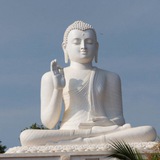
Dhammapada Verse 100
Tambadathika Coraghataka Vatthu
Sahassamapi ce vaca
anatthapadasamhita
ekam atthapadam seyyo
yam sutva upasammati.
Verse 100: Better than a thousand words that are senseless and unconnected with the realization of Nibbana, is a single word of sense, if on hearing it one is calmed.
The Story of Tambadathika
While residing at the Jetavana monastery, the Buddha uttered Verse (100) of this book, with reference to Tambadathika, the executioner of thieves.
Tambadathika served the king as an executioner of thieves for fifty-five years; he had just retired from that post. One day, after preparing rice gruel at his house, he went to the river for a bath; he had intended to take the specially prepared rice gruel on his return. As he was about to take the rice gruel, Thera Sariputta, who had just arisen from sustained absorption in Concentration (jhana samapatti), stood at his door for alms-food. Seeing the thera, Tambadathika thought to himself, "Throughout my life, I have been executing thieves; now I should offer this food to the thera." So, he invited Thera Sariputta to come in and respectfully offered the rice gruel.
After the meal, the thera taught him the Dhamma, but Tambadathika could not pay attention, because he was so agitated as he recollected his past life as an executioner. When the thera knew this, he decided to ask Tambadathika tactfully whether he killed the thieves because he wished to kill them or because he was ordered to do so. Tambadathika answered that he was ordered to kill them by the king and that he had no wish to kill. Then the thera asked, "If that is so, would you be guilty or not ?" Tambadathika then concluded that, as he was not responsible for the evil deeds, he was not guilty. He, therefore, calmed down, and requested the thera to continue his exposition. As he listened to the Dhamma with proper attention, he came very close to attaining Sotapatti Magga, and reached as far as anuloma nana.* After the discourse, Tambadathika accompanied Thera Sariputta for some distance and then returned home. On his way home a cow (actually a demon in the guise of a cow) gored him to death.
When the Buddha came to the congregation of the bhikkhus in the evening, they informed him about the death of Tambadathika. When asked where Tambadathika was reborn, the Buddha told them that although Tambadathika had committed evil deeds throughout his life, because he comprehended the Dhamma after hearing it from Thera Sariputta and had already attained anuloma nana before he died, he was reborn in the Tusita deva world. The bhikkhus wondered how such an evil-doer could have such great benefit after listening to the Dhamma just once. To them the Buddha said that the length of a discourse is of no consequence, for one single word of sense can produce much benefit.
Then the Buddha spoke in verse as follows:
Verse 100: Better than a thousand words that are senseless and unconnected with the realization of Nibbana, is a single word of sense, if on hearing it one is calmed.
*anuloma nana: Vipassana Insight which causes the namarupa process of the yogi to become fully adapted for Magga Insight.
Dhammapada, beloved and favorite teachings of the Buddha channel:
https://news.1rj.ru/str/dhammapadas
====================
Tambadathika Coraghataka Vatthu
Sahassamapi ce vaca
anatthapadasamhita
ekam atthapadam seyyo
yam sutva upasammati.
Verse 100: Better than a thousand words that are senseless and unconnected with the realization of Nibbana, is a single word of sense, if on hearing it one is calmed.
The Story of Tambadathika
While residing at the Jetavana monastery, the Buddha uttered Verse (100) of this book, with reference to Tambadathika, the executioner of thieves.
Tambadathika served the king as an executioner of thieves for fifty-five years; he had just retired from that post. One day, after preparing rice gruel at his house, he went to the river for a bath; he had intended to take the specially prepared rice gruel on his return. As he was about to take the rice gruel, Thera Sariputta, who had just arisen from sustained absorption in Concentration (jhana samapatti), stood at his door for alms-food. Seeing the thera, Tambadathika thought to himself, "Throughout my life, I have been executing thieves; now I should offer this food to the thera." So, he invited Thera Sariputta to come in and respectfully offered the rice gruel.
After the meal, the thera taught him the Dhamma, but Tambadathika could not pay attention, because he was so agitated as he recollected his past life as an executioner. When the thera knew this, he decided to ask Tambadathika tactfully whether he killed the thieves because he wished to kill them or because he was ordered to do so. Tambadathika answered that he was ordered to kill them by the king and that he had no wish to kill. Then the thera asked, "If that is so, would you be guilty or not ?" Tambadathika then concluded that, as he was not responsible for the evil deeds, he was not guilty. He, therefore, calmed down, and requested the thera to continue his exposition. As he listened to the Dhamma with proper attention, he came very close to attaining Sotapatti Magga, and reached as far as anuloma nana.* After the discourse, Tambadathika accompanied Thera Sariputta for some distance and then returned home. On his way home a cow (actually a demon in the guise of a cow) gored him to death.
When the Buddha came to the congregation of the bhikkhus in the evening, they informed him about the death of Tambadathika. When asked where Tambadathika was reborn, the Buddha told them that although Tambadathika had committed evil deeds throughout his life, because he comprehended the Dhamma after hearing it from Thera Sariputta and had already attained anuloma nana before he died, he was reborn in the Tusita deva world. The bhikkhus wondered how such an evil-doer could have such great benefit after listening to the Dhamma just once. To them the Buddha said that the length of a discourse is of no consequence, for one single word of sense can produce much benefit.
Then the Buddha spoke in verse as follows:
Verse 100: Better than a thousand words that are senseless and unconnected with the realization of Nibbana, is a single word of sense, if on hearing it one is calmed.
*anuloma nana: Vipassana Insight which causes the namarupa process of the yogi to become fully adapted for Magga Insight.
Dhammapada, beloved and favorite teachings of the Buddha channel:
https://news.1rj.ru/str/dhammapadas
====================
Telegram
Dhammapada - Buddha Dharma Teachings
Daily teachings of the Dhammapada, beloved and favorite teachings of the Buddha
👍1💯1
Forwarded from Dhammapada - Buddha Dharma Teachings
Free Buddha Dharma ebook
Clearing The Path
Writings of Nanavira Thera
(1960–1965)
Clearing the Path is a work book. Its purpose is to help the user to acquire a point of view that is different from his customary frame of reference, and also more satisfactory. Necessarily, an early step in accomplishing this change is the abandonment of specific mistaken notions about the Buddha’s Teaching and about the nature of experience. More fundamentally, however, this initial change in specific views may lead to a change in point-of-view, whereby one comes to understand experience from a perspective different from what one has been accustomed to—a perspective in which intention, responsibility, context, conditionality, hunger, and related terms will describe the fundamental categories of one’s perception and thinking—and which can lead, eventually, to a fundamental insight about the nature of personal existence.
Free download available:
https://static.sariputta.com/pdf/tipitaka/767/ctp_book_v1pdf.pdf
https://static.sariputta.com/pdf/tipitaka/768/ctp_book-2up_v1pdf.pdf
https://static.sariputta.com/pdf/tipitaka/766/ctp_screen-view_v1pdf.pdf
Clearing The Path
Writings of Nanavira Thera
(1960–1965)
Clearing the Path is a work book. Its purpose is to help the user to acquire a point of view that is different from his customary frame of reference, and also more satisfactory. Necessarily, an early step in accomplishing this change is the abandonment of specific mistaken notions about the Buddha’s Teaching and about the nature of experience. More fundamentally, however, this initial change in specific views may lead to a change in point-of-view, whereby one comes to understand experience from a perspective different from what one has been accustomed to—a perspective in which intention, responsibility, context, conditionality, hunger, and related terms will describe the fundamental categories of one’s perception and thinking—and which can lead, eventually, to a fundamental insight about the nature of personal existence.
Free download available:
https://static.sariputta.com/pdf/tipitaka/767/ctp_book_v1pdf.pdf
https://static.sariputta.com/pdf/tipitaka/768/ctp_book-2up_v1pdf.pdf
https://static.sariputta.com/pdf/tipitaka/766/ctp_screen-view_v1pdf.pdf
👍1💯1
Dhammapada Verse 101
Bahiyadaruciriya Vatthu
Sahassamapi ce gatha
anatthapadasamhita
ekam gathapadam seyyo
yam sutva upasammati.
Verse 101: Better than a thousand verses that are senseless and unconnected with the realization of Nibbana, is a single verse, if on hearing it one is calmed.
The Story of Bahiyadaruciriya
While residing at the Jetavana monastery, the Buddha uttered Verse (101) of this book, with reference to Bahiyadaruciriya.
A group of merchants went out to sea in a boat; their boat was wrecked at sea and all, except one, died. The only survivor got hold of a plank and eventually came to land at the port of Supparaka. As he was naked, he tied the plank to his body, got hold of a bowl, and sat in a place where people could see him. Passers-by gave him rice and gruel; some took him for an arahat and talked in praise of him. Some brought clothes for him to wear but he refused, fearing that by wearing clothes, people would give less to him. Besides, because some said that he was an arahat, he mistakenly came to think that he really was one. Thus, because he was a man of wrong views who was wearing a piece of wood as his clothing, he came to be known as Bahiyadaruciriya.
At about this time, Mahabrahma, who had been his friend in one of his previous existences, saw him going astray and felt that it was his duty to put Bahiya on the right path. So, Mahabrahma came to him in the night and said to him "Bahiya, you are not an arahat yet, and what is more, you do not have the qualities that make one an arahat." Bahiya looked up at Mahabrahma and said, "Yes, I must admit that I am not an arahat, as you have said. I now realize that I have done a great wrong. But is there anyone else in this world now who is an arahat?" Mahabrahma then told him that there lived in Savatthi Gotama Buddha, an arahat, who was perfectly self-enlightened.
Bahiya, realizing the enormity of his guilt, felt very much distressed and ran all the way to Savatthi. Mahabrahma helped him by his supernormal power, so that the whole stretch of one hundred and twenty yojanas was covered in one night. Bahiya found the Buddha going on an alms-round with other bhikkhus and respectfully followed him. He pleaded with the Buddha to teach him the Dhamma, but the Buddha replied that since they were on an alms-round it was not yet time for a religious discourse. And again, Bahiya pleaded, "Venerable Sir, one cannot know the danger to your life or to my life, so please talk to me about the Dhamma." The Buddha knew that Bahiya had made the journey of one hundred and twenty yojanas in one night, and also that he was overwhelmed with joy at seeing the Buddha. That was why the Buddha did not want to talk about the Dhamma immediately but wanted him to calm down to enable him to take in the Dhamma properly. Still, Bahiya persistently pleaded. So, while standing on the road, the Buddha said to Bahiya, "Bahiya, when you see an object, be conscious of just the visible object; when you hear a sound, be conscious of just the sound; when you smell or taste or touch something, be conscious of just the smell, the taste or the touch; and when you think of anything, be conscious of just the mind-object."
After hearing the above discourse, Bahiya attained arahatship and he asked permission from the Buddha to join the Order. The Buddha told him to get the robes, the bowl and other requisites of a bhikkhu. On his way to get them, he was gored to death by a cow which was, in fact, an ogress in the likeness of a cow. When the Buddha and the other bhikkhus came out after having had their meal, they found Bahiya lying dead on a rubbish heap. As instructed by the Buddha, the bhikkhus cremated the body of Bahiya and had his bones enshrined in a stupa.
Back at the Jetavana monastery, the Buddha told the bhikkhus that Bahiya had realized Nibbana. He also told them that as far as speed was concerned in attaining Magga Insight (abhinna), Bahiya was the fastest, the best (Etadaggam).
Bahiyadaruciriya Vatthu
Sahassamapi ce gatha
anatthapadasamhita
ekam gathapadam seyyo
yam sutva upasammati.
Verse 101: Better than a thousand verses that are senseless and unconnected with the realization of Nibbana, is a single verse, if on hearing it one is calmed.
The Story of Bahiyadaruciriya
While residing at the Jetavana monastery, the Buddha uttered Verse (101) of this book, with reference to Bahiyadaruciriya.
A group of merchants went out to sea in a boat; their boat was wrecked at sea and all, except one, died. The only survivor got hold of a plank and eventually came to land at the port of Supparaka. As he was naked, he tied the plank to his body, got hold of a bowl, and sat in a place where people could see him. Passers-by gave him rice and gruel; some took him for an arahat and talked in praise of him. Some brought clothes for him to wear but he refused, fearing that by wearing clothes, people would give less to him. Besides, because some said that he was an arahat, he mistakenly came to think that he really was one. Thus, because he was a man of wrong views who was wearing a piece of wood as his clothing, he came to be known as Bahiyadaruciriya.
At about this time, Mahabrahma, who had been his friend in one of his previous existences, saw him going astray and felt that it was his duty to put Bahiya on the right path. So, Mahabrahma came to him in the night and said to him "Bahiya, you are not an arahat yet, and what is more, you do not have the qualities that make one an arahat." Bahiya looked up at Mahabrahma and said, "Yes, I must admit that I am not an arahat, as you have said. I now realize that I have done a great wrong. But is there anyone else in this world now who is an arahat?" Mahabrahma then told him that there lived in Savatthi Gotama Buddha, an arahat, who was perfectly self-enlightened.
Bahiya, realizing the enormity of his guilt, felt very much distressed and ran all the way to Savatthi. Mahabrahma helped him by his supernormal power, so that the whole stretch of one hundred and twenty yojanas was covered in one night. Bahiya found the Buddha going on an alms-round with other bhikkhus and respectfully followed him. He pleaded with the Buddha to teach him the Dhamma, but the Buddha replied that since they were on an alms-round it was not yet time for a religious discourse. And again, Bahiya pleaded, "Venerable Sir, one cannot know the danger to your life or to my life, so please talk to me about the Dhamma." The Buddha knew that Bahiya had made the journey of one hundred and twenty yojanas in one night, and also that he was overwhelmed with joy at seeing the Buddha. That was why the Buddha did not want to talk about the Dhamma immediately but wanted him to calm down to enable him to take in the Dhamma properly. Still, Bahiya persistently pleaded. So, while standing on the road, the Buddha said to Bahiya, "Bahiya, when you see an object, be conscious of just the visible object; when you hear a sound, be conscious of just the sound; when you smell or taste or touch something, be conscious of just the smell, the taste or the touch; and when you think of anything, be conscious of just the mind-object."
After hearing the above discourse, Bahiya attained arahatship and he asked permission from the Buddha to join the Order. The Buddha told him to get the robes, the bowl and other requisites of a bhikkhu. On his way to get them, he was gored to death by a cow which was, in fact, an ogress in the likeness of a cow. When the Buddha and the other bhikkhus came out after having had their meal, they found Bahiya lying dead on a rubbish heap. As instructed by the Buddha, the bhikkhus cremated the body of Bahiya and had his bones enshrined in a stupa.
Back at the Jetavana monastery, the Buddha told the bhikkhus that Bahiya had realized Nibbana. He also told them that as far as speed was concerned in attaining Magga Insight (abhinna), Bahiya was the fastest, the best (Etadaggam).
Viber
Buddha
Buddha dharma teachings from the suttas and commentaries from Theravada tradition
❤1🥰1
The bhikkhus were puzzled by the statement made by the Buddha and they asked him why and when Bahiya became an arahat. To this, the Buddha replied, "Bahiya attained arahatship while he listened to my instructions given to him on the road when we were on the alms-round." The bhikkhus wondered how one could attain arahatship after listening to just a few sentences of the Dhamma. So, the Buddha told them that the number of words or the length of a speech did not matter if it was beneficial to someone.
Then the Buddha spoke in verse as follows:
Verse 101: Better than a thousand verses that are senseless and unconnected with the realization of Nibbana, is a single verse, if on hearing it one is calmed.
Buddha dharma teachings channel:
https://invite.viber.com/?g2=AQAKw1y3rv%2F6sk61PI2W4izuIiaEZj8YZujhY1tSzL%2B07s7rFnVFDAd0bAYFaMLw
====================
Then the Buddha spoke in verse as follows:
Verse 101: Better than a thousand verses that are senseless and unconnected with the realization of Nibbana, is a single verse, if on hearing it one is calmed.
Buddha dharma teachings channel:
https://invite.viber.com/?g2=AQAKw1y3rv%2F6sk61PI2W4izuIiaEZj8YZujhY1tSzL%2B07s7rFnVFDAd0bAYFaMLw
====================
Viber
Buddha
Buddha dharma teachings from the suttas and commentaries from Theravada tradition
👍2❤1
From Turning the Wheel of Truth: Commentary on the Buddha’s First Teaching
By Ajahn Sucitto
When there is understanding and a set of values that encourage sharing, then the limitations, the needs, and the lacks of any given life can be acknowledged and effort can be put into using material supports with compassion. This is also true in cases of deprivation; surely a major contributor to this is the greed and exploitation of others, which has its source in identification with material prosperity. If we could all accept the experience of limitation on our resources and comforts, if affluent people’s standard of living were not so high, there would be fewer people who felt, and actually were, “poor.” Maybe with more sharing, there would be less severe physical deprivation. Instead of creating golf courses in the desert, or seeing air-conditioning, two cars, and countless television channels as necessities of life, we could try to accept limitations to our material circumstances and acknowledge that there is suffering.
This acknowledgment doesn’t require that everyone should feel wretched; rather, it’s a matter of learning to know and accept that this earthly realm is one of limitation. When we wake up to how human life on this planet actually is, and stop running away or building walls in our heart, then we develop a wiser motivation for our life. And we keep waking up as the natural dukkha [suffering] touches us. This means that we sharpen our attention to catch our instinctive reactions of blaming ourselves, blaming our parents, or blaming society; we meditate and access our suffering at its root; and consequently we learn to open and be still in our heart. And even on a small scale in daily life situations, such as when we feel bored or ill at ease, instead of trying to avoid these feelings by staying busy or buying another fancy gadget, we learn to look more clearly at our impulses, attitudes, and defenses. In this way dukkha guides and deepens our motivation to the point where we’ll say, “Enough running, enough walls, I’ll grow through handling my blocks and lost places.”
Excerpted from Turning the Wheel of Truth: Commentary on the Buddha’s First Teaching by Ajahn Sucitto.
Ajahn Sucitto is a Theravada Buddhist monk and teacher who was the abbot of Chithurst Buddhist Monastery from 1992 to 2014.
=====
Buddha dharma teachings channel:
https://news.1rj.ru/str/lorddivinebuddha
By Ajahn Sucitto
When there is understanding and a set of values that encourage sharing, then the limitations, the needs, and the lacks of any given life can be acknowledged and effort can be put into using material supports with compassion. This is also true in cases of deprivation; surely a major contributor to this is the greed and exploitation of others, which has its source in identification with material prosperity. If we could all accept the experience of limitation on our resources and comforts, if affluent people’s standard of living were not so high, there would be fewer people who felt, and actually were, “poor.” Maybe with more sharing, there would be less severe physical deprivation. Instead of creating golf courses in the desert, or seeing air-conditioning, two cars, and countless television channels as necessities of life, we could try to accept limitations to our material circumstances and acknowledge that there is suffering.
This acknowledgment doesn’t require that everyone should feel wretched; rather, it’s a matter of learning to know and accept that this earthly realm is one of limitation. When we wake up to how human life on this planet actually is, and stop running away or building walls in our heart, then we develop a wiser motivation for our life. And we keep waking up as the natural dukkha [suffering] touches us. This means that we sharpen our attention to catch our instinctive reactions of blaming ourselves, blaming our parents, or blaming society; we meditate and access our suffering at its root; and consequently we learn to open and be still in our heart. And even on a small scale in daily life situations, such as when we feel bored or ill at ease, instead of trying to avoid these feelings by staying busy or buying another fancy gadget, we learn to look more clearly at our impulses, attitudes, and defenses. In this way dukkha guides and deepens our motivation to the point where we’ll say, “Enough running, enough walls, I’ll grow through handling my blocks and lost places.”
Excerpted from Turning the Wheel of Truth: Commentary on the Buddha’s First Teaching by Ajahn Sucitto.
Ajahn Sucitto is a Theravada Buddhist monk and teacher who was the abbot of Chithurst Buddhist Monastery from 1992 to 2014.
=====
Buddha dharma teachings channel:
https://news.1rj.ru/str/lorddivinebuddha
Telegram
Buddha
Buddha dharma teachings from the suttas and commentaries
❤1💯1
Forwarded from Buddha Dharma books
Free Buddha Dharma ebook
The Wheel Of Dhamma (Dhammacakkappavattana Sutta)
By Mahasi Sayadaw Gyi
Lord Buddha delivered the “Dhammacakkappavattana Sutta”, to a group of five Bhikkhus at the deer park of Sarnath, about 7 miles from Banaras, India on the Full Moon day of Waso in 623 B.C, soon after his Enlightenment on Full Moon day of Kason. This sermon is the first and most ancient one of Lord Buddha, and after it was delivered, the five Bhikkhus became Ariya Sotapanna on different days.
This Sutta is one of the most famous of all discourses made by Lord Buddha. When Mahasi Sayadawgyi, at the invitation of the Buddha Sasana Nuggaha Organization came to Yangon to teach Vipassana Meditation, the Meditation Centre was formally opened with a discourse of this sutta on 4th December 1949 when the first batch of 25 yogis were inducted to Vipassana Meditation. Whenever a New Meditation Centre was opened, this Sutta had been delivered as an inaugural discourse.
Mahasi Sayadawgyi had also delivered this discourse, in brief, on 11th July 1957 (Full Moon day of Waso) followed by another discourse on Anattalakkhana Sutta delivered during the Lent of 1957 and they were broadcasted by Myanmar Broadcasting Station.
Free download available:
http://www.mediafire.com/file/2uqi49wlkwe2906/
=============
The Wheel Of Dhamma (Dhammacakkappavattana Sutta)
By Mahasi Sayadaw Gyi
Lord Buddha delivered the “Dhammacakkappavattana Sutta”, to a group of five Bhikkhus at the deer park of Sarnath, about 7 miles from Banaras, India on the Full Moon day of Waso in 623 B.C, soon after his Enlightenment on Full Moon day of Kason. This sermon is the first and most ancient one of Lord Buddha, and after it was delivered, the five Bhikkhus became Ariya Sotapanna on different days.
This Sutta is one of the most famous of all discourses made by Lord Buddha. When Mahasi Sayadawgyi, at the invitation of the Buddha Sasana Nuggaha Organization came to Yangon to teach Vipassana Meditation, the Meditation Centre was formally opened with a discourse of this sutta on 4th December 1949 when the first batch of 25 yogis were inducted to Vipassana Meditation. Whenever a New Meditation Centre was opened, this Sutta had been delivered as an inaugural discourse.
Mahasi Sayadawgyi had also delivered this discourse, in brief, on 11th July 1957 (Full Moon day of Waso) followed by another discourse on Anattalakkhana Sutta delivered during the Lent of 1957 and they were broadcasted by Myanmar Broadcasting Station.
Free download available:
http://www.mediafire.com/file/2uqi49wlkwe2906/
=============
👍1💯1
Dhammapada Verses 54 and 55
Anandattherapanha Vatthu
Na pupphagandho pativatameti
na candanam tagara mallika va
satanca gandho pativatameti
sabba disa sappuriso pavayati.
Cadanam tagaram vapi
uppalam atha vassiki
etesam gandhajatanam
silagandho anuttaro.
Verse 54: The scent of flowers cannot go against the wind; nor the scent of sandalwood, nor of rhododendron (tagara), nor of jasmin (mallika); only the reputation of good people can go against the wind. The reputation of the virtuous ones (sappurisa) is wafted abroad in all directions.
Verse 55: There are the scents of sandalwood, rhododendron, lotus and jasmin (vassika); but the scent of virtue surpasses all scents.
Anandattherapanha Vatthu
Na pupphagandho pativatameti
na candanam tagara mallika va
satanca gandho pativatameti
sabba disa sappuriso pavayati.
Cadanam tagaram vapi
uppalam atha vassiki
etesam gandhajatanam
silagandho anuttaro.
Verse 54: The scent of flowers cannot go against the wind; nor the scent of sandalwood, nor of rhododendron (tagara), nor of jasmin (mallika); only the reputation of good people can go against the wind. The reputation of the virtuous ones (sappurisa) is wafted abroad in all directions.
Verse 55: There are the scents of sandalwood, rhododendron, lotus and jasmin (vassika); but the scent of virtue surpasses all scents.
🥰1😍1
Forwarded from Ajahn Chah - Theravada Thailand Buddhism
Free Buddha Dharma ebook
Bodhinyana
by Venerable Ajahn Chah
Most of the talks in this collection were originally taken from old cassette tape recordings of Venerable Ajahn Chah, some in Thai and some in the North-Eastern Dialect, most recorded on poor quality equipment under less than optimum conditions. This presented some difficulty in the work of translation, which was overcome by occasionally omitting very unclear passages and at other times asking for advice from other listeners more familiar with those languages.
As regards the translations, the various translators have tried to be as exact as possible with the content of the teachings but have omitted much of the repetition inevitably arising in oral instruction. Pali words absorbed into the Thai language have, in the course of time, acquired additional meanings: e.g., the Thai “arome” refers to the Pali “ ¯ aramman ¯ . a” – sense object or mental impression, but its common meaning is “mood” or “emotion”. The Venerable Ajahn uses these words in both ways and we have translated accordingly.
Free download here:
https://static.sariputta.com/pdf/tipitaka/266/bodhinyana_pdf.pdf
Bodhinyana
by Venerable Ajahn Chah
Most of the talks in this collection were originally taken from old cassette tape recordings of Venerable Ajahn Chah, some in Thai and some in the North-Eastern Dialect, most recorded on poor quality equipment under less than optimum conditions. This presented some difficulty in the work of translation, which was overcome by occasionally omitting very unclear passages and at other times asking for advice from other listeners more familiar with those languages.
As regards the translations, the various translators have tried to be as exact as possible with the content of the teachings but have omitted much of the repetition inevitably arising in oral instruction. Pali words absorbed into the Thai language have, in the course of time, acquired additional meanings: e.g., the Thai “arome” refers to the Pali “ ¯ aramman ¯ . a” – sense object or mental impression, but its common meaning is “mood” or “emotion”. The Venerable Ajahn uses these words in both ways and we have translated accordingly.
Free download here:
https://static.sariputta.com/pdf/tipitaka/266/bodhinyana_pdf.pdf
👍1💯1
Dhammapada Verses 102 and 103
Kundalakesitheri Vatthu
Yo ca gatha satam bhase
anatthapadasamhita
ekam dhammapadam seyyo
yam sutva upasammati.
Yo sahassam sahassena
sangame manuse jine
ekanca jeyyamattanam
sa ve sangamajuttamo.
Verse 102: Better than the recitation of a hundred verses that are senseless and unconnected with the realization of Nibbana, is the recitation of a single verse of the Teaching (Dhamma), if on hearing it one is calmed.
Verse 103: A man may conquer a million men in battle, but one who conquers himself is, indeed, the greatest of conquerors.
The Story of Theri Kundalakesi
While residing at the Jetavana monastery, the Buddha uttered Verses (102) and (103) of this book, with reference to Theri Kundalakesi.
Kundalakesi was the daughter of a rich man from Rajagaha. She had led a very secluded life; but one day, she happened to see a thief being led out to be killed and she immediately fell in love with him. Her parents had to pay for the freedom of the thief, and they married her off to him. Although she loved her husband very dearly, her husband being a thief, was only attracted to her property and her jewels. One day, he coaxed her to put on all her jewellery and led her to a mountain saying that he wanted to make some offerings to the guardian spirit of the mountain because that guardian spirit had saved his life when he was about to be killed. Kundalakesi went along with her husband, but when they reached their destination, the thief revealed that he intended to kill her and take her jewels. She pleaded with him to take her jewels, but to spare her life, but it was of no avail. She then realized that if she did not get rid of her husband, there would be no way of escape for her. She felt she must be cautious and crafty. So she said to her husband that as they would be together only for a few moments more, she wanted to pay respect to him for the last time. So saying, and going round the man respectfully, she pushed him off the crag, taking him unaware.
After this, she had no desire to return home. She left all her jewellery hanging on a tree, and went on her way, without any idea where she was going. She happened to come to a place of some Paribbajikas (female wandering ascetics) and she herself became a Paribbajikas. The Paribbajikas taught her all their one thousand problems in sophistry; being intelligent she mastered all of them within a short time. Then her teachers told her to go out into the world and if she should find somebody who could answer all her questions, to become a pupil to him. Kundalakesi went throughout the length and breadth of Jambudipa, openly challenging everyone else to compete with her. Accordingly, she came to be known as "Jambukaparibbajika."
On one occasion, she came to Savatthi. Before entering the city for alms-food she made a mound of sand and stuck a branch of eugenia on it, her usual sign of invitation to all others to take up her challenge. Thera Sariputta took up her challenge. Kundalakesi asked him a thousand questions and Thera Sariputta answered them all. When his turn came, he asked her just this, "What is the one? (ekam nama kim)." Kundalakesi could not answer, so she asked Thera Sariputta to teach her the answer to the question. Thera Sariputta replied that she should first become abhikkhuni; so she became a bhikkhuni, by the name of Theri Kundalakesi. Within a few days, she became an arahat.
Soon after this, the bhikkhus asked the Buddha, "Could it be possible for Bhikkhuni Kundalakesi to become an arahat after listening to the Dhamma only a little?" They also added that this lady had fought and won a victory over her husband, who was a thief, before she became a paribbajika.
Then the Buddha spoke in verse as follows:
Verse 102: Better than the recitation of a hundred verses that are senseless and unconnected with the realization of Nibbana, is the recitation of a single verse of the Teaching (Dhamma), if on hearing it one is calmed.
Kundalakesitheri Vatthu
Yo ca gatha satam bhase
anatthapadasamhita
ekam dhammapadam seyyo
yam sutva upasammati.
Yo sahassam sahassena
sangame manuse jine
ekanca jeyyamattanam
sa ve sangamajuttamo.
Verse 102: Better than the recitation of a hundred verses that are senseless and unconnected with the realization of Nibbana, is the recitation of a single verse of the Teaching (Dhamma), if on hearing it one is calmed.
Verse 103: A man may conquer a million men in battle, but one who conquers himself is, indeed, the greatest of conquerors.
The Story of Theri Kundalakesi
While residing at the Jetavana monastery, the Buddha uttered Verses (102) and (103) of this book, with reference to Theri Kundalakesi.
Kundalakesi was the daughter of a rich man from Rajagaha. She had led a very secluded life; but one day, she happened to see a thief being led out to be killed and she immediately fell in love with him. Her parents had to pay for the freedom of the thief, and they married her off to him. Although she loved her husband very dearly, her husband being a thief, was only attracted to her property and her jewels. One day, he coaxed her to put on all her jewellery and led her to a mountain saying that he wanted to make some offerings to the guardian spirit of the mountain because that guardian spirit had saved his life when he was about to be killed. Kundalakesi went along with her husband, but when they reached their destination, the thief revealed that he intended to kill her and take her jewels. She pleaded with him to take her jewels, but to spare her life, but it was of no avail. She then realized that if she did not get rid of her husband, there would be no way of escape for her. She felt she must be cautious and crafty. So she said to her husband that as they would be together only for a few moments more, she wanted to pay respect to him for the last time. So saying, and going round the man respectfully, she pushed him off the crag, taking him unaware.
After this, she had no desire to return home. She left all her jewellery hanging on a tree, and went on her way, without any idea where she was going. She happened to come to a place of some Paribbajikas (female wandering ascetics) and she herself became a Paribbajikas. The Paribbajikas taught her all their one thousand problems in sophistry; being intelligent she mastered all of them within a short time. Then her teachers told her to go out into the world and if she should find somebody who could answer all her questions, to become a pupil to him. Kundalakesi went throughout the length and breadth of Jambudipa, openly challenging everyone else to compete with her. Accordingly, she came to be known as "Jambukaparibbajika."
On one occasion, she came to Savatthi. Before entering the city for alms-food she made a mound of sand and stuck a branch of eugenia on it, her usual sign of invitation to all others to take up her challenge. Thera Sariputta took up her challenge. Kundalakesi asked him a thousand questions and Thera Sariputta answered them all. When his turn came, he asked her just this, "What is the one? (ekam nama kim)." Kundalakesi could not answer, so she asked Thera Sariputta to teach her the answer to the question. Thera Sariputta replied that she should first become abhikkhuni; so she became a bhikkhuni, by the name of Theri Kundalakesi. Within a few days, she became an arahat.
Soon after this, the bhikkhus asked the Buddha, "Could it be possible for Bhikkhuni Kundalakesi to become an arahat after listening to the Dhamma only a little?" They also added that this lady had fought and won a victory over her husband, who was a thief, before she became a paribbajika.
Then the Buddha spoke in verse as follows:
Verse 102: Better than the recitation of a hundred verses that are senseless and unconnected with the realization of Nibbana, is the recitation of a single verse of the Teaching (Dhamma), if on hearing it one is calmed.
Viber
Words Of The Buddha
Daily teachings from Buddha Dharma
❤3🥰1
Verse 103: A man may conquer a million men in battle, but one who conquers himself is, indeed, the greatest of conquerors.
Words of the Buddha channel:
https://invite.viber.com/?g2=AQAFqzqlj7FmI061PX17rxWMAtZ%2BRuso%2FH2KmHKZSgnv7v9DD8X0bDkKnZDr9JDq
====================
Words of the Buddha channel:
https://invite.viber.com/?g2=AQAFqzqlj7FmI061PX17rxWMAtZ%2BRuso%2FH2KmHKZSgnv7v9DD8X0bDkKnZDr9JDq
====================
Viber
Words Of The Buddha
Daily teachings from Buddha Dharma
👍2🥰2❤1🙏1
Forwarded from Dhammapada - Buddha Dharma Teachings
Free Buddha Dharma ebook
The Only Way for the Realization of Nibbāna
The only way, bhikkhus, is this path, for beings' purification, for sorrow and lamentation's overcoming, for pain and displeasure's disappearance, for the true way's attainment, for Nibbāna's realization: that is, the four foundations of mindfulness(cattāro sati∙paṭṭhānā).
'Mahā∙Sati∙Paṭṭhāna∙Suttaṃ' ('The Great Mindfulness-Foundation Sutta')
In The Only Way for the Realization of Nibbāna, the Most Venerable Sayadaw gives a brief summary of the practice necessary for such realization, namely samatha and vipassanā. He bases his discussion on the first section of the ‘Mahā∙Sati∙Paṭṭhāṇa Sutta’, the in&out-breath section of ‘The Great Mindfulness-Foundation Sutta’.
In the preface (pp.1-23), the Sayadaw discusses the ‘Mahā∙Sati∙Paṭṭhāṇa Sutta’ within the context of other suttas where The Buddha discusses the practice necessary for realizing Nibbāna. Afterwards, the Sayadaw discusses the in&out-breath section of the sutta within the context of the remaining sections of ‘The Great Mindfulness-Foundation Sutta’. Afterwards, the entire in&out-breath section is quoted (pp.25-26). And there is a brief discussion of how one progresses from mundane samatha and vipassanā to supramundane samatha and vipassanā (p.27).
The Sayadaw then discusses in practical detail The Buddha’s instructions on samatha in the in&out-breath section of the ‘Mahā∙Sati∙Paṭṭhāṇa Sutta’, beginning with Ever mindful he breathes in; ever mindful he breathes out; ending with ‘Tranquillizing the body formation, I shall breathe in ’: thus he trains. ‘Tranquillizing the body formation, I shall breathe out ’: thus he trains; this being the four stages of development for attaining the four jhānas (pp.28-36).
The Sayadaw then discusses in practical detail The Buddha’s instructions on the four stages of vipassanā. First Thus he abides contemplating the body in the body internally, or he abides contemplating the body in the body externally, or he abides contemplating the body in the body internally and externally; this being direct knowledge and contemplation of ultimate materiality and ultimate mentality through the elements contemplation section of the ‘Mahā∙Sati∙Paṭṭhāṇa Sutta’, as well as the sections of consciousness-, feelings- and dhammas contemplation (pp.37-60). Second He abides contemplating originating phenomena in the body; or he abides contemplating perishing phenomena in the body; or he abides contemplating [both] originating&perishing phenomena in the body; this being the direct knowledge and contemplation of causal and momentary rise&perish (pp.61-65). Third Or mindfulness that ‘there is the body’ is established just sufficient for knowledge, sufficient for mindfulness; this being the higher mundane vipassanā knowledges, prior to the realization of Nibbāna (p.66). Fourth And he abides independent, and does not cling to anything in the world; this being the supramundane realization of Nibbāna (p.67).
The Sayadaw describes each stage of samatha and vipassanā in terms of the Noble Eightfold Path, and he describes vipassanā in terms of the full knowledges described by The Buddha as necessary for realization of Nibbāna, quoted and discussed in the preface. Their mutual correspondence is shown in a table (p.69).
Tables describe the phenomena that make up ultimate materiality (pp.41-45) and mentality (pp.51, 53, 56-59) as described by The Buddha, and their correspondence to the various classifications given by The Buddha in earlier quoted suttas (p.71): the five aggregates (p.72), twelve bases (p.73), eighteen elements (p.74), and four Noble Truths (p.75).
Free download here:
https://drive.google.com/open?id=0B7p0UB1QfBmvS3ZaSzdEOE1Vdnc
The Only Way for the Realization of Nibbāna
The only way, bhikkhus, is this path, for beings' purification, for sorrow and lamentation's overcoming, for pain and displeasure's disappearance, for the true way's attainment, for Nibbāna's realization: that is, the four foundations of mindfulness(cattāro sati∙paṭṭhānā).
'Mahā∙Sati∙Paṭṭhāna∙Suttaṃ' ('The Great Mindfulness-Foundation Sutta')
In The Only Way for the Realization of Nibbāna, the Most Venerable Sayadaw gives a brief summary of the practice necessary for such realization, namely samatha and vipassanā. He bases his discussion on the first section of the ‘Mahā∙Sati∙Paṭṭhāṇa Sutta’, the in&out-breath section of ‘The Great Mindfulness-Foundation Sutta’.
In the preface (pp.1-23), the Sayadaw discusses the ‘Mahā∙Sati∙Paṭṭhāṇa Sutta’ within the context of other suttas where The Buddha discusses the practice necessary for realizing Nibbāna. Afterwards, the Sayadaw discusses the in&out-breath section of the sutta within the context of the remaining sections of ‘The Great Mindfulness-Foundation Sutta’. Afterwards, the entire in&out-breath section is quoted (pp.25-26). And there is a brief discussion of how one progresses from mundane samatha and vipassanā to supramundane samatha and vipassanā (p.27).
The Sayadaw then discusses in practical detail The Buddha’s instructions on samatha in the in&out-breath section of the ‘Mahā∙Sati∙Paṭṭhāṇa Sutta’, beginning with Ever mindful he breathes in; ever mindful he breathes out; ending with ‘Tranquillizing the body formation, I shall breathe in ’: thus he trains. ‘Tranquillizing the body formation, I shall breathe out ’: thus he trains; this being the four stages of development for attaining the four jhānas (pp.28-36).
The Sayadaw then discusses in practical detail The Buddha’s instructions on the four stages of vipassanā. First Thus he abides contemplating the body in the body internally, or he abides contemplating the body in the body externally, or he abides contemplating the body in the body internally and externally; this being direct knowledge and contemplation of ultimate materiality and ultimate mentality through the elements contemplation section of the ‘Mahā∙Sati∙Paṭṭhāṇa Sutta’, as well as the sections of consciousness-, feelings- and dhammas contemplation (pp.37-60). Second He abides contemplating originating phenomena in the body; or he abides contemplating perishing phenomena in the body; or he abides contemplating [both] originating&perishing phenomena in the body; this being the direct knowledge and contemplation of causal and momentary rise&perish (pp.61-65). Third Or mindfulness that ‘there is the body’ is established just sufficient for knowledge, sufficient for mindfulness; this being the higher mundane vipassanā knowledges, prior to the realization of Nibbāna (p.66). Fourth And he abides independent, and does not cling to anything in the world; this being the supramundane realization of Nibbāna (p.67).
The Sayadaw describes each stage of samatha and vipassanā in terms of the Noble Eightfold Path, and he describes vipassanā in terms of the full knowledges described by The Buddha as necessary for realization of Nibbāna, quoted and discussed in the preface. Their mutual correspondence is shown in a table (p.69).
Tables describe the phenomena that make up ultimate materiality (pp.41-45) and mentality (pp.51, 53, 56-59) as described by The Buddha, and their correspondence to the various classifications given by The Buddha in earlier quoted suttas (p.71): the five aggregates (p.72), twelve bases (p.73), eighteen elements (p.74), and four Noble Truths (p.75).
Free download here:
https://drive.google.com/open?id=0B7p0UB1QfBmvS3ZaSzdEOE1Vdnc
❤1👍1