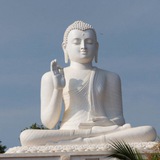
Dhammapada Verse 108
Sariputtattherassa sahayaka brahmana Vatthu
Yamkinci yittham va hutam va loke
samvaccharam yajetha punnapekkho
sabbampi tam na catubhagameti
abhivadana ujjugatesu seyyo.
Verse 108: In this world, one may make sacrificial offerings, great and small, all the year round, in order to gain merit; all these offerings are not worth a quarter of the merit gained by worshipping the Noble Ones (Ariyas) who walk the right path.
The Story of Thera Sariputta's Friend
While residing at the Veluvana monastery, the Buddha uttered Verse (108) of this book, with reference to a friend of Thera Sariputta.
On one occasion Thera Sariputta asked his friend, a brahmin, whether he was doing any meritorious deeds and he replied that he had been making sacrificial offerings on a big scale, hoping to get to the Brahma world in his next existence. Thera Sariputta told him that his teachers had given him false hopes and that they themselves did not know the way to the Brahma world. Then he took his friend to the Buddha, who showed him the way to the Brahma world. To the friend of Thera Sariputta, the Buddha said, "Brahmin, worshipping the Noble Ones (Ariyas) only for a moment is better than making sacrificial offerings, great and small, throughout the year."
Then the Buddha spoke in verse as follows:
Verse 108: In this world, one may make sacrificial offerings, great and small, all the year round, in order to gain merit; all these offerings are not worth a quarter of the merit gained by worshipping the Noble Ones (Ariyas) who walk the right path.
At the end of the discourse the brahmin attained Sotapatti Fruition.
Buddha dharma teachings channel:
https://news.1rj.ru/str/lorddivinebuddha
====================
Sariputtattherassa sahayaka brahmana Vatthu
Yamkinci yittham va hutam va loke
samvaccharam yajetha punnapekkho
sabbampi tam na catubhagameti
abhivadana ujjugatesu seyyo.
Verse 108: In this world, one may make sacrificial offerings, great and small, all the year round, in order to gain merit; all these offerings are not worth a quarter of the merit gained by worshipping the Noble Ones (Ariyas) who walk the right path.
The Story of Thera Sariputta's Friend
While residing at the Veluvana monastery, the Buddha uttered Verse (108) of this book, with reference to a friend of Thera Sariputta.
On one occasion Thera Sariputta asked his friend, a brahmin, whether he was doing any meritorious deeds and he replied that he had been making sacrificial offerings on a big scale, hoping to get to the Brahma world in his next existence. Thera Sariputta told him that his teachers had given him false hopes and that they themselves did not know the way to the Brahma world. Then he took his friend to the Buddha, who showed him the way to the Brahma world. To the friend of Thera Sariputta, the Buddha said, "Brahmin, worshipping the Noble Ones (Ariyas) only for a moment is better than making sacrificial offerings, great and small, throughout the year."
Then the Buddha spoke in verse as follows:
Verse 108: In this world, one may make sacrificial offerings, great and small, all the year round, in order to gain merit; all these offerings are not worth a quarter of the merit gained by worshipping the Noble Ones (Ariyas) who walk the right path.
At the end of the discourse the brahmin attained Sotapatti Fruition.
Buddha dharma teachings channel:
https://news.1rj.ru/str/lorddivinebuddha
====================
Telegram
Buddha
Buddha dharma teachings from the suttas and commentaries
❤1💯1
Forwarded from Buddha
Free Buddha Dharma ebook
A Comprehensive Manual
of Abhidhamma
The Abhidhammattha Sangaha
of Acariya Anuruddha
Bhikkhu Bodhi, General Editor
Pali text originally edited and translated by Mahathera Narada
Translation revised by Bhikkhu Bodhi
Introduction and explanatory guide by U Rewata Dhamma & Bhikkhu Bodhi
Abhidhamma tables by U Silananda
The present volume contains detailed exposition of Acariya Anuruddha’s Abhidhammattha Sangaha,the main primer for the study of Abhidhamma used throughout the Theravada Buddhist world. This volume began almost four years ago as a revised version of Ven. Mahathera Narada’s long-standing edition and annotated translation of the Sangaha, A Manual of Abhidhamma.
Now, as the time approaches for it to go to press, it has evolved into what is virtually an entirely new book published under essentially the same noscript. That noscript has been retained partly to preserve its continuity with its predecessor, and partly because the name “Manual of Abhidhamma” is simply the most satisfactory English rendering of the Pali noscript of the root text, which literally means “a compendium of the things contained in the Abhidhamma.” To the original noscript the qualification “comprehensive” has been added to underscore its more extensive scope.
Free download here:
https://static.sariputta.com/pdf/tipitaka/789/comprehensive_manual_of_-abhidhammapdf.pdf
A Comprehensive Manual
of Abhidhamma
The Abhidhammattha Sangaha
of Acariya Anuruddha
Bhikkhu Bodhi, General Editor
Pali text originally edited and translated by Mahathera Narada
Translation revised by Bhikkhu Bodhi
Introduction and explanatory guide by U Rewata Dhamma & Bhikkhu Bodhi
Abhidhamma tables by U Silananda
The present volume contains detailed exposition of Acariya Anuruddha’s Abhidhammattha Sangaha,the main primer for the study of Abhidhamma used throughout the Theravada Buddhist world. This volume began almost four years ago as a revised version of Ven. Mahathera Narada’s long-standing edition and annotated translation of the Sangaha, A Manual of Abhidhamma.
Now, as the time approaches for it to go to press, it has evolved into what is virtually an entirely new book published under essentially the same noscript. That noscript has been retained partly to preserve its continuity with its predecessor, and partly because the name “Manual of Abhidhamma” is simply the most satisfactory English rendering of the Pali noscript of the root text, which literally means “a compendium of the things contained in the Abhidhamma.” To the original noscript the qualification “comprehensive” has been added to underscore its more extensive scope.
Free download here:
https://static.sariputta.com/pdf/tipitaka/789/comprehensive_manual_of_-abhidhammapdf.pdf
❤1👍1💯1
Forwarded from Buddha Dharma books
Free Buddha Dharma ebook
Intelligent Man's Guide to Buddhism
By Bhadant Anand Kausalyayan
A rational presentation of Buddhism in 263 questions and answers, first published in Hindi in the 1960s.
Free download here:
http://ftp.budaedu.org/ebooks/pdf/EN055.pdf
=============
Intelligent Man's Guide to Buddhism
By Bhadant Anand Kausalyayan
A rational presentation of Buddhism in 263 questions and answers, first published in Hindi in the 1960s.
Free download here:
http://ftp.budaedu.org/ebooks/pdf/EN055.pdf
=============
🤩1😍1
Dhammapada Verse 109
Ayuvaddhanakumara Vatthu
Abhivadanasilissa
niccam vuddhapacayino
cattaro dhamma vaddhanti
ayu vanno sukham balam.
Verse 109: For one who always respects and honours those who are older and more virtuous, four benefits, viz., longevity, beauty, happiness and strength, will increase.
The Story of Ayuvaddhanakumara
While residing in a village monastery near Dighalanghika, the Buddha uttered Verse (109) of this book, with reference to Ayuvaddhanakumara.
Once, there were two hermits who fixed together practising religious austerities (tapacaranam) for forty eight years. Later, one of the two left the hermit life and got married. After a son was born, the family visited the old hermit and paid obeisance to him. To the parents the hermit said, "May you live long," but he said nothing to the child. The parents were puzzled and asked the hermit the reason for his silence. The hermit told them that the child would live only seven more days and that he did not know how to prevent his death, but Gotama Buddha might know how to do it.
So the parents took the child to the Buddha; when they paid obeisance to the Buddha, he also said, "May you live long" to the parents only and not to the child. The Buddha also predicted the impending death of the child. To prevent his death, the parents were told to build a pavilion at the entrance to the house, and put the child on a couch in the pavilion. Then some bhikkhus were sent there to recite the parittas* for seven days. On the seventh day the Buddha himself came to that pavilion; the devas from all over the universe also came. At that time the ogre Avaruddhaka was at the entrance, waiting for a chance to take the child away. But as more powerful devas arrived the ogre had to step back and make room for them so that he had to stay at a place two yojanas away from the child. That whole night, recitation of parittas continued, thus protecting the child. The next day, the child was taken up from the couch and made to pay obeisance to the Buddha. This time, the Buddha said, "May you live long" to the child. When asked how long the child would live, the Buddha replied that he would live up to one hundred and twenty years. So the child was named Ayuvaddhana.
When the child grew up, he went about the country with a company of five hundred fellow devotees. One day, they came to the Jetavana monastery, and the bhikkhus, recognizing him, asked the Buddha, "For beings, is there any means of gaining longevity?" To this question the Buddha answered, "By respecting and honouring the elders and those who are wise and virtuous, one would gain not only longevity, but also beauty, happiness and strength."
Then the Buddha spoke in verse as follows:
Verse 109: For one who always respects and honours those who are older and more virtuous, four benefits, viz., longevity, beauty, happiness and strength, will increase.
At the end of the discourse, Ayuvaddhana and his five hundred companions attained Sotapatti Fruition.
*Parittas: religious stanzas that are usually recited for protection against harmful influences.
Tibetan Buddhism - Vajrayana, Tantrayana and esoteric Buddhism channel:
https://news.1rj.ru/str/tibetanbuddha
Vajrayana Tantrayana Buddhism channel:
https://news.1rj.ru/str/tantrayanabuddhism
====================
Ayuvaddhanakumara Vatthu
Abhivadanasilissa
niccam vuddhapacayino
cattaro dhamma vaddhanti
ayu vanno sukham balam.
Verse 109: For one who always respects and honours those who are older and more virtuous, four benefits, viz., longevity, beauty, happiness and strength, will increase.
The Story of Ayuvaddhanakumara
While residing in a village monastery near Dighalanghika, the Buddha uttered Verse (109) of this book, with reference to Ayuvaddhanakumara.
Once, there were two hermits who fixed together practising religious austerities (tapacaranam) for forty eight years. Later, one of the two left the hermit life and got married. After a son was born, the family visited the old hermit and paid obeisance to him. To the parents the hermit said, "May you live long," but he said nothing to the child. The parents were puzzled and asked the hermit the reason for his silence. The hermit told them that the child would live only seven more days and that he did not know how to prevent his death, but Gotama Buddha might know how to do it.
So the parents took the child to the Buddha; when they paid obeisance to the Buddha, he also said, "May you live long" to the parents only and not to the child. The Buddha also predicted the impending death of the child. To prevent his death, the parents were told to build a pavilion at the entrance to the house, and put the child on a couch in the pavilion. Then some bhikkhus were sent there to recite the parittas* for seven days. On the seventh day the Buddha himself came to that pavilion; the devas from all over the universe also came. At that time the ogre Avaruddhaka was at the entrance, waiting for a chance to take the child away. But as more powerful devas arrived the ogre had to step back and make room for them so that he had to stay at a place two yojanas away from the child. That whole night, recitation of parittas continued, thus protecting the child. The next day, the child was taken up from the couch and made to pay obeisance to the Buddha. This time, the Buddha said, "May you live long" to the child. When asked how long the child would live, the Buddha replied that he would live up to one hundred and twenty years. So the child was named Ayuvaddhana.
When the child grew up, he went about the country with a company of five hundred fellow devotees. One day, they came to the Jetavana monastery, and the bhikkhus, recognizing him, asked the Buddha, "For beings, is there any means of gaining longevity?" To this question the Buddha answered, "By respecting and honouring the elders and those who are wise and virtuous, one would gain not only longevity, but also beauty, happiness and strength."
Then the Buddha spoke in verse as follows:
Verse 109: For one who always respects and honours those who are older and more virtuous, four benefits, viz., longevity, beauty, happiness and strength, will increase.
At the end of the discourse, Ayuvaddhana and his five hundred companions attained Sotapatti Fruition.
*Parittas: religious stanzas that are usually recited for protection against harmful influences.
Tibetan Buddhism - Vajrayana, Tantrayana and esoteric Buddhism channel:
https://news.1rj.ru/str/tibetanbuddha
Vajrayana Tantrayana Buddhism channel:
https://news.1rj.ru/str/tantrayanabuddhism
====================
Telegram
Tibetan Buddhism Vajrayana Tantrayana esoteric tradition
Buddha Dharma teachings from the esoteric Vajrayana or Tantrayana Buddhism, includes all major schools Nyingma, Kagyu, Gelug, Sakya, Jonang and Bonpo.
❤2🥰1💯1
Forwarded from Ajahn Chah - Theravada Thailand Buddhism
Free Buddha Dharma ebook
Clarity of Insight
by Venerable Ajahn Chah
Wisdom is a way of living and being, and Ajahn Chah has endeavored to preserve the simple monastic life-style in order that people may study and practice the Dhamma in the present day. Ajahn Chah’s wonderfully simple style of teaching can be deceptive. It is often only after we have heard something many times that suddenly our minds are ripe and somehow the teaching takes on a much deeper meaning. His skillful means in tailoring his explanations of Dhamma to time and place, and to the understanding and sensitivity of his audience, was marvelous to see. Sometimes on paper though, it can make him seem inconsistent or even self-contradictory! At such times the reader should remember that these words are a record of a living experience. Similarly, if the teachings may seem to vary at times from tradition, it should be borne in mind that the Venerable Ajahn spoke always from the heart, from the depths of his own meditative experience.
Free download here:
https://static.sariputta.com/pdf/tipitaka/262/clarity_of_insight_pdf.pdf
Clarity of Insight
by Venerable Ajahn Chah
Wisdom is a way of living and being, and Ajahn Chah has endeavored to preserve the simple monastic life-style in order that people may study and practice the Dhamma in the present day. Ajahn Chah’s wonderfully simple style of teaching can be deceptive. It is often only after we have heard something many times that suddenly our minds are ripe and somehow the teaching takes on a much deeper meaning. His skillful means in tailoring his explanations of Dhamma to time and place, and to the understanding and sensitivity of his audience, was marvelous to see. Sometimes on paper though, it can make him seem inconsistent or even self-contradictory! At such times the reader should remember that these words are a record of a living experience. Similarly, if the teachings may seem to vary at times from tradition, it should be borne in mind that the Venerable Ajahn spoke always from the heart, from the depths of his own meditative experience.
Free download here:
https://static.sariputta.com/pdf/tipitaka/262/clarity_of_insight_pdf.pdf
👍3❤1💯1
Dhammapada Verse 110
Samkiccasamanera Vatthu
Vo ca vassasatam jive
dussilo asamahito
ekaham jivitam seyyo
silavantassa jhayino.
Verse 110: Better than a hundred years in the life of an immoral person who has no control over his senses, is a day in the life of a virtuous person who cultivates Tranquillity and Insight Development Practice.
The Story of Samanera Samkicca
While residing at the Jetavana monastery, the Buddha uttered Verse (110) of this book, with reference to Samanera Samkicca.
On one occasion, thirty bhikkhus each took a subject of meditation from the Buddha and left for a large village, one hundred and twenty yojanas away from Savatthi. At that time, five hundred robbers were staying in a thick jungle, and they wanted to make an offering of human flesh and blood to the guardian spirits of the forest. So they came to the village monastery and demanded that one of the bhikkhus be given up to them for sacrifice to the guardian spirits. From the eldest to the youngest, each one of the bhikkhus volunteered to go. With the bhikkhus, there was also a young samanera by the name of Samkicca, who was sent along with them by Thera Sariputta. This samanera was only seven years old, but had already attained arahatship. Samkicca said that Thera Sariputta, his teacher, knowing this danger in advance, had purposely sent him to accompany the bhikkhus, and that he should be the one to go with the robbers. So saying, he went along with the robbers. The bhikkhus felt very bad for having let the young samanera go. The robbers made preparations for the sacrifice; when everything was ready, their leader came to the samanera, who was then seated, with his mind fixed on jhana concentration. The leader of the robbers lifted his sword and struck hard at the young samanera, but the blade of the sword curled up without cutting the flesh. He straightened up the blade and struck again; this time, it bent upwards right up to the hilt without harming the samanera. Seeing this strange happening, the leader of the robbers dropped his sword, knelt at the feet of the samanera and asked his pardon. All the five hundred robbers were amazed and terror-stricken; they repented and asked permission from Samkicca to become bhikkhus. He complied with their request.
The young samanera accompanied by five hundred new bhikkhus returned to the village monastery and the thirty bhikkhus felt very much relieved and happy on seeing him. Then Samkicca and the five hundred bhikkhus continued on their way to pay respect to Thera Sariputta, his teacher, at the Jetavana monastery. After seeing Thera Sariputta they went to pay homage to the Buddha. When told what had happened, the Buddha said, "Bhikkhus, if you rob or steal and commit all sorts of evil deeds, your life would be useless, even if you were to live a hundred years. Living a virtuous life even for a single day is much better than a hundred years of a life of depravity.
Then the Buddha spoke in verse as follows:
Verse 110: Better than a hundred years in the life of an immoral person who has no control over his senses, is a day in the life of a virtuous person who cultivates Tranquillity and Insight Development Practice.
At the end of the discourse, the five hundred bhikkhus attained arahatship.
Words of the Buddha channel:
https://news.1rj.ru/str/wordsofbuddha
====================
Samkiccasamanera Vatthu
Vo ca vassasatam jive
dussilo asamahito
ekaham jivitam seyyo
silavantassa jhayino.
Verse 110: Better than a hundred years in the life of an immoral person who has no control over his senses, is a day in the life of a virtuous person who cultivates Tranquillity and Insight Development Practice.
The Story of Samanera Samkicca
While residing at the Jetavana monastery, the Buddha uttered Verse (110) of this book, with reference to Samanera Samkicca.
On one occasion, thirty bhikkhus each took a subject of meditation from the Buddha and left for a large village, one hundred and twenty yojanas away from Savatthi. At that time, five hundred robbers were staying in a thick jungle, and they wanted to make an offering of human flesh and blood to the guardian spirits of the forest. So they came to the village monastery and demanded that one of the bhikkhus be given up to them for sacrifice to the guardian spirits. From the eldest to the youngest, each one of the bhikkhus volunteered to go. With the bhikkhus, there was also a young samanera by the name of Samkicca, who was sent along with them by Thera Sariputta. This samanera was only seven years old, but had already attained arahatship. Samkicca said that Thera Sariputta, his teacher, knowing this danger in advance, had purposely sent him to accompany the bhikkhus, and that he should be the one to go with the robbers. So saying, he went along with the robbers. The bhikkhus felt very bad for having let the young samanera go. The robbers made preparations for the sacrifice; when everything was ready, their leader came to the samanera, who was then seated, with his mind fixed on jhana concentration. The leader of the robbers lifted his sword and struck hard at the young samanera, but the blade of the sword curled up without cutting the flesh. He straightened up the blade and struck again; this time, it bent upwards right up to the hilt without harming the samanera. Seeing this strange happening, the leader of the robbers dropped his sword, knelt at the feet of the samanera and asked his pardon. All the five hundred robbers were amazed and terror-stricken; they repented and asked permission from Samkicca to become bhikkhus. He complied with their request.
The young samanera accompanied by five hundred new bhikkhus returned to the village monastery and the thirty bhikkhus felt very much relieved and happy on seeing him. Then Samkicca and the five hundred bhikkhus continued on their way to pay respect to Thera Sariputta, his teacher, at the Jetavana monastery. After seeing Thera Sariputta they went to pay homage to the Buddha. When told what had happened, the Buddha said, "Bhikkhus, if you rob or steal and commit all sorts of evil deeds, your life would be useless, even if you were to live a hundred years. Living a virtuous life even for a single day is much better than a hundred years of a life of depravity.
Then the Buddha spoke in verse as follows:
Verse 110: Better than a hundred years in the life of an immoral person who has no control over his senses, is a day in the life of a virtuous person who cultivates Tranquillity and Insight Development Practice.
At the end of the discourse, the five hundred bhikkhus attained arahatship.
Words of the Buddha channel:
https://news.1rj.ru/str/wordsofbuddha
====================
Telegram
Words of the Buddha
Daily teachings of Buddha Dharma
👍2❤1💯1🏆1
The Brahma-viharas: Head & Heart Together
Thai forest monk Thanissaro Bhikkhu teaches us how to use wisdom to cultivate compassion
The brahma-viharas, or “sublime attitudes,” are the Buddha’s primary heart teachings—the ones that connect most directly with our desire for true happiness. The term “brahma-vihara” literally means “dwelling place of brahmas.” Brahmas are gods who live in the higher heavens, dwelling in an attitude of unlimited goodwill, unlimited compassion, unlimited empathetic joy, and unlimited equanimity. These unlimited attitudes can be developed from the more limited versions of these emotions that we experience in the human heart.
The four brahma-viharas (sublime attitudes) are:
1) Goodwill (metta)
2) Compassion (karuna)
3) Empathetic joy (mudita)
4) Equanimity (upekkha)
Of these four emotions, goodwill (metta) is the most fundamental. It’s the wish for true happiness, a wish you can direct to yourself or to others. Goodwill was the underlying motivation that led the Buddha to search for awakening and to teach the path to awakening to others after he had found it.
The next two emotions in the list are essentially applications of goodwill. Compassion (karuna) is what goodwill feels when it encounters suffering: it wants the suffering to stop. Empathetic joy (mudita) is what goodwill feels when it encounters happiness: it wants the happiness to continue. Equanimity (upekkha) is a different emotion, in that it acts as an aid to and a check on the other three. When you encounter suffering that you can’t stop no matter how hard you try, you need equanimity to avoid creating additional suffering and to channel your energies to areas where you can be of help. In this way, equanimity isn’t cold hearted or indifferent. It simply makes your goodwill more focused and effective.
Making these attitudes limitless requires work. It’s easy to feel goodwill, compassion, and empathetic joy for people you like and love, but there are bound to be people you dislike—often for very good reasons. Similarly, there are many people for whom it’s easy to feel equanimity: people you don’t know or don’t really care about. But it’s hard to feel equanimity when people you love are suffering. Yet if you want to develop the brahma-viharas, you have to include all of these people within the scope of your awareness so that you can apply the proper attitude no matter where or when. This is where your heart needs the help of your head.
All too often, meditators believe that if they can simply add a little more heart juice, a little more emotional oomph, to their brahma-vihara practice, their attitudes can become limitless. But if something inside you keeps churning up reasons for liking this person or hating that one, your practice starts feeling hypocritical. You wonder who you’re trying to fool. Or, after a month devoted to the practice, you still find yourself thinking black thoughts about people who cut you off in traffic—to say nothing of people who’ve done the world serious harm.
This is where the head comes in. If we think of the heart as the side of the mind that wants happiness, the head is the side that understands how cause and effect actually work. If your head and heart can learn to cooperate—that is, if your head can give priority to finding the causes for true happiness, and your heart can learn to embrace those causes—then the training of the mind can go far.
This is why the Buddha taught the brahma-viharas in a context of head teachings: the principle of causality as it plays out in (1) karma and (2) the process of fabrication that shapes emotions within the body and mind. The more we can get our heads around these teachings, the easier it will be to put our whole heart into developing attitudes that truly are sublime. An understanding of karma helps to explain what we’re doing as we develop the brahma-viharas and why we might want to do so in the first place. An understanding of fabrication helps to explain how we can take our human heart and convert it into a place where brahmas could dwell.
Thai forest monk Thanissaro Bhikkhu teaches us how to use wisdom to cultivate compassion
The brahma-viharas, or “sublime attitudes,” are the Buddha’s primary heart teachings—the ones that connect most directly with our desire for true happiness. The term “brahma-vihara” literally means “dwelling place of brahmas.” Brahmas are gods who live in the higher heavens, dwelling in an attitude of unlimited goodwill, unlimited compassion, unlimited empathetic joy, and unlimited equanimity. These unlimited attitudes can be developed from the more limited versions of these emotions that we experience in the human heart.
The four brahma-viharas (sublime attitudes) are:
1) Goodwill (metta)
2) Compassion (karuna)
3) Empathetic joy (mudita)
4) Equanimity (upekkha)
Of these four emotions, goodwill (metta) is the most fundamental. It’s the wish for true happiness, a wish you can direct to yourself or to others. Goodwill was the underlying motivation that led the Buddha to search for awakening and to teach the path to awakening to others after he had found it.
The next two emotions in the list are essentially applications of goodwill. Compassion (karuna) is what goodwill feels when it encounters suffering: it wants the suffering to stop. Empathetic joy (mudita) is what goodwill feels when it encounters happiness: it wants the happiness to continue. Equanimity (upekkha) is a different emotion, in that it acts as an aid to and a check on the other three. When you encounter suffering that you can’t stop no matter how hard you try, you need equanimity to avoid creating additional suffering and to channel your energies to areas where you can be of help. In this way, equanimity isn’t cold hearted or indifferent. It simply makes your goodwill more focused and effective.
Making these attitudes limitless requires work. It’s easy to feel goodwill, compassion, and empathetic joy for people you like and love, but there are bound to be people you dislike—often for very good reasons. Similarly, there are many people for whom it’s easy to feel equanimity: people you don’t know or don’t really care about. But it’s hard to feel equanimity when people you love are suffering. Yet if you want to develop the brahma-viharas, you have to include all of these people within the scope of your awareness so that you can apply the proper attitude no matter where or when. This is where your heart needs the help of your head.
All too often, meditators believe that if they can simply add a little more heart juice, a little more emotional oomph, to their brahma-vihara practice, their attitudes can become limitless. But if something inside you keeps churning up reasons for liking this person or hating that one, your practice starts feeling hypocritical. You wonder who you’re trying to fool. Or, after a month devoted to the practice, you still find yourself thinking black thoughts about people who cut you off in traffic—to say nothing of people who’ve done the world serious harm.
This is where the head comes in. If we think of the heart as the side of the mind that wants happiness, the head is the side that understands how cause and effect actually work. If your head and heart can learn to cooperate—that is, if your head can give priority to finding the causes for true happiness, and your heart can learn to embrace those causes—then the training of the mind can go far.
This is why the Buddha taught the brahma-viharas in a context of head teachings: the principle of causality as it plays out in (1) karma and (2) the process of fabrication that shapes emotions within the body and mind. The more we can get our heads around these teachings, the easier it will be to put our whole heart into developing attitudes that truly are sublime. An understanding of karma helps to explain what we’re doing as we develop the brahma-viharas and why we might want to do so in the first place. An understanding of fabrication helps to explain how we can take our human heart and convert it into a place where brahmas could dwell.
Telegram
Buddha Dharma books
Free Buddhism books, teachings, podcasts and videos from Theravada, Mahayana and Vajrayana traditions
👍1🏆1
The teaching on karma starts with the principle that people experience happiness and sorrow based on a combination of their past and present intentions. If we act with unskillful intentions either for ourselves or for others, we’re going to suffer. If we act with skillful intentions, we’ll experience happiness. So if we want to be happy, we have to train our intentions to always be skillful. This is the first reason for developing the brahma-viharas: so that we can make our intentions more trustworthy.
Some people say that unlimited goodwill comes naturally to us, that our Buddha-nature is intrinsically compassionate. But the Buddha never said anything about Buddha-nature. What he did say is that the mind is even more variegated than the animal world. We’re capable of anything. So what are we going to do with this capability?
We could do—and have done—almost anything, but the one thing the Buddha does assume across the board is that deep down inside we want to take this capability and devote it to happiness. So the first lesson of karma is that if you really want to be happy, you can’t trust that deep down you know the right thing to do, because that would simply foster complacency. Unskillful intentions would take over and you wouldn’t even know it. Instead, you have to be heedful to recognize unskillful intentions for what they are, and to act only on skillful ones. The way to ensure that you’ll stay heedful is to take your desire for happiness and spread it around.
The second lesson of karma is that just as you’re the primary architect of your own happiness and suffering, other people are the primary architects of theirs. If you really want them to be happy, you don’t just treat them nicely. You also want them to learn how to create the causes for happiness. If you can, you want to show them how to do that. This is why the gift of dharma—lessons in how to give rise to true happiness— is the greatest gift. In the Buddha’s most famous example of how to express an attitude of unlimited goodwill, he doesn’t simply express a wish for universal happiness. He also adds a wish that all beings avoid the causes that would lead them to unhappiness: “Let no one deceive another or despise anyone anywhere, or through anger or irritation wish for another to suffer.” (Sutta Nipata 1.8) So if you’re using visualization as part of your goodwill practice, don’t visualize people simply as smiling, surrounded willy-nilly by wealth and sensual pleasures. Visualize them acting, speaking, and thinking skillfully. If they’re currently acting on unskillful intentions, visualize them changing their ways. Then act to realize those visualizations if you can.
A similar principle applies to compassion and empathetic joy. Learn to feel compassion not only for people who are already suffering, but also for those who are engaging in unskillful actions that will lead to future suffering. This means, if possible, trying to stop them from doing those things. And learn to feel empathetic joy not only for those who are already happy, but also for those whose actions will lead to future happiness. If you have the opportunity, give them encouragement.
But you also have to realize that no matter how unlimited the scope of these positive emotions, their effect is going to run into limits. In other words, regardless of how strong your goodwill or compassion may be, there are bound to be people whose past actions are unskillful and who cannot or will not change their ways in the present. This is why you need equanimity as your reality check. When you encounter areas where you can’t be of help, you learn not to get upset. Think about the universality of the principle of karma: it applies to everyone regardless of whether you like them or not. That puts you in a position where you can see more clearly what can be changed, where you can be of help. In other words, equanimity isn’t a blanket acceptance of things as they are. It’s a tool for helping you to develop discernment as to which kinds of suffering you have to accept and which ones you don’t.
Some people say that unlimited goodwill comes naturally to us, that our Buddha-nature is intrinsically compassionate. But the Buddha never said anything about Buddha-nature. What he did say is that the mind is even more variegated than the animal world. We’re capable of anything. So what are we going to do with this capability?
We could do—and have done—almost anything, but the one thing the Buddha does assume across the board is that deep down inside we want to take this capability and devote it to happiness. So the first lesson of karma is that if you really want to be happy, you can’t trust that deep down you know the right thing to do, because that would simply foster complacency. Unskillful intentions would take over and you wouldn’t even know it. Instead, you have to be heedful to recognize unskillful intentions for what they are, and to act only on skillful ones. The way to ensure that you’ll stay heedful is to take your desire for happiness and spread it around.
The second lesson of karma is that just as you’re the primary architect of your own happiness and suffering, other people are the primary architects of theirs. If you really want them to be happy, you don’t just treat them nicely. You also want them to learn how to create the causes for happiness. If you can, you want to show them how to do that. This is why the gift of dharma—lessons in how to give rise to true happiness— is the greatest gift. In the Buddha’s most famous example of how to express an attitude of unlimited goodwill, he doesn’t simply express a wish for universal happiness. He also adds a wish that all beings avoid the causes that would lead them to unhappiness: “Let no one deceive another or despise anyone anywhere, or through anger or irritation wish for another to suffer.” (Sutta Nipata 1.8) So if you’re using visualization as part of your goodwill practice, don’t visualize people simply as smiling, surrounded willy-nilly by wealth and sensual pleasures. Visualize them acting, speaking, and thinking skillfully. If they’re currently acting on unskillful intentions, visualize them changing their ways. Then act to realize those visualizations if you can.
A similar principle applies to compassion and empathetic joy. Learn to feel compassion not only for people who are already suffering, but also for those who are engaging in unskillful actions that will lead to future suffering. This means, if possible, trying to stop them from doing those things. And learn to feel empathetic joy not only for those who are already happy, but also for those whose actions will lead to future happiness. If you have the opportunity, give them encouragement.
But you also have to realize that no matter how unlimited the scope of these positive emotions, their effect is going to run into limits. In other words, regardless of how strong your goodwill or compassion may be, there are bound to be people whose past actions are unskillful and who cannot or will not change their ways in the present. This is why you need equanimity as your reality check. When you encounter areas where you can’t be of help, you learn not to get upset. Think about the universality of the principle of karma: it applies to everyone regardless of whether you like them or not. That puts you in a position where you can see more clearly what can be changed, where you can be of help. In other words, equanimity isn’t a blanket acceptance of things as they are. It’s a tool for helping you to develop discernment as to which kinds of suffering you have to accept and which ones you don’t.
❤1💯1
For example, someone in your family may be suffering from Alzheimer’s. If you get upset about the fact of the disease, you’re limiting your ability to be genuinely helpful. To be more effective, you have to use equanimity as a means of letting go of what you want to change and focusing more on what can be changed in the present.
A third lesson from the principle of karma is that developing the brahma-viharas can also help mitigate the results of your past bad actions. The Buddha explains this point with an analogy: If you put a lump of salt into a glass of water, you can’t drink the water in the glass. But if you put that lump of salt into a river, you could then drink the water in the river, because the river contains so much more water than salt. When you develop the four brahma-viharas, your mind is like the river. The skillful karma of developing these attitudes in the present is so expansive that whatever results of past bad actions may arise, you hardly notice them.
A proper understanding of karma also helps to correct the false idea that if people are suffering they deserve to suffer, so you might as well just leave them alone. When you catch yourself thinking in those terms, you have to keep four principles in mind.
First, remember that when you look at people, you can’t see all the karmic seeds from their past actions. They may be experiencing the results of past bad actions, but you don’t know when those seeds will stop sprouting. Also, you have no idea what other seeds, whatever wonderful latent potentials, will sprout in their place.
There’s a saying in some Buddhist circles that if you want to see a person’s past actions, you look at his present condition; if you want to see his future condition, you look at his present actions. This principle, however, is based on a basic misperception: that we each have a single karmic account, and what we see in the present is the current running balance in each person’s account. Actually, no one’s karmic history is a single account. It’s composed of the many different seeds planted in many places through the many different actions we’ve done in the past, each seed maturing at its own rate. Some of these seeds have already sprouted and disappeared; some are sprouting now; some will sprout in the future. This means that a person’s present condition reflects only a small portion of his or her past actions. As for the other seeds, you can’t see them at all.
This reflection helps you when developing compassion, for it reminds you that you never know when the possibility to help somebody can have an effect. The seeds of the other person’s past bad actions may be flowering right now, but they could die at any time. You may happen to be the person who’s there to help when that person is ready to receive help.
The same pattern applies to empathetic joy. Suppose that your neighbor is wealthier than you are. You may resist feeling empathetic joy for him because you think, “He’s already well-off, while I’m still struggling. Why should I wish him to be even happier than he is?” If you find yourself thinking in those terms, remind yourself that you don’t know what your karmic seeds are; you don’t know what his karmic seeds are. Maybe his good karmic seeds are about to die. Do you want them to die any faster? Does his happiness diminish yours? What kind of attitude is that? It’s useful to think in these ways.
The second principle to keep in mind is that, in the Buddha’s teaching, there’s no question of a person’s “deserving” happiness or “deserving” pain. The Buddha simply says that there are actions leading to pleasure and actions leading to pain. Karma is not a respecter of persons; it’s simply an issue of actions and results. Good people may have some bad actions squirreled away in their past. People who seem horrible may have done some wonderful things. You never know. So there’s no question of a person’s deserving or not deserving pleasure or pain.
A third lesson from the principle of karma is that developing the brahma-viharas can also help mitigate the results of your past bad actions. The Buddha explains this point with an analogy: If you put a lump of salt into a glass of water, you can’t drink the water in the glass. But if you put that lump of salt into a river, you could then drink the water in the river, because the river contains so much more water than salt. When you develop the four brahma-viharas, your mind is like the river. The skillful karma of developing these attitudes in the present is so expansive that whatever results of past bad actions may arise, you hardly notice them.
A proper understanding of karma also helps to correct the false idea that if people are suffering they deserve to suffer, so you might as well just leave them alone. When you catch yourself thinking in those terms, you have to keep four principles in mind.
First, remember that when you look at people, you can’t see all the karmic seeds from their past actions. They may be experiencing the results of past bad actions, but you don’t know when those seeds will stop sprouting. Also, you have no idea what other seeds, whatever wonderful latent potentials, will sprout in their place.
There’s a saying in some Buddhist circles that if you want to see a person’s past actions, you look at his present condition; if you want to see his future condition, you look at his present actions. This principle, however, is based on a basic misperception: that we each have a single karmic account, and what we see in the present is the current running balance in each person’s account. Actually, no one’s karmic history is a single account. It’s composed of the many different seeds planted in many places through the many different actions we’ve done in the past, each seed maturing at its own rate. Some of these seeds have already sprouted and disappeared; some are sprouting now; some will sprout in the future. This means that a person’s present condition reflects only a small portion of his or her past actions. As for the other seeds, you can’t see them at all.
This reflection helps you when developing compassion, for it reminds you that you never know when the possibility to help somebody can have an effect. The seeds of the other person’s past bad actions may be flowering right now, but they could die at any time. You may happen to be the person who’s there to help when that person is ready to receive help.
The same pattern applies to empathetic joy. Suppose that your neighbor is wealthier than you are. You may resist feeling empathetic joy for him because you think, “He’s already well-off, while I’m still struggling. Why should I wish him to be even happier than he is?” If you find yourself thinking in those terms, remind yourself that you don’t know what your karmic seeds are; you don’t know what his karmic seeds are. Maybe his good karmic seeds are about to die. Do you want them to die any faster? Does his happiness diminish yours? What kind of attitude is that? It’s useful to think in these ways.
The second principle to keep in mind is that, in the Buddha’s teaching, there’s no question of a person’s “deserving” happiness or “deserving” pain. The Buddha simply says that there are actions leading to pleasure and actions leading to pain. Karma is not a respecter of persons; it’s simply an issue of actions and results. Good people may have some bad actions squirreled away in their past. People who seem horrible may have done some wonderful things. You never know. So there’s no question of a person’s deserving or not deserving pleasure or pain.
👍1🥰1