"Oh and also, if you ever write any of this down, Plato, make sure to record how much I like gay sex."
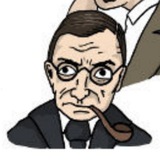
Everyone in the comic was arrested in real life for what they are arguing to do. Cops have always been the same.
Anarchism has always been a philosophy of mutual self aid, freedom, cooperation, dismantling illegitimate hierarchies, and moving towards open democratic structures in all aspects of life. Generally speaking, the people at the top of the illegitimate hierarchies, like people who command countries because they were born to the right family, or people who command workers because they have a piece of paper saying the own the factory, well...they do not care for this philosophy. And the police are on their side.
In fact, like the hover text says, everyone in this comic was arrested for what they are arguing for. Bakunin was arrested for trying to bring about democracy, Kropotkin for "subversive political activity" (whatever that means, most likely just being an anarchist), Emma Goldman for "illegally distributing information about birth control", and poor Proudhon was arrested for insulting Napoleon III, a rather silly thing to be arrested for and unfortunately for him that meant he had to look rather silly in the comic.
In every society, those in power will always call the people who are peacefully trying to change the system "violent anarchists" and the people who violently enforce the system "peace keepers". Violence, to them, is having to give up their vacation home so someone else doesn't have to be homeless. Peace is having the police beat up and jail the homeless people who are sheltering there to stay out of the cold. To those whose privilege is built on mountains of injustice, merely asking for justice will be called violence, and violence to protect their privilege will be called justice.
Do not be fooled. The police do not enforce justice, they enforce privilege, property, wealth, and power.
Black Lives Matter.
In fact, like the hover text says, everyone in this comic was arrested for what they are arguing for. Bakunin was arrested for trying to bring about democracy, Kropotkin for "subversive political activity" (whatever that means, most likely just being an anarchist), Emma Goldman for "illegally distributing information about birth control", and poor Proudhon was arrested for insulting Napoleon III, a rather silly thing to be arrested for and unfortunately for him that meant he had to look rather silly in the comic.
In every society, those in power will always call the people who are peacefully trying to change the system "violent anarchists" and the people who violently enforce the system "peace keepers". Violence, to them, is having to give up their vacation home so someone else doesn't have to be homeless. Peace is having the police beat up and jail the homeless people who are sheltering there to stay out of the cold. To those whose privilege is built on mountains of injustice, merely asking for justice will be called violence, and violence to protect their privilege will be called justice.
Do not be fooled. The police do not enforce justice, they enforce privilege, property, wealth, and power.
Black Lives Matter.
"It turns out I wasted my life worrying so much about whether I was wasting my life."
Also he was wrong about whatever the hell he was talking about in The Science of Logic.
"Also have I told you how 18th century German is objectively the best language? Again, philosophically speaking, of course."
Hegel's philosophy of history states that history is a kind of dialectal progression towards "the consciousness of freedom". What this meant is that each generation struggles to become more and more free, until eventually the reach the perfectly rational society of freedom. Then, rather amazingly, he concluded that this process had more or less concluded and that they were living in such a society in 18th century Prussia, under a Constitutional Monarchy, which was the final form of society. Some people claim this was to avoid the censures, but as he got older he got quite conservative in many areas, so it's hard to say.
Hegel did recognize that a large part of society, namely the uneducated poor who had no real hope of advancement, which he called "the rabble", were excluded from political and social influence, and more or less condemned to live and die as poor laborers (Prussia was just transitioning from Feudalism to Capitalism at this time). However, he seemed to not really be too bothered by this. In addition, rather amazingly, he seemed to not think this progression of the "consciousness of freedom" would ever apply to women, and he seemed to think that Democracy was less free than a Monarchy (although in his conception the Monarch would have very little real power). He also expounded many theories for why such a consciousness of freedom had failed to arrive in places such as Asia and African, and let's just say, well...that not all of his ideas aged so well.
Hegel did recognize that a large part of society, namely the uneducated poor who had no real hope of advancement, which he called "the rabble", were excluded from political and social influence, and more or less condemned to live and die as poor laborers (Prussia was just transitioning from Feudalism to Capitalism at this time). However, he seemed to not really be too bothered by this. In addition, rather amazingly, he seemed to not think this progression of the "consciousness of freedom" would ever apply to women, and he seemed to think that Democracy was less free than a Monarchy (although in his conception the Monarch would have very little real power). He also expounded many theories for why such a consciousness of freedom had failed to arrive in places such as Asia and African, and let's just say, well...that not all of his ideas aged so well.
Hegel's philosophy of history states that history is a kind of dialectal progression towards "the consciousness of freedom". What this meant is that each generation struggles to become more and more free, until eventually the reach the perfectly rational society of freedom. Then, rather amazingly, he concluded that this process had more or less concluded and that they were living in such a society in 18th century Prussia, under a Constitutional Monarchy, which was the final form of society. Some people claim this was to avoid the censures, but as he got older he got quite conservative in many areas, so it's hard to say.
Hegel did recognize that a large part of society, namely the uneducated poor who had no real hope of advancement, which he called "the rabble", were excluded from political and social influence, and more or less condemned to live and die as poor laborers (Prussia was just transitioning from Feudalism to Capitalism at this time). However, he seemed to not really be too bothered by this. In addition he somehow seemed to not think this progression of the "consciousness of freedom" would ever apply to women, and he seemed to think that Democracy was less free than a Monarchy (although in his conception the Monarch would have very little real power). He also expounded many theories for why such a consciousness of freedom had failed to arrive in places such as Asia and African, and let's just say, well...that not all of his ideas aged so well.
Hegel did recognize that a large part of society, namely the uneducated poor who had no real hope of advancement, which he called "the rabble", were excluded from political and social influence, and more or less condemned to live and die as poor laborers (Prussia was just transitioning from Feudalism to Capitalism at this time). However, he seemed to not really be too bothered by this. In addition he somehow seemed to not think this progression of the "consciousness of freedom" would ever apply to women, and he seemed to think that Democracy was less free than a Monarchy (although in his conception the Monarch would have very little real power). He also expounded many theories for why such a consciousness of freedom had failed to arrive in places such as Asia and African, and let's just say, well...that not all of his ideas aged so well.