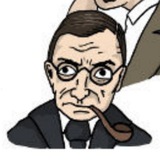
Would people from other cultures imagine a society more similar to their system? Yes, but I come from the correct system, so I'm the one who is correct.
Rawls famous Original Position thought experiment asks us to imagine a bargaining game to come up with the rules of society behind a "veil of ignorance", that is to say, without knowing anything about ourselves. The idea being this will allow us to come up with just rules to govern society that don't favor anyone. Rather remarkably, Rawls thought the result of this would be an extremely similar society to the one he was in, with a few adjustments to make things more fair. Robert Paul Wolff, the other philosopher in the comic, whose lectures on Rawls you can find here on YouTube, thought this was more or less because tenured philosophy professors, who live quite comfortable privileged lives, tend to be conservative about changes to society. He thought Rawls was more or less using the thought experiment, ironically given its nature, to defend the status quo from which he personally benefited. He thought many other people throughout history have risked their lives for justice, and if you asked them, they might imagine much more radical changes from an original position, such as an anarchist society. Also, presumably if you asked people from an anarchist or communist society to enter the thought experiment, they would not want to reinvent market capitalism.
It should be noted, however, that later in life Rawls did defend some form of market socialism, where the economy more or less resembles what we have now but companies are structured as cooperatives where they are owned by their workers. He was even open to more democratic control of production. However, even this is a far stretch from Wolff's view of ultimately abolishing hierarchy, property, money, and the market itself.
It should be noted, however, that later in life Rawls did defend some form of market socialism, where the economy more or less resembles what we have now but companies are structured as cooperatives where they are owned by their workers. He was even open to more democratic control of production. However, even this is a far stretch from Wolff's view of ultimately abolishing hierarchy, property, money, and the market itself.
"Prison, it totally sucks man, even worse than I thought."
- Michel Foucault, probably, if he ever experienced prison life first hand.
- Michel Foucault, probably, if he ever experienced prison life first hand.
Telling people "write what you know" is how we ended up with 100 books about somewhat depressed, aimless 30 year old men who are struggling to write a novel.
Philosophers have had many explanations for what humor is throughout the years. Early Greeks like Plato, Aristotle, and Epictetus generally took a negative view of it, thinking it was a vice mostly consisting of laughing at those who we thought were inferior to us. Supposedly Epictetus never laughed at all. Later philosophers, like Aquinas, thought it was more of a virtue, because it brought joy, and a kind of play used to sharpen our wits by making connections between things.
Kant also challenged the "humor as scorn" theory, instead offering a theory that it was the mental release of energy from a buildup suddenly dissipating. He thought the wound up nerves that were formed by the buildup of a joke were suddenly released by the punchline, resulting physically in laughter. However, like the Greeks, he thought jokes were a rather useless activity (although Kant seemed to think everything was useless outside philosophy, so I dont know, maybe don't take his advice on how to plan a party).
Freud had a similar theory to Kant's, where laughter was a release of nervous energy, but focused more on subconscious repressions and social taboos that aren't usually allowed to be said out loud. He probably would have liked shock humor.
All of the example jokes were real examples used to explain their theories (although Aquinas's example I took from a modern philosopher). However, I left out the best one for space. Francis Hutcheson, critiquing Hobbes's account which more or less agreed that humor was a kind of scorn, gives this cracking joke, apparently free of scorn, that still makes us laugh:
The sun, long since, had in the lap
Of Thetis taken out his nap;
And like a lobster boild, the morn
From black to red began to turn.
It's about the sun rising, in case you couldn't quite follow it. He said that "we laugh at this fantastical imitation of the poetical imagery". You have to remember that in 1750 they hadn't invented airplanes yet, and therefore couldn't make jokes about how airplane food was bad, so things like this must have seemed much funnier to them. He gives another example from the satirical poem Hudibras:
Instead of trumpet and of drum,
Which makes the warriour's stomach come,
And whets men's valour sharp, like beer
By thunder turn'd to vinegar.
He claims: "the laughter is not here raised against either valour or martial music, but merely by the wild resemblance of a mean event." Hmm. I guess I'll have to take his word on that one.
Oh, and while we have no written evidence that Freud repeated said the word "penis" to elicit laughter, I think we can all agree that it was highly likely.
Kant also challenged the "humor as scorn" theory, instead offering a theory that it was the mental release of energy from a buildup suddenly dissipating. He thought the wound up nerves that were formed by the buildup of a joke were suddenly released by the punchline, resulting physically in laughter. However, like the Greeks, he thought jokes were a rather useless activity (although Kant seemed to think everything was useless outside philosophy, so I dont know, maybe don't take his advice on how to plan a party).
Freud had a similar theory to Kant's, where laughter was a release of nervous energy, but focused more on subconscious repressions and social taboos that aren't usually allowed to be said out loud. He probably would have liked shock humor.
All of the example jokes were real examples used to explain their theories (although Aquinas's example I took from a modern philosopher). However, I left out the best one for space. Francis Hutcheson, critiquing Hobbes's account which more or less agreed that humor was a kind of scorn, gives this cracking joke, apparently free of scorn, that still makes us laugh:
The sun, long since, had in the lap
Of Thetis taken out his nap;
And like a lobster boild, the morn
From black to red began to turn.
It's about the sun rising, in case you couldn't quite follow it. He said that "we laugh at this fantastical imitation of the poetical imagery". You have to remember that in 1750 they hadn't invented airplanes yet, and therefore couldn't make jokes about how airplane food was bad, so things like this must have seemed much funnier to them. He gives another example from the satirical poem Hudibras:
Instead of trumpet and of drum,
Which makes the warriour's stomach come,
And whets men's valour sharp, like beer
By thunder turn'd to vinegar.
He claims: "the laughter is not here raised against either valour or martial music, but merely by the wild resemblance of a mean event." Hmm. I guess I'll have to take his word on that one.
Oh, and while we have no written evidence that Freud repeated said the word "penis" to elicit laughter, I think we can all agree that it was highly likely.