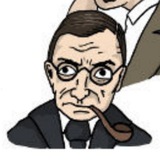
The funniest part of their split in real life though was that Jung told Freud that he thought of him more as a father figure than a friend, and Freud thought that because of his theory how everyone secretly wanted to kill their father that Jung was going to literally kill him.
Jung and Freud were friends a colleagues for a long time, and did analyze each other's dreams, but they eventually fell out over differences in theory, mostly over their theories on the consciousness. Freud thought Jung's ideas on the "collective unconscious" were unscientific nonsense, and Jung thought Freud's ideas on how everything boiled down to sex was pervy nonsense.
Jung and Freud were friends and colleagues for a long time, and did analyze each other's dreams, but they eventually fell out over differences in theory, mostly over their theories on the consciousness. Freud thought Jung's ideas on the "collective unconscious" were unscientific nonsense, and Jung thought Freud's ideas on how everything boiled down to sex was pervy nonsense.
Look, the way science works in practice is that theories are based on the entire body of knowledge within a community, no one result can disprove...
Based on Bob Mortimer's observation that warning labels saying 'not for indoor use' mean that its fine, in his story on how he burnt his house down.
Utopian theories only have one small problem, which is that no one ever wants to live there.
Thomas More's Utopia describes his vision of a fictional land that represents the ideal way to organize a society for him. While there were many shocking ideas for the time, like the complete elimination of private property, and democratic rule, which seem to benefit everyone, he couldn't help doing what most Utopian visionaries do as well: imagining that everyone lives drab, moralizing lives. He
thought there wouldn't be any ale-houses, fashion, or really any form of vice at all, and people would be perfectly content to spend their time reading philosophy (what is it with philosophers who think the ideal life for everyone is reading philosophy? Have you considered that maybe that's just what you like to do?) Even stranger, slaves were still a large part of the society. Although he
envisioned very human criminal justice reforms (at the time thieves could be put to death, a position he argues against), you could still be sentenced to slavery for crimes. Even weirder, he said that people from foreign lands would volunteer to be slaves in Utopia, because it was so great there. Seems unlikely.
thought there wouldn't be any ale-houses, fashion, or really any form of vice at all, and people would be perfectly content to spend their time reading philosophy (what is it with philosophers who think the ideal life for everyone is reading philosophy? Have you considered that maybe that's just what you like to do?) Even stranger, slaves were still a large part of the society. Although he
envisioned very human criminal justice reforms (at the time thieves could be put to death, a position he argues against), you could still be sentenced to slavery for crimes. Even weirder, he said that people from foreign lands would volunteer to be slaves in Utopia, because it was so great there. Seems unlikely.