"Oh also, I slept with your Mom, but that wasn't really part of it."
😁1
As a middle manager, is it better to be feared or loved? Well, as it turns out, it doesn't really matter because you are a meaningless cog in a giant corporate machine.
"Realpolitik" is a style of politics that is amoral, considering only the circumstances, and maintaining and expanding power. It is often connected with the works of Machiavelli, who wrote a treatise on how rulers could maintain and expand power, disregarding the moral aspects of what to do with that power. The woman is drawn loosely on Catherine the Great, who came to power through extraordinary cunning and understanding of politics.
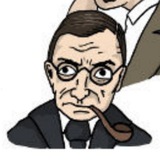
The Vienna Circle was a group of intellectuals in the early 20th century who were radically committed to the idea that empirical science was the only knowledge (known as "Logical Positivism"). They were heavily influenced by Wittgenstein's Tractatus Logico-Philosophicus, which gave a similar account of knowledge, and likewise rejected metaphysics. They discussed philosophy with him in person quite a bit, but he isn't really considered part of the circle. Logical Positivism was short lived, collapsing mostly due to their failure to cleanly demarcate between science and non-science (i.e., different formulations of their ideas would either have to throw out too much, or admit too much into "science"), and the failure of the verification principle to account for how science is done in practice (especially due to later criticisms by Popper, Quine, and Kuhn). It wasn't really abandoned, as people often think, because the formulation of their ideas was, itself, not empirical. They were aware of that fact, and thought that it could be arrived at through a priori reasoning alone.
They are widely considered the least cool group of philosophers, just behind the early Christian neo-platonists.
They are widely considered the least cool group of philosophers, just behind the early Christian neo-platonists.
That's right, those penis jokes were just the setup for that sweet, sweet indeterminacy of translation payoff.
The Indeterminacy of Translation is an idea by Quine, which says that direct, uniquely correct translations of a foreign language, even theoretically, are impossible. For Quine, knowledge was holistic, so in order to understand even simply sentence from a foreign culture, you would have to understand everything about the culture. For example, if you visit a tribe, and they point out a rabbit and say "tzqqa", you might assume the word refers to the rabbit. But if the tribe believes in some sort of idealism, they might be referring to merely the representation of those sensations, or if the tribe only thinks of objects as what they aren't, they might be pointing out everything in the universe but the rabbit. These kind of questions are undecidable from the language alone, no matter how much you try.