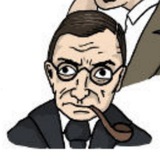
Sort of incredibly, as of the writing of this comic, it seems like the Trump shooter basically had no real motive in the normal sense (i.e. a political goal to achieve). Sartre thought that human freedom could always transcend itself, in that you can have free acts without a prior chain of events that led it. The way we talk about freedom and motives often makes it seem like our actions are wholly cause by our prior beliefs. For example, if someone hated Charles de Gaulle their entire life, and wanted France to be a communist country, and then they shot him, their hatred and political ideals would have "caused" them to shoot him. But since we are free creatures, someone could equally wake up in the morning and decide to shoot him for "no reason".
Camus had similar ideas, taking it even further in that he thought most of the stories and narratives that we tell ourselves are often lies and fabrications to impose a narrative on our lives that might not exist. We want our lives to be like novels that we author, but most of the time it is more like we are just bouncing around more or less at random like anything else in the universe.
As a side note, I can almost gaurentee that both of them thought about shooting de Gaulle at least one, especially Sartre. Existentialists love dramatic shit like that.
Camus had similar ideas, taking it even further in that he thought most of the stories and narratives that we tell ourselves are often lies and fabrications to impose a narrative on our lives that might not exist. We want our lives to be like novels that we author, but most of the time it is more like we are just bouncing around more or less at random like anything else in the universe.
As a side note, I can almost gaurentee that both of them thought about shooting de Gaulle at least one, especially Sartre. Existentialists love dramatic shit like that.
🔥19😁5❤🔥2❤2👍2🫡1
"And then Zarathustra made the classic mistake of starting a cult that wasn't a weird sex cult. If you are going to start a cult, you should at the very least be doing weird sex stuff or you aren't going to have a good time..."
💯24🍓4
Socrates more or less believed that progress towards the truth would come from discussions and cooperation between people, as long as they are earnestly seeking the truth. Nietzsche focused more on how individuals must be able to break free from the culture around him. In reality of course, scientific and cultural progress is made in the much more Socratic way. If you were able to simply seek the truth by sitting in a mountain for 10 years in solitude, then a genius from a hunter gatherer society would have come up with the Theory of Relativity long ago. In reality, it took thousands and thousands of scientists in discussions with each other to set up Einstein to even able to have those thoughts.
Of course, Nietzsche knew this I'm sure, and stories like Zarathustra aren't about making small contributions to mankind's cumulative knowledge, but re-writing values in society. I'm still not sure why you have to be in the mountains for so long, but each to his own I suppose.
Of course, Nietzsche knew this I'm sure, and stories like Zarathustra aren't about making small contributions to mankind's cumulative knowledge, but re-writing values in society. I'm still not sure why you have to be in the mountains for so long, but each to his own I suppose.
👍21👎3
Also, William James was later found to have chromosomes in a DNA test, and an social media mob believes this is clearly cheating.
👍8😁1
William James took many different drugs in his life, leading him to have mind altering and even mystical experiences. Most of this was pretty normal stoner stuff, he found the unity of all things, blah blah blah. Strangely though, he claimed he was only able to understand Hegel while under the influence of nitrous oxide. So, I don't know, if you are a student who is struggling...something to consider.
🤣16👍5😁2
Bulking phase: life affirming, meaningful pursuit, the will to power in the most literal possible sense.
Cutting phase: life denying, elevates the aesthetic to the realm of the serious, has you eating things like salads for some reason.
Cutting phase: life denying, elevates the aesthetic to the realm of the serious, has you eating things like salads for some reason.
😁11❤3
Edmund Burke argued for something called "virtual representation", which meant that an elected official did NOT represent the people who elected him, but in fact represented the nation as a whole as best he understood. These means that when voting, he should use his own judgment, and not simply vote as the people who elected him would want. On the one hand, these seems absurd, because if a representative doesn’t represent the people who vote for him, what is the point of democracy in the first place? Burke sort of agreed with this, being a kind of elitist and conservative who didn’t really believe in direct democracy. On the other hand though, in many cases it is obviously true that an elector can’t represent the local interests only. In Burke’s own speech defending himself, he was defending his vote against putting tariffs on Irish good that would protect business in his home region. Since he thought he represented Ireland (part of Great Britain at that time) as well as Bristol, he couldn’t vote for it out of pure local interest (he lost the next election, they didn’t like this it turns out).
Ironically, while he was using it to support Irish interests, his concept of “virtual representation” was the main argument used by the English to say that actual representation wasn’t needed for the Irish or the American colonists. They could simply trust that the British representatives would have their best interest at heart. Burke did not agree with this application of it, since the British members of parliament didn’t share common interests with the colonists or Catholic Irish. The Irish and Americans didn’t like the idea of “virtual representation” either, it turns out, hence the revolutions.
Ironically, while he was using it to support Irish interests, his concept of “virtual representation” was the main argument used by the English to say that actual representation wasn’t needed for the Irish or the American colonists. They could simply trust that the British representatives would have their best interest at heart. Burke did not agree with this application of it, since the British members of parliament didn’t share common interests with the colonists or Catholic Irish. The Irish and Americans didn’t like the idea of “virtual representation” either, it turns out, hence the revolutions.
🔥10👍3😢2
And yes, I am saying that to be a truly great philosopher, you MUST be a master of kung fu.
👏14🫡10👍2👾1