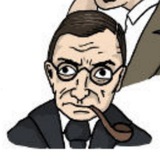
Bulking phase: life affirming, meaningful pursuit, the will to power in the most literal possible sense.
Cutting phase: life denying, elevates the aesthetic to the realm of the serious, has you eating things like salads for some reason.
Cutting phase: life denying, elevates the aesthetic to the realm of the serious, has you eating things like salads for some reason.
😁11❤3
Edmund Burke argued for something called "virtual representation", which meant that an elected official did NOT represent the people who elected him, but in fact represented the nation as a whole as best he understood. These means that when voting, he should use his own judgment, and not simply vote as the people who elected him would want. On the one hand, these seems absurd, because if a representative doesn’t represent the people who vote for him, what is the point of democracy in the first place? Burke sort of agreed with this, being a kind of elitist and conservative who didn’t really believe in direct democracy. On the other hand though, in many cases it is obviously true that an elector can’t represent the local interests only. In Burke’s own speech defending himself, he was defending his vote against putting tariffs on Irish good that would protect business in his home region. Since he thought he represented Ireland (part of Great Britain at that time) as well as Bristol, he couldn’t vote for it out of pure local interest (he lost the next election, they didn’t like this it turns out).
Ironically, while he was using it to support Irish interests, his concept of “virtual representation” was the main argument used by the English to say that actual representation wasn’t needed for the Irish or the American colonists. They could simply trust that the British representatives would have their best interest at heart. Burke did not agree with this application of it, since the British members of parliament didn’t share common interests with the colonists or Catholic Irish. The Irish and Americans didn’t like the idea of “virtual representation” either, it turns out, hence the revolutions.
Ironically, while he was using it to support Irish interests, his concept of “virtual representation” was the main argument used by the English to say that actual representation wasn’t needed for the Irish or the American colonists. They could simply trust that the British representatives would have their best interest at heart. Burke did not agree with this application of it, since the British members of parliament didn’t share common interests with the colonists or Catholic Irish. The Irish and Americans didn’t like the idea of “virtual representation” either, it turns out, hence the revolutions.
🔥10👍3😢2
And yes, I am saying that to be a truly great philosopher, you MUST be a master of kung fu.
👏14🫡10👍2👾1
Of course the real answer is that God, in His infinite wisdom, created humans to stare at computer screens for 8 hours a day.
😢11🙏6😁5👍3
Philosophers have been trying to define what a human is since the beginning, starting perhaps with Plato's hamfisted "featherless biped" which was mocked by Diogenes by presenting a plucked chicken and declaring it a man.
Aristotle thought man was the "rational animal" (remember this was before social media).
Descartes amazingly thought that not only were humans the only animal with souls, but that we were the only animal with any consciousness, and that other animals didn't even experience pain.
Schopenhauer thought the very structure of the human experience, given that we have wants and needs that can never properly be fulfilled, was suffering.
Nietzsche thought one thing that distinguished humans from animals (and perhaps even "lesser" humans, is our ability to extend our will through time by making and fulfilling promises to ourselves.
Sartre thought freedom was the essential trait to humans.
For Wittgenstein, our ability to use language was probably the most unique and defining trait.
For Postmodernists like Derrida, however, there is no human nature, as our nature is almost entirely created by the social context we find ourselves in. By coincidence though, pretty much all the postmodernists seem to be pretty similar (snobby Frenchmen for the most part).
Aristotle thought man was the "rational animal" (remember this was before social media).
Descartes amazingly thought that not only were humans the only animal with souls, but that we were the only animal with any consciousness, and that other animals didn't even experience pain.
Schopenhauer thought the very structure of the human experience, given that we have wants and needs that can never properly be fulfilled, was suffering.
Nietzsche thought one thing that distinguished humans from animals (and perhaps even "lesser" humans, is our ability to extend our will through time by making and fulfilling promises to ourselves.
Sartre thought freedom was the essential trait to humans.
For Wittgenstein, our ability to use language was probably the most unique and defining trait.
For Postmodernists like Derrida, however, there is no human nature, as our nature is almost entirely created by the social context we find ourselves in. By coincidence though, pretty much all the postmodernists seem to be pretty similar (snobby Frenchmen for the most part).
👍8😁6❤1
Whether Hume actually awoke Kant from his dogmatic slumber or if it was just a coincidence, is truly one of the greatest mysteries of philosophy.
👍7
Before reading Hume, Kant was writing more ordinary philosophy, mostly attempting to reconcile empiricism and rationalism. Once he read Hume's skepticism about causation and morality, he was spurred into action into finding a rational basis for morality and attempting to explain the structure of our conscious experience to account for things like space, time and causation. Basically he felt more or less forced to become the greatest philosopher of all time, because Hume's ideas annoyed him so much.
🔥12👍6❤1