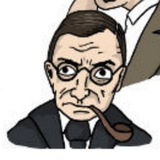
Although to be fair to Hegel if you have to eat Danish food every day it is quite rational to be sad.
😁14
Hegel’s philosophy was a sort of all encompassing philosophy, where he thought all human knowledge was progressively moving towards the truth, which he called the Absolute Ideal. He lumped in art, culture, science, philosophy, and even Christianity as fragments of this one single truth that we are slowly uncovering through rational pursuit.
Kierkegaard, on the other hand, believed that certain modes of being for human life were fundamentally different than others. For example, someone who pursues an aesthetic life (doing awesome shit because it is awesome, like for example the band AC/DC) and someone who is pursuing the moral life (like for example Greta Thunberg) are simply doing two different things. While AC/DC is undeniably more awesome than fixing climate change, and fixing climate change is undeniably more moral than badass guitar riffs, we as “rational” human beings ultimately have no way of deciding between which sort of life to live. The same goes for giving up on rationality itself to have faith in God. In his view Christianity wasn’t the culmination of rational thought, but in a way the rejection of it for faith.
Oh and also Hegel rather strangely said that German, aside from maybe Ancient Greek, was the best language to do philosophy in. Kierkegaard was so annoyed at not being able to do his dissertation in Danish (Latin or German were the choices) that he petitioned the King himself to get permission. Kinda weird but I guess the King wasn’t really as busy as you’d think back then.
Kierkegaard, on the other hand, believed that certain modes of being for human life were fundamentally different than others. For example, someone who pursues an aesthetic life (doing awesome shit because it is awesome, like for example the band AC/DC) and someone who is pursuing the moral life (like for example Greta Thunberg) are simply doing two different things. While AC/DC is undeniably more awesome than fixing climate change, and fixing climate change is undeniably more moral than badass guitar riffs, we as “rational” human beings ultimately have no way of deciding between which sort of life to live. The same goes for giving up on rationality itself to have faith in God. In his view Christianity wasn’t the culmination of rational thought, but in a way the rejection of it for faith.
Oh and also Hegel rather strangely said that German, aside from maybe Ancient Greek, was the best language to do philosophy in. Kierkegaard was so annoyed at not being able to do his dissertation in Danish (Latin or German were the choices) that he petitioned the King himself to get permission. Kinda weird but I guess the King wasn’t really as busy as you’d think back then.
❤16🔥5
To be honest not enough philosophers discuss Hot MILFs in your area, and how it relates to our broader meaning of life.
❤6🌭6👍1🍓1
And that's when he decided to become the Anti-Christ (writing a lot of long boring books that make teenagers more edgy).
🔥14😁2🤡2
Nietzsche accused Christianity of essentially being a religion to placate the weak, powerless masses. It told them that not only is their weakness a kind of moral superiority over those who oppressed them, but that they would receive their ultimate reward and their oppressors would be punished in the next life. He thought it was just appeasing their resentment over being powerless in this life.
Despite having sort of a philosopher of strength and empowerment, it's hard not to say that Nietzsche himself in his biography was bitter, weak, and resentful himself over his own lack of the ability to extend his will and influence and take action. In the long run, of course, he was massively influential, but at many points in his life he felt sickly, powerless, and weak.
Despite having sort of a philosopher of strength and empowerment, it's hard not to say that Nietzsche himself in his biography was bitter, weak, and resentful himself over his own lack of the ability to extend his will and influence and take action. In the long run, of course, he was massively influential, but at many points in his life he felt sickly, powerless, and weak.
❤18👎2👍1😁1
No one wants to admit how many of the great revolutionaries of the past would be podcasters if they were alive today.
🤣15😭3👍2💯2
This is supposedly true?? It's on wikipedia at least which means it must be.
😁7👎2
A lot of ancient philosophers died in pretty weird ways.
Like Empedocles who died jumping in a Volcano to prove that...uh, he was God or something?.
Or Pythagoras who died after being chased by soldiers and refusing to enter a field of beans, because then he would be reincarnated as bean. What is so bad about being a bean, anyway?
Or Heraclitus who died after burying himself in dung to cure himself of dropsy. Medicine was a little more primitive back then.
And then there is of course Chrysippus, who died of laughter after watching a donkey try to eat figs. Comedy was also more primitive back then, remember they didn't have YouTube.
Like Empedocles who died jumping in a Volcano to prove that...uh, he was God or something?.
Or Pythagoras who died after being chased by soldiers and refusing to enter a field of beans, because then he would be reincarnated as bean. What is so bad about being a bean, anyway?
Or Heraclitus who died after burying himself in dung to cure himself of dropsy. Medicine was a little more primitive back then.
And then there is of course Chrysippus, who died of laughter after watching a donkey try to eat figs. Comedy was also more primitive back then, remember they didn't have YouTube.
😁14🤪3🥰2
Look all I'm saying is that if a riddle doesn't use exact scienfic language to demarcate one, and only one, answer then the answer must be that it is nonsense.
❤9👍1
Carnap believed that an exact scientific language could be created in order to eliminate ambiguities and describe empirical facts precisely. He thought many problems of philosophy arose from our imprecise language, and would be resolved if we could create a language with questions and answers that had no ambiguity at all.
❤5👍2🥰1🤪1