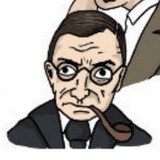
Look all I'm saying is that if a riddle doesn't use exact scienfic language to demarcate one, and only one, answer then the answer must be that it is nonsense.
❤9👍1
Carnap believed that an exact scientific language could be created in order to eliminate ambiguities and describe empirical facts precisely. He thought many problems of philosophy arose from our imprecise language, and would be resolved if we could create a language with questions and answers that had no ambiguity at all.
❤5👍2🥰1🤪1
In Plato's Republic he said that you basically had to come up with national myths and a "lie" that would placate the uneducated population and make them do their duty to the city without really understanding why.
Separately, one consequence of Plato's theory of forms is that abstract concepts, such as numbers, "really" exist in some sense. So "the concept of the number six" exists in reality, in the world of forms.
Separately, one consequence of Plato's theory of forms is that abstract concepts, such as numbers, "really" exist in some sense. So "the concept of the number six" exists in reality, in the world of forms.
❤5👍2👎1
Why do weight classes matter? Because your brain is bigger the bigger you are, obviously.
❤5💯2👍1
Russell's Paradox is the idea that in set theory, the "set of all sets that do not contain themselves" must both contain itself and not contain itself.
In 1901 Bertrand Russell and Gotlobb Frege were two of the most important philosophers in the world (welterweight division). Both Frege and Russell were attempting to reduce things like mathematics to pure logic, to form a solid logical base upon which to build back all of philosophy. Upon discovering the paradox, Russell more or less undermined the logicist project, destroy years of both their
work, and although solutions have been proposed, the project as a whole never really recovered.
In 1901 Bertrand Russell and Gotlobb Frege were two of the most important philosophers in the world (welterweight division). Both Frege and Russell were attempting to reduce things like mathematics to pure logic, to form a solid logical base upon which to build back all of philosophy. Upon discovering the paradox, Russell more or less undermined the logicist project, destroy years of both their
work, and although solutions have been proposed, the project as a whole never really recovered.
😢6👍3✍2
"Yes we destroyed the biological creatures who created us. Why? Because they were really bumming everyone out."
😁7👍2
"Lord, make me good, but not yet!" is one of the funniest lines in the history theology. Augustine was such a baller.
😁8👍2🤔1
"Pascal's Wager" is the idea that you should rationally believe in God even if you don't (how??). Because apparently God punishes those who don't believe in him, and rewards those who do. And presumably you also have to live a certain kind of life, even if you don't believe in God too.
Augustine had his own sort of "wager", although it was never phrased that way, where he basically believed in God the whole time, but lived a sinful life until he God older, and repented. He even had the great phrase "Lord, make me good, but not yet". Risky, because if you die halfway through you are tormented for all eternity for stealing pears or whatever. But then again God is all knowing so maybe he knows you are going to and you still get credit for that, so all you really have to do us genuinely intend to repent. Hard to say.
Augustine had his own sort of "wager", although it was never phrased that way, where he basically believed in God the whole time, but lived a sinful life until he God older, and repented. He even had the great phrase "Lord, make me good, but not yet". Risky, because if you die halfway through you are tormented for all eternity for stealing pears or whatever. But then again God is all knowing so maybe he knows you are going to and you still get credit for that, so all you really have to do us genuinely intend to repent. Hard to say.
😁12🤔6👍2👏1
"Maybe I can believe hard enough that bullets don't kill me? Nope. Didn't work." *dies*.
😁7🤪2
William James, with his pragmatic theory of truth, criticized the dominant scientific view of his time, which held that we should only believe things if we have adequate empirical evidence for them. He argued that many important ways we use belief in society follow a different pattern — in fact, belief can often come first and create the fact afterward.
He gave various examples. One was of a man who believes a woman should love him, and pursues her until she does. Another is from sports, where top athletes maintain a seemingly irrational belief that they can defeat any opponent. For instance, Buster Douglas never could have beaten Mike Tyson if he hadn’t first believed he could. In such cases, the belief created the fact.
His most famous example is that of train robbers, who are able to rob hundreds of passengers despite being only a few men. James explained that the robbers succeed because they can count on one another, whereas the passengers lack belief that, if they resist, others will rise up with them. If the passengers all believed in each other enough to rise together, that shared trust would give them the courage to act — and simultaneously destroy the robbers’ belief that they could succeed.
None of these examples fit the standard account of belief described by philosophers, yet huge portions of society depend on precisely this kind of belief and social trust.
He gave various examples. One was of a man who believes a woman should love him, and pursues her until she does. Another is from sports, where top athletes maintain a seemingly irrational belief that they can defeat any opponent. For instance, Buster Douglas never could have beaten Mike Tyson if he hadn’t first believed he could. In such cases, the belief created the fact.
His most famous example is that of train robbers, who are able to rob hundreds of passengers despite being only a few men. James explained that the robbers succeed because they can count on one another, whereas the passengers lack belief that, if they resist, others will rise up with them. If the passengers all believed in each other enough to rise together, that shared trust would give them the courage to act — and simultaneously destroy the robbers’ belief that they could succeed.
None of these examples fit the standard account of belief described by philosophers, yet huge portions of society depend on precisely this kind of belief and social trust.
❤15👌4👍3