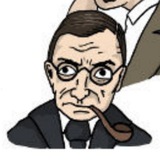
David Hume had very similar ideas to Buddha about the nature of the self, or rather, about the nature of the not-self. He believed that human existence was nothing more than a "bundle" of experiences together, and there existed no further thing which did the bundling. The Buddhist doctrine of anatta also claims there is no self at all. In fact, Hume might have gotten this idea from Buddhism, as there were very early translations of Buddhist texts available around that time where Hume was living.
The conclusions that Buddha and Hume drew from the fact that no self exists, however, couldn't be further apart. Whereas Buddha teaches something like turning away from desire, passion, and temporary pleasure for meditation and moving towards an enlightened state, Hume says exactly the opposite. While he doesn't exactly give a defense of Hedonism, he famously said that reason should be a "slave to the passions." In other words, our desires and passions should come first, and reason should merely be a tool to figure out how to obtain them. Hume himself was known for being a bit of a socialite and ladies man during his time in Paris.
The conclusions that Buddha and Hume drew from the fact that no self exists, however, couldn't be further apart. Whereas Buddha teaches something like turning away from desire, passion, and temporary pleasure for meditation and moving towards an enlightened state, Hume says exactly the opposite. While he doesn't exactly give a defense of Hedonism, he famously said that reason should be a "slave to the passions." In other words, our desires and passions should come first, and reason should merely be a tool to figure out how to obtain them. Hume himself was known for being a bit of a socialite and ladies man during his time in Paris.
I know it might not be "logical" or whatever, but I believe Hue Jackson is going to turn around the Browns. You'll see, you'll all see!
"Wait, are you accusing the Poets of corrupting the youth? I thought you were in favor of that?"
"That was when I was young. Now that I'm a cranky old man I think the youth should obey the wisdom of their elders. Namely me."
"That was when I was young. Now that I'm a cranky old man I think the youth should obey the wisdom of their elders. Namely me."
In The Republic, Plato described the ideal city, and said that the Poets would be cast out of the city, along with the rhetoricians. It can be sort of hard to understand why he hated the poets so much, or thought they were so dangerous as to be exiled entirely, which seems a little extreme to us today. He seemed to think that, like the rhetoricians, because poetry doesn't make its aim to understand the truth, it was a dangerous way to spread ideas. It worked by inciting grand feelings or emotions, rather than engaging in a sort of ration, platonic dialogue. This sort of thing he held up as being fundamentally opposed to philosophy, which is what he believed should be governing the city, and governing our lives.
You can read more about Plato's views on Poetry in the Stanford Encyclopedia of Philosophy.
You can read more about Plato's views on Poetry in the Stanford Encyclopedia of Philosophy.
"Wait, are you accusing the Poets of corrupting the youth? I thought you were in favor of that?"
"That was when I was young. Now that I'm a cranky old man I think the youth should obey the wisdom of their elders. Namely me."
"That was when I was young. Now that I'm a cranky old man I think the youth should obey the wisdom of their elders. Namely me."
In The Republic, Plato described the ideal city, and said that the Poets would be cast out of the city, along with the rhetoricians. It can be sort of hard to understand why he hated the poets so much, or thought they were so dangerous as to be exiled entirely, which seems a little extreme to us today. He seemed to think that, like the rhetoricians, because poetry doesn't make its aim to understand the truth, it was a dangerous way to spread ideas. It worked by inciting grand feelings or emotions, rather than engaging in a sort of rational, platonic dialogue. This sort of thing he held up as being fundamentally opposed to philosophy, which is what he believed should be governing the city, and governing our lives.
You can read more about Plato's views on Poetry in the Stanford Encyclopedia of Philosophy.
You can read more about Plato's views on Poetry in the Stanford Encyclopedia of Philosophy.
"What what will you do without us brave entrepreneurs?");
"I don't know, probably receive the product of our labor in full?"
"I don't know, probably receive the product of our labor in full?"
Ayn Rand and Murray Rothbard are free market, capitalist libertarians. They essential believed that we would be the most "free" if nothing interferes with property relations, free enterprise, and the ability to make voluntary agreements. They don't believe the government or public should be able to take property from the wealthy elite and redistribute it, because they got that property through voluntary transactions.
Communists like Karl Marx or Rosa Luxemburg, on the other hand, wished to abolish private property altogether. Private property, as distinct from personal property, is the machines, land, and tools used to produce modern life. Personal property are items used for personal use. So private property is something like a factory, and personal property is something like a toothbrush. Marxists believe that owning the means of productions (private property) was illegitimate, and used to extract surplus labor value from the workers.
So in this case, Rand and Rothbard own not only the land and sea, but also the tools needed to extract the coconuts and fish. Marx and Luxemburg, being property-less workers, have no choice but to work for the property owners or die. Since Rand and Rothbard essentially have a monopoly if they work together, they can enforce basically any condition they want, but again, all of this is still voluntary in some sense. The labor of the workers is owned by the capitalists, and they take what is produced, and only give back some of it to the workers, ideally (for them) just enough to survive. After the revolution, no one would own anything but personal property, and everyone would have to work, and everyone would receive the full value of what they produced (although Marx obviously calls for the abolishment of things like money and commodity trading as well).
Communists like Karl Marx or Rosa Luxemburg, on the other hand, wished to abolish private property altogether. Private property, as distinct from personal property, is the machines, land, and tools used to produce modern life. Personal property are items used for personal use. So private property is something like a factory, and personal property is something like a toothbrush. Marxists believe that owning the means of productions (private property) was illegitimate, and used to extract surplus labor value from the workers.
So in this case, Rand and Rothbard own not only the land and sea, but also the tools needed to extract the coconuts and fish. Marx and Luxemburg, being property-less workers, have no choice but to work for the property owners or die. Since Rand and Rothbard essentially have a monopoly if they work together, they can enforce basically any condition they want, but again, all of this is still voluntary in some sense. The labor of the workers is owned by the capitalists, and they take what is produced, and only give back some of it to the workers, ideally (for them) just enough to survive. After the revolution, no one would own anything but personal property, and everyone would have to work, and everyone would receive the full value of what they produced (although Marx obviously calls for the abolishment of things like money and commodity trading as well).
"Hey Sartre, have I ever explained to you my ideas about the phenomenology of punching people?"