"What what will you do without us brave entrepreneurs?");
"I don't know, probably receive the product of our labor in full?"
"I don't know, probably receive the product of our labor in full?"
Ayn Rand and Murray Rothbard are free market, capitalist libertarians. They essential believed that we would be the most "free" if nothing interferes with property relations, free enterprise, and the ability to make voluntary agreements. They don't believe the government or public should be able to take property from the wealthy elite and redistribute it, because they got that property through voluntary transactions.
Communists like Karl Marx or Rosa Luxemburg, on the other hand, wished to abolish private property altogether. Private property, as distinct from personal property, is the machines, land, and tools used to produce modern life. Personal property are items used for personal use. So private property is something like a factory, and personal property is something like a toothbrush. Marxists believe that owning the means of productions (private property) was illegitimate, and used to extract surplus labor value from the workers.
So in this case, Rand and Rothbard own not only the land and sea, but also the tools needed to extract the coconuts and fish. Marx and Luxemburg, being property-less workers, have no choice but to work for the property owners or die. Since Rand and Rothbard essentially have a monopoly if they work together, they can enforce basically any condition they want, but again, all of this is still voluntary in some sense. The labor of the workers is owned by the capitalists, and they take what is produced, and only give back some of it to the workers, ideally (for them) just enough to survive. After the revolution, no one would own anything but personal property, and everyone would have to work, and everyone would receive the full value of what they produced (although Marx obviously calls for the abolishment of things like money and commodity trading as well).
Communists like Karl Marx or Rosa Luxemburg, on the other hand, wished to abolish private property altogether. Private property, as distinct from personal property, is the machines, land, and tools used to produce modern life. Personal property are items used for personal use. So private property is something like a factory, and personal property is something like a toothbrush. Marxists believe that owning the means of productions (private property) was illegitimate, and used to extract surplus labor value from the workers.
So in this case, Rand and Rothbard own not only the land and sea, but also the tools needed to extract the coconuts and fish. Marx and Luxemburg, being property-less workers, have no choice but to work for the property owners or die. Since Rand and Rothbard essentially have a monopoly if they work together, they can enforce basically any condition they want, but again, all of this is still voluntary in some sense. The labor of the workers is owned by the capitalists, and they take what is produced, and only give back some of it to the workers, ideally (for them) just enough to survive. After the revolution, no one would own anything but personal property, and everyone would have to work, and everyone would receive the full value of what they produced (although Marx obviously calls for the abolishment of things like money and commodity trading as well).
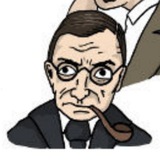
"Hey Sartre, have I ever explained to you my ideas about the phenomenology of punching people?"
"The Look" was a central concept in Sartre's phenomenology. It meant, essentially, what occurs when a consciousness if forced to recognize that it exists not only as the center of its own being gazing outward, but also as a mere object in the world of others. For Sartre, this recognition was essentially in becoming a fully realized consciousness, what he called a "self-reflective" consciousness. That is to say, not only conscious of the world, and but having your consciousness turned inwards towards itself, being aware of itself, and aware of itself in relation to others. His most famous example asks us to imagine someone gazing through the keyhole of a door (abridged heavily here, as Sartre tends to be a little long winded for how long these explanations usually run, you can find the full passage in Being and Nothingness, pg 317):
Let us imagine that moved by jealousy, curiosity, or vice I have just glued my ear to the door and looked through a keyhole. I am alone and on the level of a non-thetic self-consciousness. This means first of all that there is no self to inhabit my consciousness, nothing therefore to which I can refer my acts in order to qualify them. They are in no way known; I am my acts and hence they carry in themselves their whole justification. I am a pure consciousness of things, and things, caught up in the circuit of my selfness, offer to me their potentialities as the proof of my non-thetic consciousness (of) my own possibilities. This means that behind that door a spectacle is presented as "to be seen," a conversation as "to be heard."
...
But all of a sudden I hear footsteps in the hall. Someone is looking at me. What does this mean? It means that I am suddenly affected in my being and that essential modifications appear in my structure - modifications which I can apprehend and fix conceptually by means of the reflective cogito.
First of all, I now exist as myself for my unreflective consciousness. It is this irruption of the self which has been most often described: I see myself because somebody sees me - as it is usually expressed.
...
Only the reflective consciousness has the self directly for an object. The unreflective consciousness does not apprehend the person directly or as its object; the person is presented to consciousness in so far as the person is an object for the Other. This means that all of a sudden I am conscious of myself as escaping myself, not in that I am the foundation of my own nothingness but in that I have my foundation outside myself. I am for myself only as I am a pure reference to the Other.
If it helps, just try to imagine yourself parallel parking into a super tight space while a crowd of people watches.
Let us imagine that moved by jealousy, curiosity, or vice I have just glued my ear to the door and looked through a keyhole. I am alone and on the level of a non-thetic self-consciousness. This means first of all that there is no self to inhabit my consciousness, nothing therefore to which I can refer my acts in order to qualify them. They are in no way known; I am my acts and hence they carry in themselves their whole justification. I am a pure consciousness of things, and things, caught up in the circuit of my selfness, offer to me their potentialities as the proof of my non-thetic consciousness (of) my own possibilities. This means that behind that door a spectacle is presented as "to be seen," a conversation as "to be heard."
...
But all of a sudden I hear footsteps in the hall. Someone is looking at me. What does this mean? It means that I am suddenly affected in my being and that essential modifications appear in my structure - modifications which I can apprehend and fix conceptually by means of the reflective cogito.
First of all, I now exist as myself for my unreflective consciousness. It is this irruption of the self which has been most often described: I see myself because somebody sees me - as it is usually expressed.
...
Only the reflective consciousness has the self directly for an object. The unreflective consciousness does not apprehend the person directly or as its object; the person is presented to consciousness in so far as the person is an object for the Other. This means that all of a sudden I am conscious of myself as escaping myself, not in that I am the foundation of my own nothingness but in that I have my foundation outside myself. I am for myself only as I am a pure reference to the Other.
If it helps, just try to imagine yourself parallel parking into a super tight space while a crowd of people watches.
Utilitarianism, as described by philosophers such as Bentham, Mill, and Singer, is roughly the idea that morality should be based purely on what causes the greatest happiness for the greatest number of people. In his novel, Notes From the Underground, Dostoyevsky made a strong objection to this style of ethics, imploring us to imagine a world where Utilitarianism as a project was finished. The perfect world was created and it was known what would make us the most happy. He said at this point, the human would rebel, and reject the system. He claimed that if there was a single value that was held most high - human freedom, then no moral system could be perfect, because it would rob us of that freedom. He claimed that if happiness was indeed the ultimate goal of life, then all of human history has been a mistake. That is to say, if you observe individual humans in history, they have seldom sought out happiness for themselves. They have instead sought out only what they sought out. What they desired was merely what they desired, and often it had nothing to do with happiness, be it art, ambition, conquest, to have children, or merely spite - what they wanted to do was what they wanted to do, and the further explanation of their desire making them "happy" was superfluous, and unrelated to what their desire to be free.
❤3
Oh yeah? You think you love wisdom? Name your top five really wise things.