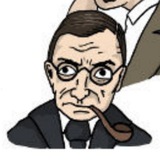
"Can I speak with your manager?"
"Okay, but the managers are only allowed to pretend to override corporate policy, when they are really just applying more specific corporate policy."
"Okay, but the managers are only allowed to pretend to override corporate policy, when they are really just applying more specific corporate policy."
Foucault's Editor: "could you maybe try to state your point a little more clearly and concisely?"
Foucault: "clear writing is one island of the carceral archipelago; binding, punishing, surveillance at all times the mind of the writer, forcing his thoughts to break down into so called scientific modes of grammar, that confine creativity and restrict freedom into contained and approved modes of expression."
Editor: "...what?"
Foucault: "In other words, no, I won't."
Foucault: "clear writing is one island of the carceral archipelago; binding, punishing, surveillance at all times the mind of the writer, forcing his thoughts to break down into so called scientific modes of grammar, that confine creativity and restrict freedom into contained and approved modes of expression."
Editor: "...what?"
Foucault: "In other words, no, I won't."
Also, memes are terrible. Enough with the memes. They aren't even funny. Is this what passes for culture now? I'm glad I died when I did so I never had to see this.
Also, memes are terrible. Enough with the memes. They aren't even funny. Is this what passes for culture now? I'm glad I died when I did so I never had to see this.
Theodor Adorno was a 20th century philosopher, social critic, and leftist theorist. He is most well known for his being a member of the Frankfurt School, who were prominent social critics in America and Europe. He's often seen as a sort of curmudgeonly elitist who hates popular culture, and well, pretty much everything else. He wrote essays, for example, attacking things like Jazz, for ruining music. A lot people think this is just a sort of old intellectual hating on the new fads, as often happens, but his major point was that Jazz had fundamentally changed what music was, and how people interacted with music, in a way that other fads had not. For example, people would have favorite Jazz tracks that they didn't even like to listen to, because they were really only "good for dancing".
He was wary of all populism, having seen it himself in Germany lead to Hitler and the Nazis. When he fled to America he saw a totally different kind of culture, which he was also highly critical of, where capitalism would create the culture itself. He thought that negative criticism was equally as important as positive advances in pushing humanity forward (in the Hegelian sense). One of his most popular works was Negative Dialectics. It isn't terribly uncommon for bad articles to pose questions like "What would Adorno think of X?", and the answer seems to almost universally be "he would hate it." Many of the institutions that Adorno criticized have only gotten stronger since he died. And he would probably not be too fond of twitter.
He was wary of all populism, having seen it himself in Germany lead to Hitler and the Nazis. When he fled to America he saw a totally different kind of culture, which he was also highly critical of, where capitalism would create the culture itself. He thought that negative criticism was equally as important as positive advances in pushing humanity forward (in the Hegelian sense). One of his most popular works was Negative Dialectics. It isn't terribly uncommon for bad articles to pose questions like "What would Adorno think of X?", and the answer seems to almost universally be "he would hate it." Many of the institutions that Adorno criticized have only gotten stronger since he died. And he would probably not be too fond of twitter.
Back in Vienna: "okay, now that we have written this 600 page tract that PROVES scientifically that we are not, in fact, nerds, that should put the matter to rest."
The Vienna Circle was a group of intellectuals in the early 20th century who were radically committed to the idea that empirical science was the only knowledge (known as "Logical Positivism"). The were heavily influenced by Wittgenstein's Tractatus Logico-Philosophicus, which gave a similar account of knowledge, and likewise rejected metaphysics. They discussed philosophy with him in person quite a bit, but he isn't really considered part of the circle. Logical Positivism was short lived, collapsing mostly due to their failure to cleanly demarcate between science and non-science (i.e., different formulations of their ideas would either have to throw out too much, or admit too much into "science"), and the failure of Carnap's verification prinicple to account for how science is done in practice (especially due to later criticisms by Popper, Quine, and Kuhn). It wasn't really abandoned, as people often think, because the formulation of their ideas was, itself, not empirical. They were aware of that fact, and thought that it could be arrived at through a priori reasoning alone.
They are widely considered the least cool group of philosophers, just behind the American Transcendentalists.
They are widely considered the least cool group of philosophers, just behind the American Transcendentalists.