"But in another possible world, learning about modal realism would be exactly what you wanted before you died."
"Not this one though."
"No, not this one."
"Not this one though."
"No, not this one."
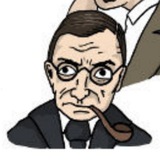
Boethius was a Roman philosopher in the 6th century. He is best known for The Consolation of Philosophy, which he wrote in prison as he faced execution. He was visited by "Lady Philosophy", who reminded him that through the philosophy of Plato and Zeno there was nothing to fear in death. True happiness lies in contemplating the eternal, perfect forms, and accepting things beyond your control. The work was extremely influential in early Christianity, which ending up borrowing heavily from Platonic philosophy and Stoic ethics.
David Lewis was a 20th century American philosopher, best known for positing that all possible worlds exist (this is called Modal Realism). Like the comic says, this was due to his problem with counterfactual statements, and what he believed was the only thing that could rescue his theory of truth. This is probably one of the best modern examples of a philosopher "biting the bullet", and going all the way with their theories in order to avoid conflicts, although David Lewis is certainly not the first to accept a fairly crazy sounding theory because he saw no other way out. In fact it is one of philosophy's longest and proudest traditions.
David Lewis was a 20th century American philosopher, best known for positing that all possible worlds exist (this is called Modal Realism). Like the comic says, this was due to his problem with counterfactual statements, and what he believed was the only thing that could rescue his theory of truth. This is probably one of the best modern examples of a philosopher "biting the bullet", and going all the way with their theories in order to avoid conflicts, although David Lewis is certainly not the first to accept a fairly crazy sounding theory because he saw no other way out. In fact it is one of philosophy's longest and proudest traditions.
Oh wait I just realized! Humans are necessarily good, and they wouldn't let a cat deceive us like that.
Fun fact: cats experience ennui at over twice the rate of any other animal. Humans are third, behind crabs. Crabs are actually, like, super angsty.
😁1
Oh also, the other part of the game is when everyone forgets their differences for a bit to kill the fascists that are invading from the Risk game.
Bakunin, Kropotkin, and Goldman were three 19th-20th century revolutionary anarchists. The anarchists wish to dismantle all illegitimate power structures in society, such as class, gender roles, and government. The philosophy shares a lot in common with Marxism, which also aims towards a stateless, classless society, but the anarchists place higher priority on eliminating state power. In particular, Marxist-Leninists believe that a transitionary state is necessary (particularly in Russia at the time), while the Anarchists believe in eliminating all authority immediately. Like the comic implies, there were some differences between them. Bakunin was an Anarcho-collectivist, meaning that the resources of society would be collected, and democratically and equally distributed among the population. So everyone would work, and for their labor they would receive "labor vouchers" which they could exchange for which goods they wanted. Kropotkin and Goldman were anarcho-communists, believing in eliminating money altogether, and society should be formed from purely mutual aid and cooperation. While most anarchists are radical feminists, Emma Goldman was much more focused on gender issues than the other two, for reasons you can probably imagine. This maybe shouldn't be exaggerated too much however, as she also fought her entire life to criticize capitalism, and authoritarian communism, as well as patriarchal oppression. Noam Chomsky has a pretty good lecture on what anarchism is, and how it developed.
Robert Nozick was a sort of right-wing American anarchist (often called Libertarianism today). He believed in the elimination of almost all state power, thinking that only a minimal state which would provide security against violence and enforce contracts should exist, but it should not have the authority to override any individual choices of the citizens. Unlike the anarchists however, he did not believe that private ownership of the means of production should end (i.e., it is perfectly legitimate to have people who own factories). The reason he thought this was that the ownership arises from free choices of individuals. So for example, the employees and employer both mutually agree to form the employment contract, so it is illegitimate for any kind of State to interfere in free choices. The logical conclusion to this, which Nozick took up, was that even minimum wage laws are illegitimate, because they prevent two individuals from coming to mutual agreements. The original anarchists found this sort of relationship to be another form of oppression, because the workers don't have a real choice, seeing as they must work in order to live. Real freedom, for them, only arises when the means of productions are socially owned.
Robert Nozick was a sort of right-wing American anarchist (often called Libertarianism today). He believed in the elimination of almost all state power, thinking that only a minimal state which would provide security against violence and enforce contracts should exist, but it should not have the authority to override any individual choices of the citizens. Unlike the anarchists however, he did not believe that private ownership of the means of production should end (i.e., it is perfectly legitimate to have people who own factories). The reason he thought this was that the ownership arises from free choices of individuals. So for example, the employees and employer both mutually agree to form the employment contract, so it is illegitimate for any kind of State to interfere in free choices. The logical conclusion to this, which Nozick took up, was that even minimum wage laws are illegitimate, because they prevent two individuals from coming to mutual agreements. The original anarchists found this sort of relationship to be another form of oppression, because the workers don't have a real choice, seeing as they must work in order to live. Real freedom, for them, only arises when the means of productions are socially owned.
❤1
There are three main aesthetic categories: the beautiful, the sublime, and really good sandwiches.
The Sublime, in aesthetic theory, is something powerful and terrifying that arouses a strange feeling of pleasure in the subject. For example, when viewing a hurricane or vast desert wasteland you can be overwhelmed by their awesome force, but exulted at the same time. For Schopenhauer, this involved a kind of "turning away of the will". The sheer awesome power of the object overwhelms our will and violently turns it away from ourselves, and we enter into a will-less state of pure contemplation of the object, which results in a strange exultation: the sublime. This is an unstable state, which is difficult to maintain, because any awareness of the particular danger that the object causes us, or reflection on ourselves in relation to the object, would destroy the affect. So we feel the sublime at witnessing the awesome power of a tornado, but if we become aware that the tornado is in fact heading towards us and is probably going to kill us, we will just feel regular old, non-sublimey terror. One of my older comics was a more serious take on this aesthetic theory.
If you are interested in more, this is a pretty good lecture of Schopenhauer's Aesthetics, by Alex Neill. The Stanford Encyclopedia also has a good article on it.
The art is a reference to Caspar David Friedrich's Wanderer above the Sea of Fog, which is commonly used to portray the sublime in art, and many of his other paintings had similar themes.
If you are interested in more, this is a pretty good lecture of Schopenhauer's Aesthetics, by Alex Neill. The Stanford Encyclopedia also has a good article on it.
The art is a reference to Caspar David Friedrich's Wanderer above the Sea of Fog, which is commonly used to portray the sublime in art, and many of his other paintings had similar themes.
👍1