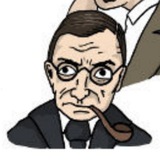
The first sin that Augustine remembers doing was as a child stealing pears, just to steal them. That is, it was the crime itself that made him want to do it, he didn't even want the pears, he just wanted to sin. It was his "original sin" in a sense, and he always felt most guilty about it.
"A perfect relationship will be achieve when neither of you cares in the slightest if the other dies."
In The Enchiridion Epictetus gives the advice that in order to avoid suffering, we should not become too attached to particular things, so that when they inevitably end we are not caused undue harm. He starts with the fairly straightforward example of a cup that we like breaking:
With regard to whatever objects give you delight, are useful, or are deeply loved, remember to tell yourself of what general nature they are, beginning from the most insignificant things. If, for example, you are fond of a specific ceramic cup, remind yourself that it is only ceramic cups in general of which you are fond. Then, if it breaks, you will not be disturbed.
The then procedes immediately to what seems a quite more drastic example:
If you kiss your child, or your wife, say that you only kiss things which are human, and thus you will not be disturbed if either of them dies.
Some may find that living in such a way is strange, to say the least.
With regard to whatever objects give you delight, are useful, or are deeply loved, remember to tell yourself of what general nature they are, beginning from the most insignificant things. If, for example, you are fond of a specific ceramic cup, remind yourself that it is only ceramic cups in general of which you are fond. Then, if it breaks, you will not be disturbed.
The then procedes immediately to what seems a quite more drastic example:
If you kiss your child, or your wife, say that you only kiss things which are human, and thus you will not be disturbed if either of them dies.
Some may find that living in such a way is strange, to say the least.
"A perfect relationship will be achieved when neither of you cares in the slightest if the other dies."
In The Enchiridion Epictetus gives the advice that in order to avoid suffering, we should not become too attached to particular things, so that when they inevitably end we are not caused undue harm. He starts with the fairly straightforward example of a cup that we like breaking:
With regard to whatever objects give you delight, are useful, or are deeply loved, remember to tell yourself of what general nature they are, beginning from the most insignificant things. If, for example, you are fond of a specific ceramic cup, remind yourself that it is only ceramic cups in general of which you are fond. Then, if it breaks, you will not be disturbed.
The then procedes immediately to what seems a quite more drastic example:
If you kiss your child, or your wife, say that you only kiss things which are human, and thus you will not be disturbed if either of them dies.
Some may find that living in such a way is strange, to say the least.
With regard to whatever objects give you delight, are useful, or are deeply loved, remember to tell yourself of what general nature they are, beginning from the most insignificant things. If, for example, you are fond of a specific ceramic cup, remind yourself that it is only ceramic cups in general of which you are fond. Then, if it breaks, you will not be disturbed.
The then procedes immediately to what seems a quite more drastic example:
If you kiss your child, or your wife, say that you only kiss things which are human, and thus you will not be disturbed if either of them dies.
Some may find that living in such a way is strange, to say the least.
The "brain in a vat" thought experiment is where we imagine that we coul just be brains in vats getting our neurons stimulated to make it appear as though reality was the way it was (basically The Matrix). Hilary Putnam is one person to try to find arguments against this, one of which is the rather strange language argument given in the comic, which like it says doesn't really convince many people that we aren't brains in vats per se, but makes us think carefully about how reference works in language, if we are committed to believing language references the outside world at all.
You can read more about the Brain in a Vat here and Putnam's Argument, or perhaps better just listen to him describe it, I should warn you though, he is extremely dorky.
You can read more about the Brain in a Vat here and Putnam's Argument, or perhaps better just listen to him describe it, I should warn you though, he is extremely dorky.