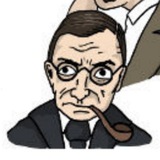
"A perfect relationship will be achieved when neither of you cares in the slightest if the other dies."
In The Enchiridion Epictetus gives the advice that in order to avoid suffering, we should not become too attached to particular things, so that when they inevitably end we are not caused undue harm. He starts with the fairly straightforward example of a cup that we like breaking:
With regard to whatever objects give you delight, are useful, or are deeply loved, remember to tell yourself of what general nature they are, beginning from the most insignificant things. If, for example, you are fond of a specific ceramic cup, remind yourself that it is only ceramic cups in general of which you are fond. Then, if it breaks, you will not be disturbed.
The then procedes immediately to what seems a quite more drastic example:
If you kiss your child, or your wife, say that you only kiss things which are human, and thus you will not be disturbed if either of them dies.
Some may find that living in such a way is strange, to say the least.
With regard to whatever objects give you delight, are useful, or are deeply loved, remember to tell yourself of what general nature they are, beginning from the most insignificant things. If, for example, you are fond of a specific ceramic cup, remind yourself that it is only ceramic cups in general of which you are fond. Then, if it breaks, you will not be disturbed.
The then procedes immediately to what seems a quite more drastic example:
If you kiss your child, or your wife, say that you only kiss things which are human, and thus you will not be disturbed if either of them dies.
Some may find that living in such a way is strange, to say the least.
The "brain in a vat" thought experiment is where we imagine that we coul just be brains in vats getting our neurons stimulated to make it appear as though reality was the way it was (basically The Matrix). Hilary Putnam is one person to try to find arguments against this, one of which is the rather strange language argument given in the comic, which like it says doesn't really convince many people that we aren't brains in vats per se, but makes us think carefully about how reference works in language, if we are committed to believing language references the outside world at all.
You can read more about the Brain in a Vat here and Putnam's Argument, or perhaps better just listen to him describe it, I should warn you though, he is extremely dorky.
You can read more about the Brain in a Vat here and Putnam's Argument, or perhaps better just listen to him describe it, I should warn you though, he is extremely dorky.
The "brain in a vat" thought experiment is where we imagine that we could just be brains in vats getting our neurons stimulated to make it appear as though reality was the way it was (basically The Matrix). Hilary Putnam is one person to try to find arguments against this, one of which is the rather strange language argument given in the comic, which like it says doesn't really convince many people that we aren't brains in vats per se, but makes us think carefully about how reference works in language, if we are committed to believing language references the outside world at all.
You can read more about the Brain in a Vat here and Putnam's Argument, or perhaps better just listen to him describe it, I should warn you though, he is extremely dorky.
You can read more about the Brain in a Vat here and Putnam's Argument, or perhaps better just listen to him describe it, I should warn you though, he is extremely dorky.
When communism comes, everyone will greet everyone all the time, and the brandy will be free.
Thought experiment: what if we took other people's intuitions as seriously as our own?
Avicenna, an 11th century Islamic philosopher, gave his "floating man" thought experiment to prove the existence of a soul, or a transcendent self. He asks us to imagine a person with no sensory experience at all:
One of us must suppose that he was just created at a stroke, fully developed and perfectly formed but with his vision shrouded from perceiving all external objects - created floating in the air or in the space, not buffeted by any perceptible current of the air that supports him, his limbs separated and kept out of contact with one another, so that they do not feel each other. Then let the subject consider whether he would affirm the existence of his self. There is no doubt that he would affirm his own existence, although not affirming the reality of any of his limbs or inner organs, his bowels, or heart or brain or any external thing. Indeed he would affirm the existence of this self of his while not affirming that it had any length, breadth or depth. And if it were possible for him in such a state to imagine a hand or any other organ, he would not imagine it to be a part of himself or a condition of his existence.
David Hume, six hundred years later, ran through basically the same thought experiment, but came to the opposite conclusion. That there was no such thing as a self without some experience attached to it:
There are some philosophers, who imagine we are every moment intimately conscious of what we call our self [...] For my part when I enter most intimately into what I call myself, I always stumble on some particular perception or other, of heat or cold, light or shade, love or hatred, pain or pleasure. I never can catch myself at any time without a perception, and never can observe anything but the perception.
This lead him to his Bundle Theory of the self, where we are nothing more than the sum of our experiences. While it seems that most people come down on Avicenna's side, it is unclear how to resolve a dispute between two people who come to opposite conclusions from such a thought experiment.
One of us must suppose that he was just created at a stroke, fully developed and perfectly formed but with his vision shrouded from perceiving all external objects - created floating in the air or in the space, not buffeted by any perceptible current of the air that supports him, his limbs separated and kept out of contact with one another, so that they do not feel each other. Then let the subject consider whether he would affirm the existence of his self. There is no doubt that he would affirm his own existence, although not affirming the reality of any of his limbs or inner organs, his bowels, or heart or brain or any external thing. Indeed he would affirm the existence of this self of his while not affirming that it had any length, breadth or depth. And if it were possible for him in such a state to imagine a hand or any other organ, he would not imagine it to be a part of himself or a condition of his existence.
David Hume, six hundred years later, ran through basically the same thought experiment, but came to the opposite conclusion. That there was no such thing as a self without some experience attached to it:
There are some philosophers, who imagine we are every moment intimately conscious of what we call our self [...] For my part when I enter most intimately into what I call myself, I always stumble on some particular perception or other, of heat or cold, light or shade, love or hatred, pain or pleasure. I never can catch myself at any time without a perception, and never can observe anything but the perception.
This lead him to his Bundle Theory of the self, where we are nothing more than the sum of our experiences. While it seems that most people come down on Avicenna's side, it is unclear how to resolve a dispute between two people who come to opposite conclusions from such a thought experiment.